“There’s a killer on the road”…

This powerful, suspenseful poem chilled me.

Depressed.

my_head

My daughter moved out last night with her current boyfriend. This was of course the plan, but I’m really in the dumps today because we fought last night. It ended with me telling her to pack up and get out last night, which she did. For a couple of months she has been sleeping on the couch (my roommate–yes, she’s still here but has been a bit better–has the other bedroom) and just got a job last month. She had paid nothing toward the rent because she was saving to move out. I had told her this was okay.

We are usually best friends but because we also both have diagnosed BPD, things can get heated between us sometimes. There can be drama. I hate drama. There was plenty of it last night though. Two things happened that made us fight.

1. When I was in the shower, she stole $10 from my purse. I wasn’t so much upset because this was all the money I had until Friday (which is bad enough–go ahead and try to make $10 last three days), but because I’d started to believe I could trust her again. (She used to steal from me a lot). I confronted her about it and she admitted she took it but called it “borrowing.” This led to a fight, because what she did was STEAL, not BORROW. I told her she didn’t seem that remorseful and that worried me. Later on she did admit she was wrong and admitted it was stealing, but that didn’t happen until several hours later, after she was gone, and it didn’t help my mood at all.

2. My father called her and asked if she had received a gift card and birthday check (her birthday was last week) because he hadn’t heard anything. She never did receive anything in the mail. Now she believes I took it when I got the mail (apparently the check was made out to me) and cashed it and used the gift card without letting her know. I don’t collect the mail (my roommate does, which makes me wonder if SHE took it). I have never stolen from my daughter and never even entertained the thought, but due to the circumstances I could actually understand why she would think along these lines. I’m also afraid my father will believe her over me, if she tells him she thinks I stole from her. I don’t know why I’m worried about this but I just am.

Even so, I was hurt that she would think I would steal from her. I told her I didn’t want to live with someone who not only stole from me, but would accuse me of stealing from them when I didn’t. I can’t convince her it might have been lost in the mail. She isn’t mad anymore but still believes I stole her money. There is nothing I can do to make her think otherwise.

It’s for the best she’s out. She is 22 and too old to be living with mom. I can’t help feeling a little sad though. I’ll miss her, even though I’ll be seeing her almost every day probably. I’m used to having her around.

I have more space now and can actually use the living room again, but because the fight happened late last night, I was so upset and wound up I didn’t sleep at all. I had to call in sick to work today (which always makes me feel guilty). It’s a pretty day and I may go outside for awhile and work in the garden or just sit on the porch and read. But right now I just want to lie on my bed and sleep the day away. I know that will only make things worse. I just want to cry right now.

ETA: I called my father and he said he never sent her anything (he doesn’t trust her and is sort of No Contact with her, so I thought it was odd he would even be sending her money). So she is lying to me though I can’t fathom why she would do that. I am going to confront her with this information and see what she has to say for herself. She doesn’t have NPD but is good at playing some of the Narc games that she learned from her father. BPD’s can be almost as manipulative sometimes.

What a narcissistic parent sounds like.

Here are two Youtube videos that graphically show exactly how a mother with a bad case of NPD (malignant narcissism) operates. These videos are entertaining in a scary and disturbing way, like watching a train wreck.

Pay close attention to what the mother says–she uses every trick in the narcissist’s book of tricks: blame, insults, changing the subject, interrupting, raging, mocking, “talking over”, gaslighting, projecting, invading boundaries, not taking responsibility, showing no empathy, and just about every other “tool” the narcissist uses to get their own way or avoid taking responsibility for their behavior and actions. Notice how childish the overall effect is–the mother sounds like a four year old having a temper tantrum.

The daughter who made the videos is trying hard to get her mother to listen, but her words seem to fall on deaf ears. She might as well be talking to a wall, for all the good it does.

12 more songs about narcissists–part 2!

Due to the enormous popularity of my previous articles about this topic (both of which now appear at the top of page one of Google–thanks everyone for making these so popular!), I’m adding 12 more songs about narcissism. Music and narcissism go together well– that’s one good thing narcissism has going for it, I guess. 🙂

The Songs.

1. “The Backstabbers” — The O’Jays

It’s very difficult to find songs about narcissists/psychopaths prior to the 1980s, but here’s an excellent one from the early 1970s.

2. “Ain’t It Fun” — Paramore

Catchy pop offering a badass challenge to a narcissist’s gameplaying.

3. “You Don’t Own Me” — Lesley Gore

Here’s another oldie (from the early ’60s) about a young woman involved with a narcissistic man.

4. “Mr. Know It All” — Kelly Clarkson

A modern take on Lesley Gore’s lament.

5. “Shadowboxer” — Fiona Apple

Apple’s musical poetry eloquently describes the way narcissistic mind games make you feel. Thanks to Amanda for suggesting this.

6. “Trouble” — Taylor Swift

The intro is pretentious and badly written, but Taylor does seem to have a way of attracting abusive and narcissistic men, at least in her songs, and this one is catchy as anything else she’s done.

7. “Black Sun” — Death Cab for Cutie

Alternative rock song about divorcing a narcissist. Thanks to Sachi for suggesting this one.

8. “Words as Weapons” — Seether

A man’s view on trying to deal with a narcissistic woman.

9. Disney’s “Tangled (Rapunzel)–Mother Knows Best”

Song from the Disney movie sung by Rapunzel’s narcissistic mother, who has made Rapunzel her “golden child.”

10. “Out of the Blue” — Julian Casablancas

Good indie rock about a narcissistic relationship.

11. “Mirrors” — Justin Timberlake

Thanks to Quixie for suggesting this one to me. Seems like a nice love song, doesn’t it? Oh, but it’s not. Listen to the lyrics.

12. “Hard to Love” — Lee Brice

A warning to his lady that he’s hard to love. Listen to the lyrics–sounds like a narcissist to me. At least he’s nice enough to warn her in advance.

I hope you enjoyed these.

For more songs about narcissists, see my previous articles:
1. 20 Songs About Narcissists (#11-20): https://luckyottershaven.com/2014/12/12/20-songs-about-narcissists-part-two-of-two/
2. 20 Songs About Narcissists (#1-10): https://luckyottershaven.com/2014/12/12/ten-songs-about-narcissists-part-one/
3. 12 More Songs About Narcissists, part 1: https://luckyottershaven.com/2015/01/05/10-more-songs-about-narcissism/

Why being a Golden Child isn’t so golden.

golden_cage

I was raised as an only child–the second marriage for both my parents–in a narcissistic family. Only children are in an especially vulnerable position in narcissistic families, because they must serve as all things to one or both parents.

In families with several children, one child (usually the most sensitive) is normally chosen to be the scapegoat–to serve as the family trash can for all the narcissistic rage of the parents. Another child, usually the one most closely resembling the narcissistic parent or the one who best serves the parent’s need for narcissistic supply, may become the Golden Child–in other words, the parent’s favorite. The Scapegoat is always wrong, bad, stupid, crazy, a “problem,” etc. The Golden Child can do no wrong. Misdeeds are overlooked or projected onto the scapegoat. Golden Children may become the narcissistic parent’s flying monkeys and are even sometimes given the “honor” of helping with the abuse against the scapegoat.

I’m reminded of a book I read some years ago called “A Child Called It,” written by Dave Pelzer, who not only recovered from the horrific abuse inflicted on him from ages 4-12 by his psychopathic mother (who had been loving up until that point) and brothers (who served as her “helpers”) once he was removed from the family and placed in a foster home, he actually seemed to become stronger because of it. Today he is an author, motivational speaker, and activist against child abuse. Dave was the scapegoat of his family, and I think his mother turned against him when she realized he was the most sensitive child and probably the most intelligent one too.

But what happens when there is only one child in the family? Well, I think that child becomes both a scapegoat and a Golden Child. If I had grown up with siblings (I have older half-siblings but I wasn’t raised with them), I’m almost certain I would have been the family scapegoat. But my parents (I am including both here, even though I don’t believe my father is a true narcissist, because they worked as a “team”–he was codependent and under my mother’s thrall) needed a Golden Child too who would serve their need to show a child off as a prized possession, a status symbol of sorts: the physical proof of how superior they believed their genes to be compared to everyone else.

Being both scapegoat and Golden Child is even more crazymaking than being just a scapegoat, because you never know where you stand. You constantly feel off balance and anxious, never knowing if something you said or did will be rewarded, ignored, or punished. Life feels chaotic and unformed. You feel like you’re playing a game you never wanted to play, a game where you were never taught the rules, and most of the time you don’t even know WHAT game you’re playing, but you’re expected to play like an expert anyway.

confused_kid

There was no consistency in the way I was disciplined or the things I was disciplined for. I was punished often (for infractions that were usually fairly minor or even nonexistent–I was a “good kid” who was terrified of angering my parents until my teens), but that wasn’t the worst thing. The worst thing was that the next time, I might actually be rewarded for the same infraction!

I was often punished for things I couldn’t help. Acting “spooky” was one of them. As a fearful, sensitive Aspie child, there were times I would retreat inside myself when I was feeling very anxious or when there was too much ‘input’ from the world, and this enraged my MN mother, who would berate or punish me for this behavior. I had no idea what I had done or how to stop being “spooky.” It just happened. I think it enraged her because it was during those times I went “inside” that she could no longer reach me with her abuse.

Even though most of the time I was treated as if my feelings didn’t matter, I was often told how pretty, smart and talented I was. It’s my belief I was no more of any of these things than any other kid my age, but I was told I was “special.” To my young mind, “special” meant “different”–and most children, myself included, dread being different from their peers.

When I was bullied at school, the reason my parents gave me was that the other kids were just jealous because of my “superior” looks, intelligence, or talent. I was also told our genes were better than other people’s, and our family was of a higher socioeconomic status than my friends’ families. I know now this was complete bullshit, but it’s the lie I was being fed while I was growing up. I think these “compliments” were intended to isolate me from my peers even further, so I’d just be “theirs.” I never felt empowered by the “praise” I got, because of the way it made me feel somehow defective and different from other kids. In addition, I felt like I could never live up to the pedestal my parents put me on at those times. I was right–and as an adult, I am looked down on by my family as actually defective.

left_out_kid

The most crazymaking thing of all was the times I’d be complimented and diminished at the same time. One of the most common ways I’d be demeaned was being told how “sensitive” I was. This was never meant to be a compliment; it was meant as a way to let me know how weak I was. Sometimes I was told I couldn’t or shouldn’t do things because of a combination of my “good” and “bad” qualities. For example, when I was about 10, I wanted to join the swim team. I remember exactly what my mother’s reaction was to this. She always liked to tell me what I was thinking, which is another way narcissists make us doubt our own reality and question our instincts. She said:
“You wouldn’t like being on the swim team because you’re too sensitive and you don’t like competition, and you’re too smart to be on a team with those people anyway.”
Huh?
Left-handed compliment much? She always sandwiched her praise this way–between insults like a shit sandwich. This was just another way I was constantly thrown off balance and this led to my becoming an extremely anxious child and later, an extremely anxious adult.

In general, my family treated me like I was a huge burden and didn’t really want me around, so the praise I got as a sometimes Golden Child made no sense and to my sensitive child’s mind, never felt sincere. Even at a very young age, I knew I was being lied to. I knew I wasn’t loved the same way other children were loved, even though my parents constantly mouthed the words like some sort of tic.

Narcissists A-Z

Narcissists A – Z
Reblogged from Life, Light, Love and Laughter After Narcissistic Abuse

narcissism_cloud

Arrogance
Attention-seeking
Bad boundaries
Blacklisting
Blackmail
Blame
Boot Licking
Bragging
Bullying
Can dish it out, but can’t take it
Character Assassination
Criticism
Coldhearted
Conniving
Controlling
Crafty
Cruel
Cunning
Cutting remarks
Deceitful
Demands
Dictatorial
Disdain
Dishonorable
Disinterest
Does not tolerate criticism
Double standards
Drama-baiting
Egomania
Engulfing
Entitlement
Envy
Faking
False Apologies
Fragile Egos
Gaslighting
Grandiose
Greed
Haughtiness
Holier than thou
Hurtful
Hypersensitivity
Ignoring
Immaturity
Imperious
Insecurities
Insensitivity
Invalidation
Irreciprocity
Jealous
Judgment
Lack of empathy
Lying
Manipulating
Martyrdom
Name Dropping
Needy
Oppression
Oversensitive
Pettiness
Phoniness
Plays victim
Possessive
Power plays
Prejudices
Projection
Punitive
Pushy
Put-downs
Rage
Retaliation
Rudeness
Scapegoating
Self-centered
Seething
Setups
Small-minded
Smarmy
Smug
Snobby
Spitefulness
Swindling
Takes all the credit
Tantrums
Threats
Triangulation
Tricks
Two-facedness
Ultimatums
Uncooperativeness
Unempathic
Vanity
Vicious
Vindictiveness
Wheedling
Whining
Yelling
Zealotry

“The Sensitive Gene: Why Some People Are Born To Feel Emotions Harder”

The Sensitive Gene: Why Some People Are Born to Feel Emotions Harder
By Alexia LaFata for Elite Daily: http://elitedaily.com
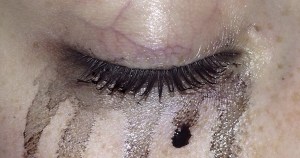
teary_eye

Scientists have long debated what exactly makes us who we are. Are our qualities more influenced by our social environment, or are we naturally inclined to be a certain way? Or — to complicate things even further — does our environment affect the way these natural tendencies display themselves?

Well, when it comes to the reasons why we do the things we do, the most complicated answer is usually the correct one.

In recent decades, the government has spent billions of dollars on gene research with the goal of trying to explain how the genes we were born with express themselves in our everyday lives.

Psychologists are optimistic — though cautiously — these advancements in gene research will help us understand ourselves better.

We haven’t even scratched the surface of the full potential of genetic research, but what we have seen so far looks promising.

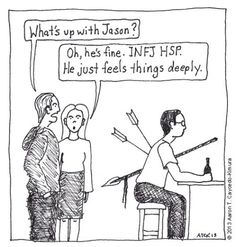
One human quality that genetics has attempted to help explain is sensitivity. People who are highly sensitive tend to respond more emotionally to their environments.

They are more inclined to cry during sad movies, jump to use social media to share something that moved them and feel heightened levels of sympathy for poor people and their friends who just got dumped.

Most notably, they are also more inclined to have a negative attention bias, which means they focus more on the negative things in their environment than the positive things.

This bias causes sensitive people great anxiety, especially if the environment they’re responding to is new.

Where do these traits come from? Why are some people more likely than others to respond more powerfully to their environment? In other words, why are some people so damn sensitive?

If this sounds like you, fear not: It turns out the answers to those questions do, indeed, have something to do with the way you were born.

Researchers from the University of California, Monmouth University and the Albert Einstein College of Medicine found that being sensitive is an innate trait that’s identifiable by physiological reactions, patterns of brain behavior and genes.

In their study, 18 participants viewed photos of either frowning or smiling faces. The researchers then scanned the participants’ brain activity while they looked at the photos to assess how emotional their responses were.

They found that people, who were considered to have sensory processing sensitivity (SPS) had greater blood flow to areas of the brain involved with emotion, awareness and empathy — indicating physical evidence of the presence of the sensitivity trait. This occurred regardless of whether they were looking at the sad or happy photo.

Another 2012 study examined biological proof of sensitivity even further. In the study, researchers Rachael Grazioplene, Colin DeYoung, Fred Rogosch and Dante Cicchetti studied the cholinergic system, a system in our bodies that determines how we respond to new environments and how sensitive we are to stimuli.

The cholinergic system becomes activated when we experience “expected uncertainty,” which happens when we’re placed in situations where we predict we will learn something new.

For example, when you were a freshman in college, you probably knew you’d be confronted with new experiences.

You experienced those feelings of “expected uncertainty” — of not knowing who your friends would be, what you wanted to major in, what clubs you wanted to join, how you would handle living away from home and so on.

Some of your peers might have perceived those new experiences as anxiety-inducing, meaning they would have proceeded with caution. Others might have seen them as intriguing, causing them to have been more inclined to explore.
sensitive_jason

The way both of these groups of people responded to those new environments was influenced by genetic variants in their cholinergic systems.

In her study, Grazioplene and her colleagues studied variations in the CHRNA4 gene, a key cholinergic receptor and determinant of whether you see the aforementioned kinds of “expected uncertainty” as threatening or exciting.

It wouldn’t be enough to say this genetic variant was the sole determinant, though, so the study also examined how, in conjunction with the variation in the CHRNA4 gene, an individual’s upbringing and social environment affected how he or she perceived uncertainty.

To study the functions of this variation, the researchers set up a week-long camp for 614 children, ages 8 through 13, all of whom came from the same socioeconomic background, but had different upbringings: Half of the children had an upbringing in which they had been maltreated with neglect or emotional, sexual or physical abuse, and the other half had an upbringing in which they had not been maltreated.

The children with the genetic variation who grew up in an abusive environment were more likely to perceive the new camp environment as threatening, and the children with the same genetic variation who had grown up in a normal environment were more likely to perceive the new environment as intriguing. Even more interestingly, these results were true regardless of age, sex or race.

Now, what does this mean? It means that, yes, there is certainly a genetic variant that makes you more inclined to be anxious or curious in new environments, but your upbringing and social environment play a role in determining which one of those two it will be.

And while this specific genetic variant is rare — only one percent of the population actually have it — it gives valuable insight into the way psychologists and scientists study behavioral patterns in relation to both genetics and environment.

So, if you’ve sobbed during “The Notebook,” impulsively shared a video on Facebook of a kitten rolling around in a patch of grass that made you tear up or found yourself crying with your best friend when her boyfriend dumped her, take comfort in the fact that you were probably born this way — feels and all.

Alexia LaFata is a Writer covering culture and lifestyle for Elite Daily. She’s a proud New Jersey native and soon-to-be Boston College graduate, and her work is featured on Thought Catalog and VentureBeat. Stalk her at alexialafata.com.

alexia_lafata

The progression of spring: April 20th

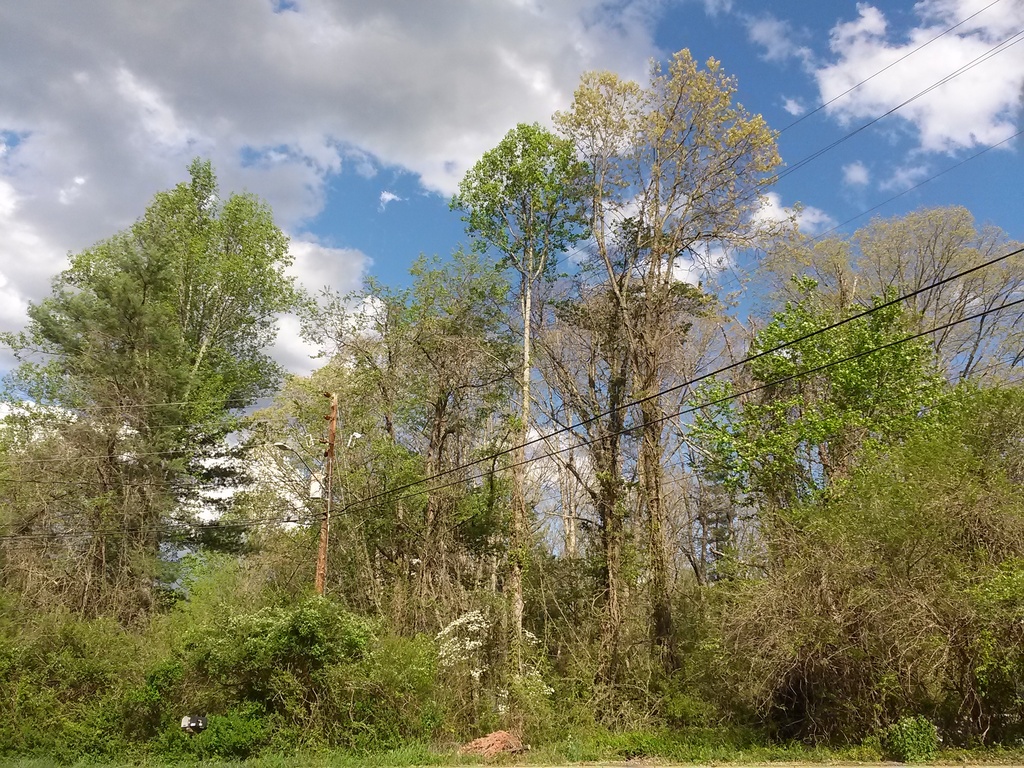
On-again off-again rain all day today, but more sunshine than yesterday. This past week, the green has exploded and it’s starting to look more like early summer than it did just a week ago. Only the tallest trees (and those at high elevations on the mountaintops some of which are STILL almost bare) are still not really green yet. I was given some bulbs today that I’ll plant tomorrow probably. I don’t know what kind of bulbs they are!

spring_4_20_1

These two photos were taken from my house, looking across the road.

spring_4_20_2 spring_4_20_3

Previous posts in this series:
1. Winter into Spring: March 8th: https://luckyottershaven.com/2015/03/08/winter-into-spring/
The Progression of Spring:
2. March 15th: https://luckyottershaven.com/2015/03/15/the-progression-of-spring-march-15th/
3. March 22nd: https://luckyottershaven.com/2015/03/22/the-progression-of-spring-march-22/
4. March 29th: https://luckyottershaven.com/2015/03/30/the-progression-of-spring-march-29/
5. April 5th: https://luckyottershaven.com/2015/04/05/progression-of-spring-april-5th/
6. April 12th: https://luckyottershaven.com/2015/04/12/the-progression-of-spring-april-12th/

Laughing for no reason.

laughing_noreason
Click to enlarge.

I do this all the time. Does that mean I’m crazy?

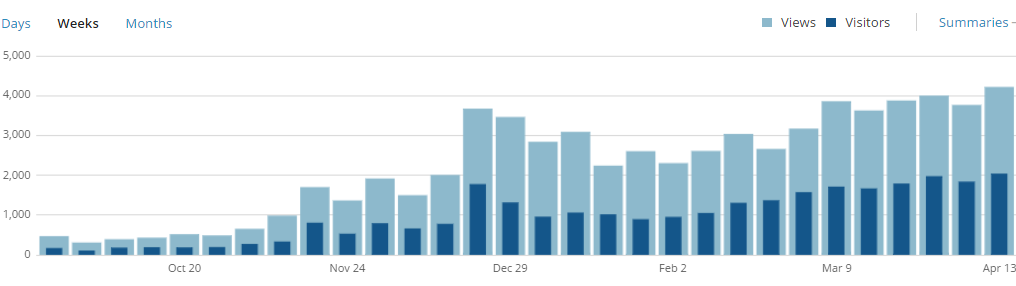
I finally broke 4K views per week!

stats_419
Click graph to enlarge.

The most views I’ve ever had for one day remains 862 (on December 25th of all days!), but I’ve never broken 4,000 views in one week before. 😀 I think it’s a good sign.