The latest on the NPD* sufferer in “Another Narcissist Who Wants Help”

trapped2

I thought this may interest those of you who read my article from April 30, “Another Narcissist Who Wants Help.” It’s a followup email he sent me yesterday, describing some of the things he’d doing to attempt to heal himself from NPD or at least be able to control its symptoms better.

* I do have some doubt he actually has NPD though, due to what appears to be a normal level of empathy and a lot of self-awareness; I think he may be being too hard on himself and suffers instead from something like BPD. He also has no official diagnosis.

All that being said, what this young man is trying to do and has dedicated himself to doing –opening himself to being vulnerable and letting himself feel and share his honest emotions–is incredibly courageous, especially for someone as young as he is (he’s in his early-mid 20s). He’s also doing his homework–he seems to be doing a LOT of reading about NPD, if this email is any indication. He may not actually be a narcissist, but even so, it’s still a courageous thing he’s doing. Any of us who suffer from being too guarded–which is most of us–can benefit by giving ourselves permission to just feel life in its glorious spectrum of colors.

I can tell this young musician is sincere because he’s been watching all of Brene Brown’s videos . In fact he is the person who tweeted about Brown’s compassionate and sometimes humorous messages of being authentic and vulnerable in a world that hates and fears those things. If you take on the challenge of setting yourself free of whatever traps you– whether it’s a narcissistic mask or the fear that fuels so many other disorders — it takes a lot of strength and courage to do that. Which means becoming vulnerable isn’t becoming “weak” at all — it’s just becoming an authentic human being.

I have permission to repost the email I got, removing personal details like names.

Original email is in this post: https://luckyottershaven.com/2015/04/30/another-narcissist-who-wants-help/

Email received 6 weeks later (yesterday)

[…]It’s not really a bad thing to share how we are feeling – in fact NOT sharing how I feel is probably one of my biggest downfalls. So it is healthy to express your emotions to someone, wherever they’ve come from. If you’re feeling emotionally down, or wounded it’s worth remembering one of my favourite quotes by Iyanla Vanzant (you’d love her when she talks about relationships check out her appearances on Oprah’s Lifeclass she’s awesome) which is that ‘a wound needs a witness’ – meaning it is in our nature as humans to want to share our feelings. The worst part of narcissism is it leads the narcissist to detach from their true feelings, and results in the narcissist viewing emotions in others as weak. I could imagine that belief that emotions are weak can be contagious but we weren’t put on earth to suppress ourselves, but express ourselves! So remember your feelings are a huge part of who you are so I don’t think you should deny them, and I don’t think it’s a bad thing to express them (even if I have been trying to silence mine for years ha!)

I hope you’re doing well – I’ve been immersed in personal exploration lately. The book ‘The Drama of the Gifted Child’ has been fascinating for me and I’d thoroughly recommend it (or maybe it was you who recommended it to me?) if you want to better understand the origins of narcissism. Much of it resonated with me and it’s a very hopeful and forgiving text. I understand it’s one of the main books on the subject. I’m moving on now to a book called Disarming the Narcissist which is interesting because even though it’s from the point of view of someone living with a narcissist in their life it helps me see how I can better inter-relate with the people in my life.

I’ve kinda realised that the worst parts of narcissism don’t actually manifest themselves in my life at large: I have healthy and thriving friendships. I’m not going to lie and say I am not centre of attention a lot because I am, but I’m here for my friends when they need me and I’m working on being even more available emotionally and otherwise in the future. I don’t think I’m ‘cured’ but I am aware that the extremes of my difficult qualities tend to bubble up tot he surface only in relationships where consistent intimacy is expected. So basically romantic relationships. That’s not to say the work I’m doing on myself isn’t important across my life but it certainly is most relevant when I’m in love, because it is in those times my frequent emotional detachment becomes a problem. Detachment from my own feelings means I am longer able to experience the feelings of those around me, which in time results in me objectifying them and treating them less than well.

Interestingly music has been important for me too. I haven’t really lay down in bed with the lights down low on my own with a great album on in the background in so long. I think listening to music keeps me connected to my emotional experiences and helps draw out my true feelings. Maybe that’s what happened with you before you drafted that post? I think it’s a good thing. Music is, of course, the feelings of other people and we feel connected to the human experience by listening to and enjoying it.

Oh and Brene Brown! What a gem! I’ve downloaded her book Daring Greatly (think that’s its name) and can’t wait to get started. I feel that book is gunna be a proper uplifting read, and with the summer kicking in here now I’m looking forward to reading in the sun in Hyde Park with a gin and tonic and some olives! Yay!

Protected: Embracing vulnerability: reparenting myself.

This content is password-protected. To view it, please enter the password below.

“The Power of Vulnerability” with Brene Brown

A friend of mine sent me this video, and it’s exactly what I needed to hear today. I found myself tearing up as I listened to Dr. Brown speak, because she speaks the truth.

“At the core of vulnerability is shame, but vulnerability is also the birthplace of joy, peace and creativity.” (paraphrased).

If everyone did what this video says we should do, the whole world would change.

“Don’t Cry Out Loud”

If you were a survivor of a narcissistic family (or were otherwise a victim of narcissistic abuse), as I was, you were probably told your emotions were not okay. Instead you were told to stuff them and hide the way you really felt from the world. Unfortunately that’s the same philosophy modern society holds in general, and of course narcissists stuff all their feelings all the time, except rage. It can get so bad you reach a point where you tell yourself you’re bad for even having feelings or being upset when someone hurts you.

Several months back, I wrote an article about the way some proponents of positive thinking use it as a way to deny their own true feelings or use it to invalidate the emotions of others. Used this way, positive thinking can become a form of abuse or self-abuse. Of course, there’s nothing wrong with being a positive person, but there’s something very off about someone who walks around wearing a fake smile pasted on all the time and insists we must always do the same. Ironically, these “positive thinking nazis” instill a sense of guilt and shame.

Here’s an article from a Christian-oriented blog that describes how damaging stuffing our emotions is and what we can do about it.

Don’t Cry Out Loud

stuart_smalley
Stuart Smalley.

Back in the early ’90s, “Saturday Night Live” did a mock self-help show called “Daily Affirmation With Stuart Smalley.” Stuart Smalley was a spoof on individuals who were obsessed with 12-step programs and who had become addicted to the act of going to therapy. Smalley ended each show by looking into a mirror and saying, “I’m good enough, I’m smart enough, and doggone it, people like me!” The skit was hilarious because Smalley was the personification of vanity, self-indulgence and narcissism — traits often used to describe our culture.

To counteract our self-absorbed culture, many Christians have gone the opposite direction. Worm Theology is based on Psalm 22:6: “I am a worm, and not a man…” or the line in the Isaac Watts hymn “Alas! and Did My Saviour Bleed,” which says, “Would He devote that sacred head for such a worm as I?” Worm Theology is a belief within Christianity that a feeling of worthlessness and expression of low self-esteem means God is more likely to show mercy and compassion.

Instead of debating the merits of this belief system, I want to focus on what I see as a natural consequence to a low view of self in our Christian culture today: a lack of self-compassion. Sadly, I even noticed this in my own house last night with my 14-year-old daughter.

My family recently relocated from Northwest Arkansas to Colorado Springs. No cross-country move is ever easy, but it’s been especially hard on my daughter Maddy. Last night I lay on the floor of Maddy’s room as she cried about feeling like no one really understands her feelings. It broke my heart to hear how alone she feels — that no one understands what she is going through. Thus, she felt that she has no one to share how she really feels. In the end, she ultimately got tough with herself and expressed that she should be over these feelings, that her feelings were wrong and that she was stupid for getting so emotional.

I so wanted to jump in and correct her, “Your feelings are not stupid!” but I didn’t. I wanted to tell her that God cares about her emotions (which He does), but I refrained. I was tempted to recue her by telling her that I care (which I do), but I stopped myself. What an insensitive father, some might think. I didn’t jump in to rescue my daughter because I want her to learn something that most Christian adults don’t get: Their feelings matter!

Beautiful song with a destructive message.

But sadly, for so many people, their emotions usually don’t matter. I watch time and again, when counseling with people, that they constantly judge, belittle, criticize, demean, minimize and marginalize their emotions. It’s like there’s this Christian belief that we must never wallow in our emotions. It’s like people are afraid they’ll become self-indulgent or vain (like Stuart Smalley) if they have compassion around their feelings. They believe self-criticism is what keeps them in line. Most people have gotten it wrong because our culture says being hard on your self is the way to be. It’s like the ’70s song by Melissa Manchester that had the lyrics, “Don’t cry out loud. Just keep it inside and learn how to hide your feelings.” Listen to some of the messages that are out there about our emotions:

Real men don’t cry.
You’re just being a drama queen.
Play through the pain.
It’s just that time of the month.
You shouldn’t feel that way!
That’s not how you really feel!
Why do you get so emotional?

Both men and women have learned these messages well, and the tragic consequence is that most people have no idea how to validate their own emotions. Since birth, most of us have had our feelings so massively invalidated that we don’t know how to care for our emotions. Instead of valuing our feelings as a great source of information, we stuff them, ignore them or judge them away. Thus, the hope for our relationships is that we will find that perfect someone who will finally care about and validate how we feel. Although we don’t do it, the fantasy is that our friend, significant other or spouse will value our emotions. Great plan, right?

I believe one of the greatest gifts we can give our self is the gift of compassion. When we are upset, frustrated, fearful or hurting (like Maddy) we should be the first one in line to care about how we feel. Why should I expect someone else to care about my heart and emotions if I don’t do that job first and foremost? The question we should be asking ourselves is do we treat our self as well as we treat our friends and family? We are often gentle, kind, compassionate and empathic with others. However, a new research study on self-compassion found that people who find it easy to support and understand others, it turns out, often score surprisingly low on self-compassion tests, berating themselves for negative emotions and perceived failures like being overweight or not exercising. The research suggests that giving us a break and validating our feelings and imperfections may be the first step toward better health. People who score high on tests of self-compassion have less depression and anxiety, and tend to be happier and more optimistic.

The more you seal yourself from your emotions, the more isolated and disconnected you feel. While you can suppress and repress your feelings, you cannot get rid of them. You always bury emotions alive. At some point they will always come out, but then they usually come exploding out like a volcanic eruption. The only way to make peace with our emotions is to value them, face them, explore them, understand them and then take them to the Lord. “Cast all your anxiety on him because he cares for you” (1 Peter 5:7). Suppression takes an incredible amount of energy — energy which is constantly being tapped to maintain a wall of protection around your heart.

The bottom line is that your emotions are incredibly valuable. Not in a way that suggests we should all indulge in emotional bliss, holding hands while singing “Kumbaya” like Stuart Smalley. Give yourself the gift of compassion around your feelings — after all, your emotions are the voice of the heart.

What do you do when you are fearful, frustrated, upset or hurting? Are you good at self-compassion, or do you stuff, ignore and judge your feelings?

Don’t Cry Out Loud

Why does it hurt?

heart_hurts

I found out something today that isn’t a given, but gives me a lot of hope. It’s a joyful thing if it’s true. It’s something I want so much to happen.

So why does this information make my heart hurt and make me feel like crying?

Is it because I want so badly for it to be true (and it may not be and I might be disappointed), or is it because I’m not used to my heart being so open and my deepest emotions being as accessible to me as they are becoming?

I guess the closest I can come to describing this emotion is feeling deeply touched and hopeful at the same time. I wonder if this weird sadness is unique to me or if others have experienced what I’m talking about. It’s very hard to explain. I don’t know if I’m explaining it well because there really aren’t any words to describe it.

Borderlines, like people with NPD, can’t always access their true emotions easily (even though we don’t wear masks and it’s much easier for us to admit we need help and actually be helped). These wonderful but weirdly sad feelings have been happening a lot lately. Like something bad is melting away. Sometimes it’s a bit scary but I wouldn’t trade it for the emotional zombie I used to be in a million years.

I think what’s happened is I’ve let go of my fear and that’s changing me inside.

Running naked in public.

streaking

I have never been a risk taker.

But this week I took a big risk. I ran naked in public twice. The first time I was scared to death; the second time, my attitude was more like, “Eh, why the hell not? Let’s go streaking.”

I’m referring to two blog posts this week in which I wrote about moments in my past where I experienced intense emotions that ran so deep I felt incredibly vulnerable and naked writing about them and sharing them with the world, especially because both these posts were about very private matters I wouldn’t even tell a casual friend. I felt somewhat embarrassed reading over the first post to myself, but also realized it was something I’d want to read if someone else wrote it. I also knew it was very well written.

After several days of stewing over posting the first article publicly and re-reading and editing it about a gazillion times, I finally took a deep breath, squeezed my eyes shut, and hit that “Publish” button. After I did so, I actually felt light in the head, like I might pass out. I couldn’t believe I was crazy enough to actually take off my psychological clothes (my natural guardedness) in public.

But I was crazy enough.

For a day or two, I feared reading my comments. I was almost afraid to look at this website at all. I didn’t want to see how many people might have read it…or WHO might have read it.

At the same time, I began to feel delightfully liberated, like I was running through the streets naked–and realizing my nakedness was a beautiful thing and nothing to be ashamed of.

naked

The second time (the abortion story) wasn’t as scary to post, because nothing untoward happened after I published my first “scary” emotionally revealing article.

I gained the courage to post these deeply personal articles by remembering that all my most liked, commented, and viewed posts have always been those in which I revealed the most about myself and my emotional state.

Of course, the ability to use the anonymity of the Internet and a handle instead of your actual name helps too. 😉

The real reason highly sensitive people get bullied.

authenticity

I had an “Aha” moment today.

The reason highly sensitive people get bullied so often isn’t because of our sensitivity. It’s because of the dismally low self esteem that tends to go along with being that sensitive, especially if we were victimized by malignant narcissists and bullies when young.

Narcissists envy and fear high sensitivity.

narcissist_face

Narcissists hate high sensitivity in others for two reasons: 1. They envy it because it’s something they can’t have or may have lost as children and it’s a sign of an authentic person, which is something they aren’t but wish they were; and 2. they fear it, because they know this quality makes it possible for to zero in on the emptiness hiding under the narcissist’s guise.

Their hatred and fear is expressed through love bombing followed by bullying and other forms of abuse meant to weaken the HSP. An HSP’s fragile ego can be destroyed or greatly diminished after years of bullying and abuse.

Sharon: an HSP who carried a can of Narc Repellent.

narc_repellent

I was thinking about a woman I used to know named Sharon.  She was an empathic young woman who felt everything so deeply–but mostly joy and love.  She’s exquisitely sensitive but is also self confident (she was raised by very loving parents). She is comfortable enough with herself to show her vulnerability openly, allowing herself the liberty to feel all her emotions as well as share the emotions of her friends.

You might think Sharon is a magnet for bullies, but she’s not.  She makes friends easily because she has such a loving and positive presence and and people feel like she cares about them, and she likes herself too (without being at all narcissistic). They are right.

Narcissists avoid Sharon like the plague. Why? They would probably love to get their hooks into her if they could, but Sharon’s confidence in herself and easygoing comfort around all kinds of people scares them right off. While still being emotionally vulnerable, Sharon is invulnerable to narcissists because they sense her strength. She’s indestructible and they know it. As a result Sharon is never victimized and tends to attract other loving people as her friends, people who just want to be around her because she’s a lot of fun but can also cry with you if that’s what you need.

If you’re a highly sensitive adult whose self esteem has been destroyed by narcissistic abuse or a sensitive kid who has become insecure and fearful because of bullying, your high sensitivity will be expressed very differently than someone like Sharon.

Sensitive children do get tested by school bullies, and it’s harder to not let that damage your self image when you’re so young, especially if your parents are also bullies and have already done a number on your self esteem. But for an adult, most people will admire emotional openness and vulnerability or at least respect it–as long as they also know you respect and love yourself. People can sense when you’re comfortable in your own skin and narcs will stay far away, because they’re only attracted to codependent types who are unsure of themselves or their place in the world.

Being highly sensitive: a curse or a blessing?

blessing

A sensitive person who hates herself will tend to act in ways that attract mean people and bullies to them. They are unsure of themselves, fearful, easily depressed or discouraged, easily hurt, easily frustrated, paranoid, hypervigilant, and insecure. They are afraid of everything, and like ravenous wolves, narcissists can smell their fear. They see this–not the underlying sensitivity–as weakness, and they will horn in on such a person for narcissistic supply or bullying because they’re an easy mark who will be too afraid to call them out on their abuse.

Things are very different for a sensitive person with high self esteem. Such a person will be appreciative, insightful, observant, compassionate, forgiving (but not stupidly forgiving), affectionate, creative, a good listener, empathetic, and with a well developed (but never mean or sarcastic) sense of humor. They are not fearful and they know their place in the world. They have a clear sense of their own boundaries (and those of others) and know how to enforce them if they think they’re being violated. They attract people like themselves as friends and lovers and these relationships tend to be self-reinforcing for both parties.

Narcissists know a strong HSP is powerful and dangerous to them.

scare_narcs

Malignant narcissists stay away from self-confident HSPs, because they know they’re much stronger than they are. They know they’re dealing with an authentic person who is happy with themselves and with life, while they are anything but. They know a confident HSP (not the same thing as narcissism) has a laser-like ability to see through their mask without fear and won’t hesitate to call them out when it’s necessary. To a malignant narcissist, a self-confident HSP is a very dangerous and powerful person. That’s why they work so hard to destroy our self confidence and make us hate and doubt ourselves. If we’re crippled by abuse, they can still get what they need from us (supply), without running the risk of having any damage done to them.

As my confidence has grown over these past two years, I’m noticing a transformation of my lifelong high sensitivity from something that made me feel weak and helpless for most of my life into something that makes me feel strong and authentic. I know now that this “curse” and “weakness” I was born with is really a blessing and a strength. I just needed to develop enough confidence to be able to use it effectively.

Learning to love your high sensitivity.

dancing

Here’ a few things I have learned.

1. If you have a talent or skill in one of the arts, use it to express what you’re really feeling. Painting, singing, dancing, writing, poetry–can all be ways we can release our deepest emotions in a “safe” way that’s socially acceptable. Don’t hold anything back when creating art, performing or writing. Allow yourself to be vulnerable even if it feels weird and awkward at first.

2. If you don’t have an artistic talent, take up a hobby that speaks to you or get involved in a sport such as running or take a martial arts class, which can build confidence. Activities that center you and build both inner and outer strength, such as yoga, can be helpful too.

3. Always be 100% honest about your emotions. If you’re very shy or fearful, write down your thoughts and feelings in a private journal. Don’t worry about the quality of writing–that’s all just gravy. The main point is to get your feelings down on paper. Seeing your thoughts on paper (or a computer screen) will give you clarity. If you choose to blog publicly instead, you will gain confidence from expressing your most private feelings to the whole world and from the feedback from others you will get. It can be very scary to publicly post something you wouldn’t tell your next door neighbor (as I have now twice this week!), but believe me, it’s worth it. You’ll be amazed at how much doing such a thing will increase your confidence and sense of inner strength. At first you’ll feel like you’re running around naked in public, but you’ll be amazed by the sense of freedom and liberation running around naked can give you! 🙂

4. Every day, try to do one nice thing for someone other than yourself. If you’re really ambitious, you can try volunteer work to help the poor, homeless, children, animals, or anyone more vulnerable or less fortunate than yourself. In doing so, you will feel like you have a purpose, and that you can help others. Knowing you have made someone happier will raise your self esteem.

5. Listen to music whenever you can.  It’s second only to writing and blogging in my healing journey.

6. Surround yourself with positive people (not the same thing as positive-thinking nazis, who are often narcissists themselves) but authentic, happy people who accept you for who you are and don’t judge you.

7. Get narcissists away from you. No Contact is best, but is not always possible. If you can’t separate from your narcissist, read as much about their disorder as you can, and read about PTSD and complex PTSD and the devastating effects these character disordered people can have on the rest of us. Read books about highly sensitive people. Elaine Aron’s The Highly Sensitive Person is probably the best known (and an excellent book) but there are other books about HSPs too. Write down your feelings in a journal your narcissist cannot access.

8. Try prayer. It does work.

Guys, I need some advice.

indecision

I need to make a decision.

Have any of you ever written a post you thought was amazing and longed, even ached–to publish it, but didn’t have the courage because you thought for whatever reason that it made you too vulnerable? That it revealed too many truths you wanted to keep private?

I have that problem right now. I just spent several hours working on what I think is my best written post ever, because my whole heart was poured into it while I wrote it. But it’s for that very reason I’m hesitant to let anyone see it. It’s not about anything controversial or shocking or illicit or illegal–I just think it shows me at my most vulnerable and that’s very, very scary.

Posting it for the world to see would be like going naked in public. Right now I’m just (figuratively!) naked in my own house–by keeping that post set to Private.
But I am longing to put it up. I feel like I must put it up even though I’m scared.

Have any of you bloggers ever experienced this, and what did you do about it? How did you resolve your indecision? If you decided to post it anyway, what happened?
What advice can you give me?

This is the post that scared me so much I almost deleted it.

tears_quotes

I have never been so scared to publish a post until this one. I had this set to Private for several days and drove myself crazy trying to decide if I ought to post it. It’s about some of my most vulnerable moments and posting about those is incredibly scary for a person who usually has their guard up. But I longed to post it. Something inside was telling me I needed to and I wouldn’t regret it. I also felt this post was my best written one ever because while writing it I allowed my emotions to flow unimpeded. What to do?

I even wrote a short post asking people if I should post something that made me feel so naked and vulnerable. Ultimately, the decision to make this post public was mine, but the consensus seemed to be that I should.

I read this post over again earlier today from the imaginary perspective of a random reader who just happened on the article and had never seen this blog before. I realized that as this “someone else” it would be something I’d want to read.

So here it is, guys. The post that made me feel like I was going to pass out cold when I pressed “Make Post Public.”

Milk and Open Hearts: Embracing the “Feminine” Emotions

open_heart

I’ve been doing a lot of thinking about vulnerability lately. I’m reaching a point in my healing journey where I can start to allow myself to become more open to my emotions and to sharing the feelings of others. It wasn’t my intention to write another post about crying so soon after my last, but I think my interest is due to something that’s happening inside…

For years I couldn’t cry, but wanted to. I was so numb from all the abuse that I had dissociated myself from my feelings. I felt like I was dead and in hell. Recently I’m finding a lump in my throat or tears starting to well much more frequently–usually because I’ve been touched by something or someone in some way, and it’s usually a pretty simple thing. I realize this is a sign that the long term dissociation within my mind is coming to an end because I’ve gained more courage to embrace my feelings instead of pushing them away or denying their existence.

I remember even during the darkest days of abuse by my psychopaths and narcs, when I walked around like an emotional zombie due to all the abuse I endured, there were rare moments of clarity when truth and beauty shone through the murk of depression and PTSD.

During my pregnancies with both my children (I was pregnant three other times–one abortion which I am writing about next–the child would have been a boy born in 1999–and two miscarriages), my brain’s marination in a continuous bath of pregnancy hormones made me very emotional. Not depressed-emotional–in fact, I was happier than I’d ever been. Things just touched me or made me feel some kind of ineffable euphoria or inexplicable sadness and suddenly there would be tears.

I think the increased emotionality experienced by pregnant and lactating women is the result of nature’s opening our hearts to connect deeply and lovingly with our children from the moment we know we are pregnant. The torrents of female hormones–mostly estrogen and progesterone–help wire our brains to to allow the limbic (emotional) system to run things for awhile. The heightened ability to feel is a gift that helps our species survive because under the right circumstances, emotional openness transforms into unconditional love and empathy.

The hormonal bath continued for some weeks after the births of both my children and I remember getting particularly emotional one dark and cold night as I held my firstborn against milk-swollen breasts, with Barber’s “Adagio for Strings” playing on the stereo. I watched as my son rooted for the nourishment he sought and found it. Latched on tightly, dark pink lips pursed in determination and a primitive and preternatural hunger, my baby son began to nurse. As I felt the milk come down, I was overwhelmed with tenderness and love for this completely helpless creature who so recently had lived inside my body and taken nourishment from my blood, and whose wastes were eliminated with my own, and suddenly my face was awash in tears.

I watched as if through antique swirled-glass windows as my tears soaked my tiny boy’s thistledown-fine hair and ran across a petal-soft pink cheek busily working my milk glands. There was a melancholy underpinning to my overwhelming elation and I allowed myself to feel that sadness too–and realized that melancholy welled up from an awareness of how fragile my tiny son was, how fragile we all are–at any age; and how easily a trusting, childlike soul can be stamped out by hurt, abandonment and abuse. I wanted to protect this child from any harm that might ever come his way. I didn’t realize then my son’s own father would set out to destroy his spirit. Thank God he did not succeed.

At the moment the first drop of salt water touched my baby, opaque dark blue eyes fluttered open and gazed at me, seeming to understand my feelings. Sighing a delicate baby sigh, this tiny human being I had created through my love for a man and sustained and nurtured by my blooming, hormone-soaked body, nestled in closer and suckled harder until swept away in blissful sleep. I marveled at the knowledge this tiny boy would one day be a man, taller and probably physically stronger than me, and that I would play a huge part in his journey to manhood. It scared me to pieces but I felt willing and ready to take on the challenge–because of love, the greatest power we have as humans.

nursing_child

This wondrous connection–this moment of almost painful sweetness–was so honest and magical I almost dared not breathe. The tears poured down. I didn’t wipe the wetness from my face for that would have disrupted the beautiful connection I felt with my child.

It’s during these moments our hearts are open and we allow ourselves to become vulnerable, that we are fully engaged and connected with life and open to the bliss and pain of pure unconditional love. That kind of love is expressed in tears (often combined with laughter or smiles) because there are no words that could ever express the depth of this sublime emotion–an emotion of such beauty, rarity and truth it nearly hurts.

Tears are the mark of our common humanity and connect us with each other. We are pushed into the world crying, and are (hopefully) cried for when we leave it. Crying marks the most important milestones of our lives, whether they are happy or sad. There are always tears at graduations, pregnancy and wedding announcements, falling in and out of love, weddings, births, baptisms, death and funerals. There are tears wherever there is honesty, intimacy and love.

The happiest people in the world are often people who cry a lot. Their hearts are open, so everything and everyone touches them. They’re not afraid to connect and to empathize. Their love sometimes overflows the confines of their physical composure, and so they cry. I used to know a beautiful young woman who said she cried five or more times a day–just because she was so happy all the time. She wasn’t annoying happy. Honest joy never is annoying. She moved through life regally and with dignity and compassion, appreciating everything and loving everything and being touched by everything, and everyone loved her right back because they knew she was an empath. People wanted to be close to her, they wanted to be touched by her, both emotionally and physically. Her large expressive eyes were almost always wet with tears. At first it seemed a little strange, but soon we got so used to seeing her that way it just seemed normal after awhile. And it WAS normal, more normal than anything could ever be.

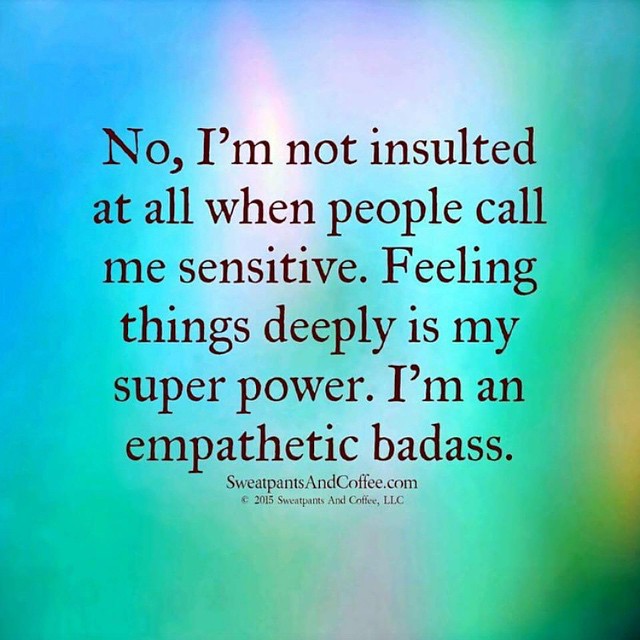
empathic_badass

I was so envious of that girl for her emotional openness. But she showed me a great truth about myself. I could be that girl because that was me. I just needed to find a way to knock down my thick concrete walls of fear. It’s getting easier. I still have a lot of emotional blockage, but I no longer feel like one of the walking dead.

In the Stephen King movie “The Green Mile,” John Coffey is an autistic man who nevertheless is an empath. He’s been unjustly sentenced to Death Row for the murder of two little girls because he was the last one seen with them (and probably due to his being black as well). You sense Coffey never killed those girls and in fact you realize how empathic this man really is. He has no defenses against the world due to his inability to hide his emotions (some autistic people have trouble regulating their emotions), and at the same time this very defenselessness gives him unbelievable strength and goodness. Coffey cried almost constantly, feeling the emotions of everyone around him and freely giving unconditional love where none existed.

A couple of years ago, there was a very popular video that went viral. It featured a 10-month old baby girl apparently crying from empathy as she listened to her mother sing. I’m not usually a fan of “cute baby” videos but watching this baby was fascinating because she cried like an adult would have–and the purity of her emotion was an achingly beautiful thing to see.

We are born withour hearts unguarded. When life begins to hurt too much (and it always does), children eventually learn to guard their hearts or in the worst cases (NPD, ASPD and some other mental disorders), dissociate themselves from their true feelings so thoroughly there is no turning back to the emotionally open state we were born with.

It’s a sad state of affairs that all the tender (“feminine”) emotions such as sadness, deep connection or friendship, love in all its forms, joy of the non-shallow type, feeling touched or moved, gratitude, and empathy– have been so devalued in modern society and are often seen as proof of weakness in a person when in fact they show a person who has the strength and courage to leave their hearts unguarded when it matters the most.

It’s interesting that all these softer emotions indicate goodness and purity of heart. They possess enormous potential to eliminate or reduce darkness and evil because they are emotions of healing, love, and our human connection with the Divine.

In a perfect world where all human beings had open, unguarded hearts, an alien from another planet upon first meeting a typical human would see smiles and laughter graced by tears. If the alien were to question what these signals meant, the answer would be “Love.”
The angels in Heaven would tell you the same.

Nobody knew who I was.

nobody
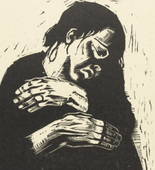
Woodcut by Käthe Kollwitz, 1867-1945

I used to be a nobody.

Or, as my malignant narcissist mother would have put it, “a nothing.”

Before I started this blog, years of psychological abuse had sealed my lips and closed my eyes to what I could be. I rarely spoke to the people around me, and when I did, I revealed nothing because I was too afraid and was convinced I was a boring person who lived an equally boring life. I never ever revealed anything about my emotional life to people outside my immediate family, and even with them, I was reticent.

I’ve always found it difficult to make friends offline, due to my Aspergers and my avoidant personality, as well as my fear of revealing too much. I still almost never talk about my feelings offline. When I was a child I revealed way too much. I was highly sensitive and vulnerable but didn’t know how to handle it. That kind of openness got me bullied and as a result, I learned it was best to say nothing at all. I didn’t realize my high sensitivity was in reality a wonderful gift.

I shut and locked all my psychological doors. After a while, I couldn’t remember how to unlock them. For me, writing was the key, but I assumed the lock was broken and the key would not work.

For most of my adulthood, although I managed to marry and have a family (with a narcissistic bully who was all wrong for me or for anyone) I had practically no social life outside of that and hardly ever engaged in any interesting activities. I gave up easily. I never completed anything I started due to my dismally low self esteem that told me I was sure to fail. I gave up writing and art and all the things I had loved when I was younger. I feared being boring but boring is exactly what I became. I was just too afraid of everything to be anything else.

charlie_brown

I believed my purpose in this life was to be an example to others of how not to be. Hell, even my own mother called me a loser and a failure, and if your own mother has no faith in you, how can you believe in yourself? Mother knows best, right?

Wrong.

I thought about writing a blog, but didn’t because I feared I would have nothing to say that would interest anyone. I also thought it would be too hard and I would give up in frustration, like I had given up on so many other things when they became too difficult. My irrational fear of failure crippled me.

Even if I could think of something to write about, I was afraid people would hate my words and ideas. Ideas? I didn’t think I had any anyway. In my own mind I was the most boring person in the world. I felt like a walking zombie, marking time until death.

I was so wrong. So very wrong. I’m free to reveal the self on this blog that was in hiding for decades and many times was hidden even from myself. I’m finding it’s safe to be open and vulnerable, at least online. And I’m finding there is so much joy to be had if you just open your eyes and your heart and let yourself feel life. It really wasn’t that hard to do, once my psychopathic sperm donor was out of the way.

I never thought I could help anyone, least of all myself. I felt impotent and helpless in the world, someone born to be a victim, a source of narcissistic supply to others, because that was how I was trained. I didn’t realize that I wasn’t really stupid, uncreative and boring. I wasn’t a loser and I only failed because I was too afraid to try anything and would give up easily the few times I did try. I didn’t realize it was my PTSD and depression that turned me into a walking zombie. Mental illness is a powerful dark beast and can engulf and eclipse your true spirit.

My creativity is blossoming. I always had ideas, but now they’ve revealed themselves as I’ve let go of my debilitating fear and self hatred. Sometimes I feel like I have too many ideas and can’t write them down fast enough.

Although my external circumstances haven’t changed very much (outside the narc being gone), I have hope now. I feel like a real person again, an interesting person who can even be a friend to others. I’m even starting to like myself, and think I’m a pretty interesting person. I’m even becoming proud of my high sensitivity I used to be so ashamed of. In its highest form, high sensitivity can reveal empathic ability.

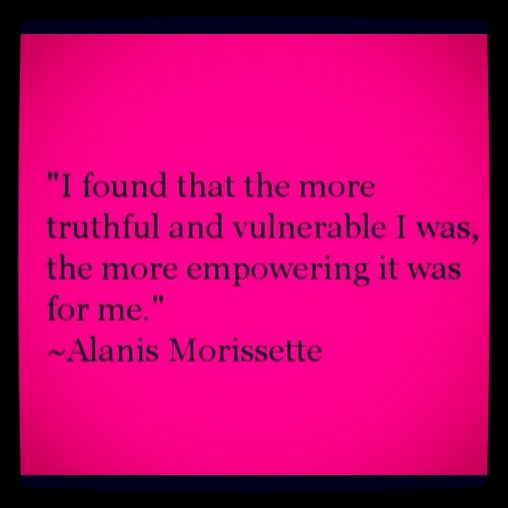
vulnerable_quote

I truly believe that once I got the narc out of my life, that God stepped in and took things over. He has shown me who I really am and what my purpose is in this world, and it’s not to be an example to others of how not to be. A plan for my life is taking shape and every day it amazes me. There’s so much to be amazed by. He is teaching me how to use the gift of writing that I had been wasting for so long on bullshit or not using at all.

Becoming vulnerable again through my writing is a beautiful thing. If you like yourself, you can handle the bullies, but chances are there will be fewer than you think, and most people will admire your willingness to be open and can relate to that. Your voice will be heard by those who are really listening. It can penetrate the darkness in other people’s lives.

Being vulnerable is about being honest. It’s embracing the truth rather than believing the lies.

Becoming vulnerable takes courage. Rather than being a trait of a weak person, it really takes a strong person to be willing to feel life in its kaleidoscope of colors. Before, I only saw in shades of gray.

I used to believe there was nothing left to look forward to. Now I know there is still so much ahead of me.

Nobody knew who I was. I wouldn’t let them in. Now the door is wide open. Come on in.