“Inside Out”: a touching and funny story about the way emotions work.

inside_out_poster

Yesterday I decided to take myself to the movies for a change, and chose to see “Inside Out,” the Disney Pixar animated summer fantasy blockbuster.

Seeing “Inside Out” was a serendipitous choice, because I just happened to have enough money to afford a ticket (which is a rarity for me), and also because, although I didn’t know it right away, this movie has a beautiful message about the way Sadness and Joy, though seemingly polar opposites, when working together make human connection and unconditional love possible. Just as the light can’t exist without darkness, or good without evil, joy cannot exist without sadness. When working in sync with each other, these two emotions create a beautiful life affirming thing called Empathy, and that’s what connects us to each other and keeps the human race from becoming extinct.

Official Trailer

Sneak Preview–Teaser Clips

Riley Andersen is a young girl of 11 who becomes severely depressed after her parents’ decision to move from Minnesota to San Francisco. The movie begins at the moment of Riley’s birth in Minnesota, shown from Riley’s point of view. Her first Emotions (depicted as loveable anthropomorphized characters) are Joy (feeling secure in her parent’s love) and Sadness (when she needs something or feels ignored or in pain). As Riley grows into early toddlerhood, sometimes her needs and desires are thwarted and Anger takes over and she throws a tantrum. Around the same time she is also capable of feeling Fear or Disgust (both necessary for her survival), and it’s at those times those characters become dominant in Riley’s growing mind.

When the five Emotions work together in harmony, not overstepping each other’s boundaries and only doing the jobs assigned to them, this teamwork manifests in Riley as a well-adjusted little girl able to feel all her emotions at the appropriate times.

The five Emotions work in Headquarters, which is the conscious part of Riley’s young mind. Joy is responsible for making sure Riley’s short term memories are sent to Long Term Memory deep in Riley’s subconscious. Her memories are depicted as glowing colored orbs containing a ghostly image of the actual memory. The color of the orbs represent the dominant Emotion Riley felt at the time of the event. Transporting Short Term memories into Long Term Memory happens during Dream Production as Riley sleeps, and sometimes the other Emotions are needed to help Joy do her job getting the memories there (and sometimes discarding certain irrelevant or painful ones.) Occasionally the other Emotions (as well as Riley’s imaginary childhood friend, Bing Bong, who is a jokester) like to play little jokes–and certain irrelevant memories like an annoying gum commercial jingle are sent to Long Term Memory along with the important memories, which causes Riley to occasionally hear the gum jingle in her head at random times years later.

rileys_emotions

At the center of Headquarters is the vault which contains Riley’s Core Memories–important but happy long term memories that are responsible for Riley’s happy go lucky personality. The orbs that represent these are colored gold (Joy’s color) and for Riley’s continued mental health, these core memories must not be contaminated by the other Emotions, which is why they are kept locked in a vault. Each of the Core Memories has a long glowing tube that leads to one of Riley’s Five Islands of Personality: Family, Goofiness, Hockey (which she loves to play), Friendship, and Honesty. Maintaining these islands is necessary for Riley’s continued normal psychological development.

The crisis in Riley’s mind is set off when her family moves from her beloved Minnesota to San Francisco. Moving away is always a traumatic event for even the most loved child. Feeling isolated from her old friends and lonely in a place she doesn’t know, Riley’s Emotions begin to make mistakes and not work in sync. Joy and the other Emotions have never been sure of Sadness’s purpose because she just seems to be a Debbie Downer who is always in the way and always making mistakes. It’s Joy’s job to keep Riley’s happiness intact, but one day shortly after the traumatic move, Sadness goes around touching Riley’s happy memories, turning them blue (sad). Joy frantically tries to undo the damage but the memories already touched cannot be repaired. Desperate, Joy tries to isolate Sadness to prevent her from doing any more damage.

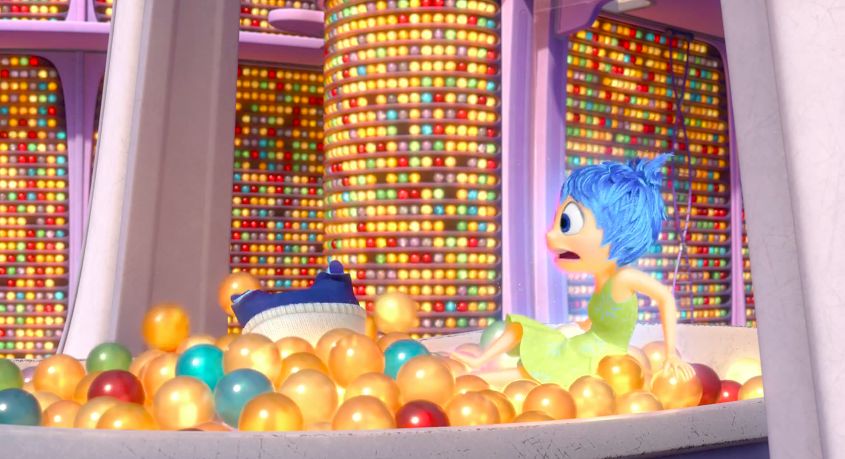
On Riley’s first day at her new school, Sadness takes over and Riley begins to cry in class, which creates a new but painful core memory. Joy frantically tries to keep this new core memory from reaching the central vault, but in her struggle with Sadness, who seems to keep contaminating more memories, she accidentally knocks out some of Riley’s untouched happy core memories, which fall off into the abyss. These memories are almost impossible to retrieve once lost to Riley’s Unconscious. Worse yet, both Joy and Sadness are sucked through the Long Term Memory Tube themselves, and are both lost deep in Riley’s vast and labyrinthine Unconscious.

During Joy and Sadness’s absence, Anger, Fear and Disgust attempt to run Headquarters in their place and make a holy mess of things. They attempt to provide “joy” but of course it’s faked now, rather than genuine. Sadness too is absent, so Riley can no longer longer cry or even feel grief over her loss. Anger, Fear and Disgust manifest in Riley’s new insolent and angry attitude toward her parents and loss of interest in the things she used to love. With the core memories now missing or contaminated, one by one the Five Islands of Personality crumble and fall into the abyss of the Memory Dump, a place deep in Riley’s mind where old memories are forgotten. The first Island to crumble into oblivion is Goofiness (Riley’s sense of humor), followed by Hockey (which she quits), and then Friendship (she no longer has any desire to make new friends).
long_term_memory
Joy and Sadness find themselves adrift after falling through the Long Term Memory tube deep into Riley’s unconscious mind.

Desperate, Anger decides to insert in Riley’s mind the idea to run back to Minnesota. He plugs this into the Control Console, in the belief this can produce new happy memories. This requires Riley to steal money from her mother’s purse in order to fund her trip back to Minnesota, and then she lies about the theft. As a result, the second to last Island left, Honesty, falls away in ruins into the Memory Dump.

Back in the abyss of Riley’s deep Unconscious, Joy and Sadness run into Bing Bong, Riley’s long forgotten childhood imaginary friend. Bing Bong wants to reconnect with Riley, so he tells Joy and Sadness they can all get back to Headquarters by riding the Train of Thought. After a series of failed attempts, they eventually catch the train, but it becomes derailed when the last personality island, Family, falls into the Dump.

At this point, giving any more away would be spoiling the plot, but gradually Joy and Sadness, who have always been at odds with each other, realize that in order for Riley to return to her normal happy state of mind, they must work together as a team and Sadness has the biggest job of all. Riley must be able to experience–and receive–empathy and love (which comprise both joy and sadness) to heal from her near-catatonic depression.

As a blogger about narcissism and personality disorders, I see Riley at this point in grave danger of suicide or developing a personality disorder, even NPD or BPD. Her trauma-induced depression has caused her to become apathetic and unable to feel anything at all. What happens next is so magical and touched me so deeply I sat there in the darkened theater with tears running unchecked down my face and my nose running. I wasn’t alone–I heard sniffles and nose blowing all over the theater, and there’s a safety and sense of connection with total strangers that comes from that, and that’s why going to see a good movie never gets old. There’s something wonderfully liberating about being able to cry in a public place yet unseen by others and unjudged for it because everyone else is crying too. I think that’s why “heartstring tugging” movies are so popular. But the emotions elicited in “Inside Out” feel real–there’s no sappiness or fake sentimentality in this film that make you feel manipulated by the producers.

five_islands
The five Islands of Personality.

But for all its poignancy, “Inside Out” has plenty of humor too, and all the jokes are clever and well timed. At times during the movie I was both laughing and crying at the same time. The Five Emotions are all funny characters with their own unique charm. Even Anger is loveable and hilarious in his own irascible way, and the Tinker-Bell like Joy, who could have been incredibly annoying for all her upbeat perkiness, has a depth you don’t expect and over time you realize she is the only Emotion who can feel all the other Emotions. I pictured Joy and Sadness as really being the same person–the two sides of Riley’s True Self–and when they were lost in Riley’s memory dump, Riley’s behavior became quite narcissistic. It wasn’t lost on me that both Joy’s hair color and her “aura” are colored blue–Sadness’ color.

Pete Doctor, the film’s director and screenwriter, was inspired to develop “Inside Out” while trying to come to terms with his own daughter’s psychological changes and mood swings as she approached adolescence. To give the complex psychological concepts presented credibility, well-known developmental psychologists were consulted during pre-production. It’s obvious that a deep knowledge of the way the human mind works fueled both the story and the landscape of Riley’s mind. Kids will adore “Inside Out” because of its lovable characters, fantastic animation, humor, its engaging story about a regular girl, and impressive special effects. In the theater I saw it in, there were plenty of children there, and all of them were rapt in the story.

But adults will love it just as much because of the movie’s deep message of Empathy being born from pain and loss, and the necessity of “negative” emotions to exist in a healthy person’s psyche, working in tandem with “positive” ones. Understanding the movie at this level requires an ability to think in an abstract way about the mechanisms behind personality development and psychological disorders. “Inside Out” is a rare movie that celebrates the human ability to feel, and to love, cry, connect, and laugh. It tells kids that all their emotions are okay, and experiencing them is normal and just part of growing up.

Parents, if you have children ages 4 to early teens, please take them to see “Inside Out.” Both you and they will leave the theater feeling great, and the ideas presented in the story can open up honest discussion about emotions between parents and their children. I’d even go so far as to suggest teachers show this movie to their students, and engage them in discussion afterwards.

I find it encouraging and heartening that such an honest and touching movie with a positive message about genuine emotions and empathy has become the hit of the summer, instead of the usual mindless dreck that passes for summer blockbusters.

“Inside Out” is rated PG. I would not recommend it for children age 3 and younger, due to several quite scary moments that could give a young child nightmares.

riley_parents
Riley with her concerned parents at the dinner table.

My rating: Five Stars! *****

Facts about “Inside Out”:
via Wikipedia

“Inside Out” is a 2015 American 3D computer-animated comedy-drama film produced by Pixar Animation Studios and released by Walt Disney Pictures. Directed and co-written by Pete Docter, the film is set in the mind of a young girl, Riley Andersen (Kaitlyn Dias), where five personified emotions—Joy (Amy Poehler), Anger (Lewis Black), Disgust (Mindy Kaling), Fear (Bill Hader), and Sadness (Phyllis Smith)—try to lead her through life as she moves with her parents (Diane Lane and Kyle MacLachlan) to a new city. The film was co-directed and co-written by Ronnie del Carmen and produced by Jonas Rivera, with music composed by Michael Giacchino.

Docter first began developing Inside Out in 2009 after noticing changes in his daughter’s personality as she grew older. The film’s producers consulted numerous psychologists, including Dacher Keltner[6] from the University of California, Berkeley, who helped revise the story emphasizing the neuropsychological findings that human emotions are mirrored in interpersonal relationships and can be significantly moderated by them.

After premiering at the 68th Cannes Film Festival in May, Inside Out was released on June 19, 2015. It received universal critical acclaim, with many film critics praising the voice performances (particularly for Poehler, Smith, and Richard Kind), its concept and poignant subject matter. The film grossed $90.4 million in its first weekend—the highest opening for an original title, besting Avatar‍ ’​s previous record.

Looking fear in the face.

eleanor_roosevelt

You gain strength, courage and confidence from every experience in which you really stop to look fear in the face. You can say to yourself “I have lived through this horror, I can take the next thing that comes along”. You must do the thing you think you can not do.

Eleanor Roosevelt

The reason we became adult victims: what can be done?

victim_badge

The other day, I posted an article about the insidious way narcissistic parents can turn scapegoated children into lifelong victims. I was thinking more about this matter today (because I was feeling victimized at work) and I think I understand what happened to us to make us such easy targets for victimization and why we are usually shown so little respect by others.

First, there is nothing wrong with you. You are not mentally deficient, defective, worthless, or unlikeable. You deserve respect as much as anyone else does. You are no less valuable than anyone else. Later in this article I’ll explain what it is about us that makes us get treated like this so often and why.

There are ways to tell if you’re an adult victim. The abuse we get is more insidious than the treatment we got from our parents or childhood peers. As adults, we are not likely to be straight-up bullied the way children and teenagers are because most adults have learned it’s not okay to bully others. Instead, the abuse manifests as a lack of respect and being treated as if we don’t exist or don’t matter.

How to tell if you’re a victimized adult.

depressed_woman

1. You find it difficult to make friends.

2. You are always overlooked for promotions or raises in the workplace, no matter how well you do your job. You may also be overlooked for special privileges when they are given out. If you ask why, no one ever seems to know how to answer you.

3. People leave you out of social events like parties or casual get-togethers.

4. If you were a scapegoated child (and most likely you were if you are victimized as an adult), even your FOO (family of origin) probably leaves you out of family events such as weddings, births, and reunions. You were probably disowned or written out of the will. You are the “black sheep” of your narcissistic family.

5. People talk over you or act like you are not there.

6. If you speak, people act like they didn’t hear you or ignore what you just said.

7. You are treated like a piece of furniture. People tend to physically push you aside, invade your personal space, or act like you are in the way. In a small group of people, they may shift their positions so you become shunted to the side or back so you don’t have a place in the circle. It isn’t really hostile; it’s as if they literally don’t see you.

8. People tend to treat you in a condescending manner, as if you are mentally defective.

9. People like to “mess” with you or make jokes at your expense.

10. In a work environment, even your co-workers may be more critical of you than they would be with others–even if your work is fine. You may notice people try to boss you around who have no real right to.

11. People may treat you as if you annoy them.

It is not your imagination that you are treated this way. You are not just being paranoid or over-sensitive (though people will tell you this). You really are being treated like this, and it’s because as children, we were trained that we were nothing and that we did not matter. We internalize these messages and carry an attitude of being undeserving of fair treatment into adulthood. People treat us the way we regard ourselves. If we think we are nothing, we will be treated like we are nothing, even by non-narcissists.

How being an adult victim can further damage us.

sad_and_lonely

Being scapegoated by narcissistic parents is child abuse, and is thoroughly evil. It can destroy a person for a lifetime. The victimization we continue to get as adults is also very damaging, and exacerbates our already dismal self esteem. Here are the ways being a victimized adult can make you feel.

1. You feel like you have no place in the world.

2. You feel unloved by everyone.

3. You believe you have no value.

4. You feel isolated and apart from the normal world.

5. You fear you may actually be stupid, incompetent or annoying.

6. You are prone to deep depressions and extreme anxiety, especially when having to deal with other people.

7. You feel envious of others for being treated with more respect than you are.

8. You feel envious of others for having loving families who care about them.

9. You feel envious of others for having friends and an active social life.

10. You feel like you are constantly having to apologize.

11. You feel like life is unfair and the world is a hostile and unfriendly place.

12. In many situations you feel like you’re on the outside looking in.

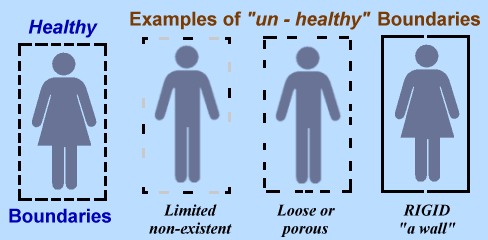
It comes down to boundaries. As adult victims, we don’t have any, or have very weak boundaries. We never established boundaries when we were young because we were (1) never trained to do so; and (2) because our early boundaries were constantly being violated.

People can sense when a person has very weak or non-existent boundaries. That’s why we continue to attract narcissists as friends, lovers and spouses. Narcissists know easy prey when they see it.

Why personal boundaries are so important.

do_not_cross

Even among non-narcissistic people people, we are seen as prey because we appear to lack boundaries. Even near-strangers are constantly stepping over the line and treating us with disrespect, even if their behavior isn’t outright abusive. It’s as if most people have an invisible line drawn around them that must not be crossed. People “see” this line–or sense it–and will respect it. But if you never established boundaries or they were destroyed by your narcissistic family, there is no invisible line drawn around you, and people will constantly step over it, because they believe it’s okay for them to do so.

The solution seems easy enough–just establish some boundaries and tell people when they are violating them. But this is much easier said than done. Most of us have such low self esteem we are terrified of letting others know it is not okay to treat you this way. We are terrified of being criticized or told we are just being “too sensitive” or paranoid. We see other people standing up to those who violate their boundaries without repercussions, but we fear that if WE do it, we will be attacked or criticized, because we were trained to believe this.

unhealthy_boundaries

The sad news is that it isn’t incorrect to believe you will be attacked or criticized or told you are overreacting if you try to stand up for yourself. That’s because people don’t like change. If people have become used to you as a mousy, fearful person with no personal boundaries, they are not going to like it much should you suddenly point out that you have some. But it doesn’t mean you are worthless and it also doesn’t mean you must forever continue to submit to this kind of treatment.

In any group, there is usually one scapegoated (or disrespected) person, and that person is the one who is seen as having the weakest boundaries (and is probably also the most sensitive, which is why we were chosen by our families to be scapegoats in the first place). Unfortunately the human condition dictates that even for normal (non-narcissistic) people, there is going to be a pecking order. This system can be observed in most animals and even some birds, like chickens. People–and animals–feel more comfortable when there is one person around they can pile on. If you suddenly announce they may not pile on you anymore, they are not going to be happy about it and will probably take out their frustration on you. It isn’t fair, but it seems to be in our human nature.

Can anything be done?

boundaries_quote

Yes, but it may be necessary for you to start over in a new place or a new job if this is happening to you. You will need to make it clear from the very beginning that you are to be treated with respect. This means the very first time you observe one of the above behaviors directed toward you, you must nip that in the bud and let the person know it is not okay to treat you like this. Doing this will be one of the hardest things you will ever have to do, because we are so afraid to speak up for ourselves. But if we have not been established yet as a victim or at the bottom of the pecking order, letting others know (nicely, of course) that we will not tolerate this sort of behavior should help. Once your boundaries are made clear to others, you will be treated more like a human being and less like a worthless piece of furniture.

If you cannot start over (and many of us can’t, because our lifetime problems with boundaries and self esteem have made it impossible for us to be able to earn the kind of living that would enable us to move elsewhere or leave a job), then you will need to go ahead and try to speak up for yourself anyway, and risk the fallout. If you find this impossible to do, then you will need to find a support system or a group that does not know you the way you are. You can join a church group, attend group therapy, or take a class. Or you can find supportive people online. For those of us who are introverted, like myself, this may be the most effective way to have a voice and be treated the way you want to be treated: like a human being worthy of respect.

my_personal_area

Keep telling yourself every day that you are not worthless or defective, because you are not. There is nothing wrong with you! Your only problem is that the family that raised you did not respect or love you the way they should have–not because you aren’t deserving of love or respect because every child is–but because as narcissists, they could not. You served a role for them as the family scapegoat.

A good therapist–or keeping a journal or a blog–can be a good way to help you deal with your past, the family that destroyed your sense of self esteem and boundaries, and help you overcome your fears and begin to act more like a person who is to be treated like everyone else.

You are worth it.

Why family scapegoats become lifelong victims.

If you were scapegoated by your family, two things can happen. You can become a narcissist yourself (narcissism being an elaborate defense mechanism to avoid further hurt and abuse) or you will internalize the early message that you’re worthless, defective and have no rights. I’m going to talk about the second scenario because that’s what this video is about and it’s what happened to me.

As a scapegoat, you are trained to live in fear. You become afraid to defend yourself, express your opinions, or demand fair treatment. This attitude of worthlessness, fear and shame is carried into adult life. Other people can immediately sense you are a pushover and a magnet for abuse, rejection, and bullying, and you become a target for abuse by others well into adult life.

You can become a lifelong victim unless you find a way to break the pattern. It’s difficult to unlearn, because it was established so early in life by the narcissistic parent.

Golden children, who more closely resemble the narcissistic parent or provide them with narcissistic supply (adulation), are more likely than scapegoats to become narcissists themselves. They will often become the aging narcissistic parent’s flying monkeys against the scapegoated adult child, continuing the family pattern of abuse.

Scapegoated children are the family shock absorbers. They are the children who have been assigned to absorb and internalize the narcissistic parents’ rage and to mirror back what has been projected onto them.

scapegoat_child

This is exactly what happened to me. Although because I was an only child I sometimes served the Golden Child role, for the most part I was the scapegoat. My Aspergers and high sensitivity made me even more perfect for that role.

Today I’m the black sheep and the “loser” of my family. I’m never included in family functions because of my poverty and the fact I’m “different” than the rest of them. Although they disapprove of me, I really became exactly what they needed me to be. My becoming a “loser” ensured they would always be winners.

I’ve been disinherited because they believe I’m undeserving, a shameful blemish on the family’s “good name,” further guaranteeing I will always remain poor and therefore powerless–unless I hit the lottery (which I don’t play) or write a book, which I plan to do. The irony of all that is the book may very well be one that exposes the people who raised me for what they really are.

I’ve always been a risk-averse, avoidant underachiever. My dealings with others have suffered because of my fear of the judgment of other people. I was often bullied as a child and teenager.

I married a narcissistic man and continued to live with him and allow his abuse even years after we were divorced.

Although as an adult I’m no longer bullied (and am Very Low Contact with my ex), people still try to push me around, treat me like a mental defective, leave me out of conversations, overlook me for promotions or raises at work, or just talk over or look through me as if I’m not there at all. When I say something, people act like they don’t hear me. It’s very hard for me to make friends or fight back when I need to because I was trained from an early age to be so very afraid of everyone. I’m the proverbial shrinking Violet and wallflower–the kind of woman my mother used to mock for being so “insipid.” I seem to have the opposite of charisma.

For many years I walked around as if ashamed to be alive. I carried shame with me like a heavy burden that affected the way I spoke, the way I related, the way I thought (all the negative self-talk and self-hate), even the way I moved and carried myself. I embarrassed myself.

Since I started writing, I’ve learned that I wasn’t put on earth as an example to others of how not to be (I actually used to believe this), but that God gave me these challenges and this life to teach me valuable things about myself–but that waking up to who God meant for me to be was going to be hard, painful work. I don’t live in self-pity: my narcissists have been my teachers.

One day I dream that people offline will know who I really am. That I have a personality. That I’m funny and intelligent. That I have opinions of my own, and that I am actually good at things. But more than anything else, that I have a finely tuned bullshit detector–a gift unintentionally bequeathed to me by my narcissists, and it’s a gift more priceless than any amount of money I may have inherited.

The following video will explain why what narcissistic parents do to their own offspring is nothing less than soul murder. Unfortunately, the original video I had posted here (which I preferred) was the best one to illustrate the way being scapegoated as a child tends to continue well into adult life, with the grown adult child now unconsciously projecting a “kick me” sort of vibe in relationships, friendships, on the job, and everywhere else, and then they wonder why they continue to feel victimized everywhere they go.     It’s hard to break the pattern, but it can be done.    Here’s a different video with the same general message as the first, although the first one (which was removed) was much better, in my opinion.

“There’s a killer on the road”…

This powerful, suspenseful poem chilled me.

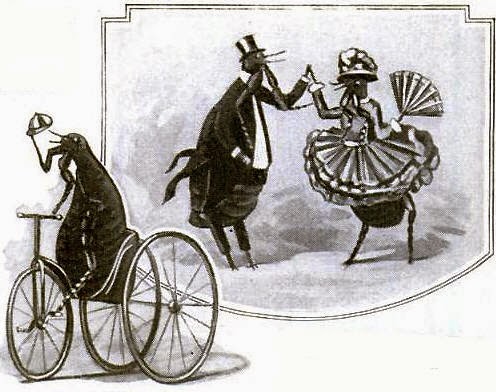
The “fleas” of narcissism and being Aspie.

fleas (1)

Fivehundredpoundpeep just posted this article yesterday, expanding on yesterday’s post about fleas acquired from narcissists who abused us, but this one from the perspective of an Aspergers sufferer who was horrifically abused and devalued by her sociopathic mother, MN sister, and other decidedly unpleasant relatives.

The Fleas of Narcissism
By Fivehundredpoundpeep

I have read about fleas of narcissism before. Lucky Otter talked about fleas recently too. These are the things you can end up with from being raised in a narcissistic household. These would include learned behaviors and reactions they taught you during your childhood.

One thing I want to add here, is that if you are worried about being a narcissist, while some children of narcissists become a narcissist like them, you often are NOT! Narcissists do not worry about it, the very idea that they may be disordered is way beyond them. They would never in a million years admit anything is wrong with them. My mother in one pissed off email fest actually wrote, “**** thinks I am disordered!” by then I had laid it out and wrote to her that she was a narcissist and had no empathy, though I came to the sociopath conclusions later on.

One fleeting thought someone raised in sick sociopathic households can have, is “Am I anything like them?”. One can have this feeling of, “Has the evil infected me?” Being raised with no love, I wonder how I was able to love people and I do. I knew by a very early age I did not want to be like my parents. For Aspies, justice is very important, it is hard to explain, some see Aspies as being little minion “rule-followers” but it’s different then that, we want to follow what is “right” over wrong. My conscience was very different then their’s. One thing that would happen to me is my parents would slap me for being “too sensitive”. I was told constantly to “harden up”! Today as a 40 something, I know telling a ten year old crying Aspie, “You can’t cope!”, is pretty sick.

I struggle with my own worries about evil then. All Christians do and have to battle against the sins they may commit. God is merciful and there to forgive once one repents but I have worried about falling away under my crushing poverty and losing trust in God. Even crazy bad health problems one’s thoughts can go into despair, instead of prayer. The concept of conscience was not taught in my family or acting according to one’s conscience. I was different. I felt guilt.

However I struggled with a few fleas from being raised in my family. My family all had violent tempers, with screaming, yelling and throwing things and using foul language. They do not censor their tempers. Even Mini-Me has a bad temper and I saw her screaming at her kids a few times.

I can struggle with a bad temper though I have learned to temper it somewhat and try to keep the yelling to myself as much as possible within the confines of my apartment. I would never touch anyone, but when angry I can yell loud.

Long ago I learned to walk away from people while yelling, to keep the damage more minimal. The other day, I started yelling about a door being locked in my face, and hopefully no one heard me. I said one irritated low volume thing with no cussing they did hear, and then thought inside, “I better cool it”. Aspie melt-downs can complicate this, sometimes an Aspie is not mad but just anxious. I know I am not perfect and well, everything is a work in progress.

My family does not feel guilt over their tempers, they think it is okay to rant and rave and cuss the room blue. I was always embarrassed to eat out with my father because he would tell the wait-staff off over every little thing and even would yell. I had visions of goobers hitting our food back in the kitchen. You know something is wrong when the neighbors are calling the police constantly over your family’s screaming and yelling and they show up and because of your father’s position do absolutely nothing while a poorer guy would be getting dragged off to jail.

This is an area where I definitely had to learn NOT to be like my family and to keep it in check.

Other ACONs may struggle with taking criticism–I am okay with criticism that is meant for improvement but not for the mean kind.

One rarer flea I can get is if I am around people I can tell do not like me or don’t understand Aspies or have personality traits like my parents is I can get very sarcastic and will go into “fight or flight” mode inside. I will go into Aspie blunt mode and not “cloak” for the neurotypicals and throw caution to the wind. However this can be dangerous around narcs and other personality disordered types who can manipulate things to turn my emotions against me. Aspies have to remember blunt honesty isn’t always the best social mode. Around narcs of course, silence and disappearing is safer.

I found myself in a “fight or flight” mode in my stomach and having some of my fleas come out too often when I was around certain personalities. Sometimes it is not even something that a particular person is doing or any personality disorder but a clashing of values and world view.

This is one thing ACONs should always pay attention to when it comes to dealing with the world. Pay attention to how you FEEL around certain parties. These are feelings I am learning to pay attention to. Not everyone is a narc but we have to learn to control our fleas around personalities who may trigger us or we may differ with. I know there are neurotypicals out there who have no capability to understand me. Of course we have to be mindful of the personality disordered who may be out to hurt us too. During the early stages of no contact we can be more sensitive too as we wake up to new ways of doing and acting coming out of fog.

Others may have a hardened view towards the world. I know I did for a short time. My parents would scream at me for being “too sensitive” and I had that weird abuse where they denied me the protection and treatment owed a young girl where I was treated more like a boy. I was told to harden up and not to have feelings. My feelings angered them. They failed in this change of me, but there was some fleas left over.

An ACON going through this one can get feelings like “Everyone is out to get me.”, “I’m not going to be a sucker”. I had this in my 20s to an extent expecting that everyone was going to screw me over. One roommate even asked me, “Why do you have to act like such a tough girl?” Get hit enough times and you are always ducking and this is not a good way to deal with the world. When I lived in the ghetto, I did grow somewhat harder and when I escaped to a small rural town, had to adjust my entire stance towards the world. I didn’t need to walk around in defense mode all the time even if I had to learn balancing this one, self protection balanced with openness. I actually had to learn and experience that there were good, kind and loving people in the world which defines many of my friends.

One thing I had to do after becoming a Christian in my thirties, was I did use the Christian people I met as role models. I would pick older women, and some I still have on my social website, and would observe how they treated people. These were women with loving families and who gave to the community and treated people fairly and kindly. While I did Aspies are more apt to do this, in choosing mentors. My best jobs when I was young, I always had a mentor. I don’t think this is a bad thing to do. I was doing it at an older age then most, but choosing positive role models when you have had negative ones for far too long is a good thing and I think a sign of healing.

So fleas can be overcome, you just have to be aware of them.

I’m ready to kick some narc ass.

rambo

Yesterday I wrote my rant about my psychopathic sperm donor getting an increase in his disability benefits because of his “homicidal tendencies.”

I was amazed by everyone’s support and encouragement to call out this useless POS and fight the travesty of his being rewarded by the system for being a potentially homicidal psychopath. I’m grateful to everyone for this, because it’s given me the courage to actually take this thing and run with it.

The first thing I need to do is contact the newspapers, either by writing a letter about this outrage or better, finding a sympathetic reporter to write up the story. I could also write a letter describing this travesty to politicians who would be sympathetic to my case. It was pointed out to me that conservatives would have a field day with this, which is very funny to me because I’m anything but a conservative. But hey, whatever works.

Since some of you asked, let me give a few details about why the sperm donor gets disability income. He has Type II diabetes, knee problems (he has trouble with his joints and kneecaps), and a host of mental disorders: he has been diagnosed with PTSD, depression, anxiety, and schizophrenia. Depression and anxiety are legitimate diagnoses, but PTSD is highly questionable and I know for a fact he does not have schizophrenia. He is a good actor and faked psychotic symptoms after his second rejection so he would qualify for a guaranteed income and never have to work a day in his life again. He’s actually a highly malignant psychopathic narcissist who is very intelligent but has zero insight. If you were to call him a narcissist, he would deny it or get angry. In fact, he’s very quick to call everyone else a narcissist, including me. If you asked him, he would probably tell you I abused him, and that’s why he has PTSD. In fact, he has said that. He’s a virtuoso at projection and the most skilled gaslighter I’ve ever known, bar none.

Projection

My father called him evil long before it even occurred to me that’s what he was. When he sent me M. Scott Peck’s “People of the Lie” back in 2005, before our divorce went through, he sent it with a note telling me to read it because it was about my ex husband. (I also discovered my mother in that book, and this horrified me but I knew it was true.)

It’s outrageous that this monster is faking psychotic symptoms and being rewarded for it. It’s outrageous that he claims to be a victim of narcissistic abuse with me as the narcissist. It’s beyond outrageous that he will be able to live comfortably, get full health coverage, and never have to work a day in his life and have plenty of disposable income from the back pay he is getting for the seven years he lived on my couch smoking weed and making troll posts on political websites while I worked my butt off to support him. It’s infuriating that while he lives the high life on his handouts, I will continue to be poor, struggling the pay the bills every month on my tiny income, not having any health insurance, and God forbid should I become disabled or ill, because there is no one who would or could take me in should that happen. If I get sick or disabled, I’ll be out on the streets. Getting disability requires that you do not work during the review process, which can take years. You need someone to support you during that time. If it weren’t for my allowing this malignant POS to freeload off me for seven years, that’s what would have happened to him. Oh, I could go on and on, but I’ll spare you.

rich_and_poor

Just writing this has made me angry. Dwelling too much on anger can cause bitterness and misery, but there is healthy anger too–righteous anger caused by realizing you have been had and are the victim of blatant injustice. Sitting around stewing about it can eat away at your soul, but anger can also be the impetus to get out there and make a stand. It’s the same sort of righteous anger that gave me the courage to finally kick out the psychopath when he physically attacked my daughter last year.

fear_roosevelt

Standing up for my rights against a sick system that rewards evil and just plain laziness is a daunting prospect, to say the least, but I think maybe God is testing my courage and ability to make a stand. He knows I’m ready for this because I’ve let go of most of my fear. There’s always a reason for everything.

Fear is the only thing that holds us back from claiming our rights.

I think I’m ready to kick some narc ass.

ETA: I have one request for those of you who have Facebook accounts. Please share this on your timeline. I don’t dare post this on my FB account because it might be seen by him or people who know him, including my kids. But I’d like to get this out there to as many people as possible. Thanks!

Why does it hurt?

heart_hurts

I found out something today that isn’t a given, but gives me a lot of hope. It’s a joyful thing if it’s true. It’s something I want so much to happen.

So why does this information make my heart hurt and make me feel like crying?

Is it because I want so badly for it to be true (and it may not be and I might be disappointed), or is it because I’m not used to my heart being so open and my deepest emotions being as accessible to me as they are becoming?

I guess the closest I can come to describing this emotion is feeling deeply touched and hopeful at the same time. I wonder if this weird sadness is unique to me or if others have experienced what I’m talking about. It’s very hard to explain. I don’t know if I’m explaining it well because there really aren’t any words to describe it.

Borderlines, like people with NPD, can’t always access their true emotions easily (even though we don’t wear masks and it’s much easier for us to admit we need help and actually be helped). These wonderful but weirdly sad feelings have been happening a lot lately. Like something bad is melting away. Sometimes it’s a bit scary but I wouldn’t trade it for the emotional zombie I used to be in a million years.

I think what’s happened is I’ve let go of my fear and that’s changing me inside.

Running naked in public.

streaking

I have never been a risk taker.

But this week I took a big risk. I ran naked in public twice. The first time I was scared to death; the second time, my attitude was more like, “Eh, why the hell not? Let’s go streaking.”

I’m referring to two blog posts this week in which I wrote about moments in my past where I experienced intense emotions that ran so deep I felt incredibly vulnerable and naked writing about them and sharing them with the world, especially because both these posts were about very private matters I wouldn’t even tell a casual friend. I felt somewhat embarrassed reading over the first post to myself, but also realized it was something I’d want to read if someone else wrote it. I also knew it was very well written.

After several days of stewing over posting the first article publicly and re-reading and editing it about a gazillion times, I finally took a deep breath, squeezed my eyes shut, and hit that “Publish” button. After I did so, I actually felt light in the head, like I might pass out. I couldn’t believe I was crazy enough to actually take off my psychological clothes (my natural guardedness) in public.

But I was crazy enough.

For a day or two, I feared reading my comments. I was almost afraid to look at this website at all. I didn’t want to see how many people might have read it…or WHO might have read it.

At the same time, I began to feel delightfully liberated, like I was running through the streets naked–and realizing my nakedness was a beautiful thing and nothing to be ashamed of.

naked

The second time (the abortion story) wasn’t as scary to post, because nothing untoward happened after I published my first “scary” emotionally revealing article.

I gained the courage to post these deeply personal articles by remembering that all my most liked, commented, and viewed posts have always been those in which I revealed the most about myself and my emotional state.

Of course, the ability to use the anonymity of the Internet and a handle instead of your actual name helps too. 😉

Guys, I need some advice.

indecision

I need to make a decision.

Have any of you ever written a post you thought was amazing and longed, even ached–to publish it, but didn’t have the courage because you thought for whatever reason that it made you too vulnerable? That it revealed too many truths you wanted to keep private?

I have that problem right now. I just spent several hours working on what I think is my best written post ever, because my whole heart was poured into it while I wrote it. But it’s for that very reason I’m hesitant to let anyone see it. It’s not about anything controversial or shocking or illicit or illegal–I just think it shows me at my most vulnerable and that’s very, very scary.

Posting it for the world to see would be like going naked in public. Right now I’m just (figuratively!) naked in my own house–by keeping that post set to Private.
But I am longing to put it up. I feel like I must put it up even though I’m scared.

Have any of you bloggers ever experienced this, and what did you do about it? How did you resolve your indecision? If you decided to post it anyway, what happened?
What advice can you give me?