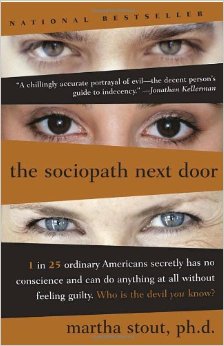
Dr. Martha Stout’s excellent “The Sociopath Next Door: The Ruthless versus The Rest of Us” is an easy to read, well researched and often entertaining study of the psychology of evil. In some ways similar to M. Scott Peck’s “People of the Lie,” but without the religious overtones, Stout chillingly describes the “ice people”–the sociopaths that walk among us.
As many as 4%–one in 25 Americans–is without a conscience or the capacity to feel empathy for others. Stout doesn’t make a distinction between sociopathy and psychopathy, and in this book she is referring to those people who meet the diagnostic criteria for Antisocial Personality Disorder (ASPD), not Narcissistic Personality Disorder. In fact, narcissism as a disorder is rarely mentioned, although she does acknowledge that all sociopaths are narcissistic.
Stout includes many case studies of how sociopathy can manifest in individuals. Contrary to popular notion, not all people with ASPD (sociopathy) are in prison or even criminals. Antisocial behavior is found as often in boardrooms as in prisons, and sometimes more so. For sociopaths who grew up in well heeled families and were able to get a good education, their antisocial traits are likely to manifest in “socially acceptable” ways. For example, a CEO who needlessly downsizes to increase his own bloated income, ruthlessly firing hundreds of employees without caring about the hardship those fired employees now face, is as conscienceless and unempathic as a cold blooded murderer.
A sociopath can be the gossipy woman next door who tells malicious lies about all the other neighbors, it can be the company president who embezzles and defrauds, or it can be the vicious serial killer who preys after college students.
Stout talks a lot about conscience, that quality that separates the antisocial from everyone else. It’s the lack of this trait that makes people evil. She offers a number of reasons why someone may lack a conscience–they may have suffered horrible abuse or neglect as young children (she discusses the sad plight of Romanian children who were adopted by American parents and many of these kids were found to have an underdeveloped conscience), they may not have been taught prosocial values, or they may be deficient in the parts of the brain where the conscience develops in normal children.
I definitely recommend “The Sociopath Next Door” to anyone who has been a victim of or had to deal with a sociopath, whether at home, work, school, or in a relationship. I’m going to extend the term “sociopath” here to include narcissists and psychopaths because they too lack empathy and a conscience. Really, this book should be read by everyone, because all of us have had to deal with ruthless “ice people” who just don’t care about anyone but themselves.
Last night Fivehundredpoundpeep disagreed with a post I wrote, saying that people who chose narcissism reach a point of no return when become thoroughly evil. She has religious reasons for this view (“reprobate” is a religious term that means the person even while still alive is destined for hell because God has turned his back on them due to their bad choices). While I don’t share her literal biblical beliefs in certain damnation for some (I believe this is from Calvinist thought), I agree with her that most narcissists do get worse with age and many reach a point of no return, where they become so hardened they have no hope of changing-and I do agree this change is due to a total selling out of whatever conscience they may have had, if they ever had any. I have seen this up close and personal with my ex, who is a frightening example of someone who completely sold his soul, for lack of a better phrase, to the devil. All Cluster B personality disorders have a spiritual as well as a mental component, but narcissism is a slippery slope into inescapable darkness and misery.
When I married my ex in 1986, he was definitely a narcissist but lower on the spectrum than he is today. While still being abusive and extremely manipulative, he did have moments where he showed what I believed was genuine goodness. He was actually a good father to our two children–at first. In fact, he was more patient with them as babies than I was. It was later that he began to scapegoat our son (who like me, is highly sensitive and able to see through his father) and started to use our daughter as a sounding board for his own problems when she was still just a child as well as a junior flying monkey against me and her brother.
I’m not entirely sure when he crossed the “point of no return” but it seemed to be between 1997 and 2001, during the time his mother lived with us before entering a nursing home. This is when I believe he became thoroughly evil and it was because of the way he treated his ailing mother.
His mother was a thoroughly malignant narcissist who was very abusive to my ex while he was growing up. She too became worse with age, but in the late 1990s, she developed Alzheimers and could no longer live alone, so we brought her to our home where an eye could be kept on her. As malignant as she was, she was losing her faculties and her mind and it would have been inhumane not to try to help her.
Most of her care fell on my shoulders, a difficult thing because my kids were still very young and I was trying to raise them too. I was also suffering from severe depressions during this time due to my ex’s increasing abusive behavior as well as his heavy drinking and drug taking, for which I had to be hospitalized twice. So you can imagine I wasn’t the most patient caregiver, especially because his mom could still be so unlikeable. It was hard for me to not become angry with her. I tried to control this, but found it so hard, especially when she began losing control of her bowel and bladder. Every day I was confronted with messy bedding because she kept pulling off her diaper and would fight me or start crying whenever I went to change her. I was never cut out to be a nurse, but this was too much and there were those times I’d yell at her in frustration.
Unknown artist.
My ex hated his mother, but did not want to put her in a nursing home due to the expense. Of course anything I had to say about the matter fell on deaf ears. He had actually made her sell her house when she moved in with us and obtained a power of attorney so the money from the sale was in his name (the money was gone within one year). I never felt this was right but admit I enjoyed having more money, so I never said anything to him about it being wrong. While what he did wasn’t illegal, it was extremely unethical and selfish. While his mother’s immediate needs were taken care of, he had complete control of the money and most of it did not go for her care and went for luxuries for us instead. I always felt badly about this and for years felt like my sin of overlooking this would never be forgiven. (Recently I repented and know I have been forgiven but it still bothers me sometimes).
But enough about that. My ex was increasingly abusive to her while she lived with us, and reached a point where he became physically abusive and would spank her like a bad child–IN FRONT OF MY CHILDREN! As awful a mother as she was to him, she did not deserve this. Whenever I brought up how wrong his behavior was, he said he had a right to treat her that way because she was such a horrible mother. He said it was karma. Not once did he ever admit he was wrong. After a while, my bad case of narc “fleas” became so bad I began to join in the abuse–not hitting her, but I stopped trying to defend her and began to think maybe his spanking her wasn’t really wrong. After all, she did act like a naughty three year old. I didn’t know it, but I was suffering a form of Stockholm Syndrome, where a victim begins to identify with their abuser and make excuses for their bad behavior. Still, I begged him to put her in a nursing home but he still refused.
It was during this time he began to grow pot in our outbuilding, and his immoral behavior ramped up a few notches. He recruited our 8 year old daughter to water the plants and watch out for cops! I couldn’t believe he would do this, but I said nothing because nothing I said ever was taken seriously or I’d be belittled for bringing it up. He also started to hit my son, and berate and belittle him constantly. All this was new for him. Before his mother had moved in he had never been physically abusive to our children and stayed away from alcohol and drugs. Now he was drunk or high most nights and began to change into a person I was becoming extremely afraid of. His look became harder and colder, and he was rarely affectionate anymore. His eyes became very cold, almost demonic at times. Both of us had affairs (I’m not proud of this either because I was actually worse than him). I was mentally ill myself due to the abuse but this doesn’t excuse the part I played in this whole mess of a marriage.
In 2000 his mother developed cancer and after her hospitalization, finally entered a nursing home. We hardly visited her at all but whenever we did, he would tell the kids how stupid and horrible his mother was and encourage them to insult and demean her. He told them she deserved the way he treated her because of the way she had treated him.
She died in January of 2002 and to this day, my ex never went to pick up her ashes.
It was during these five years from 1997-2001 that I saw my ex change from a person who could sometimes be nice and was often a lot of fun into a monster who appeared to have no emotions at all or any empathy for anyone else. Looking back, I think it was because he crossed a line from “mere” malignant narcissism into full blown psychopathy brought on by continual abuse of his helpless mother. Yes, his mother was a highly malignant narcissist herself and his hatred of her was understandable, but no one with a conscience would have treated her the way he did when she became ill. It scares me to think how close I came to becoming evil myself, because of my collusion with him in this horrible abuse. For the past few days I have been struggling with the evil I see in myself, and as a borderline, I’m so close to being a narcissist anyway. There were so many times while I was with him that I flirted with turning my back on everything good and right. I’m having a rough time accepting this and forgiving myself. But that’s for another post.
From 2002-2004 our marriage continued to worsen and the psychological abuse grew worse (not the physical, because he stopped drinking and he was only physical when he was drunk). We obtained a divorce but in 2006 I made the mistake of allowing him to move in with me. By this time he was parasitic and refused to work. I’ve written about this elsewhere.
Today I see no goodness in him at all. I’ve never seen a person so filled with hate and rage. His conversation is always sarcastic, biting, and negative. He never has anything positive to say and spends most of his time trolling political websites and getting high. He’s not out there committing violent crimes, but he’s a person who seems to have no soul. The rare times I do see him (I avoid this as much as possible), I can’t even look him in the eyes because they’re so dead and empty. I’m afraid just looking into them can infect me with his evil. Our daughter unfortunately is still in thrall to him, and I pray all the time she will be okay. I’m afraid further close contact with him can destroy her soul the way it almost destroyed mine, and she’s halfway there already, showing a number of narcissistic traits. Like me, she has a really bad case of “fleas.” I can’t keep her from seeing her father though. She is an adult and I have to accept that I can’t make her choices for her.
While it’s very sad to see a person so thoroughly gutted spiritually, I have no sympathy for my ex. I do have sympathy for the little boy he used to be, but he died a long time ago.
My son, who was scapegoated by his father, seems to be the most mentally healthy person in the immediate family. He does have some anger and self esteem issues (don’t we all?) but he is strong and determined to escape the fallout of the family illness. I am so proud of the man he’s becoming.
There are some strange things I’ve noticed narcissists do that aren’t usually mentioned as symptoms of their disorder, but seem to be common enough perhaps they should be included as additional criteria for NPD.
If you know someone who does only one or two of these things, it doesn’t necessarily mean they’re a narc, but if they do several of them regularly and also seem to fit the more well-known criteria for NPD, these things could be red flags to watch out for.
1. They don’t blink when they look at you.
Some narcs have a penetrating, predatory gaze. If a person of the opposite sex looks at you this way, you may take it as sexual interest (and it could be), but watch carefully: if they do not blink this could mean they are sizing you up as prey. Whether they blink or not, if their stare makes you squirm, get away. Listen to your instincts.
2. They interrupt you or talk over you constantly.
If someone only seems to care about what they are going to say next, and don’t even seem to have heard what you said, suspect a narcissist.
3. Whatever you tell them is really all about them.
If you say something to them about yourself, rather than acknowledge you, instead they always relate it to back something that happened to them. The Roz Chast cartoon above illustrates that well. You do not exist.
4. Their eyes look flat or dead.
This is a “dead” giveaway and those eyes usually belong to someone high on the spectrum–a malignant narcissist or a psychopath. Get away from this person. The above photo of psychopathic murderer Jodi Arias shows how flat and dead their eyes can look.
5. They sometimes act psychotic.
All malignant narcissists are bat shit crazy, and their delusions can rival those of someone with schizophrenia. In fact, narcissists denied supply over long periods of time or who have suffered a severe loss can in fact become psychotic. Schizophrenic-like neologisms and nonsensical conversation that sounds like word salad isn’t that uncommon in a malignant narcissist living in mortal fear of losing their “mask of sanity.”
6. They have dramatic, unsettling mood swings.
Narcissist mood swings (mask switching) can be so sudden and inexplicable you may think you’re dealing with someone with Dissociative Identity Disorder (DID). For example, a narcissist mother can seem to be happily playing with her child and suddenly, for no discernable reason, start screaming at or hitting the child.
7. They are bad sports.
They will act like babies if they lose a game. I remember once seeing a grown man in his 40’s get so angry that he lost Monopoly that he picked up the game board and tossed it across the room, while everyone looked on in horror. If they can’t win, they will ruin the game for everyone else.
8. They have dark interests or like things that make most people uncomfortable.
Narcissists, especially high on the spectrum, walk on the dark side and this shows in their obsession with things like the occult, mass murderers, the Holocaust, or weapons. They may listen to dark music such as death metal or watch slasher movies. Many people are interested in these things, but a malignant narcissist or psychopath, even if they put on a mask of being an upstanding moral citizen, usually have a secret hobby or interest in something dark or evil. They may not talk about it in public, but they have one.
9. They can’t let nature take its course.
If a woman has had an excess of cosmetic surgery including too many facelifts, she is probably a somatic narcissist living in mortal fear of aging.
10. They have an affected way of speaking.
Dahhhh-ling, this can manifest as a fake foreign accent, or just a speaking voice that sounds fake and affected, as if they are acting on a stage. It comes off to others as more annoying than glamorous though.
11. They use exaggerated mannerisms, facial expressions, or speaking voice.
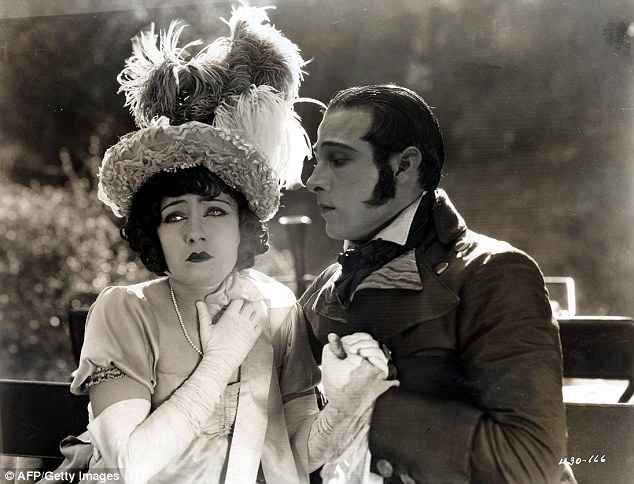
Like actors in silent movies, who used exaggerated expressions and mannerisms to make up for fact they couldn’t speak in those films, some narcissists (probably because they can’t feel emotions the way normal people can) overact to the point of being rather hilarious. This is also common in people with Histrionic Personality Disorder (HPD), another Cluster B disorder that’s been speculated by some experts on personality disorders to be a somatic form of narcissism and is far more common in women.
12. They have conversations with themselves.
I’ve heard many a narcissist talk to themselves–and actually answer themselves back. Does this mean they are insane? Do they hear voices in their heads? Or are they practicing what they might say to someone in a hypothetical conversation ahead of time (remember, everything they do is fake, so they might have to pre-plan how they will respond to others in advance). Who knows? I just know it’s weird as fck. My ex used to do this all the time–in front of a mirror too.
Here is a hypothetical letter written from the point of view of a narcissist’s True (lost) Self.
The advice given here by the True Self is almost the polar opposite of whatever their False Self would tell you. That’s because their False Self is a lie and isn’t who they really are, even though they may have been wearing this mask for so long they can never access their True Self without enormous difficulty or even at all.
Always follow the advice of their True Self, no matter how much they protest and rage, unless you want further abuse. It’s actually the best thing for them if they ever decide to look in the mirror past the lies they show the world (and may have come to believe is the truth)–and of course it’s best for you.
Letter from a Narcissist’s True Self:
Dear Victim,
I have lied to you about nearly everything. I am not sorry for this behavior because I cannot empathize with you. I chose narcissism so early in my life that I never had the chance to develop a conscience or the capacity to feel remorse or empathy for the way I hurt you. Still. I know it’s wrong on an intellectual level. I just cannot feel your pain. Sometimes I wish I could, but I can’t.
I became a narcissist because as a child I felt too vulnerable. I was sensitive. I felt too much and most of it was painful. I was made to feel like I was nothing, a nobody. I was hurt, betrayed, abused, just like you. I couldn’t understand why I wasn’t loved, or why I was treated with contempt and like I didn’t matter. I was also was never given a good example of how to become a good person. I never had anyone to model in a positive way.
Life was so painful for me I had to do something about it. Something drastic. I had to become strong and never show weakness again, because my weakness was killing me. I was trained that being a sensitive person who feels compassion and remorse, a person who can love others, is a weak person. I know that isn’t really the case, but it was how I was trained. I was so young that I couldn’t see how wrong that might have been.
I reached a point where I had to make a choice. In order to survive, I had to sacrifice my humanity. I didn’t want to do it, but I felt like I had to. I didn’t want to be hurt anymore. I had to sell my soul.
In order to sell my soul, I had to shut you and everyone else out. I couldn’t allow myself to feel too much. I couldn’t allow myself to be sensitive anymore, and that meant I could no longer allow myself to love anyone, feel anyone else’s pain or joy, or feel sorry if I did something wrong.
I had to don this mask that I wear, which is a lie. In order to keep that lie intact, I had to treat others badly. I had to diminish you to prop my false self up. I had to hate you in order to “love” the mask that I show the world, because if I didn’t continually prop myself up by making you feel bad, my mask of lies might fall off and expose the real me, a powerless and vulnerable child which I had to protect at all costs, even if it meant destroying everyone else around me. I am a bully but inside I know I am nothing. I act like I love myself but I really hate myself. I only love the mask I wear. I abuse you to protect that mask.
You can never get through to my true self because the lies I tell are nearly impenetrable. I have lied so often and for so long that I myself have come to believe my own lies. I am a walking lie. That is the truth.
I will never let you get close to what I really feel. I don’t even know what I feel anymore. Most of the time I feel nothing, because a lie has no feelings. But try to destroy my protective armor, and I will try to destroy you. If I must go down in flames, I am going to take you with me. I will rage and abuse you. I will gaslight you and tell you the most horrific lies about yourself.
I may seem nice at first or when I feel like the supply you give me is threatened or you may leave. I know how to get others to trust me–by acting like a nice person. I am good at acting like a nice person but I can’t feel a nice person’s emotions. It’s hard work to act nice, because that’s a lie too.
When you begin to trust me, I will start abusing you, because I must keep you at arm’s length and keep my mask of lies intact at all costs. Both the niceness I show you and the asshole I become are both lies. I cannot even access who I really am. I have forgotten. I just know that my true self is there, somewhere, and I can never, ever, let you meet them.
If you mirror back to me too much of the truth about me–if I become aware that you KNOW this mask I always wear is a fake–I will attempt to destroy you or cut you out of my life. I cannot afford to have the truth about myself revealed to me. Nothing terrifies me more than facing the truth about myself so I have dissociated myself from it. It scares me so much to realize how evil I have become. It hurts me so much that I had to choose this fake self because of what was done to me. I hate being evil. I really don’t want to be this way but I will never, ever admit that. I cannot ever show you or anyone in the world how weak and vulnerable I really am. But deep inside, I know I am.
I am still an infant. I never grew up. My emotional and moral development was arrested when I was just a very young child, so I only have the emotional maturity of a child that age. That’s why I can’t care about you. It’s why I must always have my way. Can a two or three year old care about YOUR feelings? Of course they can’t, and like a toddler, I can’t either. I am like a mentally challenged person, only my retardation isn’t mental, it’s emotional and moral. I’m emotionally retarded.
It’s hard work keeping up my false self. I am paranoid and defensive all the time that I will be discovered and exposed. It’s enormously stressful to be a narcissist. It’s stressful and often painful, and I know I have sacrificed the ability to ever feel real happiness in order to never be hurt again.
But still, I hurt all the time. You can hurt me very easily. The only way I dare show my hurt is by projecting it back onto you through my abuse and through my rages. I’m a bully because I always hurt so much. But I can’t hurt FOR you, only for myself. I cannot afford to hurt for you. I’m too busy always licking my own wounds and trying to keep the lie going. I will hurt YOU if I must to keep the lie intact.
As I age, I may soften a little but most likely I won’t. I could even become worse. Don’t wait for me to change because I most likely never will. Once I chose this life, there was no going back. I chose darkness and once that’s done, there is no going back to the light. I sold my soul and there’s no way to buy it back, but through the grace of God himself.
If you care about yourself (because I can never care about you), you must leave now. Don’t play my games. Ignore me and act like I don’t exist. Being treated like I don’t exist is the worst thing I can imagine, but if you care about your own survival it’s what you must do. I will destroy you if you don’t. Heed my warning.
There’s even a small–a very small–chance that your abandoning me and taking away the supply I get from you could make me take a look in the mirror for the first time at the lost child I left behind so long ago. If that happens, I will be in so much pain I may seek the help I need. Don’t count on it though. Even if I ever seek help, once I start feeling too much pain I will probably leave counseling. Feeling that pain is too terrifying. It’s easier to abuse my own mind (and yours) by keeping up the masks and lies.
Here is a song that describes me well.
Don’t wait for me to change. I won’t. Don’t play my games. Even if I rage, hold your ground. You’re stronger than I am. I will never let you know I know this. Don’t fall for my lies.
Better yet, leave now. Keep your soul intact. Don’t allow me to turn you into a shell of what you used to be or worse, a person like me, even though it’s what I want.
So much truth in all of this. I have seen all of these lies up close and personal. The one “You are responsible for the way you feel” when they have just said something hurtful to you REALLY hit home with me. And of course the way they gaslight, gaslight, gaslight and always try to make you feel like there’s something wrong with YOU.
If you’ve found yourself in the unfortunate company of a Narcissist, you’ve undoubtedly discovered their innate ability to lie without missing a beat. Narcissists lie for a variety of reasons, but the main reason, while immature, is simple. If he or she lies and gets away with it, they interpret this as their being clever and superior to others. In short, it’s a means to demonstrate how brainless others are. A sincere and honest person is viewed by the Narcissist as a weak chump who deserves to be manipulated.
Wondering if your significant other could be a Narcissist? Read the following list of their favorite lies to determine if your partner fits the mould.
“I can’t imagine my life without you.” (or, “I’ve grown so attached to you”, “You’re in my blood”) – Sadly, victims of Narcissistic abuse believe their partner really cares about…
If you were scapegoated by your family, two things can happen. You can become a narcissist yourself (narcissism being an elaborate defense mechanism to avoid further hurt and abuse) or you will internalize the early message that you’re worthless, defective and have no rights. I’m going to talk about the second scenario because that’s what this video is about and it’s what happened to me.
As a scapegoat, you are trained to live in fear. You become afraid to defend yourself, express your opinions, or demand fair treatment. This attitude of worthlessness, fear and shame is carried into adult life. Other people can immediately sense you are a pushover and a magnet for abuse, rejection, and bullying, and you become a target for abuse by others well into adult life.
You can become a lifelong victim unless you find a way to break the pattern. It’s difficult to unlearn, because it was established so early in life by the narcissistic parent.
Golden children, who more closely resemble the narcissistic parent or provide them with narcissistic supply (adulation), are more likely than scapegoats to become narcissists themselves. They will often become the aging narcissistic parent’s flying monkeys against the scapegoated adult child, continuing the family pattern of abuse.
Scapegoated children are the family shock absorbers. They are the children who have been assigned to absorb and internalize the narcissistic parents’ rage and to mirror back what has been projected onto them.
This is exactly what happened to me. Although because I was an only child I sometimes served the Golden Child role, for the most part I was the scapegoat. My Aspergers and high sensitivity made me even more perfect for that role.
Today I’m the black sheep and the “loser” of my family. I’m never included in family functions because of my poverty and the fact I’m “different” than the rest of them. Although they disapprove of me, I really became exactly what they needed me to be. My becoming a “loser” ensured they would always be winners.
I’ve been disinherited because they believe I’m undeserving, a shameful blemish on the family’s “good name,” further guaranteeing I will always remain poor and therefore powerless–unless I hit the lottery (which I don’t play) or write a book, which I plan to do. The irony of all that is the book may very well be one that exposes the people who raised me for what they really are.
I’ve always been a risk-averse, avoidant underachiever. My dealings with others have suffered because of my fear of the judgment of other people. I was often bullied as a child and teenager.
I married a narcissistic man and continued to live with him and allow his abuse even years after we were divorced.
Although as an adult I’m no longer bullied (and am Very Low Contact with my ex), people still try to push me around, treat me like a mental defective, leave me out of conversations, overlook me for promotions or raises at work, or just talk over or look through me as if I’m not there at all. When I say something, people act like they don’t hear me. It’s very hard for me to make friends or fight back when I need to because I was trained from an early age to be so very afraid of everyone. I’m the proverbial shrinking Violet and wallflower–the kind of woman my mother used to mock for being so “insipid.” I seem to have the opposite of charisma.
For many years I walked around as if ashamed to be alive. I carried shame with me like a heavy burden that affected the way I spoke, the way I related, the way I thought (all the negative self-talk and self-hate), even the way I moved and carried myself. I embarrassed myself.
Since I started writing, I’ve learned that I wasn’t put on earth as an example to others of how not to be (I actually used to believe this), but that God gave me these challenges and this life to teach me valuable things about myself–but that waking up to who God meant for me to be was going to be hard, painful work. I don’t live in self-pity: my narcissists have been my teachers.
One day I dream that people offline will know who I really am. That I have a personality. That I’m funny and intelligent. That I have opinions of my own, and that I am actually good at things. But more than anything else, that I have a finely tuned bullshit detector–a gift unintentionally bequeathed to me by my narcissists, and it’s a gift more priceless than any amount of money I may have inherited.
The following video will explain why what narcissistic parents do to their own offspring is nothing less than soul murder. Unfortunately, the original video I had posted here (which I preferred) was the best one to illustrate the way being scapegoated as a child tends to continue well into adult life, with the grown adult child now unconsciously projecting a “kick me” sort of vibe in relationships, friendships, on the job, and everywhere else, and then they wonder why they continue to feel victimized everywhere they go. It’s hard to break the pattern, but it can be done. Here’s a different video with the same general message as the first, although the first one (which was removed) was much better, in my opinion.
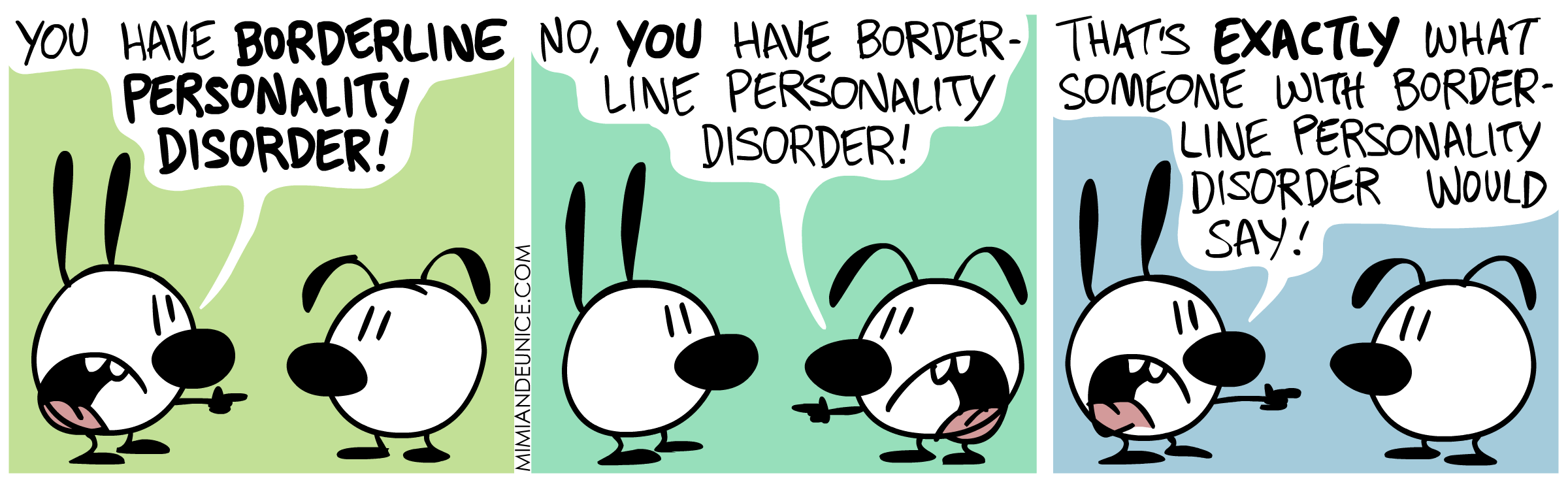
Articles like this one make me want to rage. The author, Doug Bartholomew, a licensed social worker, believes that people with Borderline Personality Disorder (BPD) are pretty much the same as people with Narcissistic Personality Disorder (NPD). He even goes so far as to say BPD’s, along with NPDs, fit the criteria for M. Scott Peck’s “People of the Lie.”
Wait just one second. Peck’s People of the Lie don’t even include all narcissists–his definition describes those with Antisocial Personality Disorder and malignant narcissism (there’s a huge difference even between MN’s and garden variety narcissists–a malignant narcissist has ill will toward others and decided antisocial traits while a “benign” narcissist isn’t necessarily ill-intentioned but is just self centered and doesn’t care about your feelings). Peck never said all manipulative people (people with one of the four Cluster B personality disorders) were by nature evil, but evil people is what his book is about.
At the same time I understand where Bartholomew is coming from. On the surface, people with BPD can be manipulative and even resort to some of the same unpleasant tactics and mind-games (gaslighting, etc.) that narcissists like to play. They can appear to lack empathy, because they get so caught up in their own drama that they can literally forget that others exist. They can be demanding, high maintenance and prone to irrational rages (just like narcs) but are far more likely than narcs to turn their rage inward and become self-destructive or even suicidal.
Not much to do with this article, but I couldn’t resist.
Borderlines also usually regret their acting-out and selfish or manipulative behaviors when the crisis has passed or their bad behavior is called out to them. They may be self-centered and impulsive but are not lacking remorse or the ability to feel shame and guilt. The problem with Borderlines is they tend to act as they feel at the moment without thinking things through. They can get so caught up in their own fear of abandonment that they almost literally forget that you have feelings too. However, after the fact Borderlines usually will feel remorseful and ashamed of their behavior, and on top of that, realize that their offputting behavior may cause others to do what they fear the most–abandon them.
Bartholomew also states that all Cluster B disorders are characterized by a lack of empathy:
The overwhelmingly most commonly mentioned behavior or trait associated with all the Cluster B Personality Disorders is a lack of empathy or compassion. They seem unmoved by the effect their behavior has on their loved ones other than what is necessary to keep their loved ones engaged and around. It is as if they were tone deaf or color blind to the feelings and experiences of others.
While it’s true that people with NPD and ASPD are characterized by a lack of empathy, I disagree that this is true of people with BPD. I think this is a gross overgeneralization.
Borderlines can feel empathy, but due to their impulsiveness and fear of abandonment, they can act in selfish, defensive, and manipulative ways that may hurt others (but they hurt themselves even more so). However, unlike malignant narcissists and people with ASPD, Borderlines do not set out to hurt others and they do care how others feel. Unfortunately their good judgment is clouded by their disorder which makes it difficult or impossible for them to regulate their emotions. That’s why they act so impulsively and often fail to think things through before they act out. It’s also why their relationships tend to be stormy and short-lived.
A person with BPD does not wear a mask or have a “false self” like someone with NPD–but their fear of abandonment can cause them to knowingly or unknowingly push others away. Their ambivalence in relationships can be very confusing to others–they can seem to adore you one moment, and then hate you the next. They can seem needy and rejecting by turns. When others grow tired of this crazymaking and confusing “I hate you, don’t leave me” behavior and finally leave them, the Borderline genuinely doesn’t understand what they have done to drive the other person away, and so they become even more fearful of being abandoned. Their behavior is maladaptive because it tends to cause the very thing they are trying so desperately to avoid.
While the two disorders, both being part of the Cluster B group of personality disorders, do have overlapping symptoms and are often confused with each other and/or misdiagnosed as the other disorder (with males being far more likely to be diagnosed with NPD and females with BPD), this author, unlike Bartholomew, understands that both the motives and mechanics of the disorders are quite distinct from each other:
[…]both BPD and NPD deal with conflict in a way that is unhealthy to themselves and those around them. It’s the expression of the anger that results from the conflict that is different.
In her article “Blame-Storms and Rage Attacks,” Randi Kreger, co-author of Walking on Eggshells, points out the difference in how those with BPD and NPD express anger. While those with Borderline Personality Disorder may fly into a rage and push people away, they will often calm down, feel shame for their reaction, and promise never to do it again.
“Unless they’re in treatment, the underlying issues don’t go away. Some conventional [borderlines] do not get angry at all, but hold it in or express it inwardly through self-harm,” says Kreger.
“The anger of narcissists, on the other hand, can be more demeaning,” she continues. “Their criticism evolves from their conviction that others don’t meet their lofty standards — or worse, aren’t letting them get their own way.”
Here are two Youtube videos that graphically show exactly how a mother with a bad case of NPD (malignant narcissism) operates. These videos are entertaining in a scary and disturbing way, like watching a train wreck.
Pay close attention to what the mother says–she uses every trick in the narcissist’s book of tricks: blame, insults, changing the subject, interrupting, raging, mocking, “talking over”, gaslighting, projecting, invading boundaries, not taking responsibility, showing no empathy, and just about every other “tool” the narcissist uses to get their own way or avoid taking responsibility for their behavior and actions. Notice how childish the overall effect is–the mother sounds like a four year old having a temper tantrum.
The daughter who made the videos is trying hard to get her mother to listen, but her words seem to fall on deaf ears. She might as well be talking to a wall, for all the good it does.
I was raised as an only child–the second marriage for both my parents–in a narcissistic family. Only children are in an especially vulnerable position in narcissistic families, because they must serve as all things to one or both parents.
In families with several children, one child (usually the most sensitive) is normally chosen to be the scapegoat–to serve as the family trash can for all the narcissistic rage of the parents. Another child, usually the one most closely resembling the narcissistic parent or the one who best serves the parent’s need for narcissistic supply, may become the Golden Child–in other words, the parent’s favorite. The Scapegoat is always wrong, bad, stupid, crazy, a “problem,” etc. The Golden Child can do no wrong. Misdeeds are overlooked or projected onto the scapegoat. Golden Children may become the narcissistic parent’s flying monkeys and are even sometimes given the “honor” of helping with the abuse against the scapegoat.
I’m reminded of a book I read some years ago called “A Child Called It,” written by Dave Pelzer, who not only recovered from the horrific abuse inflicted on him from ages 4-12 by his psychopathic mother (who had been loving up until that point) and brothers (who served as her “helpers”) once he was removed from the family and placed in a foster home, he actually seemed to become stronger because of it. Today he is an author, motivational speaker, and activist against child abuse. Dave was the scapegoat of his family, and I think his mother turned against him when she realized he was the most sensitive child and probably the most intelligent one too.
But what happens when there is only one child in the family? Well, I think that child becomes both a scapegoat and a Golden Child. If I had grown up with siblings (I have older half-siblings but I wasn’t raised with them), I’m almost certain I would have been the family scapegoat. But my parents (I am including both here, even though I don’t believe my father is a true narcissist, because they worked as a “team”–he was codependent and under my mother’s thrall) needed a Golden Child too who would serve their need to show a child off as a prized possession, a status symbol of sorts: the physical proof of how superior they believed their genes to be compared to everyone else.
Being both scapegoat and Golden Child is even more crazymaking than being just a scapegoat, because you never know where you stand. You constantly feel off balance and anxious, never knowing if something you said or did will be rewarded, ignored, or punished. Life feels chaotic and unformed. You feel like you’re playing a game you never wanted to play, a game where you were never taught the rules, and most of the time you don’t even know WHAT game you’re playing, but you’re expected to play like an expert anyway.
There was no consistency in the way I was disciplined or the things I was disciplined for. I was punished often (for infractions that were usually fairly minor or even nonexistent–I was a “good kid” who was terrified of angering my parents until my teens), but that wasn’t the worst thing. The worst thing was that the next time, I might actually be rewarded for the same infraction!
I was often punished for things I couldn’t help. Acting “spooky” was one of them. As a fearful, sensitive Aspie child, there were times I would retreat inside myself when I was feeling very anxious or when there was too much ‘input’ from the world, and this enraged my MN mother, who would berate or punish me for this behavior. I had no idea what I had done or how to stop being “spooky.” It just happened. I think it enraged her because it was during those times I went “inside” that she could no longer reach me with her abuse.
Even though most of the time I was treated as if my feelings didn’t matter, I was often told how pretty, smart and talented I was. It’s my belief I was no more of any of these things than any other kid my age, but I was told I was “special.” To my young mind, “special” meant “different”–and most children, myself included, dread being different from their peers.
When I was bullied at school, the reason my parents gave me was that the other kids were just jealous because of my “superior” looks, intelligence, or talent. I was also told our genes were better than other people’s, and our family was of a higher socioeconomic status than my friends’ families. I know now this was complete bullshit, but it’s the lie I was being fed while I was growing up. I think these “compliments” were intended to isolate me from my peers even further, so I’d just be “theirs.” I never felt empowered by the “praise” I got, because of the way it made me feel somehow defective and different from other kids. In addition, I felt like I could never live up to the pedestal my parents put me on at those times. I was right–and as an adult, I am looked down on by my family as actually defective.
The most crazymaking thing of all was the times I’d be complimented and diminished at the same time. One of the most common ways I’d be demeaned was being told how “sensitive” I was. This was never meant to be a compliment; it was meant as a way to let me know how weak I was. Sometimes I was told I couldn’t or shouldn’t do things because of a combination of my “good” and “bad” qualities. For example, when I was about 10, I wanted to join the swim team. I remember exactly what my mother’s reaction was to this. She always liked to tell me what I was thinking, which is another way narcissists make us doubt our own reality and question our instincts. She said: “You wouldn’t like being on the swim team because you’re too sensitive and you don’t like competition, and you’re too smart to be on a team with those people anyway.”
Huh?
Left-handed compliment much? She always sandwiched her praise this way–between insults like a shit sandwich. This was just another way I was constantly thrown off balance and this led to my becoming an extremely anxious child and later, an extremely anxious adult.
In general, my family treated me like I was a huge burden and didn’t really want me around, so the praise I got as a sometimes Golden Child made no sense and to my sensitive child’s mind, never felt sincere. Even at a very young age, I knew I was being lied to. I knew I wasn’t loved the same way other children were loved, even though my parents constantly mouthed the words like some sort of tic.
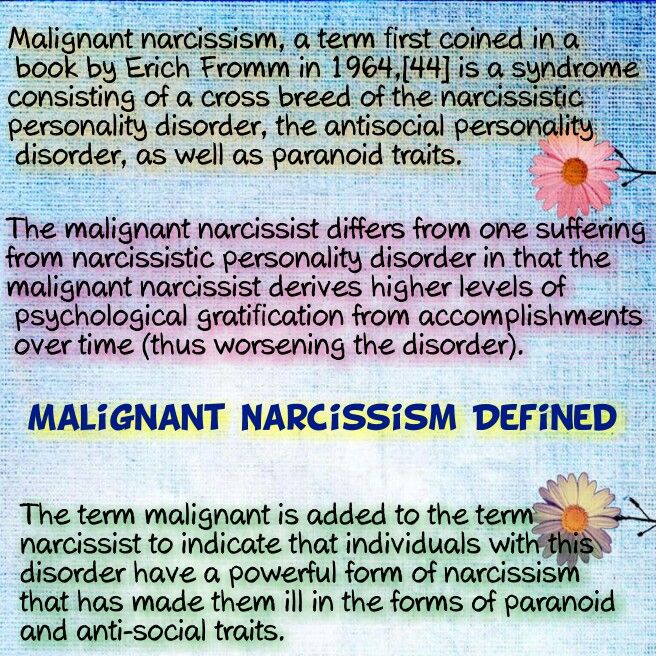
The term “malignant narcissism” seems to be everywhere these days, especially on the Internet. But what exactly makes it different from “normal” narcissism?
Here’s a very good definition of how it differs from garden-variety NPD. I had no idea the term has existed this long!














 Lucky Otters Haven