Narcissists who love animals and their mothers.

dr_evil_cat

I’ve noticed something strange about some narcissists that I’ve never seen mentioned anywhere else. Some narcissists, though lacking empathy for other people, seem to have it in spades for animals. Even some psychopathic malignant narcissists are actually very good with non-human creatures. My ex is one of these. He cried like a baby when our dog, Daisy, died of a massive stroke in early 2013. He was always very kind to her and the cats. He used to be beside himself with worry when one of them got sick. The animals seemed to trust him and even preferred him to me! In spite of being No Contact (really, very low contact) with him, I completely trusted him when I had to recently rehome two cats and a dog, all whom I cared about very much (the pets are now staying with my daughter).

But that’s the only time you would ever see him be genuinely kind. Any “kindness” he showed other people was meant to be either manipulative or to impress.

A commenter on another post, discussing her psychopathic ex-lover who is still actively gaslighting her and generally being psychologically abusive, had this to say about him:

The guy I know loves cats. Many of the photographs he sent me have him in photos with kittens in his hands. The photos make him look very loving. Because you would think that any man that relates to cats and kittens in photos would be loving, gentle and harmless.
[…] His nickname for me was Kitty Kat.

This phenomenon is actually pretty common. It surprises me it’s almost never discussed.
So here is the conclusion I come to about why some narcissists can genuinely feel empathy for animals. The problem isn’t that the narcissist lacks empathy per se, but that they have shut off their capacity to feel empathy for other humans. They may feel it for an animal (or maybe for some, a lesser or non-mammalian animal because dogs and cats may be seen as “too human.”). Here are two surprisingly touching essays Sam Vaknin wrote about his relationship with a goldfish and a snail. The reason some narcissists have normal or even excessive levels of empathy for animals is because animals are “safer” to feel empathy for than other humans, who they have come to hate and devalue due to abuse they suffered at the hands of their parents.

Of course this doesn’t apply to all narcissists or people with an antisocial personality. We have all read of cases of serial killers and other sadistic criminals who spent their childhoods tormenting all living creatures, even the lowly ants and spiders of the world. But only some are like this. Most are probably indifferent to animals.

Mama’s boys.

mother_tattoo

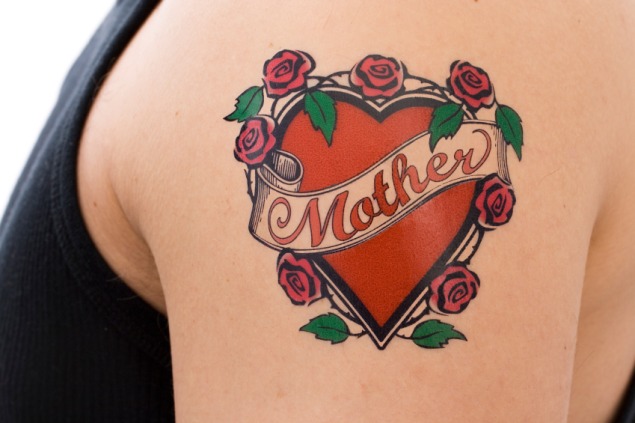
I have also seen a related phenomenon that’s even more strange than the affinity some narcs have with animals. Some psychopaths and malignant narcissists (almost always male) who seem to live to abuse or even torment other people, at the same time seem to genuinely love their own mothers and even feel protective of them. You hear about serial killers who worshipped their mothers (but hate all other women), even though the mothers were almost always abusive to them. The movie “Psycho” illustrates this in Norman Bates’ relationship with his dead mother. Obviously the exceptions these psychopaths make for their mothers are rooted in severe codependency to the point most people see their relationships with them as “sick,” but it’s still an indicator of a more vulnerable, codependent side of themselves they show to no one else.

For both the seriously character disordered who love animals (because they’re safer to love than people) and those who love their mothers (because they have unhealthy codependency with them), it’s as if little piece of their true self somehow remains split off and immune from their otherwise impenetrable wall of narcissism.

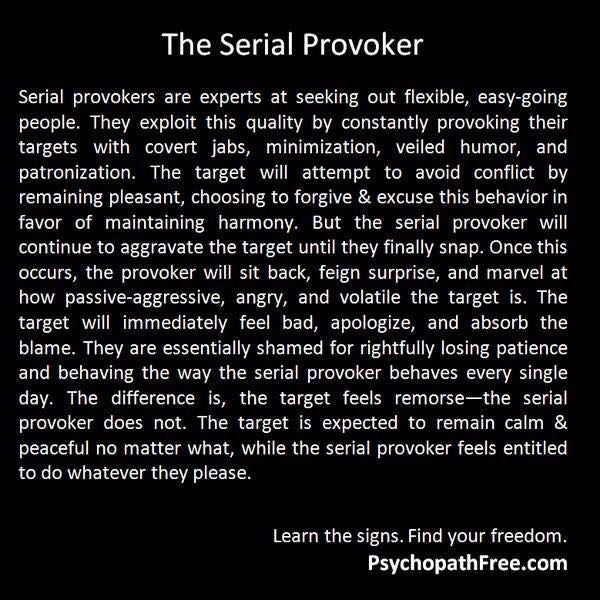
Serial provokers.

This is my ex to a T.

serial_provoker

The 4 types of narcissistic abuse victims.

abuse_boy

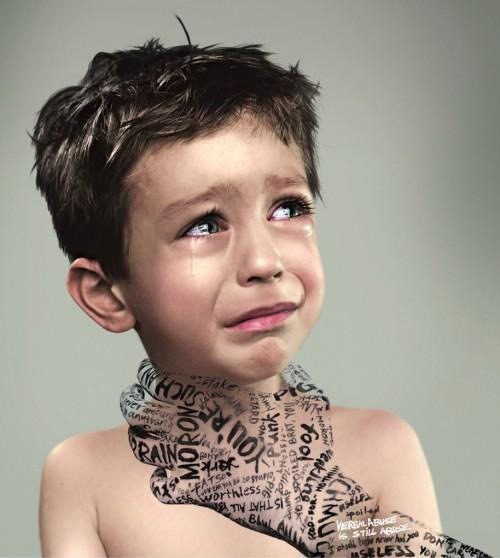
It’s become clear to me that not all ACONs and abuse survivors are on the same page when it comes to their attitudes toward narcissists.
Because we all are abuse survivors you would think there’d be more solidarity among us, but this is not necessarily the case.

It seems there are four distinct types. In spite of things I may have alluded to in the past, I don’t think any one group is worse or better than any other. They are different, and each has their reasons for having the attitudes they do. I’ll explain why I think the attitudes are different among the four groups. There is definitely a pattern I’ve noticed.

1. The Narc-Hating Group.

female_warrior

These ACONs usually underwent the worst abuse as children, or had two narcissistic parents instead of just one. Having abusive parents seems to instill the greatest anger in victims–more so than having been with an abusive spouse–and this anger isn’t easily let go of. This group has a warrior mentality: to them, ALL narcissists are evil, bad seeds, or demonic, and have no hope whatsoever of recovery or healing. They may acknowledge a continuum or spectrum among narcissists, but it’s not important to them. A narc is a narc is a narc, and they are all considered impervious to change and anything they do is suspect. Some ACONs of this type are ultra-religious and believe all narcissists are seared souls destined for hell.

2. All Cluster Bs are the Same Group.

cluster_b

This group goes a step beyond the first one, in that they believe anyone with a Cluster B disorder–Borderline, Histrionic, Narcissistic, or Antisocial–is character disordered and manipulative, and therefore all pretty much the same and to be avoided like the plague. They do not make exceptions even for Borderlines–the least “malignant” of the four disorders. People who subscribe to this view were as damaged by their malignant narcissistic parents as the first group. One of their parents may have been Borderline or Histrionic, rather than narcissistic– but people with those disorders don’t always make very good parents either. It’s unfortunately all too common for narcissists to collude with Borderlines in the abuse of the child, with the Borderline in the more codependent, subservient role.

3. Not all Narcs are Hopeless Group.

smashingmirror

This group may be in the minority among ACONs (at least among bloggers), but it’s the group I’m evidently in–which has raised the ire of some of the Narc-Hating ACONs. People in this group aren’t going around singing the praises of narcissists and in fact the vast majority strongly encourage No Contact (just as the other two groups do). They do not tolerate or enable narcissistic manipulations and abuse, but they hold that because narcissism may be a spectrum disorder, that those at the lower end of the spectrum (non-malignants) may be redeemable under the proper circumstances and with the proper treatment. They may show more sympathy or empathy for people with narcissism than the first two groups, but they aren’t enablers either. Most do not believe malignant narcissists and psychopaths/sociopaths are redeemable, however.

Many people in this group were part of the Narc-Hating group when they were trying to disengage or go No Contact with their abusers. They used their anger to give them the courage and motivation to disconnect and stay disconnected. But because their hatred and anger toward narcissists isn’t as deeply ingrained as in the first two groups (I’ll explain why in the next paragraph), people in this group eventually can no longer hold onto their anger and prefer to try to understand the motives of those who abused them, while at the same time remaining disconnected from their abusers and not enabling narcissistic behavior. Their desire to let go of anger is very difficult for ACONs of the first two groups to understand, and people of the third group may be seen as betraying the ACON cause, even though this isn’t really the case at all. They’re just handling things differently.

Another reason a person may hold that some narcissists are redeemable is they may have a narcissistic child, and it’s an extremely difficult thing for a parent to accept that their own child may be beyond hope.

It’s been my observation that people in this group may have suffered less severe abuse as children, or had only one narcissistic parent instead of two. One of the parents (usually a codependent spouse) may have actually loved their child, and this love tempered the abuse inflicted on them by the narcissistic parent even if they were forced to collude with the abuse at times. Some people in this group may have even had normal childhoods with non-narcissistic parents, but got involved in relationships or marriages to narcissists (which technically means they are not ACONs at all). It’s been my observation that people who suffered most of their abuse at the hands of a narcissistic spouse or lover rather than a parent never developed the deep hatred toward all narcissists that the first two groups tend to do.

4. Codependents.

Fashion model stylized as marionette doll sitting on violet studio background

Codependents are often (but not always) personality disordered in some way, and many of them are Borderlines or covert narcissists. They are usually victimized by their narcissists, but also identify with and collude with their abusers. Most codependents were abused by narcissistic parents, and are drawn to narcissistic relationships where they are compelled to re-enact their abusive childhoods. This is the group that may never acknowledge they are being abused or reach out for help. They continue to defend and enable their abusers and may believe they are the ones at fault for anything that goes wrong. If a Codependent leaves their narcissist and realizes they were actually being abused, then they are no longer Codependent and join one of the first three categories.

Why being a Golden Child isn’t so golden.

golden_cage

I was raised as an only child–the second marriage for both my parents–in a narcissistic family. Only children are in an especially vulnerable position in narcissistic families, because they must serve as all things to one or both parents.

In families with several children, one child (usually the most sensitive) is normally chosen to be the scapegoat–to serve as the family trash can for all the narcissistic rage of the parents. Another child, usually the one most closely resembling the narcissistic parent or the one who best serves the parent’s need for narcissistic supply, may become the Golden Child–in other words, the parent’s favorite. The Scapegoat is always wrong, bad, stupid, crazy, a “problem,” etc. The Golden Child can do no wrong. Misdeeds are overlooked or projected onto the scapegoat. Golden Children may become the narcissistic parent’s flying monkeys and are even sometimes given the “honor” of helping with the abuse against the scapegoat.

I’m reminded of a book I read some years ago called “A Child Called It,” written by Dave Pelzer, who not only recovered from the horrific abuse inflicted on him from ages 4-12 by his psychopathic mother (who had been loving up until that point) and brothers (who served as her “helpers”) once he was removed from the family and placed in a foster home, he actually seemed to become stronger because of it. Today he is an author, motivational speaker, and activist against child abuse. Dave was the scapegoat of his family, and I think his mother turned against him when she realized he was the most sensitive child and probably the most intelligent one too.

But what happens when there is only one child in the family? Well, I think that child becomes both a scapegoat and a Golden Child. If I had grown up with siblings (I have older half-siblings but I wasn’t raised with them), I’m almost certain I would have been the family scapegoat. But my parents (I am including both here, even though I don’t believe my father is a true narcissist, because they worked as a “team”–he was codependent and under my mother’s thrall) needed a Golden Child too who would serve their need to show a child off as a prized possession, a status symbol of sorts: the physical proof of how superior they believed their genes to be compared to everyone else.

Being both scapegoat and Golden Child is even more crazymaking than being just a scapegoat, because you never know where you stand. You constantly feel off balance and anxious, never knowing if something you said or did will be rewarded, ignored, or punished. Life feels chaotic and unformed. You feel like you’re playing a game you never wanted to play, a game where you were never taught the rules, and most of the time you don’t even know WHAT game you’re playing, but you’re expected to play like an expert anyway.

confused_kid

There was no consistency in the way I was disciplined or the things I was disciplined for. I was punished often (for infractions that were usually fairly minor or even nonexistent–I was a “good kid” who was terrified of angering my parents until my teens), but that wasn’t the worst thing. The worst thing was that the next time, I might actually be rewarded for the same infraction!

I was often punished for things I couldn’t help. Acting “spooky” was one of them. As a fearful, sensitive Aspie child, there were times I would retreat inside myself when I was feeling very anxious or when there was too much ‘input’ from the world, and this enraged my MN mother, who would berate or punish me for this behavior. I had no idea what I had done or how to stop being “spooky.” It just happened. I think it enraged her because it was during those times I went “inside” that she could no longer reach me with her abuse.

Even though most of the time I was treated as if my feelings didn’t matter, I was often told how pretty, smart and talented I was. It’s my belief I was no more of any of these things than any other kid my age, but I was told I was “special.” To my young mind, “special” meant “different”–and most children, myself included, dread being different from their peers.

When I was bullied at school, the reason my parents gave me was that the other kids were just jealous because of my “superior” looks, intelligence, or talent. I was also told our genes were better than other people’s, and our family was of a higher socioeconomic status than my friends’ families. I know now this was complete bullshit, but it’s the lie I was being fed while I was growing up. I think these “compliments” were intended to isolate me from my peers even further, so I’d just be “theirs.” I never felt empowered by the “praise” I got, because of the way it made me feel somehow defective and different from other kids. In addition, I felt like I could never live up to the pedestal my parents put me on at those times. I was right–and as an adult, I am looked down on by my family as actually defective.

left_out_kid

The most crazymaking thing of all was the times I’d be complimented and diminished at the same time. One of the most common ways I’d be demeaned was being told how “sensitive” I was. This was never meant to be a compliment; it was meant as a way to let me know how weak I was. Sometimes I was told I couldn’t or shouldn’t do things because of a combination of my “good” and “bad” qualities. For example, when I was about 10, I wanted to join the swim team. I remember exactly what my mother’s reaction was to this. She always liked to tell me what I was thinking, which is another way narcissists make us doubt our own reality and question our instincts. She said:
“You wouldn’t like being on the swim team because you’re too sensitive and you don’t like competition, and you’re too smart to be on a team with those people anyway.”
Huh?
Left-handed compliment much? She always sandwiched her praise this way–between insults like a shit sandwich. This was just another way I was constantly thrown off balance and this led to my becoming an extremely anxious child and later, an extremely anxious adult.

In general, my family treated me like I was a huge burden and didn’t really want me around, so the praise I got as a sometimes Golden Child made no sense and to my sensitive child’s mind, never felt sincere. Even at a very young age, I knew I was being lied to. I knew I wasn’t loved the same way other children were loved, even though my parents constantly mouthed the words like some sort of tic.

All my narcissistic lovers.

johann_heinrich

Not long ago, when I started studying narcissism in depth for this blog, I came to a shocking and disturbing realization: Every single one of the men I had relationships with or fell in love with were narcissists. It’s because I was trained by my family to be Narcissistic Supply, and as a Borderline, these relationships tended to be stormy.

Having BPD means I’m not the ideal codependent doormat, and when I felt violated–even though I’d allow the abuse to continue because after all, I was trained that way–I’d still try to fight back, at least for awhile. This led to lots of drama and some truly terrible fights with narcissistic men who I could never fix, no matter how hard I tried. I sure wish I knew then what I know now.

I have always been attracted to narcissistic men and they have always been attracted to me. I’m easily taken in by their elaborate displays of romance and promises in the beginning–there’s no one more romantic than a narcissist trying to procure you as supply. It’s fun while it lasts, but as soon as they know they have conquered you, the abuse begins. One red flag to watch out for: a man who moves in too fast, or starts talking about a permanent commitment or marriage only weeks after you met them.

Here’s a list of the narcissists I was seriously involved with (or married to). Only one wasn’t a narcissist, but he was severely bi-polar. The names are made up.

narcjoke

Steve P: my first serious boyfriend in high school. Steve called constantly (like 8-10 times a day at first), wanted to be with me all the time, regularly sent flowers, was very passionate and loving at first. He actually would cry because he “loved me so much.” After a while he became physically and mentally abusive, insulting me, questioning me about other boys, what I was doing when he wasn’t around, calling me names, and finally becoming physically abusive. One day, with absolutely no warning, he called me and told me he was dumping me because he met someone else. I was enraged at the nerve of this but actually relieved to be rid of him finally.

Mark S: my second serious lover during my college years. Mark was very cool–knew everything there was to know about art, music, theater, and he had offbeat, interesting friends. He used to take me to the East Village in New York City where we’d attend all the punk and new wave clubs and shop in funky vintage clothing and record stores. We had a lot of fun. But he was also an intellectual snob and looked down on my “pedestrian” tastes in music, movies, etc. He looked down on my friends, whose intellectual abilities he felt were beneath him. Mark saw himself as a rogue and a cultural rebel, and after awhile his constant put downs became annoying and we’d fight. He also never wanted to have sex (he was a cerebral narcissist), thinking it was a huge waste of time that could be better spent feeding his mind with new cultural experiences. After about a year, he told me I was too boring and my tastes too commercial and pedestrian, and he dumped me for a woman who looked exactly like me but was apparently much more hip and “in the know” about what was cool and cutting edge than I was. He wound up marrying her.

new_wave_guy

David B: David was not a narcissist; he was bipolar and suffered from severe depressions and substance abuse. He drank heavily to self-medicate and was always in and out of the psychiatric ward. He regarded me as a sort of mother figure and I liked the idea of being needed so much. But his neediness and clinginess became cloying and suffocating, he was constantly drunk, so eventually I left him, not without a little guilt in doing so. But he was really driving me crazy.

Michael B: The malignant narcissist I married. He is actually a psychopath. Michael acted very much like Steven in the beginning–showering constant attention and gifts on me, moving in very fast, talking about marriage just three months after we met. Being that I was in my mid-20s, I was open to marriage and he seemed perfect. I should have seen one HUGE red flag: the expensive engagement ring he insisted I have was purchased with my own credit card, because he had already maxed all his out. He always lived way above his means. He’d take me to expensive restaurants and insist I pay (and of course, he would pay me back later, but he never did). The rest of our story can be found in the articles under “My Story” in the header. Let’s just say the man is a psychopathic monster with serious substance abuse issues and a parasitic monster at that.

rottencard

Daniel S: The only lover I’ve had since the divorce. Well, okay, we were actually still married. (I’m not proud of this). But my marriage was already long over and I was desperate and miserable and not thinking straight (not that it’s an excuse to cheat). Daniel was actually a worse malignant narcissist than my ex, if that can be believed. He had that intense predatory stare, which I took to mean sexual and romantic interest, but was really his way of sizing up me as his prey. Of course I found him irresistably attractive. Unfortunately Daniel was another cerebral who had very little interest in sex. After a huge show of ardent romance and all that goes with it, he started the abuse, which included insulting me and comparing me (unfavorably) with his past lovers and what he saw as an “ideal woman.” He said he wanted babies with me but constantly criticized my parenting skills (as if he could know, since he never met my kids). He raged a lot although he never actually became physically abusive. He sulked and gave me the silent treatment when I didn’t do things his way or wanted to spend time with my family. He was stingy and although he had a lot more money than I did, he always made me pay my own way on dates. He obsessed about money. He would buy me things and constantly remind me how much those things cost him. He also would give me gifts and then ask for them back later, telling me he was only letting me “borrow” them. I am serious about this. After I ended our relationship (due to guilt at least as much as his abusive treatment), he still continued to call me constantly “as a friend.” After several of these phone calls, I finally worked up the guts to tell him to bug off and blocked his number.

ucallthislove

I have not had one lover or husband who was a just a nice regular guy. There have been a few of these men who seemed interested in me, but I always found them boring and rejected their attentions because I didn’t feel any “chemistry” with them.

I think it’s time to change all this. I want to start dating again soon. I know what red flags to look out for now so I think I can avoid the narcs, but can I fall in love with a normal man who will treat me well?

If you choose to stay with your narcissist…

velveteen_rabbit

Lidija Rangelovska (Sam Vaknin’s wife) recently wrote about staying with her narcissistic husband and how she handles him.

My view, my principle…
People, unconsciously, but more often intentionally, complicate their lives in order to make some sense of their existence and to justify their actions. Me included. We are all, as my FB friend put it: “personal strength junkies”, who try so hard to be accepted and to belong. It comes from our upbringing, our unstable environment, and the fear of being alone. So, when we find a person that loves us or shows us affection, we are “hooked” and we won’t give up on that person. But we also don’t want to compromise, we want to keep our freedom and to have control over the other. And what now? It’s simple: we have to adapt to the changes and find a new meaning in life!
For me personally freedom is the most important. So, I assume that it is the same with all others and I do give people space… where their selves emerge and grow. If there is a person who has common sense and similar views of life to mine, there is a solid and healthy ground on which to develop the relationship.
But we should learn to communicate, share experiences and emotions, be honest and truthful… not be afraid and manipulative. We should learn to trust in order to understand and accept the other. We should build safe grounds for unconditional love to grow on. And isn’t this all that matters in life?

And later…

…my mother tongue is “narcissist”, literally. I was raised by malignant narcissists and HAD to learn how to communicate with them. And I wouldn’t name it as such, because it’s not the “language” of the narcissist, but of the abused. The “language” consists of understanding the abuse that occurred in the narcissist’s early childhood owing to which s/he adopted the False Self later in the adolescence. It is the ONLY self that the narcissist is aware of and if you can’t accept it, you won’t be able to understand her/him.

My advice would be to not even try to go there, as I call it, the “twilight zone”… it’s the “unknown and forbidden” to some people. For me that zone was my natural habitat. I was there… growing up in an emotionally and physically abusive family. I became codependent and was raised to be a good Source of Supply. I honestly don’t wish that on anyone!

So, then, why am I with Sam?
We are both emotionally damaged and we do understand each other’s pain. It’s in a space and at a time where we fulfill each other’s our unique psychodynamic needs. Where conditions don’t exist and there isn’t a room for any – that is where unconditional love exists… at least, where I found it.

[Anonymous] explained this dynamic […] in a very subtle way. “Personal strength junkies” is her term, not mine…

I’m glad there are people who really want to explore their and other people’s nature/character driven by their curiosity to learn more about themselves in order to relate to their significant others. Indeed, a person has to have the courage to do so… they’re the real heroes, not the ones that deny their existence and adopted the “go with the flow” principle… that’s selfish.

Then she posted the beautiful quote above from the children’s book “The Velveteen Rabbit.” It’s amazing how profound certain books for children can be but there’s a wonderful message about unconditional love for adults too.

Several other people who are married to or in relationships with narcissists discussed how they are able to cope with staying with them without losing themselves or developing mental disorders like PTSD. Without exception, the narcissistic spouses (all male) have insight into their disorder and their wives have learned how to “speak narcissist.” There seem to be two primary requirements (besides the patience of a saint): (1) a strong maternal instinct, and (2) an unflappable sense of humor. Under these unusual circumstances, a relationship with a narcissist may actually work for both partners. Some may think of this as an unequal, codependent and even abusive partnership, but if framed as a kind of eternal mother/child relationship, it doesn’t have to be pathological.

elizabeth_bowen

As for myself, I could never work things out with my malignant narcissist ex-husband and I went No Contact early last year (it’s actually Low Contact because we have children, so being completely No Contact isn’t really a possibility.) He had zero insight and denied he was a narcissist at all (instead, he projected his narcissism onto me and made himself out to be the victim and me the abuser). I think when a narcissist has no capacity for insight (which is probably most of them) and is in denial, No Contact (or Low Contact) is the best way to go to avoid psychological damage to ourselves. Even insightful narcissists who are not in denial about their disorder are highly dangerous people and should be handled with extreme caution. They are ticking time bombs.

What [Anonymous] and Lidija have shared provide hope that for SOME narcissists, there may be a way to stay with them and nurture them while not allowing them to obliterate our psyches–and in some cases even benefit from the relationship. It would take someone with a LOT of empathy and even more patience but I believe it can be done in some cases. Having a strong maternal instinct is of utmost importance because essentially, a narcissist is an emotional infant, unable to see others as separate from them. You must accept the fact they are probably never going to get “better.”

As for reproducing with them? Having children with a narcissist you are voluntarily and mindfully nurturing would be disastrous because to the narcissist, a child would be competition and have demands that would need to be met before theirs. This would enrage them in the same way a new brother or sister enrages a three year old. If you are married to or in a relationship with a narcissist and wish to stay with them and nurture them instead of going No Contact, they must be your ONLY “child.” When you choose to be with a narcissist, you are adopting an eternal infant. You would have to accept the fact they will most likely never grow up. Obviously, this choice wouldn’t be for everyone.

Second to a strong desire to “mother” your narcissist would be the ability to laugh at their antics and not take things too seriously. In one woman’s case, she said her narcissistic husband laughs WITH her, even though she admits the joke is usually on her.

I’m happy to hear there are people who can actually make things work with a narcissist. It requires a great deal of unconditional love and the ability to always put your own needs in a distant second place. I don’t recommend it for most people though.

ETA: I would recommend another requirement to making a relationship with a narcissist work: establish FIRM and VERY CLEAR boundaries, early in the relationship. Lidija clearly does this– I remember her saying in “I, Psychopath” when asked who made the rules she said she did. You would have to! Part of the maternal relationship requires the ability to provide discipline when it’s needed too. A narcissist who respects you because you established boundaries and can laugh with them and speak to them in their language won’t have a problem following your rules but may need to be reminded sometimes. 😉

Making love last with a narcissist: the rules

Old Couple

In summary, here are the cardinal rules for keeping your sanity intact while in a relationship or marriage to a narcissist:

1. Be a high empathy person with a strong maternal instinct.

2. Accept the fact they will probably never be cured.

3. Establish FIRM boundaries as early as possible and don’t be afraid to remind them of the rules when they balk or disobey. Remember you are dealing with an emotional toddler.

4. Be willing to always be in their shadow and not steal the show from them

5. Be able to LAUGH and not take what they do and say too personally.   It’s not about you.

6. Do not have children with your narcissist.  He/she is your child. (I used to joke that my MN ex husband was my “other child.” How true that was, and in some ways I wish I had known some of these rules back then, which might have made my life a little easier while still with him.)

The narcissist has to fulfill a requirement too. He or she must be insightful enough to recognize they are narcissists and mentally ill.

I’m ready to kick some narc ass.

rambo

Yesterday I wrote my rant about my psychopathic sperm donor getting an increase in his disability benefits because of his “homicidal tendencies.”

I was amazed by everyone’s support and encouragement to call out this useless POS and fight the travesty of his being rewarded by the system for being a potentially homicidal psychopath. I’m grateful to everyone for this, because it’s given me the courage to actually take this thing and run with it.

The first thing I need to do is contact the newspapers, either by writing a letter about this outrage or better, finding a sympathetic reporter to write up the story. I could also write a letter describing this travesty to politicians who would be sympathetic to my case. It was pointed out to me that conservatives would have a field day with this, which is very funny to me because I’m anything but a conservative. But hey, whatever works.

Since some of you asked, let me give a few details about why the sperm donor gets disability income. He has Type II diabetes, knee problems (he has trouble with his joints and kneecaps), and a host of mental disorders: he has been diagnosed with PTSD, depression, anxiety, and schizophrenia. Depression and anxiety are legitimate diagnoses, but PTSD is highly questionable and I know for a fact he does not have schizophrenia. He is a good actor and faked psychotic symptoms after his second rejection so he would qualify for a guaranteed income and never have to work a day in his life again. He’s actually a highly malignant psychopathic narcissist who is very intelligent but has zero insight. If you were to call him a narcissist, he would deny it or get angry. In fact, he’s very quick to call everyone else a narcissist, including me. If you asked him, he would probably tell you I abused him, and that’s why he has PTSD. In fact, he has said that. He’s a virtuoso at projection and the most skilled gaslighter I’ve ever known, bar none.

Projection

My father called him evil long before it even occurred to me that’s what he was. When he sent me M. Scott Peck’s “People of the Lie” back in 2005, before our divorce went through, he sent it with a note telling me to read it because it was about my ex husband. (I also discovered my mother in that book, and this horrified me but I knew it was true.)

It’s outrageous that this monster is faking psychotic symptoms and being rewarded for it. It’s outrageous that he claims to be a victim of narcissistic abuse with me as the narcissist. It’s beyond outrageous that he will be able to live comfortably, get full health coverage, and never have to work a day in his life and have plenty of disposable income from the back pay he is getting for the seven years he lived on my couch smoking weed and making troll posts on political websites while I worked my butt off to support him. It’s infuriating that while he lives the high life on his handouts, I will continue to be poor, struggling the pay the bills every month on my tiny income, not having any health insurance, and God forbid should I become disabled or ill, because there is no one who would or could take me in should that happen. If I get sick or disabled, I’ll be out on the streets. Getting disability requires that you do not work during the review process, which can take years. You need someone to support you during that time. If it weren’t for my allowing this malignant POS to freeload off me for seven years, that’s what would have happened to him. Oh, I could go on and on, but I’ll spare you.

rich_and_poor

Just writing this has made me angry. Dwelling too much on anger can cause bitterness and misery, but there is healthy anger too–righteous anger caused by realizing you have been had and are the victim of blatant injustice. Sitting around stewing about it can eat away at your soul, but anger can also be the impetus to get out there and make a stand. It’s the same sort of righteous anger that gave me the courage to finally kick out the psychopath when he physically attacked my daughter last year.

fear_roosevelt

Standing up for my rights against a sick system that rewards evil and just plain laziness is a daunting prospect, to say the least, but I think maybe God is testing my courage and ability to make a stand. He knows I’m ready for this because I’ve let go of most of my fear. There’s always a reason for everything.

Fear is the only thing that holds us back from claiming our rights.

I think I’m ready to kick some narc ass.

ETA: I have one request for those of you who have Facebook accounts. Please share this on your timeline. I don’t dare post this on my FB account because it might be seen by him or people who know him, including my kids. But I’d like to get this out there to as many people as possible. Thanks!

Why you should never jump into a new relationship after narcissistic abuse

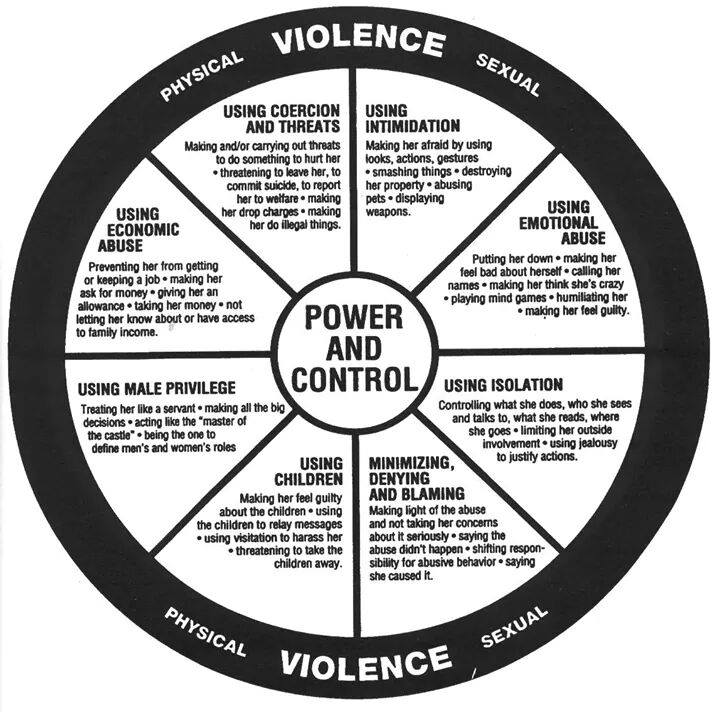
The Wheel of Abuse

cycle_of_violence
Not all abusive relationships involve physical abuse. Emotional and mental abuse can be every bit as damaging, and sometimes more so. (Click image to make larger).

A new friend of mine (a survivor of several abusive relationships with narcs) and I were talking on Facebook. Rather than try to paraphrase, I’ll quote her directly–and then give my own opinions.

Friend:

“I realized he [her malignant narcissist ex-boyfriend who she’s still in minimal contact with but who is still trying to gaslight her and get her attention by stalking her on Facebook] did everything on that wheel except for the Economic abuse. He started to subtle test the boundaries…and realized I wasn’t game. Although I believe he probably still believes I’ll contact him again. It’s amazing, [Lauren.]

The more time your away, they stronger you feel. Your self-esteem comes back slowly. I get those frightened moments when I think my new boyfriend will just Abandoned me out of nowhere. I understand why the Psychopathic free support group did not recommend a relationship right away. They know you suffer from PTSD from the aftermath of this abuse. It’s difficult. I find myself having dark flashbacks. I also believe you have to be careful and choosy about your women friends and surround yourself with only kind people. We are fragile and vulnerable after this abuse.

My reply (My original reply was short–I embellished it when I wrote this post. I hope my friend sees it).

These are all great points. It makes sense to stay out of relationships if you’ve just escaped from an abusive one because of the PTSD you probably have or even worse problems such as major depression–you need time to find yourself and work on yourself. You need time to be selfish and not have to answer to anyone because you’ve been giving, giving and giving some more with nothing to show for it in return.

We’re mentally and emotionally exhausted and need time to recover, just as if we’re recovering from any illness. We need to not have to be responsible for someone else’s welfare or self esteem or happiness for a while before taking the plunge into a new relationship. We need to take care of ourselves and find out who we are–whether that means going to therapy, writing a journal, turning that journal into a public spectacle like a blog or video diary, taking up martial arts, yoga, or finding God. We need time to heal.

Jumping into any new relationship–even with a non-narc–when you’re this vulnerable is almost guaranteed to fail and retard you in your self growth, and if you’ve been attracted to another narcissistic abuser (which is common in codependent, PTSD and Borderline women), you may wind up much worse when all is said and done.

We’re like addicts. Narcs need their narcissistic supply; we codependents need our narcs. Let’s face it: Narcissistic suitors (male or female)–at first–make us feel alive, vital and fulfill our wildest romantic and sexual fantasies (when they are trying to trap you as their prey). In a weakened state like PTSD or depression, your judgment is not going to be great and you re going to be VERY suggestible. Most likely, you’ll also become unconsciously attracted to a romantic partner who reminds you of the narc you just left (or who left you). He made sure you can’t forget him easily, even if he was terribly cruel at the end.

anime
Anime drawing (artist unknown).

Also, we tend to be attracted to the same type of person anyway. So if you’re usually or always attracted to narcissists, then most likely your taste is not going to change.

Getting involved too early after the end of a relationship with a narcissist is dangerous. Even with a non-narcissist, old patterns will still come up and you will be hypervigilant and suspicious of your new partner, causing them confusion and eventual discord. If you’re falling for a non-narc, that’s a good sign, but if you just left an abusive relationship, please wait. Envision a giant red STOP sign. Be friends instead. Now’s not the time to get involved beyond that level. If you met someone who truly cares for you, they won’t mind waiting a while and being friends with you.

If you’re already falling hard for someone, I know it’s going to be really hard to resist the pull of a new romance. It’s a powerful force, built into normally-wired people’s genes.

But remember, even though it feels like the most exciting, heady, intoxicating rush you ever felt, that feeling won’t last: what you feel is infatuation, a crush–actually caused by changes in the brain that act like a euphoric drug. That’s really what it boils down to.

infatuation-vs-love1

Infatuation so soon after an abusive relationship is really just a form of transference onto a phantom “therapist” [the person you are infatuated with] when you are at your most vulnerable. You’re looking for someone to rescue you. There is no Prince Charming. A love relationship cannot rescue you from yourself, your memories, or your PTSD. By its nature, it can’t. You are the only one who can make you well, with the help of therapists, counselors or another other trusted person who is not involved sexually or romantically with you.

So be patient, wait until you heal yourself and feel more confident. Then if you fall in love, dive in and enjoy it–and with any luck it might turn into the real thing.

Thank you to Mary Pranzatelli for this idea.

Insanity, interrupted.

insanity
Click to enlarge. Thanks to Lidija Rankelovska for this

Albert Einstein, brilliant physicist, philosopher, and fellow Aspie, had so many great quotes. One of his best is this:

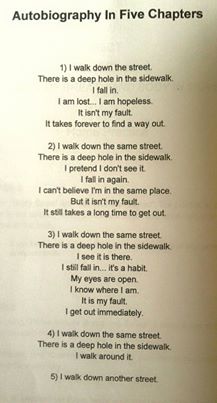
The definition of insanity is doing something over and over again and expecting a different result.

If you keep allowing your narcissist to continue to play their crazymaking mind games, f*ck with your head, gaslight you, triangulate against you, physically abuse you, steal from you, judge you, isolate you, lie to and about you, project their own character defects onto you; tell you how you should dress, behave and look; refuse to listen to you, insult you, condescend to you, hoover you, love bomb you, use you as a neverending source of narcissistic supply, and ultimately try to destroy you–and you keep listening to their lies and phony promises that they will change, and you keep giving them a second and third and fourth and one hundredth chance, then that is insanity.

Stop the insanity. Leave your narcissist or do what you can to get them to leave. Don’t listen to their lies and don’t believe their fake “apologies.”

Don’t be drawn into their death-spiral of evil and soul-destruction. Their intent is to annihilate themselves and take you with them.

Are You An Empath/HSP Who Was Almost Destroyed By a Narcissist? Watch This Video

I found this fascinating video on Kim Saeed’s blog. Even though Jenna Forrest doesn’t use the term “narcissist” (she uses the term “adversary” instead), we who have been victims of malignant narcissists know exactly what sort of dark forces she’s talking about. Very interesting analysis of the dynamics of codependent relationships and why HSPs/empaths and Narcissists are drawn to each other. The video is kind of long and uses a lot of new age terminology but is still worth watching. Listen and learn.

Kim Saeed's avatarLet Me Reach with Kim Saeed

http://youtu.be/kvTFPP9yDz4

I recently subscribed to Jenna Forrest’s YouTube channel and as an Empath myself, I would highly recommend watching this video.  Although Jenna doesn’t mention the term “Narcissist”, she talks about how the Adversary (any dark force) tries to destroy us by:

  • exhausting us by manipulating us to use our emotions against ourselves
  • making us afraid, thus having control over us
  • making us sick (which often leads to cancer or suicide)

The video is almost 13 minutes long, so you’ll need to account for that.  I hope it enlightens you as much as it did me.  She answers questions that come up on my Stats page often, such as, “Can the Narcissist change”.  This video will help you understand why they can’t, as well as help you understand why you need to detach from the relationship if you haven’t already…

View original post