
Psychopathy may not be what you think.

gearhead

I’ve been doing some reading about psychopathy and have found out some surprising things. I always was a little confused as to how psychopathy differed from sociopathy and have used those terms interchangeably on this blog due to my confusion. I’ve also used the term interchangeably with Antisocial Personality Disorder (ASPD) and sometimes even malignant narcisissm. It turns out it’s probably something completely different from the other three disorders and may not even be a disorder at all!

Before you start laughing, hear me out.

It all started with this colorful, humorous description someone wrote on a forum I’ve been active on, describing how a Psychopath differs from a Narcissist:

When I picture a Psychopath, I think of someone who at bedtime bounces around from one thing to the next, essentially a high-energy, happy person. When I picture a Narc at bedtime, I imagine someone wearing long pajamas and a nightcap (yes, a nightcap), walking around a 19th Century house, holding a candle, checking for ghosts.

At first I thought this was a weird (but funny) analogy. But it really isn’t. According to psychologist Theodore Millon, Primary Psychopathy is something you are born with and is not due to abuse, unlike NPD or ASPD. Studies have shown that the limbic system (emotional center) of primary psychopaths is simply less active than in normal people. So they don’t experience empathy or have a conscience regardless of how they were raised, but they also don’t have very deep emotions in general.
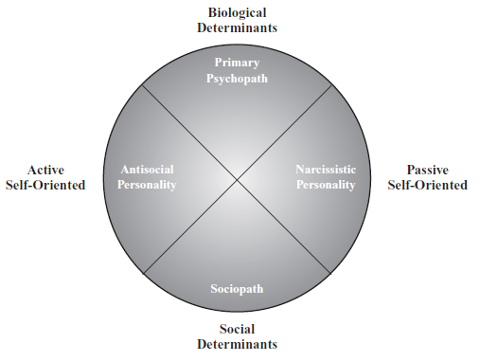
Millon

Because they lack deep emotions, primary psychopaths tend to be fearless risk takers. They also aren’t moody because they don’t experience anxiety or depression the way others do–if they experience those states at all. But psychopathy has become associated with sociopathy and/or ASPD or malignant narcissism because a born psychopath may be more prone to developing personality disorders than the normal population, if they are abused. Because they don’t have the capacity to develop a conscience or empathy, if they do develop a personality disorder, it’s likely to be Antisocial Personality Disorder, where the right of others are callously violated. That’s why so many psychopaths are also antisocial and dangerous.

But there is nothing wrong with the cognitive functioning of a psychopath. They are able to learn the difference between right and wrong, and if they do not develop a personality disorder, theoretically they can choose to do what’s right. Only the limbic system is impaired, so any decisions a true psychopath makes are cognitively based. Emotion simply doesn’t play into it at all. They do “whatever works.” They lack a conscience because conscience is emotion- or shame-based, and a psychopath isn’t capable of much emotion in general.

So a primary psychopath can theoretically be a good person who is just extremely unemotional and only uses logic and reason to make decisions. Unlike narcissists, who actually have deep emotions but have turned all their emotions inward toward themselves and require “supply” to bolster their fragile egos, a non-disordered psychopath has no need for supply. They simply don’t care what anyone thinks. What you think is simply not something that even occurs to them. In contrast, a narcissist cares very much what you think and falls apart like wet toilet paper if supply in the form of approval or adoration is not forthcoming.

Primary psychopathy seems analogous to the Myers-Briggs ESTJ (Extroverted/Sensing/Thinking/Judging) personality type. In other words, a psychopath is an outgoing, sensation seeking, hedonistic thinker who happily jumps around from activity to activity like someone jacked up on Red Bull, yet they don’t have ADHD either because the J(udging) aspect means their high level of activity always has a goal or purpose. Such a person would be easily bored (which could also lead to antisocial behavior), never worry about things or experience (or even understand) guilt, and unafraid to try and experience new things. Their lack of emotionality would suit them well for the business world. In fact, people who have become very successful in business tend to score high in psychopathic traits.
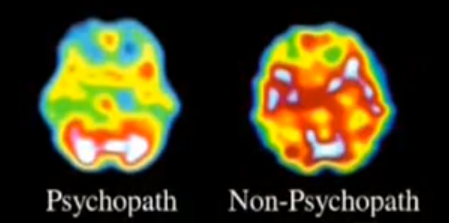
two-brains

While many high level executives do abuse the rights of others and callously close entire departments and treat their employees like so many pieces in a chess game (whatever works, right?), because psychopaths can tell the difference between right and wrong, some will try to do the right thing just the same. The difference is, they are using cognition rather than emotion to back any prosocial decisions.

Looked at this way, primary psychopathy may not be a disorder at all but a personality variation. Of course, the term “psychopathy” has negative connotations because most of us associate it with antisocial criminals, shady con artists, and serial killers. And in fact many of them are, but not all.

Sociopathy differs from primary psychopathy because (according to Millon, above), it’s antisocial behavior that may develop in a person with ASPD or NPD and is always due to abuse somewhere in the person’s past. A primary psychopath can become a sociopath if they become disordered, and that’s where you would find the serial killers and criminals (and these people usually have ASPD). But a sociopath isn’t always (or even usually) a psychopath. Sociopaths who aren’t psychopathic are usually very malignant narcissists (high spectrum NPD + ASPD) or sometimes even Borderlines, and they differ from psychopaths because there is no logic or rational thinking behind their antisocial or destructive behaviors, only unhealthy, toxic emotion. They seem to have no empathy because all their empathy–and most of their other emotions except anger–are turned inward toward themselves. The false self is what they present to others instead of their real emotions. Narcissists have plenty of empathy but it’s all for themselves–that’s why they are prone to wallowing in self pity. A psychopath would never wallow in self pity. They simply don’t care what you think.

What’s my problem?

confused

After over a month of being convinced I’m a covert narcissist, now I’m starting to wonder if my assessment of myself could be incorrect. Most people are having trouble believing me (even good friends) and there are so many disorders that appear similar to it. I no longer think my symptoms are due to Aspergers the way I used to, but BPD + Avoidant PD in the same person can look exactly like covert NPD. So can complex PTSD in some cases.

I’ve been told again and again that real narcissists are unlikely to ever admit they are narcissists, and if they do, they won’t be beating themselves up that much over it. I don’t know if that’s always true (I’ve met a few low spectrum covert narcissists on Psychforums who actually have a diagnosis and feel terrible about things they’ve done and want to change, but maybe the diagnosis they got is wrong and they just have more than the normal amount of N traits). Victims of narcissistic abuse are often quick to diagnose narcissism in themselves and others. We’re hypervigilant and tend to see narcissism everywhere, and we don’t even exempt ourselves. The real narcissists are probably more likely to keep insisting that they are not. Abuse victims think too damn much. It’s all very confusing.

narcissism_selfies

I guess there was a reason why I never added “Covert NPD” to “My Disorders” in the header. Without an official diagnosis for that, I really can’t say that’s what my problem is. It could be, but if so I think it’s at a low level. I know I have a number of narcissistic traits, but most abuse victims do. That doesn’t necessarily mean I have NPD, covert or otherwise. I could just have a really bad case of “fleas,” or just BPD + AvPD, or even complex PTSD.

I’m still glad I started Down The Rabbit Hole because it’s also intended for people with BPD, which I have an actual diagnosis for. I still think my “trip down the rabbit hole” early in August was real but that doesn’t necessarily mean I have NPD. It was still a trip to the walled off parts of my mind, and most abuse victims are at least partly walled off from themselves. We may be partially narcissistic but not enough to qualify for the label.

I care about people with low spectrum NPD and BPD who want to heal or improve, so that’s another reason I’m going to keep DTRH going. It’s getting a good reception. Another one of my missions is to help reduce the negative stigma against people with BPD. I don’t ever expect DTRH to gain the amount of activity this blog has received, but if only one or two people can be helped by my posts, and I can help myself by continuing to do exactly what I’ve been doing, then it’s worth it to keep it going, isn’t it?

Really, at the end of the day, all these labels are just labels and don’t really mean anything at all.

Marriage counseling is another weapon a narcissist can use against you.

marriage_counseling1

If you’re still with your narcissist, you may be tempted to insist they attend marriage or family counseling with you. It’s a common error to believe and hope the counselor or family therapist can help the narcissist understand your point of view and, seeing the light, stop their abuse of you or the children.

This is a mistake. Don’t do it. Don’t drag a narcissist to a marriage counselor or family therapist. I have my own horror story about this, and I’ve heard many similar stories to mine.

My ex, “Michael” (not his real name) and I had not been getting along for some time. I won’t go into the details in this article, because I’ve documented his abuse elsewhere in this blog. Whenever a malignant narcissist (in his case, full-blown ASPD!) pairs up with a Borderline or a low spectrum covert narcissist (I believe I am both), the Borderline or covert N is almost always going to be in the supplicating, codependent, people-pleasing victim role. They will be gaslighted, projected onto, triangulated against, given the silent treatment, insulted, used, taken advantage of, stolen from, lied to, and possibly physically abused as well. A Borderline will rage and lose their composure under such treatment, while a covert N will try to “fight back” using more underhanded means such as passive aggression or the silent treatment. If you’re not disordered, staying around someone who’s doing those things to you long enough, you can actually become a narcissist yourself, or at least pick up a lot of narcissistic traits as well as severe PTSD.

Enraged by Michael’s constant insults, disrespect, and gaslighting using the children as flying monkeys, I’d react by giving him the silent treatment or make sarcastic remarks. Neither of these weak weapons made a dent in the impenetrable armor of this professional malignant narcissist, and the abuse just escalated. As a BPD, another thing I’d do was rage. I’d hold in my anger for days, and finally explode into a mighty dish-smashing, profanity spewing temper tantrum. Of course it was then that Michael told everyone–including our young children–that I was an insane c__t and bitch who should be locked up and the key thrown away.

Sure, we were both disordered, but in that relationship I was definitely the victim. I remember a couple of friends even told me on meeting him that they got “bad vibes” and thought there was something “evil” about him and to be very careful.

At one point I suggested we see a marriage counselor. At first Michael resisted, but he finally relented when a friend of his told him he should go just to get me to STFU. So he agreed to go, on the condition that HE got to pick the therapist we’d be seeing. The therapist he chose was a woman and she did seem very nice. I actually felt comfortable with her, which surprised me.

One of the issues we’d been having was the volume at which Michael played his music. He listened to music I did not enjoy–mostly death metal, thrash, and riot girl punk/metal (this was in the late 1990s). Now I’m an eclectic and open minded music lover, but those particular genres acted like assault weapons on my ears. He also liked to blast this noise late at night when the kids and I were trying to sleep. But whenever I asked him to turn the music down, he’d tell me to shut up and deliberately increase the volume.

So this was one of the topics that came up in marriage counseling. I was the one who brought it up. Michael always seemed calm and reasonable on the surface (he had a lot of charm back in those days which he never showed me when we were alone together) while I always seemed stressed, on edge, a raw nerve about to snap like a violin string (this was in fact the case–his manipulations and cruelty to both me and the kids were systematically driving me insane). After I told the therapist about how loud he played his music whenever we were trying to sleep and refused to turn it down when asked, Michael turned on the charm, smiling and in a very reasonable and calm tone of voice explaining to her that I was a “control freak” and hated music in general. He told her I never let him play anything, even during the day, which was a lie.

The therapist turned to me and told me I needed to stop trying to control my husband and allow him to pursue his interests. I looked over at Michael, wearing his most smug, self-satisfied grin. I wanted to walk over and smack him hard upside the head. I started to shake with rage. I couldn’t hide my frustration and anger the way he could. It took everything I had not to throw something at him or throttle him. I looked down at my clenched fists and my knuckles were so white their bones seemed to have popped through my skin.

marriage_counseling

Back in those days, my BPD symptoms were in full force, and so to the therapist, I probably did seem a little crazy. Michael, in contrast, had the composure of an attorney (I always used to tell him he should have been a lawyer because he always won every argument).

Other things came up too. But it always came back to the same thing–that I was trying to control HIM and he was just a reasonable man confused by my emotional instability and craziness. Michael had that therapist wrapped around his little finger. Once I tried to explain to her the way he acted in our sessions was not the way he acted at home, that he wasn’t showing her his cruel, callous and disrespectful nature. Of course he called me a liar, telling the therapist I had “mental issues.” Once again I got scolded by the therapist for trying to control him and making up stories to make him seem worse than he was. She asked me if I had delusions often.

Finally, sick of the two of them ganging up on me and blaming me for everything wrong in our marriage, I walked out in the middle of a session, which only convinced that therapist I wasn’t “serious about counseling” and should seek psychotherapy for myself (this is what Michael told me later).

I’ve heard this sort of thing happening to so many victims of narcissistic abuse. They go to marriage or family counseling, thinking it might help, and instead, the therapist gets turned into a flying monkey siding with the abuser and joining in the gaslighting and projection against the abused.

Malignant narcissists and psychopaths like Michael are good at convincing people they are perfectly sane and they will lie very convincingly. The real victim, probably suffering from PTSD and high stress levels, is more likely to “lose it” or act out, making it seem as if they are the one causing the problems with the relationship.

Based on this experience and those I’ve heard from others, I don’t recommend marriage counseling if your spouse or partner is a narcissist. But if you do decide to try it, make sure YOU choose the therapist, and pick one who has a background in Cluster B personality disorders and has a working knowledge of the way narcissists operate.

Even better, if it’s at all possible, lose the narc who’s making your life such a hell.

For more on this subject, please read my article, Narcs Who Use Therapy to Gaslight Their Victims.

For another blatant example of the type of gaslighting my ex liked to use against me (and get his way at the same time), see my article How My ASPD Control Freak Ex Used a Dog to Gaslight Me

Why does a narcissist need a false self?

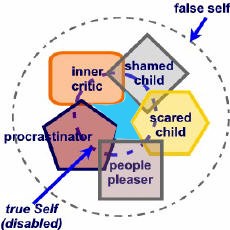
trueself_falseself

On one of Sam Vaknin’s discussion pages, someone asked a very good question:
Why does the narcissist conjure up another Self? Why not simply transform his True Self into a False one?

I’ve wondered about this too. Here’s Sam’s explanation, which is a link to one of his articles from his website. While his long answer is predictably bleak and hopeless, and I don’t agree with him about everything, taken as a whole, this article did answer a lot of questions I had been wondering about and as always it made me think.

The Dual Role of the Narcissist’s False Self
By Sam Vaknin

We often marvel at the discrepancy between the private and public lives of our idols: celebrities, statesmen, stars, writers, and other accomplished figures. It is as though they have two personalities, two selves: the “true” one which they reserve for their nearest and dearest and the “fake” or “false” or “concocted” one which they flaunt in public.

In contrast, the narcissist has no private life, no true self, no domain reserved exclusively for his nearest and dearest. His life is a spectacle, with free access to all, constantly on display, garnering narcissistic supply from his audience. In the theatre that is the narcissist’s life, the actor is irrelevant. Only the show goes on. The False Self is everything the narcissist would like to be but, alas, cannot: omnipotent, omniscient, invulnerable, impregnable, brilliant, perfect, in short: godlike. Its most important role is to elicit narcissistic supply from others: admiration, adulation, awe, obedience, and, in general: unceasing attention.

The narcissist constructs a narrative of his life that is partly confabulated and whose purpose is to buttress, demonstrate, and prove the veracity of the fantastically grandiose and often impossible claims made by the False Self. This narrative allocates roles to significant others in the narcissist’s personal history. Inevitably, such a narrative is hard to credibly sustain for long: reality intrudes and a yawning abyss opens between the narcissist’s self-imputed divinity and his drab, pedestrian existence and attributes. I call it the Grandiosity Gap. Additionally, meaningful figures around the narcissist often refuse to play the parts allotted to them, rebel, and abandon the narcissist.

The narcissist copes with this painful and ineluctable realization of the divorce between his self-perception and this less than stellar state of affairs by first denying reality, delusionally ignoring and filtering out all inconvenient truths. Then, if this coping strategy fails, the narcissist invents a new narrative, which accommodates and incorporates the very intrusive data that served to undermine the previous, now discarded narrative. He even goes to the extent of denying that he ever had another narrative, except the current, modified one.

The narcissist’s (and the codependent’s) introjects and inner voices (assimilated representations of parents, role models, and significant peers) are mostly negative and sadistic. Rather than provide succour, motivation, and direction, they enhance his underlying ego-dystony (discontent with who he is) and the lability of his sense of self-worth.

buddhanature
“Buddha nature” True Self vs. “Ego” False Self. Click to enlarge graphic.

Introjects possess a crucial role in the formation of an exegetic (interpretative) framework which allows one to decipher the world, construct a model of reality, of one’s place in it, and, consequently of who one is (self-identity). Overwhelmingly negative introjects – or introjects which are manifestly fake, fallacious, and manipulative – hamper the narcissist’s and codependent’s ability to construct a true and efficacious exegetic (interpretative) framework.

Gradually, the disharmony between one’s perception of the universe and of oneself and reality becomes unbearable and engenders pathological, maladaptive, and dysfunctional attempts to either deny the hurtful discrepancy away (delusions and fantasies); grandiosely compensate for it by eliciting positive external voices to counter the negative, inner ones (narcissism via the False Self and its narcissistic supply); attack it (antisocial/psychopathy); withdraw from the world altogether (schizoid solution); or disappear by merging and fusing with another person (codependence.)

Once formed and functioning, the False Self stifles the growth of the True Self and paralyses it. Henceforth, the ossified True Self is virtually non-existent and plays no role (active or passive) in the conscious life of the narcissist. It is difficult to “resuscitate” it, even with psychotherapy. The False Self sometimes parades the child-like, vulnerable, needy, and innocent True Self in order to capture, manipulate, and attract empathic sources of narcissistic supply. When supply is low, the False Self is emaciated and dilapidated. It is unable to contain and repress the True Self which then emerges as a petulant, self-destructive, spoiled, and codependent entity. But the True Self’s moments in the sun are very brief and, usually, inconsequential.

This substitution is not only a question of alienation, as Horney observed. She said that because the Idealised (=False) Self sets impossible goals to the narcissist, the results are frustration and self hate which grow with every setback or failure. But the constant sadistic judgement, the self-berating, the suicidal ideation emanate from the narcissist’s idealised, sadistic, Superego regardless of the existence or functioning of a False Self.

There is no conflict between the True Self and the False Self.

First, the True Self is much too weak to do battle with the overbearing False. Second, the False Self is adaptive (though maladaptive). It helps the True Self to cope with the world. Without the False Self, the True Self would be subjected to so much hurt that it will disintegrate. This happens to narcissists who go through a life crisis: their False Ego becomes dysfunctional and they experience a harrowing feeling of annulment.

falseself_graphic
Anatomy of the mind of a narcissist.

The False Self has many functions. The two most important are:

1. It serves as a decoy, it “attracts the fire”. It is a proxy for the True Self. It is tough as nails and can absorb any amount of pain, hurt and negative emotions. By inventing it, the child develops immunity to the indifference, manipulation, sadism, smothering, or exploitation – in short: to the abuse – inflicted on him by his parents (or by other Primary Objects in his life). It is a cloak, protecting him, rendering him invisible and omnipotent at the same time.

2. The False Self is misrepresented by the narcissist as his True Self. The narcissist is saying, in effect: “I am not who you think I am. I am someone else. I am this (False) Self. Therefore, I deserve a better, painless, more considerate treatment.” The False Self, thus, is a contraption intended to alter other people’s behaviour and attitude towards the narcissist.
These roles are crucial to survival and to the proper psychological functioning of the narcissist. The False Self is by far more important to the narcissist than his dilapidated, dysfunctional, True Self.

The two Selves are not part of a continuum, as the neo-Freudians postulated. Healthy people do not have a False Self which differs from its pathological equivalent in that it is more realistic and closer to the True Self.

It is true that even healthy people have a mask [Guffman], or a persona [Jung] which they consciously present to the world. But these are a far cry from the False Self, which is mostly subconscious, depends on outside feedback, and is compulsive.

The False Self is an adaptive reaction to pathological circumstances. But its dynamics make it predominate, devour the psyche and prey upon the True Self. Thus, it prevents the efficient, flexible functioning of the personality as a whole.

That the narcissist possesses a prominent False Self as well as a suppressed and dilapidated True Self is common knowledge. Yet, how intertwined and inseparable are these two? Do they interact? How do they influence each other? And what behaviours can be attributed squarely to one or the other of these protagonists? Moreover, does the False Self assume traits and attributes of the True Self in order to deceive the world?

Read the rest of Sam’s article here.

12 weird things you might see a narcissist do.

It’s been several months since I posted this and since I haven’t written anything new about narcissism in a few days (I’m a little burned out on narcissism right now, to be perfectly honest–but I’m sure that’s temporary), I thought I’d repost this one since it seems to be getting some traction and it’s also one of my favorite posts.
These are all red flags not commonly mentioned and you may not know about, but they can help you identify a potential narcissist.

Be sure to also click on the link at the bottom of the article (5 More Weird Things You Might See a Narcissist Do).

luckyotter's avatarLucky Otters Haven

the_color_9

There are some strange things I’ve noticed narcissists do that aren’t usually mentioned as symptoms of their disorder, but seem to be common enough perhaps they should be included as additional criteria for NPD.

If you know someone who does only one or two of these things, it doesn’t necessarily mean they’re a narc, but if they do several of them regularly and also seem to fit the more well-known criteria for NPD, these things could be red flags to watch out for.

1. They don’t blink when they look at you.

googly_eyes

Some narcs have a penetrating, predatory gaze. If a person of the opposite sex looks at you this way, you may take it as sexual interest (and it could be), but watch carefully: if they do not blink this could mean they are sizing you up as prey. Whether they blink or not, if their stare makes you…

View original post 709 more words

What a narcissistic parent sounds like.

I’m sure a lot of victims of narcissist parents will be able to relate to this graphic example of how a mother with obviously high spectrum NPD abuses, mocks, and scapegoats her daughter. Warning: these videos may be triggering.

In watching this, you can graphically see how a malignant narcissist operates, by exhausting the victim to the point that eventually the victim “loses it” (which the daughter here did not do) and then the narcissist can sit back and tell everyone how “crazy” or “irrational” the victim is. It’s an insidious kind of gaslighting.

luckyotter's avatarLucky Otters Haven

Here are two Youtube videos that graphically show exactly how a mother with a bad case of NPD (malignant narcissism) operates. These videos are entertaining in a scary and disturbing way, like watching a train wreck.

Pay close attention to what the mother says–she uses every trick in the narcissist’s book of tricks: blame, insults, changing the subject, interrupting, raging, mocking, “talking over”, gaslighting, projecting, invading boundaries, not taking responsibility, showing no empathy, and just about every other “tool” the narcissist uses to get their own way or avoid taking responsibility for their behavior and actions. Notice how childish the overall effect is–the mother sounds like a four year old having a temper tantrum.

The daughter who made the videos is trying hard to get her mother to listen, but her words seem to fall on deaf ears. She might as well be talking to a wall, for all the…

View original post 3 more words

I think age of NPD onset correlates with malignancy and curability.

kids_different_ages

Because of a recent conversation I was having on Psychforums about age of onset and prognosis for a cure for different levels of narcissism, I’ve been doing a lot of thinking about this.

I do think how old a narcissist was when Ground Zero occurred–that would be the primary traumatic event that forced the child to create a False Self–determines the difficulty/ease of healing, and also how low or high the narcissist falls on the spectrum.

Here’s what I came up with.

Age of onset of Trauma/stage of child development (Piaget, Freud):

0-2 (Piaget’s Sensorimotor stage; establishing boundaries, physical and comfort needs met; Freudian Oral/Anal stage):

toddler_bear

High spectrum, malignant narcissism and/or psychopathy/sociopathy (if as an infant)– not curable except under extreme circumstances in very rare cases. May be self aware but has no incentive to change.

3-6 (Piaget’s Concrete Operations; Freudian Anal–Oedipal/Electra stage )

childabuse

Mid-high spectrum narcissist who may or may not be malignant. May become self aware but will be resistant to a cure. In unusual circumstances (total loss of supply or primary supply), a narcissist this high on the spectrum might seek therapy. They are unlikely to be willing to do all the work required for healing due to its difficulty for someone this high, but there might be a few exceptions.

7-11 (Piaget’s Formal Operational stage; abstract learning, competence; Freudian “latency” period)

sad_girl2

Mid-spectrum narcissist. Could become self aware and if so, there’s a good chance of them seeking therapy or treatment. They’re more likely to be cured, but it’s not a guarantee.
Therapy would be difficult at the higher end (onset before 8-9), moderately easy at lower end (onset between 9-11).

12-21 (adolescence)

sadness

sadness

Low-mid spectrum narcissist. Likely to become self aware and good chance of being cured.
Low spectrum at the higher ages (onset after 15/16), mid spectrum at the lower ages (younger than 15).
Good prognosis for a cure and self awareness. If very low, may be able to heal him or herself without outside help

21 +

How's my hair?

How’s my hair?

A person cannot become a true narcissist after age 21 or so. They may instead have a lot of narcissistic traits, have DNP (Destructive Narcissistic Pattern disorder–just below NPD on the spectrum), or in rare cases they could develop “acquired narcissism” (this is something a lot of celebrities and famous people get) which is temporary and lasts only as long as the adulation or fame lasts.

ETA: I got a rebuttal to this on Psychforums. I think this poster’s argument may be valid too, so I’m going to post it:

I believe the PD occurs in the first 5-6 years due to abuse/trauma, the critical level of which differs for each person depending on genetics (temperament, sensitivity).

I think NPD-like traits resulting from abuse/trauma after age 6 would be cPTSD to a normally developed personality.

I suspect traits from coddling/overvaluation after age 6 would be easier to “return to earth” from than something like sexual abuse and humiliation (say, having to testify in court) after age 6. I think the former might be unwind’able to a level of stable narcissism. I think the latter could be a more permanent scar/condition.

left-out_child

But, I don’t know much about. That’s just the way I think of it. It doesn’t seem feasible that PD could occur after the P(personality) is developed. I thought the whole point of a PD was that the P stopped developing, became a defective structure. Not merely unresolved trauma (like PTSD is?) but structural and permanent.

Basically his argument is that after age 6, true narcissism won’t develop but complex PTSD (C-PTSD) could. This could mean a child acquires a lot of narcissistic traits (what ACONs call “fleas”) that could resemble NPD in many ways but is more treatable/curable. I think this would be the same thing as the spectrum condition called the Destructive Narcissistic Pattern (DNP)
This would also take into account type of abuse inflicted and level of severity.

“The Narcissist in Chief” (New York Times article)

Republican presidential candidate Donald Trump gestures and declares “You’re fired!” at a rally in Manchester, New Hampshire, June 17, 2015. REUTERS/Dominick Reuter TPX IMAGES OF THE DAY – RTX1GZCO

The Narcissist in Chief
By Scott O. Lilienfield and Ashley L. Watts, for The Opinion Pages, The New York Times, September 4, 2015

WITH the presidential campaign in full swing, a perennial question has resurfaced: How much weight should voters give to candidates’ personalities? The political rise of Donald J. Trump has drawn attention to one personality trait in particular: narcissism. Although narcissism does not lend itself to a precise definition, most psychologists agree that it comprises self-centeredness, boastfulness, feelings of entitlement and a need for admiration.

We have never met Mr. Trump, let alone examined him, so it would be inappropriate of us to offer a formal assessment of his level of narcissism. And in all fairness, today’s constant media attention makes a sizable ego a virtual job requirement for public office. Still, the Trump phenomenon raises the question of what kinds of leaders narcissists make. Fortunately, a recent body of research has suggested some answers.

In a 2013 article in Psychological Science, we and our colleagues approached this question by studying the 42 United States presidents up to and including George W. Bush. (The primary data were collected before Barack Obama’s presidency.) First we took a data set compiled by the psychologists Steven Rubenzer and Thomas Faschingbauer, who for an earlier study asked experts on each president to complete personality surveys on the subjects of their expertise. Then, using standard formulas from the research literature on personality, we produced estimates of each president’s narcissism level. Finally, we correlated these personality ratings with data from surveys of presidential performance obtained from independent panels of historians.

We found that narcissism, specifically “grandiose narcissism” — an amalgam of flamboyance, immodesty and dominance — was associated with greater overall presidential success. (This relation was small to moderate in magnitude.) The two highest scorers on grandiose narcissism were Lyndon B. Johnson and Theodore Roosevelt, the two lowest James Monroe and Millard Fillmore.

Grandiose narcissism was tied to slightly better crisis management, public persuasiveness and agenda-setting. Presidents with high levels of this trait were also more likely to assume office by winning election in a landslide (55 percent or more of the popular vote) and to initiate new legislation.

Read the rest of this article here.

Here is a bonus quiz on political ideology and your best candidates that was suggested by Linda Lee–it can be taken here: http://www.isidewith.com/political-quiz?utm_source=outbrain&utm_medium=cpc&utm_campaign=q_us_hrvd1
I’m 91% Bernie Sanders. 🙂

A “new” personality disorder?

passive-aggressive-watch-out

I’ve heard of Passive Aggressive (Negativistic) Personality Disorder before, but it’s not currently recognized by the DSM. I think it should be added because I know people like this. In many ways it resembles narcissism, but some of the well known traits of narcissism are lacking, such as arrogance and grandiosity. It also resembles Paranoid Personality Disorder in some ways, without the schizoid traits. Passive-aggressives can be quite manipulative. They are well known for giving the “silent treatment” and sabotaging others. A person who complains constantly, is never satisfied, always sees the glass as half empty, and openly envies the more fortunate would probably qualify.

Negativistic (Passive-Aggressive) Personality Disorder
From “Personality Disorders Revisited” (450 page e-book) – by Sam Vaknin

Negativistic (Passive-Aggressive) Personality Disorder is not yet recognized by the DSM Committee. It makes its appearances in Appendix B of the Diagnostic and Statistical Manual, titled “Criteria Sets and Axes Provided for Further Study.”

Some people are perennial pessimists and have “negative energy” and negativistic attitudes (“good things don’t last”, “it doesn’t pay to be good”, “the future is behind me”). Not only do they disparage the efforts of others, but they make it a point to resist demands to perform in workplace and social settings and to frustrate people’s expectations and requests, however reasonable and minimal they may be. Such persons regard every requirement and assigned task as impositions, reject authority, resent authority figures (boss, teacher, parent-like spouse), feel shackled and enslaved by commitment, and oppose relationships that bind them in any manner.

Whether these attitudes and behaviors are acquired/learned or the outcome of heredity is still an open question. Often, passive-aggression is the only weapon of the weak and the meek, besieged as they are by frustration, helplessness, envy and spite, the organizing principles of their emotional landscape and the engines and main motivating forces of their lives.

Passive-aggressiveness wears a multitude of guises: procrastination, malingering, perfectionism, forgetfulness, neglect, truancy, intentional inefficiency, stubbornness, and outright sabotage. This repeated and advertent misconduct has far reaching effects. Consider the Negativist in the workplace: he or she invests time and efforts in obstructing their own chores and in undermining relationships. But, these self-destructive and self-defeating behaviors wreak havoc throughout the workshop or the office.

passive_aggressive_bitch

People diagnosed with the Negativistic (Passive-Aggressive) Personality Disorder resemble narcissists in some important respects. Despite the obstructive role they play, passive-aggressives feel unappreciated, underpaid, cheated, and misunderstood. They chronically complain, whine, carp, and criticize. They blame their failures and defeats on others, posing as martyrs and victims of a corrupt, inefficient, and heartless system (in other words, they have alloplastic defenses and an external locus of control).

Passive-aggressives sulk and give the “silent treatment” in reaction to real or imagined slights. They suffer from ideas of reference (believe that they are the butt of derision, contempt, and condemnation) and are mildly paranoid (the world is out to get them, which explains their personal misfortune). In the words of the DSM: “They may be sullen, irritable, impatient, argumentative, cynical, skeptical and contrary.” They are also hostile, explosive, lack impulse control, and, sometimes, reckless.

Inevitably, passive-aggressives are envious of the fortunate, the successful, the famous, their superiors, those in favor, and the happy. They vent this venomous jealousy openly and defiantly whenever given the opportunity. But, deep at heart, passive-aggressives are craven. When reprimanded, they immediately revert to begging forgiveness, kowtowing, maudlin protestations, turning on their charm, and promising to behave and perform better in the future.

Click here to read about passive aggressive bureaucracies and collectives: http://www.narcissistic-abuse.com/personalitydisorders36.html#pacollect

Derealization and depersonalization in NPD and BPD.

Worlds_Collide___Phaeton___by_Meckie
Worlds Collide-Phaeton: by Meckie at Deviantart.com

A common symptom of both NPD and BPD is dissociation: a splitting or fragmenting of the personality not very different from what occurs in the Dissociative disorders such as DID (Dissociative Identity Disorder) and Psychogenic Fugue. It usually happens in response to a severe loss of supply or major narcissistic injury, or a sudden awareness of oneself as not oneself (realizing your false self is not who you really are–which happens when a narcissist becomes self aware). These disorders themselves, especially NPD, are dissociative in nature because a split in the personality has occurred. In the narcissist, it’s a substitution of the original personality for a false one.

Borderlines, rather than having a false self per se, are more like chameleons, adapting their personalities to fit the people and situation around them. That’s why Borderlines can seem so changeable.

I first started to experience dissociation as a young child. I remember at age 4, waking up for breakfast and walking down to the kitchen where my parents were already eating, and seeing colored specks like glitter falling all around me. When I asked my parents if they saw the “glitter,” they just looked at me like I was crazy. I also had dreams that would continue after I awoke and often felt I was living in a dream. Maybe that’s the case with most young children though. I also remember hearing music from TV shows late at night after everyone was asleep that couldn’t possibly be coming from anywhere, as this was in the 1960s and no one had the capability to record a show on VCR yet, nor was there TV after midnight or so–all we’d get in those days was a test pattern until morning.

I remember at around the same age, banging my head against the wall in the family room to relieve some kind of congestion in my head. I think it may have been to relieve those odd feelings of unreality–not much different than the way a Borderline will sometimes cut herself to “feel alive.” In fact, this may well have been an early symptom of my BPD (and I always thought it was autism).

Most people have probably experienced dissociation, perhaps under the influence of a drug. Sometimes people experience it on hearing shocking news that could be either tragic or fortuitous–like hearing one’s child just died, or winning the lottery.

But for people who have certain personality disorders (as well as people with various dissociative disorders and psychotic disorders like schizophrenia, and also those with PTSD and C-PTSD), dissociation is both common and chronic. It’s also severe enough to sometimes interfere with functioning.

Q: So what does dissociation FEEL like?
A. Because something so ungrounded in the tangible and everyday reality is so hard to explain in words, I’m not sure if these descriptions of what it feels like will make a lot of sense, but I’ll try.

Derealization.
I’ve actually experienced this the most. The world seems odd and dreamlike. Reality seems somehow “off” the way things are in a dream. In a dream, a familiar scene can look the same as it does in reality, but at the same time there’s this feeling of offness and otherworldiness about it. When I was younger and used to ride the subway, sometimes I couldn’t look up at the people because they all seemed like masks…sinister, somehow. It’s a very weird feeling but not always unpleasant. Sometimes that dreamlike oddness about everything is sort of compelling and interesting.

Depersonalization.
This definitely causes me serious panic attacks. I first had episodes of this at about age 9 or 10 and thought I was going crazy. I felt oddly disconnected from my body, like I was floating. People talking to you sound like they’re coming from either a great distance or out of a tube. You can’t focus on what they’re saying because you’re freaking out and panicking but trying to hide it to keep from appearing as crazy as you feel.

I think people with NPD and BPD (as well as the Schizoid, Schizotypal and Paranoid PD’s) who do not improve or try to change, are probably at high risk for developing psychotic disorders and even schizophrenic like conditions when things are going badly for them, there’s been a massive loss of narcissistic supply, or when the person becomes gravely ill or very late in life.