The science of sadness.

Last weekend I went to see the Pixar animated movie, “Inside Out,” and reviewed it in this article. In researching the article about positive thinking I just posted before this one, I saw an interesting New York Times article describing the science behind the five emotions in the movie, especially the important role that Sadness played in 11 year old Riley’s mind. The article states that our emotions, when working together in harmony, fuel rational thinking, rather than interfering with it. I think I agree. Rational thinking isn’t the absence of emotion. It’s when one or more of the emotions is sleeping on the job or overpowering the others that we become irrational.

Here is the article:

The Science of “Inside Out.”
By Dacher Keltner and Paul Ekman

rileys_emotions

FIVE years ago, the writer and director Pete Docter of Pixar reached out to us to talk over an idea for a film, one that would portray how emotions work inside a person’s head and at the same time shape a person’s outer life with other people. He wanted to do this all in the mind of an 11-year-old girl as she navigated a few difficult days in her life.

As scientists who have studied emotion for decades, we were delighted to be asked. We ended up serving as scientific consultants for the movie, “Inside Out,” which was recently released.

Our conversations with Mr. Docter and his team were generally about the science related to questions at the heart of the film: How do emotions govern the stream of consciousness? How do emotions color our memories of the past? What is the emotional life of an 11-year-old girl like? (Studies find that the experience of positive emotions begins to drop precipitously in frequency and intensity at that age.)

“Inside Out” is about how five emotions — personified as the characters Anger, Disgust, Fear, Sadness and Joy — grapple for control of the mind of an 11-year-old girl named Riley during the tumult of a move from Minnesota to San Francisco. (One of us suggested that the film include the full array of emotions now studied in science, but Mr. Docter rejected this idea for the simple reason that the story could handle only five or six characters.)

Riley’s personality is principally defined by Joy, and this is fitting with what we know scientifically. Studies find that our identities are defined by specific emotions, which shape how we perceive the world, how we express ourselves and the responses we evoke in others.

But the real star of the film is Sadness, for “Inside Out” is a film about loss and what people gain when guided by feelings of sadness. Riley loses friends and her home in her move from Minnesota. Even more poignantly, she has entered the preteen years, which entails a loss of childhood.

We do have some quibbles with the portrayal of sadness in “Inside Out.” Sadness is seen as a drag, a sluggish character that Joy literally has to drag around through Riley’s mind. In fact, studies find that sadness is associated with elevated physiological arousal, activating the body to respond to loss. And in the film, Sadness is frumpy and off-putting. More often in real life, one person’s sadness pulls other people in to comfort and help.

Those quibbles aside, however, the movie’s portrayal of sadness successfully dramatizes two central insights from the science of emotion.

First, emotions organize — rather than disrupt — rational thinking. Traditionally, in the history of Western thought, the prevailing view has been that emotions are enemies of rationality and disruptive of cooperative social relations.

But the truth is that emotions guide our perceptions of the world, our memories of the past and even our moral judgments of right and wrong, most typically in ways that enable effective responses to the current situation. For example, studies find that when we are angry we are acutely attuned to what is unfair, which helps animate actions that remedy injustice.

We see this in “Inside Out.” Sadness gradually takes control of Riley’s thought processes about the changes she is going through. This is most evident when Sadness adds blue hues to the images of Riley’s memories of her life in Minnesota. Scientific studies find that our current emotions shape what we remember of the past. This is a vital function of Sadness in the film: It guides Riley to recognize the changes she is going through and what she has lost, which sets the stage for her to develop new facets of her identity.

Second, emotions organize — rather than disrupt — our social lives. Studies have found, for example, that emotions structure (not just color) such disparate social interactions as attachment between parents and children, sibling conflicts, flirtations between young courters and negotiations between rivals.

Other studies find that it is anger (more so than a sense of political identity) that moves social collectives to protest and remedy injustice. Research that one of us has conducted has found that expressions of embarrassment trigger others to forgive when we’ve acted in ways that momentarily violate social norms.

This insight, too, is dramatized in the movie. You might be inclined to think of sadness as a state defined by inaction and passivity — the absence of any purposeful action. But in “Inside Out,” as in real life, sadness prompts people to unite in response to loss. We see this first in an angry outburst at the dinner table that causes Riley to storm upstairs to lie alone in a dark room, leaving her dad to wonder what to do.

And toward the end of the film, it is Sadness that leads Riley to reunite with her parents, involving forms of touch and emotional sounds called “vocal bursts” — which one of us has studied in the lab — that convey the profound delights of reunion.

“Inside Out” offers a new approach to sadness. Its central insight: Embrace sadness, let it unfold, engage patiently with a preteen’s emotional struggles. Sadness will clarify what has been lost (childhood) and move the family toward what is to be gained: the foundations of new identities, for children and parents alike.
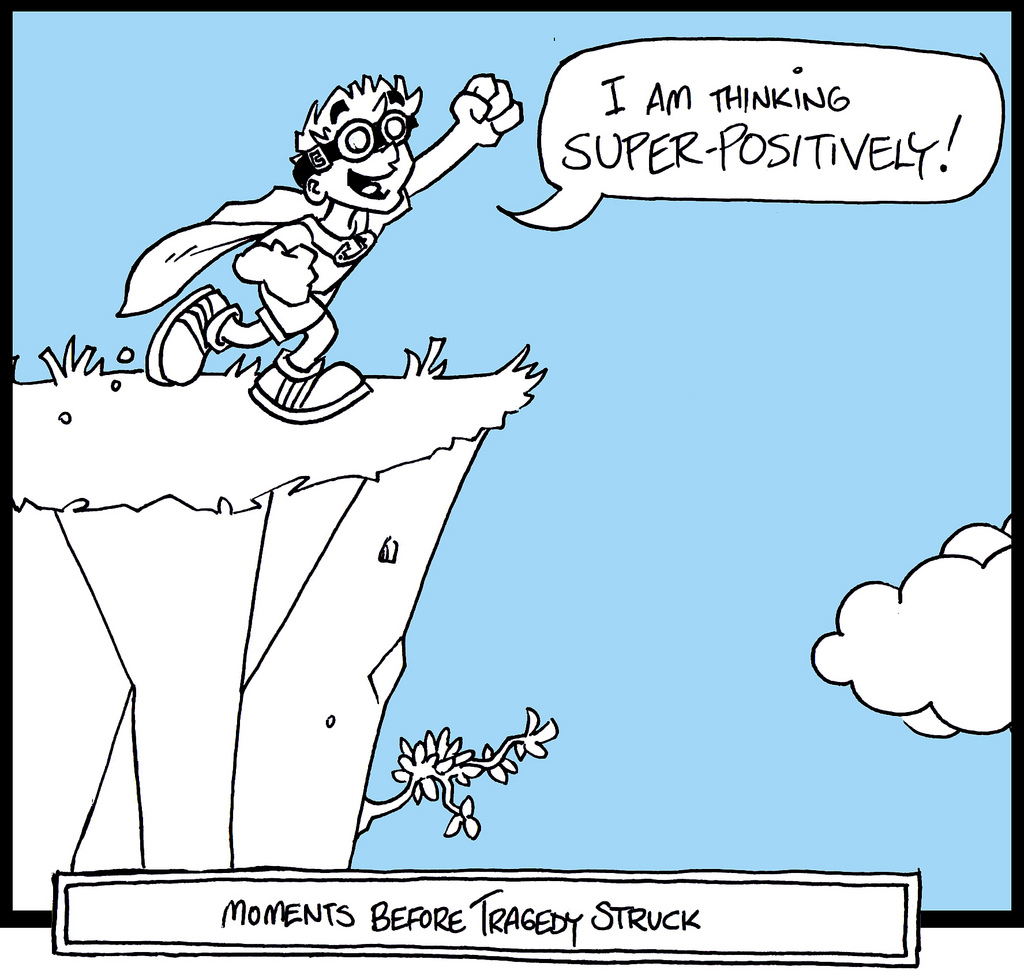

Where I stand on “positive thinking.”

positive_thinking_problem
Positive thinking taken to extremes is deluded thinking.

I’ve seen several blog posts about the problem of forced positive thinking lately, and since this is an issue that has concerned me for a long time, I thought I’d add my own take on it.

In recent years, there’s been an increased societal pressure toward “positive thinking.” I think two factors have led to this trend–the New Age philosophy that we can “be as gods ourselves,” and the continued glorification of the Reaganistic optimism of the 1980s. The signs are everywhere, in self-help and pop psychology books, in countless popular slogans and memes that appear on bumper stickers and coffee mugs, on motivational posters, on calendars, on the political campaign trail, and all over social media such as Facebook. The forced positive thinking brigade has even infiltrated churches. Motivational speakers like Tony Robbins and preachers of the “Prosperity Gospel” like Joel Osteen have gotten rich by telling us that if we only think positive thoughts, our entire lives will change for the better. They tell us if we let go of negative thought patterns, we can become happy, successful, healthy, and wealthy.

This is all fine and good, and personally I see nothing wrong with positive thinking for its own sake. Even if the outer trappings of your life rival those of someone living in a Third World nation, it’s certainly better for you if you can scare up a little optimism and hopefulness, and it’s definitely bad for you to dwell in hopelessness, depression and negativity. At the very least, seeing the glass as always half-full will make you more accepting of your sorry lot and therefore happier. That said, it’s incredibly difficult to see the glass as half full when there is barely a drop in your glass. That would be deluded, not positive, thinking.

For all its advantages to our psychological well-being, there’s a dark side to the positive thinking movement too, which goes hand in hand with the current societal glorification of narcissism and the nasty belief that selfishness and lack of compassion are virtues. While telling people that thinking positive thoughts is not a bad thing itself (because there is truth to the idea that negativity tends to draw in negative things–I have seen this dynamic for myself), the positive thinking movement has been taken to disturbing extremes. It’s led to victim-blaming and an overall lack of empathy for the less fortunate. The poor are blamed for their own poverty, regardless of the circumstances that might have led to it or keep them trapped there. They are told they are “not positive enough” or “made bad choices.” Even worse, some churches of the “prosperity gospel” ilk tell them they must have some moral failing or God would be rewarding them with material blessings. They are made to feel shame and guilt for their sorry financial condition. The chronically ill and disabled are likewise blamed for “not taking care of themselves” or “choosing bad habits.” It’s easy enough for someone who has never had to struggle with poverty or serious illness to thumb their noses at those who have and tell them it’s all their own fault.

broken_society

Is this the way Jesus would have acted? No, of course it isn’t. In fact, most of Jesus’ followers and disciples were the most financially and physically vulnerable members of his society. Jesus himself was humble carpenter and certainly not rich. He didn’t condemn these unfortunates or shame them for failing to be positive enough, or making the “wrong choices.” In fact, he seemed to love these vulnerable people most of all. Whatever happened to the “social gospel” of the late 19th and early 20th century? Oh, that’s right–it became “communism.” Somewhere along the way, compassion for the less fortunate and the culture of charity got twisted into “weakness” and “enabling.” The enormous popularity of Ayn Rand, who believed the greatest human evil was altruism, is disturbing, especially since her philosophy of “objectivism” has infected the minds of powerful politicians of a certain political persuasion, including many “Christians.”

While I don’t subscribe to some Christian fundamentalists’ idea that Satan is behind all this worship of greed and self-love and the denigration and victim-blaming of the less fortunate, I do think it’s a very destructive turn in the way our culture thinks, and it’s psychopathic in nature. Lately I’ve been seeing more blog articles criticizing this trend, and that seems like a good sign that at least a few people (usually victims of narcissistic abuse themselves) are finally realizing our society has become woefully empathy-deprived. Hopefully their message can break out of the blogosphere it’s currently confined to and begin to touch the hearts of The Powers That Be who are not yet completely brainwashed by the Cult of John Galt.

It’s absolutely fine (and desirable) to be a positive thinker, because positive thinking does tend to have its rewards, but blaming the misfortunes of others on their negative thinking or worse, their moral failings is just a form of societal gaslighting and is utterly evil itself. It’s also rife with hypocrisy– the Positive Thinking Powers That Be denigrate the emotions of guilt and shame for themselves, but they make sure those who haven’t been blessed the way they have feel plenty of guilt and shame for not having been “enough.” They never stop to think how impossible it is for someone who is struggling every day just to have enough to eat or with severe pain or illness to think in a positive way. It’s much easier for the already privileged and healthy to be able to say “life is good” and mean it. The well heeled Positive Thinking bots never stop to think of this–or they just don’t care, which is most likely the case, because those who haven’t been “blessed” with wealth or good health MUST have done something wrong to deserve it.

Any society that is empathy-starved is eventually going to self destruct.

For further reading, check out this article from The New York Times and also this one about empathy being a choice.

A field guide to the most common narcissist subspecies.

hunter

Narcissists are predators, but they can be turned into prey fairly easily. Here’s a quick field guide to the most common types of narcissists you may find out in the wilderness of real life. Binoculars are good to have on hand to spot them, but make sure you keep yourself camouflaged well and carry the weapon of Truth. Truth to a narc is like garlic to a vampire–they will run faster than Montezuma’s Revenge.

It’s easy to learn how to identify the subspecies of common narcissists by using this Field Guide to help you identify the most common types, their preferred habitat, and chosen source of supply (food). They can all be either male or female, but where a particular gender is more commonly seen, it will be indicated in the subspecies description.

1. Narcissus grandiosis.

conceptual caricature of caucasian businessman in suit he whips employee pulling him around in chair

N. grandiosis is the “classic”, grandiose, aggressively ambitious (and often successful) narcissist. Usually male but there are many females too. N. grandiosis is full of himself, boasts about his achievements, uses and consumes others to get ahead, and the only emotion they show is rage and occasional glee over their own greatness. A close subtype of N. grandiosis is N. grandiosis cerebrus. He is smarter than you and wants to make sure you and everyone else knows just how superior his mind is to the all the plebes like yourself.
Habitat: the corner office in big corporations, the political trail, Hollywood, Wall Street.
Preferred food: unassertive, codependent people they can boss around, impress, use, and have complete control over.

2. Narcissus coverticus vulnerabilis.

pouting_man

Looks can be deceiving. N. vulnerabilis may appear to be some other species of psychological or personality disorder. N. vulnerabilis is likely to be female (but not always). They seem almost cloyingly nice, but watch out–they are predators of the emotional vampire subspecies. They seem to have endless problems and misfortunes and emotional crises and expect you to ALWAYS be there for them. If you are not, they will sulk, whine, cry, give you the silent treatment, or tell everyone what a heartless, cold narcissist YOU are. Or make endless excuses why the advice you give them will NEVER work. Eventually, they will suck away your soul until you’re as down and out as they are. They’re going down and taking you with them.
Habitat: Unemployment and social service offices, food banks, therapist’s offices, your couch, your bed.
Preferred food: Highly empathetic people, people working in the helping professions.

3. Narcissus religiosis.

church_lady2

N. religiosis is likely to be female, but don’t be fooled. Males often rise to positions of leadership in churches, at which point they can be easily confused with N. grandiosis (a subspecies who may share their habitat). N. religiosis is always holy, always pious, always reads their Bible and attends church (or other place of worship) whenever they can, and is always right. They love to lord their self-righteousness over those they deem unworthy of salvation, and secretly desire to be Gods themselves. If anyone tells you you’re going to hell for believing what you believe, you are looking at a N. religiosis. Many of this subspecies are hypocritical and don’t practice what they preach.
Habitat: Churches, synagogues, religious events. They are also common on the political trail and can be spotted on school boards trying to get certain books or the teaching of sex education or evolution banned.
Preferred food: The unworthy, the ungodly, the sinful, all atheists and agnostics, or anyone who doesn’t believe exactly as they do.

4. Narcissus generosa.

giving_to_homeless

This subspecies can fool you because they appear to be so giving. N. generosa is usually female. They are big givers to charitable organizations and causes and loudly talk about how much they gave. They don’t really care about helping others–they are doing it to impress you with how altruistic and selfless they are. N. generosa gets a huge dose of narcissistic supply when others are impressed by their giving nature and makes sure you know about all those other times they gave selflessly too. N. generosa is often the long-suffering female relative, often a mother, who endlessly reminds you how much they have done for you and what a martyr they have been for doing so.
Habitat: Charitable events and meetings, volunteer organizations, church groups, the kitchen (slaving away to cook dinner for you). They have also been spotted in hospitals, spending time with the sick and disabled.
Preferred food: The poor, the sick, the disabled, the down on their luck, the very young and old, and vulnerable prey of all kinds.

5. Narcissus minimus.

little_bit_narcissistic

N. minimus may be a hybrid species because they show fewer traits of the Narcissus species. The only subspecies who may have the ability to become a member of Homo sapiens with the appropriate care and feeding. They may have narcissistic traits and act arrogant and full of themselves, but have small levels of empathy and a slight ability to feel bad about their predatory behaviors.
Habitat: Anywhere.
Preferred food: N. minimus can survive on a low calorie diet and can go for long periods without food at all, although they would prefer to have a more frequent diet, and are willing to hunt for their prey, although with less aggression than the other subspecies.

6. Narcissus hypochondrosis.

which_illness

N. hypochondrosis can be male or female. They are always sick or complaining about their endless ailments. Their chronic fake maladies make it possible for them to get supply from others in the form of medical or nursing care, or just the sympathy they crave. Being “sick” so often also frees them from the need to have to work for a living, because, you see, they are too sick. N. hypochondrisis is often a hybrid type combined with N. parasitis. Also known by their alternative name, N. Malingerosa. Being “sick” could also mean they “suffer” from a nonexistent mental disorder such as schizophrenia or Bipolar. Because they are “crazy,” this gives them carte blanche to treat you in whatever shabby manner they desire and exempts them from societal expectations to treat others with respect and manners.
Habitat: Doctor’s offices, hospital emergency rooms, at home in bed, at home in your bed or on your couch.
Preferred food: The sympathetic and people pleasing, the nurturing, nurses and doctors.

7. Narcissus parasitis.

narc_on_couch

Closely related to N. hypochondronsis and N. coverticus vulnerabilis, N. parasitis seems meek and unassuming. But she will eat you alive in her neverending quest for nurturing, sympathy, a bed to sleep in, free access to your home, fridge and bank account, and an aversion to having to hunt for their own food.
Habitat: Your home and your entire life.
Preferred food: codependent and people-pleasing people, the generous, the softhearted, the maternal, or anyone who can be easily manipulated and used.

8. Narcissus psychopathis dangerosa.

charles_manson

N. psychopathis dangerosa is also known as the malignant narcissist, or sometimes, psychopath. Many are hybrid with Antisocialis dangerosa. These are the most aggressive and dangerous predators in the narcissist kingdom, and will stop at nothing to get what they want, even if it means they have to kill you to get it. Some enjoy the means to that end, and others just do what they have to do to get their fix of supply. To them, you are no better than common housefly and they will think nothing of swatting the life out of you.
Habitat: Everywhere. While not the most common subspecies, they have no preferred habitat. However, prisons and jails seem to have a surplus of this subspecies.
Preferred food: Everyone who appears to be “weaker” or nicer than they are, which means almost everybody. They will avoid other individuals of their own subtype, however.

9. Narcissus somaticus histrionicus.

somatic_narc2

Here we find the Somatic subtype of narcissist. These predators care only about their physical appearance, and like a cat, will preen and primp all day if they weren’t required to also hunt to survive. They are much better looking and enjoy much better health than you, you ugly piece of garbage. If you fail to give them the attention they deserve, expect a vicious attack.
Habitat: gyms, health clubs, the beach (to show off their perfect bodies), in front of a camera, especially their own. They have perfected the skill of taking the Selfie to a fine art form.
Preferred food: Anyone who fawns over how beautiful or handsome they are and worships them for the gods and goddesses they are.

10. Narcissus borderlinensis.

unstable_emotions

N. borderlinensis is another hybrid type, with Borderline traits. N. borderlinensis is emotionally unstable, moody, and prone to frequent rages and temper tantrums. It’s surprising this subspecies hasn’t gone extinct yet, since so many of them display self destructive tendencies and are prone to self-starvation, self-induced vomiting, using mind-expanding (or more likely mind numbing) substances, habitual risk taking, and other forms of self abuse. While these are dangerous predators, spotters have noticed when things are not going well for them, they are as likely to attack themselves as they are to attack you. Unlike most other subspecies, N. borderlinensis have been spotted apologizing for their actions.
Habitat: Everywhere.
Preferred food: Anyone they can take out their anger and bad temper on.

Protect Yourself!
Make sure you come well armed with either of these two products to repel them.

Spray this on the narcs:
narc_b_gone

Spray this on yourself:
narc_repellant

Finally, it’s always prudent to remember this slogan–

narc_repellent

Most important of all: the Truth will set you free and make the narcs flee!

Wild carrots.

There’s always something by the the side of the road worthy of a photograph. Even weeds like these can be beautiful. Click photos for more detail.

wild_carrots1

wild_carrots2

wild_carrots3

10 Annoying as Shit Things Bloggers Do

If you blog, please DON’T do these things!

This TV movie about child abuse was way ahead of its time.

Today I was thinking about a TV movie I saw back in the 1980s that has haunted me ever since. I decided to watch it again tonight (you can watch the entire movie on Youtube–it’s in seven parts; I have posted the first part). It’s called Mary Jane Harper Cried Last Night and was first aired in 1977. Susan Dey (of Partridge Family fame) played an abusive, alcoholic mother to a 4 year old girl and she becomes completely unhinged. The movie is extremely triggering and may be upsetting to some.

There are several things about this movie that I found quite interesting.

— Rowena (Susan Dey) seems to have every symptom of Borderline Personality Disorder–but a case could also be made that her symptoms could well be untreated severe PTSD caused by the abuse she suffered at the hands of her own parents. This movie illustrates why I think BPD is really severe PTSD caused by chronic childhood abuse and could make a good case for that.

— Rowena’s parents are both textbook examples of malignant narcissists. Her mother is cold, rejecting, gaslighting, and blames her daughter for her unhappiness, as well as pathologically envious of the attention she receives from her father, who sexually abused her (and apparently still does).

— Rowena’s psychiatrist is a narcissistic jerk who coldly dismisses her from a breakthrough therapy session at the moment she recalls and re-experiences a long forgotten memory of being locked in a closet as a small child. This turned out to be an extremely cruel (and unwise) thing for him to do.

— In the almost 40 years since this film was made, not much has changed. The child protective system is still hit and miss at best and often tragically incompetent.

— It’s a fascinating and convincing study of the way the pathology of abuse infects succeeding generations.

The movie, being made for TV, isn’t perfect. There are a few holes in the plot and certain scenes just seem contrived. I also can’t help thinking of “Dean Wormer” from the movie Animal House whenever John Vernon (the head doctor) is onscreen. But the acting, especially by Susan Dey and the little girl who plays her daughter Mary Jane (Natasha Ryan), as well as the caring doctor who stands up to the Powers That Be and tries to protect Mary Jane, is top notch.

The “personal ATM machine” dream.

personal_atm_machine
This might be the real thing or a toy that teaches kids how to be greedy consumers.

I had a dream I was sitting outside in a park with several rich women. One of them reached into her Fendi bag and pulled out an “automatic personal ATM” about the size of a Notebook that flipped open and had a little screen and keyboard. She punched some data into the machine, and I watched as she checked her balance and then requested cash. The machine spit out the cash from a slot in the front.

I made a dumb comment about not being able to afford something like that because I’m poor. The women just looked at me blankly. Of course they did. What a stupid thing to say.

Then I woke up, and for a moment thought, “Wow! I don’t think anyone’s invented something like that. Maybe I could pitch that idea to someone, they could develop it, and I could get rich!” After all, lots of good ideas come from dreams, right?

But as the fog of dreamland cleared away, I realized there’d be a huge problem with that. If the cash was already in the personal ATM machine, why the hell would someone even need one? They could just keep their cash in their wallet, for God’s sake, instead of having to punch in a bunch of numbers to get it. It certainly wouldn’t be any more secure than a wallet, and such a tiny streamlined thing couldn’t hold more than a few bills at a time anyway.

Out of curiosity, I Googled “personal ATM machine” and it turns out they do actually exist, so obviously someone else thought of it first. The ones available are too big to be held in your hand like a cell phone, like that rich dream-woman’s was.

I laughed when I realized how dumb my dream idea was, but thought it was a good idea for a funny post about a stupid dream.

Is it okay to say no?

other_peoples_kids

I have a dilemma.

I am still living with my annoying narcissistic roommate. Actually, over time I came to the conclusion she is really just annoying, not all that narcissistic. Things have improved. She has gotten much better at respecting my boundaries and pays her rent on time and doesn’t invite crackheads over to the house, so there’s no reason to make her leave (although I would much prefer to not have to have any roommate at all).

But a problem arose last night. She has two granddaughters, ages 4 and 6, she hasn’t seen in two years. I know she misses them terribly. She talks to them on Skype all the time and cries every time she does, so I know seeing them is very important to her.

When I came home yesterday, she said she had something to tell me. She told me in a month she has invited them here for two days.

First of all, I was a little irked that she didn’t discuss this with me first, and just assumed it would be okay to have them come stay here. I regard this as a huge boundary invasion but at the same time I understand she feels it’s the only way she can see them. She cannot afford to travel to Florida where they currently live.
But there are a few problems.

1. I don’t like other people’s kids. Okay, there, I said. it. Of course I adored my own when they were little (and would adore my own grandchildren, when and if I ever have any). But other people’s kids, not so much.

2. The house is tiny. I live in the bottom level of a duplex, and there are only two bedrooms, one bathroom, an outdated kitchen, a small living room and a covered porch. Four people sharing one bathroom, including two little girls? I’m not looking forward to that prospect. At all.

3. There is absolutely nothing for them to do. I don’t even have TV (cable is too expensive) and there is nothing in this house that would interest children except for the 3 cats and maybe playing on the trampoline in the yard my upstairs neighbor uses for his kids when they visit.

4. My roommate stupidly sold her car for $150 several months back and has no means of transportation, so she cannot take the kids anywhere fun. There are no activities in the immediate area and no easy access to a bus line. I am not willing or able to chauffer them all around town either.

So, we are dealing with a situation where two young children would be stuck in a tiny house for two days with nothing to do and someone (me) who doesn’t want them here.

I appealed to my daughter (who is living in a larger 3 bedroom, 2 bathroom ranch house with her boyfriend who owns the house) and is closer to town and a bus line. They also have our dog, Dexter, who loves children. They also have a big screen television and the rooms are big enough for the kids to run around in. She knows my roommate so I thought this might be an option. She said no. I don’t blame her.

I suggested to my roommate she stay at the local Motel 6 with the girls. I have stayed there and it’s cheap, clean, and has a swimming pool. it’s also close to restaurants and movies. My roommate said no.

I can’t think of any other options. I hate to tell her she can’t have them here because I know how much it means for her to see them, but I really am dreading the idea of them staying here and being bored out of their minds.

Am I being heartless and selfish if I tell her they can’t come? Is it outrageous of her to expect me to accommodate them here? I have run out of options. What should I do?

I can’t get enough of this song.

Here’s a popular country pop song that has more meaning than most current offerings in this genre. I posted the lyric video because I think they’re special. There are those times in our lives we remember many years later because they still remind us that sometimes even the most humdrum life can surprise us with moments of perfect happiness. Those memories keep us going even when the present and future look bleak.
If I played guitar I sure would love to learn how to play this song.

Mental Health Blogger Award nomination.

mental_health_award

I’m humbled and proud to announce that Tessa from Tessa Can Do it has nominated this blog for the Mental Health Blogger Award. This award recognizes blogs that both promote mental health awareness and attempt to reduce the stigma associated with mental disorders.

Thank you so much for the honor, Tessa!

So I’m paying it forward by nominating five blogs I think deserve this award too. Nominees should do the following if they wish to accept the award:

The Rules:

1. Place this award somewhere on your website.

2. Nominate five bloggers who promote Mental Health awareness to receive this award.

3. Give reasons for your nominations.

My Nominations:

1. BPD Transformation has a very informative and well researched blog about Borderline personality disorder (BPD) and believes the negative “Cluster B” stigma associated with BPD can be eliminated by focusing on treating its symptoms over the medical model of misleading diagnostic labeling.

2. An Upturned Soul is a narcissistic abuse survivor whose articles are very well written and entertaining at the same time. This blogger definitely knows a lot about NPD and malignant narcissism but writes in a way that doesn’t automatically bash people who have NPD but instead attempts to educate people about them so they can protect themselves accordingly. I also like her out of the box thinking and thought provoking ideas.

3. Grace For My Heart is a Christian-oriented blog written by a pastor. While not specifically about mental illness, every Friday Pastor Dave features his intelligent and engaging “Narcissist Friday” posts, which focus on NPD and narcissistic abuse. I’m impressed by Pastor Dave’s intelligently written posts that do not stigmatize or promote hatred of people with NPD, but at the same time make it clear how dangerous people with this disorder can be and that the best thing the rest of us can do for ourselves is not to have contact with them.

4. Make BPD Stigma-Free! — the title of this blog is self explanatory. It’s also a good source of information about BPD and methods of treatment and therapy.

5. Discussing Dissociation: Thoughts from a Trauma Therapist — Although this site focuses on those suffering from DID (dissociative identity disorder), there is much information and help here for anyone suffering from other mental disorders caused by abuse and trauma, such as C-PTSD; and the dissociative symptoms associated with the “dramatic” Cluster B personality disorders.