At around 7:30 PM the sky began to get very dark, and a severe thunderstorm warning was issued. I drove to the nearby shopping center parking lot so I could get some good photos of the storm coming in.
It looked pretty impressive and scary as it rolled in, but turned out to be a washout, with rain but no hail, although it did get VERY windy for a few minutes just before the rain started.
I also got a couple of shots of the sky as the storm moved out, around sunset, and the colors were so pretty. (Click on the photos to see more detail).
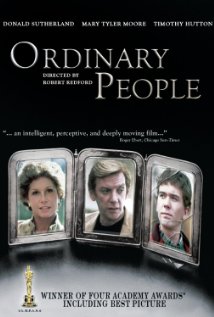
I remember when I first saw this 1980 Academy Award winning movie being quite triggered by it, because the main character, Beth Jarrett (played convincingly by Mary Tyler Moore) reminded me so much of my mother, all the way down to her impatient, flippant mannerisms, fake cheerfulness, and clipped speech. And at the time I felt very much like the teenage son, Conrad (Timothy Hutton), who was clearly suffering from a severe case of PTSD and depression, which no doubt had its roots in his mother’s emotional abuse and coldness.
“Ordinary People” (directed by Robert Redford) is about an upper middle class family from the Chicago suburbs, but the individuals involved are certainly not ordinary–or at least you hope they aren’t. Moore’s Beth Jarrett is a high-spectrum malignant narcissist who cares only about her social position and status and the appearance of having “the perfect family” and “the perfect life.” She is always perfectly dressed and coiffed, and can pour on the fake charm whenever she is trying to impress their friends and colleagues. Beth’s husband Calvin (Donald Sutherland) provides his family with their affluent lifestyle and is a good man who cares deeply for his family but is codependent to his narcissistic wife, who makes endless demands on him to keep up the image of perfection, and you can see from his demeanor it’s destroying him.
Their son, Conrad, is his mother’s scapegoat, and while she never actually says so, it’s clear that she blames him for the accidental boating death of her Golden Child, Buck (shown only in flashbacks). Conrad was with Buck at the time of the accident, and suffers from survivor’s guilt in addition to PTSD which was probably caused by his mother’s horrific treatment of him as well as his guilt over the accident, because he was unable to save his older brother’s life. The movie begins just after Conrad has been released from the hospital after a suicide attempt. I think there is more to Beth’s hatred of her child than her belief he is to blame for Buck’s accident. I think she hates him because he sees the truth about her, and calls her out on it. He is sensitive and able to see through her mask of perfection to the monstrous narcissist she actually is, and she can’t handle that.
From the very beginning, we can tell Beth despises her depressed remaining child. Her attitude toward Conrad is dismissive and impatient, and she makes no attempt to understand and appears to have no empathy for the emotional turmoil he’s in. She always puts her own needs ahead of her son and husband, and berates Calvin for attempting to understand his son’s pain. There’s not one moment where she shows the slightest shred of sympathy or love for him, and yet on the surface, no one would call her abusive, because of the mask of normality she always wears. Here’s a scene where Conrad attempts to talk to his mother about why they never had a pet–you can see how disconnected Beth is from Conrad’s (or her own) emotions, and Conrad’s hurt comes out as rage.
There’s a heartbreaking scene where the grandparents are present and Calvin is taking pictures. When he asks Beth to pose with her son, she glibly changes the subject to avoid having to SAY she doesn’t want her picture taken with him, but her disgust is obvious. Calvin insists, and Beth smiles with gritted teeth as she coldly stands next to her son. Conrad, who is sensitive, picks up on his mother’s hatred but tries to smile anyway. Beth, still smiling her fake smile, demands that Calvin give her the camera so she doesn’t have to have her picture taken with Conrad, but Calvin keeps insisting. Conrad, fed up and hurt, loses his temper and screams “Give her the goddamn camera!” It’s scenes like this that so brilliantly depict the subtle emotional abuse a malignant narcissist mother inflicts on her most sensitive child.
The camera scene.
Conrad begins seeing a psychiatrist, Dr. Berger (Judd Hirsch) who begins to get Conrad to open up about his feelings and show his anger. He also begins to date a girl he met in band practice (Elizabeth McGovern), who is upbeat yet understanding and helps bring Conrad out of his shell.
Calvin and his mother seem to be constantly arguing. Calvin tries to referree, but can’t seem to appeal to his wife’s loving nature, because she apparently has none. After one of these arguments, Conrad calls out his mother for never having visited him in the hospital, adding that “You would have visited Buck if he was in the hospital,” to which Beth retorts, “Buck never would have been in the hospital!” This is a clear implication of the higher esteem she held her older son in, who she believed would never have “gone crazy” and had to be hospitalized. Unlike Conrad, Buck would have enhanced, rather than diminished, the image she had of having the perfect life and perfect family.
Beth’s evil really comes out when they go on vacation to Texas to visit with some of Calvin’s colleagues. While golfing, Beth sweetly suggests to Calvin they go on another vacation–which would be during Christmas. Calvin agrees, but suggests they should bring Calvin along with them because he might enjoy the trip. To this, Beth flies into a narcissistic rage and loudly berates her husband for always trying to include Conrad in everything. During this rage, she projects her own anger and selfishness onto her husband, who unsuccessfully tries to stand up to her. Later in this clip, there’s a chilling scene after Conrad’s parents return home and Conrad tries to give Beth a hug. Beth’s face stays cold and hard and you can feel the hatred and disgust she has for her child while she barely returns his embrace at all.
The golf scene and “the cold hug.”
Conrad finds out his friend Karen from the hospital (Dinah Manoff) has committed suicide. Frantic, he makes an emergency appointment with Dr. Berger, and shows up in his office in a broken state. He rages and then sobs uncontrollably and everything comes pouring out: the whole story about the night Buck died and how he blamed himself, his mother’s hatred for him, and how he was never good enough. Dr. Berger listens and holds him like a parent would a child, and finally Conrad begins to calm down.
Gradually, Calvin becomes more aware of his wife’s malignant narcissism and is beginning to doubt her ability to love anyone but herself. One night Beth finds him crying alone and asks him why he is crying. Calvin asks Beth if she really loves him and she gives him a non-answer, saying “I feel the way I’ve always felt about you.” Calvin admits he is not sure he loves her anymore. He’s beginning to see the soulless monster she really is. Early in the morning, Beth leaves for good, not saying goodbye to her husband or son, leaving them to fend for themselves and try to pick up the shattered pieces of their lives together. No doubt both are much better off this way.
Calvin’s realization and confrontation with Beth.
This is one of the most convincing and well acted movies about the havoc a malignant narcissist mother can wreak on her family I have ever seen, and 35 years later, it still hits home because of the uncanny similarities I see to my own mother (who was not as outwardly rejecting or quite as malignant as Beth Jarrett). Every one of the 9 DSM indicators of Narcissistic Personality Disorder is evident in Beth. If anyone is interested in studying the myriad ways a malignant narcissist inflicts their abuse and scapegoats their children, this movie is the best case study I can think of, outside of having to deal with one yourself. Of course, not all malignant narcissists are upper middle class like Beth is, but even though the specific words and actions may differ from one social class to the next, the manipulations and abuse are always the same.
This trailer shows other scenes of the way Beth emotionally abuses, gaslights,projects, and triangulates against her surviving son.
Bree makes an excellent point here about the habit so many of us have when referring to the narcissists we have known intimately as “my” narcissist. Unfortunately I’m guilty of this. But it’s stupid when you think about it, referring to narcs this way, especially if we’ve gone No Contact. We have disengaged and disowned them so why would we still refer to something we no longer have or want as “my”? I’m reblogging this because I think it’s important for victims of narcissistic abuse to get out of this habit because little words like “my” can have the effect of keeping us emotionally connected, even if we no longer have contact with them.
“Sticks and stones may break my bones, but words will never hurt me”. What a huge lie we all grew up with on the playground at school. Actions may speak louder than words, but words DO hurt us, even our own. They also have the power to influence or destroy, liberate or enslave, encourage or shatter and attach or disconnect.
Perhaps, that’s why I just cringe every time I hear someone or myself say, “MY ex narcissist”. I recognize that many people might think I am making a big to-do about these 3 little words but every word we say matters. Words are so important. Even more than we realize. They literally shape our perceptions and our inner reality. The words we choose not only have a gigantic impact on our listeners but on ourselves as well.
Yesterday I decided to take myself to the movies for a change, and chose to see “Inside Out,” the Disney Pixar animated summer fantasy blockbuster.
Seeing “Inside Out” was a serendipitous choice, because I just happened to have enough money to afford a ticket (which is a rarity for me), and also because, although I didn’t know it right away, this movie has a beautiful message about the way Sadness and Joy, though seemingly polar opposites, when working together make human connection and unconditional love possible. Just as the light can’t exist without darkness, or good without evil, joy cannot exist without sadness. When working in sync with each other, these two emotions create a beautiful life affirming thing called Empathy, and that’s what connects us to each other and keeps the human race from becoming extinct.
Official Trailer
Sneak Preview–Teaser Clips
Riley Andersen is a young girl of 11 who becomes severely depressed after her parents’ decision to move from Minnesota to San Francisco. The movie begins at the moment of Riley’s birth in Minnesota, shown from Riley’s point of view. Her first Emotions (depicted as loveable anthropomorphized characters) are Joy (feeling secure in her parent’s love) and Sadness (when she needs something or feels ignored or in pain). As Riley grows into early toddlerhood, sometimes her needs and desires are thwarted and Anger takes over and she throws a tantrum. Around the same time she is also capable of feeling Fear or Disgust (both necessary for her survival), and it’s at those times those characters become dominant in Riley’s growing mind.
When the five Emotions work together in harmony, not overstepping each other’s boundaries and only doing the jobs assigned to them, this teamwork manifests in Riley as a well-adjusted little girl able to feel all her emotions at the appropriate times.
The five Emotions work in Headquarters, which is the conscious part of Riley’s young mind. Joy is responsible for making sure Riley’s short term memories are sent to Long Term Memory deep in Riley’s subconscious. Her memories are depicted as glowing colored orbs containing a ghostly image of the actual memory. The color of the orbs represent the dominant Emotion Riley felt at the time of the event. Transporting Short Term memories into Long Term Memory happens during Dream Production as Riley sleeps, and sometimes the other Emotions are needed to help Joy do her job getting the memories there (and sometimes discarding certain irrelevant or painful ones.) Occasionally the other Emotions (as well as Riley’s imaginary childhood friend, Bing Bong, who is a jokester) like to play little jokes–and certain irrelevant memories like an annoying gum commercial jingle are sent to Long Term Memory along with the important memories, which causes Riley to occasionally hear the gum jingle in her head at random times years later.
At the center of Headquarters is the vault which contains Riley’s Core Memories–important but happy long term memories that are responsible for Riley’s happy go lucky personality. The orbs that represent these are colored gold (Joy’s color) and for Riley’s continued mental health, these core memories must not be contaminated by the other Emotions, which is why they are kept locked in a vault. Each of the Core Memories has a long glowing tube that leads to one of Riley’s Five Islands of Personality: Family, Goofiness, Hockey (which she loves to play), Friendship, and Honesty. Maintaining these islands is necessary for Riley’s continued normal psychological development.
The crisis in Riley’s mind is set off when her family moves from her beloved Minnesota to San Francisco. Moving away is always a traumatic event for even the most loved child. Feeling isolated from her old friends and lonely in a place she doesn’t know, Riley’s Emotions begin to make mistakes and not work in sync. Joy and the other Emotions have never been sure of Sadness’s purpose because she just seems to be a Debbie Downer who is always in the way and always making mistakes. It’s Joy’s job to keep Riley’s happiness intact, but one day shortly after the traumatic move, Sadness goes around touching Riley’s happy memories, turning them blue (sad). Joy frantically tries to undo the damage but the memories already touched cannot be repaired. Desperate, Joy tries to isolate Sadness to prevent her from doing any more damage.
On Riley’s first day at her new school, Sadness takes over and Riley begins to cry in class, which creates a new but painful core memory. Joy frantically tries to keep this new core memory from reaching the central vault, but in her struggle with Sadness, who seems to keep contaminating more memories, she accidentally knocks out some of Riley’s untouched happy core memories, which fall off into the abyss. These memories are almost impossible to retrieve once lost to Riley’s Unconscious. Worse yet, both Joy and Sadness are sucked through the Long Term Memory Tube themselves, and are both lost deep in Riley’s vast and labyrinthine Unconscious.
During Joy and Sadness’s absence, Anger, Fear and Disgust attempt to run Headquarters in their place and make a holy mess of things. They attempt to provide “joy” but of course it’s faked now, rather than genuine. Sadness too is absent, so Riley can no longer longer cry or even feel grief over her loss. Anger, Fear and Disgust manifest in Riley’s new insolent and angry attitude toward her parents and loss of interest in the things she used to love. With the core memories now missing or contaminated, one by one the Five Islands of Personality crumble and fall into the abyss of the Memory Dump, a place deep in Riley’s mind where old memories are forgotten. The first Island to crumble into oblivion is Goofiness (Riley’s sense of humor), followed by Hockey (which she quits), and then Friendship (she no longer has any desire to make new friends).
Joy and Sadness find themselves adrift after falling through the Long Term Memory tube deep into Riley’s unconscious mind.
Desperate, Anger decides to insert in Riley’s mind the idea to run back to Minnesota. He plugs this into the Control Console, in the belief this can produce new happy memories. This requires Riley to steal money from her mother’s purse in order to fund her trip back to Minnesota, and then she lies about the theft. As a result, the second to last Island left, Honesty, falls away in ruins into the Memory Dump.
Back in the abyss of Riley’s deep Unconscious, Joy and Sadness run into Bing Bong, Riley’s long forgotten childhood imaginary friend. Bing Bong wants to reconnect with Riley, so he tells Joy and Sadness they can all get back to Headquarters by riding the Train of Thought. After a series of failed attempts, they eventually catch the train, but it becomes derailed when the last personality island, Family, falls into the Dump.
At this point, giving any more away would be spoiling the plot, but gradually Joy and Sadness, who have always been at odds with each other, realize that in order for Riley to return to her normal happy state of mind, they must work together as a team and Sadness has the biggest job of all. Riley must be able to experience–and receive–empathy and love (which comprise both joy and sadness) to heal from her near-catatonic depression.
As a blogger about narcissism and personality disorders, I see Riley at this point in grave danger of suicide or developing a personality disorder, even NPD or BPD. Her trauma-induced depression has caused her to become apathetic and unable to feel anything at all. What happens next is so magical and touched me so deeply I sat there in the darkened theater with tears running unchecked down my face and my nose running. I wasn’t alone–I heard sniffles and nose blowing all over the theater, and there’s a safety and sense of connection with total strangers that comes from that, and that’s why going to see a good movie never gets old. There’s something wonderfully liberating about being able to cry in a public place yet unseen by others and unjudged for it because everyone else is crying too. I think that’s why “heartstring tugging” movies are so popular. But the emotions elicited in “Inside Out” feel real–there’s no sappiness or fake sentimentality in this film that make you feel manipulated by the producers.
The five Islands of Personality.
But for all its poignancy, “Inside Out” has plenty of humor too, and all the jokes are clever and well timed. At times during the movie I was both laughing and crying at the same time. The Five Emotions are all funny characters with their own unique charm. Even Anger is loveable and hilarious in his own irascible way, and the Tinker-Bell like Joy, who could have been incredibly annoying for all her upbeat perkiness, has a depth you don’t expect and over time you realize she is the only Emotion who can feel all the other Emotions. I pictured Joy and Sadness as really being the same person–the two sides of Riley’s True Self–and when they were lost in Riley’s memory dump, Riley’s behavior became quite narcissistic. It wasn’t lost on me that both Joy’s hair color and her “aura” are colored blue–Sadness’ color.
Pete Doctor, the film’s director and screenwriter, was inspired to develop “Inside Out” while trying to come to terms with his own daughter’s psychological changes and mood swings as she approached adolescence. To give the complex psychological concepts presented credibility, well-known developmental psychologists were consulted during pre-production. It’s obvious that a deep knowledge of the way the human mind works fueled both the story and the landscape of Riley’s mind. Kids will adore “Inside Out” because of its lovable characters, fantastic animation, humor, its engaging story about a regular girl, and impressive special effects. In the theater I saw it in, there were plenty of children there, and all of them were rapt in the story.
But adults will love it just as much because of the movie’s deep message of Empathy being born from pain and loss, and the necessity of “negative” emotions to exist in a healthy person’s psyche, working in tandem with “positive” ones. Understanding the movie at this level requires an ability to think in an abstract way about the mechanisms behind personality development and psychological disorders. “Inside Out” is a rare movie that celebrates the human ability to feel, and to love, cry, connect, and laugh. It tells kids that all their emotions are okay, and experiencing them is normal and just part of growing up.
Parents, if you have children ages 4 to early teens, please take them to see “Inside Out.” Both you and they will leave the theater feeling great, and the ideas presented in the story can open up honest discussion about emotions between parents and their children. I’d even go so far as to suggest teachers show this movie to their students, and engage them in discussion afterwards.
I find it encouraging and heartening that such an honest and touching movie with a positive message about genuine emotions and empathy has become the hit of the summer, instead of the usual mindless dreck that passes for summer blockbusters.
“Inside Out” is rated PG. I would not recommend it for children age 3 and younger, due to several quite scary moments that could give a young child nightmares.
Riley with her concerned parents at the dinner table.
“Inside Out” is a 2015 American 3D computer-animated comedy-drama film produced by Pixar Animation Studios and released by Walt Disney Pictures. Directed and co-written by Pete Docter, the film is set in the mind of a young girl, Riley Andersen (Kaitlyn Dias), where five personified emotions—Joy (Amy Poehler), Anger (Lewis Black), Disgust (Mindy Kaling), Fear (Bill Hader), and Sadness (Phyllis Smith)—try to lead her through life as she moves with her parents (Diane Lane and Kyle MacLachlan) to a new city. The film was co-directed and co-written by Ronnie del Carmen and produced by Jonas Rivera, with music composed by Michael Giacchino.
Docter first began developing Inside Out in 2009 after noticing changes in his daughter’s personality as she grew older. The film’s producers consulted numerous psychologists, including Dacher Keltner[6] from the University of California, Berkeley, who helped revise the story emphasizing the neuropsychological findings that human emotions are mirrored in interpersonal relationships and can be significantly moderated by them.
After premiering at the 68th Cannes Film Festival in May, Inside Out was released on June 19, 2015. It received universal critical acclaim, with many film critics praising the voice performances (particularly for Poehler, Smith, and Richard Kind), its concept and poignant subject matter. The film grossed $90.4 million in its first weekend—the highest opening for an original title, besting Avatar ’s previous record.
Here is another guest post by the same writer who contributed “The Narc from Costa Rica.” Again she has asked to remain anonymous, but I think this story does a better job of describing the narcissism of a man who seemed to be extremely romantic. Talk about a whirlwind romance!
It’s common for narcissists (especially somatic ones) to act very romantic in the beginning of relationships. But the problem is, it’s an ACT. They can sweep you off your feet with their charm, declarations of undying love (which are lies), seemingly endless desire to make love to you, and gifts of wine, candy and roses. They also can move in very fast, and it’s not uncommon for one to propose marriage very soon into the relationship. (There are other narcs who are relationship-phobic, usually the cerebral type.). My ex proposed only three months after we met. He was cerebral though, so not all “romantic,” fast-moving narcissists are somatics.
The man in this story, Michael, seems to be a covert or “vulnerable” narcissist. They can seem to have very deep emotions and be quick to express their insecurities and vulnerabilities, but they’re still dishonest and manipulative, and they still have no empathy and will leave you in a heartbeat if a better source of supply comes along. Covert narcissists can be more dangerous than aggressive (classic) narcissists because you never see what’s coming. They can completely fool you because they seem to need you so much.
A Beachside Affair By Anonymous
My whirlwind relationship with Michael lasted for only 3 months. It was a summer love, like something out of the movies. Our affair ended abruptly, leaving me completely gutted emotionally and even physically. It was as if he’d ripped my heart out and taken it with him, leaving me with a huge hole inside my soul.
I met Michael on the beach. We quickly became obsessed with each other. He was like an addiction to me. I went to work during the day and all I could think about was Michael. I’d go home and polish myself from head to toe, making sure I looked and felt as beautiful as possible. Before I met Michael I just didn’t feel good. I was in a failing marriage to another narcissist. My husband ignored me. He never talked to me and I was dying inside. I remember that I’d go home and get drunk on wine, just to blur out the feelings of emptiness I felt from my husband’s coldness, on top of having suffered an empty childhood and adolescence due to having been raised by a narcissistic father and a borderline mother who wasn’t much better.
I knew having an affair was wrong, but at that point I no longer cared. I needed to feel loved and needed. Michael fit the bill perfectly, at first. I remember the day I met Michael. He was beautiful, his tanned muscles shimmering and rippling in the sun. We talked for a little while and before long he started to kiss me and held me for 4 hours straight, as the sun went down over the ocean.
After that heady experience I made a decision to leave my husband because I no longer could stand being with him. There was just no comparison.
I’m not sure why Michael had me under such a powerful spell. I’m not sure if it was inverted or covert narcissism or codependency on my part that made me so attracted to him. I know he mirrored my own narcissism and I think that was part of the attraction. Or (in my thinking at the time) maybe it was just that we were both artists that craved something more and we needed attention and had a burning desire to express our vision of life through our art. All I know is that when the two of us got together we melted together like butter. All the love that I never got, all the love I craved and all my neediness was being filled by Michael and I couldn’t get enough of him. He was everything to me.
Michael had an apartment in a very famous town in coastal New Jersey that was known for its rock n roll legacy, especially Bruce Springsteen. Famous bands played in a place called The Stone Pony in Asbury Park. Back then, over 30 years ago, the town was run down and almost abandoned. The Stone Pony was the only thing that held the weak fabric of this town together. But I loved it there. This run down seaside town was always beautiful to me because I always felt like this was my home. I still do. I knew that one day I’d play up on the same stage where other famous artists had played. There was fire in my belly. A void that needed to be filled with a whole lot more than a man’s love. If there was an Angel on Ocean Avenue, she was certainly watching over me.
Micheal was an art student who had nude sketches of himself all over his wall. He played the guitar too and we often played music together and I would sing. I use to stay at Michael’s house every night. We went to parties at the homes of mutual friends we had met out on the beach. The bonfires were wonderful and we would all sit around and sing songs. We sang Beatles songs and Bowie songs and I felt like a reincarnated hippie. My favorite song we sang was David Bowie’s “Space Oddity.”
“Tell my wife I love her very much…she knows.
I’m here and I’m floating in my tin can.
Far above the world. Planet earth is blue and there’s nothing I can do.”
There was magic and presence and energy and the love in all the people we met at these parties and on the beach. People liked to watch Michael and I, because they were intrigued by our obsession and need for each other. We vicariously fulfilled their need for romance. I felt so validated, loved, sexy and happy. It seemed too good to be true and it was. This couldn’t be real life. It was too perfect.
We were a study in contrasts physically, and I think that’s another reason for the fascination our friends had for us. Michael had beautiful blue eyes and long blonde silky hair, and a great body. I had long black hair and lots of curves. People liked to photograph us together. We use to sit down in front of a long mirror in his room and stare at the contrast. We made each other feel beautiful. And together, we were. At that time it seemed we were good for each other’s self-esteem. At the county college Michael was studying for an Associates degree in graphic arts we were both asked to pose nude for $10 dollars an hour for the students who sketched still lifes in the human anatomy drawing class.
Michael’s background was sad. He told me that he was beaten by his father with a belt consistently during his infancy and his dad was also an alcoholic. Michael was depressed and he had to take psychiatric medication to fight his depression from the abuse he endured as a child. I remember watching him go into this weird state where sometimes seemed almost frozen and off in some other universe (dissociation is a common symptom in people with NPD and BPD). When in these near-catatonic states, he’d punch the floor or the wall over and over again, sometimes lasting for up to 20 minutes. It was sad and very scary. He was not mean or malignant though. He seemed like a gentle, artistic soul who just couldn’t take care of himself. He was never controlling, but seemed very needy for my constant attention and love. I think he was a covert narcissist.
Our affair came to an abrupt end at the end of that summer, because Michael left me for another women who said she was in love with him. She was willing to pay the rent on his apartment. So in the end, he chose money and security over me. I was devastated because the drug of my addiction to him filled me all summer and was suddenly ripped out of my heart in an instant and the devastation and grief was almost too much to bear.
But if I’d known about narcissism, I would have known Idealize and Devalue is all part of their game. They can’t help it. Even covert narcissists are at heart predators out to use you and throw you away when you’re no longer of use to them.
My next phantom lover was a drummer named Karl. I was so needy that I of course fell into the hands of another narcissistic man. And so it goes on…
The writer of this post wishes to remain anonymous. Her story of her Costa Rican lover is both sad and funny, so I asked her to write up the story because it’s so colorful. The relationship was doomed because not only was the man in question a narcissist, there was a clash between two different cultures that had no resolution.
My Narcissistic Costa Rican Lover: He hated window screens more than he loved me. By Anonymous
This is about my relationship with my ex boyfriend who was from Costa Rica.
To start off, I’d have to say that he was extremely good looking. He looked like an all American milk and cookies guy. He had perfect teeth and smile and dark hair. He was happy go lucky. His name is “Julio.” I worked part time in a local truck stop with him. He was the head cook, and everyone called him Joe. That’s what they do in diners. They take their migrated names away and call them by a nickname. He did look like a Joe too. He was also a damned good cook. That guy could cook egg after egg and he rarely broke a yolk. If he did break one you’d know all about it. He didn’t know much English but he knew how to swear when he broke the yolk of an egg.
I remember the one time when we were working together during a blizzard. It was just me and him. Then at around 3 AM all the snow plough workers piled in. All 50 of them walked in one after the other and Joe started swearing in the back of the kitchen. I started putting orders up for Joe. Around 20 orders at the same time. Joe couldn’t take the heat in the kitchen and he started throwing the buttered toast out the little window where the food comes out and he rings the bell when its ready. We were so overwhelmed by the 50 snow plough guys that my regular customer jumped in the back of the kitchen and made the toast and helped me serve the coffee.
I also remember that Joe would wig out if you messed with his bread. On one shelf Joe had 20 loaves of bread with the wrappers all twisted in the right direction. Loaves of white, wheat and rye. If you twisted the wrapper to the left Joe went crazy. It took me a while to figure out what was wrong with Joe. We had a language barrier and it took me a while to understand it was an OCD problem he had.
Eventually Joe got tired of the USA and he flew back out to Costa Rica knowing he would not be able to fly back in. Joe original got here by crossing over the border of Mexico. So in a few months I decided to live in Costa Rica with him. Life over there was different. It was laid back and very family oriented. To an extreme. Wherever you went the family came along. A night out included the family. Grocery shopping included the family. All meals included the family.
I used to help his mother wash the clothes. I lived in rural costa Rica in a town called Perez Zeledon and we hand washed most of our clothes and then put the heavy jeans through a spinning machine. The children were adorable and well behaved. They didn’t eat much candy. One day I bought bags of candy and the 3 little girls I played with everyday kept asking me for more candy. Then Joe started laughing and he pointed out the window. I saw lots and lots of children outside and I realized I was feeding the whole neighborhood.
The children didn’t have many toys. One of the little girls use to play with chicken feet. They raised chickens and butchered them. It was a rural farming community and if you owned lots of cattle you were considered rich. At night the guys all played soccer in a big field and they woke up at the crack of dawn. At the crack of dawn the roosters would crow and Joe’s brothers would yell at us to wake up in our window. I was definitely not in sync with Costa Rican life. I’m not an early riser.
I did not like the bugs in Costa Rica. The bugs were horrific. And huge. Crickets as big as a tablespoon. Dragonflies with wingspans of a foot. Moths so huge they looked like bats. Giant ants you could hear walking on the ground. In the rural part of Costa Rica window screens were not vogue. None of the native people minded the bugs. I managed to keep the bugs away by turning the porch light on and keeping a fan on me all night with a sheet over me. The bugs were attracted to the porch. In the morning Joe’s sister would wake up and sweep the bugs out. They took pride in their daily chores. Everyday they tore the entire house apart and scrubbed it from top to bottom. They had beautiful ceramic tiles and big huge ceramic sinks.
I asked Joe to please put window screens on the windows to keep out the giant bugs that flew in constantly. He got angry and refused to do it, saying it wasn’t part of his culture and that window screens were “ugly.” He lacked empathy for my concerns about the huge flying insects. I started to think things were not going to work out because he refused to consider my feelings.
I liked Joe’s mom a lot and she loved me. Even though we didn’t speak the same language, I had no problem communicating with her. She was an emotional woman and we always knew what was on each other’s minds.
After 3 months of Costa Rican life I left because my Visa was about to expire over there and because of Joe’s self-centered and sexist behavior. I loved him but I couldn’t live in a country with a man who refused to put screens on the window, got angry so easily, and treated me like a plaything.
I remember the last day I saw Joe in Costa Rica. I was sad. I thought we may never see each other again due to the strict immigration laws. I looked at him and I thought…I’m going to miss him and I also thought I’m so glad I’m leaving these bugs.
Eventually Joe missed me and he crossed through the border of Mexico again. We stayed together for 9 years but I broke up with him eventually because of the immigration laws and he was 12 years younger than me and because our cultural differences were too great.
Joe was devastated. But he had a double standard when it came to love. Culturally its acceptable for Costa Rican men to run around and do whatever they want. Worse that he was such a narcissist too. That just doesn’t work for an American girl, especially one who’s a feminist.
I never saw this film (Narcissism: The Psychology of Demons) before. While I dislike the all-too-common merging together of the characteristics of psychopathy/sociopathy/ASPD with those of NPD (non-malignant narcissists are not without feelings, even if they are very self-centered), this is still a very interesting, scary and disturbing video describing the emotional vampires in our lives and that dominate our society.
Several people are interviewed about narcissism in the video. Zain Arcane (the smarmy Slash-looking dude in the hat and sunglasses), a vocal coach who makes videos about narcissism, gives me VERY stong narc vibes. I have read elsewhere he does in fact have NPD and is probably a psychopath. During the few minutes he takes off his sunglasses, his eyes look unfocused and lifeless and he doesn’t seem mentally all there. Maybe he’s on drugs, but there’s every reason to believe he’s a wolf in sheep’s clothing and thinks of himself as a god, based on what I read.
The creepiest part of this film is the interview with the little 5 year old girl from “Toddlers and Tiaras” and her mother (this starts at 33:32). The mother is obviously a narcissist, and has turned her daughter into her little mini-me by forcing her into beauty pageants. The little girl is already showing the odd emotional disconnection, complete self-absorption and the dead, flat eyes of the malignant narcissist/sociopath–and her self absorption is so great she doesn’t even seem to hear the interviewer and her mother talk. If this girl doesn’t get intervention very soon (and she probably will not), she is going to become an extremely dangerous, Jezebel-like woman when she gets older and utterly destroyed when her looks begin to decline. It may already be too late for her, because something about her already seems thoroughly corrupted, even evil. It’s hard for me to look at her face without wanting to recoil and get away fast.
I decided I spend enough time every weekend holed up in my small dark house blogging like a maniac like some sort of avoidant Aspie hermit (which I kind of am!) Suddenly the idea came to me that I wanted–needed–to spend part of today doing something different. It’s too cloudy for the pool or lake, and I have no one to go with anyway, so I decided going to the movies would be a good idea.
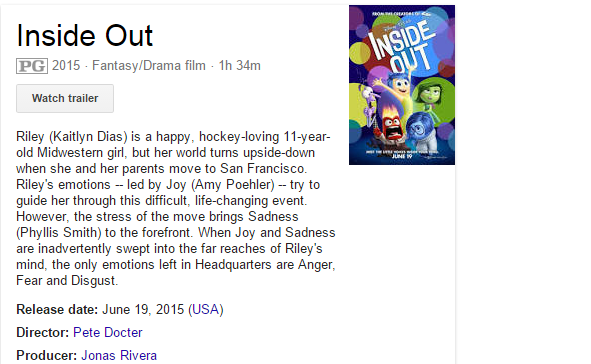
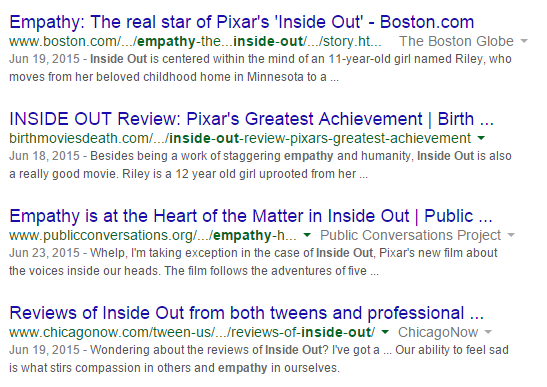
Here’s an example of the wonderful and mysterious ways God sometimes works. When I Googled movies in my area the first one I saw was the popular Pixar cartoon, “Inside Out.” Yes, it’s a kid’s movie but seems to have a very profound message of empathy–and it appears to be a girl who shuts off her true feelings following a traumatic event for any child–moving away. Anything sound familiar to those of you who read about narcissism? 😉
I am posting both the description of the movie as well as the Google results “Inside Out and Empathy.”
Click to enlarge.
It’s almost surreal the way this happened. I mean, I almost NEVER have the idea to go to a movie, because I never have enough money–but this week I do.
Something similar happened with the comedy-drama “Welcome to Me,” which I saw in May. I had no idea before I entered the theatre that it was about a woman with BPD, which I was reading and writing a lot about at the time.
I can’t believe I’m this excited to see a children’s movie, but I think it’s going to have a lot to do with what I have been focusing on in myself and on this blog–empathy. I will be writing up a review tonight, when it’s still fresh on my mind. I also need a good cry and I have a strong feeling this movie will be making me bawl. Should I come armed with a box of Kleenex? Sometimes emotional music and movies are the most effective ways for me to get the tears out.
There are many casual bloggers who only blog for themselves or their friends. They don’t care about views, hits or visibility, and have never looked at their stats page, and that is perfectly okay. Casual bloggers can write one blog post a year and it won’t matter because the few views they get are all they care about anyway. Their sole reason for blogging is to share their thoughts, feelings or pictures with a few friends–or just get them down “on paper,” so to speak. There is, of course, nothing wrong with that.
So if you’re a casual type of blogger who blogs only for yourself or your friends or family, this article will not apply to you.
But if you’re a serious blogger, like I am, you will want to increase your readership, get more views, and be more visible on the web. I think for most of us, the primary reason we blog is for the love of it and to share our thoughts with others, but let’s be honest: that isn’t quite enough. For aspiring writers like me, maximum visibility is important because visibility helps us promote our writing. Blogging can act as a springboard to other things. An active and well-known blog can be parlayed into a writing career or even the eventual publication of a book.
If you’re a serious blogger, you can’t be lazy. You have to work hard at it, and it becomes a job. A fun job to be sure, but still a job. So I am going to give you some pointers for how to promote your blog and get as much visibility as possible. I’ve been blogging for almost a year now, and have learned enough about this along the way that I think my advice can help you too.
1. The most important thing is to write every day.
I’m serious. I’ve noticed that if I skip even ONE DAY without writing a new post, my viewership declines and I get fewer hits. Until you’re really well established or have a really famous blog (which most of us don’t), you cannot rest on the laurels of your last well-received and popular blog post. You must keep writing. Of course there will be days you can’t think of an original idea or are simply too tired to write anything original. In that case, it’s okay to post a photo, meme, cartoon, or reblog someone else’s article. If you do reblog an article though, try to write at least a paragraph or two introducing it and explaining why you’re reblogging it. Don’t reblog just for the sake of posting something. Make sure it’s something you really like or that resonates with you. Your readers will pick up your enthusiasm if you write an intro. But be careful not to do this to often. If you hardly ever post original material, people will lose interest in your blog because it becomes nothing more than a platform to promote the material of others.
2. Have a good looking blog.
WordPress has many themes and many of them are free. I think the majority of them are tasteful and easy on the eyes, and they are easy to set up. If you run ads on your blog (you won’t be doing this unless you’re a serious blogger anyway), be careful about having too many other graphics and widgets on your blog. I’m probably guilty of this, because my sidebar looks like a widget sardine can, but I can’t bring myself to delete any of them. But I don’t think this blog looks too “busy.” Don’t use background colors and patterns that are hard on the eyes or that clash with the content. Use a font that’s easy to read, not just because you think it looks “cool.”
3. No walls of text!
If you write long articles, it’s best to break them up into subheaders, “listicles” (numbered lists), or use graphics and pictures. Google Image is great for finding the perfect graphic for an article, or if you’re a good photographer, you can take your own pictures.
4. Reply to your comments.
This should be a no-brainer. If you allow comments but don’t answer them, people will think you’re a snob or that you don’t care. If you get many comments, it may not be practical to answer all of them, but at least “Like” them to let the commenter know you saw their comment. There is of course the option to not allow comments at all (which may be necessary if you are being stalked or bullied excessively) but if you want your blog to grow, I don’t recommend this. Blogging should be an interactive activity, and if you don’t allow comments, people will think you only care about your own opinion and will probably lose interest eventually. Also, don’t run people off by not allowing them to disagree with you. There’s a big difference between someone who merely disagrees with something you wrote and a bully. Disagreements can turn into interesting and lively debates and discussions.
5. Use the share buttons, even if you don’t use social media.
There are many social media share buttons that WordPress makes available. You should make all of these available under each article, so even if you don’t use social media yourself, other people will share your articles for you and that will help you gain visibility. It’s a fantastic feeling to look at your share buttons and see your counters growing. When one article of mine hit 1K shares on Facebook, I felt like I won the lottery.
6. Use Twitter and Facebook even if you hate them.
If you want your blog to grow, I recommend sharing articles on at least Twitter and Facebook, even if that’s the only reason you use these social media platforms. You can set your blog up so your articles are automatically shared to the social media platforms you choose without you having to actually go to the sites to do so.
7. Use Twitter #hashtags.
If you have a Twitter account, and you have an older article you want to promote, or one that seems to be especially popular, I recommend re-sharing it using #hashtags. The automatic share feature won’t do this for you, but if you manually share an article to Twitter, include a few #hashtags in your tweet (a box will pop up where you can do this). Hashtags are basically just one word tags that describe the content of your article. For example if you write about narcissism, and you are tweeting about a relevant article, use hashtags like #NPD, #narcissism, etc. You won’t be able to add too many so make sure they sum up the content and are popular words people search for. Doing this works because even if people aren’t following you on Twitter, if they look up a topic by using a certain #hashtag, your article will be listed and it will get a lot more views than if you do not use hashtags. It may sound #stupid, but it works for me every time.
8. Reference and link to other blogs and websites in your posts.
Not only does it appear you’ve done your research by quoting or referring to material from other blogs, every time you link to another blog or site, it creates a trackback, which appears on that blog, and from there people visiting the other blog can click on the trackback or pingback link and be taken to your blog post. It also helps foster goodwill between bloggers–most bloggers love to be credited and have their blog linked to, and they may recommend yours or link to yours in return. I can’t even tell you how many of my “referrers” are blogs I linked to months ago in a single blog post.
9. Make your content easy to find.
I’ve seen blogs you can’t navigate because there’s no option for finding what you’re looking for. That drives me crazy. No one wants to scroll through every article you ever wrote to find what they want to read (and how would they know it exists anyway if there’s no navigational tools?) At the very least, use a search bar (which you can add easily via the Widgets on the Admin page), but I recommend using a few other features too that make navigating your site easier, such as a tag cloud, a category list, a table of contents, or topics listed in the header or sidebar (mine are listed in the header and some include subtopics). If people can’t find what they’re looking for, they’ll throw their hands up in frustration and go to other blogs instead.
10. Make good use of tags and categories. I still have a lot to learn about this. I tend to use too many tags and categories, and I hear this is a no-no. I’m getting better though. Like Twitter #hashtags, using relevant words and phrases that describe your article’s content draws viewers, because when they’re searching for a topic in a search engine such as Google, tag words will make sure your article is listed there, even if it’s on page 20 to start with. As your blog grows, you will find your Google rankings rising and some articles may start appearing on the first page if they get enough views. There is no reason why you should have to pay for SEO. All you need is patience.
11. Make your blog mobile-friendly.
Just about everyone these days has a Smartphone with Internet access and many people even use it more often than their computer for reading web content. WordPress has a feature under Admin Tools for making your blog readable on mobile phones. Doing this will also increase your traffic because it makes it possible for people to read your blog even when they’re at work, walking the dog, eating dinner at the Olive Garden, or taking a bath.
12. Don’t let bullies and trolls intimidate you or destroy your will to blog. If you blog regularly, and especially if you start to get a lot of views and hits, be prepared for this. There are going to be people who won’t like you, your blog, or your content, or are jealous of you or just want to stir up trouble because that’s what trolls do. Be forewarned: it’s not a matter of if but when. Fortunately, other than nursing your hurt feelings (if you’re sensitive), dealing with these people shouldn’t pose too much of a problem. It’s pretty easy to control your haters on WordPress. You can’t block people the way you can on social media, but you can delete (or not approve) their comments. It’s your blog; you can write about whatever you wish, and if some people have a problem with what you have to say, they are basically telling you how to run your blog or even whether you have the right to blog, and neither of those things is okay. THEY are not your boss–YOU are. You can’t be fired from your job as a blogger–you can only quit. Write about what you want and put those nasty comments where they belong–in the Trash. Lick your wounds and keep on writing.
If you are being stalked or threatened (like a certain very popular WordPress blogger was recently), you can always set your blog to private or password-protected for awhile until the dust settles, or disable comments. With any luck, you won’t ever have to do either of those things.
One of my long-standing interests is demographics, and the interplay between the different living generations. Here is a video that explains the interactions between the four living generations born before 2005 (or possibly, 2001 — the jury’s still out on the last birthyear of the Millennials).
The birth years are based on Strauss and Howe’s “Generations” and “The Fourth Turning,” both books I have read and highly recommend for anyone interested in how generations impact history (and are, in turn, impacted by history). I agree with these birth years over the more popular ones used by most marketers and the popular media. I also believe there are “cusps” that straddle the generations and bleed over several years in both directions, so someone born in a cusp year would have characteristics of both adjacent generations. Of course, these are just guidelines (some have compared generational types to astrological signs) and some people may not fit their generation at all, but maybe a different one.
The generations discussed here:
1. GI Generation (Hero generation, born 1900 – 1924) — few still alive.
2. Silent (Artist generation, born 1925 – 1942)
(Silent/Boom cusp subgeneration: War Babies born about 1936-1946)
3. Boomer (Prophet generation, born 1943 – 1960)
(Boom/X cusp subgeneration: Generation Jones born 1955-1965)
4. Generation X (Nomad generation, born 1961 – 1981
(X/Millennial cusp subgeneration: Generation Y born 1976-1986)
5. Millennial (Hero generation, born 1982 – 2005 (?)
If you’re interested in this stuff, I recommend these two books by William Strauss and Neil Howe: