Guest Post #1: When My World Shattered

Favim.com-26101
Credit: Unknown artist, Favim.com

I’m thrilled to introduce my first guest blogger, Tessa from Advocate for Mental Illness.   Her blog is about her daily struggles with Bipolar disorder, told from a Christian perspective.  She has recently given her life to Jesus Christ.  Here is her bio from her About page:

ABOUT TESSA

Teresa (Tessa) Smeigh is over 55 and still going strong despite her disabilities affecting both physical and mental abilities. She has bipolar disorder (mental), Fibromyalgia (nerves), degenerative disc disease (spine), and arthritis (joints). Despite that she is active in Mental Health Advocating, writing for http://www.IBPF.org (volunteer for non-profit) and has 5 blog posts already published by them. She is also working on 2 fiction books (mysteries). She keeps her blog filled with useful content, daily devotionals (She is a Christian), stories and poems. Plenty to keep you busy. She has also been interviewed by blogs and had other posts published on many different blogs. She has 2 blogs so far http://www.tessacandoit.com and http://www.finallyawriter.com She is from Deptford, NJ. Her family and blogs keep her busy.
Although she doesn’t focus on it in her blog, Tessa also has Borderline Personality Disorder (BPD) and complex PTSD.  I have asked her to write a guest post about having BPD, because none of my other guest bloggers are writing about BPD but I already have several who will be writing about Bipolar and complex PTSD.
Here is her guest post.
When My World Shattered!
I am a 59 year old female who has suffered mental health conditions since birth. Since I was born in the 50’s people didn’t talk about mental health. Even with a suicide in the family it was not talked about.
As an infant I took anxiety medication in order to keep food in my stomach. I was considered to have a “nervous stomach.” My mother kept a supply of anxiety medicine at hand all through my childhood because anything could set me off into an “anxiety episode” and hysteria. This was common throughout my childhood. My self-soothing unfortunately was considered self-harm by today’s standards.
At a very young age I developed signs of bipolar disorder which at the time we did not know. I got an official diagnosis in my early 30’s after a breakdown. Also by the same procedure, a hospital stay almost 4 years ago picked up on the Borderline Personality Disorder (BPD) and I followed the symptoms back to when I was a child as well, but a little bit later than the bipolar.
Bipolar disorder and BPD are similar in symptoms and are often misdiagnosed. I have officially now been diagnosed with both. The biggest difference between the two is the length between the mood swings. Since my mood swings as a very young child were months apart it is most likely the bipolar disorder started first. Then later when the BPD developed they became rapid even changing during a single day or even hour.
It is difficult to break the symptoms down and say this belongs to bipolar disorder and this belongs to BPD. I will just go into the symptoms I suffer as one. Which is the direct cause, is not really necessary to know at this point.
How about a little history on BPD?
Symptoms usually manifest in childhood, but don’t become serious until a person becomes a young adult. This fits close to my time-line. Only I figure mine started in my teens after a traumatic experience of having been almost raped twice by the time I was 15 years old. I was then emotionally raped at 17 years old where I was told by the young man that either we had sex at that point or he was leaving me (abandonment considered to play a role in BPD) and we had just gotten back together. I couldn’t let him go. I gave in and that was also traumatic. I wasn’t ready. During that time I also suffered a miscarriage although I really didn’t know it at the time. I was totally naive even though my low self-esteem led me to wear sexy clothing and flaunt my body to every man. I didn’t know why I did it. I craved that attention though (promiscuity).
The exact cause of BPD is not know though they suspect brain chemistry plays a role, also genetics and environmental factors, along with the possibility of childhood trauma.
To add to the trauma, the 17 year old played the “I am going to kill myself if you don’t marry me” game when I tried to break up our relationship. I felt stuck, my emotions caused me to give in and marry him. I didn’t love him, but I was married at 19 years old. At 21 I had my first child, 22 I had my second and by 30 I had three children.  By then my weight was out of control due to binge eating.
My self-harm became more severe although I did resist cutting after I tried it and felt it didn’t give me the feelings I needed to soothe myself.
My anger intensified, but I kept it inside. I did not explode into rages unless you really pushed me but those rages were severe. People didn’t listen to my warnings and I flew into rages, shocking people with their intensity.
Paranoia became a constant state of my life. I am always sure people are talking about me. Even today.
Dissociation has been a constant since childhood. I always daydreamed and put myself into my books. I loved to read and my parents would force me outside. That triggered my anxiety and panic.
Severe depression for months on end would cause suicidal thoughts and several attempts and the last one landed me in the hospital for treatment and intense therapy. Luckily I didn’t succeed. The last one was the most serious.
I am currently in severe financial poverty due to low disability payments and reckless spending while I was manic.  Manic episodes are currently considered a symptom of both bipolar disorder and BPD.
I also have had a lot of unsafe sex due to my promiscuity, which is another shared trait.
BPD is difficult to treat. Usually a therapist, especially one trained in DBT (Dialectical Behavior Therapy) or CBT (Cognitive Behavior Therapy), combined with medications such as anti-psychotics, anti-depressants and mood stabilizers will help tone down the symptoms.
***
Please visit Tessa’s blog here. 
My apologies about the wonky spacing.  WP isn’t letting me change the coding and I don’t know CSS.  I hope that doesn’t affect anyone’s reading experience!

BPD Awareness: end the stigma

bpd-pride1

Borderline Personality Disorder is a serious mental disorder with its roots in childhood abuse (usually narcissistic or sexual abuse) and as you can see in one of the memes below, it shares much in common with Complex PTSD and may in fact be a variation of the same disorder.

But BPD is terribly stigmatized, with its sufferers being called everything from evil to incurable.  Many mental health professionals refuse to work with Borderlines because of this stigma.  They’re afraid of us!  While some more aggressive borderlines can certainly do bad things to others and be manipulative, for people with BPD, their actions are caused by an inability to control or regulate their emotions, so they act out instead of thinking before they act. Many Borderlines are more destructive to themselves than to others.  They can seem self-centered and narcissistic not because they lack empathy (many borderlines, in fact have an excess of empathy) but because they get too caught up in their own emotional turmoil to be mindful of others.    Unlike people with NPD, they also don’t have a sense of entitlement.   In fact, they often feel like they deserve nothing.

BPD is much more treatable and receptive to therapy than other Cluster B disorders like NPD or Antisocial Personality Disorder.   Unlike those disorders, too, people with BPD can be helped by medication.


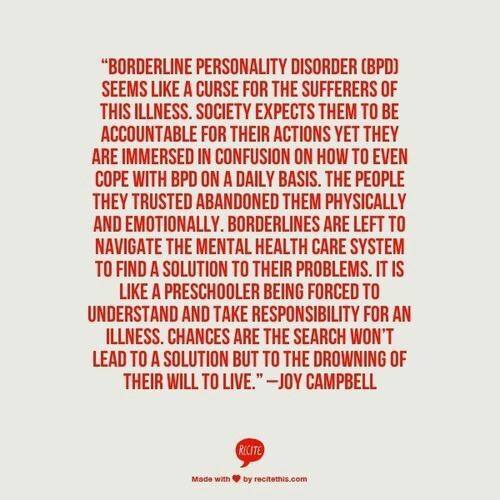
bpdpride2

bpdpride3

bpdpride4

bpdpride6

bpdpride8

bpdpride7

bpdpride9

bpdpride10

Show your pride:

pbdpridebutton

Order one here: 
http://www.zazzle.com/bpd_pride_button-145549130796752314

BPD/mental illness awareness/LGBT bracelets and jewelry: 

Awareness Jewelry Shop

The One Who Got Away

Living with Narcissism is a new WordPress blog written from a man’s point of view. He suffers from C-PTSD and writes about his toxic relationships with character disordered women.

This is a highly readable account of his devastating breakup with a young woman who had Borderline Personality Disorder. While BPD is highly stigmatized, many women with active BPD behave just this way. I’m ashamed to admit I recognized some of Kerry’s behaviors in the ways I used to act in my relationships. This was an excellent post from a wonderful new blogger. Please go visit his blog and leave comments there.

donshelby's avatarLiving With Narcissism

Even after 15 years of marriage there was this one woman who I just never got over completely.  In my mind, she was my soulmate.  The one who got away.  Leaving her was like an addict giving up their drug of choice.  She was my heroine.  My soul was so enmeshed with hers that it literally felt like a tearing apart inside my heart and soul when I finally left her.  After all of those years I still pined for her and yearned for closure.  I had no idea what I’d done wrong or why we couldn’t work out.  I felt like our relationship was just an innocent baby and she killed it.  I should have hated her for that.  If it had really been a child, no doubt, I would have.  But it was a metaphorical child.  I didn’t hate her.  I missed her and still loved her even…

View original post 1,823 more words

Come closer…go away.

I hesitated about posting this here, but I’m going to take the plunge and do it that because I’ve never once regretted “running naked in public.” (I haven’t changed the URL yet because it costs money for me to do that so I have to wait.)

Borderline Personality traits linked to lowered Empathy

A new study found that people with BPD may have lowered or limited empathy, and that it may be biochemical. I sometimes think I’m a bit empathy challenged, though not in a general sense. For example, I feel just awful when I see or read about someone’s suffering (especially if it’s an animal or a child) but it’s hard to me to empathize on an interpersonal, emotional level with another person (which could be due to my introversion and social awkwardness, and also my complex PTSD).  I do have cognitive empathy (KNOWING how another feels), even if its sometimes hard for me to feel WITH someone else. This is something I want to change and am working on in therapy.

I’ve known other Borderlines who seem to almost have too much empathy, and are very profoundly affected by the moods of those around them. The problem for BPDs, whether they have too much or too little empathy, is that we get so caught up in our own problems we can seem to be oblivious to what others are feeling. Usually when we’re called out on our selfishness though, we feel pretty badly about it and try to make up for it.

I think a lot more research needs to be done on this matter before any blanket judgments are made. Unlike people with NPD or Antisocial Personality Disorder, I don’t think lack of empathy is a defining characteristic for Borderlines.

Cluster B disorders are not cool.

uncool

Although Cluster B disorders (the dramatic, emotional, erratic group of personality disorders), are largely demonized on the Internet by narcissistic abuse survivors, there’s another growing attitude online that’s pretty much the opposite–that having a Cluster B disorder somehow makes you an uber-cool badass.

This is a dangerous delusion.  Take it from me, having a Cluster B disorder like BPD (in my case) is NOT fun. Nor is it cool. In fact, it really really sucks. 😦 Both for yourself and everyone else.

This growing attitude of “Cluster B coolness” I’ve been seeing more of goes something like this:

NPD:

bad_sport
This is what your narcissist is really all about.

The Myth:  If you have Narcissistic Personality Disorder (NPD), you’re a self-confident, go-out-and-knock-em-all-dead, ambitious, and highly intelligent badass who Gets. Things. Done. Psychopaths are similarly glorified, but they’re basically the reason why everything’s wrong with the world and empathy is seen as a “weakness.” The narcissistic woman is regarded as a diabolical yet seductive Jezebel who turns strong men into whimpering slaves at the snap of her pretty fingers and who every other woman strives to be. The narcissistic man is regarded as a buff, handsome, masculine, virile, successful go-getter who all women melt for (and that’s how they regard themselves, of course).

The Reality:  In actuality, if you have NPD, you’re a negative, selfish, deluded, demanding, envious, entitled, whining crybaby with no real sense of self who everyone hates (and who hates everyone) but are afraid to say so because it might set off one of your infamous rages or you giving them the even more crazymaking “silent treatment.” People are always walking on eggshells around you because you’re really so unstable, hypersensitive to criticism,  and deluded by and drunk  with your own “greatness.”  You’re a sore loser too and can’t stand to see anyone else do well or get any attention.   No one really likes you and you’re probably right that people are talking about you behind your back, but frankly you deserve it. Also, many narcissists are just plain stupid and have no emotional intelligence.  As for their reputed skillfulness in bed,  many narcs (especially the cerebral types) hate sex and can’t or won’t perform.  Or, as with everything else, they only care about their own needs and to hell with yours.

BPD:

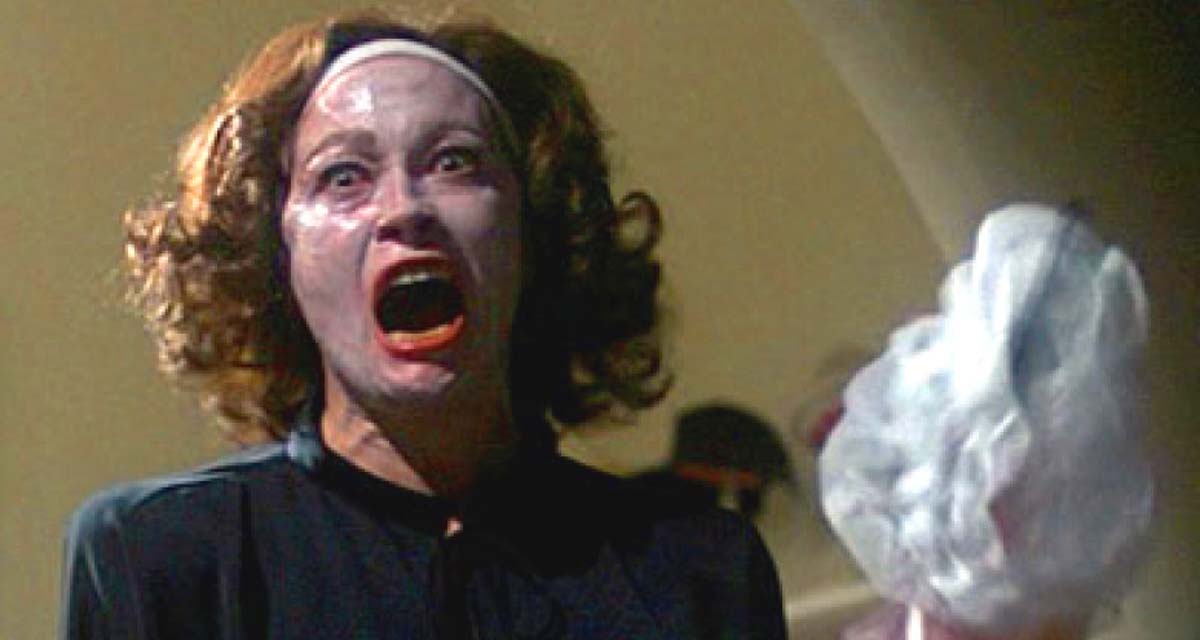
mommie_dearest2
Joan Crawford had a BPD diagnosis. Is this sexy, alluring, and “quirky” to you?

The Myth: If you have Borderline Personality Disorder, some people think this means you’re a sexy beast or babe who’s alluring, unpredictable, passionate, always charming and “quirky”, and never boring. Your chameleon-like abilities to match the attitudes of those around you is seen as evidence of potential Oscar-winning ability. It’s always pointed out how many actors and musicians suffer from BPD.

The Reality:  Let’s be honest.   If you have BPD you’re emotionally unstable, volatile, almost crazy (the original term “borderline” referred to the disorder being on the border between neurosis and psychosis), out of touch with reality, unable to take a firm stance on anything (or conversely, switching back and forth between two extremes, which just makes you look insane) due to your terror of being rejected or abandoned, prone to be an addict, (drugs, booze, gambling, shopping, cutting, eating and/or dieting, other people), clingy,  codependent, insecure, high-maintenance,  and fickle. The borderline doesn’t really have a false self per se like the narcissist, but they can’t access their true self either, so they wind up “taking on” the attitudes and emotions of those who happen to be around them like some kind of emotional bodysnatcher (in contrast with true empathy, their feelings overwhelm them and are out of control), and they just plain overreact to every damn thing so you feel like you’re always walking on eggshells.

HPD:

clown_makeup
You think you look seductive. Everyone else thinks you look like a clown.

The Myth: Although Histrionic Personality Disorder (HPD) isn’t widely talked about, its reputation is similar to that of BPD (but is really the stereotypically feminine form of Overt NPD): usually female, a sexy, seductive siren, dramatic, highly social, loves parties and being the center of attention, and is never, ever boring. You’ll fall madly in love with this bewitching seductress due to their many charms and their great looks.

The Reality: The real truth about people with HPD is that they’re insincere, emotionally labile to the point of being embarrassing (but their over-the-top “emotional displays” are largely an act), shallow, materialistic, and emotionally retarded. They often overdress (or underdress!) or are overly made up for an occasion, are sexually promiscuous, and are inappropriate in social situations, but they don’t care if you’re cringing in embarrassment for them because even negative attention is still attention and that’s what they crave more than the air itself.

ASPD:

aspd
Nuff said.

The Myth:  So here we are at the juggernaut of the Cluster Bs, the baddest badass of them all, Antisocial Personality Disorder (ASPD). Often confused with Psychopathy (and often overlapping with it), the antisocial or psychopathic badass is a sexy and fearless rogue, unconcerned with how others feel about them, possessed of an arresting and penetrating gaze (actually a predatory, creepy stare) that makes you feel like they are really listening to you, determined to get what they want (whether it’s their latest kill or their latest corporate takeover) and never giving up or allowing themselves to be intimidated, by anything. They’re the Rebels Without a Cause, the self-confident Ferris Buellers, the Coolest of the Cool, the celebrated anti-heroes of novels and films socially sanctioned to serve as a receptacle for the Shadow Self that resides within us all. The ASPD badass gives us permission to mentally “act out” our darker impulses, without actually hurting anyone, and that’s why we all love serial killers so much, and why the Ted Bundys and Charlie Mansons of the world get more marriage proposals than any football or film star.

The Reality:  The antisocial badass is really just a heartless and criminally minded horse’s ass, who has no capacity for empathy, isn’t even socially constrained by their need to impress others to garner narcissistic supply (because they don’t require any), and is frequently in prison or has a rap sheet the size of War and Peace. This is a guy (or gal) who will make your life a living hell, beat you to a pulp any chance they get and leave you in a heartbeat and not even remember your name.

If they’re high functioning, they’re the people who are responsible for everything that’s wrong in the world today and the reason why you work 3 jobs and can’t afford a vacation or health insurance.

If they’re low-functioning, if they’re not straight up criminals, they’re flabby, pasty Basement Dwellers who dishonestly leech off the system or their family members so they never have to work and spend all their time trolling Internet forums to get a rise out of random strangers.   Just like my ex.


basement_dweller

Ah, what a studly, irresistably dangerous heartbreaker you are.

If you’re a psychopath or sociopath, you operate more like a machine than a human. Is that something we should be aspiring to?

So there you have it. Cluster B disorders are not cool. They are serious mental (and some believe, spiritual) illnesses, and they are pathetic.   And let’s not forget that people suffering from Cluster B disorders are not happy people.  In fact, most of them are pretty miserable.  They are to be pitied (and avoided) rather than emulated.

A rebuttal in defense of Cluster B. 

“If Looks Could Kill: Anatomy of a Borderline”

littlegirlwithacurl

People with BPD, like all the Cluster B disorders, can at times seem demonic, especially when raging. I used to have these episodes of uncontrolled rage, in which I’d dissociate pretty severely. It was as if an actual demon inside me was unleashed and I couldn’t control my actions or my words, even though I knew I’d wind up regretting it and apologizing profusely hours later, hanging my head in shame. I think these rage episodes scared me as much as they scared everyone else, but there didn’t seem to be anything I could do about them. They were far too big for me to handle. Although no one ever told me I looked “evil,” I probably did during these episodes.

DBT and mindfulness tricks helped me get things under control, but I do seem to have mellowed in general with age. That seems to happen with some BPD women (some even become spontaneously “cured” after their childbearing years end), which makes me wonder if BPD is really a personality disorder at all, or something more biochemical. Since abuse or neglect in childhood is almost always present in Borderlines, maybe abuse causes brain chemistry to change for people who develop it, and this affects the female hormones in some way.

The emotional numbness is still there, but that’s nothing new–and it could be my PTSD rather than BPD. “Zombie” used to be my default setting in between rages so severe I seemed possessed. With increasing self awareness I’m becoming more able to access real emotions without losing control. The emotional numbness is lessening but the rages of my younger years have not returned. I’m not sure which emotions are still under wraps but I think it’s closer to sadness over some undefinable loss than rage.

This article accurately describes the Borderline’s ever-shifting emotional extremes and just how black their dark moods really can be.

If Looks Could Kill: Anatomy of a Borderline

By Shari Schreiber, M.A.
GettinBetter.com

There was once a little girl who had a little curl, right in the middle of her forehead. When she was good, she was very, very good–but when she was bad, she was horrid.

My other articles on Borderline Personality Disorder speak to elements in the Borderline that seduce you and keep you enraptured, despite their push-pull emotional gymnastics, disruptive come here/go away cycles, and confusing, crazy-making behaviors. This piece exposes the volatile, frightening dark side of this individual who has gotten you under their spell and won’t let you go, but also uncovers the root cause of these issues. There’s a comprehensive list of features/traits at the bottom, which can help you determine if you’re involved with someone who has BPD–or it may serve as a self-diagnostic tool.

While many BPD people have killer looks, not all Borderlines are beautiful or handsome–but that doesn’t make them any less seductive or diabolical. It’s much easier for a great looking man or woman to find continuous streams of narcissistic supply via adulation and romantic pursuit from others, and until this ego fuel isn’t obtainable, they won’t consider therapy. Why should they? Humans don’t change, until what they’ve been doing doesn’t work for them anymore–or they’re in enough pain, to re-direct their energies and efforts toward seeking the help they need to get truly well.

Read the rest of this article here.

What’s my problem?

confused

After over a month of being convinced I’m a covert narcissist, now I’m starting to wonder if my assessment of myself could be incorrect. Most people are having trouble believing me (even good friends) and there are so many disorders that appear similar to it. I no longer think my symptoms are due to Aspergers the way I used to, but BPD + Avoidant PD in the same person can look exactly like covert NPD. So can complex PTSD in some cases.

I’ve been told again and again that real narcissists are unlikely to ever admit they are narcissists, and if they do, they won’t be beating themselves up that much over it. I don’t know if that’s always true (I’ve met a few low spectrum covert narcissists on Psychforums who actually have a diagnosis and feel terrible about things they’ve done and want to change, but maybe the diagnosis they got is wrong and they just have more than the normal amount of N traits). Victims of narcissistic abuse are often quick to diagnose narcissism in themselves and others. We’re hypervigilant and tend to see narcissism everywhere, and we don’t even exempt ourselves. The real narcissists are probably more likely to keep insisting that they are not. Abuse victims think too damn much. It’s all very confusing.

narcissism_selfies

I guess there was a reason why I never added “Covert NPD” to “My Disorders” in the header. Without an official diagnosis for that, I really can’t say that’s what my problem is. It could be, but if so I think it’s at a low level. I know I have a number of narcissistic traits, but most abuse victims do. That doesn’t necessarily mean I have NPD, covert or otherwise. I could just have a really bad case of “fleas,” or just BPD + AvPD, or even complex PTSD.

I’m still glad I started Down The Rabbit Hole because it’s also intended for people with BPD, which I have an actual diagnosis for. I still think my “trip down the rabbit hole” early in August was real but that doesn’t necessarily mean I have NPD. It was still a trip to the walled off parts of my mind, and most abuse victims are at least partly walled off from themselves. We may be partially narcissistic but not enough to qualify for the label.

I care about people with low spectrum NPD and BPD who want to heal or improve, so that’s another reason I’m going to keep DTRH going. It’s getting a good reception. Another one of my missions is to help reduce the negative stigma against people with BPD. I don’t ever expect DTRH to gain the amount of activity this blog has received, but if only one or two people can be helped by my posts, and I can help myself by continuing to do exactly what I’ve been doing, then it’s worth it to keep it going, isn’t it?

Really, at the end of the day, all these labels are just labels and don’t really mean anything at all.

Derealization and depersonalization in NPD and BPD.

Worlds_Collide___Phaeton___by_Meckie
Worlds Collide-Phaeton: by Meckie at Deviantart.com

A common symptom of both NPD and BPD is dissociation: a splitting or fragmenting of the personality not very different from what occurs in the Dissociative disorders such as DID (Dissociative Identity Disorder) and Psychogenic Fugue. It usually happens in response to a severe loss of supply or major narcissistic injury, or a sudden awareness of oneself as not oneself (realizing your false self is not who you really are–which happens when a narcissist becomes self aware). These disorders themselves, especially NPD, are dissociative in nature because a split in the personality has occurred. In the narcissist, it’s a substitution of the original personality for a false one.

Borderlines, rather than having a false self per se, are more like chameleons, adapting their personalities to fit the people and situation around them. That’s why Borderlines can seem so changeable.

I first started to experience dissociation as a young child. I remember at age 4, waking up for breakfast and walking down to the kitchen where my parents were already eating, and seeing colored specks like glitter falling all around me. When I asked my parents if they saw the “glitter,” they just looked at me like I was crazy. I also had dreams that would continue after I awoke and often felt I was living in a dream. Maybe that’s the case with most young children though. I also remember hearing music from TV shows late at night after everyone was asleep that couldn’t possibly be coming from anywhere, as this was in the 1960s and no one had the capability to record a show on VCR yet, nor was there TV after midnight or so–all we’d get in those days was a test pattern until morning.

I remember at around the same age, banging my head against the wall in the family room to relieve some kind of congestion in my head. I think it may have been to relieve those odd feelings of unreality–not much different than the way a Borderline will sometimes cut herself to “feel alive.” In fact, this may well have been an early symptom of my BPD (and I always thought it was autism).

Most people have probably experienced dissociation, perhaps under the influence of a drug. Sometimes people experience it on hearing shocking news that could be either tragic or fortuitous–like hearing one’s child just died, or winning the lottery.

But for people who have certain personality disorders (as well as people with various dissociative disorders and psychotic disorders like schizophrenia, and also those with PTSD and C-PTSD), dissociation is both common and chronic. It’s also severe enough to sometimes interfere with functioning.

Q: So what does dissociation FEEL like?
A. Because something so ungrounded in the tangible and everyday reality is so hard to explain in words, I’m not sure if these descriptions of what it feels like will make a lot of sense, but I’ll try.

Derealization.
I’ve actually experienced this the most. The world seems odd and dreamlike. Reality seems somehow “off” the way things are in a dream. In a dream, a familiar scene can look the same as it does in reality, but at the same time there’s this feeling of offness and otherworldiness about it. When I was younger and used to ride the subway, sometimes I couldn’t look up at the people because they all seemed like masks…sinister, somehow. It’s a very weird feeling but not always unpleasant. Sometimes that dreamlike oddness about everything is sort of compelling and interesting.

Depersonalization.
This definitely causes me serious panic attacks. I first had episodes of this at about age 9 or 10 and thought I was going crazy. I felt oddly disconnected from my body, like I was floating. People talking to you sound like they’re coming from either a great distance or out of a tube. You can’t focus on what they’re saying because you’re freaking out and panicking but trying to hide it to keep from appearing as crazy as you feel.

I think people with NPD and BPD (as well as the Schizoid, Schizotypal and Paranoid PD’s) who do not improve or try to change, are probably at high risk for developing psychotic disorders and even schizophrenic like conditions when things are going badly for them, there’s been a massive loss of narcissistic supply, or when the person becomes gravely ill or very late in life.

How I became a Cluster B basketcase.

left-out_child

I had some new insights today on the genesis of my disorders. Not actual new memories, but insights on memories I already had that I know now led to my covert narcissism and BPD. I can pinpoint the exact events that turned me into a borderline, and later on, a covert narcissist.

I’ve been a borderline since about age 4 (in a young child incipient personality disorders are known as attachment disorders). A few weeks ago, following my trip down the rabbit hole, I mentioned having remembered that someone told me something when I was 4 years old that was significant in the development of my BPD.

I still don’t remember what was said, or who said it, but somehow I know I began to be sexually abused at that age. By who or in what context, I can’t tell you because I don’t actually remember. I just know I was.

That’s when things began to get weird for me. I have a vague, dreamlike recollection of sitting on the short flight of carpeted stairs of our split-level house in New Jersey, watching my parents (who were probably drunk) dancing in the living room. They were doing the Cha Cha Cha, a dance popular at that time. I remember feeling unreasoning (and probably Oedipal) jealousy at that moment, because my father was ignoring me, even though I was calling to him to dance with me too. I believe that’s when my hatred toward my mother began. Instead of reassuring me or including me in the moment with them, I was simply ignored and impatiently told to go back to bed.

I don’t remember what happened after that, but I began to have terrible nightmares, and sometimes would wake up screaming. Sometimes after I woke, the dreamlike, dissociated state would continue. I remember hearing, ghostlike, the theme from the TV show “The Mickey Mouse Club” playing somewhere–although it was 3 in the morning and in those days, it wasn’t possible for anyone to have recorded the show and play it somewhere later. I got out of my bed to find out where the music was coming from, but the house was completely dark and everyone was asleep. It was very eerie. I also remember one morning, having gotten out of bed for breakfast, seeing tiny colored sparkly objects that looked like glitter, falling everywhere around me. No one else seemed to see them. I asked my parents if they saw the falling glitter and they looked at me like I was crazy. There was something else that happened around that time that was equally strange, but I can’t recall now what it was. It’s not far from my conscious awareness though. I think I’ll remember soon. I might remember what was said to me and who said it too–because I know it was important.

I started doing things like banging my head against the wall in the family room, because it felt good to me for some reason. My mother would tell me to stop but I’d keep doing it, because I couldn’t stop. It seemed to relieve some kind of congestion inside my head. I don’t know–I tried it recently just to see if it still felt good, and it didn’t at all. It hurt! I also began to develop strange ticks and habits like pulling my hair and sucking on it. My mother started keeping my fine hair short because “I was ruining my hair” by doing that.

I began to get a taste of rejection in kindergarten. I always felt somehow different from the other children, but couldn’t figure out why. Not different in a good way, but in a defective one. I’d already internalized the conflicting golden child/scapegoat messages given to me by my parents, who expected me to serve both roles because I was their only child. No wonder I longed for a younger sibling! This alternating, unpredictable and crazymaking golden child/scapegoat treatment exacerbated my BPD (which I think already existed) and set the stage for covert narcissism–unworthiness and inferiority (beaten into me by being their scapegoat) that overlaid grandiosity and a sense of being better or more “special” than other kids because my parents sometimes told me I was when they weren’t punishing me. I didn’t know who I was. When people told me to “just be yourself,” I had no idea what they meant. Who was I? I couldn’t live up to their lofty idea of the perfect little girl they wanted me to be or thought I was; but it also made no sense when they wouldn’t allow me to try new things or make decisions on my own, always saying things like, “you can’t do that,” or “you know you don’t want that.”

Their punishments were severe and I became a fearful child, and feared rejection wherever I was. How could anyone like a child that was so bad, but at the same time, was supposed to be this perfect princess but could never live up to being one? I was so confused and felt so apart from others. I remember when I wasn’t crying (I wrote a article about what a huge crybaby I was), I was nervously asking the other kids at school if they liked me. Was that my true self or a newly minted false self asking them that? I’m not sure, but I think it was a last ditch attempt of my true self to get reassurance, love and acceptance, because I sure didn’t get it at home.

I was an unpopular, oversensitive child and everyone always told me how sensitive I was too. I remember being mortified and embarrassed by this but had no idea what to do about it. my mother used it against me too, calling me out for my “hypersensitivity” in front of other people, or making excuses for her hurtful comments by blaming me for “always taking things the wrong way.”

I started to try to hide my emotions but wasn’t very good at it, and the other kids could always see right through that transparent mask I tried to wear. I was intelligent, and my grades were okay, but my teachers always told my parents that I was an underachiever and a daydreamer and of course “too sensitive.” They also wrote on my report cards things like, “Lauren is intellectually brilliant and very creative, but she is an underachiever. She could be doing so much better if she applied herself. She also has problems socializing appropriately with the other children.”

And I did. I never fit in anywhere. I got bullied throughout my elementary and most of my high school years. It didn’t help any that we moved three times within my first 8 years of school, requiring me to start two new schools in the middle of the year (actually, the second school was due to my having been bullied so badly my parents were forced to have me change schools). I used to be chased home by bullies everyday and was never invited to parties or after school activities that weren’t teacher- or parent-planned.

I did manage to always have one or two close girlfriends so I’d sometimes get a respite when a sleepover was scheduled. But for some reason, my mother wouldn’t allow me to go on sleepovers very much. She didn’t like the idea of me doing things on my own without her. It got so bad that around the age of 11 or 12, I got very upset one night because she had failed to come in to the bathroom to wash my hair while I sat in the tub. I felt like I couldn’t handle something like washing my hair on my own, and more than that, I felt…rejected and forgotten! I remember going downstairs crying and asking my mother to tell me she still loved me, just because she had failed to come in to wash my hair. I don’t think I got that reassurance. At the time I still went out of my way to make friends. But I was too friendly and clingy too, so although at the time my debilitating shyness hadn’t set in and I made new friends fairly easily, I didn’t keep them for long. I was already demanding too much from them, I guess.

My parents divorced when I was 14, and I moved to New York with my mother. I already blamed her for their divorce, and already had pegged her as a narcissist, although I didn’t have a word for it then. I remember telling her how “empty” and “shallow” she was. This would make her rage. But under my anger was terror. She scared me on some deep gut level and she seemed to hate me. Even as an adult, I’d always revert back to being a child in her presence. She was drinking heavily, and I began to drink too. She didn’t try to stop me. She had a string of lovers that came and went, and to get to the kitchen or bathroom, I’d have to walk through the living room where she and some boyfriend were sleeping. One of her lovers used to love to make fun of me with her. I remember sitting at the dinner table with the two of them laughing at my worries, speech, the way I looked, and anything else they could pick on. I remember running away from the table in tears more times than I can count. I was left alone in the house often, which I actually liked because it meant I didn’t have to deal with her or her nasty boyfriend, and I’d cook my own dinner, usually a TV dinner or frozen pizza. Inside, I secretly worried that this woman who seemed to always want me by her side when I was younger (and be her mini-me) didn’t seem to want me around at all anymore. I wondered what I had done wrong to make her stop loving me. Now I know she never had.
I was a depressed, sullen, underachieving teenager who lived in a fantasy world inside my head because I was learning to hate people.

At age 15, I was rejected by a group of girls that I described in “Crybaby.” That was devastating to me, and I spent several days literally sick in bed after that. I don’t remember if I cried. I think I might have already stopped being able to cry easily, but I felt like I wanted to die. I remember making a promise to myself I would never again reach out to anyone in friendship and that I’d have to hide my emotions from that day on.
I think this was the beginning of my narcissism–my false self was born. Up until then, I’d displayed borderline attitudes and behaviors (as they would appear in a child), but after this event I became increasingly aloof and tried to pretend I didn’t care what anyone thought of me.

I began to act up more at home too, and outwardly rebel. My mother and I got into huge drunken screaming matches that would end with her either passed out on the floor drunk, or with us both throwing things at each other. One night, unable to control my rage, I grabbed a kitchen knife out of the drawer in the kitchen and went after her with it. She was drunk. I held it in front of her to scare her but did nothing, then dropped it and told her I was sorry when I realized what I’d done.

That was the night she kicked me out. I was 17. I went to live with my father for a time before entering a girls’ residential facility for a year that treated adolescents with emotional or behavioral problems.

But even though I can’t say I blame her for kicking me out since I probably scared her to death with the knife incident, being kicked out by my own mother was traumatic. I took this as proof she never loved me, because threatening her with the knife had been a desperate cry for help, to be validated. Even though I can understand why she didn’t want me around anymore, the hurt from her total rejection of me (she didn’t speak to me for another three months after that night) stayed with me and ate away at me for years. I believe this incident–being literally tossed out of the house by my own mother before I reached 18–was what solidified my narcissism and when my false self became a permanent fixture.

I became colder and more aloof. I stopped being able to access my true feelings, except for rage and fear. I could no longer meet people easily. To get too close to anyone meant I’d be rejected, or made fun of. Occasionally I’d explode into a BPD rage, but mostly I kept my emotions inside–so far inside I couldn’t even feel them much anymore. The only exceptions were the times I fell in love. My crushes were intense, insane, overpowering; they were a force of nature. My emotions would be all over the place, and I’d be completely obsessed with some boy I imagined would make me happy for the rest of my life. I couldn’t seem to live without a boy who could reflect me and act as a mirror. I was attractive and seemed to find dates easily, and I had a way of getting boys to fall in love with me (I had the slightly pitiful yet charming waif act down to a science). I think I’d become very manipulative in these relationships. Eventually these relationships would end, and I’d be miserable until the next one came along. When I wasn’t dating, I had intense unrequited crushes and lived in my fantasies of happily ever after. I think I might have been showing histrionic PD traits too, although my narcissism is actually the cerebral type. I was never that interested in sex for some reason.

Without a relationship to validate me and prove that I existed, I felt empty inside. Without a relationship, I was nothing. I had no real interests and any type of hobby I did pick up, I’d eventually drop. I couldn’t stick with anything, and began abusing alcohol and later, drugs. These were the only other things that seemed to temporarily fill the vast black hole I felt inside. I still had no idea who I was or what I was here for.

This was longer than I intended, but it’s pretty clear now when my BPD and narcissism began. My BPD began at age 4 due to some type of sexual abuse and something that was said to me. As for my cNPD, it didn’t happen overnight. It gradually developed in me between the ages of 14 and 17. What solidified it were two things–being rejected by a group of girls who had seemed to like me; and the final boot by my mother. My BPD always lay beneath the narcissism, ready to erupt at the worst possible times.