If you look in the header, you will probably see the headings are completely different. I did some rearranging, renaming, and cleaning up, which meant some of the headers had to be demoted to sub-headers. There were simply too many headers which were becoming unwieldy and making the blog look cluttered, not to mention they were becoming disorganized and hard to navigate. I think this change will make it easier to find what you are looking for.
Hopefully everyone likes the new header arrangement. So take a look, play with the headers and subheaders, and see where your favorite topics are.
So. Why not take the idea described in my last article to even more absurd extremes. Yes, it’s the Narcautism Spectrum!
This invaluable tool for study was tweeted to me by a blogger, Don “Dr.” Depresso, who was inspired to send it to me because of the article I posted earlier tonight.
All kidding aside, the chart does make sense, but I’m trying to figure out how “malignant narcissism” is where it is on the chart. I think it refers to the fact that MN’s have a high level of cognitive (“cold”) empathy–they KNOW how you feel, and use it against you. It looks like the “intersection” would be where non-narcissistic neurotypicals (most people) would be. The Schizoid is a complete droid–no empathy (either warm or cold) and no social skills.
Narcissism and autism–they go together, like rama lamma lamma ka dinga da dinga dong.
Manic Chart: Narcautism Spectrum Narcautism Spectrum = intersection of narcissism and autism spectra, shown across two dimensions of empathy. Low affective empathy (not caring how people feel) is related to narcissism, while low cognitive empathy (not knowing how people feel) is related to autism. Chart not drawn to scale.
Because I write so much about my Aspergers, I realized it would be easier for my readers to find related articles if I made a kind of “Table of Contents” listing the relevant posts. I decided to do the same for my Avoidant Personality Disorder, even though I haven’t written too much about it (my Aspergers and Avoidant traits tend to blend together so there’s a lot of overlap).
Later, I may add an additional tab about BPD, but because my articles about BPD tend to blend in with the NPD and general Cluster B disorders articles (of which there are far too many to list in a header tab), it would be a lot more difficult to separate them. It would also be harder to pick out the ones applying only to my own experience in having BPD, from those talking about BPD in general. Anyway, my header graphic pretty much announces that this blog is primarily about narcissism and BPD (which I’ve been writing a lot more about recently).
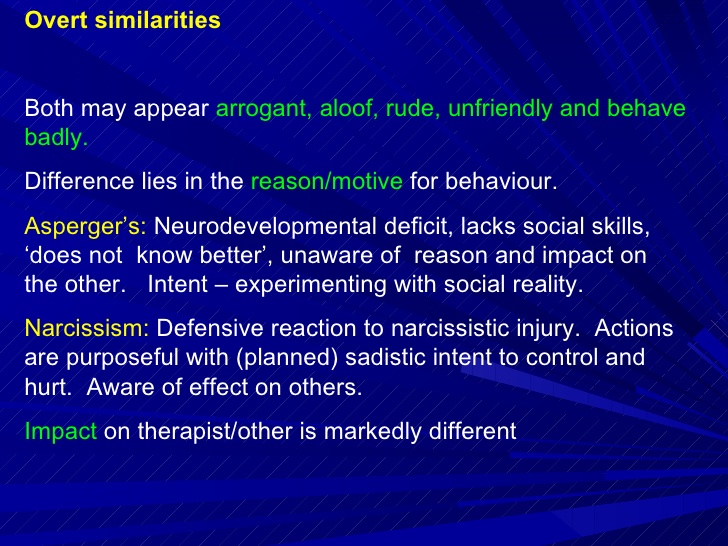
As a person with Aspergers who has been a victim of narcissists all my life, the difference seems pretty clear to me, but to some people, including mental health professionals, high-functioning autism (Aspergers) and narcissism are seen as the same disorder!
A thread on Wrong Planet, a forum for people with autism and Aspergers (a high functioning form of autism) discusses the confusion, with people on both sides of the Aspergers=Narcissism fence. Cited there is an article from Psychology Today, which quotes Sam Vaknin who believes narcissism is an autism spectrum disorder! The British psychiatrist Dr. Khalid A. Mansour concurs.
I understand where the confusion comes from. On the surface, the two disorders can appear similar. People on the autism spectrum may seem as if they lack empathy because they do not express their emotions well, which of course includes showing empathy. They also sometimes blurt out inappropriate or hurtful things, not because they mean to, but because they honestly don’t know any better: they have great difficulty reading social cues. They can appear selfish and sometimes get angry or upset when their routines are interrupted or they are forced to pull themselves away from their solitary pursuits to engage with others. They can also violate the boundaries of others. All of these surface behaviors may look a lot like narcissism.
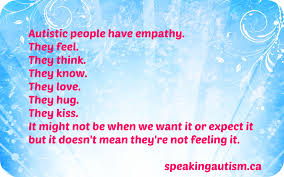
But appearances are only skin deep, and this is where any similarity ends. Lack of empathy seems to be the most commonly mentioned “characteristic” of both Aspies and narcissists. But in actuality, as far as empathy is concerned, a person with autism/Aspergers is the polar opposite of a narcissist. A narcissist cannot feel empathy, but can act as if they do. They are good actors and can fake emotion they do not feel. They can lie well; Aspies cannot lie or lie very badly. People with Aspergers and high functioning autism are great at picking up the emotions of others around them and are even sometimes overwhelmed by other people’s emotions (which sometimes makes them withdraw and that can make them seem like they lack empathy). They can be bad at expressing empathy because of their inability to read social cues or know what to say and do. Therefore, Aspies can feel empathy but often act as if they do not.
Narcissists can say hurtful or damaging things because (a) they don’t care how you feel; or (b) because they want to hurt you. People with autism/Aspergers say hurtful things too sometimes, but it’s never intentional and they do care how you feel. If they are told they said something hurtful, most autists/Aspies are consumed with guilt and will sincerely apologize. They blurt things out because they sometimes do not know it’s not appropriate to do so.
Aspies and autists hate to have their comforting routines interrupted because repetition is something that grounds and relaxes them. A low functioning person with autism will sometimes perform repetitive movements or repeat a phrase over and over. This is how they cope with too much stimuli coming in. If they are interrupted, a low-functioning autist may fly into a rage or have a temper tantrum. Disengaging and switching gears is impossible for them.
At the higher end of the spectrum, an Aspie or high functioning autist may not repeat the same word or action over and over, but they have their hobbies and obsessions which they pursue with a single-minded intensity. They tend to hyper-focus on whatever interests them. If they are interrupted from whatever their mind is focused on, they may snap at you or become very annoyed. They can switch gears if they must but they hate doing it.
A narcissist may also snap or become annoyed, but not because they have difficulty switching gears but because they are just plain selfish and don’t want to do something that might please someone else besides themselves. Think of the narcissistic husband playing a video game. His wife comes into the room and asks for some help opening a stuck window. The husband flies into a rage and tells her he’s busy and to do it herself. It’s not because he’s that engrossed in the game or even cares about it that much, it’s because he doesn’t want to put himself out for his wife. For an Aspie or autist, the game engages all of their senses and their mind is extremely focused. They simply can’t pull away from it.
A person with autism or Aspergers can and do violate the boundaries of others. Again, this is because they can’t read social cues well enough to know when they are violating someone else’s boundaries. A narcissist knows full well when they are violating boundaries, but they simply do not care.
A forum member on Wrong Planet sums up the confusion this way:
To me it’s as absurd as comparing the small narcissistic child recklessly driving a car, to a person trying to cross the street in a wheelchair, and saying they have a lot in common because they both have a set of wheels.
I think mental health professionals and others who believe narcissism and Aspergers are on the same spectrum need to dig a lot deeper before they make such sweeping generalizations. They are not the same disorder at all and are certainly not on the same spectrum. Aspergers/high functioning autism is a neurodevelopmental deficit and really a type of learning disability; narcissism is a moral deficit.
I didn’t post anything last night because my power went out and when it got dark, there was nothing else to do but go to bed.
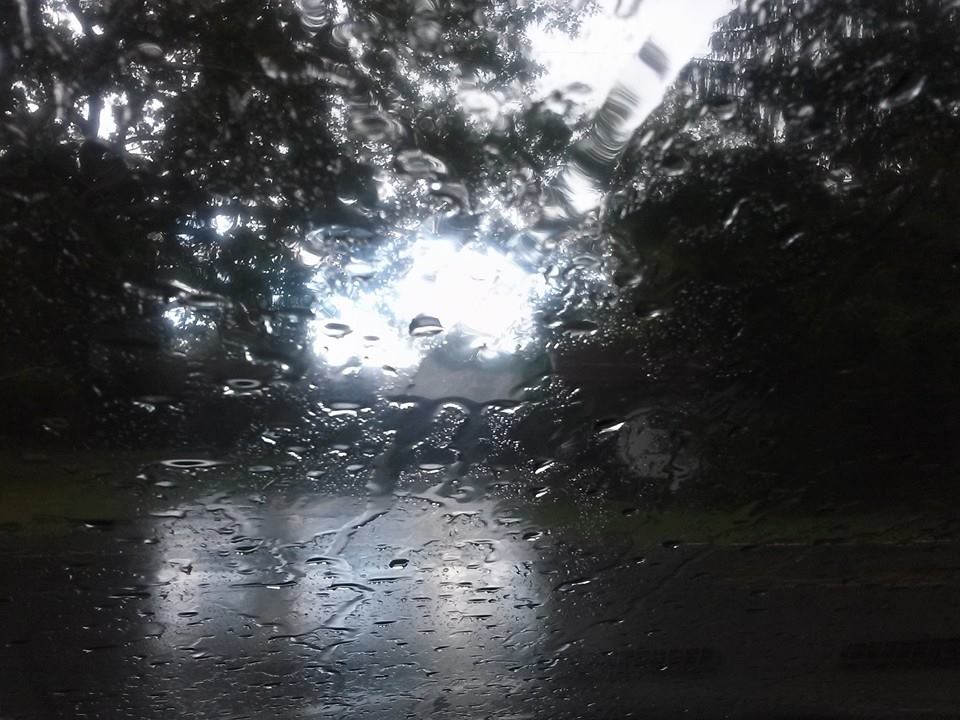
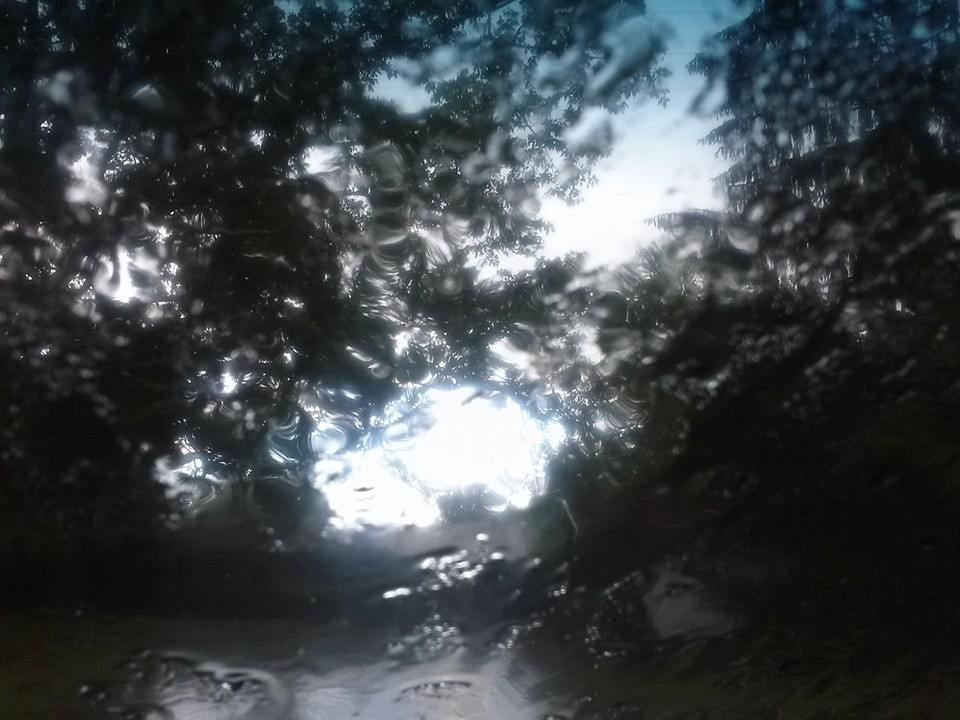
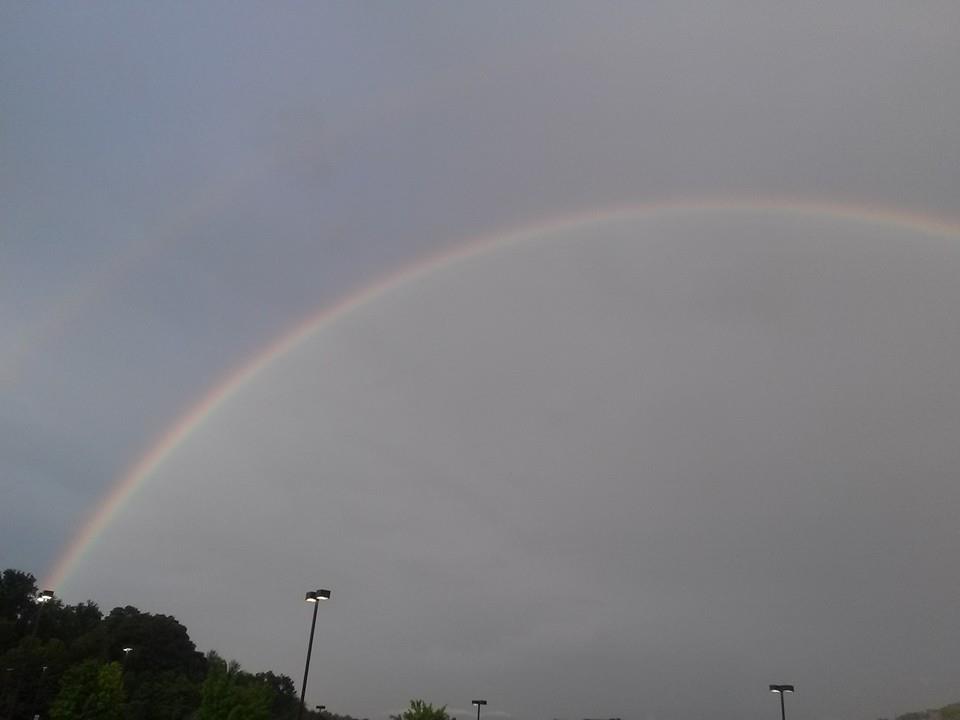
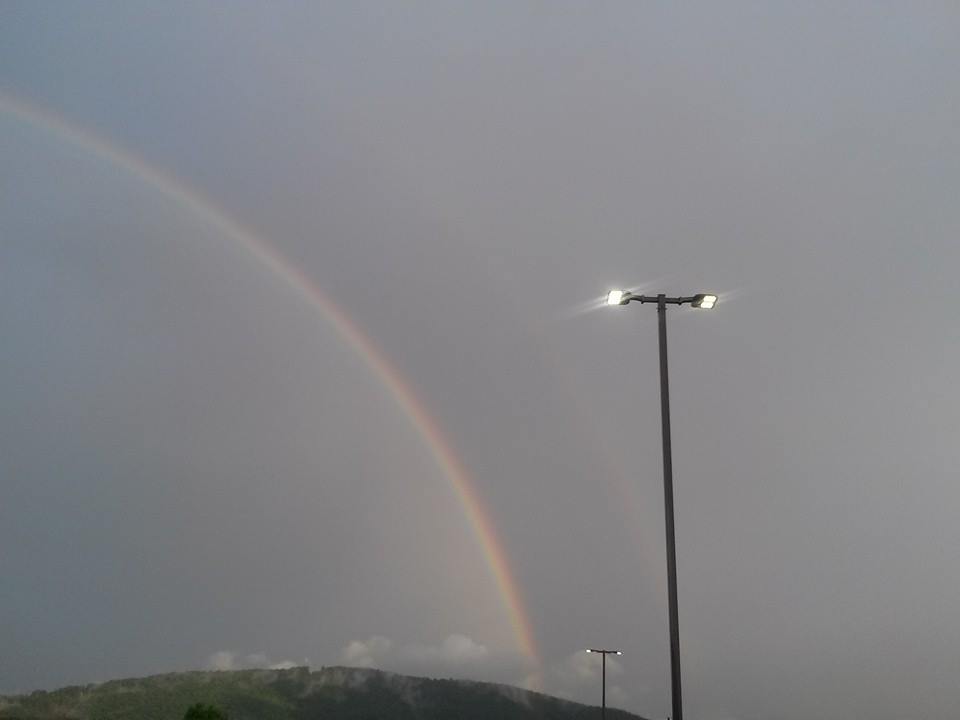
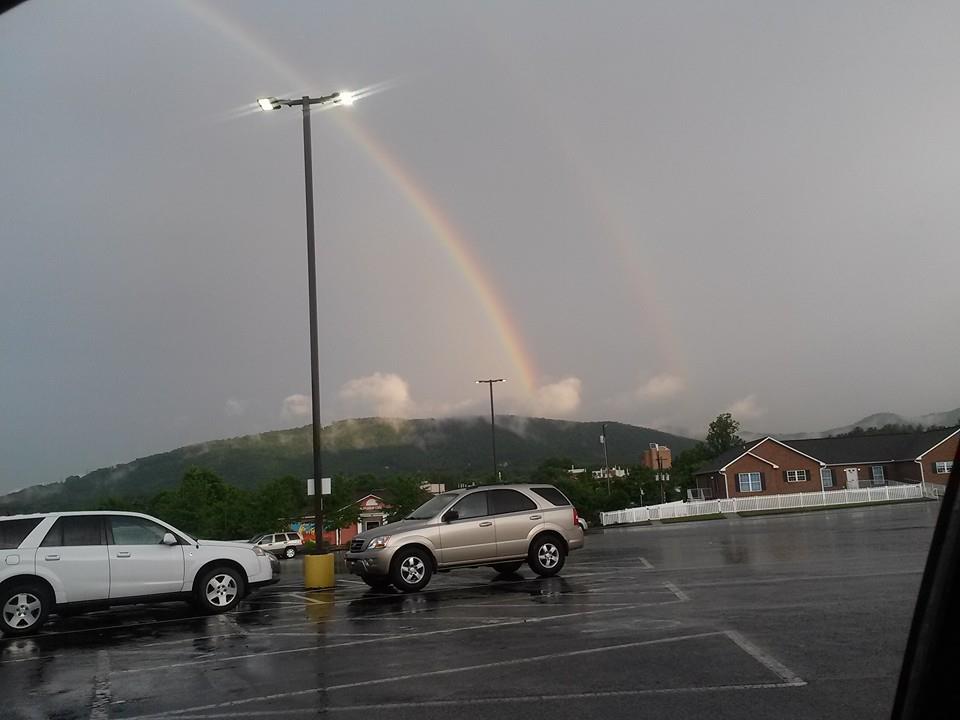
So anyway. For the past few days I was worried because I didn’t seem to be coming up with many creative ideas and have been resorting to reblogging and video-posting to make up for that. But driving home last night it started raining, and suddenly I started snapping pictures when I saw the electrical pylons, which seem otherworldly to me. I’ve always been fascinated by electrical pylons and at some point (when it isn’t raining) want to go to the electrical field and do a photographic study of them.
When I was in my early 20s, photography was a hobby of mine and I thought I might become a professional photographer, but unfortunately my expensive 35mm camera I’d saved for months to purchase was stolen, along with all my camera equipment, and that made me give up that dream.
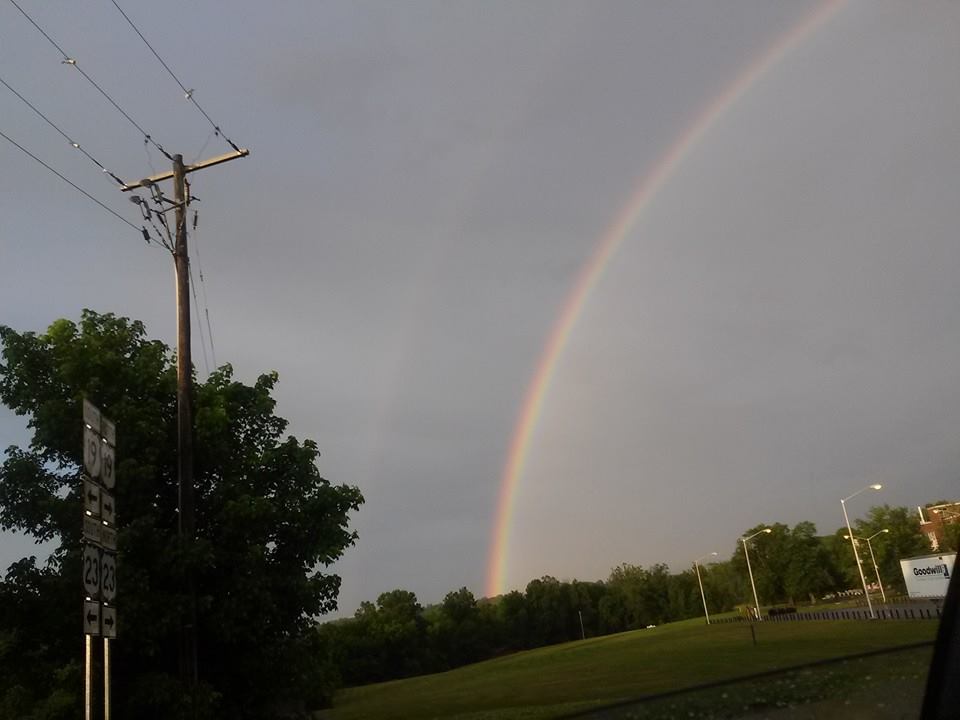
The rainbow at the end of these photos seemed to me like a promise from God telling me my future is still bright and NO ONE one can convince me it’s all over for me because of my age or any other “reason” why I will fail to become successful in the things I love to do the most (mainly writing–maybe I’ll write a book that includes photography).
Enjoy the photographs. Unfortunately, my crappy phone camera didn’t really capture the brilliance of the rainbow. Can you see the double rainbow there?
If you were a survivor of a narcissistic family (or were otherwise a victim of narcissistic abuse), as I was, you were probably told your emotions were not okay. Instead you were told to stuff them and hide the way you really felt from the world. Unfortunately that’s the same philosophy modern society holds in general, and of course narcissists stuff all their feelings all the time, except rage. It can get so bad you reach a point where you tell yourself you’re bad for even having feelings or being upset when someone hurts you.
Several months back, I wrote an article about the way some proponents of positive thinking use it as a way to deny their own true feelings or use it to invalidate the emotions of others. Used this way, positive thinking can become a form of abuse or self-abuse. Of course, there’s nothing wrong with being a positive person, but there’s something very off about someone who walks around wearing a fake smile pasted on all the time and insists we must always do the same. Ironically, these “positive thinking nazis” instill a sense of guilt and shame.
Back in the early ’90s, “Saturday Night Live” did a mock self-help show called “Daily Affirmation With Stuart Smalley.” Stuart Smalley was a spoof on individuals who were obsessed with 12-step programs and who had become addicted to the act of going to therapy. Smalley ended each show by looking into a mirror and saying, “I’m good enough, I’m smart enough, and doggone it, people like me!” The skit was hilarious because Smalley was the personification of vanity, self-indulgence and narcissism — traits often used to describe our culture.
To counteract our self-absorbed culture, many Christians have gone the opposite direction. Worm Theology is based on Psalm 22:6: “I am a worm, and not a man…” or the line in the Isaac Watts hymn “Alas! and Did My Saviour Bleed,” which says, “Would He devote that sacred head for such a worm as I?” Worm Theology is a belief within Christianity that a feeling of worthlessness and expression of low self-esteem means God is more likely to show mercy and compassion.
Instead of debating the merits of this belief system, I want to focus on what I see as a natural consequence to a low view of self in our Christian culture today: a lack of self-compassion. Sadly, I even noticed this in my own house last night with my 14-year-old daughter.
My family recently relocated from Northwest Arkansas to Colorado Springs. No cross-country move is ever easy, but it’s been especially hard on my daughter Maddy. Last night I lay on the floor of Maddy’s room as she cried about feeling like no one really understands her feelings. It broke my heart to hear how alone she feels — that no one understands what she is going through. Thus, she felt that she has no one to share how she really feels. In the end, she ultimately got tough with herself and expressed that she should be over these feelings, that her feelings were wrong and that she was stupid for getting so emotional.
I so wanted to jump in and correct her, “Your feelings are not stupid!” but I didn’t. I wanted to tell her that God cares about her emotions (which He does), but I refrained. I was tempted to recue her by telling her that I care (which I do), but I stopped myself. What an insensitive father, some might think. I didn’t jump in to rescue my daughter because I want her to learn something that most Christian adults don’t get: Their feelings matter!
Beautiful song with a destructive message.
But sadly, for so many people, their emotions usually don’t matter. I watch time and again, when counseling with people, that they constantly judge, belittle, criticize, demean, minimize and marginalize their emotions. It’s like there’s this Christian belief that we must never wallow in our emotions. It’s like people are afraid they’ll become self-indulgent or vain (like Stuart Smalley) if they have compassion around their feelings. They believe self-criticism is what keeps them in line. Most people have gotten it wrong because our culture says being hard on your self is the way to be. It’s like the ’70s song by Melissa Manchester that had the lyrics, “Don’t cry out loud. Just keep it inside and learn how to hide your feelings.” Listen to some of the messages that are out there about our emotions:
Real men don’t cry.
You’re just being a drama queen.
Play through the pain.
It’s just that time of the month.
You shouldn’t feel that way!
That’s not how you really feel!
Why do you get so emotional?
Both men and women have learned these messages well, and the tragic consequence is that most people have no idea how to validate their own emotions. Since birth, most of us have had our feelings so massively invalidated that we don’t know how to care for our emotions. Instead of valuing our feelings as a great source of information, we stuff them, ignore them or judge them away. Thus, the hope for our relationships is that we will find that perfect someone who will finally care about and validate how we feel. Although we don’t do it, the fantasy is that our friend, significant other or spouse will value our emotions. Great plan, right?
I believe one of the greatest gifts we can give our self is the gift of compassion. When we are upset, frustrated, fearful or hurting (like Maddy) we should be the first one in line to care about how we feel. Why should I expect someone else to care about my heart and emotions if I don’t do that job first and foremost? The question we should be asking ourselves is do we treat our self as well as we treat our friends and family? We are often gentle, kind, compassionate and empathic with others. However, a new research study on self-compassion found that people who find it easy to support and understand others, it turns out, often score surprisingly low on self-compassion tests, berating themselves for negative emotions and perceived failures like being overweight or not exercising. The research suggests that giving us a break and validating our feelings and imperfections may be the first step toward better health. People who score high on tests of self-compassion have less depression and anxiety, and tend to be happier and more optimistic.
The more you seal yourself from your emotions, the more isolated and disconnected you feel. While you can suppress and repress your feelings, you cannot get rid of them. You always bury emotions alive. At some point they will always come out, but then they usually come exploding out like a volcanic eruption. The only way to make peace with our emotions is to value them, face them, explore them, understand them and then take them to the Lord. “Cast all your anxiety on him because he cares for you” (1 Peter 5:7). Suppression takes an incredible amount of energy — energy which is constantly being tapped to maintain a wall of protection around your heart.
The bottom line is that your emotions are incredibly valuable. Not in a way that suggests we should all indulge in emotional bliss, holding hands while singing “Kumbaya” like Stuart Smalley. Give yourself the gift of compassion around your feelings — after all, your emotions are the voice of the heart.
What do you do when you are fearful, frustrated, upset or hurting? Are you good at self-compassion, or do you stuff, ignore and judge your feelings?
In order to be diagnosed with Narcissistic Personality Disorder (NPD) a person must meet at least five of the nine criteria specified in the DSM. Most narcissists do not meet all 9.
Brian Blackwell, a young man who murdered both his parents and then callously left their bodies behind to take a trip to New York City with his girlfriend, met all 9 criteria. Here is his story.
Here is a very interesting but disturbing documentary featuring Dr. Robert Hare, the forensic psychologist who developed The Psychopathy Checklist (which is used routinely in courts of law and police departments to identify psychopaths.) Here, the focus is on the non-prison population of psychopaths, which includes a high percentage of financially successful people in business.
Psychopaths tend to rise to corporate stardom quickly because the qualities they have (ability to focus on a goal, risk-taking, cunning, ruthlessness, etc.) are valued in business, while the ones they don’t have (empathy, guilt, caring, love, etc.) are not. High-functioning psychopathy was behind the 2008 financial crisis, and it’s said here that many banks were actually using Hare’s Psychopathy Checklist to hire new employees!
The video also discusses psychopaths in relationships, how psychopathic brains differ from normal ones, and the causes of psychopathy.
I’ve often noticed how dead-looking the eyes of some of our CEOs and politicians are. It’s like they have no soul. It’s very scary that these are the people who have the most power right now. They are like reptiles. Snakes in suits.
Here’s my son’s latest music video–“Glycerine” by Bush (he was only three when this song was released in 1994). I love this song and this is an interesting interpretation.
My friend (and commenter on this blog) Alaina lives in Eastern New Mexico, where the prairie meets the desert. Severe storms and tornadoes are a common occurrence in her part of the country in the spring. She sent me these unbelievable pictures on Twitter. I am including her words in the captions of this incredible moment. I would have been so scared I doubt I could have held the camera steady, or even had the presence of mind to take photos at all!
While driving in eastern NM last week we saw this storm tracker beside the road watching the sky…..
…We drove to a nearby truck stop. I got out of the car and took pictures of the storm cloud…
Suddenly a wall of dust and debris was whirling all around us!
We were standing directly under a supercell, inside the vortex of a weak mesocyclone approx. 200′ wide!
It looked & sounded scarier than my pics show. Wish I’d switched to video~dramatic high plains weather!
I would say Alaina was very lucky! But what a fantastic opportunity to take some amazing photos.