Me and jokes.

grumpycat_notfunny

Having my kind of disorders (Avoidant, BPD and possible [self-identified] cNPD), I have a hard time coping with jokes made at my own expense. I try to hide my anger/hurt and joke back, but it never goes over very well and people can usually tell I’m offended or hurt anyway. It makes me feel too exposed and vulnerable, and that’s why I prefer solitude than being around people.

I also don’t care for those old fashioned jokes you have to “get.” It’s not that I can’t understand the joke, but that I always feel pressure to “get it” and spend the whole time they’re telling me the joke worrying that I might not get it and they’ll think I’m stupid. 😳 😕

It’s a self fulfilling prophecy too, because I spend so much time stressing over maybe not getting the joke that I wind up *not* getting it! And then feeling stupid when I have to fake-laugh.

Most people always want to tell you those kind of jokes and I stress too much about it.
I much prefer random, goofy, wtf humor you don’t have to “get.” Like Roz Chast cartoons. 8)

An upsetting memory.

little_booklets

I remembered something today. Little by little my mind is pulling up ancient memories from dark and forgotten corners as I move further along in my recovery. This one almost knocked me over.

For years…YEARS!…I couldn’t write. This past year and a half has been the first time in my life I haven’t in under the thrall of a high spectrum (malignant) narcissist, and it wasn’t until I freed myself from them that my words began to come back.

As a child I wrote all the time. I drew pictures too. I remember my father bringing home these little blank stapled booklets in different colors with lined paper in them. There were about 50 of them, tied up in rubber bands. I used to write little stories and illustrate them. I could spend hours doing this.

I always blame my mother for everything. I act as if my father (who was codependent, and probably either covert N or borderline) had nothing to do with my disorders. I always saw him as a victim too. But he colluded with my mother; both were abusers. I remember one day when I was 7 or 8, I came home from school, and as I did every day, I went to my desk and opened the drawer to start writing my little stories. I noticed some of my finished booklets were gone. Panicking, I looked everywhere for them, and couldn’t find them. They were very personal to me, like diaries. They were for my eyes only (my Avoidant traits had already set in) . I was very upset but couldn’t tell my parents because then they’d be looking for them and they’d KNOW.

I looked all over the house for them, and finally found them in my father’s filing cabinet in a folder with my name on it. I was horrified. He stole my private creations from me! I felt so violated. My boundaries had been viciously invaded. I remember stealing them back and destroying them. I couldn’t even bring myself to look at them anymore. There was too much shame.
It was as if I wanted to annihilate myself…my true self.

After that I seemed to lose interest in drawing, although I continued to write. But my passion for even that was gone. I didn’t say anything to my dad about him stealing those booklets because to do so would be to invite critique and shame. I knew instinctively he liked them (otherwise he wouldn’t have taken them from me), but I didn’t even want to hear anything good about them. The stuff in them was just too personal. I felt like I’d been raped.

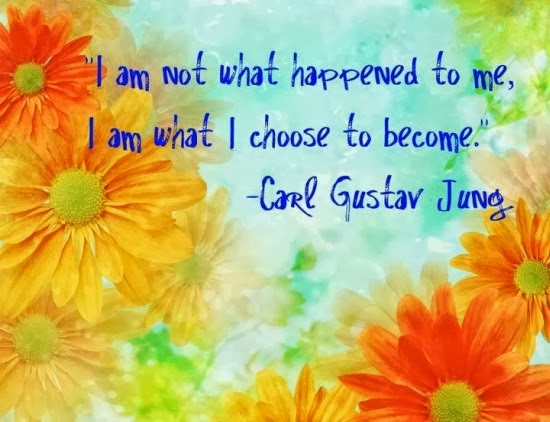
jung_quote

I wrote a novel in 2003. No one wanted to publish it. It sucked. I still have it but it’s embarrassing to read because of how bad it is. I know why though; at that time, still under the thrall of my ex, I was trying too hard to be “a writer,” to make an impression, instead of being authentic.

And now…I’ve done a 180 from when I’d hide my little illustrated books and was so horrified when they were discovered: deliberately posting the most personal stuff imaginable for total strangers all over the Internet to see (under an assumed name, of course). It’s like I’m trying to redeem my shame, somehow. It’s very hard to explain.

After being in my abusive marriage, I thought I’d lost all my ability to do anything at all. I’d sit down and try to write something, and….I couldn’t do it. I even thought I’d lost my intelligence. I was marking time until death. I felt stupid, dead. But I didn’t care either…or thought I didn’t care. I couldn’t feel anything at all. All my emotions were gone.

I was wrong, so wrong about all that.

I hate “soft” toilet paper.

toilet_paper1

My roommate went shopping yesterday and brought home a 12 pack of toilet paper, which was a good thing because we were just about out.

But the toilet paper will be gone in less than a week, and it’s not because either one of us have some…uh, problem. It’s because the toilet paper she bought is the soft, puffy kind where one roll lasts about one day. Maybe less, if you ate a big, rich, greasy dinner the night before or come down with some bug.

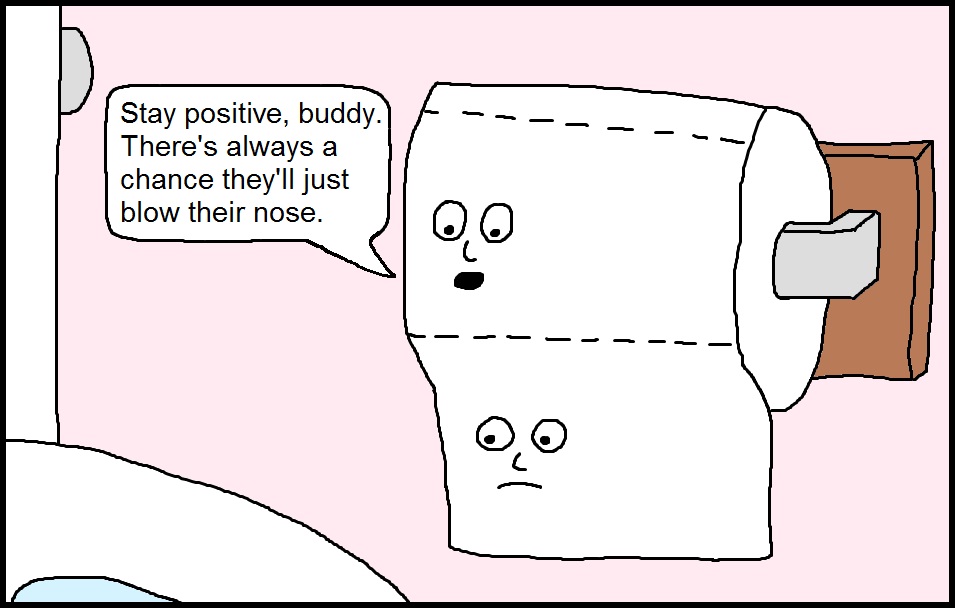
toilet-paper-cartoon

It’s annoying to me. It’s not even worth putting the damn roll on the toilet paper holder, because it won’t last long enough to make that effort worth it, so I just set it on top, like this:

toilet_paper2

The toilet paper companies dupe you into thinking you’re getting a bargain but you’re really getting ripped off. A four-pack of cheap one-ply lasts about 4 times as long as that 12-pack will and costs about the same (and probably kills fewer trees too).
The softness of it bugs me too. Personally I prefer a little grit.

Bye bye, Charmin Ultra Soft! Hello, Scott 1-ply!

Is narcissism a product of confirmation bias?

confirmation_bias

I just read a very well written post on Psychforums (written by a self-proclaimed empath) suggesting that NPD could be a product of confirmation bias. In simpler terms, a happy, normal person became that way because from an early age, they perceived their caregivers as good and kind, and the world as a friendly, welcoming place. In contrast, a narcissist became a narcissist because they perceived, from an early age, that the world was full of pain and terror, people were hostile and untrustworthy, and life in general sucks.
People give back what they they get.

Confirmation bias also explains why most narcissists hang onto their narcissism the way a shipwrecked person hangs onto a block of wood to keep from drowning.

According to Wikipedia,

Confirmation bias, also called myside bias, is the tendency to search for, interpret, favor, and recall information in a way that confirms one’s beliefs or hypotheses while giving disproportionately less attention to information that contradicts it. It is a type of cognitive bias and a systematic error of inductive reasoning. People display this bias when they gather or remember information selectively, or when they interpret it in a biased way. The effect is stronger for emotionally charged issues and for deeply entrenched beliefs. People also tend to interpret ambiguous evidence as supporting their existing position. Biased search, interpretation and memory have been invoked to explain attitude polarization (when a disagreement becomes more extreme even though the different parties are exposed to the same evidence), belief perseverance (when beliefs persist after the evidence for them is shown to be false), the irrational primacy effect (a greater reliance on information encountered early in a series) and illusory correlation (when people falsely perceive an association between two events or situations).

thinking-conf-bias

So, here is that post:

I wonder if NPD might largely be a product of confirmation bias. I guess a less pretentious way of saying that would be that people tend to hear what they want to hear or what they expect to hear.

I was raised in a supportive environment by truly loving people. I was very lucky; like, winning-lottery-number lucky. I first experienced the world as a benevolent place, and so I now tend to approach it with love and warmth and openness. (I hate how sugary that sounds, but I have to accept that it’s true — it’s who I am.) I trust people. I believe they’re basically kind and well-intentioned and that their flaws don’t make them less beautiful. Generally, I feel safe and good and happy to be around them.

But meanwhile, if you’re a narcissist, you first experienced people as sources of abuse, neglect, manipulation. You are born into this cold, threatening world, and the people tasked with protecting you from it are capricious, deceitful, cunning, selfish. That’s bad enough, but what’s far crueller is that there’s a world of happy-looking people out there, and none of them — not one — seems to give a $#%^ about what is happening to you. No one comes to help. Everyone totally buys into your parents’ facade of being just the best parents ever. So you learn the importance of facades. You learn it again, later, when — as a consequence of your nightmare of a childhood — you start getting into trouble. This time it’s cops or doctors teaching you the lesson, but it’s the same: the inability to maintain a facade of normalcy can cost you everything.

(######6 Christ. As an aside, if anyone is wondering what having empathy feels like, it feels like wanting to throw up/cry/punch walls while writing the above paragraph.)

But right, okay: confirmation bias. Since my emotional experience of the world is positive, I tend to seek out and remember things that confirm and validate that worldview. I.e. in relationships I tend to remember the good things people do and forget the bad, and I tend to believe that the kind/honest/giving aspects of people’s personalities are “who they really are.” And I guess narcissists do pretty much the opposite: they dismiss the good stuff you do, but the bad stuff stays so front-and-center it’s as though you’re doing it fresh, day after day, every time they remember it. When they ultimately find out you have flaws, they take this as evidence that they were always right: people are basically evil & untrustworthy & disappointing.

I’m not saying narcissists are necessarily wrong. There’s ample evidence that people really are monstrous (just open a newspaper). I’m also not saying my tendency to be compassionate/forgiving makes me some kind of saint, because I’m pretty sure some of it is ego protection. Seriously, you can smash me over the head a dozen times with a blunt instrument and I will still stupidly, doggedly believe you didn’t mean it or it was an accident or you were just hurt so it’s okay. I believe that in part because I need to believe that. If I allow that some people simply view others with hate or callow indifference or cold, calculating self-interest, then I have to revise the whole framework on which my understanding of the world and my place in it is built. And I really don’t want to do that. That $#%^ is so core and so central it feels like changing it would destroy everything.

But it would be so much worse for someone with NPD trying to revise their worldview in order to “get better.” Because in my case I’d be moving from a place of trust to a place of distrust, which some animal part of me knows how to do: you get hurt and so you withdraw, harden, your eyes get cold. It’s not fun but it feels familiar and safe. Whereas I guess a narcissist would have to do exactly the opposite. Move from a place of distrust to a place of trust. Which…how would you even do that? How would you surrender the only thing that ever made you feel protected or safe or stable? That would be so terrifying I can’t even imagine it. And what would ever inspire you to do it? Except for trust that there really are kind, well-meaning, loving people out there, which trust a narcissist, by definition, does not have?
How my ex became a malignant narcissist.

I thought I’d repost this article again, because it shows exactly how narcissism can be passed from one generation to the next, due to emotional abuse of a child that stunts or halts their healthy development of a sense of self.

Since this article was written back in February, my ex was diagnosed with Antisocial Personality Disorder (ASPD) and due to his “unemployability due to possible homicidal tendencies,” he got $31K in disability back pay AND an increase in disability payments. Commenting on this outrage is beyond the scope of this article and I’ve already ranted enough about it anyway. He has already gone through all the money, as I suspected he would. It still doesn’t sit well with me that his monthly income due to being a narcissistic, antisocial jackass who games the system and freeloads off others so he never has to work again exceeds mine.

luckyotter's avatarLucky Otters Haven

Martin-Luther-King-Good-vs-Evil

I’ve talked about several of my own family members and how narcissism has infected other family members with NPD and/or made them victims, but I haven’t focused too much on how my ex husband Michael, as malignant as they come, got that way.

So I am doing that now.

Michael, like most narcissists, wasn’t born that way. He was the only child of a machinist who was rarely home and when he was, stayed in the background, believing raising a child was “woman’s work.” The household was blue collar but back in the early ’60s, blue collar didn’t mean poor. A working class man could adequately support his family, buy a home, have two cars, and his wife didn’t have to work to help make ends meet.

From all accounts, Michael’s father loved him in his rough-around-the-edges macho way, but he spent hours every day in bars or at the…

View original post 1,593 more words

What exactly is Narcissistic Personality Disorder?

For those of you who follow this blog, this question probably seems like a no-brainer, but this is one of the most informative and readable articles I’ve ever read on the subject, and I even learned a few new things I didn’t know, so I wanted to share it.

What Exactly Is Narcissistic Personality Disorder?
By Christine Louis deCanonville, author of The Three Faces of Evil: Unmasking the Full Spectrum of Narcissistic Abuse

deviantartecho
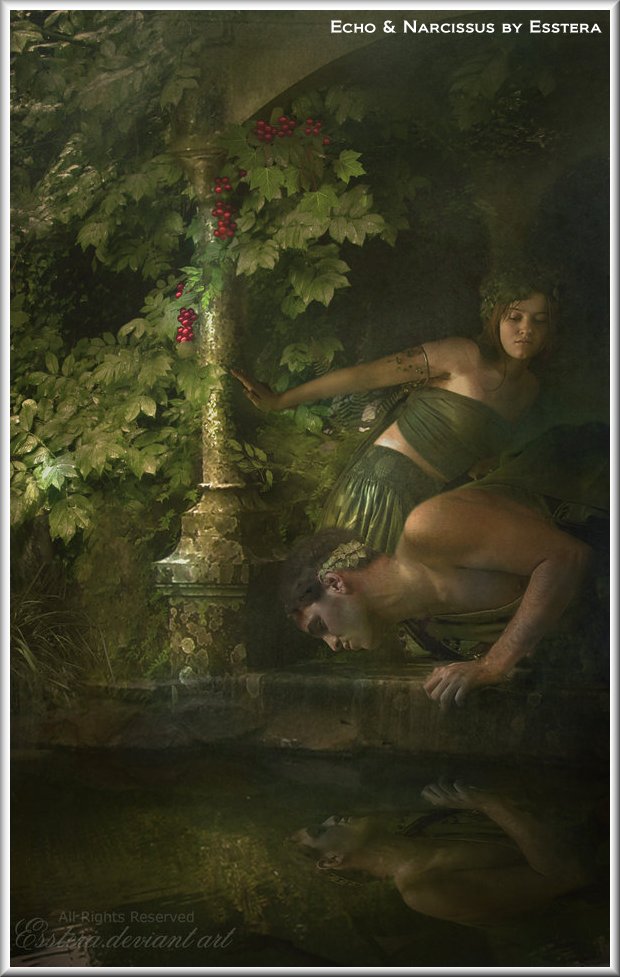
Narcissus and Echo by Esstera, Deviantart

Explaining the Many Facets of Narcissism!

Narcissistic Personality Disorder, what exactly is it? Trying to explain exactly what narcissistic personality is takes some doing, the reason being that there are so many facets of behaviour involved. However, Narcissism, roughly translated means “love of oneself”. The term itself refers to a set of character traits that involve self-admiration, self-centeredness, and self-regard; to the point where the narcissistic person becomes very grandiose, arrogant, aggressive, lacking in empathy for others, superior to everybody else, and sporting a sense of entitlement that leaves them in constant need for attention and admiration in all their relationships. The term was coined by Sigmund Freud who picked the myth of Narcissus as a symbol of a self-absorbed person whose libido is invested in the ego itself, rather than in other people. There are several versions of the myth, but roughly translated Narcissus, in Greek mythology, was a beautiful Greek boy who found himself to be so attractive, that he falls in love with his own reflection. The term narcissistic personality disorder, also taken from the myth, describes a self-loving character with grandiose feelings of uniqueness.

The Spectrum of Narcissism is on a Continuum.

Narcissism is a spectrum of behaviour that is prevalent in the human condition universally. What this means is that we are all narcissistic to a degree, and the narcissistic traits can range on a continuum from 1 – 10, from what we call Healthy Narcissism (being a 1), all the way to a pathological form, called Narcissistic Personality Disorder or NPD (being a 10), with varying degrees in between. When narcissism reaches a stage called “Malignant Narcissism” the person consistently manifests at least 5 of the 9 criteria necessary to put it into the category of being a mental disorder.

To the casual observer, telling the difference between a normal range narcissistic personality and a narcissistically disordered personality may not be very evident to begin with, because the difference is the difference between the individuals “intentions”. The healthy narcissistic personality operates from a place of good will towards another person, while the unhealthy malignant disordered personality operates from a place of ill will towards another person, which naturally enough puts a chasm between them.

Healthy Narcissism Style vs. Unhealthy Narcissism:

Every human being craves approval. This need for approval is driven by the ego in order to make us feel loved, important, powerful and in control, and perhaps even more importantly, to steer us away from any criticism, which can lead to feelings of inferiority. Adler (psychologist) believed that it was the pain of inferiority that motivated all human action to strive for a sense of superiority and perfection. This is natural, and is healthy narcissism in action, a normal defense that is essential for psychological health. It is this action that protects us from painful disappointments, failures, and keeps us away from feelings of helplessness. This boosting of our morale (Healthy Narcissism) is what motivates us to do better with our lives.

Read the rest of Christine’s article here.

Has anyone noticed the trees are already changing color?

fall_tree

It’s still only August, but it seems like autumn has arrived early. I first noticed about 2 weeks ago that many of the trees in this area (western NC, US) are already changing to their fall colors. Normally this doesn’t start to happen in this part of the country until mid-late September, so this is about a month ahead of time.

It’s been swelteringly hot (and only in the past week have I noticed it’s getting a bit cool at night and in the early morning), so I don’t think the temperature has anything to do with what’s happening to the trees. Someone told me this can happen when the weather is very dry too, because without enough water, the trees can’t produce chlorophyll, which is what makes them green. We’ve had little rain this summer, so perhaps this is the reason.

Too depressed.

Bad day. Hour long fight with my mobile provider. Car barely running. Work sucks. Fall is in the air and the trees are already changing and that doesn’t help.
Too much stress. Too much anger at my parents for making me what I am. Too much pain and regret. Too much grief to handle. I’m not that strong; right now I feel very weak.
I’m much too depressed tonight to write anything longer. I’m sorry. Don’t worry. I’ll be fine.

A little romance.

I love this photo of my daughter and her fiance.

photo_rb

Is NPD really a dissociative disorder?

dissociative_identity_disorder

I think there’s good reason to think NPD (and to some extent, BPD) is really a dissociative disorder. Think about it. There is a true self and a false self that are split from each other, much the way a person with dissociative identity disorder (DID) has a “waking self” or the “host personality” (the DID’s equivalent of the true self) that has split into different “personalities”, some of which aren’t even aware that others exist. Still, the narrative of the true self runs beneath everything, like an underground river feeds the land above it. In other words, the false self’s behaviors are driven by the need to keep the true self hidden and/or protected.

NPDs (and BPDs) also have episodes of dissociation and feelings of unreality, depersonalization, derealization, or even annihilation when under stress or when injured, and these dissociative episodes can become so bad during a narcissistic crisis that a psychotic break can occur. Narcissists are not unknown to become psychotic during old age due to massive loss of supply.

There are other things too that are dissociative–the magical thinking, the splitting, and the manifestation of the FS itself, which is, in essence, a separate “personality” from the TS.
I’ve read elsewhere that NPD could be a dissociative disorder, and I think it’s a valid argument. Thoughts?