How my ex became a malignant narcissist.

I thought I’d repost this article again, because it shows exactly how narcissism can be passed from one generation to the next, due to emotional abuse of a child that stunts or halts their healthy development of a sense of self.

Since this article was written back in February, my ex was diagnosed with Antisocial Personality Disorder (ASPD) and due to his “unemployability due to possible homicidal tendencies,” he got $31K in disability back pay AND an increase in disability payments. Commenting on this outrage is beyond the scope of this article and I’ve already ranted enough about it anyway. He has already gone through all the money, as I suspected he would. It still doesn’t sit well with me that his monthly income due to being a narcissistic, antisocial jackass who games the system and freeloads off others so he never has to work again exceeds mine.

luckyotter's avatarLucky Otters Haven

Martin-Luther-King-Good-vs-Evil

I’ve talked about several of my own family members and how narcissism has infected other family members with NPD and/or made them victims, but I haven’t focused too much on how my ex husband Michael, as malignant as they come, got that way.

So I am doing that now.

Michael, like most narcissists, wasn’t born that way. He was the only child of a machinist who was rarely home and when he was, stayed in the background, believing raising a child was “woman’s work.” The household was blue collar but back in the early ’60s, blue collar didn’t mean poor. A working class man could adequately support his family, buy a home, have two cars, and his wife didn’t have to work to help make ends meet.

From all accounts, Michael’s father loved him in his rough-around-the-edges macho way, but he spent hours every day in bars or at the…

View original post 1,593 more words

What exactly is Narcissistic Personality Disorder?

For those of you who follow this blog, this question probably seems like a no-brainer, but this is one of the most informative and readable articles I’ve ever read on the subject, and I even learned a few new things I didn’t know, so I wanted to share it.

What Exactly Is Narcissistic Personality Disorder?
By Christine Louis deCanonville, author of The Three Faces of Evil: Unmasking the Full Spectrum of Narcissistic Abuse

deviantartecho
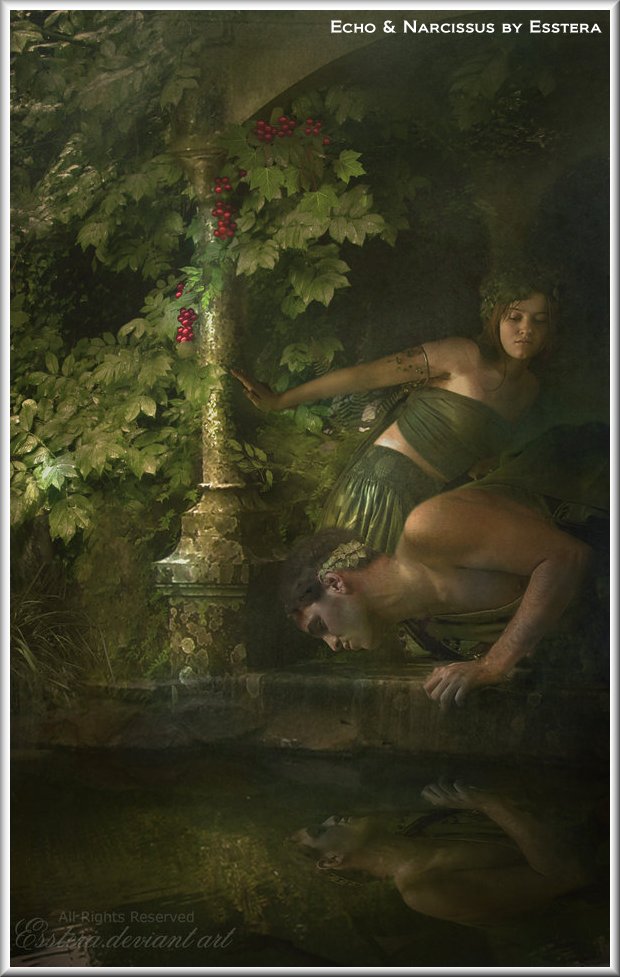
Narcissus and Echo by Esstera, Deviantart

Explaining the Many Facets of Narcissism!

Narcissistic Personality Disorder, what exactly is it? Trying to explain exactly what narcissistic personality is takes some doing, the reason being that there are so many facets of behaviour involved. However, Narcissism, roughly translated means “love of oneself”. The term itself refers to a set of character traits that involve self-admiration, self-centeredness, and self-regard; to the point where the narcissistic person becomes very grandiose, arrogant, aggressive, lacking in empathy for others, superior to everybody else, and sporting a sense of entitlement that leaves them in constant need for attention and admiration in all their relationships. The term was coined by Sigmund Freud who picked the myth of Narcissus as a symbol of a self-absorbed person whose libido is invested in the ego itself, rather than in other people. There are several versions of the myth, but roughly translated Narcissus, in Greek mythology, was a beautiful Greek boy who found himself to be so attractive, that he falls in love with his own reflection. The term narcissistic personality disorder, also taken from the myth, describes a self-loving character with grandiose feelings of uniqueness.

The Spectrum of Narcissism is on a Continuum.

Narcissism is a spectrum of behaviour that is prevalent in the human condition universally. What this means is that we are all narcissistic to a degree, and the narcissistic traits can range on a continuum from 1 – 10, from what we call Healthy Narcissism (being a 1), all the way to a pathological form, called Narcissistic Personality Disorder or NPD (being a 10), with varying degrees in between. When narcissism reaches a stage called “Malignant Narcissism” the person consistently manifests at least 5 of the 9 criteria necessary to put it into the category of being a mental disorder.

To the casual observer, telling the difference between a normal range narcissistic personality and a narcissistically disordered personality may not be very evident to begin with, because the difference is the difference between the individuals “intentions”. The healthy narcissistic personality operates from a place of good will towards another person, while the unhealthy malignant disordered personality operates from a place of ill will towards another person, which naturally enough puts a chasm between them.

Healthy Narcissism Style vs. Unhealthy Narcissism:

Every human being craves approval. This need for approval is driven by the ego in order to make us feel loved, important, powerful and in control, and perhaps even more importantly, to steer us away from any criticism, which can lead to feelings of inferiority. Adler (psychologist) believed that it was the pain of inferiority that motivated all human action to strive for a sense of superiority and perfection. This is natural, and is healthy narcissism in action, a normal defense that is essential for psychological health. It is this action that protects us from painful disappointments, failures, and keeps us away from feelings of helplessness. This boosting of our morale (Healthy Narcissism) is what motivates us to do better with our lives.

Read the rest of Christine’s article here.

Has anyone noticed the trees are already changing color?

fall_tree

It’s still only August, but it seems like autumn has arrived early. I first noticed about 2 weeks ago that many of the trees in this area (western NC, US) are already changing to their fall colors. Normally this doesn’t start to happen in this part of the country until mid-late September, so this is about a month ahead of time.

It’s been swelteringly hot (and only in the past week have I noticed it’s getting a bit cool at night and in the early morning), so I don’t think the temperature has anything to do with what’s happening to the trees. Someone told me this can happen when the weather is very dry too, because without enough water, the trees can’t produce chlorophyll, which is what makes them green. We’ve had little rain this summer, so perhaps this is the reason.

Too depressed.

Bad day. Hour long fight with my mobile provider. Car barely running. Work sucks. Fall is in the air and the trees are already changing and that doesn’t help.
Too much stress. Too much anger at my parents for making me what I am. Too much pain and regret. Too much grief to handle. I’m not that strong; right now I feel very weak.
I’m much too depressed tonight to write anything longer. I’m sorry. Don’t worry. I’ll be fine.

A little romance.

I love this photo of my daughter and her fiance.

photo_rb

Is NPD really a dissociative disorder?

dissociative_identity_disorder

I think there’s good reason to think NPD (and to some extent, BPD) is really a dissociative disorder. Think about it. There is a true self and a false self that are split from each other, much the way a person with dissociative identity disorder (DID) has a “waking self” or the “host personality” (the DID’s equivalent of the true self) that has split into different “personalities”, some of which aren’t even aware that others exist. Still, the narrative of the true self runs beneath everything, like an underground river feeds the land above it. In other words, the false self’s behaviors are driven by the need to keep the true self hidden and/or protected.

NPDs (and BPDs) also have episodes of dissociation and feelings of unreality, depersonalization, derealization, or even annihilation when under stress or when injured, and these dissociative episodes can become so bad during a narcissistic crisis that a psychotic break can occur. Narcissists are not unknown to become psychotic during old age due to massive loss of supply.

There are other things too that are dissociative–the magical thinking, the splitting, and the manifestation of the FS itself, which is, in essence, a separate “personality” from the TS.
I’ve read elsewhere that NPD could be a dissociative disorder, and I think it’s a valid argument. Thoughts?

Yikes! Does this mean I’m a narcissist?

Almost a year ago, I wrote this slightly jocular post after I read an article describing covert narcissism. It was the first time I’d actually read anything about it. Even back then, I recognized the symptoms as fitting me like a glove, but was far away from awareness. This slightly humorous, false self-deprecating attitude was typical of a lot of my posts at the time. I think somewhere deep inside though, I knew.

I can’t believe how different everything seems now.

luckyotter's avatarLucky Otters Haven

yikes
I just finished reading a Scientific American article that delineates narcissists into two categories: Overt Narcissists and Covert Narcissists:

When most people think of narcissism, they think of the public face of narcissism: extraversion, aggression, self-assuredness, grandiosity, vanity, and the need to be admired by others (see “How to Spot a Narcissist“). But as far back as 1938, Harvard psychologist Henry Murray noticed another breed of narcissist among his undergraduates: the covert narcissist. While the “overt” narcissists tended to be aggressive, self-aggrandizing, exploitative, and have extreme delusions of grandeur and a need for attention, “covert” narcissists were more prone to feelings of neglect or belittlement, hypersensitivity, anxiety, and delusions of persecution [I’ve also seen this referred to as “inverted narcissism,” whatever that means].

Um, I’m prone to feelings of neglect or belittlement, am known to be hypersensitive and anxious, and there are times I believe I’m being persecuted…

But it…

View original post 294 more words

I can’t relate to narcissists who love their disorder.

android

I read this post at Psychforums written by a person who sees their narcissism as a huge advantage.

I spent all my life trying to figure out why I felt so different from other people. A few months ago I was researching in detail narcissism for my master thesis on The Picture of Dorian Gray when I suddenly realized that I fit perfectly with all the criteria to be assessed as a high functioning, cerebral, covert narcissist. I immediately felt amazing about it. Not even for one second I believed that there is something wrong in me, but I soon realized that the rest of the world doesn’t seem to agree with my view.

The idea that my malignant tendencies have a reason to exist empowers them, and all the studies I have read on this topic instead of making me feel like I have a mental illness that should be cured provided me with the tools I need to expand my narcissism and use it in my favor. I guess this sounds like I really am sick, but bear with me: why would I, as a narcissist who feeds upon the desire of being special and unique, have a problem with being diagnosed as such? It makes me different from others for real. I am not going to stand in line with all those narcissists who fear themselves, who punish the way they are. Becoming self-aware opens infinite doors to the great potential I have.

I always deeply enjoyed manipulation, now I know why, but I also know that I have the power to bring this skill on a higher level and the more I master this “science” the less people will realize what I am doing to them. I don’t have a problem letting people know that I am a narcissist, but they never believe it – they still see me as a caring, loving, trustworthy girl who would go out of her way to help, too nice and interesting to be classified as “evil”. This discovery has given a great boost to my self-esteem which used to be pretty low. But it was low because I didn’t embrace and accept who I am. Knowledge is power. I am more functional now than before, I test my potential daily to see how far it can go, how much more I can get from it. Why would people ever want to heal from this?!

They say that a lack of empathy is a terrible thing. I don’t even know what empathy is, so why would I be concerned about owning it? They say I will never be happy with the way I am, but, let’s state the truth, people are never satisfied and fully happy anyway; they live for unhappiness because hope is far more enjoyable and stimulating. They say I cannot have fulfilling and real relationships, but that’s not true: given the right partner I can make him feel like he is the most special person in the world. Of course, all of this is done primarily to make myself feel like I have total control over them, but it can still provide them with some good things for themselves. It’s twisted, but I find unconditional love far more twisted. Self-awareness helps me regulating my depression since now I understand that it’s triggered by a lack of NS, so I just need to adjust that to feel back on track.

And when a NS is not readily available I feed my ego by trying to achieve success and praise in my work or studies. The more difficult and stressful it is, the larger my ego grows when I get there. Have you ever felt a proper ego boost? When it feels like there is something extremely warm in your chest which is expanding throughout your body? I live for that feeling.

I always wanted to become a teacher, but I was scared that I wasn’t good enough for that. Right now it has become clear that this is the only thing that I can do successfully. What’s better than a group of people who you can manipulate on a daily basis without being perceived badly? And here by manipulation I don’t mean in a bad way: you can convince them that they can be and do whatever they want in life. And they will repay you by making you feel omnipotent.

That’s a fair deal to me. Last but not least, being a narcissist made me finally forgive my mother for all the years of psychological and physical torture I had to endure. She made me the person that I am today, for better and for worse. I let go of all the grudge and hate and established a far better relationship with her.

I am human, but if my being a narcissist means that I am an evil human being, I can totally accept that and carry on. I would rather be good and be a hero for others, but I always found villains much more charming and true to themselves.

android2

This is an example of ego-syntonic narcissism and is common in high spectrum grandiose (classic, not covert) narcissists whether they’re self aware or not. It seems psychopathic to me. While on an intellectual level I can understand the logic behind it, and yes, I’ll even concede that it is possible to be devoid of empathy or a conscience and still choose to be prosocial (people with NPD and even ASPD can tell the difference between right and wrong, but usually won’t choose to do the right thing, only what suits them), I simply cannot relate to this way of thinking. It seems very machine-like to me, almost a parrot-like existence.

Sure, without a conscience you don’t suffer from guilt and shame the way most people do, but living this way just seems so cold and sterile to me. I spent years unable to feel much of anything, and am recently beginning to discover my softer emotions and wouldn’t have it any other way. Even sadness adds depth to the experience of being alive. How can a person like this be able to experience higher emotions like love, empathy or real joy? A machine can’t experience joy, sadness or love, all they can do is fake it. To me, this seems like a sterile, joyless way to live, an imitation of being a human, and I want no part of it. How can you really enjoy life when everything and everyone becomes nothing but narcissistic supply? I’m sorry, but I’m a person, not a parrot.

That being said, high functioning/high spectrum narcissists do seem to like their narcissistic traits, because they tend to be beneficial in the selfish and narcissistic society we currently live in. The enormous popularity of Ayn Rand and her philosophy of selfishness as a virtue attests to this. But such a world, run by people who feel nothing and get high off their own perceived power and superiority, is deeply frightening to me.
Sensitive Children and the Adult Child in the Abusive Narcissistic Home

Excellent article about the devastating effect narcissistic parents have on the most sensitive children in the family and why they tend to become scapegoats. They grow up into codependent adults prone to repeat the same toxic patterns with others. But this doesn’t have to be a life sentence. Read on.

1solutionfocusedcoaching's avatarSITE FOR CREATIVE SOLUTIONS

flute-player-h7x

In a home affected with an abusive narcissistic parent emotions are repressed and become twisted.  Rules are built on shame, guilt, or fear.  Feelings are often not shared and when they are expressed, it is done in a judgmental manner placing blame on one another.  The narcissistic parent is self-involved and feels no empathy for their children.  They are incapable of mirroring real love and try to get their children to fulfill their unmet dependency needs.  The narcissistic parent’s unresolved drives for attention and caretaking takes center stage as the child’s early developmental needs are ignored and denied.  The self-involved parent shames the child for having desires and makes them feel guilty.  All of the family attention and energy is focused on the demands of the narcissist.

Sensitive children growing up in abusive narcissistic homes build their personalities based on what they have to do to survive.  Many of these children…

View original post 685 more words

A gay child doesn’t mean you failed as a parent.

Being the mother of a gay son, this really hit home for me when I saw it today.

gay_child

I’m glad my son is proud of who he is and where he’s going. I’ve learned so much from him.