The N vibes are strong with this one.

wolf-cartoon

A few weeks ago I did some work for my landlord, clearing out one of his properties where the tenants were being evicted so he could get it ready to sell. The landlord is craggily attractive, about my age. He told me he is divorcing his wife. He didn’t say why, and I didn’t ask. I felt embarrassed when he told me this. I really didn’t want to know why. At first I didn’t connect this news with his recruiting of me to help him clear out one of his properties.

I got paid well to help him clean up the place, which was a disaster. The first day I wore a Hazmat suit (due to meth dust and dog fleas). The second day I wore skinny jeans and a tank top. He complimented me on the dragonfly tattoo on the back of my right shoulder.

He didn’t touch me but I noticed the way he kept looking at me, like a dog looks at bowl of food. I didn’t have a problem, in fact I barely registered this. Otherwise, he was perfectly fine. He didn’t try to touch me or make suggestive remarks. We actually had a good time clearing out the place.

He took me out to lunch while the flea bombs were working, an expensive place with excellent Greek and Italian food.

I didn’t hear from him again until this morning. When I saw his name on my phone, I assumed it was about the rent, part of which is late again. But the text said he liked the outfit I wore the last time we worked together, and could I please text him a photo of me in it.
I did not reply to this text.

I know this guy’s a player and probably a narc too. I get strong narcvibes from him. Especially because he’s flirting with me before he’s even divorced. But I don’t want to get on his bad side, because I don’t want to lose my apartment! When your landlord begins to flirt with you, things can get pretty dicey.

I’ve had enough experience dealing with narcissists and am pretty well educated about them too. If he’s really just love bombing me because he sees me as good potential supply, I think I know how to disarm him without angering him: appeal to his ego, while at the same time making the rejection MY fault, putting no responsibility on him. Like a razor blade wrapped in a sugar cube. He’d barely register that it’s a rejection at all. I’d say something like, “I’m really flattered you liked my outfit that day, but I was in an abusive relationship for years and am not over it yet. I’m still just trying to work on myself, find out who I am. I do find you attractive (that would not be a lie, because he is) but right now, I couldn’t handle anything more than just friendship. I’ll be happy to be your friend, but that’s all I can be right now. Besides, you’re not divorced yet. Wait until that happens and then we can talk about this more.” I still have no problem doing work for him should he ask again.

I would not be leading him on or saying anything that would cause narcissistic injury (assuming he is a narcissist at all). It’s also leaving a window of opportunity open, on the off chance that in the future I find he’s not a narcissist at all and someone who might actually be good for me.

A “new” personality disorder?

passive-aggressive-watch-out

I’ve heard of Passive Aggressive (Negativistic) Personality Disorder before, but it’s not currently recognized by the DSM. I think it should be added because I know people like this. In many ways it resembles narcissism, but some of the well known traits of narcissism are lacking, such as arrogance and grandiosity. It also resembles Paranoid Personality Disorder in some ways, without the schizoid traits. Passive-aggressives can be quite manipulative. They are well known for giving the “silent treatment” and sabotaging others. A person who complains constantly, is never satisfied, always sees the glass as half empty, and openly envies the more fortunate would probably qualify.

Negativistic (Passive-Aggressive) Personality Disorder
From “Personality Disorders Revisited” (450 page e-book) – by Sam Vaknin

Negativistic (Passive-Aggressive) Personality Disorder is not yet recognized by the DSM Committee. It makes its appearances in Appendix B of the Diagnostic and Statistical Manual, titled “Criteria Sets and Axes Provided for Further Study.”

Some people are perennial pessimists and have “negative energy” and negativistic attitudes (“good things don’t last”, “it doesn’t pay to be good”, “the future is behind me”). Not only do they disparage the efforts of others, but they make it a point to resist demands to perform in workplace and social settings and to frustrate people’s expectations and requests, however reasonable and minimal they may be. Such persons regard every requirement and assigned task as impositions, reject authority, resent authority figures (boss, teacher, parent-like spouse), feel shackled and enslaved by commitment, and oppose relationships that bind them in any manner.

Whether these attitudes and behaviors are acquired/learned or the outcome of heredity is still an open question. Often, passive-aggression is the only weapon of the weak and the meek, besieged as they are by frustration, helplessness, envy and spite, the organizing principles of their emotional landscape and the engines and main motivating forces of their lives.

Passive-aggressiveness wears a multitude of guises: procrastination, malingering, perfectionism, forgetfulness, neglect, truancy, intentional inefficiency, stubbornness, and outright sabotage. This repeated and advertent misconduct has far reaching effects. Consider the Negativist in the workplace: he or she invests time and efforts in obstructing their own chores and in undermining relationships. But, these self-destructive and self-defeating behaviors wreak havoc throughout the workshop or the office.

passive_aggressive_bitch

People diagnosed with the Negativistic (Passive-Aggressive) Personality Disorder resemble narcissists in some important respects. Despite the obstructive role they play, passive-aggressives feel unappreciated, underpaid, cheated, and misunderstood. They chronically complain, whine, carp, and criticize. They blame their failures and defeats on others, posing as martyrs and victims of a corrupt, inefficient, and heartless system (in other words, they have alloplastic defenses and an external locus of control).

Passive-aggressives sulk and give the “silent treatment” in reaction to real or imagined slights. They suffer from ideas of reference (believe that they are the butt of derision, contempt, and condemnation) and are mildly paranoid (the world is out to get them, which explains their personal misfortune). In the words of the DSM: “They may be sullen, irritable, impatient, argumentative, cynical, skeptical and contrary.” They are also hostile, explosive, lack impulse control, and, sometimes, reckless.

Inevitably, passive-aggressives are envious of the fortunate, the successful, the famous, their superiors, those in favor, and the happy. They vent this venomous jealousy openly and defiantly whenever given the opportunity. But, deep at heart, passive-aggressives are craven. When reprimanded, they immediately revert to begging forgiveness, kowtowing, maudlin protestations, turning on their charm, and promising to behave and perform better in the future.

Click here to read about passive aggressive bureaucracies and collectives: http://www.narcissistic-abuse.com/personalitydisorders36.html#pacollect

Derealization and depersonalization in NPD and BPD.

Worlds_Collide___Phaeton___by_Meckie
Worlds Collide-Phaeton: by Meckie at Deviantart.com

A common symptom of both NPD and BPD is dissociation: a splitting or fragmenting of the personality not very different from what occurs in the Dissociative disorders such as DID (Dissociative Identity Disorder) and Psychogenic Fugue. It usually happens in response to a severe loss of supply or major narcissistic injury, or a sudden awareness of oneself as not oneself (realizing your false self is not who you really are–which happens when a narcissist becomes self aware). These disorders themselves, especially NPD, are dissociative in nature because a split in the personality has occurred. In the narcissist, it’s a substitution of the original personality for a false one.

Borderlines, rather than having a false self per se, are more like chameleons, adapting their personalities to fit the people and situation around them. That’s why Borderlines can seem so changeable.

I first started to experience dissociation as a young child. I remember at age 4, waking up for breakfast and walking down to the kitchen where my parents were already eating, and seeing colored specks like glitter falling all around me. When I asked my parents if they saw the “glitter,” they just looked at me like I was crazy. I also had dreams that would continue after I awoke and often felt I was living in a dream. Maybe that’s the case with most young children though. I also remember hearing music from TV shows late at night after everyone was asleep that couldn’t possibly be coming from anywhere, as this was in the 1960s and no one had the capability to record a show on VCR yet, nor was there TV after midnight or so–all we’d get in those days was a test pattern until morning.

I remember at around the same age, banging my head against the wall in the family room to relieve some kind of congestion in my head. I think it may have been to relieve those odd feelings of unreality–not much different than the way a Borderline will sometimes cut herself to “feel alive.” In fact, this may well have been an early symptom of my BPD (and I always thought it was autism).

Most people have probably experienced dissociation, perhaps under the influence of a drug. Sometimes people experience it on hearing shocking news that could be either tragic or fortuitous–like hearing one’s child just died, or winning the lottery.

But for people who have certain personality disorders (as well as people with various dissociative disorders and psychotic disorders like schizophrenia, and also those with PTSD and C-PTSD), dissociation is both common and chronic. It’s also severe enough to sometimes interfere with functioning.

Q: So what does dissociation FEEL like?
A. Because something so ungrounded in the tangible and everyday reality is so hard to explain in words, I’m not sure if these descriptions of what it feels like will make a lot of sense, but I’ll try.

Derealization.
I’ve actually experienced this the most. The world seems odd and dreamlike. Reality seems somehow “off” the way things are in a dream. In a dream, a familiar scene can look the same as it does in reality, but at the same time there’s this feeling of offness and otherworldiness about it. When I was younger and used to ride the subway, sometimes I couldn’t look up at the people because they all seemed like masks…sinister, somehow. It’s a very weird feeling but not always unpleasant. Sometimes that dreamlike oddness about everything is sort of compelling and interesting.

Depersonalization.
This definitely causes me serious panic attacks. I first had episodes of this at about age 9 or 10 and thought I was going crazy. I felt oddly disconnected from my body, like I was floating. People talking to you sound like they’re coming from either a great distance or out of a tube. You can’t focus on what they’re saying because you’re freaking out and panicking but trying to hide it to keep from appearing as crazy as you feel.

I think people with NPD and BPD (as well as the Schizoid, Schizotypal and Paranoid PD’s) who do not improve or try to change, are probably at high risk for developing psychotic disorders and even schizophrenic like conditions when things are going badly for them, there’s been a massive loss of narcissistic supply, or when the person becomes gravely ill or very late in life.

6 Sure Signs of Narcissism (quiz from Psychology Today)

This quiz measures traits that underlie both covert and overt narcissism, so a covert narcissist should still be able to “pass” this test.
Amazing that narcissism can be assessed in 6 questions.

https://www.psychologytoday.com/blog/resolution-not-conflict/201210/are-you-narcissist-6-sure-signs-narcissism

I scored 35. 😳 At least I’m not in the “severely narcissistic” category.

Narcissists *can* love…but run!

This article by psychotherapist Ross Rosenberg makes a surprising claim about non-pathological narcissists (those who are not malignant or psychopathic, which means high spectrum Ns having ASPD traits)–they CAN love. But the “love” is shortlived because it’s really intense infatuation (limerence) and depends on the other person fulfilling the idealized image of the person the narcissist has formed in their mind, and such a relationship is doomed to fail.

Narcissists Can Love–But Run! Understanding Narcissistic Codependent Love
By Ross Rosenberg, M.Ed., LCPC, CADC, CSAT

narcissus1_caravaggio

Considering Narcissists have hurt and damaged the lives of so many people, it makes a great deal of sense why there is a proliferation of information, advice, articles and books on the subject of narcissism. There seems to be a surplus of people on Facebook, YouTube and other social networking sites who are making it their life’s mission to vilify narcissists, while making themselves out to be specialists (or even experts) on the subject. Those who contribute are often victims of narcissistic abuse and want to help others avoid their mistakes. I am thankful for their efforts, especially since it is connected to codependency recovery, which is where I spend a great deal of my personal and professional effort. It seems to be one of the biggest psychological movements I have seen in recent years.

And there are well-researched and experienced experts in the area who have and are making valuable contributions to the understanding of narcissism. Sam Vaknin is one such expert on narcissism who, just by his own efforts, has almost made the term “Malignant Narcissist” a household term. But even with his contributions, and perhaps because of them, there has been a backlash of misunderstanding on the subject. By focusing on Malignant Narcissism (which happens to be the condition he purports to have), he has accidentally and unintentionally given the impression that “Malignant Narcissism” is the same clinical condition or psychopathology as Narcissistic Personality Disorder (NPD). The truth of the matter is Malignant Narcissism is a subcategory of NPD. Moreover, those with NPD, or what I call “garden variety narcissists,” do not display many of the same characteristics as those with Malignant Narcissism.

One common mistake about Narcissism, which I see frequently on the Internet, about which there is now a deluge of articles, posts and blogs is that those with NPD cannot love and do not have empathy. This subject was discussed in detail in a recent YouTube collaboration video with me and Sam Vaknin entitled, “Can Narcissists Love and Do They Have Empathy?” Although Vaknin and I agreed it was a complicated question that has an equally complicated answer, we agreed for the most part that narcissists can, in fact, feel and express love and can be empathetic.

We also mostly agreed that Malignant Narcissists and those with Antisocial Personality Disorder (ASPD or Sociopaths) cannot feel or experience love. Because Malignant Narcissism is often confused with ASPD, it is necessary to simply define it as a subcategory of NPD, which is not only a pathologically narcissistic disorder, but also combines traits of Paranoid Personality Disorder and Antisocial Personality Disorder. For more information on Malignant Narcissism, consider reading Vaknin’s book, “Malignant Self-Love: Narcissism Revisited” (2015). It is, therefore, correct to assume that Malignant Narc’s and ASPD’s cannot love as it is understood in our general culture. But it is incorrect to make that same leap for those with Narcissistic Personality Disorder, which will henceforth be referred to as “narcissists.”

Please read the rest of Dr. Rosenberg’s article here:
http://humanmagnetsyndrome.com/narcissists-can-love-but-run-understanding-narcissistic-codependent-love/

20 Signs That You Are Dealing with a Covert Narcissist

I love Spartan Life Coach’s videos and this one is as great as all his others. Find out what you need to know to identify whether than sensitive introvert you’re with is really a narcissist in disguise.

host's avatarNarcissism Experts

View original post

Me and jokes.

grumpycat_notfunny

Having my kind of disorders (Avoidant, BPD and possible [self-identified] cNPD), I have a hard time coping with jokes made at my own expense. I try to hide my anger/hurt and joke back, but it never goes over very well and people can usually tell I’m offended or hurt anyway. It makes me feel too exposed and vulnerable, and that’s why I prefer solitude than being around people.

I also don’t care for those old fashioned jokes you have to “get.” It’s not that I can’t understand the joke, but that I always feel pressure to “get it” and spend the whole time they’re telling me the joke worrying that I might not get it and they’ll think I’m stupid. 😳 😕

It’s a self fulfilling prophecy too, because I spend so much time stressing over maybe not getting the joke that I wind up *not* getting it! And then feeling stupid when I have to fake-laugh.

Most people always want to tell you those kind of jokes and I stress too much about it.
I much prefer random, goofy, wtf humor you don’t have to “get.” Like Roz Chast cartoons. 8)

An upsetting memory.

little_booklets

I remembered something today. Little by little my mind is pulling up ancient memories from dark and forgotten corners as I move further along in my recovery. This one almost knocked me over.

For years…YEARS!…I couldn’t write. This past year and a half has been the first time in my life I haven’t in under the thrall of a high spectrum (malignant) narcissist, and it wasn’t until I freed myself from them that my words began to come back.

As a child I wrote all the time. I drew pictures too. I remember my father bringing home these little blank stapled booklets in different colors with lined paper in them. There were about 50 of them, tied up in rubber bands. I used to write little stories and illustrate them. I could spend hours doing this.

I always blame my mother for everything. I act as if my father (who was codependent, and probably either covert N or borderline) had nothing to do with my disorders. I always saw him as a victim too. But he colluded with my mother; both were abusers. I remember one day when I was 7 or 8, I came home from school, and as I did every day, I went to my desk and opened the drawer to start writing my little stories. I noticed some of my finished booklets were gone. Panicking, I looked everywhere for them, and couldn’t find them. They were very personal to me, like diaries. They were for my eyes only (my Avoidant traits had already set in) . I was very upset but couldn’t tell my parents because then they’d be looking for them and they’d KNOW.

I looked all over the house for them, and finally found them in my father’s filing cabinet in a folder with my name on it. I was horrified. He stole my private creations from me! I felt so violated. My boundaries had been viciously invaded. I remember stealing them back and destroying them. I couldn’t even bring myself to look at them anymore. There was too much shame.
It was as if I wanted to annihilate myself…my true self.

After that I seemed to lose interest in drawing, although I continued to write. But my passion for even that was gone. I didn’t say anything to my dad about him stealing those booklets because to do so would be to invite critique and shame. I knew instinctively he liked them (otherwise he wouldn’t have taken them from me), but I didn’t even want to hear anything good about them. The stuff in them was just too personal. I felt like I’d been raped.

jung_quote

I wrote a novel in 2003. No one wanted to publish it. It sucked. I still have it but it’s embarrassing to read because of how bad it is. I know why though; at that time, still under the thrall of my ex, I was trying too hard to be “a writer,” to make an impression, instead of being authentic.

And now…I’ve done a 180 from when I’d hide my little illustrated books and was so horrified when they were discovered: deliberately posting the most personal stuff imaginable for total strangers all over the Internet to see (under an assumed name, of course). It’s like I’m trying to redeem my shame, somehow. It’s very hard to explain.

After being in my abusive marriage, I thought I’d lost all my ability to do anything at all. I’d sit down and try to write something, and….I couldn’t do it. I even thought I’d lost my intelligence. I was marking time until death. I felt stupid, dead. But I didn’t care either…or thought I didn’t care. I couldn’t feel anything at all. All my emotions were gone.

I was wrong, so wrong about all that.

I hate “soft” toilet paper.

toilet_paper1

My roommate went shopping yesterday and brought home a 12 pack of toilet paper, which was a good thing because we were just about out.

But the toilet paper will be gone in less than a week, and it’s not because either one of us have some…uh, problem. It’s because the toilet paper she bought is the soft, puffy kind where one roll lasts about one day. Maybe less, if you ate a big, rich, greasy dinner the night before or come down with some bug.

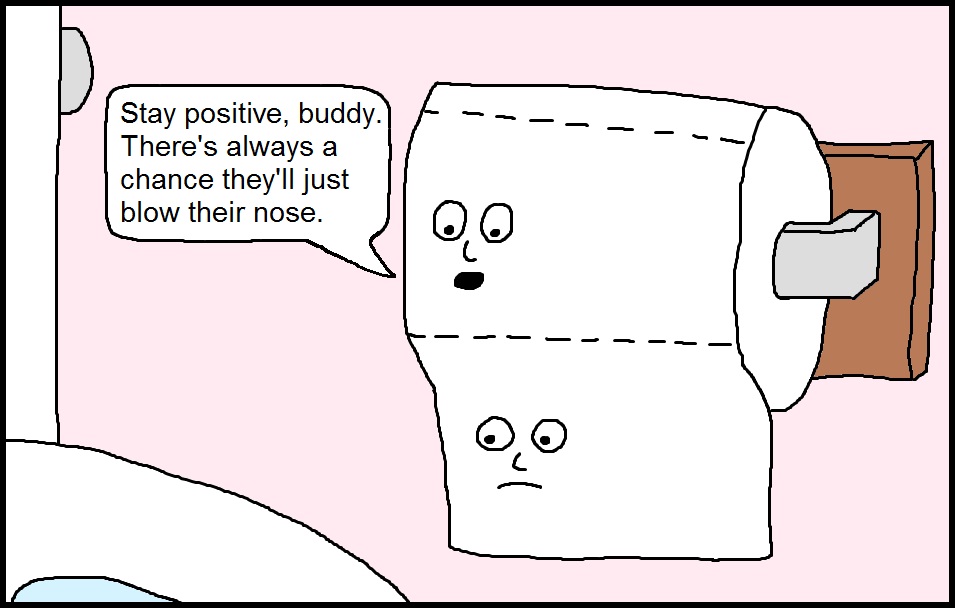
toilet-paper-cartoon

It’s annoying to me. It’s not even worth putting the damn roll on the toilet paper holder, because it won’t last long enough to make that effort worth it, so I just set it on top, like this:

toilet_paper2

The toilet paper companies dupe you into thinking you’re getting a bargain but you’re really getting ripped off. A four-pack of cheap one-ply lasts about 4 times as long as that 12-pack will and costs about the same (and probably kills fewer trees too).
The softness of it bugs me too. Personally I prefer a little grit.

Bye bye, Charmin Ultra Soft! Hello, Scott 1-ply!

Is narcissism a product of confirmation bias?

confirmation_bias

I just read a very well written post on Psychforums (written by a self-proclaimed empath) suggesting that NPD could be a product of confirmation bias. In simpler terms, a happy, normal person became that way because from an early age, they perceived their caregivers as good and kind, and the world as a friendly, welcoming place. In contrast, a narcissist became a narcissist because they perceived, from an early age, that the world was full of pain and terror, people were hostile and untrustworthy, and life in general sucks.
People give back what they they get.

Confirmation bias also explains why most narcissists hang onto their narcissism the way a shipwrecked person hangs onto a block of wood to keep from drowning.

According to Wikipedia,

Confirmation bias, also called myside bias, is the tendency to search for, interpret, favor, and recall information in a way that confirms one’s beliefs or hypotheses while giving disproportionately less attention to information that contradicts it. It is a type of cognitive bias and a systematic error of inductive reasoning. People display this bias when they gather or remember information selectively, or when they interpret it in a biased way. The effect is stronger for emotionally charged issues and for deeply entrenched beliefs. People also tend to interpret ambiguous evidence as supporting their existing position. Biased search, interpretation and memory have been invoked to explain attitude polarization (when a disagreement becomes more extreme even though the different parties are exposed to the same evidence), belief perseverance (when beliefs persist after the evidence for them is shown to be false), the irrational primacy effect (a greater reliance on information encountered early in a series) and illusory correlation (when people falsely perceive an association between two events or situations).

thinking-conf-bias

So, here is that post:

I wonder if NPD might largely be a product of confirmation bias. I guess a less pretentious way of saying that would be that people tend to hear what they want to hear or what they expect to hear.

I was raised in a supportive environment by truly loving people. I was very lucky; like, winning-lottery-number lucky. I first experienced the world as a benevolent place, and so I now tend to approach it with love and warmth and openness. (I hate how sugary that sounds, but I have to accept that it’s true — it’s who I am.) I trust people. I believe they’re basically kind and well-intentioned and that their flaws don’t make them less beautiful. Generally, I feel safe and good and happy to be around them.

But meanwhile, if you’re a narcissist, you first experienced people as sources of abuse, neglect, manipulation. You are born into this cold, threatening world, and the people tasked with protecting you from it are capricious, deceitful, cunning, selfish. That’s bad enough, but what’s far crueller is that there’s a world of happy-looking people out there, and none of them — not one — seems to give a $#%^ about what is happening to you. No one comes to help. Everyone totally buys into your parents’ facade of being just the best parents ever. So you learn the importance of facades. You learn it again, later, when — as a consequence of your nightmare of a childhood — you start getting into trouble. This time it’s cops or doctors teaching you the lesson, but it’s the same: the inability to maintain a facade of normalcy can cost you everything.

(######6 Christ. As an aside, if anyone is wondering what having empathy feels like, it feels like wanting to throw up/cry/punch walls while writing the above paragraph.)

But right, okay: confirmation bias. Since my emotional experience of the world is positive, I tend to seek out and remember things that confirm and validate that worldview. I.e. in relationships I tend to remember the good things people do and forget the bad, and I tend to believe that the kind/honest/giving aspects of people’s personalities are “who they really are.” And I guess narcissists do pretty much the opposite: they dismiss the good stuff you do, but the bad stuff stays so front-and-center it’s as though you’re doing it fresh, day after day, every time they remember it. When they ultimately find out you have flaws, they take this as evidence that they were always right: people are basically evil & untrustworthy & disappointing.

I’m not saying narcissists are necessarily wrong. There’s ample evidence that people really are monstrous (just open a newspaper). I’m also not saying my tendency to be compassionate/forgiving makes me some kind of saint, because I’m pretty sure some of it is ego protection. Seriously, you can smash me over the head a dozen times with a blunt instrument and I will still stupidly, doggedly believe you didn’t mean it or it was an accident or you were just hurt so it’s okay. I believe that in part because I need to believe that. If I allow that some people simply view others with hate or callow indifference or cold, calculating self-interest, then I have to revise the whole framework on which my understanding of the world and my place in it is built. And I really don’t want to do that. That $#%^ is so core and so central it feels like changing it would destroy everything.

But it would be so much worse for someone with NPD trying to revise their worldview in order to “get better.” Because in my case I’d be moving from a place of trust to a place of distrust, which some animal part of me knows how to do: you get hurt and so you withdraw, harden, your eyes get cold. It’s not fun but it feels familiar and safe. Whereas I guess a narcissist would have to do exactly the opposite. Move from a place of distrust to a place of trust. Which…how would you even do that? How would you surrender the only thing that ever made you feel protected or safe or stable? That would be so terrifying I can’t even imagine it. And what would ever inspire you to do it? Except for trust that there really are kind, well-meaning, loving people out there, which trust a narcissist, by definition, does not have?