What living with a psychopathic malignant narcissist does to your looks.

This is a picture of me taken two years ago, about a year before I finally got my MN ex out of the house for good.  He was turning my daughter against me (although he failed with my son, who moved to another state to escape from all the drama) and had already succeeded in turning all my friends against me with his gaslighting and triangulation.    He had everyone convinced I was insane, deluded,  and stupid.    I had no one to turn to and no money (well, I still have no money) but I had to support him even though he refused to work.   I felt so trapped.   We hadn’t even been married since 2005 but he continued to play his narc games, using the kids as pawns,  and I made a huge mistake allowing him to move back in with me in 2006, because I was so easily manipulated and afraid of what he might do if I didn’t agree.

sbrombacher_cat

I was fat, out of shape, exhausted all the time, and look several years older than I do now. I didn’t care about my appearance or much of anything. I think you can tell by the expression I’m wearing here that I was severely depressed and had pretty much given up having any kind of future. I was just marking time until death and aging fast.

Me in December 2006: I don’t look very happy. I wasn’t. I never smiled.
laurenb_2008

At a wedding in 1996–around the time his abuse turned physical and my son became scapegoated. Yes, that’s him on the left. He looks like a bum today.
1996_wedding

Here is me today:
laurenb1
This was taken in April this year.

laurenb2

I think the change is dramatic.

Can an adult turn into a narcissist?

crossroads1

I believe the answer to this is yes. While most cases of NPD are formed during childhood as a reaction to abuse or neglect, there are situations where a person who is not a narcissist can later become one, even as an adult. It can happen because of narcissism being, essentially, a choice. Even a small child makes a choice to become a narcissist, even if they’re not really conscious of that “decision.” In an adult, it may be more conscious, but once made, the personality can change dramatically.

An adult who becomes a narcissist is probably more easily healed, because the disorder is less deeply ingrained in the personality, but I think there are certain situations where if someone makes a choice to walk in darkness, something evil grabs hold of the soul and there is no turning back to a normal way of relating to others. Here are four scenarios in which I think a person can acquire NPD.

1. Abandonment or abuse starting during adolescence.

teenage_depression

Teenagers are narcissistic by nature and vulnerable to peer pressure, so they often act out in risky ways and experiment with the illicit and unhealthy. This is normal to some degree. But for a few, if familial abuse or abandonment begins during the teen years, the narcissistic behaviors of adolescence may become a lifestyle and coping tactic that the person will not let go of as they enter adulthood. I believe my ex is an example of a psychopathic malignant narcissist who did not become one until the age of 13, when he found his father dead in the bathroom in the middle of the night and his mother refused to do anything and left it to him to take care of his father’s body. Although his mother had always been a malignant narcissist, my ex was a good kid until that point; after that he changed.

In most cases though, I think narcissism starting during adolescence is likely to be fairly mild. I have been in communication with a young man who believes he is a narcissist. He explained to me that he was raised by loving parents but his mother became severely depressed when he was in his early teens, and began to ignore him due to her depression. He didn’t understand it was her depression causing her sudden coldness; he thought she she didn’t love him anymore. He explained that’s when his narcissistic behavior patterns began. In such cases, I think the narcissism that develops is actually a condition called DNP (destructive narcissistic pattern disorder) which lies below NPD on the narcissistic continuum, and is a more easily treatable form of narcissism where the person does retain some ability to feel empathy, love, and remorse.

2. Choosing evil.

fearofbridge

M. Scott Peck talks about a man who almost became evil in his book “People of the Lie.” A family man who loved his wife and children suffered from severe panic attacks, especially when driving over a certain bridge. Although he didn’t believe in the devil, he made a “deal” with Satan that if he could pass over the bridge without suffering a panic attack, that Satan could do what he wanted to with his favorite son. He didn’t think it really counted since he didn’t believe in the Devil (and nothing happened to his son), but he realized later that if he hadn’t repented, his own soul would have been seared. I think when a person knowingly chooses evil over good, the soul can be damaged or destroyed. It’s even possible that making such a choice allows an entryway for an evil entity that works to destroy all goodness in that person. The change can be dramatic and happen almost overnight.

3. Severe reaction to trauma.

ptsd_soldier

Related to the above, I think sometimes a person can engage in evil through no choice of their own. Victims of Stockholm Syndrome, who identify with their abusers and cannot escape, will sometimes be forced to commit evil acts or help their abuser carry them out, such as Patty Hearst back in the early 1970s. It sometimes happens in war, too. A normal person forced to kill innocent civilians will often develop PTSD, but for some soldiers, in order to protect themselves from their unbearable guilt, they learn to shut off all their emotions and any feelings of empathy or remorse, and come to regard other people as less than human. Unfortunately, a few veterans have their hearts hardened during war, and become cold-blooded narcissists.

4. Overnight success.

narcrealityshows

Celebrities and other people who achieve overnight success or fame have to be careful not to let their success go to their heads. Many celebrities are narcissistic, which begs the question: were they narcissistic in the first place and that led to them becoming rich and famous, or did becoming rich and famous turned them into narcissists? I think both come into play, depending on the individual. Certainly narcissistic personality types are the most drawn to fame and fortune, but I’ve heard of cases where a highly successful person was kind to others until fame and success went to their heads. I think though, since evil wasn’t chosen by the person under these circumstances, that a celebrity who didn’t already have NPD can discard their acquired narcissism if their arrogance and sense of entitlement is pointed out to them, or they realize they have hurt someone. So a celebrity’s narcissism may not be true NPD, but a condition called “situational acquired narcissism” which may be temporary.

Is BPD a real disorder or should it be eliminated as a diagnosis?

bpd_treatments
The myriad ways experts “see” borderline personality disorder. (click to enlarge)

There’s a great deal of confusion and disagreement in the professional literature about the nature of Borderline Personality Disorder. The blogger BPDTransformation (whose blog is excellent if sometimes a little on the scholarly side), who was cured of BPD, thinks the label should simply be done away with and that BPD doesn’t really exist at all–the label being merely a placeholder for a group of symptoms that are widely variable, and that experts can’t even agree on. He believes BPD is categorized as a Cluster B (dramatic/emotional) disorder only because mental health experts can’t decide where else to put it.

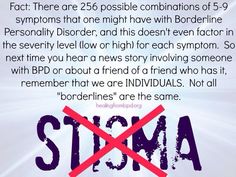
The stigma of BPD as a Cluster B disorder.

borderline_stigma

The problem with labeling BPD in the Cluster B category of personality disorders is the stigma that classification carries–that people with BPD (like those with NPD or ASPD) are evil, untrustworthy, selfishly manipulative, grandiose, dishonest, lack empathy, and really no better than people with malignant narcissism or even ASPD. (It sure doesn’t help any that an obviously sociopathic criminal like Jodi Arias has a diagnosis of BPD, when she more likely fits the criteria for high spectrum [malignant] narcissism, at the very least.) Insurance companies assume anyone with a Cluster B disorder is incurable, and therefore will not pay claims where a person is diagnosed with a Cluster B disorder. This is very damaging to those of us with BPD who have either successfully learned to modify and control our symptoms–or have even been cured, as BPDTransformation has been. People continue to believe we are lying about the success of the treatments or therapy we have received. Borderlines who have never been treated may find it difficult to find a therapist willing to work with them.

BPD is far more amenable to deep insight therapy than NPD (which is extremely difficult to cure but not impossible for non-malignants) and light years away from a disorder like ASPD (antisocial personality disorder), which can probably not be cured. Because the symptoms of BPD are so disagreeable to the sufferer (and not just to others), it is common for borderlines to present themselves for therapy, unlike people with NPD or ASPD. The vast majority or borderlines are unhappy with themselves and the way their lives have turned out. But many therapists won’t work with borderlines (other than with behavior modification treatments like DBT) because they know insurance companies will not pay such a claim.

What are borderlines on the border of, anyway?

tightrope

The name “borderline” itself is confusing. What are borderlines on the border of anyway? Neurosis and psychosis? A normal sense of self and Narcissism? Mexico and the United States?

The experts are all over the map on this, with some recent theories stating that BPD is actually a less adaptive, more ego-dystonic form of narcissism. But the original term “borderline” actually referred to the belief that the disorder was on the “border” between psychosis and neurosis:

[…]It is called borderline because it was originally thought that people were on the ‘border’ of psychosis and neurosis. BPD is also sometimes called Emotionally Unstable Personality Disorder (Borderline type). Approximately 75% of people given this diagnosis are women and 50% have experienced physical and/or sexual abuse.

Because BPD is more commonly diagnosed in women than in men, it’s also been referred to as the female form of narcissistic personality disorder (which is more commonly diagnosed in men than in women).

Psychotic, neurotic, both, or none of the above?

bpd (1)
Credit: Judgybitch/Dzhokhar Tsarnaev

The reason why BPD is sometimes regarded as the midpoint between neuroses (mild and easily treated anxiety or depressive disorders) and psychoses (disorders where the victim is out of touch with reality, such as schizophrenia and the manic-depressive form of bipolar disorder) is because people with BPD can, when emotionally upset, display psychotic or delusional symptoms such as splitting (black and white thinking), dissociation (feelings of unreality either about the self or the environment), magical thinking, severe paranoia, delusions of grandeur or persecution, and sometimes even hallucinations and disorganized speech or thought. However, for a borderline, these psychotic symptoms don’t last and as soon as the emotional crisis has passed, the borderline’s “sanity” normally returns. Antipsychotic medication can be helpful, but isn’t always necessary, as it usually is for a truly psychotic individual.

Others have speculated that BPD is really a severe form of PTSD or C-PTSD caused by trauma, and should be treated the same way as PTSD. Personally, I think it’s more long-standing than a reactive disorder like PTSD and is a true personality disorder, but it does make sense that BPD may have originally begun as a form of PTSD at an early age, often due to sexual abuse.

There is so much confusion and contradiction in the literature about BPD that I’m slowly coming around to BPDTransformation’s way of thinking that it should possibly be removed from the Diagnostic and Statistical Manual of Mental Disorders (DSM) until mental health professionals can get a better handle on what BPD actually is, and whether it’s even a valid diagnosis (or simply a group of symptoms that could indicate several other disorders). There should at least be more agreement among the professionals at any rate.

The curse of the Aspergers/Avoidant/Borderline triad.

social_isolation

Today I attended a beautiful Pentecost mass that was held outdoors. The day couldn’t have been more perfect for an outdoor celebration of the descent of the Holy Spirit on Jesus’ disciples. Unlike the disciples, I didn’t experience a sudden spiritual epiphany or dramatic change in my heart, or start speaking in tongues. But as always when I attend mass, I felt God’s presence around me (if not actually IN me) and felt surrounded by peace and light.

I looked at the tall trees gently swaying in the distance, their bright spring greens illuminated in the bright sunshine against the azure blue sky, and asked God to change me, to let the Holy Spirit flow inside me and fill me with its divine gifts of empathy, unconditional love, and joy. I asked Him to make me a better person who can connect with other people on a meaningful level–and having those gifts would make it so much easier for me to do that.

The truth is, I feel that I’m lacking in all three of these gifts. I do not have NPD and therefore have no desire to act in evil or toxic ways to others, but due to my other disorders–only one of them probably not due to abuse (Aspergers)–I often feel like there’s an emotional blockage keeping me from really being able to connect with other people, to really being able to empathize and feel WITH them the way people who have not been abused and do not have these disorders can do.

This particular triad of disorders is a tragic one. Even having one of these disorders cripples you and isolates you in various ways from others and can lead to a lonely life lacking in meaningful relationships, but having all three at once is devastating. It’s so hard for me to connect with the rest of humanity except on the most abstract level and as a result I’m often so very sad and lonely.

First, being an Aspie (the only disorder I was probably born with) makes it almost impossible for me to read social cues normally and although I can socialize well enough online (because it doesn’t require me to “think on my feet”–I have time to think through what I want to say or how to respond), in the day to day physical world my Aspieness makes me appear awkward and sometimes slow when I am forced to socialize, especially with neurotypicals who don’t understand people with Aspergers, so I avoid people. Due to my awkwardness I was a frequent target of school bullies, and it didn’t take long to learn that it was best to just keep my mouth shut and say nothing. I became painfully shy, fearing ridicule and humiliation. The old adage, “Tis better to say nothing and have others believe you are daft than open your mouth and remove all doubt” has been my motto most of my life.

aspergers_cartoon

The other two disorders I have–avoidant AND borderline personality disorders–I am certain were due to years of abuse by my narcissistic mother and to a lesser extent, my codependent father who colluded with her most of the time (although I never really doubted his love for me). The AVPD (a Cluster C “anxious” personality disorder) only exacerbates my Aspergers. They feed off each other.

Avoidants shy away from social contact because of their low self esteem and overwhelming fear of rejection. As a result they are usually painfully shy but can even seem aloof or cold. Avoidants are not schizoid though (people with Schizoid personality disorder dislike other people and prefer a hermit-like lifestyle; they don’t care how others regard them): on the contrary, we WANT friends, we WANT meaningful relationships, we WANT romance, we WANT others to like us–but our fear of engaging with others due to possible rejection keeps us isolated and alone. We build a protective shell of aloofness around ourselves so we can’t be hurt. People with AVPD are risk-averse, and are likely to be underachievers due to their unwillingness to take risks that may expose them to social embarrassment.

An Aspie with AVPD is nearly–or is–a social hermit, but not out of choice, like a person with schizoid personality disorder. Making friends–a skill that comes so naturally to most people–is something most of us never mastered well, if at all. Even having a relaxed conversation or opening ourselves to another human is like rocket science to those of us with both disorders. It’s a wonder that I was even ever able to engage in romantic relationships and have a family. Of course, all the men I dated and of course the one I married were narcissistic, mirroring the toxic dynamics I had with my family of origin.

avoidant_pd
Like the girl in this cartoon, I can relate to all of this, even the refusal to play charades! I was always terrified of that game because it requires a level of being able to read social cues and an ability to think on your feet, two qualities I don’t possess. And of course, the fear of risk-taking and humiliation.

And that brings us to my borderline personality disorder. BPD is not usually marked by overwhelming shyness or social awkwardness; in fact most borderlines are quite socially adept. But their disorder, like an Avoidant, is fueled by a deep-seated fear of rejection and almost always has its roots in childhood emotional abuse or neglect, as do all the personality disorders.

Borderlines long for close relationships and actively seek them out, but then push others away if they sense the other person might pull away or reject them first. They overreact to slights and are highly sensitive to criticism or rejection. Like a narcissist, they can be difficult to deal with because of this type of selfish oversensitivity can lead them to engage in some of the same antisocial behaviors and game playing people with NPD or even ASPD are guilty of, though not usually to the same degree because people with BPD have a conscience (even if it’s stunted in some) and don’t normally actively seek to hurt others. There are exceptions though–I was shocked and dismayed to read that both the murderer Jodi Arias and serial killer Aileen Wournos were both diagnosed with BPD, though in Wournos’ case, she was also comorbid with ASPD. Still, most borderlines, when they are made aware of how they have hurt their loved ones, feel remorse–but their guilt and shame can make them feel worthless and lead to self-destructive behaviors. It is not a fun disorder.

Though Borderlines are more likely to be self-destructive instead of deliberately destructive to others, this self destructiveness causes huge problems in their ability to form meaningful relationships, and due to their “go away–come closer” way of relating to others, their relationships are usually stormy and short-lived.

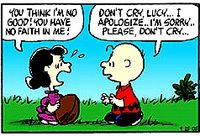
lucy_charlie
Sometimes I feel like either Lucy or Charlie Brown (who I’m pretty sure would have AVPD), and sometimes both of them at once.

I am cursed with the overwhelming shyness and social anxiety of Aspergers and AVPD, but during the rare times I have been able to form relationships or friendships, sooner or later I push those people away in some form or another–not because I want to, but because I either become so afraid of rejection I reject the other person first–or more frequently, unconsciously do something to make the other person leave me. BPD is very maladaptive to the sufferer–it tends to bring on the very thing the Borderline fears the most–rejection.

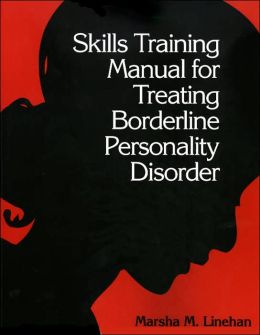
I was diagnosed with BPD in 1996 during a three month long hospitalization for major depression. At the time, I also had PTSD from being a victim of abuse by a malignant narcissist husband, who gaslighted me constantly and even tried (but eventually failed) to turn my own children against me. During that hospital stay, I was given a copy of Marsha Linehan’s excellent manual for BPD, “Skills Training Manual for Treating Borderline Personality Disorder.Dr. Linehan is a borderline herself (she had originally been diagnosed with schizophrenia but felt her “schizophrenia” was really a manifestation of her BPD). The techniques in the book are a form of DBT (dialectical behavioral training) which teaches the Borderline patient to act mindfully–to think before they act and consider consequences, because Borderlines (unlike people with NPD) act on impulse when they feel threatened.

linehan_book
Linehan’s excellent manual can be ordered here.

Linehan’s book helped immensely and since my long-ago hospital stay, I have learned to control many of my borderline symptoms. In fact I have become so good at it I rarely fly off the handle the way I used to or overreact to the degree I used to do. I still have my copy and have recently begun doing some of the excercises again because I still know there’s a LOT of room for improvement.

Like NPD, BPD doesn’t just go away. All personality disorders are incredibly hard to cure because they have become so much a part of the individual’s personality. There are still many times I unwittingly either push other people away OR get too close (or do both at the same time); I still have problems with understanding where other people’s boundaries begin and end. I also feel like there is a wall there keeping me from really being able to empathize with other people in a normal way. I can empathize in an abstract sort of way (it’s hard to explain what I mean by that but the empathy I do feel is sincere). It’s just so hard for me to connect on a meaningful level because I fear rejection so much. I want to be a friend to others; I want to make others happy; I want to be able to fully share in their emotions, good or bad–but I find it all so hard–not just because of my BPD, but my fear of engaging with others in the first place due to Aspergers and AVPD. This triad has been a huge curse all my life. But at least I know what my problem is. I’m what you would call “complicated.” I have my work cut out for me.

hope

Having all three disorders has made my life incredibly difficult and my relationships–when they exist at all–have been stormy or don’t last. But I don’t feel that I’m beyond hope. In fact, I’ve been feeling much better about myself since I started blogging and accepted God into my life. I do feel that He is changing me in a very meaningful and deep way. Maybe it’s not happening as quickly or dramatically as I had hoped, but it’s happening. I am feeling more ability to empathize with others and feel moments that come very close to pure joy. I have always had a great capacity to feel guilt and shame, so that has never been a problem. For a person with a Cluster B disorder, my conscience is probably TOO well-developed. I apologize for things I haven’t even done. Sometimes I feel like I’ve spent my entire life apologizing for my existence. I hate the idea of being a bad or evil person. I like it when I know I’ve made someone else happy. Those times when I can make others happy are becoming more frequent, and I think that’s a step toward healing. I’m also happy to report that my lifelong problem with envy appears to be disappearing. Envy is so toxic–mostly to the person harboring it. It’s a great relief to have that particular monkey off my back most of the time now.

So today’s celebration of Pentecost had special meaning, because even though I wasn’t knocked to my knees by the Holy Spirit, I felt a deep sense of peace, centeredness and just “being in the moment” that has always eluded me. I felt a genuine desire to become a person who can make a positive difference in the lives of others and can feel unconditional love even for those I do not know well. Now I just need to overcome my fear of engagement with others, but I have faith that in time that will happen too, and when that happens, a whole new world will open up to me as the walls I built at an early age begin to crumble and reveal the me I want to be–which is really the me God meant for me to be.

Never give up hope. Ever.

“Reclaiming My Life”– Michelle Mallon’s Story of Healing

after_narc_abuse

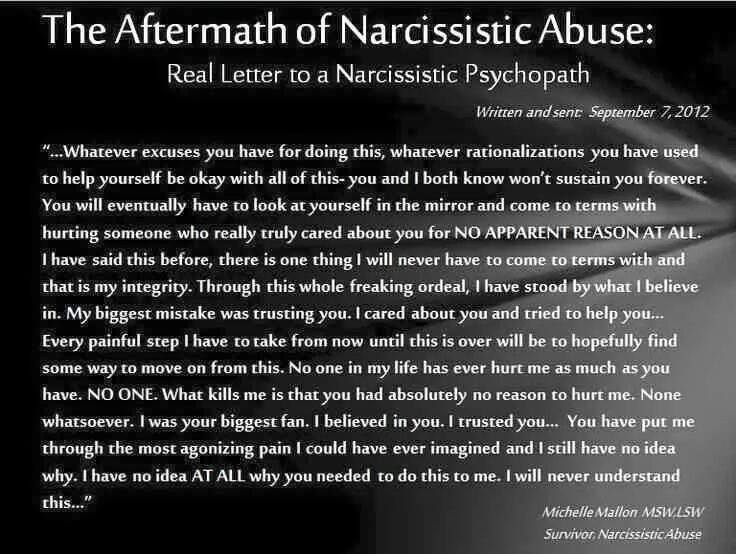
The following is a followup article to the one I linked to in my post After Narcissistic Abuse, in which Michelle Mallon talked about how her psychopathic therapist almost destroyed her life and stole her soul.

This is an important topic, because malignant narcissists, sociopaths and psychopaths are so often in the “helping” professions, especially psychotherapy. They prey on vulnerable people who come to them in desperation, hurting and wanting to trust someone. These “mental health” professionals know this. After gaining a patient’s trust, evil-intentioned and sadistic therapists like Michelle’s therapist use the things their client told them in confidence against them, or even use them to threaten or gaslight them.

I’ll only post the first part of the article, which is long. But the journey back to feeling normal from PTSD caused by abuse is sometimes a long and arduous journey. There’s no way to describe this process in just a few words or even a few paragraphs. To read the rest, you will need to click on the link to Michelle’s article, which appears at the end of this post.

Reclaiming My Life
By Michelle Mallon, MSW, LSW
In this article, Michelle Mallon discusses her healing journey following abuse by a psychopathic therapist.

Recovering from therapist abuse is hands-down the most painful experience I have ever gone through in my entire life. Healing was incredibly difficult for so many reasons, some of which make me very angry and some of which have brought me great insight. Because of the impact healing from therapist abuse has had on my life, I find it impossible not to want to reach out to others who have been hurt by mental health professionals. Some people have told me that this is because I am unable to “get over” what happened. I explain to them that there is a difference between “getting over” something terrifying and callously moving on, leaving so many others behind knowing that you were very lucky to have ever healed. (I usually say this right before I tell them what they can go do with themselves.) The reality is that for most of us trying to overcome therapist abuse (regardless of whether it is sexual, emotional, spiritual, etc.), very few other people have any idea what we are going through (even the mental health professionals we finally get up the courage to see after the abusive ones to try and pull ourselves back together). And because of that, healing can be significantly more difficult than it should be.

Just recently, I began reading the Your Stories page on this site. I was immediately reminded of the isolation and fear I felt as I tried to find my way through the aftermath of therapist abuse. I drafted a message for the Your Stories page and then I immediately felt like it was just not enough. I then asked Kristi if I could write a piece that would hopefully reach more survivors. I have found the path to healing. I don’t really know how I ever found it because, looking back, I can see just how carefully hidden the path is. I don’t know if my path to healing will be similar to yours. In the hopes that there will be some similarities, I want to identify the things that helped me find my way through this in case it can help even one survivor.

This time last year, I was just beginning to feel my “old self” returning. I was finally able to leave my house for short periods of time without having panic attacks or near panic attacks. I was beginning to be able to focus on something other than what had happened in the years before. And I have to tell you, I couldn’t have been more relieved. The truth was that for a very long time before this, I wasn’t sure I would EVER recover from what I had been put through. In fact, I truly believed I was broken beyond repair. It was the most frightened I have ever been in my life.

nurse-ratched
Nurse Ratched, the sadistic psychopathic nurse/therapist in the movie “One Flew Over the Cuckoo’s Nest.”

This year, my life is very different. I look back at the woman I was a year ago and I can see tremendous growth. However, I can also see that even as I was beginning to re-find myself under all of the manipulation and destruction I had been through, I still had a long way to go. There were times when I first started out on this journey where I was making progress, but I didn’t realize I was making progress. I would frequently begin to feel stronger only to be dealt a cruel blow of fear and confusion that would set me back for days, sometimes weeks. If I would have known then that this was how the process went, I don’t think the journey would have been nearly as frightening. And perhaps, this time next year, I will look back and see that I have continued to grow, even from this year. It’s impossible to say. This journey to healing has been nothing short of miraculous. Just when I think I have “uncovered” all of the insight this journey has to offer, I am humbled by another incredible phase of insight. I don’t know if this growth and self-discovery will ever stop. Perhaps if I viewed all of this more as a journey and not as simply reaching a destination, I would have found more peace in the whole process. But to be perfectly honest, as I started out on this journey there was nothing peaceful at all about any of this.

The truth is that the very start of my journey, like many of yours, was incredibly painful—almost unbearable at times. I felt completely lost. I really didn’t know how I had gotten to where I was, and I really had no idea how the hell to get back to where I was before. Some of the worst parts of the journey to healing after therapist abuse had to do with trying to make sense out of what happened with the abusive therapist. And because I still missed him, I was convinced there must be something wrong with me. For almost a year after I refused to see him any longer, I replayed everything that happened during the time that I knew him, trying to make sense out of what happened. I tried desperately to understand what I could have done differently to prevent the relationship from crumbling the way it did. I would look at certain aspects of what happened and think, “He must have cared about me and just lost sight of what he was doing.” And I would be at peace with that thought for a few days. And then nagging doubts would creep in, “But if that were true, why did he just leave me to fall apart on my own? Why, after I told him just how much this had harmed me, did he choose to remain silent and not help me find closure?” A person who cares doesn’t leave someone they hurt (even if it was unintentional) to self-destruct in the aftermath. It seemed like no matter which way I looked at what happened, I could not come up with a “reason” for what happened that made any sense at all. And for that reason alone I was doomed to continue to replay the events in my head, searching for an answer I might never ever find. How else could I feel safe against something like this happening again in the future? The only way I could move on was if I understood what happened and why. And the person who needed to help me understand all of that made it very clear that he had no intentions of ever helping me get to that point. And because of that, it felt like he completely controlled my recovery from this.

evil_inside

And then it happened. Driven by a relentless desire to understand WHY, I had searched tirelessly online for something that would help me understand what the hell happened. I had been seeing a new therapist for about nine months (and I have to tell you, doing that took all of the courage I had in my body!). There were so many times that she seemed just as confused as I was about what happened with the abusive therapist. I was trapped in a cycle of reliving everything that happened over and over again, searching for answers. It was driving me to the point of insanity. As I learned more and more about this thing called “Narcissistic abuse” I began to realize that there was a reason why I had been spinning my wheels trying to understand what happened. There are people who exist who lack any ability or desire to feel any empathy or remorse. Even worse, they lack a conscience. They can cruelly destroy people who are loving, caring and honest and not feel a bit guilt or sorrow for having done so. In fact, in many ways they appear to be “annoyed” by the fact that the people they have hurt are making such a big deal out of what happened. Even worse, they are masters at making themselves out to be victims. Oftentimes, people like these leave behind them a trail of broken bodies and wounded souls as they continue on their destructive paths.

I began to learn new words—words like grooming, gaslighting, trauma bonding and soul murder. These were words that I either had never heard before or had never truly understood until I lived them. These words—words that described things that I experienced but couldn’t put into my own words—were a vital part of my healing. Suddenly I felt a lot less alone. I knew that if someone came up with these words and the definitions that explained my story, somebody, somewhere understood.

But learning these words and reading about Narcissistic abuse was really just the start of my journey. Taking all of it in was a different story. I would frequently find myself wanting to read as much as I could about Narcissistic abuse and then I would experience times where I didn’t want to look at anything at all about it. At first I would get angry at myself because I thought I needed to go through this process a specific way and it was not always the same way that I was feeling. I would get so frustrated with myself as I would read pieces that helped me begin to move forward in my understanding of what happened, but then feel like I was moving backwards. I remember thinking that maybe I was just making myself believe that I was feeling better and that I was really not making any progress at all.

It turns out that understanding and reprocessing what I had been through happened in phases. This wasn’t like any learning I had done before. In the past, if I wanted to understand something I would read about it and integrate it into my way of seeing things. With Narcissistic abuse, there were so many “layers” of understanding that were essential to my healing that this linear process of learning that had worked for me in the past was ineffective with this. There were many times where I would read an article or a book about healing from Narcissistic abuse and feel as if I had taken all of the important insight that the piece had to offer. And then later, I would stumble upon the work again and be shocked that there was insight in it that I hadn’t noticed before. It wasn’t that the piece had been edited. It was because my brain was allowing me to take in more of the picture of what I had been through. That brain of mine, that part of me that I thought had surely been destroyed in the abuse, was actually guiding me carefully through the process of slowly taking in what I could handle. In fact, I can remember times where my brain would almost “compel” me to read more about Narcissistic abuse and times where it would want to do anything other than reading about Narcissistic abuse. I slowly learned to listen to my brain and do what it seemed to be urging me to do whenever it would do this.

And there was another aspect to understanding what I had been through. As I began to understand what my abusive therapist had put me through I began to realize that I had seen this kind of abuse before in my life. In fact, many adult survivors of Narcissistic abuse eventually come to learn (if they can find the path to healing) that they have been primed by previous Narcissistic abuse to tolerate later Narcissistic abuse. For me, like so many other survivors of this type of abuse, I found myself not only healing from one emotionally destructive relationship, but several. The grief was overwhelming.

warning_sign9
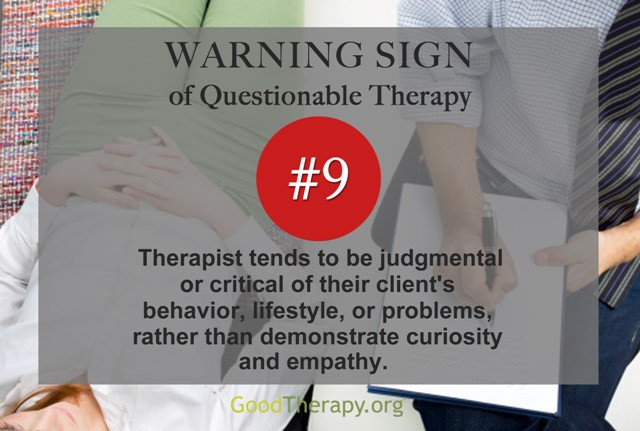
From 50 Warning Signs of Questionable Therapy or Counseling.

Perhaps one of the more difficult aspects of the abuse that I had tried to understand was where in the relationship with the abusive therapist that things went wrong. For a while, I believed that the therapist had somehow changed, since he seemed so competent for a long time before the abuse actively began. And I found myself searching for some point in time where I should have stopped trusting him. I think I believed that knowing this was important so I could have understood at what point my “screaming gut” was right. It wasn’t until a good friend of mine pointed something out to me that I hadn’t thought of before. He told me that there wasn’t any point in time when I should have trusted the abusive therapist. He said to me, “Michelle, he’s a predator. The only reason why he seemed so competent and trustworthy for so long at first was to gain your trust so he could effectively lure you away from your comfort zone. Tell me, would you have allowed him to say many of the things he said to you if he had started the relationship out doing that? No, your inner alarm bells would have been going off like crazy.” This was a pivotal moment for me because I had not given any thought at all to this possibility. I would never imagine hurting someone like that. It was finally starting to click in my head that I didn’t understand what happened for a reason. In fact, I never saw any of it coming because I never imagined anyone would ever treat another human being like this. My own profound compassion and deep empathy for others was something I assumed everyone else had. I am finding that many survivors of this type of abuse “suffer” from the same naiveté because of their own inner compassion and empathy.

Read the rest of Michelle’s story here: http://www.survivingtherapistabuse.com/2015/03/reclaiming-my-life/

Also, please read this article: 50 Warning Signs of Questionable Therapy or Counseling.
If your therapist does any of these things, they are red flags. Be wary or find another therapist.

Looking death in the face: I was almost murdered at age 18

lauren_bennett4
Me during the late spring/summer of 1976, somewhere in upstate New York. I was 17.

Alaina Holt-Adams did a very brave thing the other day. She posted about her rape experience at the hands of her psychiatrist when she was 15 years old. It took enormous courage for her to post about that, and I am proud of her for doing so. I think she’s glad she did too.

But it made me start thinking about something that happened to me when I was 18. I’m not really ashamed or afraid to post about it, because it happened so many years ago, but for years I couldn’t even think about it without it setting off severe panic attacks.

I was raped and almost murdered–in my own bed by a total stranger.

During the summer of 1977 I was living in a co-ed residential facility for adolescents with emotional or behavioral problems, most of whom could not live with their families for one reason or another. Many of these kids were personality disordered themselves, having suffered at the hands of abusive psychopathic or narcissistic parents. Many of them had grown up in poverty. My mother and I could no longer live with each other, and my psychiatric problems were severe enough to qualify me a spot in the residence.

The residential facility was in New York City, in the East Eighties. During the 1970s and 1980s (until Rudy Giuliani became mayor and started his campaign to clean up the city in the early 90’s), New York City was a cesspool of filth and crime. The city was losing money fast, and funds that would normally go toward improving the infrastructure or finishing building projects just weren’t available.

New York was riddled with unfinished buildings that sat in their half-completed state, sometimes for years, attracting squatters and the homeless, and serving as hangouts and crash pads for heroin and other hardcore drug addicts. As you might expect, these unfinished buildings were hotbeds for violent crime. No woman (or man for that matter) who valued her body, her possessions, or her life would be caught dead walking anywhere alone at night. The subways were filthy, covered with graffiti and trash, and extremely dangerous, even during the day. I always carried a can of pepper spray with me, just in case. Everyone I knew did too.

The residence I was staying in (which no longer exists) was housed in a Brutalist building on East 87th Street. Located next to it was one of these abandoned, underfunded buildings, its steel-and-plywood scaffolding still up, and you’d have to walk under a makeshift plywood tunnel to pass it on the street. The scaffolding was about four feet away from my bedroom window (I had a private room) and about two feet beneath it.

My room was on the third floor and had casement windows–the type that open out rather than slide up and down, and you have to crank open. It’s my understanding that casement windows are much easier to break into than the more popular sash-type windows, and during the summer months, I’d leave the windows closed (there was air conditioning) though unlocked. I had a lot of potted plants on my window sill, but no curtains or any other type of window covering. I hated the Venetian blinds and kept them up all the time. Anyone could have seen in. I never really gave this any thought. To the best of my knowledge, no one could see me in there. My room was in the back of the building and we faced no other occupied buildings.

new_york_1970s
New York City was filled with scenes like this during the 1970s and 1980s. Even the “good” neighborhoods weren’t immune to urban blight due to the lack of funds.

I had dark blue plastic sheeting taped to cover the built-in fluorescent light over the small Formica desk in the corner. I never could sleep in complete darkness (to this day, I can’t) and the blue light was soothing to me as I listened to the radio while I fell asleep. It was dark, but I could still see.

One hot summer night I woke up suddenly. At first I thought I must have been having a terrible nightmare, but I realized with dawning horror that this was no dream–it was actually happening.

There was a man lying on top of me, and he had his rough fingers up inside me. My face was pressed down into the pillow (I was on my stomach) and I couldn’t move. I tensed my body and tried to fight him off, which was impossible given the position I was in. Realizing that I was awake, the man shoved his entire fist into my mouth (I have no idea how he was able to do that, but it sure felt like he did) and pushed my head down further into the pillow so I couldn’t breathe. At the same time, he pulled his fingers out of me. And then he spoke, in a low, demonic voice:

“Scream and I’ll kill you.”

I didn’t scream. Like a trapped animal, I froze in place while struggling to breathe. I felt dissociated from my body, as if I was watching this happen to someone else.

I felt him shift on top of me and use his knee to roughly push my legs under my body, and then he raped me. Still pushing my head hard into the pillow, when he realized I would not make a sound, he finally removed his fist from my mouth. I began to feel dizzy from lack of air. The pain I experienced during those moments was so intense I felt like my head was exploding with knives of white hot light.
I knew he was going to kill me.

Then something happened. I stopped panicking. I started to relax. I knew I was going to die on this night, at the age of 18. In my mind’s eye, I saw the headline of my murder on the front page of the next day’s edition of the New York Daily News, my entire sad life memorialized by a smiling black and white newsprint photo, reduced to another tragic statistic that would be forgotten within months. There would be a funeral and a lot of fake tears and hugs. Life would go on. My existence really didn’t matter in the grand scheme of things. I felt my smallness, my powerlessness in a world that was never very kind to me. I think this sort of “relaxing” happens when we know we are going to die a violent or painful death. The dissociation is the mind’s way of coping with unbearable pain and the unbearable knowledge of imminent mortality.

lauren_bennett2
Photo taken in 1977, the year I was almost murdered.

My dissociated state probably saved my life. Suddenly–I don’t know if he heard something or not–the man stopped raping me, got up, and ran out of the room. I turned around just in time to see the side of his face as he fled the room. In the blue light, I could see he was either white or Hispanic, and not very tall. He had dark hair and a short beard. That was all I could make out.

I began to come back into myself and started to shake and sob uncontrollably. I ran to the houseparents and told them what happened. They believed me, and came upstairs to investigate. They inspected the empty room next door to mine, and discovered an open window that was directly over the scaffolding below. Police determined the man had probably seen me in my room, figured out the room next door was unoccupied, and used the scaffolding as a means to climb into the building. The window may have been left open, or he could easily have opened it himself.

What really made my blood run cold was discovering a large butcher knife under my bed the next day. The man must have dropped it as he fled my room. I knew with the certainly the sun will rise tomorrow that he had been intending to maim or kill me with it.

The rape investigation required me to be checked by a medical doctor. No semen was found inside my body, and I was unable to identify enough information about the intruder to be able to pick him out of a book of mug shots the police showed me. There seemed to be hundreds of violent criminals who fit the description I gave.

For two years I could not sleep without my door barricaded at night. Things got especially bad after I got my first apartment. I had trouble sleeping, frequent nightmares, and slept fitfully at best. I was always tired. I was afraid to go out, and afraid to be alone. I was terrified to be alone at night, and had to sleep with every light in the apartment on.

Gradually I overcame these fears, but the rape has always haunted me and I still can’t sleep in complete darkness. I still get chilled to the bone when I think about how close I came to death that night in 1977.

Have You Ever Been Hurt by a Psychiatrist? (Guest Post by Alaina Holt-Adams)

WARNING: The following may be triggering for many abuse victims. This article is especially harrowing because a therapist is supposed to help us cope and heal from trauma already endured, not add even more trauma. This is one of the most disturbing stories of an abusive psychiatrist I’ve ever read. And this psychopathic monster’s abuse was inflicted on a child of fifteen.

Unfortunately, malignant narcissists, psychopaths and sociopaths are attracted to the mental health field because it gives them an easy way to take advantage or further abuse the hurting, the vulnerable, the abused, and even children. Be very careful when choosing a therapist. Sometime soon, I’ll be researching this topic in more depth and write an article about red flags to look out for.

The author has been so afraid to come out about this experience she asked me to let her write it as a guest post here rather than put it on her own blog. I am more than happy to do that, because I think her story can help expose the abuses that still go on in the mental health field and it may be of help to others.

Have You Ever Been HURT By A Psychiatrist?
By Alaina Holt-Adams

DrMonster500 (1)
I found this photo through an online memorial site. A single comment is posted under the picture. It says: “This man was my biological father, but I never got to know him. He didn’t want me and I never saw him. RIP.” The comment is signed: “Anonymous.” *

Out of respect for this monster’s adult child, I will refer to him as “Dr. Smith,” which was not his real name.

Handsome fellow, wasn’t he? Tall, dark, and aristocratic. Going by the date printed on this photo (which I cropped off because it was printed next to his name), Dr. Smith was in his late twenties when this picture was taken. He looked basically the same when I knew him twenty years later, with just a touch of gray at his temples to lend an air of wise sophistication, in sync with the leather elbow patches and carved pipes that were all the rage for image-conscious psychiatrists in the late 1960s.

His deep, softly hypnotic voice and sympathetic manner were even more compelling than his Rock Hudson good looks. With soulful gray eyes that seemed to read your innermost thoughts, everything about him said: “I Care Deeply About You And Your Problems.”

But everything about him was a lie.

If anyone ever fit the description of a charming, successful, suave sociopath, this man certainly did. He almost killed me — literally, almost murdered me. I believe he gave me the drug overdose on purpose, because I had told a nurse about the “good doctor” sexually abusing me.

Of course, I wasn’t believed. I was only fifteen and I was a mental patient. Later I was told that many other patients had accused this man of raping them, male patients as well as female. But he kept getting away with it because he was a “great and wonderful doctor” and “above reproach.”

The truth about this evil man finally came to light the last time he raped me, the night when he almost murdered me. A nurse told me later that she had heard me “screaming bloody murder” inside his office. She had tried to open the door but it was locked. She said the doctor told her through the door that I was in a deep hypnotic state, reliving a terrible trauma.

Hypnosis was his specialty. At first, all he used to put me under was a swinging pocket watch. He switched to giving me an injected drug to “enhance” the hypnosis, after I pushed his hands away when he tried to molest me. As the drug took effect, I became too weak to fight him off. That was when he would molest me. Probably because of the drugs he gave me, I have only vague, partial memories of the rapes.

That last time, as he was slowly injecting an amber-colored liquid into the vein inside my left arm, the doctor told me: “If you ever again tell anyone about what I’m doing, I will stick you in a hole so far you will never see the light of day again.”

Suddenly my chest hurt. I mean, it really HURT! I felt like a giant hand was squeezing my heart. I clutched at my chest and told Dr. Smith that my heart was hurting. He let go of the syringe and took my pulse… then he quickly injected all of the remaining drug into my vein.

The pain in my chest seemed to explode at that point. The pain was bigger than I was, bigger than the room we were in, bigger than the whole hospital. When I could not take the pain any longer, I passed out. What the doctor was doing to my body lying spread-eagled on the floor of his office, I could not see or feel.

After it was over, he woke me and told me to go back to the ward. I stood and almost fell over. “Kiss me goodbye,” he commanded. I shook my head no. “You will never be well until you stop repressing what you really want,” he said. That was the last time I saw him.

I felt like I was floating as I walked out of his office and across the street to my ward. I had the eerie sensation of only being in the top half of my body. My legs were moving up and down, taking one step after another, but my feet and legs did not feel like they belonged to me anymore. They were like the legs of a puppet and I was making them move by pulling a string.
As I walked onto the ward, my body crumpled to the floor. I seemed to be floating in the air, looking down at myself. The two nurses on duty rushed out of their office. They knelt beside my body. I was floating above them, looking at the back of their heads. I heard one of them say, “Her lips are blue.” Then the other nurse said, “I can’t find a pulse!”

Suddenly — Z*A*P! — I was back inside my body. I sat up with a jolt. I felt very dizzy.

The nurses helped me to my feet, then walked me back and forth, holding me upright between them. Hours seemed to go by as they walked me from one end of the ward to the other. While we walked, they chatted with each other the way friends do, talking about their lives, their children, and their husbands.

Finally my head cleared enough that I could speak. I asked if I could go to the bathroom. It was hard for me to talk, my mouth felt like it was full of cotton.

One of the nurses helped me into the bathroom, while the other went back to the office. The nurse stood beside me and watched as I pulled down my underwear. It was obvious from the condition of my underpants that I had been raped. She went out into the hall and called the other nurse to come and look at my underwear.

They must have reported everything to the police. Two male detectives in suits came to the hospital the next day and questioned me. I never saw Dr. Smith again. I don’t know if he was arrested or if he lost his license or what happened to him.

I do know that he committed suicide the following year.

To this day, any time I am given an injection by anyone, for any reason — by a dentist, a nurse, male or female, it doesn’t matter who gives me the shot or why I’m getting it or where it is being given — every time, I flash back to this. And I feel like I am being murdered all over again.

Years after this happened, even after I knew he was dead, when I tried to tell this story I would hear Dr. Smith’s hypnotic voice inside my head: “If you ever again tell anyone about what I’m doing, I will stick you in a hole so far you will never see the light of day again.”

Even today, more than four decades after his death, I am struggling with whether or not I should post this. Telling the truth about what this evil man did to me isn’t going to kill me…. right? I am NOT going to end up “in a hole so far that I will never see the light of day again” — am I?

Intellectually, I know that Dr. Smith’s hypnotic threat has no power over me today. But my heart is pounding while I’m writing this.

His anonymous child who never got to know him was lucky. And I am lucky, and deeply grateful, for those two nurses who saved my life.

BUT… unbelievably… several hospital staff people, including another psychiatrist, actually BLAMED ME, a fifteen-year-old in-patient, for “luring the good doctor with my sexuality” and “ruining the life of a wonderful man.”

I will (try to) write about that in a future post.
~ ~ ~

PS: In case anyone reading this wonders why a lonely, love-starved, hormonal 15-year-old would push away the hands of such a handsome man when he was touching me inappropriately, the whole truth is that I was flattered and excited the first time he rubbed my arms and shoulders and lightly ran his hands down the front of my dress when I was under hypnosis. Although Dr. Smith was older than my parents, he looked much younger, and he was also single (divorced) at the time. I was young and needy and naive enough to believe that the Cinderella fairy tale was true — that a handsome charming Prince could fall deeply in love with a poor little nobody, at first sight. When Dr. Smith first touched me, on the outside of my clothes, I actually thought he was doing it because he was falling in love with me. I was so starved for love and attention that I did not try to stop him, then.

But shortly after this, Dr. Smith was gone on vacation and a nurse said he had gotten married and was on his honeymoon. When he returned to work, he brought his beautiful bride to the ward one day. My heart was crushed then, as I realized that he did not love me and he was not planning to “rescue” me from the hell of the mental institution. I was raised in a very strict religion, so sex with a married man was a huge no-no. That was why I pushed his hands away when he tried to touch my genitals, and I told a nurse about what the doctor was doing. But even before he married his second wife, I never in any way “enticed” him. I was very shy and inhibited, and he was my doctor, more than three times my age. The thought of enticing him never occurred to me.

BUT — even if I had allowed him to have sex with me — which I did not — with him being my doctor and me being a mental patient, him in his late forties and me only fifteen years old — under those circumstances, it would have still been RAPE, regardless.

Rape is never about love or even about sex — it is all about evil power and control, as his almost-murder of me ultimately proved.

And psychiatrists and medical doctors and therapists are not gods. Some of them aren’t even human.

alaina_holtadams
The author of this post, Alaina Holt-Adams, has a blog here at WordPress, Surviving Complex PTSD. You must be signed in to view it.

* There was one other photo Alaina sent me to use, but it has a trigger warning and I was unable to open it. I will see what I can do.
What my fear of rejection makes me do

borderline_pd

Time for a true confession.

I’ve been focusing a bit less on narcissism because the topic itself is somewhat of a trigger for me right now.

But I’ve recently decided to write openly about my BPD, which (along with Aspergers) is often misdiagnosed as narcissism.

Besides the envy and pride I’ve previously mentioned as my worst narcissistic traits, there is one other thing that has sometimes made me wonder if I might really be a narcissist.

Whenever any male in a position of authority has tried to tell me the truth about myself (like a therapist or teacher), I want to attack them. When I was much younger (teens and 20s) this manifested as rage attacks (as it did with my therapist during my 20’s). Today it’s more likely to be expressed as sarcasm, snarkiness, or just…silence. All of this is very narcissistic of me and makes me want to cringe in the corner when I think about it. Because knowingly hurting someone goes against the bigger, better part of me, a person who is kind and compassionate and hates to see anyone suffering or hurt.

I used to torment my therapist back in the 1980s. He didn’t know the intense feelings I had for him. I wouldn’t give him the satisfaction. If you’ve ever watched the ’90s Nickelodeon cartoon “Hey Arnold,” you will remember how cruel Helga always was to Arnold, but secretly she mooned over him.

helga_arnold

My therapist must have hated me. I LIKED tormenting him. He sat there week after week taking it like a trouper. If he was angry or upset, he never showed it. Most likely my strong feelings and verbal attacks were a form of transference. Maybe I experience a form of transference toward any male in an authority position who mirrors me.

I finally told that therapist I was quitting. Why? Because of my fear he was so tired of my mindfucking him that he’d tell me he couldn’t be my therapist anymore. I knew I wasn’t cured, but I left anyway. Sure, I was having trouble handling my infatuation, but now I know it was really all about hurting him before he could hurt me. How stupid of me, since he was probably more than happy to see the back of me.

hateyou_leaveme

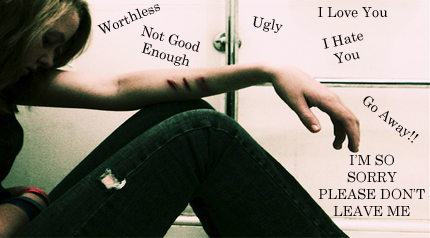
I’ve really been thinking a lot lately about my BPD and the unpleasant ways it sometimes manifests itself. The behaviors are narcissistic, and they don’t happen all the time, or with most people (thank God for that!) But the reason they exist at all is because as a Borderline, I live in mortal terror of being rejected or abandoned, and certain men in authority who tell me truths about myself may represent my father, who I was afraid would reject me (even though he wasn’t really the problem at all).

Sometimes I do wonder if I may be a narcissist.

But I know I’m not because it makes no sense. Real narcissists don’t have a conscience or empathy. They can’t be happy for you or sad for you and I can be. If I do something wrong–even if I derive some kind of sick pleasure during the time I’m engaged in it–afterwards I feel terrible. I just want to run and hide.

I’m working on these behaviors, using an old workbook I got in 1996, because lately I’ve been thinking about possibly dating again. I’m getting over my fear of finding myself with another narc, because I feel like I know enough to read them now, to see the red flags and know when to run if I must–but I also don’t want to drive a nice guy away due to my “I hate you….don’t leave me” Borderline tendencies.

There’s so much apologizing I would like to do to so many people. I know that’s not possible but I wish it were.

I know I’m changing for the better, but a lot of bad and painful emotions are coming to the surface in the process of discovering who I am, because I’m feeling again. I think my PTSD is almost healed, and that’s a great thing, but mixed in with all the nice, loving, tender emotions are some not so nice ones too. Like a maggot crawling on the petals of a rose.

I never said I was perfect.

My character flaws.

not_there_yet

Just because I write a blog that sometimes gives advice to others about Narcissistic Personality Disorder and other mental disorders such as Aspergers, doesn’t mean I don’t still have a long way to go in recovery myself.

Blogging and prayer have helped immensely in raising my self esteem and general outlook on life, but it’s important to stay humble too. I’m not anyone’s “guru” even though I may have good ideas from time to time. So lest anyone think I’m tooting my own horn or purporting to be some kind of expert, here’s a list of my character flaws that sometimes get in the way of recovery.

Aspergers/Avoidant Personality Disorder (AvPD) Flaws:

notobsessive

1. Shyness in social situations that comes off to some as aloofness, coldness or sometimes stupidity (when combined with my Aspie tendency to be “out of it” sometimes).

2. Awkwardness in social situations — doing or saying the wrong thing at the wrong time; occasional social gaffes that make me look obtuse or clueless.

3. Obsessiveness.

4. Narrow focus on one or two interests at a time. I dislike interruptions from the real world that interrupt my focus and force me to engage with the world.

5. Sometimes instead of not talking at all, I talk too much.

6. I avoid people. I prefer being alone (or with my pets) to being with other people.

7. I am a creature of habit and dislike interruptions from my routines.

8. I don’t like “surprises” or things being sprung on me at the last minute, where I don’t have a chance to prepare for them.

9. I get freaked out and overwhelmed by too much input from the world at one time. I can’t stand chaos, loud people, too much going on at once, or too many people around me outside of formal settings like a classroom or meeting. When I feel like too much is coming at me at once, I shut down and tune out–or get annoyed and angry.

10. Tendency to like to put everything in categories, or as some like to say, in “little boxes.” This leads to a tendency to label people and like labels.

11. General weirdness. This is probably a good thing.

Borderline Personality Disorder (BPD)/ PTSD Flaws:

all-or-nothing

These have been getting a lot better and I have learned some valuable tools in dealing with the symptoms in myself that have become second nature now, but it’s hard to be cured of this disorder and I still have some Borderline traits:

1. Tendency to either idealize or devalue people.

2. Hypersensitivity to criticism, jokes at my expense, or rejection.

3. Snap judgments about people before I truly get to know them.

4. Black and white thinking. Things and people are either all good or all bad.

5. Insecurity and worry about being liked (even though I avoid people). Try to figure that one out.

6. When angry, I can sometimes get so enraged I lose common sense and just want to do something to even the score without thinking about the consequences. Healthy fearfulness goes out the window and I act out in anger. Fortunately this happens a LOT less often than it used to; actually it’s pretty rare these days.

7. Rapid mood swings. This goes hand in hand with being bipolar too (that’s in remission). This too has been getting a lot better.

8. Paranoia and hypervigilance. I have a hard time trusting anyone.

9. Envy.

10. Excessive worry. Someone once told me, it’s useless to worry about things because if the bad thing does happen, then you’ve experienced it twice, and if it doesn’t happen, you’ve wasted energy on worrying. Wise words.

11. Fear of taking risks. This too has been getting a lot better, but in the offline world, I still have a long way to go.

15. Defensiveness.

16. Excessive guilt and shame. Easily embarrassed.

Other flaws.

smoking

1. Smoking. (I’ve cut down to less than a pack a day though)

2. A diet that doesn’t include enough fresh fruits and veggies.

3. Laziness.

4. Procrastination.

5. Self-sabotage (this has gotten a lot better).

6. Excessive worry about my adult kids. Overprotectiveness.

7. Beating myself up.

8. Beating myself up for having character flaws.

character_flaws

All in all I’m far from perfect, but I think my flaws probably make me more interesting too.

This is the post that scared me so much I almost deleted it.

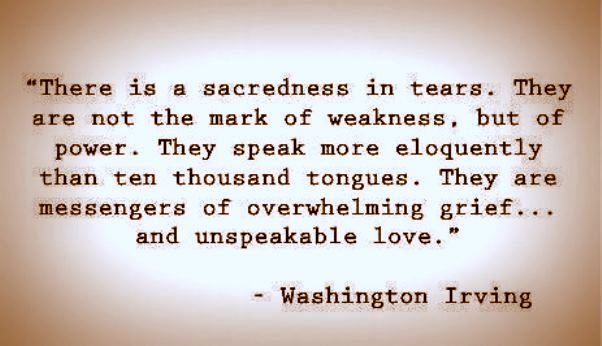
tears_quotes

I have never been so scared to publish a post until this one. I had this set to Private for several days and drove myself crazy trying to decide if I ought to post it. It’s about some of my most vulnerable moments and posting about those is incredibly scary for a person who usually has their guard up. But I longed to post it. Something inside was telling me I needed to and I wouldn’t regret it. I also felt this post was my best written one ever because while writing it I allowed my emotions to flow unimpeded. What to do?

I even wrote a short post asking people if I should post something that made me feel so naked and vulnerable. Ultimately, the decision to make this post public was mine, but the consensus seemed to be that I should.

I read this post over again earlier today from the imaginary perspective of a random reader who just happened on the article and had never seen this blog before. I realized that as this “someone else” it would be something I’d want to read.

So here it is, guys. The post that made me feel like I was going to pass out cold when I pressed “Make Post Public.”

Milk and Open Hearts: Embracing the “Feminine” Emotions

open_heart

I’ve been doing a lot of thinking about vulnerability lately. I’m reaching a point in my healing journey where I can start to allow myself to become more open to my emotions and to sharing the feelings of others. It wasn’t my intention to write another post about crying so soon after my last, but I think my interest is due to something that’s happening inside…

For years I couldn’t cry, but wanted to. I was so numb from all the abuse that I had dissociated myself from my feelings. I felt like I was dead and in hell. Recently I’m finding a lump in my throat or tears starting to well much more frequently–usually because I’ve been touched by something or someone in some way, and it’s usually a pretty simple thing. I realize this is a sign that the long term dissociation within my mind is coming to an end because I’ve gained more courage to embrace my feelings instead of pushing them away or denying their existence.

I remember even during the darkest days of abuse by my psychopaths and narcs, when I walked around like an emotional zombie due to all the abuse I endured, there were rare moments of clarity when truth and beauty shone through the murk of depression and PTSD.

During my pregnancies with both my children (I was pregnant three other times–one abortion which I am writing about next–the child would have been a boy born in 1999–and two miscarriages), my brain’s marination in a continuous bath of pregnancy hormones made me very emotional. Not depressed-emotional–in fact, I was happier than I’d ever been. Things just touched me or made me feel some kind of ineffable euphoria or inexplicable sadness and suddenly there would be tears.

I think the increased emotionality experienced by pregnant and lactating women is the result of nature’s opening our hearts to connect deeply and lovingly with our children from the moment we know we are pregnant. The torrents of female hormones–mostly estrogen and progesterone–help wire our brains to to allow the limbic (emotional) system to run things for awhile. The heightened ability to feel is a gift that helps our species survive because under the right circumstances, emotional openness transforms into unconditional love and empathy.

The hormonal bath continued for some weeks after the births of both my children and I remember getting particularly emotional one dark and cold night as I held my firstborn against milk-swollen breasts, with Barber’s “Adagio for Strings” playing on the stereo. I watched as my son rooted for the nourishment he sought and found it. Latched on tightly, dark pink lips pursed in determination and a primitive and preternatural hunger, my baby son began to nurse. As I felt the milk come down, I was overwhelmed with tenderness and love for this completely helpless creature who so recently had lived inside my body and taken nourishment from my blood, and whose wastes were eliminated with my own, and suddenly my face was awash in tears.

I watched as if through antique swirled-glass windows as my tears soaked my tiny boy’s thistledown-fine hair and ran across a petal-soft pink cheek busily working my milk glands. There was a melancholy underpinning to my overwhelming elation and I allowed myself to feel that sadness too–and realized that melancholy welled up from an awareness of how fragile my tiny son was, how fragile we all are–at any age; and how easily a trusting, childlike soul can be stamped out by hurt, abandonment and abuse. I wanted to protect this child from any harm that might ever come his way. I didn’t realize then my son’s own father would set out to destroy his spirit. Thank God he did not succeed.

At the moment the first drop of salt water touched my baby, opaque dark blue eyes fluttered open and gazed at me, seeming to understand my feelings. Sighing a delicate baby sigh, this tiny human being I had created through my love for a man and sustained and nurtured by my blooming, hormone-soaked body, nestled in closer and suckled harder until swept away in blissful sleep. I marveled at the knowledge this tiny boy would one day be a man, taller and probably physically stronger than me, and that I would play a huge part in his journey to manhood. It scared me to pieces but I felt willing and ready to take on the challenge–because of love, the greatest power we have as humans.

nursing_child

This wondrous connection–this moment of almost painful sweetness–was so honest and magical I almost dared not breathe. The tears poured down. I didn’t wipe the wetness from my face for that would have disrupted the beautiful connection I felt with my child.

It’s during these moments our hearts are open and we allow ourselves to become vulnerable, that we are fully engaged and connected with life and open to the bliss and pain of pure unconditional love. That kind of love is expressed in tears (often combined with laughter or smiles) because there are no words that could ever express the depth of this sublime emotion–an emotion of such beauty, rarity and truth it nearly hurts.

Tears are the mark of our common humanity and connect us with each other. We are pushed into the world crying, and are (hopefully) cried for when we leave it. Crying marks the most important milestones of our lives, whether they are happy or sad. There are always tears at graduations, pregnancy and wedding announcements, falling in and out of love, weddings, births, baptisms, death and funerals. There are tears wherever there is honesty, intimacy and love.

The happiest people in the world are often people who cry a lot. Their hearts are open, so everything and everyone touches them. They’re not afraid to connect and to empathize. Their love sometimes overflows the confines of their physical composure, and so they cry. I used to know a beautiful young woman who said she cried five or more times a day–just because she was so happy all the time. She wasn’t annoying happy. Honest joy never is annoying. She moved through life regally and with dignity and compassion, appreciating everything and loving everything and being touched by everything, and everyone loved her right back because they knew she was an empath. People wanted to be close to her, they wanted to be touched by her, both emotionally and physically. Her large expressive eyes were almost always wet with tears. At first it seemed a little strange, but soon we got so used to seeing her that way it just seemed normal after awhile. And it WAS normal, more normal than anything could ever be.

empathic_badass

I was so envious of that girl for her emotional openness. But she showed me a great truth about myself. I could be that girl because that was me. I just needed to find a way to knock down my thick concrete walls of fear. It’s getting easier. I still have a lot of emotional blockage, but I no longer feel like one of the walking dead.

In the Stephen King movie “The Green Mile,” John Coffey is an autistic man who nevertheless is an empath. He’s been unjustly sentenced to Death Row for the murder of two little girls because he was the last one seen with them (and probably due to his being black as well). You sense Coffey never killed those girls and in fact you realize how empathic this man really is. He has no defenses against the world due to his inability to hide his emotions (some autistic people have trouble regulating their emotions), and at the same time this very defenselessness gives him unbelievable strength and goodness. Coffey cried almost constantly, feeling the emotions of everyone around him and freely giving unconditional love where none existed.

A couple of years ago, there was a very popular video that went viral. It featured a 10-month old baby girl apparently crying from empathy as she listened to her mother sing. I’m not usually a fan of “cute baby” videos but watching this baby was fascinating because she cried like an adult would have–and the purity of her emotion was an achingly beautiful thing to see.

We are born withour hearts unguarded. When life begins to hurt too much (and it always does), children eventually learn to guard their hearts or in the worst cases (NPD, ASPD and some other mental disorders), dissociate themselves from their true feelings so thoroughly there is no turning back to the emotionally open state we were born with.

It’s a sad state of affairs that all the tender (“feminine”) emotions such as sadness, deep connection or friendship, love in all its forms, joy of the non-shallow type, feeling touched or moved, gratitude, and empathy– have been so devalued in modern society and are often seen as proof of weakness in a person when in fact they show a person who has the strength and courage to leave their hearts unguarded when it matters the most.

It’s interesting that all these softer emotions indicate goodness and purity of heart. They possess enormous potential to eliminate or reduce darkness and evil because they are emotions of healing, love, and our human connection with the Divine.

In a perfect world where all human beings had open, unguarded hearts, an alien from another planet upon first meeting a typical human would see smiles and laughter graced by tears. If the alien were to question what these signals meant, the answer would be “Love.”
The angels in Heaven would tell you the same.