Almost 10% of the United States population is personality disordered, with Cluster B being the rarest (which surprised me).
It looks like Histrionic (Cluster B), Schizoid and Paranoid (Cluster A) and Dependent (Cluster C) are all slated to possibly be removed from the next edition of the Diagnostic and Statistical Manual of Mental Disorders (DSM). That would leave only 6 personality disorders. I don’t think that’s enough. Schizoid Personality Disorder in particular doesn’t seem like it could be merged with anything else. Perhaps they’re planning on adding replacement categories.
While there aren’t official psychiatric diagnoses for dogs, I think dogs (and other pet animals) can and do develop psychiatric conditions, including the canine equivalent of the personality disorders. As in humans, “personality disorders” in dogs develop when a dog has been abused or neglected, usually in puppyhood. Neglecting a dog is just as bad as abusing it, because they are social creatures who need “mirroring” from their humans and regular social interaction. Without these things, a dog can become aggressive, aloof, or learn to fear everything and everyone. Since disturbed dogs do not make good pets, they are usually euthanized.
Because dogs and other pets aren’t capable of higher level reasoning, there’s no doggie equivalent of a “false self,” gaslighting, triangulation, or splitting, but we do find manipulative, attention-seeking, unpleasant behaviors.
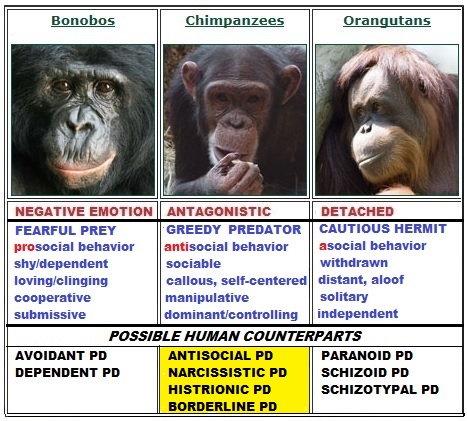
Here’s an article about the behavioral problems dogs can develop. Next to each item, I’ve named the personality disorder that would be the human equivalent for that behavior.
Selfishness and Aggressiveness: Some dogs aggressively guard their food and possessions, and bite any dog or human foolish enough to challenge them. Antisocial Personality Disorder.
Impulsiveness: Some dogs are very impulsive. They impulsively run off chasing after something at the slightest provocation. Often this behavior either gets them lost or run over by a car. Antisocial or Borderline Personality Disorder
Dominance: Some dogs are very dominant and literally control their submissive owners. You will see these dogs pulling their owners around on a leash, or involved in some other power struggle with their owner. Antisocial or Narcissistic Personality Disorder
Fear or Wariness: Some dogs are very fearful and wary of strangers. Some fearful, shy dogs eventually learn to trust their owner. However, other fearful dogs never learn to trust their owner and remain wary, aloof and distant. Schizoid, Avoidant, or Dependent Personality Disorder
Separation Anxiety: Some dogs become hysterical when their owner leaves them. They howl or tear up furniture in a fearful rage. Some dogs bloody themselves trying to paw through walls or smash through glass doors trying to reunite with their owners. Borderline Personality Disorder
Attention-Seeking: Some dogs constantly demand attention from their owner. Yet the more attention the owner gives these dogs, the more excited and attention-seeking they become. The end result is that these demanding dogs are always jumping up on their owners or otherwise pestering their owner for more attention. Borderline, Histrionic, or Narcissistic Personality Disorder
Lack Of Affection: Owners want an affectionate dog that loves them. Unfortunately, some dogs never warm up to their owner and remain aloof and cold. In addition, other dogs never learn to trust their owner, and remain suspicious and isolated. Paranoid,Schizoid or Avoidant Personality Disorder
Here is a dramatic video that shows how powerful the lack of mirroring is on an infant. It’s amazing how quickly the baby in this video notices the mother’s lack of affect and responds negatively to it. This is at the root of attachment disorders in children and most personality disorders, especially Cluster B. Without appropriate mirroring a child can’t develop empathy because it has never been modeled for them.
This article is a must read for anyone who isolates themselves from others and doesn’t understand why. You may not have Avoidant Personality Disorder; you may just be introverted or have a few of the traits. I just discovered this blog and the blogger is an amazing writer and I could relate to every word.
Example of the type of visuals you might see in the beginning of a DMT trip.
Disclaimer: I do not recommend or condone taking illegal drugs, nor do I recommend tampering with occult or new age practices such as attempting to open the Third Eye (which really does exist as far as I’m concerned) since I do think it could potentially open doors for evil spirits to gain access to your soul. Still, the intensely psychedelic chemical known as DMT (dimethyltryptamine), which is produced naturally by the human pineal gland (and is present in almost all plants and animals), has fascinating implications for treating or curing personality disorders, including NPD. So read on, even if (like me) you never want to mess with it.
I’m an obsessive kind of person who gets intensely interested in certain topics and reads as much as I can about them while my intense interest lasts (another reason I thought I was an Aspie for so long).
Over the past week or so, I’ve been reading up a lot about DMT (dimethyltryptamine), a naturally produced hallucinogen that has several unique properties: (1) it’s naturally produced in the human brain (by the pineal gland, which corresponds to the “third eye”) during birth, death (and accounts for NDE’s), and while we dream; (2) it occurs in almost all living things, including ourselves, and therefore is widely available although it’s hard to extract and synthesize and is also the most illegal drug there is (except in places where it is sanctioned for shamanic use, such as Peru, where it’s drank in ayahuasca tea); (3) In almost all “trip reports” of DMT users report “coming back” feeling completely humbled and with a renewed appreciation for life and our connection with the universe and with others; and (4) the trip lasts only about 10 minutes! It’s also been known to cure drug addiction (!) and alcoholism. DMT itself is non addictive, as are all psychedelics.
DMT is the most intense psychedelic known.
The DMT molecule.
Unlike most other psychedelics, you do not lose your sense of judgment and rationality during the experience. Although you’re completely out of touch with reality (as we know it) and you won’t remember you’ve taken a drug at all, your cognitive functioning remains intact so you are able to learn from the experience–if you can remember it.
Is DMT really a drug at all? I’m not so sure after reading what I have on Erowid.org and watching a number of videos and reading articles and trip reports. I think it’s a chemical that causes you to become aware of other dimensions and realities, and the “hallucinations” are actually quite real–ways of seeing the universe with the Third Eye (the pineal gland) rather than the physical eyes.
I’ve always been fascinated by trip reports for some reason, even though the only drug I’ve ever taken regularly (besides alcohol) is weed.
I’m not encouraging anyone to take illegal drugs, and personally, while one part of me longs for this experience, I doubt I could handle it. I just know I’d be one of those people who’d totally freak out. From everything I’ve read, the trip is INCREDIBLY intense–much more so than with any other hallucinogen. Even with LSD (which I really disliked the one time I took it) you still have some tenuous grip on reality and some ability to ground yourself/control the trip. You don’t forget the fact that you are tripping, and can usually remind yourself of that to avoid a really bad trip.
But with DMT (which is usually smoked) you are completely out of control and find yourself so out of touch with 3-dimensional reality you don’t even remember you have taken a drug, and believe things have always been this way and always will be, and what you’re seeing is your new reality. You can’t remember who you are, where you are, what your name is, or even what you are. Yet your cognitive abilities remain intact!
Delicate DMT crystals.
What a DMT trip is like.
From my readings, it seems the entire experience goes something like this for almost everyone who’s tried it.
1. you smoke about 2-3 hits which is enough to get the full effect; 3 if you want to “break through” (which I’ll explain in a minute). Usually you can’t smoke more because the trip comes on so rapidly and by the time you’d be ready for a 4th hit you are in hyperspace and have no idea what you just did or where you came from or who you are.
2. almost immediately you start seeing intricate, colorful, geometric patterns, fractals, grids, and other psychedelia constantly moving and shifting into new configurations. Some of the visuals you see are impossible in 3 dimensional reality because they are showing you other dimensions. Sometimes you can get a similar effect during hypnagogic hallucinations that happen just as you fall asleep. But we rarely remember those and they’re fleeting. Apparently (though it’s not proven), DMT is released by the brain when we dream, and we only remember the dreams that are most like reality (usually, the ones that happen toward the morning) but actually most of the dreams we have earlier in the night or in deep REM sleep are very similar to a DMT trip. Also, like a dream, it’s very difficult to remember the trip after “coming to”–it fades or dissolves very similar to a dream. DMT is also released during near death experiences (NDE’s).
3. Early in the trip, if you have smoked enough, you pass through a kind of membrane that is similar to a lotus flower. Once you “break through” you will be in a place where impossible things happen and time and space don’t exist the same way they do in the physical world. Time either stops, or the person feels like they spend years or even eons in this place. Most people report a feeling of familiarity, as if they have been there many times before (maybe remembering their own birth or time spent in dreams?) Objects have more than three dimensions and almost everyone reports a feeling of meeting other entities who communicate with them. They could be demons, angels, or aliens, or sometimes are disembodied entities who don’t actually speak at all, but the user feels like someone or something is communicating with them. Sometimes these entities offer gifts–objects so incredibly intricate and beautiful they defy the imagination and can’t possibly exist in our own 3 dimensions. Profound insights are revealed. You are warned to not allow your astonishment (and you will be astonished) to keep you from paying attention to what you are being shown. At some point the user is told their time is limited and they begin to slowly feel reality come back.
There is no way to ground yourself in any way during these experiences; you must completely give into it and in fact you have no other choice. If you go into such a trip with any trepidation, the experience could be the most terrifying thing that ever happened to you.
But even when the experience is terrifying, most people say later they’re glad they experienced it, because they were able to take away some realization of unbelievable profundity and say theywere humbled by the experience and see life and their relationships in a completely new way after returning. People have been cured of PTSD, drug addictions, and other psychological disorders by using DMT only one time. Some people are also able to recall long-forgotten childhood memories during the trip.
The stories I’ve read are so similar in nature (although each person receives a different insight or message or communicates with different entities) that I think the trip is to an actual place, not just something created by the mind. Shamans in South America and Mexico have been using it for ages and many people come to these shamanic healing sessions and leave a changed person.
During the intense trip, there is often a cleansing of both body and soul. Participants have reported severe nausea and vomiting (which could be due to slight poisoning) followed by diarrhea, but there is also emotional cleansing and catharsis with participants screaming and crying as they shed their egos and forget who or what they are. Sometimes spontaneous orgasm is even reported. Almost all these participants, although they appear to have suffered severely during the trip, feel great the next day, as if they’ve been reborn. Some say they are forever changed for the better, and the one experience they had doesn’t lead to a desire to do it again, because there’s simply no need to anymore.
To get a small idea of what a DMT trip is like, here’s an excellent simulation that includes commentary by Terence McKenna.
As one commenter who’s tried DMT under the video pointed out, this simulation is accurate but only about .000000001% what the real experience is like! I don’t think I want to try it! 😮
Implications for healing NPD and other personality disorders.
Since DMT has been effective on people with PTSD and other physical and psychological disorders and addictions to drugs and alchohol, I wonder if it could be effective on someone with NPD, even deeply ingrained or malignant NPD. NPD is itself a type of addiction and in many respects it does resemble addiction to a drug, the drug being narcissistic supply.
On DMT a person experiences complete ego death, to the point they don’t even know if they exist or what they are or where they come from. But even with a bad experience, the user (if they don’t go psychotic) is changed for the better. People who were overly concerned with acquisition or materialism or money before their experience come back with different priorities, and more caring for themselves and others. They realize there is much more to the universe than themselves or their image, or the material things they can attain. They realize how insignificant they are and yet at the same time how much power they have (but power in a truly confident sense, not a narcissistic one). They feel more connected to the spiritual. Some atheists have suddenly come to believe in God. People emerging from the DMT trip are able to see beauty and goodness in the world and in others for the first time since early childhood, and sometimes memories of early childhood are aroused and purged during the trip. Some people report they suddenly can feel empathy and caring for others they never felt before.
South American shaman offering cup of ayahuasca.
For anyone interested in the implications of the beneficial uses for DMT, I highly recommend reading the FAQ and trip reports for DMT over at Erowid.org. There is a book called “DMT: The Spirit Molecule” by Dr. Richard Strassman. A man called Terence McKenna also has many interesting Youtube videos where he describes his own trips and the properties of DMT. He doesn’t seem any the worse for wear.
Why is it illegal?
DMT is a Class 1 drug in the United States (and most other countries), which means it’s highly illegal and carries severe charges for possession, distribution, or synthesis. There’s a reason why this drug is illegal even though it occurs naturally in all of us–it’s intense and otherworldly beyond anyone’s wildest imagination and probably would cure many disorders instantaneously (well, within the 10-15 minutes the trip takes) and the pharmaceutical companies would lose money on their synthetic antidepressants and sedative drugs that don’t cure but simply maintain a person so they can function. If made legal, unconventional therapists or practitioners of alternative medicine might use it on a patient during a session and the drug companies would go out of business! (So would traditional therapists, for that matter.)
Again, I’m not recommending that anyone do illegal drugs or take something so intense as DMT. It’s very hard to obtain in smokable form or extract yourself anyway. But I think the implications here are fascinating and possibly earth-shattering for people with NPD and other personality disorders.
The dark side of DMT.
There are several drawbacks to using DMT (besides the severe nausea and vomiting some people report). People with NPD and a few other personality disorders (such as Schizoid or Obsessive Compulsive PD) might have a more unpleasant trip than the non-disordered, due to how closed off from themselves and unwilling to “let go” they are. But in the end, that unpleasantness could actually be a good thing. Long term psychodynamic therapy for people with NPD is extremely unpleasant too. There’s no way around it–the cure is going to be unpleasant, whether it’s in the form of 10 years of therapy, or a ten minute DMT trip.
DMT/ayahuasca aren’t drugs that should EVER be used for recreational purposes, if at all. They aren’t fun drugs so you and your buddies can “get high.” They may have healing, religious, or shamanic purposes if used responsibly, and preferably under supervision or at least with a responsible trip sitter. They have had some success not only with people with certain physical and mental illnesses such as PTSD, but with the terminally ill to help them come to terms with impending death and what the experience of dying will be like. Terminally ill patients given DMT usually become less afraid of death and dying. DMT is a serious drug meant only for sacred or teaching purposes and should never be used for recreation.
They can also open you up to evil or malicious entities who take advantage of the psychic door that’s opened during a trip. There are ways you can protect yourself. Here’s a very good article about the darker side of using DMT/ayahuasca (and other psychedelics) and how to avoid encountering dark spirits who might want to take something from you.
I read on one Christian website about a born again Christian who claims he was actually saved during a DMT trip, and still uses it occasionally to communicate directly with Jesus/God, but only with his sober pastor present, who apparently condones his use. I can’t say what my own faith’s stance is on using psychedelic substances for enlightenment, but as far as I know, it’s not condemned anywhere in the Bible. Of course, Adam and Eve’s “Tree of Knowledge” could well have been a psychedelic plant and their ingestion led to the Fall…so who knows? Deliberately ingesting psychedelic drugs could also be considered a form of sorcery, so if you have religious misgivings about it, you should probably stay away, even if only to avoid a bad trip caused by your fear of having one! Suggestibility while on any psychedelic substance is high, so if you believe you will run into demons or evil entities, then that’s what you’ll probably see.
DMT won’t kill you, but there’s always the small possibility of developing PTSD or even psychotic conditions due to suffering a particularly intense bad trip. There is no sure way to say for sure you won’t be a casualty. I can’t stress enough how potent this drug is.
A dream journal as an alternative.
One way around having to obtain or take DMT could be to keep a dream diary and begin to record and pay attention to your dreams and what they are telling you. Wake yourself up earlier in the night, when the dreams are of the more intense, DMT-type variety that are probably blocked off by the conscious mind to protect yourself. It’s been speculated the reason both DMT trips and dreams are so easily forgotten when we wake up or “come to” is because both stir up repressed memories and buried information in the unconscious mind that would freak the person out if they became conscious of it, or cause a severe depression. A person with NPD is especially cut off from their unconscious mind and repressed memories.
At some point I’ll be writing a longer post about dreams and how keeping a dream journal and recording dreams can help people with personality disorders and PTSD.
Here’s an interesting quiz to find out how in touch you are with your own or other’s emotions. Alexithymia is a Greek term meaning emotional blindness (a–without; lex–word; thymia–feeling). A person with alexithymia has problems understanding their own emotional state or those of other people. They may feel emotionally numb or even have a flat affect. They could be extremely reserved or shy, or just seem aloof or cold to others. They could come across as “mysterious” or inaccessible.
Low levels of alexithymia are correlated with high empathy, ability to engage emotionally in relationships, and having an active imagination. A very low score would indicate neediness and high emotional lability (common in most people with BPD, Histrionic PD, or Dependent PD).
Personality disorders associated with alexithymia are Schizoid, Antisocial, Avoidant, Narcissistic, Obsessive Compulsive, and sometimes Schizotypal. PTSD can also be associated with alexithymia.
I’ve been doing some reading about psychopathy and have found out some surprising things. I always was a little confused as to how psychopathy differed from sociopathy and have used those terms interchangeably on this blog due to my confusion. I’ve also used the term interchangeably with Antisocial Personality Disorder (ASPD) and sometimes even malignant narcisissm. It turns out it’s probably something completely different from the other three disorders and may not even be a disorder at all!
Before you start laughing, hear me out.
It all started with this colorful, humorous description someone wrote on a forum I’ve been active on, describing how a Psychopath differs from a Narcissist:
When I picture a Psychopath, I think of someone who at bedtime bounces around from one thing to the next, essentially a high-energy, happy person. When I picture a Narc at bedtime, I imagine someone wearing long pajamas and a nightcap (yes, a nightcap), walking around a 19th Century house, holding a candle, checking for ghosts.
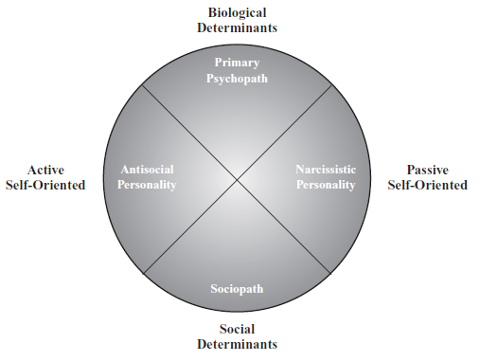
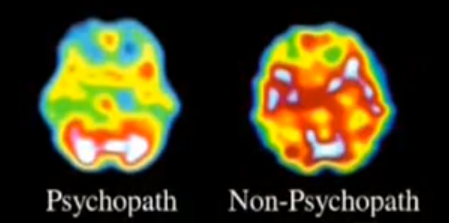
At first I thought this was a weird (but funny) analogy. But it really isn’t. According to psychologist Theodore Millon, Primary Psychopathy is something you are born with and is not due to abuse, unlike NPD or ASPD. Studies have shown that the limbic system (emotional center) of primary psychopaths is simply less active than in normal people. So they don’t experience empathy or have a conscience regardless of how they were raised, but they also don’t have very deep emotions in general.
Because they lack deep emotions, primary psychopaths tend to be fearless risk takers. They also aren’t moody because they don’t experience anxiety or depression the way others do–if they experience those states at all. But psychopathy has become associated with sociopathy and/or ASPD or malignant narcissism because a born psychopath may be more prone to developing personality disorders than the normal population, if they are abused. Because they don’t have the capacity to develop a conscience or empathy, if they do develop a personality disorder, it’s likely to be Antisocial Personality Disorder, where the right of others are callously violated. That’s why so many psychopaths are also antisocial and dangerous.
But there is nothing wrong with the cognitive functioning of a psychopath. They are able to learn the difference between right and wrong, and if they do not develop a personality disorder, theoretically they can choose to do what’s right. Only the limbic system is impaired, so any decisions a true psychopath makes are cognitively based. Emotion simply doesn’t play into it at all. They do “whatever works.” They lack a conscience because conscience is emotion- or shame-based, and a psychopath isn’t capable of much emotion in general.
So a primary psychopath can theoretically be a good person who is just extremely unemotional and only uses logic and reason to make decisions. Unlike narcissists, who actually have deep emotions but have turned all their emotions inward toward themselves and require “supply” to bolster their fragile egos, a non-disordered psychopath has no need for supply. They simply don’t care what anyone thinks. What you think is simply not something that even occurs to them. In contrast, a narcissist cares very much what you think and falls apart like wet toilet paper if supply in the form of approval or adoration is not forthcoming.
Primary psychopathy seems analogous to the Myers-Briggs ESTJ (Extroverted/Sensing/Thinking/Judging) personality type. In other words, a psychopath is an outgoing, sensation seeking, hedonistic thinker who happily jumps around from activity to activity like someone jacked up on Red Bull, yet they don’t have ADHD either because the J(udging) aspect means their high level of activity always has a goal or purpose. Such a person would be easily bored (which could also lead to antisocial behavior), never worry about things or experience (or even understand) guilt, and unafraid to try and experience new things. Their lack of emotionality would suit them well for the business world. In fact, people who have become very successful in business tend to score high in psychopathic traits.
While many high level executives do abuse the rights of others and callously close entire departments and treat their employees like so many pieces in a chess game (whatever works, right?), because psychopaths can tell the difference between right and wrong, some will try to do the right thing just the same. The difference is, they are using cognition rather than emotion to back any prosocial decisions.
Looked at this way, primary psychopathy may not be a disorder at all but a personality variation. Of course, the term “psychopathy” has negative connotations because most of us associate it with antisocial criminals, shady con artists, and serial killers. And in fact many of them are, but not all.
Sociopathy differs from primary psychopathy because (according to Millon, above), it’s antisocial behavior that may develop in a person with ASPD or NPD and is always due to abuse somewhere in the person’s past. A primary psychopath can become a sociopath if they become disordered, and that’s where you would find the serial killers and criminals (and these people usually have ASPD). But a sociopath isn’t always (or even usually) a psychopath. Sociopaths who aren’t psychopathic are usually very malignant narcissists (high spectrum NPD + ASPD) or sometimes even Borderlines, and they differ from psychopaths because there is no logic or rational thinking behind their antisocial or destructive behaviors, only unhealthy, toxic emotion. They seem to have no empathy because all their empathy–and most of their other emotions except anger–are turned inward toward themselves. The false self is what they present to others instead of their real emotions. Narcissists have plenty of empathy but it’s all for themselves–that’s why they are prone to wallowing in self pity. A psychopath would never wallow in self pity. They simply don’t care what you think.
This post is strictly for fun. It’s not meant to belittle personality disorders or the people who have them, nor do I believe in astrology. The idea came from a funny conversation I was having on Facebook today.
Cluster A Personality Disorders (anxious)
1. Avoidant: Cancer
(fearful of rejection, sensitive, homebody, shy, cautious)
2. Dependent: Pisces
(wants to be taken care of, clingy, passive, codependent)
3. Obsessive-compulsive: Virgo/Taurus
(clean/neat freak, obsessed with order and predictability; cautious and stubborn)
Cluster B Personality Disorders (dramatic, emotional)
1. Borderline: Libra
(wild mood swings, romantic fantasies, changes mind, can’t make decisions, can’t take sides)
2. Narcissistic: Scorpio/Aries
(vindictive when injured, easily offended; arrogant and entitled, infantile)
3. Histrionic: Leo
(full of themselves, dramatic displays of shallow emotion, vain, grandiose)
4. Antisocial: Gemini
(two faced, fast talkers, glib, deceitful, manipulative)
Cluster C Personality Disorders (odd or eccentric)
I think this article applies to anyone trying to heal from any personality disorder, PTSD, or the fallout of narcissistic abuse, so I’m posting it here too.







 Lucky Otters Haven