This was a question I thought of after posting my list of 50 things I ponder about, but I want to explore this further because I’ve never heard anyone else ask this same question.
Limerence is a term coined by psychotherapist Dorothy Tennov in 1979 in her excellent book, Love and Limerence. Limerence is a newer word for the state of infatuation, being “in love” (as opposed to real, agape or mature love), or simply “having a crush.” I’ve always liked her word because I think it sounds exactly like what the emotion feels like. I never liked the term infatuation because it sounds disgusting, having a crush implies an “unserious” problem only teenagers have, and being in love is probably not accurate.
She hypothesizes that limerence is an evolutionary adaptation that makes it possible for men and women to meet and mate, and lasts just long enough for them to marry and reproduce. That’s why the typical limerent episode lasts on average two years, and why it more commonly afflicts the young.
I’ve always been what Tennov calls a “limerent”–a person who gets crushes easily. Not everyone does. People with Cluster B disorders, especially BPD, are more prone to limerence than others, because we tend to idealize other people without really knowing them well or at all. It’s actually very narcissistic, because the other person serves as a kind of mirror, reflecting back the ideal qualities you want to see in them–until they don’t. Tennov calls the object of a crush a “limerent object.” In some ways, when you’re limerent about someone, you do see them as an object, because the idealized image of the other person isn’t based on reality or even accurate. At least that’s the common belief.
Psyche Revived by Cupid’s Kiss – Antonio Canova (Italian, 1757–1822) – Eric Pouhier (May 2007)
But what if it IS accurate? What if limerence is actually a hyper-real state where you see another person as they really are, and just aren’t seeing everyone else the way they really are? What if it’s kind of like the idiot savant phenomenon in severe autism, where the autistic person seems to focus ALL their intellect into one narrow subject at the expense of everything else? In other words, if we were all created in God’s image, then maybe we are all far more beautiful and closer to perfection than we can perceive in everyday reality, and only in the state of limerence, when all our attention is focused on one person, we can see that person the way they really are, which is the way God perceives each one of us.
If you’ve ever been limerent about someone, and especially if they return your feelings (or you believe they do), you feel heady, giddy, euphoric, almost high. It’s a very spiritual feeling, and falling in love with someone does feel very spiritual. When we look at someone we are limerent about, are we really seeing them through a small window that lets us see them the way God sees the whole universe and everything in it?
Maybe the people who are closest to God and the spiritual, and who are the happiest, walk through life feeling limerent about everything. Being able to feel that way all the time about everything is the closest thing to heaven I can imagine.
That feeling can also be induced by certain drugs. Limerence could be closer to a drug high, but I prefer to think it’s a small peek into the divine.
I read somewhere that limerence is being considered as a mental illness in later editions of the DSM. Whether or not it’s real, I think that would be a shame, because limerence can be one of the most profound and magical experiences in life.
One of the things my therapist and I have been working on is getting me to cry in session. I’ve talked before about how hard it is for me to cry, except in private, and even then it isn’t always easy. As a child I cried all the time. Because I was usually shamed for my tears, sometime during my teens or early 20s, I pretty much stopped being able to cry and outbursts of anger, seething resentment, or “freaking out” seemed to replace the tears. Rage and anger, while they have their place, is often destructive to others and yourself, and if used as an outlet where tears would be more appropriate, isn’t really very healing. Freaking out is never adaptive because it just makes you appear crazy. Before I learned mindfulness in DBT, I’d act out against others or freak out without thinking about the consequences, and usually feel regret, embarrassment, and shame later, much more so than if I had just cried instead.
Sure, tears can be manipulative. Narcissists cry to get attention or to manipulate others into pitying them or giving them what they want. Babies and young children do this too. That’s the kind of crying that has given tears such a bad reputation. But if a child is crying for other reasons–because they are hurt, because they are sad or overwhelmed with any other emotion (ANY strong emotion, not just sadness, can cause tears)–parents should never tell them “big boys (or girls) don’t cry” because that just teaches them to stifle their emotions, and stifling emotions is bad for you and can even affect your physical health. If a child is shamed out of crying often enough, they may learn to turn off the tears and become unable to cry as adults. This is especially common for boys in a culture that has traditionally frowned on men and boys crying because it’s a sissy or “weak” thing to do. But this no-crying policy applies to women as well, especially in the business and professional world, where showing softer emotions is a big no-no.
People cry for many reasons, but I think there are four basic reasons for genuine emotional (not manipulative) tears: (1) need for help or care; (2) connection, empathy and love; (3) awe, gratitude and joy; and (4) stress relief. I’ll go through each of these and explain why each one is awesome.
1. Need for help or care.
When a baby cries, it’s usually because they need something. They may be wet, in pain, hungry, tired, or just lonely. A baby’s cry brings mom running to give the baby what it needs, after which the baby stops crying. We are born into the world crying; tears are a pre-verbal language and the first language we ever learn. When we are born, we cry to communicate our distress or other needs, and get what we need to survive. If healthy attachment is achieved, a baby learns more sophisticated ways to get their needs fulfilled later on, but there are still times when needy tears are appropriate and NOT manipulative, even for grownups.
It’s always healthy and appropriate to grieve after a devastating loss, such as the death of a friend, family member or beloved pet. It’s appropriate to cry when hearing very bad news or when in great emotional or physical pain. There are survival reasons for this. A crying person usually draws people near them and attracts sympathy. If we have normal levels of empathy, we have an instinctive urge to touch or physically comfort a crying person. A person who has just found out their best friend has cancer or Fluffy died needs the comfort of others. They need to be held and hugged and have their back stroked and their hand held. They need physical contact. They need to be able to pour their story out to another person. It would be cruel to deny someone in great physical or emotional pain that kind of succor. Some societies understand this need, and that is why there are public rituals such sacramental wailing in some cultures, or sitting shiva in the Jewish faith after a loved one dies. Only when it becomes excessive or is done to attract attention to yourself does this type of crying become annoying to others.
2. Attachment, empathy, and love.
This is closely related to the above, but a bit different because the tears shed aren’t intended to draw help or comfort, but to connect with others or with the world. Many new mothers find that they become very emotional during pregnancy and for a few months after their babies are born. Even though as an adult I’ve always found crying difficult, an exception was made when I was pregnant or lactating. My emotions went into overdrive! I remember when I nursed my babies, sometimes I became overwhelmed with pure emotion I couldn’t name or explain, and silent tears began to run. It wasn’t unpleasant at all. It just felt natural and real. I think those tears connected me more deeply with my children. Tears are words an infant can understand instinctively, and when a young infant sees his or her mother’s tears, they understand this means attachment and love with her has been achieved, and a good mother responds to and feels her baby’s emotions too.
Grownups, even men, sometimes just feel overwhelmed with emotion, sometimes very positive emotion. People who are deeply in love sometimes find as they gaze into their lover’s eyes, their own well up. It can happen at any moment when the love they feel seems bigger than they are. This is why sudden tears are common in lovemaking that isn’t merely for sexual release, but to more deeply connect with the lover.
Tears of attachment and connection indicate high levels of empathy. A person who is able to feel the emotions of a friend who is sad can sometimes actually cry with their friend, and this serves to connect them on a deeper level. A world in which we can’t share the emotions of those around us–either negative or positive–is a world where no one cares and everyone is out for themselves. Any society that regards empathy as a weakness is a sick and dangerous one. If the human race is doomed to self destruction, I’m pretty sure the growing lack of empathy and care for others we see around us today would be the primary culprit.
3. Awe, joy, and gratitude.
Kelly Clarkson learns she won American Idol, 2002.
Tears of awe are the kind you shed when you are blown away by an incredible sunset or magnificent landscape. Some people get very emotional in church or when hearing a certain piece of music or reading a certain poem. I think these are the kind of tears we shed when moved by something we perceive as being greater than ourselves. They are humbling and remind us of our insignificance, but not in a bad way, because at those times, though we feel humbled, we also feel more connected to the universe or to God. Tears of awe connect us with the divine.
People shed tears of joy when something wonderful happens to them, usually a great surprise. Winning the lottery, winning a contest, your team winning the Superbowl, walking into your house to a surprise birthday party, hearing your baby’s cry for the first time…all these things make people cry. They’re anything but sad or manipulative! Tears of joy may also be a form of stress relief, as in some cases, there’s often an element of relief, which I’ll explain more in the next section about stress relief. For example, contestants in singing or dance competition shows or in pageants almost always cry when they win. For many months, they’ve been under enormous stress. The moment of winning not only validates all the hard work they’ve done, it’s also a sudden release of months of the built up stress of heavy competition. It’s okay to let go!
Related to tears of joy are tears of laughter–those times we laugh so hard we begin to cry. Crying and laughter are physiologically very similar and serve a similar purpose of relieving stress, so it’s not too surprising that sometimes our bodies get laughter confused with tears!
Finally, there are tears of gratitude. Sometimes we are taken by surprise when someone does something nice for us. Especially when it’s unexpected, kind words or deeds can bring on tears. Colloquially, this is known as being touched, which differs from being moved because it’s more human and less spiritual/humbling than being moved. Tears of gratitude connect us with each other.
4. Stress relief.
Some unpleasant emotions aren’t normally expressed through tears. For example, people don’t usually cry when they’re afraid or anxious or angry. To do so wouldn’t be in our best interests survival-wise. When we’re in danger or there’s some kind of threat facing us, showing vulnerability might get us killed. So when we’re angry, we want to attack. When we’re afraid, it’s fight-or-flight. When we’re worried, we want to remove the source of worry or solve the problem. But once the danger or stressor has passed, and we feel a measure of relief, it’s common for people to break down in tears. A child who has become lost doesn’t usually cry while they’re looking for their caregiver, because that’s too dangerous. They cry the minute they see Mom or Dad’s arms reaching out to them (and very often Mom or Dad cries right along with them!)
Sometimes people cry even when the danger hasn’t passed, when they just feel overwhelmed and have given up trying to fight or escape or trying to solve their problem. In those cases, crying is a last-ditch effort to solve the problem. If all else has failed, then crying may bring help or comfort from others. It’s not necessarily manipulative if everything else has been tried first and nothing has worked.
Sometimes even when the threat is gone or the issue resolved, or the horrible outcome we expected didn’t come to pass, we still cry, because it’s finally safe to do so. The tears shed at those times are really tears of relief because they help release all the emotion that was pent up while we were in danger. When thought of this way, it makes no sense to tell someone not to cry, because it doesn’t mean they’re upset, it means they’re relieved and finally feel safe enough to release all that bottled-up stress through tears.
And then there are those times when you just need to have a good cry, and you don’t even know why. After a few minutes or hours of sobbing, pouring out snot and tears, you come away feeling like a million dollars. So if you want to cry, go ahead and let it out. It’s good for your body, mind and soul.
I have mixed feelings about being in a relationship. On the one hand, I long for it because I can’t deny that my inability to connect with anyone on a deep emotional level has caused me a lot of sadness and pain.
At the same time I need my solitude, and it’s almost always my preferred state, due to my avoidant personality. I’d much rather do things alone than do them with others. I’m simply too selfish and don’t want to give of myself to anyone else. I think the selfishness stems from fear though. I’m too afraid: I struggle with fears of rejection, abandonment, judgement, engulfment, being hurt, being used, being abused, etc. I have little to no interest in sex, although I can be sexually attracted. (maybe this is TMI, but I prefer my fantasies to the real thing).
So I have a sort of conundrum. I don’t want to grow old and die alone, but at the same time I don’t want to and am afraid to do what it takes to avoid being alone forever. I was married to my malignant narcissist ex for many years, but the marriage was extremely dysfunctional and I was always in the codependent role. Thinking about the marriage’s failure (which was inevitable from Day One) now makes me feel sad, although for a long time I just felt rage (which is why I started my first blog).
I would only consider a relationship with a non-narcissist now (and really, not with any Cluster B), but that’s a problem because I’m simply not attracted to non-disordered people. I never have been.
The other problem is I’m “in love with the idea of being in love.” Like most Cluster B’s, I become limerent easily (though less so than I used to) and get addicted to the whole “high” that infatuated feeling brings. But it never lasts and I know intellectually it’s not real love. It’s a type of addiction that feels as good as a drug, but the crash (and there always is one) is just as bad as coming down from a powerful drug too. I miss that drug-like high of falling in love though.
To rectify this longing, I live the limerent experience out in my mind by developing powerful crushes on people who cannot give me anything in return for a variety of reasons. Oddly enough, this lack of reciprocation is okay with me. I don’t feel like anything is “unrequited” because I deliberately and consciously get attached to a person only in my own mind and prefer not to share my feelings with the person in question. I have an active enough imagination that there is no need to play it out in reality. In fact, I’d probably run away in terror if it became obvious my feelings were returned. I’d get off on the supply that comes with that, of course–but it would send me into panic mode too. It’s very weird. I don’t know if this is just an eccentricity of mine, or if this sort of thing is experienced by others. Having an active imagination does have its benefits. It’s very narcissistic though.
I think unless I can become non-disordered (which is unlikely), that I need to accept the idea of being alone for the rest of my life. On a day to day basis, I’m okay with that, but it’s sometimes so hard when you look around and everyone else in my age group is married or in a relationship, and I have to do everything on my own. You’re treated by society as defective and if you don’t make a good living, it’s hard to even survive. I feel like a freak sometimes. I can’t look at singleness as a permanent lifestyle or I get very sad and afraid. I have to do what they do in AA, and take things one day at a time.
This article by psychotherapist Ross Rosenberg makes a surprising claim about non-pathological narcissists (those who are not malignant or psychopathic, which means high spectrum Ns having ASPD traits)–they CAN love. But the “love” is shortlived because it’s really intense infatuation (limerence) and depends on the other person fulfilling the idealized image of the person the narcissist has formed in their mind, and such a relationship is doomed to fail.
Considering Narcissists have hurt and damaged the lives of so many people, it makes a great deal of sense why there is a proliferation of information, advice, articles and books on the subject of narcissism. There seems to be a surplus of people on Facebook, YouTube and other social networking sites who are making it their life’s mission to vilify narcissists, while making themselves out to be specialists (or even experts) on the subject. Those who contribute are often victims of narcissistic abuse and want to help others avoid their mistakes. I am thankful for their efforts, especially since it is connected to codependency recovery, which is where I spend a great deal of my personal and professional effort. It seems to be one of the biggest psychological movements I have seen in recent years.
And there are well-researched and experienced experts in the area who have and are making valuable contributions to the understanding of narcissism. Sam Vaknin is one such expert on narcissism who, just by his own efforts, has almost made the term “Malignant Narcissist” a household term. But even with his contributions, and perhaps because of them, there has been a backlash of misunderstanding on the subject. By focusing on Malignant Narcissism (which happens to be the condition he purports to have), he has accidentally and unintentionally given the impression that “Malignant Narcissism” is the same clinical condition or psychopathology as Narcissistic Personality Disorder (NPD). The truth of the matter is Malignant Narcissism is a subcategory of NPD. Moreover, those with NPD, or what I call “garden variety narcissists,” do not display many of the same characteristics as those with Malignant Narcissism.
One common mistake about Narcissism, which I see frequently on the Internet, about which there is now a deluge of articles, posts and blogs is that those with NPD cannot love and do not have empathy. This subject was discussed in detail in a recent YouTube collaboration video with me and Sam Vaknin entitled, “Can Narcissists Love and Do They Have Empathy?” Although Vaknin and I agreed it was a complicated question that has an equally complicated answer, we agreed for the most part that narcissists can, in fact, feel and express love and can be empathetic.
We also mostly agreed that Malignant Narcissists and those with Antisocial Personality Disorder (ASPD or Sociopaths) cannot feel or experience love. Because Malignant Narcissism is often confused with ASPD, it is necessary to simply define it as a subcategory of NPD, which is not only a pathologically narcissistic disorder, but also combines traits of Paranoid Personality Disorder and Antisocial Personality Disorder. For more information on Malignant Narcissism, consider reading Vaknin’s book, “Malignant Self-Love: Narcissism Revisited” (2015). It is, therefore, correct to assume that Malignant Narc’s and ASPD’s cannot love as it is understood in our general culture. But it is incorrect to make that same leap for those with Narcissistic Personality Disorder, which will henceforth be referred to as “narcissists.”
Narcissists can’t love but they can and do fall in love. All the time. What they feel is a state Dorothy Tennov has called “limerence,” more commonly known as infatuation or colloquially known as a crush.
Limerence (also infatuated love) is a state of mind which results from a romantic attraction to another person typically including compulsive thoughts and fantasies and a desire to form or maintain a relationship and have one’s feelings reciprocated. Psychologist Dorothy Tennov coined the term “limerence” for her 1979 book “Love and Limerence: The Experience of Being in Love” to describe the concept that had grown out of her work in the mid-1960s, when she interviewed over 500 people on the topic of love.
Limerence has been defined by one writer as “an involuntary interpersonal state that involves intrusive, obsessive, and compulsive thoughts, feelings, and behaviors that are contingent on perceived emotional reciprocation from the object of interest”. Limerence has also been defined in terms of the potentially inspirational effects and the relationship to attachment theory, which is not exclusively sexual, as being “an involuntary potentially inspiring state of adoration and attachment to a limerent object involving intrusive and obsessive thoughts, feelings and behaviors from euphoria to despair, contingent on perceived emotional reciprocation”.
In other words, the state of limerence is much like being high on a drug. The “LO” (limerent object) is the person fixated on, and this person is a mirror for the infatuated narcissist. When a narcissist falls in love with you, they can be the most romantic people you could ever imagine. They’ll gaze longingly into your eyes, bring you flowers, want to spend every moment with you, tell you they want to be with you forever.
But it’s not you they are seeing. What they are seeing is a reflection of themselves that you are showing them by reciprocating. You make them feel good about themselves because you are giving them supply and attention, and letting them know how wonderful you think they are. You’re basically nothing more than a mirror, and your narcissist, when he gazes into your eyes, is really gazing at his own false self you are feeding.
This doesn’t mean that only narcissists experience limerence or infatuation. Most people do at some point in their lives. It’s much more common for teenagers and young adults to have a “crush,” but it’s a temporary state. I think it’s more common in young people because they are still rather narcissistic and trying to find out who they are. Mature adults can “fall in love” too, but will normally move from the initial state of limerence with all its heady excitement and intensity, into a more stable state of deep love, which is less emotionally intense but much more rewarding for both partners.
Psyche Revived by Cupid’s Kiss. Antonio Canova (Italian, 1757–1822) – Eric Pouhier (May 2007)
Limerence only lasts an average of 1-2 years (in evolutionary terms, this is just enough time for a relationship to result in the birth of offspring, and is also about the length of time of an average engagement). But limerence isn’t love. It’s what Tennov calls a state of “cognitive obsession.” You can be “in love” with someone you don’t even know or have never met (like a celebrity for example), so how can that be real love? It isn’t. It’s obsession. You may be projecting what you want to see onto the limerent object, rather than seeing what’s actually there. That’s why later, after you’re “over” the object of your infatuation, it’s common to wonder, “what did I ever see in her?”
A narcissist can certainly fall in love (unless they’re the commitment-phobic type), but once you begin to express your own needs, and begin to show cracks in your armor that mean you’re only an imperfect human, you are no longer mirroring the narcissist as they want to be mirrored, and that’s when the abuse and manipulations will begin–or in some cases they will begin to devalue you before the final discard.
A narcissist cannot move from a limerent state into real love, as a normal adult can. Real, lasting love requires mutual give-and-take, empathy, sacrifice, compromise, and a lot of hard work–all things that narcissists simply can’t handle. That’s why their marriages and relationships usually don’t last that long–or if they do, become such hotbeds of misery and discord.
If you’ve been discarded by a narc and they’ve moved onto someone else, don’t feel too bad. Before you know it, that new “perfect” lover will seem not so perfect to them anymore, and they will be abused or discarded too, joining their long list of conquests.
Yesterday I decided to take myself to the movies for a change, and chose to see “Inside Out,” the Disney Pixar animated summer fantasy blockbuster.
Seeing “Inside Out” was a serendipitous choice, because I just happened to have enough money to afford a ticket (which is a rarity for me), and also because, although I didn’t know it right away, this movie has a beautiful message about the way Sadness and Joy, though seemingly polar opposites, when working together make human connection and unconditional love possible. Just as the light can’t exist without darkness, or good without evil, joy cannot exist without sadness. When working in sync with each other, these two emotions create a beautiful life affirming thing called Empathy, and that’s what connects us to each other and keeps the human race from becoming extinct.
Official Trailer
Sneak Preview–Teaser Clips
Riley Andersen is a young girl of 11 who becomes severely depressed after her parents’ decision to move from Minnesota to San Francisco. The movie begins at the moment of Riley’s birth in Minnesota, shown from Riley’s point of view. Her first Emotions (depicted as loveable anthropomorphized characters) are Joy (feeling secure in her parent’s love) and Sadness (when she needs something or feels ignored or in pain). As Riley grows into early toddlerhood, sometimes her needs and desires are thwarted and Anger takes over and she throws a tantrum. Around the same time she is also capable of feeling Fear or Disgust (both necessary for her survival), and it’s at those times those characters become dominant in Riley’s growing mind.
When the five Emotions work together in harmony, not overstepping each other’s boundaries and only doing the jobs assigned to them, this teamwork manifests in Riley as a well-adjusted little girl able to feel all her emotions at the appropriate times.
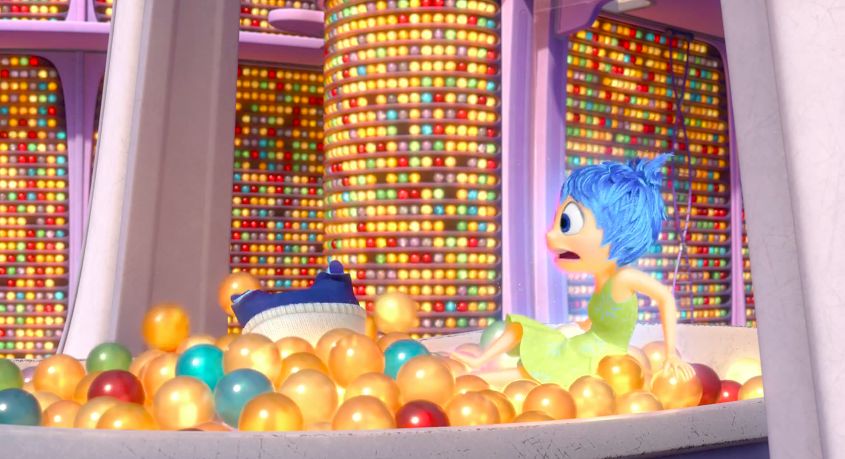
The five Emotions work in Headquarters, which is the conscious part of Riley’s young mind. Joy is responsible for making sure Riley’s short term memories are sent to Long Term Memory deep in Riley’s subconscious. Her memories are depicted as glowing colored orbs containing a ghostly image of the actual memory. The color of the orbs represent the dominant Emotion Riley felt at the time of the event. Transporting Short Term memories into Long Term Memory happens during Dream Production as Riley sleeps, and sometimes the other Emotions are needed to help Joy do her job getting the memories there (and sometimes discarding certain irrelevant or painful ones.) Occasionally the other Emotions (as well as Riley’s imaginary childhood friend, Bing Bong, who is a jokester) like to play little jokes–and certain irrelevant memories like an annoying gum commercial jingle are sent to Long Term Memory along with the important memories, which causes Riley to occasionally hear the gum jingle in her head at random times years later.
At the center of Headquarters is the vault which contains Riley’s Core Memories–important but happy long term memories that are responsible for Riley’s happy go lucky personality. The orbs that represent these are colored gold (Joy’s color) and for Riley’s continued mental health, these core memories must not be contaminated by the other Emotions, which is why they are kept locked in a vault. Each of the Core Memories has a long glowing tube that leads to one of Riley’s Five Islands of Personality: Family, Goofiness, Hockey (which she loves to play), Friendship, and Honesty. Maintaining these islands is necessary for Riley’s continued normal psychological development.
The crisis in Riley’s mind is set off when her family moves from her beloved Minnesota to San Francisco. Moving away is always a traumatic event for even the most loved child. Feeling isolated from her old friends and lonely in a place she doesn’t know, Riley’s Emotions begin to make mistakes and not work in sync. Joy and the other Emotions have never been sure of Sadness’s purpose because she just seems to be a Debbie Downer who is always in the way and always making mistakes. It’s Joy’s job to keep Riley’s happiness intact, but one day shortly after the traumatic move, Sadness goes around touching Riley’s happy memories, turning them blue (sad). Joy frantically tries to undo the damage but the memories already touched cannot be repaired. Desperate, Joy tries to isolate Sadness to prevent her from doing any more damage.
On Riley’s first day at her new school, Sadness takes over and Riley begins to cry in class, which creates a new but painful core memory. Joy frantically tries to keep this new core memory from reaching the central vault, but in her struggle with Sadness, who seems to keep contaminating more memories, she accidentally knocks out some of Riley’s untouched happy core memories, which fall off into the abyss. These memories are almost impossible to retrieve once lost to Riley’s Unconscious. Worse yet, both Joy and Sadness are sucked through the Long Term Memory Tube themselves, and are both lost deep in Riley’s vast and labyrinthine Unconscious.
During Joy and Sadness’s absence, Anger, Fear and Disgust attempt to run Headquarters in their place and make a holy mess of things. They attempt to provide “joy” but of course it’s faked now, rather than genuine. Sadness too is absent, so Riley can no longer longer cry or even feel grief over her loss. Anger, Fear and Disgust manifest in Riley’s new insolent and angry attitude toward her parents and loss of interest in the things she used to love. With the core memories now missing or contaminated, one by one the Five Islands of Personality crumble and fall into the abyss of the Memory Dump, a place deep in Riley’s mind where old memories are forgotten. The first Island to crumble into oblivion is Goofiness (Riley’s sense of humor), followed by Hockey (which she quits), and then Friendship (she no longer has any desire to make new friends).
Joy and Sadness find themselves adrift after falling through the Long Term Memory tube deep into Riley’s unconscious mind.
Desperate, Anger decides to insert in Riley’s mind the idea to run back to Minnesota. He plugs this into the Control Console, in the belief this can produce new happy memories. This requires Riley to steal money from her mother’s purse in order to fund her trip back to Minnesota, and then she lies about the theft. As a result, the second to last Island left, Honesty, falls away in ruins into the Memory Dump.
Back in the abyss of Riley’s deep Unconscious, Joy and Sadness run into Bing Bong, Riley’s long forgotten childhood imaginary friend. Bing Bong wants to reconnect with Riley, so he tells Joy and Sadness they can all get back to Headquarters by riding the Train of Thought. After a series of failed attempts, they eventually catch the train, but it becomes derailed when the last personality island, Family, falls into the Dump.
At this point, giving any more away would be spoiling the plot, but gradually Joy and Sadness, who have always been at odds with each other, realize that in order for Riley to return to her normal happy state of mind, they must work together as a team and Sadness has the biggest job of all. Riley must be able to experience–and receive–empathy and love (which comprise both joy and sadness) to heal from her near-catatonic depression.
As a blogger about narcissism and personality disorders, I see Riley at this point in grave danger of suicide or developing a personality disorder, even NPD or BPD. Her trauma-induced depression has caused her to become apathetic and unable to feel anything at all. What happens next is so magical and touched me so deeply I sat there in the darkened theater with tears running unchecked down my face and my nose running. I wasn’t alone–I heard sniffles and nose blowing all over the theater, and there’s a safety and sense of connection with total strangers that comes from that, and that’s why going to see a good movie never gets old. There’s something wonderfully liberating about being able to cry in a public place yet unseen by others and unjudged for it because everyone else is crying too. I think that’s why “heartstring tugging” movies are so popular. But the emotions elicited in “Inside Out” feel real–there’s no sappiness or fake sentimentality in this film that make you feel manipulated by the producers.
The five Islands of Personality.
But for all its poignancy, “Inside Out” has plenty of humor too, and all the jokes are clever and well timed. At times during the movie I was both laughing and crying at the same time. The Five Emotions are all funny characters with their own unique charm. Even Anger is loveable and hilarious in his own irascible way, and the Tinker-Bell like Joy, who could have been incredibly annoying for all her upbeat perkiness, has a depth you don’t expect and over time you realize she is the only Emotion who can feel all the other Emotions. I pictured Joy and Sadness as really being the same person–the two sides of Riley’s True Self–and when they were lost in Riley’s memory dump, Riley’s behavior became quite narcissistic. It wasn’t lost on me that both Joy’s hair color and her “aura” are colored blue–Sadness’ color.
Pete Doctor, the film’s director and screenwriter, was inspired to develop “Inside Out” while trying to come to terms with his own daughter’s psychological changes and mood swings as she approached adolescence. To give the complex psychological concepts presented credibility, well-known developmental psychologists were consulted during pre-production. It’s obvious that a deep knowledge of the way the human mind works fueled both the story and the landscape of Riley’s mind. Kids will adore “Inside Out” because of its lovable characters, fantastic animation, humor, its engaging story about a regular girl, and impressive special effects. In the theater I saw it in, there were plenty of children there, and all of them were rapt in the story.
But adults will love it just as much because of the movie’s deep message of Empathy being born from pain and loss, and the necessity of “negative” emotions to exist in a healthy person’s psyche, working in tandem with “positive” ones. Understanding the movie at this level requires an ability to think in an abstract way about the mechanisms behind personality development and psychological disorders. “Inside Out” is a rare movie that celebrates the human ability to feel, and to love, cry, connect, and laugh. It tells kids that all their emotions are okay, and experiencing them is normal and just part of growing up.
Parents, if you have children ages 4 to early teens, please take them to see “Inside Out.” Both you and they will leave the theater feeling great, and the ideas presented in the story can open up honest discussion about emotions between parents and their children. I’d even go so far as to suggest teachers show this movie to their students, and engage them in discussion afterwards.
I find it encouraging and heartening that such an honest and touching movie with a positive message about genuine emotions and empathy has become the hit of the summer, instead of the usual mindless dreck that passes for summer blockbusters.
“Inside Out” is rated PG. I would not recommend it for children age 3 and younger, due to several quite scary moments that could give a young child nightmares.
Riley with her concerned parents at the dinner table.
“Inside Out” is a 2015 American 3D computer-animated comedy-drama film produced by Pixar Animation Studios and released by Walt Disney Pictures. Directed and co-written by Pete Docter, the film is set in the mind of a young girl, Riley Andersen (Kaitlyn Dias), where five personified emotions—Joy (Amy Poehler), Anger (Lewis Black), Disgust (Mindy Kaling), Fear (Bill Hader), and Sadness (Phyllis Smith)—try to lead her through life as she moves with her parents (Diane Lane and Kyle MacLachlan) to a new city. The film was co-directed and co-written by Ronnie del Carmen and produced by Jonas Rivera, with music composed by Michael Giacchino.
Docter first began developing Inside Out in 2009 after noticing changes in his daughter’s personality as she grew older. The film’s producers consulted numerous psychologists, including Dacher Keltner[6] from the University of California, Berkeley, who helped revise the story emphasizing the neuropsychological findings that human emotions are mirrored in interpersonal relationships and can be significantly moderated by them.
After premiering at the 68th Cannes Film Festival in May, Inside Out was released on June 19, 2015. It received universal critical acclaim, with many film critics praising the voice performances (particularly for Poehler, Smith, and Richard Kind), its concept and poignant subject matter. The film grossed $90.4 million in its first weekend—the highest opening for an original title, besting Avatar ’s previous record.
Here is another guest post by the same writer who contributed “The Narc from Costa Rica.” Again she has asked to remain anonymous, but I think this story does a better job of describing the narcissism of a man who seemed to be extremely romantic. Talk about a whirlwind romance!
It’s common for narcissists (especially somatic ones) to act very romantic in the beginning of relationships. But the problem is, it’s an ACT. They can sweep you off your feet with their charm, declarations of undying love (which are lies), seemingly endless desire to make love to you, and gifts of wine, candy and roses. They also can move in very fast, and it’s not uncommon for one to propose marriage very soon into the relationship. (There are other narcs who are relationship-phobic, usually the cerebral type.). My ex proposed only three months after we met. He was cerebral though, so not all “romantic,” fast-moving narcissists are somatics.
The man in this story, Michael, seems to be a covert or “vulnerable” narcissist. They can seem to have very deep emotions and be quick to express their insecurities and vulnerabilities, but they’re still dishonest and manipulative, and they still have no empathy and will leave you in a heartbeat if a better source of supply comes along. Covert narcissists can be more dangerous than aggressive (classic) narcissists because you never see what’s coming. They can completely fool you because they seem to need you so much.
A Beachside Affair By Anonymous
My whirlwind relationship with Michael lasted for only 3 months. It was a summer love, like something out of the movies. Our affair ended abruptly, leaving me completely gutted emotionally and even physically. It was as if he’d ripped my heart out and taken it with him, leaving me with a huge hole inside my soul.
I met Michael on the beach. We quickly became obsessed with each other. He was like an addiction to me. I went to work during the day and all I could think about was Michael. I’d go home and polish myself from head to toe, making sure I looked and felt as beautiful as possible. Before I met Michael I just didn’t feel good. I was in a failing marriage to another narcissist. My husband ignored me. He never talked to me and I was dying inside. I remember that I’d go home and get drunk on wine, just to blur out the feelings of emptiness I felt from my husband’s coldness, on top of having suffered an empty childhood and adolescence due to having been raised by a narcissistic father and a borderline mother who wasn’t much better.
I knew having an affair was wrong, but at that point I no longer cared. I needed to feel loved and needed. Michael fit the bill perfectly, at first. I remember the day I met Michael. He was beautiful, his tanned muscles shimmering and rippling in the sun. We talked for a little while and before long he started to kiss me and held me for 4 hours straight, as the sun went down over the ocean.
After that heady experience I made a decision to leave my husband because I no longer could stand being with him. There was just no comparison.
I’m not sure why Michael had me under such a powerful spell. I’m not sure if it was inverted or covert narcissism or codependency on my part that made me so attracted to him. I know he mirrored my own narcissism and I think that was part of the attraction. Or (in my thinking at the time) maybe it was just that we were both artists that craved something more and we needed attention and had a burning desire to express our vision of life through our art. All I know is that when the two of us got together we melted together like butter. All the love that I never got, all the love I craved and all my neediness was being filled by Michael and I couldn’t get enough of him. He was everything to me.
Michael had an apartment in a very famous town in coastal New Jersey that was known for its rock n roll legacy, especially Bruce Springsteen. Famous bands played in a place called The Stone Pony in Asbury Park. Back then, over 30 years ago, the town was run down and almost abandoned. The Stone Pony was the only thing that held the weak fabric of this town together. But I loved it there. This run down seaside town was always beautiful to me because I always felt like this was my home. I still do. I knew that one day I’d play up on the same stage where other famous artists had played. There was fire in my belly. A void that needed to be filled with a whole lot more than a man’s love. If there was an Angel on Ocean Avenue, she was certainly watching over me.
Micheal was an art student who had nude sketches of himself all over his wall. He played the guitar too and we often played music together and I would sing. I use to stay at Michael’s house every night. We went to parties at the homes of mutual friends we had met out on the beach. The bonfires were wonderful and we would all sit around and sing songs. We sang Beatles songs and Bowie songs and I felt like a reincarnated hippie. My favorite song we sang was David Bowie’s “Space Oddity.”
“Tell my wife I love her very much…she knows.
I’m here and I’m floating in my tin can.
Far above the world. Planet earth is blue and there’s nothing I can do.”
There was magic and presence and energy and the love in all the people we met at these parties and on the beach. People liked to watch Michael and I, because they were intrigued by our obsession and need for each other. We vicariously fulfilled their need for romance. I felt so validated, loved, sexy and happy. It seemed too good to be true and it was. This couldn’t be real life. It was too perfect.
We were a study in contrasts physically, and I think that’s another reason for the fascination our friends had for us. Michael had beautiful blue eyes and long blonde silky hair, and a great body. I had long black hair and lots of curves. People liked to photograph us together. We use to sit down in front of a long mirror in his room and stare at the contrast. We made each other feel beautiful. And together, we were. At that time it seemed we were good for each other’s self-esteem. At the county college Michael was studying for an Associates degree in graphic arts we were both asked to pose nude for $10 dollars an hour for the students who sketched still lifes in the human anatomy drawing class.
Michael’s background was sad. He told me that he was beaten by his father with a belt consistently during his infancy and his dad was also an alcoholic. Michael was depressed and he had to take psychiatric medication to fight his depression from the abuse he endured as a child. I remember watching him go into this weird state where sometimes seemed almost frozen and off in some other universe (dissociation is a common symptom in people with NPD and BPD). When in these near-catatonic states, he’d punch the floor or the wall over and over again, sometimes lasting for up to 20 minutes. It was sad and very scary. He was not mean or malignant though. He seemed like a gentle, artistic soul who just couldn’t take care of himself. He was never controlling, but seemed very needy for my constant attention and love. I think he was a covert narcissist.
Our affair came to an abrupt end at the end of that summer, because Michael left me for another women who said she was in love with him. She was willing to pay the rent on his apartment. So in the end, he chose money and security over me. I was devastated because the drug of my addiction to him filled me all summer and was suddenly ripped out of my heart in an instant and the devastation and grief was almost too much to bear.
But if I’d known about narcissism, I would have known Idealize and Devalue is all part of their game. They can’t help it. Even covert narcissists are at heart predators out to use you and throw you away when you’re no longer of use to them.
My next phantom lover was a drummer named Karl. I was so needy that I of course fell into the hands of another narcissistic man. And so it goes on…
I saw this post in the NPD forum at Psychforums. The discussion was about narcissists who seem to care more about animals than people. “StupidPig,” a poster with NPD wrote an interesting post, which I think is a great explanation of what “love” means to a narcissist. In a nutshell: it’s not love. It’s not even really attachment. Everything is an object to them. A narcissist can be as “attached” to an object or an animal as a person, sometimes more so. It all depends whatever is giving the narcissist more pleasure/supply at a given time and whatever requires less maintenance or emotional input from them. The “love object” can change from one day to the next. People and animals are just objects to a narcissist.
I did not edit StupidPig’s post or correct his spelling errors.
I am a narcissist with NPD, and I used to like to “own” animals as a kid. However, I never liked to “care” for them.
Someone with NPD cares only for his image, or what the books call the “Glorified Self Image”. Anything else other than his Glorified Self Image is considered an object to him (be it his mother, his children, his spouce, his boss, his car, his own body, or his pet snake or whatever) , and the value of such object will be defined only on basis of how much narcissistic supply it would give him. I.e. how much it enhances his Glorified Self Image.
So, if owning a dog (or a car or a pretty girlfriend) would make me look better, then I would enjoy it, but I would never do any effort to maintain the car, walk the dog, or be nice to the girlfriend, because, as someone with NPD, I have an exagerrated sense of entitlement. this means that I strongly belive that I “deserve” to have the objects that make me look good, and I do not need to do any effort to “keep” those objects.
A pet is no different from a spouce or a car or a friend or a watch or a parent to a Narc. It is just an object that gains value when it makes him look better or feel superior and loses value immidiatly if it doesn’t give him such supply. Based on this, if your car does a 18/20 job in making you look better and feel superior, while your dog does a 10/20 at that job, and your spouce or son does a 5/20, then you would love your care more than your dog and your dog more than your family. But, if on the next day your son wins the world championship in swiming and tells the world on TV that you, his father, is the reason behind this victory, you would shift into loving your son more than your dog and your car, and if three days latter your son makes a fight with you because he wants the car, and the car gets dented in an accident, you will love your dog more than your car and your son, and so on.
In all cases, the narc will never do much to maintain those “objects” and will never really hold any of them dear to his heart because they are all just objects to him.
Only in the light of this should one talk a comparitive view at the different objects in a narc ‘s life and their different merrits and drawbacks. using myself as an example, the advantages and dissadvantages go as follows:
– Pet-objects: They are submissive ( do not need much effort to do as told) and not judgemental (and so do not pose a threat to the Narc’s ego), but they do have several drawbacks, the most important of which is that they need feeding, cleaning, medical care, etc. Narcs hate objects that require lots of maintenance.
Another drawback concerning pet-objects is that they sometimes require “feelings” from you. Not as much as human-objects do of course, but it is still a nagging requirement.
– Human-objects: They can offer much more supply than a pet-object ( e.g. a woman-object who adores you gives more types and quantities of narcissistic supply than a dog) but the drawbacks are that human-objetcs require much more maintenance than other objects and are apt to judge you (and hence are a threat to the ego, or the glorified self image) and they need scary amounts of feelings in order to function properly and, worst of all, they might have “opinions” about your actions and would try to aplly measures that restrict your freedom. They are great objects but they come with a great price..in most cases, this makes them not worth the Narc’s effort(in his twisted opinion of course).
-Inanimate objects (like watches, cars, computers, etc) : They do what they are expected to do, they are never judgemental, and they do not require any emotional input to function properly and they hardly limit your freedom in anyway.
Give me robots at work, at home and in bed and I’ll be a very happy narcissist! ( oh, but please make them cheap, efficient, self maintaining and guranteed for life.)
But, once again, you are never really attached to any of those “things”. You can, as a narc, always kick your dog away for a better looking and more submissive dog, and never regret it. You will never feel any remorse for having sex a billion times outside your marriage, and you will never remember how your old battered car which served you for 10 years looked like after the first week of driving your new BMW around.
A narc may have a preference for one of those posessions over the other for one day (cat over son, girlfriend over dog), but don’t let that fool you, because it is only ephemeral and can very easily change on the next day.
Not long ago, when I started studying narcissism in depth for this blog, I came to a shocking and disturbing realization: Every single one of the men I had relationships with or fell in love with were narcissists. It’s because I was trained by my family to be Narcissistic Supply, and as a Borderline, these relationships tended to be stormy.
Having BPD means I’m not the ideal codependent doormat, and when I felt violated–even though I’d allow the abuse to continue because after all, I was trained that way–I’d still try to fight back, at least for awhile. This led to lots of drama and some truly terrible fights with narcissistic men who I could never fix, no matter how hard I tried. I sure wish I knew then what I know now.
I have always been attracted to narcissistic men and they have always been attracted to me. I’m easily taken in by their elaborate displays of romance and promises in the beginning–there’s no one more romantic than a narcissist trying to procure you as supply. It’s fun while it lasts, but as soon as they know they have conquered you, the abuse begins. One red flag to watch out for: a man who moves in too fast, or starts talking about a permanent commitment or marriage only weeks after you met them.
Here’s a list of the narcissists I was seriously involved with (or married to). Only one wasn’t a narcissist, but he was severely bi-polar. The names are made up.
Steve P: my first serious boyfriend in high school. Steve called constantly (like 8-10 times a day at first), wanted to be with me all the time, regularly sent flowers, was very passionate and loving at first. He actually would cry because he “loved me so much.” After a while he became physically and mentally abusive, insulting me, questioning me about other boys, what I was doing when he wasn’t around, calling me names, and finally becoming physically abusive. One day, with absolutely no warning, he called me and told me he was dumping me because he met someone else. I was enraged at the nerve of this but actually relieved to be rid of him finally.
Mark S: my second serious lover during my college years. Mark was very cool–knew everything there was to know about art, music, theater, and he had offbeat, interesting friends. He used to take me to the East Village in New York City where we’d attend all the punk and new wave clubs and shop in funky vintage clothing and record stores. We had a lot of fun. But he was also an intellectual snob and looked down on my “pedestrian” tastes in music, movies, etc. He looked down on my friends, whose intellectual abilities he felt were beneath him. Mark saw himself as a rogue and a cultural rebel, and after awhile his constant put downs became annoying and we’d fight. He also never wanted to have sex (he was a cerebral narcissist), thinking it was a huge waste of time that could be better spent feeding his mind with new cultural experiences. After about a year, he told me I was too boring and my tastes too commercial and pedestrian, and he dumped me for a woman who looked exactly like me but was apparently much more hip and “in the know” about what was cool and cutting edge than I was. He wound up marrying her.
David B: David was not a narcissist; he was bipolar and suffered from severe depressions and substance abuse. He drank heavily to self-medicate and was always in and out of the psychiatric ward. He regarded me as a sort of mother figure and I liked the idea of being needed so much. But his neediness and clinginess became cloying and suffocating, he was constantly drunk, so eventually I left him, not without a little guilt in doing so. But he was really driving me crazy.
Michael B: The malignant narcissist I married. He is actually a psychopath. Michael acted very much like Steven in the beginning–showering constant attention and gifts on me, moving in very fast, talking about marriage just three months after we met. Being that I was in my mid-20s, I was open to marriage and he seemed perfect. I should have seen one HUGE red flag: the expensive engagement ring he insisted I have was purchased with my own credit card, because he had already maxed all his out. He always lived way above his means. He’d take me to expensive restaurants and insist I pay (and of course, he would pay me back later, but he never did). The rest of our story can be found in the articles under “My Story” in the header. Let’s just say the man is a psychopathic monster with serious substance abuse issues and a parasitic monster at that.
Daniel S: The only lover I’ve had since the divorce. Well, okay, we were actually still married. (I’m not proud of this). But my marriage was already long over and I was desperate and miserable and not thinking straight (not that it’s an excuse to cheat). Daniel was actually a worse malignant narcissist than my ex, if that can be believed. He had that intense predatory stare, which I took to mean sexual and romantic interest, but was really his way of sizing up me as his prey. Of course I found him irresistably attractive. Unfortunately Daniel was another cerebral who had very little interest in sex. After a huge show of ardent romance and all that goes with it, he started the abuse, which included insulting me and comparing me (unfavorably) with his past lovers and what he saw as an “ideal woman.” He said he wanted babies with me but constantly criticized my parenting skills (as if he could know, since he never met my kids). He raged a lot although he never actually became physically abusive. He sulked and gave me the silent treatment when I didn’t do things his way or wanted to spend time with my family. He was stingy and although he had a lot more money than I did, he always made me pay my own way on dates. He obsessed about money. He would buy me things and constantly remind me how much those things cost him. He also would give me gifts and then ask for them back later, telling me he was only letting me “borrow” them. I am serious about this. After I ended our relationship (due to guilt at least as much as his abusive treatment), he still continued to call me constantly “as a friend.” After several of these phone calls, I finally worked up the guts to tell him to bug off and blocked his number.
I have not had one lover or husband who was a just a nice regular guy. There have been a few of these men who seemed interested in me, but I always found them boring and rejected their attentions because I didn’t feel any “chemistry” with them.
I think it’s time to change all this. I want to start dating again soon. I know what red flags to look out for now so I think I can avoid the narcs, but can I fall in love with a normal man who will treat me well?













 Lucky Otters Haven