Narcissists who love animals and their mothers.

dr_evil_cat

I’ve noticed something strange about some narcissists that I’ve never seen mentioned anywhere else. Some narcissists, though lacking empathy for other people, seem to have it in spades for animals. Even some psychopathic malignant narcissists are actually very good with non-human creatures. My ex is one of these. He cried like a baby when our dog, Daisy, died of a massive stroke in early 2013. He was always very kind to her and the cats. He used to be beside himself with worry when one of them got sick. The animals seemed to trust him and even preferred him to me! In spite of being No Contact (really, very low contact) with him, I completely trusted him when I had to recently rehome two cats and a dog, all whom I cared about very much (the pets are now staying with my daughter).

But that’s the only time you would ever see him be genuinely kind. Any “kindness” he showed other people was meant to be either manipulative or to impress.

A commenter on another post, discussing her psychopathic ex-lover who is still actively gaslighting her and generally being psychologically abusive, had this to say about him:

The guy I know loves cats. Many of the photographs he sent me have him in photos with kittens in his hands. The photos make him look very loving. Because you would think that any man that relates to cats and kittens in photos would be loving, gentle and harmless.
[…] His nickname for me was Kitty Kat.

This phenomenon is actually pretty common. It surprises me it’s almost never discussed.
So here is the conclusion I come to about why some narcissists can genuinely feel empathy for animals. The problem isn’t that the narcissist lacks empathy per se, but that they have shut off their capacity to feel empathy for other humans. They may feel it for an animal (or maybe for some, a lesser or non-mammalian animal because dogs and cats may be seen as “too human.”). Here are two surprisingly touching essays Sam Vaknin wrote about his relationship with a goldfish and a snail. The reason some narcissists have normal or even excessive levels of empathy for animals is because animals are “safer” to feel empathy for than other humans, who they have come to hate and devalue due to abuse they suffered at the hands of their parents.

Of course this doesn’t apply to all narcissists or people with an antisocial personality. We have all read of cases of serial killers and other sadistic criminals who spent their childhoods tormenting all living creatures, even the lowly ants and spiders of the world. But only some are like this. Most are probably indifferent to animals.

Mama’s boys.

mother_tattoo

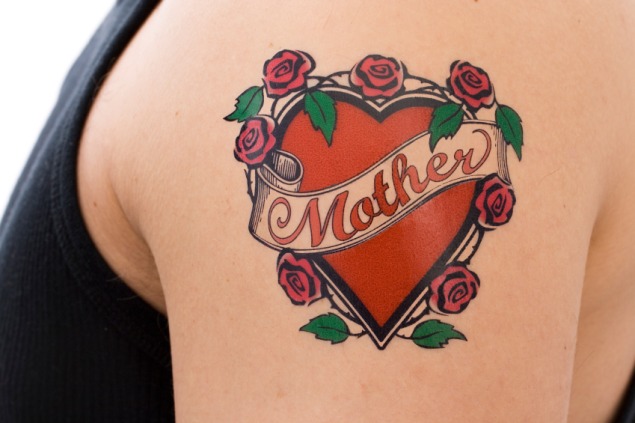
I have also seen a related phenomenon that’s even more strange than the affinity some narcs have with animals. Some psychopaths and malignant narcissists (almost always male) who seem to live to abuse or even torment other people, at the same time seem to genuinely love their own mothers and even feel protective of them. You hear about serial killers who worshipped their mothers (but hate all other women), even though the mothers were almost always abusive to them. The movie “Psycho” illustrates this in Norman Bates’ relationship with his dead mother. Obviously the exceptions these psychopaths make for their mothers are rooted in severe codependency to the point most people see their relationships with them as “sick,” but it’s still an indicator of a more vulnerable, codependent side of themselves they show to no one else.

For both the seriously character disordered who love animals (because they’re safer to love than people) and those who love their mothers (because they have unhealthy codependency with them), it’s as if little piece of their true self somehow remains split off and immune from their otherwise impenetrable wall of narcissism.

How could someone even survive this?

dark_pozadia
Credit: http://dark.pozadia.org

I just read a comment on a forum about narcissism that made me want to throw up.

A woman who had been scapegoated all her life by her malignant narcissist mother and had gone No Contact said her adult son had been found dead (she didn’t say what the cause of death was). She says her mother never had the slightest interest in her grandson because any child this woman bore couldn’t possibly amount to anything. She never sent him a birthday or Christmas gift, or even so much as a card. She had never even come to see him when he was born.

The woman received no condolences from her mother after her son died. Instead, three days after his death, on the day of his inquest, she found out from relatives that her mother had gone out to celebrate with other family members and friends. Although the reason for the outing wasn’t her grandson’s death per se, she was told by a relative that her mother said “that stupid bitch got what she deserved.”

Wow. Just wow. Talk about lack of empathy. How could anyone be that callous? Losing a child is bad enough (I don’t think I could survive if that happened to me and I marvel at anyone who doesn’t lose their mind after losing a child) but to have YOUR OWN MOTHER–No Contact or not–say something like that is just so evil it’s beyond my comprehension. A mother who would say something like that upon her own child’s bereavement doesn’t deserve to live. Incredible.

I think if that happened to me I wouldn’t want to live anymore. Driving her own daughter to suicide was probably this so-called mother’s intention.

Apes and personality disorders.

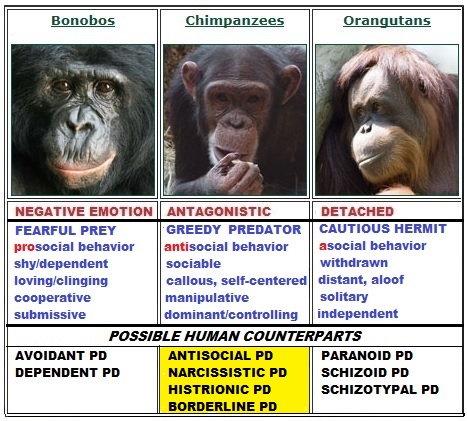
I don’t necessarily agree with all of this, but it still got a laugh out of me. Click to enlarge.

Primates_chimps

Histrionic personality disorder: the other Cluster B disorder

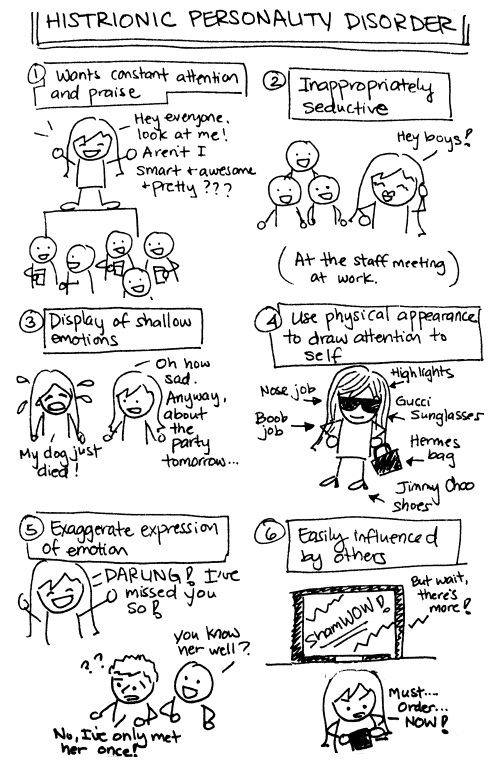
Histrionic personality disorder (HPD) is the forgotten step-child of the Cluster B group of personality disorders, which also includes the Borderline, Narcissistic and Antisocial personality disorders.

HPD: the “other” Cluster B disorder.
histronic_pd

NPD is of course the King of the Cluster B disorders (which is exactly the way a narcissist would have it). It’s one of the hottest topics on the Internet right now, with ACONs everywhere (adult children of narcissists) rising from the silence of abuse like vampire slayers on a mission of justice. In addition, there are probably hundreds of blogs and forums about NPD and the damage people with that disorder inflict on everyone else. If you Google the word “narcissist” or “narcissism” you will see thousands of articles, personal stories, quotes, videos and support groups for victims of narcissistic abuse (but only a sprinkling of the same for people WHO HAVE the disorder–because NPD normally hurts its victims more than its sufferers).

Borderline personality disorder (BPD) is also widely discussed on the web, and it appears to be a common catch-all diagnosis, especially for women who were victims of abuse or sexual abuse and show emotional instability resulting from that. People diagnosed with BPD may actually be suffering from an array of other disorders (such as PTSD) and labeled BPD because the experts have so little understanding of BPD and it might not even be a real disorder anyway. Or maybe it is a real disorder but is a lot rarer than you’d think because so many people (mostly women) are erroneously diagnosed with it. In any case, there are blogs, support groups and forums all over the web for people with BPD and those who love them (or must cope with them).

And finally, if you’re like me and enjoy reading about psychopathic and sociopathic murderers, serial killers, mass murderers, cult leaders, and other violent (and non-violent) criminals, you are going to find out a lot about Antisocial personality disorder (ASPD), which is actually at the top of the narcissistic spectrum if you’re of the school of thinking that believes narcissism runs on a continuum from merely manipulative to heinous beyond words. Sociopath World is an interesting website that features blog posts written by ASPD writers. If you like this sort of stuff, or are just curious to find out what the inside of a sociopath’s head is like, I recommend checking out the site.

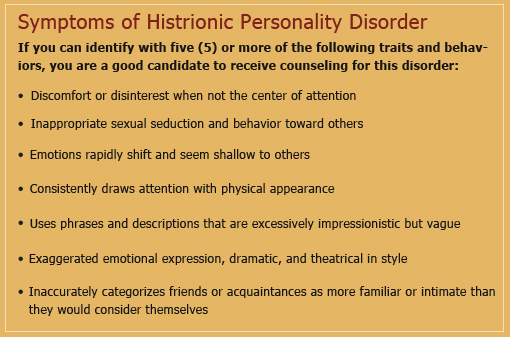
A fourth (and rather interesting) Cluster B disorder, HPD or Histrionic personality disorder, somehow got lost in the Cluster B shuffle. You don’t hear much about it and there’s very little written about it either, except for cursory mentions in the psychological and psychiatric literature, and it’s rarely featured by itself–it’s only mentioned in articles about the Cluster B disorders in general. But while it’s not widely talked about, Histrionics (mostly women) are frequent characters in movies, novels and TV shows because they make good theater.

histrionic_symtoms

People with HPD crave attention, so much that Sam Vaknin speculates that HPD may actually be the somatic, “female” form of NPD–or at least resembles it a lot. Most (but not all) Histrionics are women. A woman with HPD will act very much like a somatic narcissist, but may show somewhat more empathy or genuine (but shallow) emotion than a true narcissist. In fact, showing emotion is what Histrionics do best–hence their name. Their exaggerated emotional displays are over-the-top and dramatic. They are the original drama queens. I’m going to go out on a limb here and speculate that a lot of male HPD’s are probably flamboyantly gay men of the type who have exaggerated feminine affectations and interests (this is certainly not a slur on gay men, just an observation). Histrionics are also easily bored and besides attention, crave constant activity or social interaction. They tend to smother those they become attached to.

For convenience’s sake (and because most histrionics are women), I’ll describe a hypothetical woman with this disorder.

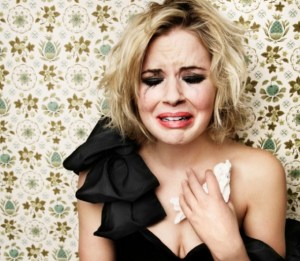
Histrionic Haley.
histrionic_personality

Haley was the youngest child of her family of origin, and also the prettiest. At the age of 12, her parents divorced and her mother remarried. Haley’s stepfather appeared to love her–but that was just how things appeared. In actuality, he came into her room at night and forced himself on her, telling her how pretty she was and what a beautiful woman she was turning into. He made her strip naked and lie down on the bed while he fondled her developing breasts. When Haley questioned him about why he did this, her stepfather told her he was just “checking to see how she was developing.”

Haley was spoiled by both her mother (a narcissist who actually hated Haley for “seducing my husband” but still needed her because Haley made HER look good) and her stepfather, who constantly bought her clothes, mostly revealing outfits that showed off her adolescent curves.

Haley was never encouraged to think for herself or develop her mind or any skills other than her physical appearance and flirting ability. Her mother, a somatic narcissist, taught Haley that acting helpless and exaggeratedly feminine was the most effective way to attract a boy. Haley was spoiled rotten but abused at the same time. She was attractive, obsessed with clothes, makeup and shopping, and used her “feminine wiles” to attract boys, who she proceeded to manipulate (usually using sexy smiles, skimpy outfits, exaggeratedly demure behavior, or tears) to get whatever she wanted.

Haley was highly romantic–besides being obsessed with cheap romance novels, she was constantly “in love” with someone. Unfortunately she never learned how to love anyone on a deeper level because she didn’t know how to give, only take. She learned that sex was the best way to obtain what she wanted, and that’s all most of her lovers wanted her for anyway, so she was more than happy to oblige. Due to her immaturity and emotional instability, she was prone to drawn out, over the top tantrums when she didn’t get her way. Of course, her frequent temper tantrums, crying jags, unreasonable demands, and general high-maintenance behavior caused all her relationships to be short lived. With each breakup, Haley got worse, and upped the ante for the next relationship, believing she hadn’t asked for enough the last time. It never occurred to Haley that she might be too demanding and high maintenance. She never learned from her own mistakes, because being needy and demanding was all she had ever been taught.

Haley had good social skills, and became the life of any party she attended. While she had no close friends (due to her inability to maintain any deep and meaningful relationship), she had plenty of acquaintances and casual friends, who though of her as a dynamic, fun and exciting woman. She had lots of charm, was very pretty, and adored being the center of attention–just as she had been in her family growing up. Each year she would throw herself a huge birthday party, and expansively invite more people than she could realistically afford to entertain. But that didn’t matter because she had so many admirers, no one cared that the food and drink always ran out. Haley kept everyone entertained. Even though she’d almost always wind up sobbing loudly and theatrically at some point due to some slight during these parties, even that in itself kept her admirers around, who became protective of her. Haley basked in all the solicitous attentions she received.

Haley also used her sexuality in inappropriate ways. On several job interviews, she wore revealing see-through tops or short shorts, or allowed her bra strap to “accidentally” fall down her shoulder from under a tight spaghetti strap tank top. She openly flirted with her male interviewers. While a couple of employers fell for the bait and hired her–Haley was never taken seriously as an employee and then she’d tearfully complain to anyone who would listen about how she was treated like a sex object and got no respect.

How HPD differs from BPD

comedy_tragedy

Histrionic personality disorder resembles BPD in some ways–but the Borderline is ambivalent about relationships and tends to alternately smother and abandon people–their tendency toward “splitting” (black and white thinking) causes them to idealize others followed by devaluation or pre-emptive rejection when they perceive a slight. A histrionic will just keep on smothering and making more demands. They lack the ambivalence of a borderline.

While a borderline may be sexually promiscuous or seductive, not all are–and they don’t use their sexuality or body to exclusively the way someone with HPD does. Borderlines also tend to be more self-destructive (cutting, eating disorders, drug abuse, compulsive gambling, etc.) than a Histrionic, and more prone to suicide or suicidal ideation, as well as having dissociative and sometimes psychotic symptoms that Histrionics lack.
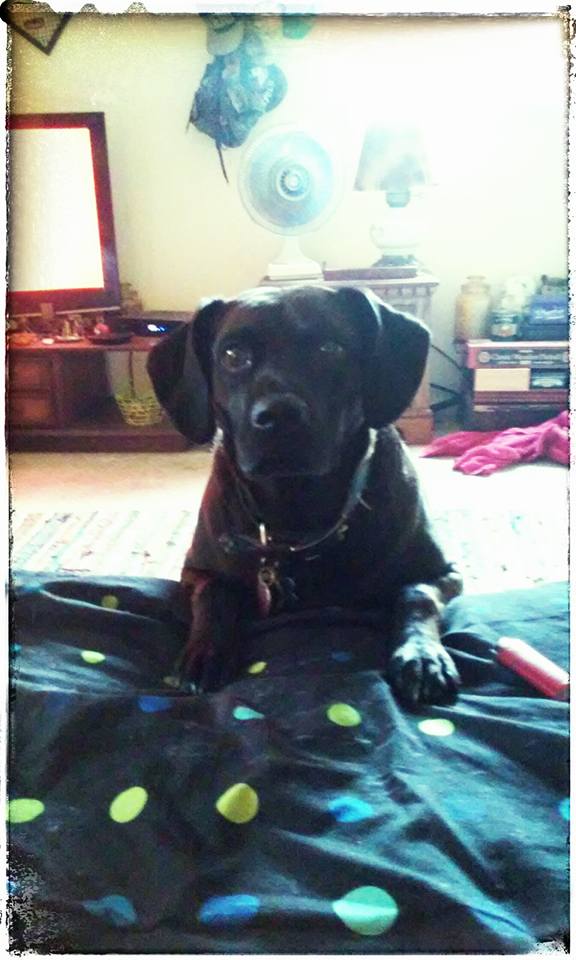
Dexter at home in his new home.

Dexter has been living with my daughter and her boyfriend now for over a month. I think he looks very chill and happy.

dexter_now
Click photo to enlarge.

I write like William Gibson, Arthur C. Clarke, and David Foster Wallace.

William_Gibson_Zero_History_signing_at_Forbidden_Planet_London
William Gibson book signing at Forbidden Planet, London, UK.

According to this very cool website, which analyzes a writing sample and then tells you who your style resembles, I write exactly like William Gibson, a contemporary author of the cyberpunk genre.

2 factoids:
1. William Gibson coined the term “cyberspace.”
2. I never read anything by William Gibson. I guess now I should.

ETA: I took the test again, using a longer writing sample (both samples were from this blog)–and got science fiction author Arthur C. Clarke, whose books I love.

…and even later:
I tried this with 3 more writing samples, and got David Foster Wallace all three times! So I guess that’s who I really write the most like. I haven’t read his books either. Now I will.

df_wallace
David Foster Wallace. Should this man be my muse?

MENTAL HEALTH – Shared Psychosis

This is a really great article about the way psychopaths can manipulate others by inducing a “shared psychosis” with their victim(s) — otherwise known as trauma bonding or Stockholm Syndrome. Psychopaths are way too far gone to ever be cured. Don’t try to help one; you can’t. This well written article really drives home the evil and creepiness of psychopathy–and most are not even criminals. They achieve their desire to completely destroy another person or group of people (such as the followers of a cult leader) using perfectly legal means. No Contact is the only way to handle a psychopath (NC here could be expanded to to include malignant narcissists who are just under psychopaths on the narcissism spectrum, most garden variety narcissists, and yes, even a few very sick borderlines too).

Why I warn people I have Aspergers.

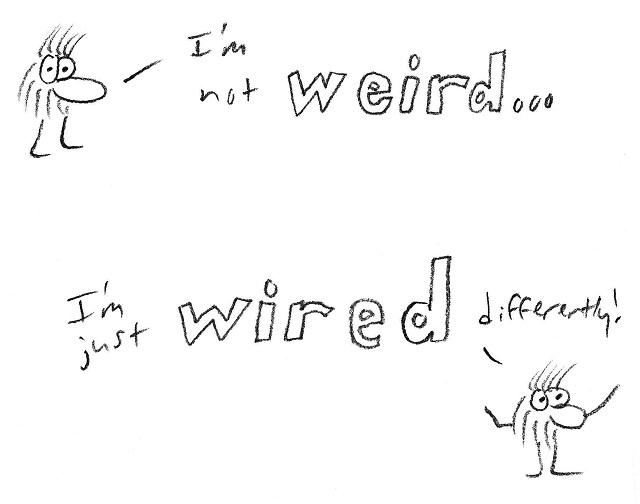
wired_differently

At the time I wrote this post, I thought I had Aspergers.  I don’t.  But I still think this is good advice if you do or even if you don’t.  It could get you out of a lot of awkward situations.   

Most neurotypicals don’t get Aspies. Although there’s a certain cachet now for Aspies on the Internet (because so many of us feel more at home online than in the real world), in the neurotypical world, we’re still socially awkward oddballs who don’t fit in.

I noticed if I say nothing about having this disorder, people tend to treat me like I’m stupid, snobbish, or annoying, or sometimes all three! As Rodney Dangerfield (who probably didn’t have Aspergers) used to say, “I can’t get no respect!”

On top of my Aspergers, I’m also avoidant — AND I have hearing issues. As a child, I had a lot of ear infections so I have only 10-20% hearing in my left ear. My Avoidant personality and hearing deficit both tend to exacerbate my Aspie traits, so when it comes to being able to interact normally in a social setting, I just plain suck at it. I usually just stay quiet but people still think I’m probably a cold and unfriendly person, if not stupid.

assburgers
I didn’t make this graph but it made me laugh.

I found a sort of solution to this problem, and found that it does improve the way people treat me. It’s a very simple solution. I TELL people I have Aspergers (and hearing problems). No further explanation is generally required. If they know in advance that my brain is differently wired and keeps me from reading social cues well and that I also don’t hear very well (from my left side), then they tend to be more patient and become less annoyed at me for asking them to repeat things, saying something awkward, or saying nothing at all.

At first it embarrassed me to tell near-strangers that I have a mental disorder differently wired brain (I don’t tell them about the Avoidant PD–it’s not necessary and no one know what it is anyway), but it’s a lot less embarrassing than being thought of as an idiot, a snob, or an annoying person. Doing this gets easier over time. Now, telling someone I barely know I have Aspergers and can’t hear well out of my left ear feels no weirder than telling them I don’t care for shellfish. And it’s usually met with a knowing “Ah, okay then.”

There’s an additional benefit too. If someone doesn’t know much about what Aspergers is, it gives me the opportunity to tell them. Since it’s something I know a lot about, and I like to talk about psychology anyway, telling people I have Aspergers acts as a sort of icebreaker. It disarms them, and sometimes they share something personal with me.

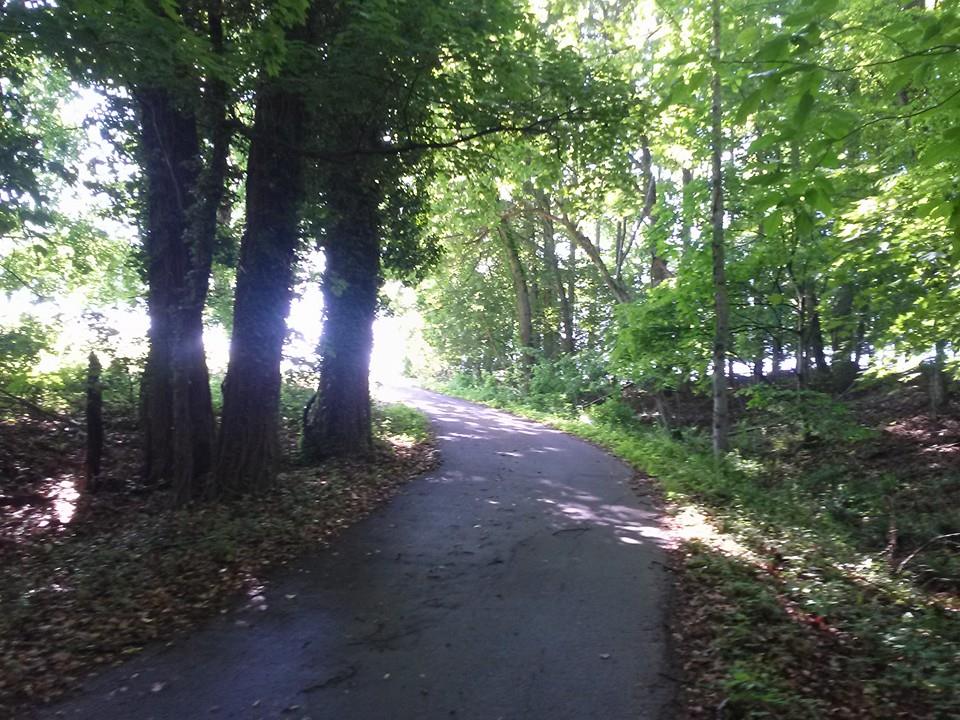
How I spent my break today.

I took photos!

woods_1

woods_2

woods_3

woods_4

woods_5

woods_6

woods_7

woods_8

woods_9

Would a narcissist who lost their memory “forget” how to be a narc?

Memory-Loss

I saw this posted on Psychforums in the NPD forum:

I’ve long thought what might happen if an N suffered complete lose of memory. Would he remember he was narcissistic? There is a novel in which this happened. Ursula Brangwen in D H Lawrence’s “The Rainbow” falls gravely ill and recovers as a near as damn it normal person.

I know it’s a weird question but it’s interesting. I’ve read that sometimes people who suffer head trauma (without severe brain damage or damage to only a small part of the brain) that produces complete amnesia occasionally display dramatic personality changes when they awaken–even to the point of seeming to have a completely different type of personality than they did originally. It’s as if they are forced to use a different part of the brain and form a new personality — and new brain connections — from scratch.

In most cases, language and other basic life skills are left intact, but I have read of rare cases where even though the brain is left largely undamaged, the person must literally “grow up” and relearn basic skills. This learning usually happens at a much faster rate than it would for an actual child growing up, because the individual already has the brain of an adult.

Think of the System Restore function on your computer. Your computer gets a virus or has some other serious issue. You set the computer back to an earlier date before the problem started. Yes, you lose important files and other saved information (which can be replaced later) but the problem is gone. It’s the same concept — a traumatic brain injury that results in amnesia could work like “system restore” for a narcissistic brain. You could also erase the hard drive and re-install it. (That would be analogous to a more severe injury where the narcissist would have to start out again as a virtual infant–and receive the sort of nurturing they never got when they were a real infant.)

In either case, is it possible that a narc who suffered complete amnesia and could remember nothing of their past, might “wake up” with the capacity to learn empathy and become a non-narcissist?

If so, it gives new meaning to the idea that the best cure for a narcissist is a kick in the head.