When your therapist rejects you.

Abandonmentsign

I just read a post from a blogger who describes how her therapist suddenly terminated her without warning.  She writes,

I spend pockets of time here and there throughout the days just wracking my brain trying to figure out what went so wrong. I replay our conversations in my head and try to decipher what this meant or why she said that. I try to figure out what the fuck I did wrong.

It’s devastating and crazymaking.  Unfortunately, being suddenly rejected by a mental health professional seems to be pretty common.   People who have never been in therapy sometimes have trouble understanding how devastating this can be.  We become extremely attached to our therapists through a process known as transference, especially when the therapy is of the psychodynamic type (as opposed to behavioral/cognitive methods like CBT).  The therapist acts as a surrogate parent and for a therapist to terminate a patient without warning is akin to a parent rejecting their child. It’s extremely traumatic and the victim often develops PTSD from the rejection, especially if they already have attachment or trauma-related issues due to rejection or neglect by caregivers when they were children.   The problem is that many people with mental disorders themselves become therapists, often to work out their own emotional issues by proxy.  They may not be aware they are doing this, but it happens all the time.  That’s why therapists are encouraged and even required to be in therapy themselves, in order to address any counter-transference issues that may come up with their patients.

If my therapist ever rejected me like that…ugh, I don’t even want to think about that. I think I would just want to crawl into a hole somewhere and die.  I know he would never suddenly terminate me without good reason and without explaining why, but because I worry about everything, sometimes I worry about that too.

I’ll give you an example of how ridiculous this worry gets.   In my last session, toward the end, I asked my therapist if he had any children.    I don’t think I had any reason to ask other than simple curiosity.   But after I asked I felt liked I’d somehow overstepped his boundaries (he did answer me).   I don’t even know why, really.  He asked me what made me ask him that.  Maybe he thinks this is significant.   I imagined I saw an angry or concerned look on his face after I asked.   But I always imagine negative looks on people’s faces even when their expression is actually neutral.   I feel like I should apologize.    I don’t even know if he was upset by my question but I still feel like it might have been a boundary invasion.    I know he wouldn’t terminate me for this, but I still worry that he might like me less because I *might* have invaded his boundaries.

It’s so dumb that sometimes I feel like I have to be perfect even for my therapist.

Further reading:

50 Warning Signs of Questionable Therapy  (red flags you should know about):

There are over 700 comments under the above post. I was shocked at some of the stories I read about horrible therapists who make their clients even worse.

Infatuation and Transference:  Please be aware that I wrote this post over a year ago and my views about transference, which were mostly negative at that time, have changed.


Always waiting for the other shoe to drop…

afraid-to-be-happy

I think I made a kind of breakthrough in my therapy session tonight. For years one of my problems has been this overwhelming fear that something bad will happen to one of my kids. (I don’t like to even say the D word because I irrationally believe if I say it, I’ll somehow make it happen, by putting it out into the universe or something).

Of course all parents worry about their adult kids, especially when they know they’re out there somewhere in cars, which we all know are dangerous hunks of metal capable of the most ghastly and gory deaths you can imagine and operated by countless idiots and drunks on the road who can’t drive. I think my apprehension about something bad happening to my adult children edges into OCD-type territory though, because of how overpowering and pervasive these thoughts are, intruding where and when they are not welcome, even though I know that in all likelihood, something bad will NOT happen and even if it does, worrying about it excessively is like living through it twice. I think about my hypothetical reaction to such an event and wonder how I would retain my sanity, if not my will to live. I always marvel at people who have lost a child in a sudden manner like a car accident (a long illness is more bearable because you have time to prepare for it and process it) and wonder how they can still go on with their day to day activities–going shopping, paying bills, working at a job, watching a movie, hell, even having FUN sometimes. I know that wouldn’t be me and I obsess over how I might react.

I’ve been so haunted by the remote possibility of getting THAT life-changing phone call late some night (you know the one), that it’s even been a recurrent theme in my writings. I had a dream over a year ago about losing my son, and wrote a post about it, called Losing Ethan.

fine_line

Anyway, I decided to bring up this problem because it doesn’t exactly make my life happier and it annoys the hell out of my kids. The first thing my therapist did was tell me to stop BEING those feelings, but just OWN them. In other words, he’d noticed that when I talk about bad feelings that make me ashamed or anxious, I always use the term “I am….” Instead he told me to practice saying, “I feel…” or “I have…” In this way, you create a bit of a distance between yourself and the bad feeling. That doesn’t mean you don’t feel it, but with a little distance, the emotion can be explored, almost from the viewpoint of a third person. Ironically, what happens is you feel the emotion MORE (I can’t really explain why that works but it does).

His advice was brilliant, because a few minutes later, I made a connection. In 1998, with my then-husband in jail, I was forced to learn to drive his stickshift truck. I had to teach myself and never learned to park the truck properly. So after picking up my kids from their after school program and pulling into our driveway, I set it to Neutral and the truck began to roll downhill–containing both my kids, then ages 5 and 7, straight toward a TREE. The events that played out next are described in this post, called The Tree.

The important thing is, I’d connected this traumatic event in August of 1998 to my current obsessive thoughts about tragedy striking and generally always feeling like I’m about to receive some devastating news–and I knew immediately that these unpleasant thoughts are based on guilt and shame. I started to tell my therapist that I always felt guilty that the truck had rolled and that I *could* have killed them. For about 10 years I couldn’t even talk about it, because any time I did, I’d start feeling very dissociated and anxious. My ex knew how to press all my buttons, and knew this was my biggest one. If he wanted to upset me all he had to do was remind me what a rotten mother I was to almost kill my kids that night because he knows I’m still struggling with guilt over my failure to protect them, my failure to be smart enough to know how to park a stickshift.

I’m always very mindful of my body language, voice and gestures when I’m in session, probably as much as my therapist is. These things can tell you a LOT about yourself, not just about others. And I realized as I was making these connections that my body relaxed and I leaned back but my voice became softer and sadder. I was opening up to him in a way I hadn’t before. He just listened, with what appeared to be a great deal of empathy.

somedays

And at some point I felt tears come to my eyes. My eyes just barely glistening, tears not overflowing, but there, making the backs of my eyelids feel warm. I looked off to my left like I always do when I get deep into stuff, and kept on talking. I felt myself opening up and feeling some kind of generic emotion that wasn’t sadness and wasn’t guilt and wasn’t gratitude or joy but was none of these things and yet all of these things. I wanted to share all this with him. I heard myself speak and my voice became thick and my eyes burned again.

There was more, much more, but I’ll end this here because I’m getting emotional writing this. The important thing is, I almost shed tears in front of my therapist tonight. That might not seem like such a big a deal, but for me it was a huge deal because I haven’t been able to cry in front of another human being in about 15 years–which I realized is when THAT happened. (It might have been longer than that though–my memories of the time I was in my horrible marriage are gray, shadowy and even have yawning gaps in places).

What happened tonight is only the proverbial tip of the iceberg–I was seriously fucked up for a very, very, VERY long time, at least since age 4 or 5–but it’s significant because it means the wall in my head that prevents me from really being able to connect to my emotions is developing a few weak spots.

Emotional blockages.

emotional_blocks

I think my challenges in really feeling my emotions are due to blockages of energy within my body. I discovered this simply by focusing on how my body felt in my therapy sessions or when I feel an emotion bubbling to consciousness. There’s a definite tightness in three parts of my body, which actually correspond to three of the chakras. If the emotion is strong, there can be a dull pain, as if the pain of the emotion is trying to get out and can’t. I can never fully let go, because of my fear that if I do, I might completely lose control.   I’m learning that ironically,  I have less control by holding negative emotions inside because when I do that, they continue to act as a slow-acting poison long after their job is done, instead of passing out of me like the release they’re supposed to be and freeing my soul to be able to experience more positivity in my life and more able to access my creative spark.

I think I’ve grown to trust my therapist enough that I’ve begun to let go just a little.

There are three places where my emotions are blocked:

The middle of my abdomen. This corresponds to the third, or solar plexus, chakra, which represents competence and power. I’ve always felt so powerless and incompetent.

My chest. This corresponds to the fifth, or heart chakra. This is where the higher emotions such as agape love, empathy, all kinds of (nonsexual) connectedness, and gratitude reside. It’s always been so hard for me to really connect with others, due to fear and lack of trust.

The middle of my throat. This corresponds to the 6th, or throat, chakra, which represents the ability to communicate with others. I’ve always been a shy person afraid to speak up, even if it’s for my own rights as a human being.  Blogging has helped, but it’s not nearly enough.

I think by focusing in on bodily sensations and becoming mindful of your feelings, you can zero in on which ones you need to work on and focus on relaxing and breathing deeply into the blocked areas to be able to feel it fully enough so you can purge it.

Unfolding.

origami_crane_in_hand_by_miaauraylea

Tissue paper origami wings
pressed down flat on the table
now unrecognizable sharp edges that cut and slice
No longer beautiful
no longer delicate
a paper thing bound for the trash
made ugly by the rage of its creator
because it didn’t come out perfect
It insulted her pride
and filled her with shame

You came along and saw beauty there
in its flattened ruins
I see you holding it gently in your hands
I see the sadness in your eyes
at what this once was and could have been

Your clumsy but tender fingers prodding its innards
working to bring it back to beauty
Wrinkles are its scars
You are so careful not to tear the aging paper
as you work the jumbled angles back to life

It will never be perfect
even so much as the day it was made
but its unfolding is a testament to your compassion
made beautiful by those who see its value
and breathe life into it
and save it from incineration.

Solipsism syndrome.

dave the solipsist

A few times throughout my life, usually when overtired/anxious (and once when VERY high), I’ve had this peculiar (and terrifying) feeling of being the only person in the universe (the time I was high and it happened it was even worse–I was disembodied consciousness, a singularity in space/time–I finally came to the conclusion at the time that I must be God and must have created the entire universe and everything in it from my mind–talk about narcissism lol!). It’s a rather frightening experience, if truth be told. If you’ve ever experienced it, you’ll understand the overwhelming feeling of immense and indescribable loneliness, even though your rational mind is telling you it’s an illusion and isn’t true.

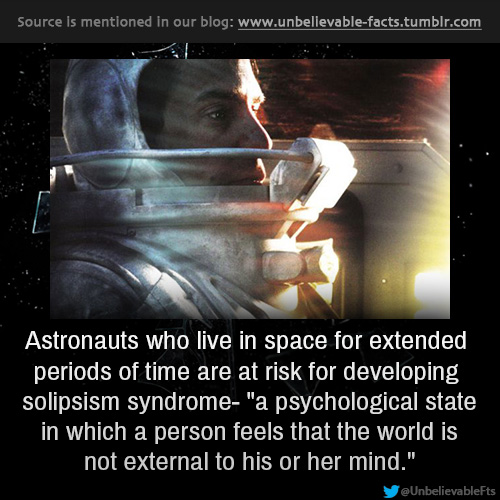
I was thinking about this today for some reason so I looked it up on Google. I found out this feeling of nothing else existing except your own consciousness is a fairly common dissociative experience called solipsism syndrome. It’s a form of derealization. I never knew it had a name.

Some Eastern religions are built around the concept of solipsism and many philosophers throughout history have considered it a possibility too. Of course I don’t believe in it but during the few times I’ve experienced it, it does feel very real.

A similar phenomenon is the feeling/belief that everyone else is just yourself in another incarnation and/or is a projection of yourself. Solipsism seems extremely narcissistic, even though it has nothing to do with NPD and is a fairly common experience in both psychotic and dissociative conditions, drug intoxication (especially psychedelics and dissociatives), and PTSD and C-PTSD. It’s also common in astronauts who spend long periods of time living in space.
solipsism+syndrome

I read this story today and wanted to share it.

The Egg
By: Andy Weir

You were on your way home when you died.

It was a car accident. Nothing particularly remarkable, but fatal nonetheless. You left behind a wife and two children. It was a painless death. The EMTs tried their best to save you, but to no avail. Your body was so utterly shattered you were better off, trust me.

And that’s when you met me.

“What… what happened?” You asked. “Where am I?”

“You died,” I said, matter-of-factly. No point in mincing words.

“There was a… a truck and it was skidding…”

“Yup,” I said.

“I… I died?”

“Yup. But don’t feel bad about it. Everyone dies,” I said.

You looked around. There was nothingness. Just you and me. “What is this place?” You asked. “Is this the afterlife?”

“More or less,” I said.

“Are you god?” You asked.

“Yup,” I replied. “I’m God.”

“My kids… my wife,” you said.

“What about them?”

“Will they be all right?”

“That’s what I like to see,” I said. “You just died and your main concern is for your family. That’s good stuff right there.”

You looked at me with fascination. To you, I didn’t look like God. I just looked like some man. Or possibly a woman. Some vague authority figure, maybe. More of a grammar school teacher than the almighty.

“Don’t worry,” I said. “They’ll be fine. Your kids will remember you as perfect in every way. They didn’t have time to grow contempt for you. Your wife will cry on the outside, but will be secretly relieved. To be fair, your marriage was falling apart. If it’s any consolation, she’ll feel very guilty for feeling relieved.”

“Oh,” you said. “So what happens now? Do I go to heaven or hell or something?”

“Neither,” I said. “You’ll be reincarnated.”

“Ah,” you said. “So the Hindus were right,”

“All religions are right in their own way,” I said. “Walk with me.”

You followed along as we strode through the void. “Where are we going?”

“Nowhere in particular,” I said. “It’s just nice to walk while we talk.”

“So what’s the point, then?” You asked. “When I get reborn, I’ll just be a blank slate, right? A baby. So all my experiences and everything I did in this life won’t matter.”

“Not so!” I said. “You have within you all the knowledge and experiences of all your past lives. You just don’t remember them right now.”

I stopped walking and took you by the shoulders. “Your soul is more magnificent, beautiful, and gigantic than you can possibly imagine. A human mind can only contain a tiny fraction of what you are. It’s like sticking your finger in a glass of water to see if it’s hot or cold. You put a tiny part of yourself into the vessel, and when you bring it back out, you’ve gained all the experiences it had.

“You’ve been in a human for the last 48 years, so you haven’t stretched out yet and felt the rest of your immense consciousness. If we hung out here for long enough, you’d start remembering everything. But there’s no point to doing that between each life.”

“How many times have I been reincarnated, then?”

“Oh lots. Lots and lots. An in to lots of different lives.” I said. “This time around, you’ll be a Chinese peasant girl in 540 AD.”

“Wait, what?” You stammered. “You’re sending me back in time?”

“Well, I guess technically. Time, as you know it, only exists in your universe. Things are different where I come from.”

“Where you come from?” You said.

“Oh sure,” I explained “I come from somewhere. Somewhere else. And there are others like me. I know you’ll want to know what it’s like there, but honestly you wouldn’t understand.”

“Oh,” you said, a little let down. “But wait. If I get reincarnated to other places in time, I could have interacted with myself at some point.”

“Sure. Happens all the time. And with both lives only aware of their own lifespan you don’t even know it’s happening.”

“So what’s the point of it all?”

“Seriously?” I asked. “Seriously? You’re asking me for the meaning of life? Isn’t that a little stereotypical?”

“Well it’s a reasonable question,” you persisted.

I looked you in the eye. “The meaning of life, the reason I made this whole universe, is for you to mature.”

“You mean mankind? You want us to mature?”

“No, just you. I made this whole universe for you. With each new life you grow and mature and become a larger and greater intellect.”

“Just me? What about everyone else?”

“There is no one else,” I said. “In this universe, there’s just you and me.”

You stared blankly at me. “But all the people on earth…”

“All you. Different incarnations of you.”

“Wait. I’m everyone!?”

“Now you’re getting it,” I said, with a congratulatory slap on the back.

“I’m every human being who ever lived?”

“Or who will ever live, yes.”

“I’m Abraham Lincoln?”

“And you’re John Wilkes Booth, too,” I added.

“I’m Hitler?” You said, appalled.

“And you’re the millions he killed.”

“I’m Jesus?”

“And you’re everyone who followed him.”

You fell silent.

“Every time you victimized someone,” I said, “you were victimizing yourself. Every act of kindness you’ve done, you’ve done to yourself. Every happy and sad moment ever experienced by any human was, or will be, experienced by you.”

You thought for a long time.

“Why?” You asked me. “Why do all this?”

“Because someday, you will become like me. Because that’s what you are. You’re one of my kind. You’re my child.”

“Whoa,” you said, incredulous. “You mean I’m a god?”

“No. Not yet. You’re a fetus. You’re still growing. Once you’ve lived every human life throughout all time, you will have grown enough to be born.”

“So the whole universe,” you said, “it’s just…”

“An egg.” I answered. “Now it’s time for you to move on to your next life.”

And I sent you on your way.

“A human being is a part of a whole, called by us a ‘universe’ a part limited in time and space. He experiences himself, his thoughts and feelings as something separated from the rest… a kind of optical delusion of his consciousness. This delusion is a kind of prison for us, restricting us to our personal desires and to affection for a few persons nearest to us. Our task must be to free ourselves from this prison by widening our circle of compassion to embrace all living creatures and the whole of nature in its beauty.” (Albert Einstein)

DMT, healing, spirituality and ego death.

dmt_trip
Example of the type of visuals you might see in the beginning of a DMT trip.

Disclaimer: I do not recommend or condone taking illegal drugs, nor do I recommend tampering with occult or new age practices such as attempting to open the Third Eye (which really does exist as far as I’m concerned) since I do think it could potentially open doors for evil spirits to gain access to your soul. Still, the intensely psychedelic chemical known as DMT (dimethyltryptamine), which is produced naturally by the human pineal gland (and is present in almost all plants and animals), has fascinating implications for treating or curing personality disorders, including NPD. So read on, even if (like me) you never want to mess with it.

I’m an obsessive kind of person who gets intensely interested in certain topics and reads as much as I can about them while my intense interest lasts (another reason I thought I was an Aspie for so long).
Over the past week or so, I’ve been reading up a lot about DMT (dimethyltryptamine), a naturally produced hallucinogen that has several unique properties: (1) it’s naturally produced in the human brain (by the pineal gland, which corresponds to the “third eye”) during birth, death (and accounts for NDE’s), and while we dream; (2) it occurs in almost all living things, including ourselves, and therefore is widely available although it’s hard to extract and synthesize and is also the most illegal drug there is (except in places where it is sanctioned for shamanic use, such as Peru, where it’s drank in ayahuasca tea); (3) In almost all “trip reports” of DMT users report “coming back” feeling completely humbled and with a renewed appreciation for life and our connection with the universe and with others; and (4) the trip lasts only about 10 minutes! It’s also been known to cure drug addiction (!) and alcoholism. DMT itself is non addictive, as are all psychedelics.
DMT is the most intense psychedelic known.

dmt_molecule
The DMT molecule.

Unlike most other psychedelics, you do not lose your sense of judgment and rationality during the experience. Although you’re completely out of touch with reality (as we know it) and you won’t remember you’ve taken a drug at all, your cognitive functioning remains intact so you are able to learn from the experience–if you can remember it.

Is DMT really a drug at all? I’m not so sure after reading what I have on Erowid.org and watching a number of videos and reading articles and trip reports. I think it’s a chemical that causes you to become aware of other dimensions and realities, and the “hallucinations” are actually quite real–ways of seeing the universe with the Third Eye (the pineal gland) rather than the physical eyes.
I’ve always been fascinated by trip reports for some reason, even though the only drug I’ve ever taken regularly (besides alcohol) is weed.

I’m not encouraging anyone to take illegal drugs, and personally, while one part of me longs for this experience, I doubt I could handle it. I just know I’d be one of those people who’d totally freak out. From everything I’ve read, the trip is INCREDIBLY intense–much more so than with any other hallucinogen. Even with LSD (which I really disliked the one time I took it) you still have some tenuous grip on reality and some ability to ground yourself/control the trip. You don’t forget the fact that you are tripping, and can usually remind yourself of that to avoid a really bad trip.

But with DMT (which is usually smoked) you are completely out of control and find yourself so out of touch with 3-dimensional reality you don’t even remember you have taken a drug, and believe things have always been this way and always will be, and what you’re seeing is your new reality. You can’t remember who you are, where you are, what your name is, or even what you are. Yet your cognitive abilities remain intact!

dmt_crystals
Delicate DMT crystals.

What a DMT trip is like.
From my readings, it seems the entire experience goes something like this for almost everyone who’s tried it.

1. you smoke about 2-3 hits which is enough to get the full effect; 3 if you want to “break through” (which I’ll explain in a minute). Usually you can’t smoke more because the trip comes on so rapidly and by the time you’d be ready for a 4th hit you are in hyperspace and have no idea what you just did or where you came from or who you are.

2. almost immediately you start seeing intricate, colorful, geometric patterns, fractals, grids, and other psychedelia constantly moving and shifting into new configurations. Some of the visuals you see are impossible in 3 dimensional reality because they are showing you other dimensions. Sometimes you can get a similar effect during hypnagogic hallucinations that happen just as you fall asleep. But we rarely remember those and they’re fleeting. Apparently (though it’s not proven), DMT is released by the brain when we dream, and we only remember the dreams that are most like reality (usually, the ones that happen toward the morning) but actually most of the dreams we have earlier in the night or in deep REM sleep are very similar to a DMT trip. Also, like a dream, it’s very difficult to remember the trip after “coming to”–it fades or dissolves very similar to a dream. DMT is also released during near death experiences (NDE’s).

3. Early in the trip, if you have smoked enough, you pass through a kind of membrane that is similar to a lotus flower. Once you “break through” you will be in a place where impossible things happen and time and space don’t exist the same way they do in the physical world. Time either stops, or the person feels like they spend years or even eons in this place. Most people report a feeling of familiarity, as if they have been there many times before (maybe remembering their own birth or time spent in dreams?) Objects have more than three dimensions and almost everyone reports a feeling of meeting other entities who communicate with them. They could be demons, angels, or aliens, or sometimes are disembodied entities who don’t actually speak at all, but the user feels like someone or something is communicating with them. Sometimes these entities offer gifts–objects so incredibly intricate and beautiful they defy the imagination and can’t possibly exist in our own 3 dimensions. Profound insights are revealed. You are warned to not allow your astonishment (and you will be astonished) to keep you from paying attention to what you are being shown. At some point the user is told their time is limited and they begin to slowly feel reality come back.

There is no way to ground yourself in any way during these experiences; you must completely give into it and in fact you have no other choice. If you go into such a trip with any trepidation, the experience could be the most terrifying thing that ever happened to you.

other_realities

But even when the experience is terrifying, most people say later they’re glad they experienced it, because they were able to take away some realization of unbelievable profundity and say theywere humbled by the experience and see life and their relationships in a completely new way after returning. People have been cured of PTSD, drug addictions, and other psychological disorders by using DMT only one time. Some people are also able to recall long-forgotten childhood memories during the trip.

The stories I’ve read are so similar in nature (although each person receives a different insight or message or communicates with different entities) that I think the trip is to an actual place, not just something created by the mind. Shamans in South America and Mexico have been using it for ages and many people come to these shamanic healing sessions and leave a changed person.

During the intense trip, there is often a cleansing of both body and soul. Participants have reported severe nausea and vomiting (which could be due to slight poisoning) followed by diarrhea, but there is also emotional cleansing and catharsis with participants screaming and crying as they shed their egos and forget who or what they are. Sometimes spontaneous orgasm is even reported. Almost all these participants, although they appear to have suffered severely during the trip, feel great the next day, as if they’ve been reborn. Some say they are forever changed for the better, and the one experience they had doesn’t lead to a desire to do it again, because there’s simply no need to anymore.

To get a small idea of what a DMT trip is like, here’s an excellent simulation that includes commentary by Terence McKenna.

As one commenter who’s tried DMT under the video pointed out, this simulation is accurate but only about .000000001% what the real experience is like! I don’t think I want to try it! 😮

Implications for healing NPD and other personality disorders.
Since DMT has been effective on people with PTSD and other physical and psychological disorders and addictions to drugs and alchohol, I wonder if it could be effective on someone with NPD, even deeply ingrained or malignant NPD. NPD is itself a type of addiction and in many respects it does resemble addiction to a drug, the drug being narcissistic supply.

On DMT a person experiences complete ego death, to the point they don’t even know if they exist or what they are or where they come from. But even with a bad experience, the user (if they don’t go psychotic) is changed for the better. People who were overly concerned with acquisition or materialism or money before their experience come back with different priorities, and more caring for themselves and others. They realize there is much more to the universe than themselves or their image, or the material things they can attain. They realize how insignificant they are and yet at the same time how much power they have (but power in a truly confident sense, not a narcissistic one). They feel more connected to the spiritual. Some atheists have suddenly come to believe in God. People emerging from the DMT trip are able to see beauty and goodness in the world and in others for the first time since early childhood, and sometimes memories of early childhood are aroused and purged during the trip. Some people report they suddenly can feel empathy and caring for others they never felt before.

shaman_ayahuasca
South American shaman offering cup of ayahuasca.

For anyone interested in the implications of the beneficial uses for DMT, I highly recommend reading the FAQ and trip reports for DMT over at Erowid.org. There is a book called “DMT: The Spirit Molecule” by Dr. Richard Strassman. A man called Terence McKenna also has many interesting Youtube videos where he describes his own trips and the properties of DMT. He doesn’t seem any the worse for wear.

Why is it illegal?
DMT is a Class 1 drug in the United States (and most other countries), which means it’s highly illegal and carries severe charges for possession, distribution, or synthesis. There’s a reason why this drug is illegal even though it occurs naturally in all of us–it’s intense and otherworldly beyond anyone’s wildest imagination and probably would cure many disorders instantaneously (well, within the 10-15 minutes the trip takes) and the pharmaceutical companies would lose money on their synthetic antidepressants and sedative drugs that don’t cure but simply maintain a person so they can function. If made legal, unconventional therapists or practitioners of alternative medicine might use it on a patient during a session and the drug companies would go out of business! (So would traditional therapists, for that matter.)

Again, I’m not recommending that anyone do illegal drugs or take something so intense as DMT. It’s very hard to obtain in smokable form or extract yourself anyway. But I think the implications here are fascinating and possibly earth-shattering for people with NPD and other personality disorders.

The dark side of DMT.

bad_trip

There are several drawbacks to using DMT (besides the severe nausea and vomiting some people report). People with NPD and a few other personality disorders (such as Schizoid or Obsessive Compulsive PD) might have a more unpleasant trip than the non-disordered, due to how closed off from themselves and unwilling to “let go” they are. But in the end, that unpleasantness could actually be a good thing. Long term psychodynamic therapy for people with NPD is extremely unpleasant too. There’s no way around it–the cure is going to be unpleasant, whether it’s in the form of 10 years of therapy, or a ten minute DMT trip.

DMT/ayahuasca aren’t drugs that should EVER be used for recreational purposes, if at all. They aren’t fun drugs so you and your buddies can “get high.” They may have healing, religious, or shamanic purposes if used responsibly, and preferably under supervision or at least with a responsible trip sitter. They have had some success not only with people with certain physical and mental illnesses such as PTSD, but with the terminally ill to help them come to terms with impending death and what the experience of dying will be like. Terminally ill patients given DMT usually become less afraid of death and dying. DMT is a serious drug meant only for sacred or teaching purposes and should never be used for recreation.

They can also open you up to evil or malicious entities who take advantage of the psychic door that’s opened during a trip. There are ways you can protect yourself. Here’s a very good article about the darker side of using DMT/ayahuasca (and other psychedelics) and how to avoid encountering dark spirits who might want to take something from you.

I read on one Christian website about a born again Christian who claims he was actually saved during a DMT trip, and still uses it occasionally to communicate directly with Jesus/God, but only with his sober pastor present, who apparently condones his use. I can’t say what my own faith’s stance is on using psychedelic substances for enlightenment, but as far as I know, it’s not condemned anywhere in the Bible. Of course, Adam and Eve’s “Tree of Knowledge” could well have been a psychedelic plant and their ingestion led to the Fall…so who knows? Deliberately ingesting psychedelic drugs could also be considered a form of sorcery, so if you have religious misgivings about it, you should probably stay away, even if only to avoid a bad trip caused by your fear of having one! Suggestibility while on any psychedelic substance is high, so if you believe you will run into demons or evil entities, then that’s what you’ll probably see.

DMT won’t kill you, but there’s always the small possibility of developing PTSD or even psychotic conditions due to suffering a particularly intense bad trip. There is no sure way to say for sure you won’t be a casualty. I can’t stress enough how potent this drug is.

A dream journal as an alternative.
One way around having to obtain or take DMT could be to keep a dream diary and begin to record and pay attention to your dreams and what they are telling you. Wake yourself up earlier in the night, when the dreams are of the more intense, DMT-type variety that are probably blocked off by the conscious mind to protect yourself. It’s been speculated the reason both DMT trips and dreams are so easily forgotten when we wake up or “come to” is because both stir up repressed memories and buried information in the unconscious mind that would freak the person out if they became conscious of it, or cause a severe depression. A person with NPD is especially cut off from their unconscious mind and repressed memories.
At some point I’ll be writing a longer post about dreams and how keeping a dream journal and recording dreams can help people with personality disorders and PTSD.

Are you alexithymic?

alexithymia

Here’s an interesting quiz to find out how in touch you are with your own or other’s emotions.
Alexithymia is a Greek term meaning emotional blindness (a–without; lex–word; thymia–feeling). A person with alexithymia has problems understanding their own emotional state or those of other people. They may feel emotionally numb or even have a flat affect. They could be extremely reserved or shy, or just seem aloof or cold to others. They could come across as “mysterious” or inaccessible.

Low levels of alexithymia are correlated with high empathy, ability to engage emotionally in relationships, and having an active imagination. A very low score would indicate neediness and high emotional lability (common in most people with BPD, Histrionic PD, or Dependent PD).

Personality disorders associated with alexithymia are Schizoid, Antisocial, Avoidant, Narcissistic, Obsessive Compulsive, and sometimes Schizotypal. PTSD can also be associated with alexithymia.

Here is the test:
http://www.alexithymia.us/test-alex.html

My results:

My total score was 108 (possible alexithymic).

Category: Difficulty Identifying Feelings: 17 Points
In this category you show some alexithymic traits.

Category: Difficulty Describing Feelings: 10 Points
In this category you show no alexithymic traits.

Category: Vicarious Interpretation of Feelings: 11 Points
In this category you show high alexithymic traits.

Category: Externally-Oriented Thinking: 17 Points
In this category you show no alexithymic traits.

Category: Restricted Imaginative Processes: 18 Points
In this category you show some alexithymic traits.

Category: Problematic Interpersonal Relationships: 20 Points
In this category you show high alexithymic traits.

Category: Sexual Difficulties and Disinterest: 15 Points
In this category you show high alexithymic traits.

This seems to describe me well.

What’s my problem?

confused

After over a month of being convinced I’m a covert narcissist, now I’m starting to wonder if my assessment of myself could be incorrect. Most people are having trouble believing me (even good friends) and there are so many disorders that appear similar to it. I no longer think my symptoms are due to Aspergers the way I used to, but BPD + Avoidant PD in the same person can look exactly like covert NPD. So can complex PTSD in some cases.

I’ve been told again and again that real narcissists are unlikely to ever admit they are narcissists, and if they do, they won’t be beating themselves up that much over it. I don’t know if that’s always true (I’ve met a few low spectrum covert narcissists on Psychforums who actually have a diagnosis and feel terrible about things they’ve done and want to change, but maybe the diagnosis they got is wrong and they just have more than the normal amount of N traits). Victims of narcissistic abuse are often quick to diagnose narcissism in themselves and others. We’re hypervigilant and tend to see narcissism everywhere, and we don’t even exempt ourselves. The real narcissists are probably more likely to keep insisting that they are not. Abuse victims think too damn much. It’s all very confusing.

narcissism_selfies

I guess there was a reason why I never added “Covert NPD” to “My Disorders” in the header. Without an official diagnosis for that, I really can’t say that’s what my problem is. It could be, but if so I think it’s at a low level. I know I have a number of narcissistic traits, but most abuse victims do. That doesn’t necessarily mean I have NPD, covert or otherwise. I could just have a really bad case of “fleas,” or just BPD + AvPD, or even complex PTSD.

I’m still glad I started Down The Rabbit Hole because it’s also intended for people with BPD, which I have an actual diagnosis for. I still think my “trip down the rabbit hole” early in August was real but that doesn’t necessarily mean I have NPD. It was still a trip to the walled off parts of my mind, and most abuse victims are at least partly walled off from themselves. We may be partially narcissistic but not enough to qualify for the label.

I care about people with low spectrum NPD and BPD who want to heal or improve, so that’s another reason I’m going to keep DTRH going. It’s getting a good reception. Another one of my missions is to help reduce the negative stigma against people with BPD. I don’t ever expect DTRH to gain the amount of activity this blog has received, but if only one or two people can be helped by my posts, and I can help myself by continuing to do exactly what I’ve been doing, then it’s worth it to keep it going, isn’t it?

Really, at the end of the day, all these labels are just labels and don’t really mean anything at all.

I think age of NPD onset correlates with malignancy and curability.

kids_different_ages

Because of a recent conversation I was having on Psychforums about age of onset and prognosis for a cure for different levels of narcissism, I’ve been doing a lot of thinking about this.

I do think how old a narcissist was when Ground Zero occurred–that would be the primary traumatic event that forced the child to create a False Self–determines the difficulty/ease of healing, and also how low or high the narcissist falls on the spectrum.

Here’s what I came up with.

Age of onset of Trauma/stage of child development (Piaget, Freud):

0-2 (Piaget’s Sensorimotor stage; establishing boundaries, physical and comfort needs met; Freudian Oral/Anal stage):

toddler_bear

High spectrum, malignant narcissism and/or psychopathy/sociopathy (if as an infant)– not curable except under extreme circumstances in very rare cases. May be self aware but has no incentive to change.

3-6 (Piaget’s Concrete Operations; Freudian Anal–Oedipal/Electra stage )

childabuse

Mid-high spectrum narcissist who may or may not be malignant. May become self aware but will be resistant to a cure. In unusual circumstances (total loss of supply or primary supply), a narcissist this high on the spectrum might seek therapy. They are unlikely to be willing to do all the work required for healing due to its difficulty for someone this high, but there might be a few exceptions.

7-11 (Piaget’s Formal Operational stage; abstract learning, competence; Freudian “latency” period)

sad_girl2

Mid-spectrum narcissist. Could become self aware and if so, there’s a good chance of them seeking therapy or treatment. They’re more likely to be cured, but it’s not a guarantee.
Therapy would be difficult at the higher end (onset before 8-9), moderately easy at lower end (onset between 9-11).

12-21 (adolescence)

sadness

sadness

Low-mid spectrum narcissist. Likely to become self aware and good chance of being cured.
Low spectrum at the higher ages (onset after 15/16), mid spectrum at the lower ages (younger than 15).
Good prognosis for a cure and self awareness. If very low, may be able to heal him or herself without outside help

21 +

How's my hair?

How’s my hair?

A person cannot become a true narcissist after age 21 or so. They may instead have a lot of narcissistic traits, have DNP (Destructive Narcissistic Pattern disorder–just below NPD on the spectrum), or in rare cases they could develop “acquired narcissism” (this is something a lot of celebrities and famous people get) which is temporary and lasts only as long as the adulation or fame lasts.

ETA: I got a rebuttal to this on Psychforums. I think this poster’s argument may be valid too, so I’m going to post it:

I believe the PD occurs in the first 5-6 years due to abuse/trauma, the critical level of which differs for each person depending on genetics (temperament, sensitivity).

I think NPD-like traits resulting from abuse/trauma after age 6 would be cPTSD to a normally developed personality.

I suspect traits from coddling/overvaluation after age 6 would be easier to “return to earth” from than something like sexual abuse and humiliation (say, having to testify in court) after age 6. I think the former might be unwind’able to a level of stable narcissism. I think the latter could be a more permanent scar/condition.

left-out_child

But, I don’t know much about. That’s just the way I think of it. It doesn’t seem feasible that PD could occur after the P(personality) is developed. I thought the whole point of a PD was that the P stopped developing, became a defective structure. Not merely unresolved trauma (like PTSD is?) but structural and permanent.

Basically his argument is that after age 6, true narcissism won’t develop but complex PTSD (C-PTSD) could. This could mean a child acquires a lot of narcissistic traits (what ACONs call “fleas”) that could resemble NPD in many ways but is more treatable/curable. I think this would be the same thing as the spectrum condition called the Destructive Narcissistic Pattern (DNP)
This would also take into account type of abuse inflicted and level of severity.

Derealization and depersonalization in NPD and BPD.

Worlds_Collide___Phaeton___by_Meckie
Worlds Collide-Phaeton: by Meckie at Deviantart.com

A common symptom of both NPD and BPD is dissociation: a splitting or fragmenting of the personality not very different from what occurs in the Dissociative disorders such as DID (Dissociative Identity Disorder) and Psychogenic Fugue. It usually happens in response to a severe loss of supply or major narcissistic injury, or a sudden awareness of oneself as not oneself (realizing your false self is not who you really are–which happens when a narcissist becomes self aware). These disorders themselves, especially NPD, are dissociative in nature because a split in the personality has occurred. In the narcissist, it’s a substitution of the original personality for a false one.

Borderlines, rather than having a false self per se, are more like chameleons, adapting their personalities to fit the people and situation around them. That’s why Borderlines can seem so changeable.

I first started to experience dissociation as a young child. I remember at age 4, waking up for breakfast and walking down to the kitchen where my parents were already eating, and seeing colored specks like glitter falling all around me. When I asked my parents if they saw the “glitter,” they just looked at me like I was crazy. I also had dreams that would continue after I awoke and often felt I was living in a dream. Maybe that’s the case with most young children though. I also remember hearing music from TV shows late at night after everyone was asleep that couldn’t possibly be coming from anywhere, as this was in the 1960s and no one had the capability to record a show on VCR yet, nor was there TV after midnight or so–all we’d get in those days was a test pattern until morning.

I remember at around the same age, banging my head against the wall in the family room to relieve some kind of congestion in my head. I think it may have been to relieve those odd feelings of unreality–not much different than the way a Borderline will sometimes cut herself to “feel alive.” In fact, this may well have been an early symptom of my BPD (and I always thought it was autism).

Most people have probably experienced dissociation, perhaps under the influence of a drug. Sometimes people experience it on hearing shocking news that could be either tragic or fortuitous–like hearing one’s child just died, or winning the lottery.

But for people who have certain personality disorders (as well as people with various dissociative disorders and psychotic disorders like schizophrenia, and also those with PTSD and C-PTSD), dissociation is both common and chronic. It’s also severe enough to sometimes interfere with functioning.

Q: So what does dissociation FEEL like?
A. Because something so ungrounded in the tangible and everyday reality is so hard to explain in words, I’m not sure if these descriptions of what it feels like will make a lot of sense, but I’ll try.

Derealization.
I’ve actually experienced this the most. The world seems odd and dreamlike. Reality seems somehow “off” the way things are in a dream. In a dream, a familiar scene can look the same as it does in reality, but at the same time there’s this feeling of offness and otherworldiness about it. When I was younger and used to ride the subway, sometimes I couldn’t look up at the people because they all seemed like masks…sinister, somehow. It’s a very weird feeling but not always unpleasant. Sometimes that dreamlike oddness about everything is sort of compelling and interesting.

Depersonalization.
This definitely causes me serious panic attacks. I first had episodes of this at about age 9 or 10 and thought I was going crazy. I felt oddly disconnected from my body, like I was floating. People talking to you sound like they’re coming from either a great distance or out of a tube. You can’t focus on what they’re saying because you’re freaking out and panicking but trying to hide it to keep from appearing as crazy as you feel.

I think people with NPD and BPD (as well as the Schizoid, Schizotypal and Paranoid PD’s) who do not improve or try to change, are probably at high risk for developing psychotic disorders and even schizophrenic like conditions when things are going badly for them, there’s been a massive loss of narcissistic supply, or when the person becomes gravely ill or very late in life.