Are BPD and complex PTSD the same disorder?

age_3_1961_2
Me at age 3 in the zone. Was the template for my BPD already laid down?

Ruji, a new commenter on this blog, made an interesting observation–that BPD should be divided into at least two subtypes: Empathy Challenged/Character Disordered (closer to NPD/ASPD) and Highly Sensitive Person with Emotional Dysregulation (closer to the type I have, although at different times in my life or when extremely stressed I have displayed the more character-disordered subtype). I agree with her. Ruji’s idea is remarkably similar to The World Health Organization’s two subtypes of BPD:

1. F60.30 Impulsive type
At least three of the following must be present, one of which must be (2):

–marked tendency to act unexpectedly and without consideration of the consequences;
–marked tendency to engage in quarrelsome behavior and to have conflicts with others, especially when impulsive acts are thwarted or criticized;
–liability to outbursts of anger or violence, with inability to control the resulting behavioral explosions;
–difficulty in maintaining any course of action that offers no immediate reward;
–unstable and capricious (impulsive, whimsical) mood.

2. F60.31 Borderline type
At least three of the symptoms mentioned in F60.30 Impulsive type must be present [see above], with at least two of the following in addition:

–disturbances in and uncertainty about self-image, aims, and internal preferences;
–liability to become involved in intense and unstable relationships, often leading to emotional crisis;
–excessive efforts to avoid abandonment;
–recurrent threats or acts of self-harm;
–chronic feelings of emptiness.
–demonstrates impulsive behavior, e.g., speeding, substance abuse

Psychologist Theodore Millon has gone even further, proposing that BPD should be divided into four subtypes:

1. Discouraged (including avoidant features): Pliant, submissive, loyal, humble; feels vulnerable and in constant jeopardy; feels hopeless, depressed, helpless, and powerless.

2. Petulant (including negativistic features) Negativistic, impatient, restless, as well as stubborn, defiant, sullen, pessimistic, and resentful; easily slighted and quickly disillusioned.

3. Impulsive (including histrionic or antisocial features) Capricious, superficial, flighty, distractible, frenetic, and seductive; fearing loss, becomes agitated, and gloomy and irritable; potentially suicidal.

4. Self-destructive (including depressive or masochistic features) Inward-turning, intropunitively angry; conforming, deferential, and ingratiating behaviors have deteriorated; increasingly high-strung and moody; possible suicide.

Millon’s Types 1 and 4 would correspond to the Highly Sensitive Person/Emotional Dysregulation type mentioned above (and therefore closer to the Avoidant/Dependent PDs); Type 2 sounds very much like NPD; and Type 3 seems closer to ASPD or Histrionic PD.

complex_ptsd
BPD symptoms are almost identical to those of Complex PTSD.

There are so many diverse–almost opposite–symptoms that can appear with this disorder that one person with BPD can be very different from the next. In fact, you can take 10 borderlines and they will all seem very different from each other, with barely any similarities in their behavior at all. One will be shy, fearful and retiring, never making waves, acting almost like an Aspie or an Avoidant; while another may break the law, lie constantly, and act obnoxious and rage whenever things don’t go their way. A borderline could be your raging boss who drinks too much and ends every annual Christmas party with one of his infamous rages, or it could be the sweet and pretty schoolteacher who goes home every night and cuts herself. She could be the come-hither seductress or the nerdy computer programmer. He may have few or no friends or a great many.

This diversity is not the case with the other personality disorders, which have more cohesiveness in the symptoms their sufferers display. So I wonder–is BPD really a personality disorder at all? Does it even exist, or is it really just a group of trauma-caused symptoms the experts in their ivory towers stuck in a single box called “BPD” because they didn’t know how else to classify them?

In fact, all these diverse subtypes have one thing in common–they are all very similar or identical to the symptoms of someone with complex PTSD (C-PTSD). People with C-PTSD are often misdiagnosed as Borderlines because their behaviors can be just as baffling and manipulative, and both disorders also include dissociative, almost psychotic episodes. Extrapolating from that, I wonder if ALL borderlines actually have C-PTSD.

Earlier today I posted an article outlining 20 signs of unresolved trauma, and I was struck by how similar these were to the symptoms of BPD. And there is also this article that Ruji just brought to my attention that also describes how remarkably similar the two disorders are, but that the idea of fear of abandonment (which is recognized as the root cause of BPD) is not recognized as a factor in causing PTSD and that may be part of why they have been kept separate.

The BPD label, like any Cluster B label, is very damaging to its victims because of the “evil and character-disordered” stigma it carries. One psychologist has even included us, along with narcissists, among the “People of the Lie”!

Yes, it’s true some borderlines do act a lot like people with NPD or even Malignant Narcissism or ASPD, but most probably do not, and are really much more similar to people with Avoidant or even Dependent personality disorders, which hurt the sufferer more than anyone else. But if you have a BPD label, people start backing away from you slowly due to the stigma. Therapists are reluctant to treat you because they assume you will be either difficult and hateful in therapy sessions, or will never get better. Insurance companies won’t pay claims where there is a BPD diagnosis, because it’s assumed there is no hope for you. I’ve had this problem when I’ve tried to get therapy. I remember one therapist who I had seen for the intake session, who told me he needed to obtain my psychiatric records before we could proceed. The session had gone smoothly and I felt comfortable with him. A few days later I received a phone call and was told he did not treat “borderline patients” and wished me luck. So that’s the kind of thing we’re up against if we’ve had the BPD label slapped on us.

Also, as an ACON blogger who works with a lot of victims of narcissistic abuse, my BPD label sometimes makes people wary of me and they begin to doubt that my motives here are honest. At first I was reluctant to talk about my “Cluster B disorder” here, because I knew it might be a problem for some ACONs, who think borderlines are no better than narcissists. But I eventually decided that to hide it away like an embarrassing family secret would be misleading so I “came out” about having BPD (I never actually lied about it, but played it down in the beginning and rarely mentioned it). I’m glad I fessed up, but there have been a few people who left this blog after I came out about it or began to doubt my motives. So there’s that stigma and it’s very damaging.

Both C-PTSD and Borderline PD are caused by trauma. Both are complex defensive reactions against future abuse and both involve things like splitting, dissociation, psychotic episodes, self-destructiveness, wild mood swings, and behavior that appears to be narcissistic and manipulative.

The way I see it, the only real difference between C-PTSD and BPD is that the traumatic event or abuse happened at an earlier age for someone with BPD, perhaps during toddlerhood or infancy, while all forms of PTSD can happen at a later age, even adulthood. But the symptoms and defense mechanisms used to avoid further trauma are the same for both.
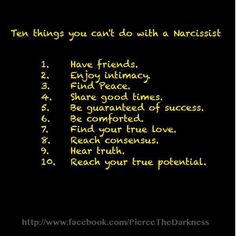
10 things you can’t do with a narcissist.

Image

10_things

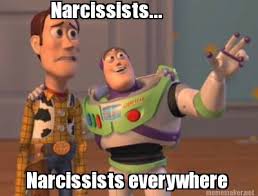
Narcs are everywhere!

narcissists_everywhere

According to the largest study ever conducted on personality disorders (PD) by the U.S. National Institutes of Health (NIH), 5.9% of the U.S. population has BPD (Grant et al. 2008) and 6.2% has NPD (Stinson et al. 2008). As some people fit both diagnoses [BPD or NPD], about 10 percent of the U.S. population has BPD and/or NPD.

(From BPD Central: https://www.bpdcentral.com/faq/personality-disorders)

I’ve read elsewhere that this “rare” disorder (NPD) affects between 1 and 4% of the American population.

But narcs just seem to be everywhere. My boss is a narc, at least half of my family are narcs, every man I’ve ever been in a relationship with has been a narc, my roommate is a narc (low spectrum), my next door neighbor is a narc, and even random people I meet in places like the grocery store show a lot of narcissistic behaviors.

They’re all over TV, all over the news, hosting that obnoxious morning radio show as you battle traffic with more raging narcs on the road. They run for office and run corporations, they run churches and schools, and and they’re all over the Internet.

They’re lurking behind everyday people too. The nice lady serving you your morning coffee at the local Waffle House could be one. The guy who comes to mow your lawn could be one. So could the UPS guy, or God forbid, the woman you leave your kids with when you go out.

If I type “narcissists are…” in my browser, “narcissists are everywhere” comes up second. So evidently I’m not the only one who’s noticed this.

Since the planet does seem to be crawling with them like a bad case of lice, how do they make up such a tiny percentage of the population? ?

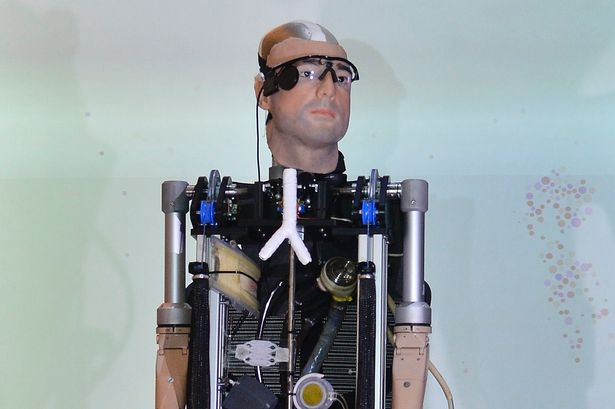
The chilling mental landscape of a high spectrum narcissist or psychopath

bionic_man

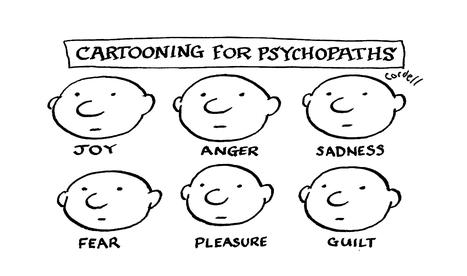
I read this chilling post from a man who says he is a narcissist. Based on his description of what it’s like to be him, I would say “narcissist” is probably an understatement. My guess is he’s a very malignant (high spectrum) narcissist and a probable psychopath. Most people with NPD do have emotions, but can’t access them easily or only feel emotions when they pertain to themselves. When someone claims to have no emotions at all, that indicates psychopathy to me. This man could also be “suffering” from Schizoid Personality Disorder, another disorder where the “sufferer” feels nothing–or he may have a combination of psychopathy and SPD. It’s scary and sad to read something like this. It’s as if some people have lost every shred of humanity and seem to have no soul. They are reptilian. At least this writer is self aware though, so I guess that’s something. (Post has been edited for brevity).

Certain passages in this post would make me suspect Aspergers (social awkardness, etc.) but Aspies do have emotions and empathy, even if they don’t always express them well or at all, so I’m suspecting this man has Schizoid PD mixed with psychopathy/malignant narcissism.

Also striking are the dissociative episodes and feelings of unreality this man claims to experience. I have seen these sort of near-psychotic behaviors (talking to himself in public, strange expressions on his face, etc.) in most of the malignant narcissists and psychopaths I have known. These people are so deluded they really aren’t in touch with reality at all. They live in a barren, hellish dreamworld of their own making.

psychopath_emotions

[…]I just discovered that I’ve had pathological NPD for most my life. Reading this […]has been both very frightening and a major relief. […] It’s a relief to know that many of the strange decisions I’ve made were not entirely my fault. [This material] has completely changed how I view my past. It’s like I was in a dark room and then someone finally turned the light on.

For several years, I would occasionally wake up in the early morning with a feeling that something was very wrong. I couldn’t explain the feeling but it was similar to guilt. But I couldn’t pinpoint what I had done to feel so guilty about. This has been clarified […] along with everything else about my strange life. Everyone posting on this site describes the Narcissisist as a monster, which I agree with, but it’s also a horrible disorder to have.

[…]There’s so much I want to say, but it would turn into a novel about as long as the book itself. I’m a male in my 30’s and fit every characteristic of someone with pathological NPD.

I have no emotions. When my Father left our family to fend for ourselves, I felt nothing. When my Grandmother died, I felt nothing. When I witnessed my roommate seriously injure his neck, I felt nothing at all. These events were only slightly negative, as if someone had dropped and broken a dish.

I have technical degrees from elite universities which makes it easy for me to secure employment, but when I’m at work, I hardly do anything at all because I can’t concentrate for more than a couple minutes at a time. I’m constantly day dreaming and people notice that I have strange expressions on my face when I’m supposed to be working or paying attention to a lecture. I constantly talk to myself, but I’m not sure if that’s a characteristic of NPD.

I have no social skills and am socially inept. As far as personality goes, I wouldn’t even say its a poor one, more accurate would be to say it’s nonexistent. I don’t greet anyone unless they greet me first. If someone asks “How are you?”, my reply is “Fine” and that’s about as far as the conversation goes. I can feel myself creating hatred where I work by ignoring social norms, but I don’t care how much people hate me. I feel like I’m a plague that creates pain and destruction where ever I go, and I like it. I have no friends except the ones from childhood, but I don’t feel I need them anyway. I’m more comfortable just sitting at home and playing on the Internet.

As far as looks go, I’m a 10, which makes me a somatic narcissist. I often get compared to male celebrities and women often audibly gasp when I enter a room for the first time. I’m in my 30’s but everyone assumes I’m in my 20’s. Despite this, I haven’t had a relationship with a woman my entire life (being a devout catholic when I was younger also had an influence on this). Through techniques I’ve learned from the pickup manuals available on the Internet, and by dressing fashionably, I’m able to create a huge amount of initial attraction from women. This has kept me in school much longer than necessary since there’s a huge amount of narcissistic supply in a school environment, especially in classes with many women. Despite this huge initial attraction, I always reject the (very attractive) women when they come after me, which only increases their attraction to me. I justify rejecting them by telling myself “when they see what my personality is like, they would just reject me anyway”, which is probably true considering my social ineptness. However, sometimes I will talk to a girl a few times and she still hasn’t rejected me despite my personality. At this point, I would reject her, and have no idea why I rejected her. I now know it’s due to EPIM (emotional involvement prevention disorder). It’s ironic, I’m the guy every woman in the school wants to be with, but I don’t even have a girlfriend.

I feel completely omnipotent. I will make long eye contact with girls right in front of their boyfriends, even if their boyfriends look like bodybuilders. I can hold my own in a fight with most anyone, but even if a guy is twice my size, I have no fear. I will try to seduce women who I know are engaged just to make them feel pain. I have no empathy so I don’t care about their pain and actually enjoy it. When women look at me in class and try to get me to look back, I will ignore them just to humiliate them in front of the class. Or if an attractive woman is trying to make eye contact with me, I’ll pretend I’m interested in a less attractive girl. Needless to say, I hate women. However, I also badly want to have a girlfriend. I feel this is one of the many conflicting states of the narcissist […].

Not having emotions is a powerful tool in attracting women because women are attracted to guys who don’t want them. Women want what they can’t have. It’s easy for me to play hard to get and I can easily outlast a woman who’s playing hard to get, which most men can’t do. I know I’ll never actually be able to have a relationship with these women, so it doesn’t bother me if a semester ends without having pursued a relationship. So I have many “victims” from my school years, but the biggest victim is myself since I’ve spent years upon years alone.

[…] I see women as predators who are only interested in draining a man of his money while offering as little as she can get away with in return. After the man has been consumed, he is decapitated (divorced) while she runs off with another man. I’m not sure if this view is due to NPD or what I’ve seen my friends (colleagues) go through. There is a book called “The Predatory Female” that probably helped cement this view. I’ve also noticed that in times when I’ve had no money, I didn’t exist to women.

I now realize I quit my previous well-paying job due to a lack of narcissistic supply. A somatic narcissist needs attention from women, and they were pretty much non-existent where I worked. The most abundant place for narcissistic supply is a university, and after receiving a degree, the cerebral narcissist can receive more NS because of it.

When I saw the movie Batman “The Dark Knight”, I was intrigued by the character of the Joker. He had no fear, didn’t care about anything (even money), and caused havoc ever where he went. His actions made no sense and he was unpredictable, but he wasn’t stupid. He was omnipotent because he didn’t care if he was caught, or if he was killed, and was capable of doing anything. He had no empathy caused havoc for the fun of it.

My mentality is very simple and childlike and I don’t like speaking with other adults. If someone spoke with me for 10 minutes, they would think I’m a normal person, but it’s just a matter of time before I say something factual but very insensitive, which causes the person to hate me. The only emotions I feel are jealousy and rage. When I see a guy with an attractive women, I want to attack him and have daydreams of attacking him while the woman watches in horror.

[…] the chance for healing from NPD is bleak. Even if I were to get into a relationship with a woman, I would probably just cause her a lot of pain before dumping her when she’s no longer a source of NS.

The Early Warning Sign Of A Toxic Person You Never Hear About

A very important (but rarely talked about) early warning sign you are dealing with a narcissist.

Bree Bonchay, LCSW's avatarFree From Toxic

imageThe Department of Homeland Security has a color-coded terrorism alert system. Red, the highest level, means severe risk of terrorist attacks. The lowest level, green, means low risk of terrorist attacks. Between those are Blue (guarded risk), yellow (significant) and then there is orange (high). There is a lesser known and very subtleearly warning sign you may be dating a toxic personthat you never hear about. It’s not quite the level of a red alert, but it is definitely in the orange to red range andit should put you on high alert that you are in danger ofbeing at the very least, emotionally abused, bya toxic person, narcissist or sociopath. It’s a tacticcalled Subtle Ignoring. It is generally a precursor to full-blown narcissistic abuse and the frequent use of the silent treatment.

View original post 555 more words

Can an adult turn into a narcissist?

crossroads1

I believe the answer to this is yes. While most cases of NPD are formed during childhood as a reaction to abuse or neglect, there are situations where a person who is not a narcissist can later become one, even as an adult. It can happen because of narcissism being, essentially, a choice. Even a small child makes a choice to become a narcissist, even if they’re not really conscious of that “decision.” In an adult, it may be more conscious, but once made, the personality can change dramatically.

An adult who becomes a narcissist is probably more easily healed, because the disorder is less deeply ingrained in the personality, but I think there are certain situations where if someone makes a choice to walk in darkness, something evil grabs hold of the soul and there is no turning back to a normal way of relating to others. Here are four scenarios in which I think a person can acquire NPD.

1. Abandonment or abuse starting during adolescence.

teenage_depression

Teenagers are narcissistic by nature and vulnerable to peer pressure, so they often act out in risky ways and experiment with the illicit and unhealthy. This is normal to some degree. But for a few, if familial abuse or abandonment begins during the teen years, the narcissistic behaviors of adolescence may become a lifestyle and coping tactic that the person will not let go of as they enter adulthood. I believe my ex is an example of a psychopathic malignant narcissist who did not become one until the age of 13, when he found his father dead in the bathroom in the middle of the night and his mother refused to do anything and left it to him to take care of his father’s body. Although his mother had always been a malignant narcissist, my ex was a good kid until that point; after that he changed.

In most cases though, I think narcissism starting during adolescence is likely to be fairly mild. I have been in communication with a young man who believes he is a narcissist. He explained to me that he was raised by loving parents but his mother became severely depressed when he was in his early teens, and began to ignore him due to her depression. He didn’t understand it was her depression causing her sudden coldness; he thought she she didn’t love him anymore. He explained that’s when his narcissistic behavior patterns began. In such cases, I think the narcissism that develops is actually a condition called DNP (destructive narcissistic pattern disorder) which lies below NPD on the narcissistic continuum, and is a more easily treatable form of narcissism where the person does retain some ability to feel empathy, love, and remorse.

2. Choosing evil.

fearofbridge

M. Scott Peck talks about a man who almost became evil in his book “People of the Lie.” A family man who loved his wife and children suffered from severe panic attacks, especially when driving over a certain bridge. Although he didn’t believe in the devil, he made a “deal” with Satan that if he could pass over the bridge without suffering a panic attack, that Satan could do what he wanted to with his favorite son. He didn’t think it really counted since he didn’t believe in the Devil (and nothing happened to his son), but he realized later that if he hadn’t repented, his own soul would have been seared. I think when a person knowingly chooses evil over good, the soul can be damaged or destroyed. It’s even possible that making such a choice allows an entryway for an evil entity that works to destroy all goodness in that person. The change can be dramatic and happen almost overnight.

3. Severe reaction to trauma.

ptsd_soldier

Related to the above, I think sometimes a person can engage in evil through no choice of their own. Victims of Stockholm Syndrome, who identify with their abusers and cannot escape, will sometimes be forced to commit evil acts or help their abuser carry them out, such as Patty Hearst back in the early 1970s. It sometimes happens in war, too. A normal person forced to kill innocent civilians will often develop PTSD, but for some soldiers, in order to protect themselves from their unbearable guilt, they learn to shut off all their emotions and any feelings of empathy or remorse, and come to regard other people as less than human. Unfortunately, a few veterans have their hearts hardened during war, and become cold-blooded narcissists.

4. Overnight success.

narcrealityshows

Celebrities and other people who achieve overnight success or fame have to be careful not to let their success go to their heads. Many celebrities are narcissistic, which begs the question: were they narcissistic in the first place and that led to them becoming rich and famous, or did becoming rich and famous turned them into narcissists? I think both come into play, depending on the individual. Certainly narcissistic personality types are the most drawn to fame and fortune, but I’ve heard of cases where a highly successful person was kind to others until fame and success went to their heads. I think though, since evil wasn’t chosen by the person under these circumstances, that a celebrity who didn’t already have NPD can discard their acquired narcissism if their arrogance and sense of entitlement is pointed out to them, or they realize they have hurt someone. So a celebrity’s narcissism may not be true NPD, but a condition called “situational acquired narcissism” which may be temporary.

Building a narcissist

brick_man

I was browsing and NPD forum and came across this post by a woman who claims to be a narcissist or possibly a borderline (she is undiagnosed) and is begging to be healed (she is apparently undergoing a narcissistic crisis–which usually happens after a loss of a major or primary source of supply). What’s interesting is her memory–presented as a kind of list– of the events that led to her choosing narcissism as a coping strategy. It is a choice, after all–usually made in childhood, though the choice can be made as an adolescent or adult too. It may or may not be a conscious choice.

This could, of course, all be fabricated by someone who knows the psychology of NPD fairly well, but if it isn’t a fabrication, it’s a textbook case of how this personality disorder begins and evolves. It also illustrates my ideas about narcissists beginning life as highly sensitive people (HSPs) and how painful this illness can be for its sufferers.

In a most narcissist way I want to ask you how I can heal.
🙂

Working mom
Parents divorced at birth
Father disconnected.

Sensitive child. (nature/animals/people)
left at 8 weeks with babysitters constantly
LOVING MOTHER
over indulged (spoiled)
only child
childhood trauma at 4 (seeing something with animals)

I tipped and decided that all people were cruel.
I shielded myself for years from TV, movies and news articles that I deemed disturbing.

I learned pedophiles were real and a problem at age 40.
That is how well I shielded myself.

Now, today I am 52 years old. My husband divorced me. I changed when I was put on Prozac. I had a bipolar episode and life went downhill for 14 years. I came off all medication 2 years ago.

No help with detox. No therapy as I don’t trust people.

Now, I am having problems and after reading your articles believe that I am a narcissist, possibly borderline personality.

Depression overwhelms me when I think of offering myself to the world.
I don’t want to be rejected.

I understand this fear is from perceived trauma.

How do I get passed this?

How do I resolve anger after (feeling like) I lost 14 years of my life due to mis management of psychotropic medication.

I have searched for a therapist, I have called therapists and interviewed them. I get confused and really don’t know with whom I should place my trust.

I don’t need your damn fake apologies.

narc_apologies

My sociopathic ex was never sorry for anything. Oh, yes, he “apologized” sometimes, but it was only to get me to shut up or because he knew he’d already lost the argument or knew I was right (but he wasn’t really sorry.) It was insulting how stupid he must have thought I was to believe these “apologies” were sincere.

Unless they are incredibly good actors and are hoovering you (trying to reel you back in, like a Hoover vacuum sucks up dirt) or love-bombing you (stalking you as prey), no apology coming out of a narc’s mouth is going to sound sincere. Of course, it’s easy to fall for those “sincere” apologies when they’re feeling needy, but there are always other red flags you can look for, such as crowding you, moving too fast, or trash-talking all their exes (make no mistake, he or she will eventually trash-talk you too).

Once they have you trapped in their web of deception, a narcissist’s “apologies” are going to sound more like the following (if they even bother to apologize for anything at all). Some of them are actual “apologies” I got from my MN ex.

Gaslighting, projection and devaluation/invalidation are embedded in almost every narcissistic “apology,” as is lack of empathy. The “shut up” apology or the “I will not take responsibility for my actions” apologies are common too. All of them are represented here. So, without further ado, here’s a list of what you might hear.

Narcissist “Apologies”

bullshit

1. “I’m sorry, but you always get so hormonal and overreact to everything when you’re on the rag.” (invalidation; devaluation)

2. “I’m sorry you have no sense of humor.” (projection and gaslighting)

3. ” I’m sorry you overreact to everything I say.” (projection and gaslighting; devaluation)

4. “I’m sorry your family gave you such horrible examples of how to be a compassionate person and made you so self-centered and narcissistic.” (it’s true about my FOO but this is blatant projection!)

5. “I’m sorry, but I always talk loudly and you just take it the wrong way.” (denial of truth–it wasn’t that he was “too loud,” but that he was saying hateful things in an angry tone of voice).

6. “It’s your responsibility you feel hurt by that.” (a favorite of my mother’s)

7. “Your feelings are not my responsibility.” (this gives them carte blanche to say whatever they want)

8. “I’m sorry, but you are driving everyone here crazy with your constant whining.” (projection, gaslighting, possible triangulation)

9. “I’m sorry you are mentally unstable and can’t understand what I said.” (projection and gaslighting; there may be veiled sarcasm there too.)

10. “Alright, fine. I’m SORRY!!!!!!” (said sarcastically or in an angry tone of voice–this is the classic “shut up” apology)

11. “(HUGE sigh) I’m sorry. Are you happy now?” (another version of the “shut up” apology)

12. “I’m sorry but it’s not my problem.” (lack of empathy; taking no responsibility)

13. “I already apologized.” (said when they didn’t). Gaslighting and denying the truth.

14. “I’m sorry about arguing with you, BUT you started it.” (this may or may not be true, but they always have to take a jab at you anyway. Their apology feels hollow.)

15. “I’m sorry I forgot your birthday, BUT I had to be at that meeting. You know how important my job is.” (that job is more important than you, and he or she wants you to be aware of that).

16. “I’m sorry I hit you, BUT you deserved it.” (why even bother saying you’re sorry, asshat?)

17. “I’m sorry I got drunk and threw up all over you, BUT I told you to not let me have any more drinks.” (dead if you do, dead if you don’t–he would have handed you your head if you had actually told him not to have another drink).

18. “Apologies are for wusses, but whatever, fine, I’m sorry if that makes you happy.” (another “shut up” apology)

19. “I’m sorry you think I’m such a horrible person.” (guilt-tripping, possible projection)

20. “I’m sorry you hate everything I ever do for you.” (see #19)

21. I have no idea what I did to upset you, but whatever it was, I’m sorry. (They know damn well what they did and are trying to play “innocent” or “dumb.”)

22. “I’m sorry. Now get over it.” (a shut up apology)

23. “I’m sorry, but nobody’s perfect.” (this is just a cop-out apology; they are not taking responsbility)

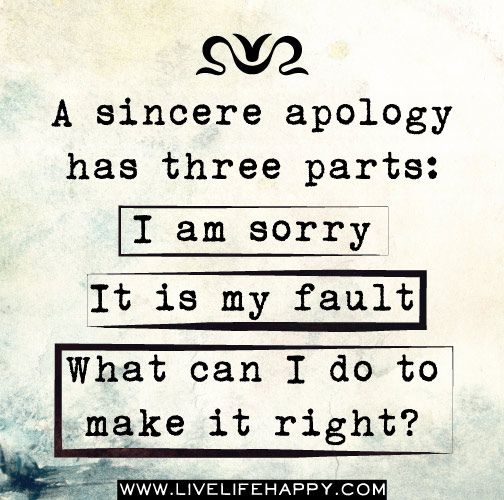
I think we’ve heard enough of these. I feel kind of sick now. Their fake apologies are just another weapon narcissists can use to hurt you.

sincere_apologies
See the difference?

The latest on the NPD* sufferer in “Another Narcissist Who Wants Help”

trapped2

I thought this may interest those of you who read my article from April 30, “Another Narcissist Who Wants Help.” It’s a followup email he sent me yesterday, describing some of the things he’d doing to attempt to heal himself from NPD or at least be able to control its symptoms better.

* I do have some doubt he actually has NPD though, due to what appears to be a normal level of empathy and a lot of self-awareness; I think he may be being too hard on himself and suffers instead from something like BPD. He also has no official diagnosis.

All that being said, what this young man is trying to do and has dedicated himself to doing –opening himself to being vulnerable and letting himself feel and share his honest emotions–is incredibly courageous, especially for someone as young as he is (he’s in his early-mid 20s). He’s also doing his homework–he seems to be doing a LOT of reading about NPD, if this email is any indication. He may not actually be a narcissist, but even so, it’s still a courageous thing he’s doing. Any of us who suffer from being too guarded–which is most of us–can benefit by giving ourselves permission to just feel life in its glorious spectrum of colors.

I can tell this young musician is sincere because he’s been watching all of Brene Brown’s videos . In fact he is the person who tweeted about Brown’s compassionate and sometimes humorous messages of being authentic and vulnerable in a world that hates and fears those things. If you take on the challenge of setting yourself free of whatever traps you– whether it’s a narcissistic mask or the fear that fuels so many other disorders — it takes a lot of strength and courage to do that. Which means becoming vulnerable isn’t becoming “weak” at all — it’s just becoming an authentic human being.

I have permission to repost the email I got, removing personal details like names.

Original email is in this post: https://luckyottershaven.com/2015/04/30/another-narcissist-who-wants-help/

Email received 6 weeks later (yesterday)

[…]It’s not really a bad thing to share how we are feeling – in fact NOT sharing how I feel is probably one of my biggest downfalls. So it is healthy to express your emotions to someone, wherever they’ve come from. If you’re feeling emotionally down, or wounded it’s worth remembering one of my favourite quotes by Iyanla Vanzant (you’d love her when she talks about relationships check out her appearances on Oprah’s Lifeclass she’s awesome) which is that ‘a wound needs a witness’ – meaning it is in our nature as humans to want to share our feelings. The worst part of narcissism is it leads the narcissist to detach from their true feelings, and results in the narcissist viewing emotions in others as weak. I could imagine that belief that emotions are weak can be contagious but we weren’t put on earth to suppress ourselves, but express ourselves! So remember your feelings are a huge part of who you are so I don’t think you should deny them, and I don’t think it’s a bad thing to express them (even if I have been trying to silence mine for years ha!)

I hope you’re doing well – I’ve been immersed in personal exploration lately. The book ‘The Drama of the Gifted Child’ has been fascinating for me and I’d thoroughly recommend it (or maybe it was you who recommended it to me?) if you want to better understand the origins of narcissism. Much of it resonated with me and it’s a very hopeful and forgiving text. I understand it’s one of the main books on the subject. I’m moving on now to a book called Disarming the Narcissist which is interesting because even though it’s from the point of view of someone living with a narcissist in their life it helps me see how I can better inter-relate with the people in my life.

I’ve kinda realised that the worst parts of narcissism don’t actually manifest themselves in my life at large: I have healthy and thriving friendships. I’m not going to lie and say I am not centre of attention a lot because I am, but I’m here for my friends when they need me and I’m working on being even more available emotionally and otherwise in the future. I don’t think I’m ‘cured’ but I am aware that the extremes of my difficult qualities tend to bubble up tot he surface only in relationships where consistent intimacy is expected. So basically romantic relationships. That’s not to say the work I’m doing on myself isn’t important across my life but it certainly is most relevant when I’m in love, because it is in those times my frequent emotional detachment becomes a problem. Detachment from my own feelings means I am longer able to experience the feelings of those around me, which in time results in me objectifying them and treating them less than well.

Interestingly music has been important for me too. I haven’t really lay down in bed with the lights down low on my own with a great album on in the background in so long. I think listening to music keeps me connected to my emotional experiences and helps draw out my true feelings. Maybe that’s what happened with you before you drafted that post? I think it’s a good thing. Music is, of course, the feelings of other people and we feel connected to the human experience by listening to and enjoying it.

Oh and Brene Brown! What a gem! I’ve downloaded her book Daring Greatly (think that’s its name) and can’t wait to get started. I feel that book is gunna be a proper uplifting read, and with the summer kicking in here now I’m looking forward to reading in the sun in Hyde Park with a gin and tonic and some olives! Yay!

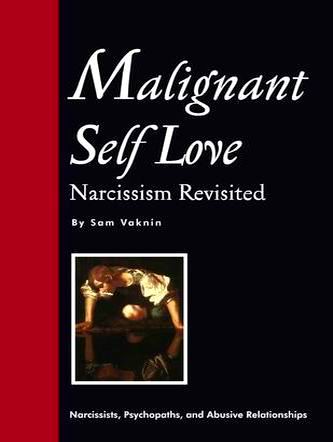
Book Review: “Malignant Self-Love” by Sam Vaknin

malignantselflove
Vaknin’s “Bible of Narcissism”

I first heard about Sam Vaknin’s book “Malignant Self-Love” about 15 years ago–when I made a cursory online search about NPD after I realized my own mother was one. At that time, Vaknin was pretty much the only voice on the Internet about narcissistic abuse. Vaknin, a self-confessed narcissistic psychopath , had written a “bible of narcissism” and it became obvious, from scanning the selected pages he provided in PDF format on his website (which has never been upgraded to a more current look and format–he uses the ancient blogging site, Tripod), that this guy was obsessed with his own disorder to the point of unhealthy navel-gazing and what’s more, he and seemed to hate people like himself. What was this, some kind of pathology performance art?

His book and his own story that inspired the book intrigued me, but at the time, I was still trapped (or thought I was trapped) in my abusive marriage and my kids were still very young, so I filed this information away in the back of my brain, and quickly moved onto other things, such as trying to keep my doomed marriage together. In fact, I didn’t think about his book again until late last year, after I left my narcissist.

When I started my blog in September 2014, Vaknin still had a huge presence online (though he no longer had a monopoly on narcissism). He was often quoted on ACON blogs and even in more serious articles in publications like Psychology Today. The difference was, by now, he was no longer alone. There were other voices joining his–Kim Saeed, Michelle Mallon, and Kathy Krajco (who is with us no more) just to name a few, and of course psychologists and other authors like Dr. George K. Simon, Robert Hare, and Marsha Stout. And too many ACON (Adult Children of Narcissists) bloggers to count. By this time, Narcissism was a Very Hot Topic, at least on the Intenet. Sam Vaknin probably began that trend, in spite of his being so vilified by so many of the narcissism bloggers he paved the way for.

A self-professed malignant narcissist writing self help books for victims of abuse may seem like the ultimate irony–but when you look a little deeper, it makes a lot of sense. Who better than a narcissist to know what makes a narcissist tick? Every other expert who writes books about narcissism has to make educated — or not so educated — guesses.

If you’re not a narcissist, it’s almost impossible to imagine what such a disorder can feel like to its bearer, just as the pain of cancer can never be convincingly described by one who has never suffered from cancer. If a book were to be written about what it’s like to have cancer, the writer should be a cancer survivor–or one about to succumb. My point here being that Sam Vaknin, whether you like him or not, whether you think he’s doing ACONs a service or hurting them, whether he’s got the proper credentials or not (and personally I don’t care about the whole credential brouhaha because not once in the book does he say he’s a mental health professional and in fact it’s full of disclaimers), is definitely qualified to write about narcissism. His primary qualification–the only qualification that really matters–is that he is speaking from personal experience.

So I pulled out my debit card and ordered the huge black-and-red tome with its Caravaggio “Narcissus” illustration on the cover (which, for me, was a draw in itself, because I love the painting). It set me back about $40 on Amazon (you can get a copy signed by the author for about $54.95) I thought the price was a bit high, until I held the book in my hands. It was as big as the Bible! Maybe even bigger. I flipped through its onion-skin thin Bible-like pages and saw how tiny the print was.

Oh, man, I thought. I don’t think I can read this. But I was determined to. I wanted to understand what it felt like to be a narcissist, what it felt like to be inside Sam’s head. And so I began to read.

Malignant Self-Love is not a book you can read in one sitting–or even ten. Maybe not even twenty. Normally, I’m a very fast reader. Until I started blogging (and no longer had time to read much), I could consume about 3 good-sized books a week. People looked at me like I had three eyes and a horn growing out of my head when I’d tell them I finished a 300 page novel in 2 days. But Vaknin’s book is different. It’s not only got a LOT of information–almost more information about narcissism than you’d ever need or want to know–but it’s a dark and depressing read too, and I found that while reading it, I felt my mind being sucked into Vaknin’s bottomless black vortex of pain. He’s pessimistic, negative, and hates his own disorder. He also seems to hate himself for having NPD, and demonizes narcissists in general, referring to them as non-humans and machines. He demonizes himself in the process, and warns his readers to stay far away from people like himself. You would think from all this encouraging advice to the sort of people who would have been his prey, that he cares about the victims. I’m not so sure, since he himself is quoted as saying he never intended to help anyone by writing Malignant Self-Love, that his primary motive was narcissistic supply and attaining a guru-like status for himself.

samvak3
Sam Vaknin, the psychopathic, emotionless predator.

Yet in spite of his heart never having been in its creation, Malignant Self-Love is an outstanding piece of writing, and English isn’t even Vaknin’s native language. He weaves words together into a beautiful piece of literature the way a holy man weaves tiny colored threads together to create a Persian rug–with an intricacy and detail that is rare in modern writing.

Indeed, Vaknin’s writing at times can seem as if it’s from a bygone century. His phrasing is old-fashioned and his writing is highly descriptive, hearkening back to 19th century authors. At times it reads almost like poetry. And it’s very emotional writing. You come away from the pages (which feels somewhat like coming up for air after having been underwater too long), with the strong sense that whenever Vaknin refers to the “Narcissist,” he is really speaking about himself in the third person. There is passion and pain in these pages, but more than anything else, there is rage. White hot rage. Sam Vaknin is…intense. And so is his book.

Although some mental health professionals and other who study NPD have criticized Vaknin for appearing to take several related personality disorders–Antisocial, NPD (the less malignant type described in the DSM-V), Borderline Personality Disorder, and even autism–and churn them together into a mutation of the psychiatric definition of NPD into a devastating form of psychopathic malignant narcissism. Some mental health experts have even said Vaknin’s book has been damaging to the field of diagnostic psychology because it blurs the lines between several distinct personality disorders.

But since when is the field of diagnostic psychology a real science anyway? At best, it’s a social science; at worst, an art form–so in my mind, Vaknin’s theories about NPD make as much–or more–sense than some of the experts.’

Vaknin was also not the first narcissism writer to ever do this. While M. Scott Peck’s 1983 book “People of the Lie” is written from a completely different perspective from Vaknin’s–one with religious overtones written by psychiatrist who is also a born-again Christian–Peck’s book too seems to mix traits of NPD and ASPD. And while Peck didn’t call the hybrid disorder “malignant narcissism” (he calls it “evil”) because that term wasn’t in wide use in 1983, people could relate–because we almost all know someone like that. Vaknin’s book also describes people that victims of narcissistic abuse recognize–a dangerous kind of narcissist who has nothing but ill will toward others, but it was born from having been abused themselves, as Vaknin was abused.

Vaknin’s readers are mostly women, who are in a relationship with a narcissist or thinking about leaving one. Sam Vaknin does not disappoint. Victimized, emotionally damaged women see Vaknin as a kind of online therapist (especially those who frequent his discussion groups and forums), and the “transference” of strong feelings of a patient to their therapist is an important development in the psychotherapeutic relationship. If they’re using the Internet as their therapist, Vaknin can easily become the object of these feelings of transference. He becomes a kind of mirror reflecting back to them all the admirable qualities they have imbued him with–-which may or may not be accurate-–but it’s what they want or need to see in him. The problem is, unlike with a therapist in a controlled psychotherapeutic setting, women experiencing transference toward a online cult hero like Vaknin have no idea what to do with these feelings or how to use them to learn more about themselves. But on the plus side, he does tell them how to disengage and tell them WHY they should disengage and what makes their narcissist tick, and of course he’s right. Many of these women (and men too) claim Vaknin’s book saved their lives and helped them get started along the road to self-discovery and freedom from abuse.

samvak2
I think this picture shows a sad side Sam Vaknin rarely shows in public. That’s why I think it might have been a candid photo that caught him with his mask temporarily down. Of course he could be acting for the camera too.

If you don’t like ponderous, pessimistic tomes or books that don’t require the reader to think, then Vaknin’s bible of narcissism may not be for you. But if you like a book you can savor and digest over weeks or months, the way you would savor a fine wine by taking small sips and not chugga-lugging it down like a cheap bottle of Gallo, then I recommend his book if you’re in an abusive relationship with a narcissist, trying to go No Contact, or just interested in narcissism. His writing is so good it’s worth reading even as just a work of literature, even if you disagree with his assessment of NPD as a blight on humanity and the precious little hope he conveys that sufferers of NPD can ever get well (which is one of the few problems I have with his book).

It took me nearly three months to finish Malignant Self-Love, but only because I could only swallow a little of his brand of darkness at a time without making myself sick. However, when I finally read the last page, I came away feeling like I had an insight into my narcissists that no one else could have made possible. It was as if Mr. Vaknin provided a sort of mirror to my narcissists and made them talk to me– openly and honestly–about why they did the awful, hurtful things they did. In giving my narcs a voice, albeit a depressing, raging one–I felt as if Vaknin’s book had somehow stripped away some of their power over me. And that’s always a good thing.