What It FEELS Like to Live This Way

Incredible description of covert narcissism. This is exactly what it feels like to be one.
I can’t even express how glad I am that now I know. Things have already shifted and my whole perspective is changing. I’m so glad I “came out” about it too. Doing so was TERRIFYING!

healingnarc's avatarFrom Narcissism to Nirvana

There is a wonderful NPD research paper available at: http://ps.psychiatryonline.org/data/Journals/AJP/3874/08aj1473.PDF

It is my personal opinion that this is the most scientifically accurate description of NPD and its subtypes.

My NPD falls under the ‘fragile’ category.

According to their Q-factor analysis, the following traits are typical of the fragile narcissist experience. In order to add the actual viewpoint of a fragile narc, I am including the ranked list of traits and how they manifest in my life.

Please note that it is difficult for me to separate my current sense of awareness from my history. I may use past and present text in some places, but my general intent here is to describe what my life has felt like for the past 35 years.

Maybe it can be useful to help self identify if you think this is what you have!  Just be sure to confirm with a trained and licensed…

View original post 3,326 more words

Fear breeds narcissism; the antidote is vulnerability.

I think this article applies to anyone trying to heal from any personality disorder, PTSD, or the fallout of narcissistic abuse, so I’m posting it here too.

How my NPD/ASPD control freak ex used a dog to gaslight me.

jack_russel_puppy

In 2011, when my parasitic MN/ASPD ex was still living on my couch, he decided he wanted a dog.

We already had a dog, Dexter, who was an awesome black lab mix (he lives with my daughter and her fiance now). The house I live in (and lived in then) is tiny. At the time, we had Dexter and 5 cats. Far too many animals for a two bedroom house, but these were pets I cared about, so I wasn’t too bothered by the overpopulation problem in the house.

But oh no, a dog and five cats wasn’t enough for the Parasite (which is his new name as far as I’m concerned so that’s who he’ll be from now on). No, he had to have his OWN dog, one that HE picked. I told him we had no room for another pet, and it was already too expensive feeding and taking care of the ones we had (remember, he contributed nothing financially since he refused to work so all their expenses fell on me) but he couldn’t see reason.
Instead, he whined petulantly, “But Dexter needs a playmate!”
Dexter did not need a playmate. Parasite needed some easy narcissistic supply.

A few weeks passed and Parasite gaslighted me by telling me and everyone else who would listen that “Lauren hates animals” because I put my foot down about getting a new puppy.

One day I came home from work and found Parasite slumped on the couch that had a huge valley in the center from his constant inert and hateful presence, and in his arms was a puppy. A Jack Russell puppy.

For anyone who isn’t familiar with Jack Russells, they’re a cute beagle-like breed of hunting dog but they have serious ADHD and need to be able to run as much as they want. They bark a lot and are just extremely hyper. They are difficult to train because they’re so stubborn. They may be fine for a family with kids who lives on a farm or has acres of land for the dog to run, but they are definitely NOT the kind of dog that would do well in a small apartment or house with only a smallish unfenced yard. They are not the kind of dog to have if you live in a suburban development where the neighbors are no more than 40 feet away.

I hate Jack Russells. (But I love dogs).

But it looked like we had one, at least for the moment.
I told him to take it back wherever he got it.
“Oh, but he’s so cuuuuuuuuuute! Look at him!” (said in low-register baby talk)
I roll my eyes. “Yes, he’s very cute, but we have too many pets already, and I can’t afford to feed him too.”
“Oh, he won’t be expensive to feed. Dexter needs a friend!” He shoves the the puppy up in my face. “LOOOOOOOK at him, he LOOOOOVES you. Isn’t he CUUUUUTE?”
I see red. He isn’t listening. Again. He never listens. He never cares about anyone but himself. I tell him this.

He projects and gaslights. “No, YOU’RE the one who only thinks about yourself. You don’t care about animals. You only think about YOU! You don’t care about MEEEE. I have diabetes and mental problems and a bad knee and I have to live here on your couch and don’t have my own home and it’s always too hot or cold in here and you buy crappy food and now you’re telling me I can’t have a dog who won’t be any bother to you at all.”
I stare daggers at him. I can feel the lava of BPD rage boiling in my gut. I try to stay calm. I count to ten.
“I want you to take him back.”
“No.”
Maybe pleasantry might help. “Please take the puppy back.”
“No, and if you dare try to take him to the shelter, I’ll kill myself and make it look like a murder.”

The BPD volcano erupts. “YOU’RE A F&%KING ASSHOLE! TAKE THAT GODDAM DOG BACK TOMORROW, YOU STUPID FREAK!”
“What will you do if I don’t?” He’s baiting me. He has me on the spot. There’s nothing I could do or would do, and he knows it. He’s in complete control.
“Uh…I don’t know….But I’LL FIND SOMETHING!”
“You’d probably have Barnaby (he already picked a name) put to sleep,” he says, fake pouting. “You hate animals, you have no compassion or you’d let me keep him.”
I give up and leave the room, but out of the corner of my eye see Parasite holding Barnaby up to his face and telling him in that infuriating fake-masculine baby talk what a “meanie” I am.

control_freak

So Barnaby stayed. For two years. I never hated a dog before, but I hated this one. He chewed everything, the furniture, the rugs, important papers, my favorite book. Once he ate an entire pack of cigarettes and vomited them up all over the chewed up and shredded rugs. He pissed and shat everywhere, up until he was a year old. Parasite kept making excuses for him such as “but he’s only a PUPPEEE!” or shifting the blame to me–“you’re so impatient!” Not only did I hate him because he was so out of control, I hated him because Parasite refused to train him and that dog represented to me everything bad about the Parasite himself. Every time I saw that dog, it reminded me of how controlled, intimidated and powerless I had become.

Barnaby barked and howled nonstop. Morning, noon and night. Once he got a taste of the great outdoors, he decided this was something he couldn’t live without, so running away for hours at a time was a weekly occurrence, and eventuall a daily occurrence.
But running away wasn’t all he did. Oh, no. If he’d run away and never returned there’d be no love lost.

But he’d run into neighbors’ backyards. He’d devour their gardens, then sit there and howl for hours. You’d go try to catch him, and the little demon would run. It was a game to him. He’d run, then sit down and look at you, waiting for you to make a move. You’d lunge after him, and he’d bound off again, then sit down and look at you, teasing you and daring you. He was too fast, I could never catch him. And Parasite wouldn’t try. It was up to me to get him to come back. And I never could.
I’d go to bed and hear him howling somewhere nearby and wonder what the hell I was going to do.

Soon the neighbors were mad at us for allowing our out of control dog to keep them up all night and ruin their yards. Animal Control was called twice. The second time, I answered the door when they came, and when they told me there’d be a fine if it happened again, I told them they were free to take him, I couldn’t handle him. But Parasite was home, and intercepted, promising he’d be good and it wouldn’t happen again. Animal Control left. Barnaby stayed.

The next night, Barnaby ran off and howled in another neighbor’s yard. Animal control came and took him away. Parasite was inconsolable at first, then his grief morphed into rage. He threatened me: “You go get that dog back tomorrow.”
“I don’t have the money.”
“You’re lying. Do it or I’ll kill myself. And make it look like you did it.”
I used my week’s entire paycheck to go retrieve Demon Dog from the shelter, leaving us without food that week (which Parasite of course complained about).

This time, Parasite actually had the presence of mind to build a makeshift fence from steel beams where Barnaby could be confined. So although he continued to chew everything in sight and bark too much (and still seemed to have problems containing his bowels) he seemed calmer in his grassy kingdom and the howling ceased.

But this didn’t last. Barnaby was smart. One night Barnaby dug his way out from under the pen and I heard the distant howling.
I couldn’t do this anymore. I remembered Parasite’s threat. But sometimes frustration or anger can override fear, and I reasoned that it was probably an empty threat anyway, since he rarely had followed through on any of his past threats.
I was going to place an ad on Craigslist.
But Parasite had an announcement of his own.
“I don’t want Barnaby anymore,” he said.
I just stared at him stupidly.

A week later Barnaby went to live with a family that answered our ad on Craigslist. The man who came to get him said he had five acres of land and 4 kids, and they’d always wanted a Jack Russell.
Why family scapegoats become lifelong victims.

I thought it seemed like a good time to post this again.

luckyotter's avatarLucky Otters Haven

I just watched a video that really hit home for me.

If you were scapegoated by your family, two things can happen. You can become a narcissist yourself (narcissism being an elaborate defense mechanism to avoid further hurt and abuse) or you will internalize the early message that you’re worthless, defective and have no rights. I’m going to talk about the second scenario because that’s what this video is about and it’s what happened to me.

As a scapegoat, you are trained to live in fear. You become afraid to defend yourself, express your opinions, or demand fair treatment. This attitude of worthlessness, fear and shame is carried into adult life. Other people can immediately sense you are a pushover and a magnet for abuse, rejection, and bullying, and you become a target for abuse by others well into adult life.

You can become a lifelong victim unless you find…

View original post 664 more words

Emotional vomiting.

Reposted from Down The Rabbit Hole.

vomiting

My moods have been as unstable as the ocean before an approaching hurricane. One day euphoric, the next in the depths of rage and despair. My few good moods lately are so easily shattered.

Then I see my own narcissism and have trouble sorting it out from the normal “negative” emotions we all have for survival. What’s worth being upset about? What is just selfishness and entitlement?

I observe and watch myself. Since my revelation, the wall of cognitive blindness that kept me unable to see my narcissism melted away and what is revealed is the underlying envy, rage, entitlement and grandiosity. This layer was always the most painful to me (and hardest for others to deal with, because the false grandiosity (which can be pleasant, even if deluded) came marinated in a poisonous concoction of envy and rage. So the grandiosity and entitlement is toxic to everyone. It’s like snake poison.

Becoming humble isn’t becoming weak or masochistic. It doesn’t mean you allow people to flagellate you or abuse you. It means knowing you have limits, acknowledging you are only human and not a superman or woman. It means accepting the truth about yourself, even when it hurts. It means seeing what’s real. The scales falling from our eyes may be painful, but in the end this pain will set you free.

I’ve been emotionally unstable for three weeks now. Of course those could be BPD traits coming to the surface too. But I know a lot of it is all the spiritual poison of long term narcissism rising to the surface of my consciousness so they can be purged.

I can feel these black poisons in my body and mind, dragging me down and making me feel sick. I’ve cried more this week than I cried in the past 10 years. It’s cleansing, satisfying crying. It feels good. I feel more centered and relaxed and more at peace when I’m done. The truth becomes clearer. If you really want to get better, tears are the vehicle that carries the sickness from the body. If you have a stomach virus and couldn’t vomit you could die. The same thing goes for spiritual and emotional sickness like NPD or BPD.

cry_tears

I also write bad purple prose poetry where I vomit everything out. I haven’t done that since I was in my teens writing angsty, angry poetry in my school notebooks. It doesn’t matter that the poems are awful. They’re helping me purge myself of the spiritual poison of decades of abuse. It’s part of getting better. Like the crying, writing these poems brings me relief and more clarity. So do writing out my thoughts and feelings, no matter how “ugly” they may be.

The actual nitty gritty of healing from NPD is going to be so painful. I can see how painful and scary it will be. I’ve seen the entrance to the tunnel and it’s dark and vast and depressing, but I’m going in there to rescue my real self, my child self trapped there who never got to grow up or to know who she was. I care about that little girl now. I used to hate her, I wanted to divorce myself from her. She embarrassed me and shamed me. Now I need her help because she has empathy and sensitivity and enormous strength of character and I need those things more than I need a million dollars or a lover. She is my beacon of light. I know she is me but we’re so disconnected; there is so much baggage between us.

Even becoming self aware is painful. Strange, unfamiliar emotions come to the surface of awareness but at first they make no sense. You feel dissociated, apart from yourself, looking inside. But then it starts to make a lot of sense and you can’t believe you never saw it before. Looking inward from the outside is like you’ve been transported to a psychedelic upside down land. You don’t know what’s the true self and what’s the false one. You feel your different selves battling it out, and it makes you confused and disoriented. It also gives me headaches.

This is the stage I’m at right now. I can finally see my behaviors as others saw them, and sometimes stop myself before I act out. I’m getting better but I still slip up a lot. My emotions seem to be rising from both the “good me” and the “bad me” and they fight for center stage. It’s like a collage in relief and you’re not sure which is the background and which is the foreground. You can’t always tell yet which self is the true one and which one is the liar, and you’re begging a higher power or somebody, anybody, to show you what is true.

If the narcissistic mind in the process of healing were the whole universe, this inner conflict would be a battle between good and evil of Biblical proportions. Most of us aren’t evil, we are deeply conflicted and make bad choices.

But only you can know what are the right choices, and what is true–and that takes patience. You have to accept it’s going to take time to be able to internalize what’s right and good and what connects you with others. You can’t give up, no matter what.

I need clarity. I need help sorting out all these conflicting, confusing emotions that churn inside me and make me sick. This cathartic emotional puking–relieved with episodes of expansiveness, optimism, limerence-like euphoria and even moments of real empathy–is removing these toxins from me and I think in time, the episodes of joy and optimism will become more frequent and more stable and replace the episodes of vomiting.

I’m beginning to see the direction God planned for me. Since making this shattering discovery about myself, everything is becoming clearer. Ideas are finally gelling together from my chaos of conflicting ideas and insights. And these ideas aren’t popular and they’re not what I thought they would be; they’re what’s needed. But before I can make these ideas a a reality, I need to face the pain and purge it and remember it’s all part of healing. I need to go in that void and slay the dragons–ether that or reconcile with them.
I’m up for the challenge…I think.

I just wish that in going through this process I didn’t have to engage with the mundane world of work and paying bills. I wish I could isolate myself somewhere on a remote beach, just listen to the waves and feel the hot sun and the coolness of the sea…go inside my beach cabin and play music and write things that elicit my real feelings…and not have to deal with other people for months or even a year or two. Just spend all that time working on myself instead of having to keep up the lie just to survive in the world. When my self imposed exile is over, I’d return to modern life a changed person.

My scarlet letter.

When does a narcissist cross the point of no return?

no_going_back

This question came up on the forums I’ve been active on. I think this question has fascinating implications but may never be answered with any degree of certainty.

Where the point of no return (the point at which a narc cannot be healed) exists on the narcissistic spectrum isn’t a question we will probably ever know. However, I have a couple of theories that ping ponged around inside my head.

1. Level of sadism/paranoia. (these traits were suggested by another forum member)
I think the ratio of ASPD traits to NPD traits would come into play–and most ASPDs are at least somewhat sadistic. I don’t know what the percentage of ASPD traits would have to be (and maybe it would vary in individuals anyway) but obviously a narcissist with a lot of ASPD is going to be more sadistic, and therefore more malignant/psychopathic, and that’s the point where no self awareness is possible–when a narc becomes malignant or psychopathic. Paranoia would come into play too, as I think paranoia rises with sadism. The more malignant the narcissist, the more paranoid (and sadistic) they will be.
For more, please see my article about The Dark Triad.

2. Soul-murder/cognitive dissonance.
My second theory about the point of no return is going to sound a little strange. I don’t believe the world is just the physical world we see. I’m not especially religious and don’t interpret biblical events literally but I am Christian (Catholic) and believe with no doubt that evil exists. Whether there’s an actual entity called Satan is not something I can answer. But I think there are evil entities, or energies, and I think M. Scott Peck’s book “People of the Lie” explains all this brilliantly (and was the first book to explain malignant narcissism even though it wasn’t called that in 1983). It was also the book that helped me identify my mother and my ex as MNs.

Anyway, I think it’s possible for a person (a victim of abuse) to be infected with the evil of another person. If it goes on long enough, the victims’ “narcissism fleas” (N traits picked up from their narcissists) can become cancerous and turn into full blown narcissism. If the victim was especially abused or sensitive (or was both scapegoat and golden child) they may be more covert but are still N.
I think choice also has to do with it. If one sides with their abusers all the time, or colludes with them in antisocial acts, I think something in the person’s soul can turn dark.

npd_spectrum

Once this darkness sets in, a person who was low-mid spectrum moves higher on the spectrum into malignant narcissism and can’t go back to being the way they were. That’s the point of no return. This has happened in wartime, with soldiers forced to do things that go against their morals like killing innocents, or accidentally killing a fellow soldier in combat — when these veterans return they suffer severe PTSD but for some, who were forced to commit deeds that went against their conscience and morals, they crossed a line into evil.

I think the mechanics of what happens is that when one makes a choice or is forced to do something that goes against their morals, there’s so much cognitive dissonance that a split in the mind occurs, where the person, feeling so guilty over their deed that it’s unbearable, takes the side of evil, to correct the dissonance.

I think all PD’s may actually be complex PTSD (c-PTSD) that is more deeply embedded in the personality.

As far as narcisissts lower on the spectrum (low-through mid spectrum)–and I absolutely believe it’s a spectrum disorder like autism–a non-malignant/non ASPD narcissist isn’t evil and hasn’t crossed the point of no return. It won’t be easy to get that “skeleton transplant” (and will be extremely painful!) but it can be done.

I hope my BPD wall of words made sense (someone told me that all BPD’s write posts that are as long as books with a lot of run on sentences, LOL!)

My “dark night of the soul.”

Although this post is more related to people who have NPD or BPD, I think it belongs here too because transformative experiences like this can happen to anyone when healing from any mental disorder begins to make itself felt.

Dragon slayers: the origins of grandiosity.

I thought this article fit on both my blogs. It’s something I was thinking about earlier.

Comparing covert narcissism and BPD

covert_narcissism2

I read an excellent article (thank to Natasha!) last night about covert narcissism, which is not currently recognized by the DSM, although it’s been considered as a provisional diagnosis.

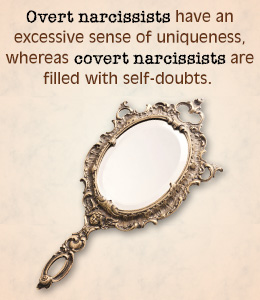
Covert (vulnerable) narcissists are essentially low-functioning narcissists who present a shy, avoidant, humble, or caring image but they also constantly struggle with feelings of inferiority, emptiness, and self hatred. Like overt narcissists, they are hypersensitive to criticism but don’t hide it as well. They can become quite parasitic, relying on the support of others, either financially, emotionally or otherwise–but never giving back, even if they try to make a show of how “giving” they are. From what I’ve read in this article, it seems that the symptoms of covert narcissism, a subtype of NPD, are remarkably similar to those of BPD, with a few glaring differences:

— The covert narcissist suffers from more pathological envy than a person with BPD. The envy stems from a hidden sense of entitlement or superiority to others that belies their false humility and actual low self esteem. BPD is not characterized by a sense of entitlement. In a way they are wearing a double mask or have two false selves: the grandiose false self (that cloaks the emptiness they really feel) which is cloaked by false humility and shame. A covert narcissist may constantly be apologizing, but they don’t really mean it.

— A covert narcissist is more likely than a borderline to seek out friends who they perceive as “beneath” them so they can feel superior in comparison. This also stands out from an overt narcissist, who will seek out anyone who can provide them with supply (and likes to be associated with those they look up to). Covert narcissists avoid people they perceive as superior or having more than they do, which is most people.

— The covert narcissist has Avoidant (or introverted) features not associated with the DSM-recognized symptoms of BPD (although it’s possible for a borderline to be introverted and socially phobic, or for Avoidant PD and BPD to be comorbid with each other, as they are for me). Covert narcissists are more socially awkward than borderlines and can seem very similar on the surface to someone with Aspergers or Social Phobia. But behind the avoidant or socially awkward traits is a fear of being discovered and a hidden feeling of superiority to other people, unlike someone with Aspergers who simply finds relating to people exhausting or uncomfortable or a person with Social Phobia, who finds relating to others terrifying.

— They have no empathy. Any “empathy” they show is false, intended to get supply by bolstering their image as a “nice” person. Borderlines usually have at least a rudimentary ability to experience empathy.

— Like a classic narcissist, a covert narcissist lives in fear of their own emptiness being exposed, while someone with BPD lives in fear of being abandoned.

— Borderlines are more likely to be suicidal or self-harm than a covert narcissist, who may do self destructive things or threaten suicide for attention (supply) but will rarely make a serious attempt.

— Borderlines are more impulsive.

http://www.researchgate.net/publication/275665641_Narcissistic_Personality_Disorder_Diagnostic_and_Clinical_Challenges

This is also a very good article comparing covert NPD with overt (classic, grandiose) NPD: http://narcissisticbehavior.net/revealing-the-two-faces-of-narcissism-overt-and-covert-narcissism/

Some people believe covert narcissists are actually more malignant than classic narcissists, because their agenda is so hidden (covert) and they can seem like such nice, humble people. Although they are harder to detect, I think they really want people to see them as “nice” even though their motives are entirely selfish. I think the reason some narcissists become covert is because early in childhood they learned that acting grandiose or entitled was too dangerous (they were likely to be punished for it) so they cloaked their grandiosity behind false humility and shame. This is why they often feel victimized by everyone but at the same time feel entitled to be treated as if they are special and separate themselves from others, who they see as morally inferior (but actually feel inferior to–yes, it’s very confusing!) At the same time, a covert narcissist is more likely to seek therapy than a classic narcissist because their lives are so unsatisfying and limited–and for the same reason also more likely to be cured if they commit themselves to getting better. In this way they don’t differ too much from people with BPD.

A person with NPD can also switch back and forth between the covert and overt subtypes. When things are going well and supply is abundant, a covert narcissist may become grandiose and aggressive, and a normally grandiose narcissist can become much more covert when their supply is running low or has been removed.