You are just an object to a narcissist.

objectification

I saw this post in the NPD forum at Psychforums. The discussion was about narcissists who seem to care more about animals than people. “StupidPig,” a poster with NPD wrote an interesting post, which I think is a great explanation of what “love” means to a narcissist. In a nutshell: it’s not love. It’s not even really attachment. Everything is an object to them. A narcissist can be as “attached” to an object or an animal as a person, sometimes more so. It all depends whatever is giving the narcissist more pleasure/supply at a given time and whatever requires less maintenance or emotional input from them. The “love object” can change from one day to the next. People and animals are just objects to a narcissist.

I did not edit StupidPig’s post or correct his spelling errors.

http://www.psychforums.com/narcissistic-personality/topic47260-10.html

I am a narcissist with NPD, and I used to like to “own” animals as a kid. However, I never liked to “care” for them.

Someone with NPD cares only for his image, or what the books call the “Glorified Self Image”. Anything else other than his Glorified Self Image is considered an object to him (be it his mother, his children, his spouce, his boss, his car, his own body, or his pet snake or whatever) , and the value of such object will be defined only on basis of how much narcissistic supply it would give him. I.e. how much it enhances his Glorified Self Image.
So, if owning a dog (or a car or a pretty girlfriend) would make me look better, then I would enjoy it, but I would never do any effort to maintain the car, walk the dog, or be nice to the girlfriend, because, as someone with NPD, I have an exagerrated sense of entitlement. this means that I strongly belive that I “deserve” to have the objects that make me look good, and I do not need to do any effort to “keep” those objects.

A pet is no different from a spouce or a car or a friend or a watch or a parent to a Narc. It is just an object that gains value when it makes him look better or feel superior and loses value immidiatly if it doesn’t give him such supply. Based on this, if your car does a 18/20 job in making you look better and feel superior, while your dog does a 10/20 at that job, and your spouce or son does a 5/20, then you would love your care more than your dog and your dog more than your family. But, if on the next day your son wins the world championship in swiming and tells the world on TV that you, his father, is the reason behind this victory, you would shift into loving your son more than your dog and your car, and if three days latter your son makes a fight with you because he wants the car, and the car gets dented in an accident, you will love your dog more than your car and your son, and so on.

In all cases, the narc will never do much to maintain those “objects” and will never really hold any of them dear to his heart because they are all just objects to him.

Only in the light of this should one talk a comparitive view at the different objects in a narc ‘s life and their different merrits and drawbacks. using myself as an example, the advantages and dissadvantages go as follows:

– Pet-objects: They are submissive ( do not need much effort to do as told) and not judgemental (and so do not pose a threat to the Narc’s ego), but they do have several drawbacks, the most important of which is that they need feeding, cleaning, medical care, etc. Narcs hate objects that require lots of maintenance.
Another drawback concerning pet-objects is that they sometimes require “feelings” from you. Not as much as human-objects do of course, but it is still a nagging requirement.

– Human-objects: They can offer much more supply than a pet-object ( e.g. a woman-object who adores you gives more types and quantities of narcissistic supply than a dog) but the drawbacks are that human-objetcs require much more maintenance than other objects and are apt to judge you (and hence are a threat to the ego, or the glorified self image) and they need scary amounts of feelings in order to function properly and, worst of all, they might have “opinions” about your actions and would try to aplly measures that restrict your freedom. They are great objects but they come with a great price..in most cases, this makes them not worth the Narc’s effort(in his twisted opinion of course).

-Inanimate objects (like watches, cars, computers, etc) : They do what they are expected to do, they are never judgemental, and they do not require any emotional input to function properly and they hardly limit your freedom in anyway.

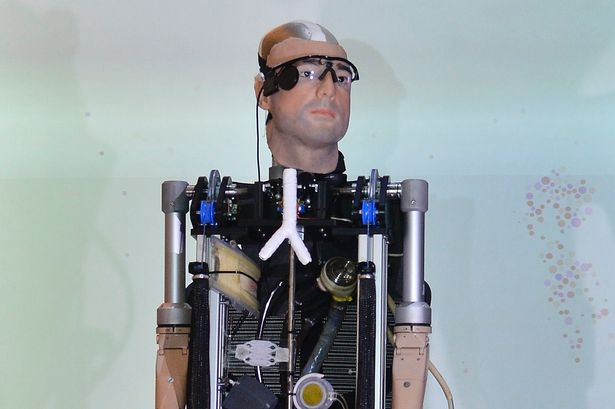
Give me robots at work, at home and in bed and I’ll be a very happy narcissist! ( oh, but please make them cheap, efficient, self maintaining and guranteed for life.)

But, once again, you are never really attached to any of those “things”. You can, as a narc, always kick your dog away for a better looking and more submissive dog, and never regret it. You will never feel any remorse for having sex a billion times outside your marriage, and you will never remember how your old battered car which served you for 10 years looked like after the first week of driving your new BMW around.
A narc may have a preference for one of those posessions over the other for one day (cat over son, girlfriend over dog), but don’t let that fool you, because it is only ephemeral and can very easily change on the next day.

Does your narcissist do this?

no_empathy

There is something I noticed narcissists do, that is one of the most infuriating things about them. They seek to invalidate your experience or side with others who have hurt you, even if there’s no real reason for them to do this.

Here are some examples from real life:

You: “I don’t really like that person.”
Narcissist: “Well, *I* never had a problem with them.”

You: “I really like that person.”
Narcissist: “Well, *I* don’t!”

You: “I wish we got paid every week instead of every two weeks.”
Narcissist: “Well, it doesn’t bother *me*!”

You: “I’m so heartbroken since he left.”
Narcissist: “Well, if you had been more attentive he might have stayed!”

You: “I wish I had more friends.”
Narcissist: “Well, you’re not that easy to be around, you know.”

A great example of this is the way my mother used to act when I told her about a problem I was having at work. No matter what the situation, it was always my fault. One time I made the mistake of telling her I thought there was a lot of favoritism at my job and I was being passed over for promotions (a problem that’s familiar to me due to my avoidant/Aspie personality). Instead of getting sympathy or support, she shot back with, “Well, you must be doing something wrong. You’re not the most pleasant person to deal with, you know.” This sort of thing happened all the time. Everything bad that happened was ALWAYS somehow my fault. That’s how narcissists invalidate your experience and diminish you at the same time.

Another version of the same thing is if you object to one of their insults, they will accuse you of being too sensitive or having no sense of humor.

“I really take offense to what you just said.”
Narcissist: “Well, it was only a JOKE! Lighten up.” (usually what they said was not meant to be a joke, so this is a lie).

Narcissists will never offer support, encouragement, or comfort. They seek to demean you by never taking your side, even when there’s no reason not to. They like to be contrary just to be contrary and “keep you in your place.”

The chilling mental landscape of a high spectrum narcissist or psychopath

bionic_man

I read this chilling post from a man who says he is a narcissist. Based on his description of what it’s like to be him, I would say “narcissist” is probably an understatement. My guess is he’s a very malignant (high spectrum) narcissist and a probable psychopath. Most people with NPD do have emotions, but can’t access them easily or only feel emotions when they pertain to themselves. When someone claims to have no emotions at all, that indicates psychopathy to me. This man could also be “suffering” from Schizoid Personality Disorder, another disorder where the “sufferer” feels nothing–or he may have a combination of psychopathy and SPD. It’s scary and sad to read something like this. It’s as if some people have lost every shred of humanity and seem to have no soul. They are reptilian. At least this writer is self aware though, so I guess that’s something. (Post has been edited for brevity).

Certain passages in this post would make me suspect Aspergers (social awkardness, etc.) but Aspies do have emotions and empathy, even if they don’t always express them well or at all, so I’m suspecting this man has Schizoid PD mixed with psychopathy/malignant narcissism.

Also striking are the dissociative episodes and feelings of unreality this man claims to experience. I have seen these sort of near-psychotic behaviors (talking to himself in public, strange expressions on his face, etc.) in most of the malignant narcissists and psychopaths I have known. These people are so deluded they really aren’t in touch with reality at all. They live in a barren, hellish dreamworld of their own making.

psychopath_emotions

[…]I just discovered that I’ve had pathological NPD for most my life. Reading this […]has been both very frightening and a major relief. […] It’s a relief to know that many of the strange decisions I’ve made were not entirely my fault. [This material] has completely changed how I view my past. It’s like I was in a dark room and then someone finally turned the light on.

For several years, I would occasionally wake up in the early morning with a feeling that something was very wrong. I couldn’t explain the feeling but it was similar to guilt. But I couldn’t pinpoint what I had done to feel so guilty about. This has been clarified […] along with everything else about my strange life. Everyone posting on this site describes the Narcissisist as a monster, which I agree with, but it’s also a horrible disorder to have.

[…]There’s so much I want to say, but it would turn into a novel about as long as the book itself. I’m a male in my 30’s and fit every characteristic of someone with pathological NPD.

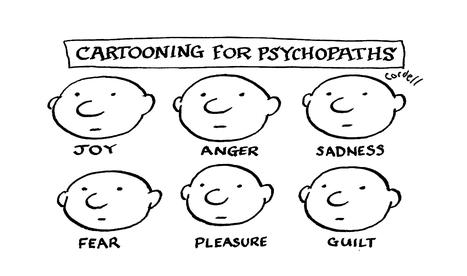
I have no emotions. When my Father left our family to fend for ourselves, I felt nothing. When my Grandmother died, I felt nothing. When I witnessed my roommate seriously injure his neck, I felt nothing at all. These events were only slightly negative, as if someone had dropped and broken a dish.

I have technical degrees from elite universities which makes it easy for me to secure employment, but when I’m at work, I hardly do anything at all because I can’t concentrate for more than a couple minutes at a time. I’m constantly day dreaming and people notice that I have strange expressions on my face when I’m supposed to be working or paying attention to a lecture. I constantly talk to myself, but I’m not sure if that’s a characteristic of NPD.

I have no social skills and am socially inept. As far as personality goes, I wouldn’t even say its a poor one, more accurate would be to say it’s nonexistent. I don’t greet anyone unless they greet me first. If someone asks “How are you?”, my reply is “Fine” and that’s about as far as the conversation goes. I can feel myself creating hatred where I work by ignoring social norms, but I don’t care how much people hate me. I feel like I’m a plague that creates pain and destruction where ever I go, and I like it. I have no friends except the ones from childhood, but I don’t feel I need them anyway. I’m more comfortable just sitting at home and playing on the Internet.

As far as looks go, I’m a 10, which makes me a somatic narcissist. I often get compared to male celebrities and women often audibly gasp when I enter a room for the first time. I’m in my 30’s but everyone assumes I’m in my 20’s. Despite this, I haven’t had a relationship with a woman my entire life (being a devout catholic when I was younger also had an influence on this). Through techniques I’ve learned from the pickup manuals available on the Internet, and by dressing fashionably, I’m able to create a huge amount of initial attraction from women. This has kept me in school much longer than necessary since there’s a huge amount of narcissistic supply in a school environment, especially in classes with many women. Despite this huge initial attraction, I always reject the (very attractive) women when they come after me, which only increases their attraction to me. I justify rejecting them by telling myself “when they see what my personality is like, they would just reject me anyway”, which is probably true considering my social ineptness. However, sometimes I will talk to a girl a few times and she still hasn’t rejected me despite my personality. At this point, I would reject her, and have no idea why I rejected her. I now know it’s due to EPIM (emotional involvement prevention disorder). It’s ironic, I’m the guy every woman in the school wants to be with, but I don’t even have a girlfriend.

I feel completely omnipotent. I will make long eye contact with girls right in front of their boyfriends, even if their boyfriends look like bodybuilders. I can hold my own in a fight with most anyone, but even if a guy is twice my size, I have no fear. I will try to seduce women who I know are engaged just to make them feel pain. I have no empathy so I don’t care about their pain and actually enjoy it. When women look at me in class and try to get me to look back, I will ignore them just to humiliate them in front of the class. Or if an attractive woman is trying to make eye contact with me, I’ll pretend I’m interested in a less attractive girl. Needless to say, I hate women. However, I also badly want to have a girlfriend. I feel this is one of the many conflicting states of the narcissist […].

Not having emotions is a powerful tool in attracting women because women are attracted to guys who don’t want them. Women want what they can’t have. It’s easy for me to play hard to get and I can easily outlast a woman who’s playing hard to get, which most men can’t do. I know I’ll never actually be able to have a relationship with these women, so it doesn’t bother me if a semester ends without having pursued a relationship. So I have many “victims” from my school years, but the biggest victim is myself since I’ve spent years upon years alone.

[…] I see women as predators who are only interested in draining a man of his money while offering as little as she can get away with in return. After the man has been consumed, he is decapitated (divorced) while she runs off with another man. I’m not sure if this view is due to NPD or what I’ve seen my friends (colleagues) go through. There is a book called “The Predatory Female” that probably helped cement this view. I’ve also noticed that in times when I’ve had no money, I didn’t exist to women.

I now realize I quit my previous well-paying job due to a lack of narcissistic supply. A somatic narcissist needs attention from women, and they were pretty much non-existent where I worked. The most abundant place for narcissistic supply is a university, and after receiving a degree, the cerebral narcissist can receive more NS because of it.

When I saw the movie Batman “The Dark Knight”, I was intrigued by the character of the Joker. He had no fear, didn’t care about anything (even money), and caused havoc ever where he went. His actions made no sense and he was unpredictable, but he wasn’t stupid. He was omnipotent because he didn’t care if he was caught, or if he was killed, and was capable of doing anything. He had no empathy caused havoc for the fun of it.

My mentality is very simple and childlike and I don’t like speaking with other adults. If someone spoke with me for 10 minutes, they would think I’m a normal person, but it’s just a matter of time before I say something factual but very insensitive, which causes the person to hate me. The only emotions I feel are jealousy and rage. When I see a guy with an attractive women, I want to attack him and have daydreams of attacking him while the woman watches in horror.

[…] the chance for healing from NPD is bleak. Even if I were to get into a relationship with a woman, I would probably just cause her a lot of pain before dumping her when she’s no longer a source of NS.

What’s up with this crazy idea that narcissism and Aspergers are the same thing?

aspie_narcissist

As a person with Aspergers who has been a victim of narcissists all my life, the difference seems pretty clear to me, but to some people, including mental health professionals, high-functioning autism (Aspergers) and narcissism are seen as the same disorder!

A thread on Wrong Planet, a forum for people with autism and Aspergers (a high functioning form of autism) discusses the confusion, with people on both sides of the Aspergers=Narcissism fence. Cited there is an article from Psychology Today, which quotes Sam Vaknin who believes narcissism is an autism spectrum disorder! The British psychiatrist Dr. Khalid A. Mansour concurs.

Clearly, some people don’t understand much about high functioning autism/Aspergers. Yes, I believe it’s possible for a person to be both a narcissist AND on the autism spectrum (an example might be Mark Zuckerberg, creator of Facebook, especially as he was portrayed in the movie “The Social Network“), but they are two vastly different disorders.

Appearances are only skin deep.

aspergers_narcissism

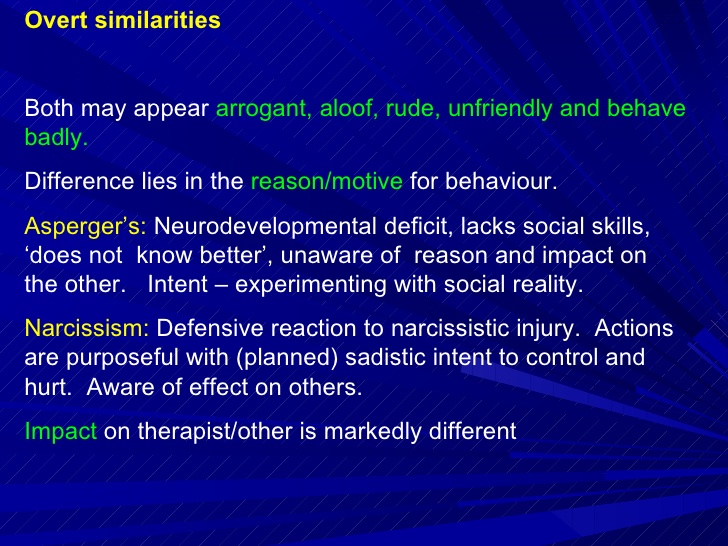
I understand where the confusion comes from. On the surface, the two disorders can appear similar. People on the autism spectrum may seem as if they lack empathy because they do not express their emotions well, which of course includes showing empathy. They also sometimes blurt out inappropriate or hurtful things, not because they mean to, but because they honestly don’t know any better: they have great difficulty reading social cues. They can appear selfish and sometimes get angry or upset when their routines are interrupted or they are forced to pull themselves away from their solitary pursuits to engage with others. They can also violate the boundaries of others. All of these surface behaviors may look a lot like narcissism.

But appearances are only skin deep, and this is where any similarity ends. Lack of empathy seems to be the most commonly mentioned “characteristic” of both Aspies and narcissists. But in actuality, as far as empathy is concerned, a person with autism/Aspergers is the polar opposite of a narcissist. A narcissist cannot feel empathy, but can act as if they do. They are good actors and can fake emotion they do not feel. They can lie well; Aspies cannot lie or lie very badly. People with Aspergers and high functioning autism are great at picking up the emotions of others around them and are even sometimes overwhelmed by other people’s emotions (which sometimes makes them withdraw and that can make them seem like they lack empathy). They can be bad at expressing empathy because of their inability to read social cues or know what to say and do. Therefore, Aspies can feel empathy but often act as if they do not.

autism

Narcissists can say hurtful or damaging things because (a) they don’t care how you feel; or (b) because they want to hurt you. People with autism/Aspergers say hurtful things too sometimes, but it’s never intentional and they do care how you feel. If they are told they said something hurtful, most autists/Aspies are consumed with guilt and will sincerely apologize. They blurt things out because they sometimes do not know it’s not appropriate to do so.

Aspies and autists hate to have their comforting routines interrupted because repetition is something that grounds and relaxes them. A low functioning person with autism will sometimes perform repetitive movements or repeat a phrase over and over. This is how they cope with too much stimuli coming in. If they are interrupted, a low-functioning autist may fly into a rage or have a temper tantrum. Disengaging and switching gears is impossible for them.

At the higher end of the spectrum, an Aspie or high functioning autist may not repeat the same word or action over and over, but they have their hobbies and obsessions which they pursue with a single-minded intensity. They tend to hyper-focus on whatever interests them. If they are interrupted from whatever their mind is focused on, they may snap at you or become very annoyed. They can switch gears if they must but they hate doing it.

A narcissist may also snap or become annoyed, but not because they have difficulty switching gears but because they are just plain selfish and don’t want to do something that might please someone else besides themselves. Think of the narcissistic husband playing a video game. His wife comes into the room and asks for some help opening a stuck window. The husband flies into a rage and tells her he’s busy and to do it herself. It’s not because he’s that engrossed in the game or even cares about it that much, it’s because he doesn’t want to put himself out for his wife. For an Aspie or autist, the game engages all of their senses and their mind is extremely focused. They simply can’t pull away from it.

aspie_misdiagnosis

A person with autism or Aspergers can and do violate the boundaries of others. Again, this is because they can’t read social cues well enough to know when they are violating someone else’s boundaries. A narcissist knows full well when they are violating boundaries, but they simply do not care.

A forum member on Wrong Planet sums up the confusion this way:

To me it’s as absurd as comparing the small narcissistic child recklessly driving a car, to a person trying to cross the street in a wheelchair, and saying they have a lot in common because they both have a set of wheels.

I think mental health professionals and others who believe narcissism and Aspergers are on the same spectrum need to dig a lot deeper before they make such sweeping generalizations. They are not the same disorder at all and are certainly not on the same spectrum. Aspergers/high functioning autism is a neurodevelopmental deficit and really a type of learning disability; narcissism is a moral deficit.

For further reading, please see my article, People with Autism Do Not Lack Empathy!
Also see The Spectrums of Autism and Narcissism.

“The Psychopath Next Door”

Here is a very interesting but disturbing documentary featuring Dr. Robert Hare, the forensic psychologist who developed The Psychopathy Checklist (which is used routinely in courts of law and police departments to identify psychopaths.) Here, the focus is on the non-prison population of psychopaths, which includes a high percentage of financially successful people in business.

Psychopaths tend to rise to corporate stardom quickly because the qualities they have (ability to focus on a goal, risk-taking, cunning, ruthlessness, etc.) are valued in business, while the ones they don’t have (empathy, guilt, caring, love, etc.) are not. High-functioning psychopathy was behind the 2008 financial crisis, and it’s said here that many banks were actually using Hare’s Psychopathy Checklist to hire new employees!

The video also discusses psychopaths in relationships, how psychopathic brains differ from normal ones, and the causes of psychopathy.

I’ve often noticed how dead-looking the eyes of some of our CEOs and politicians are. It’s like they have no soul. It’s very scary that these are the people who have the most power right now. They are like reptiles. Snakes in suits.

How could someone even survive this?

dark_pozadia
Credit: http://dark.pozadia.org

I just read a comment on a forum about narcissism that made me want to throw up.

A woman who had been scapegoated all her life by her malignant narcissist mother and had gone No Contact said her adult son had been found dead (she didn’t say what the cause of death was). She says her mother never had the slightest interest in her grandson because any child this woman bore couldn’t possibly amount to anything. She never sent him a birthday or Christmas gift, or even so much as a card. She had never even come to see him when he was born.

The woman received no condolences from her mother after her son died. Instead, three days after his death, on the day of his inquest, she found out from relatives that her mother had gone out to celebrate with other family members and friends. Although the reason for the outing wasn’t her grandson’s death per se, she was told by a relative that her mother said “that stupid bitch got what she deserved.”

Wow. Just wow. Talk about lack of empathy. How could anyone be that callous? Losing a child is bad enough (I don’t think I could survive if that happened to me and I marvel at anyone who doesn’t lose their mind after losing a child) but to have YOUR OWN MOTHER–No Contact or not–say something like that is just so evil it’s beyond my comprehension. A mother who would say something like that upon her own child’s bereavement doesn’t deserve to live. Incredible.

I think if that happened to me I wouldn’t want to live anymore. Driving her own daughter to suicide was probably this so-called mother’s intention.

Clearing up some misunderstandings about BPD.

borderline

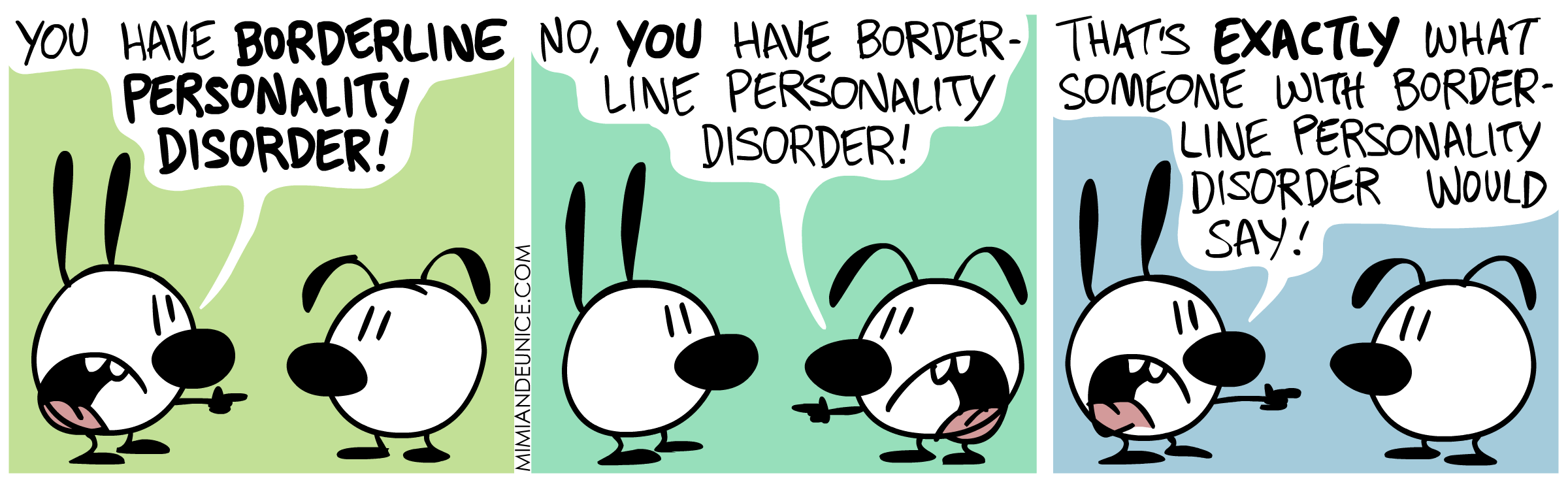
There seems to be a lot of misunderstanding about borderline personality disorder. I’ve noticed many people seem to confuse it with narcissistic personality disorder (NPD). While there ARE some overlapping symptoms (and it’s even been speculated by a number of mental health professionals that BPD is actually a less severe form of NPD), they are quite different from each other. I’d like to clear up a few of these misunderstandings and discuss both the similarities and the differences.

New DSM Criteria for BPD.

According the the DSM-V (2013), these are the diagnostic criteria for BPD (the new list of criteria is quite long and ponderous so I will not attempt to talk about each of these points here):

A. Significant impairments in personality functioning manifest by:

1. Impairments in self functioning (a or b):

a. Identity: Markedly impoverished, poorly developed, or unstable self-image, often associated with excessive self-criticism; chronic feelings of emptiness; dissociative states under stress.

b. Self-direction: Instability in goals, aspirations, values, or career plans.

AND

2. Impairments in interpersonal functioning (a or b):

a. Empathy: Compromised ability to recognize the feelings and needs of others associated with interpersonal hypersensitivity (i.e., prone to feel slighted or insulted); perceptions of others selectively biased toward negative attributes or vulnerabilities.

b. Intimacy: Intense, unstable, and conflicted close relationships, marked by mistrust, neediness, and anxious preoccupation with real or imagined abandonment; close relationships often viewed in extremes of idealization and devaluation and alternating between over involvement and withdrawal.

B. Pathological personality traits in the following domains:

1. Negative Affectivity, characterized by:

a. Emotional lability: Unstable emotional experiences and frequent mood changes; emotions that are easily aroused, intense, and/or out of proportion to events and circumstances.

b. Anxiousness: Intense feelings of nervousness, tenseness, or panic, often in reaction to interpersonal stresses; worry about the negative effects of past unpleasant experiences and future negative possibilities; feeling fearful, apprehensive, or threatened by uncertainty; fears of falling apart or losing control.

c. Separation insecurity: Fears of rejection by – and/or separation from – significant others, associated with fears of excessive dependency and complete loss of autonomy.

d. Depressivity: Frequent feelings of being down, miserable, and/or hopeless; difficulty recovering from such moods; pessimism about the future; pervasive shame; feeling of inferior self-worth; thoughts of suicide and suicidal behavior.

2. Disinhibition, characterized by:

a. Impulsivity: Acting on the spur of the moment in response to immediate stimuli; acting on a momentary basis without a plan or consideration of outcomes; difficulty establishing or following plans; a sense of urgency and self-harming behavior under emotional distress.

b. Risk taking: Engagement in dangerous, risky, and potentially self-damaging activities, unnecessarily and without regard to consequences; lack of concern for one’s limitations and denial of the reality of personal danger.

3. Antagonism, characterized by:

a. Hostility: Persistent or frequent angry feelings; anger or irritability in response to minor slights and insults.

C. The impairments in personality functioning and the individual’s personality trait expression are relatively stable across time and consistent across situations.

D. The impairments in personality functioning and the individual’s personality trait expression are not better understood as normative for the individual’s developmental stage or socio-cultural environment.

E. The impairments in personality functioning and the individual’s personality trait expression are not solely due to the direct physiological effects of a substance (e.g., a drug of abuse, medication) or a general medical condition (e.g., severe head trauma).

Is it really true that Borderlines can’t feel empathy?

welcome_to_me_photo
BPD patient “Alice” (Kristen Wiig) in “Welcome to Me.”

The very first thing that stood out to me (and was not included in the older DSM criteria) is “lack of empathy.” Yes, it is a fact that many borderlines have difficulty feeling empathy under normal circumstances, but the reasons for this are vastly different than the lack of empathy seen in people with NPD.

Most people with BPD have the capacity to feel empathy, and can feel very guilty when they become aware (or it’s pointed out to them) that they have treated others badly, but because Borderlines have great difficulty regulating their emotional reactions and have an unfortunate tendency to lose themselves in their own drama when they perceive they are being attacked, at those times they can “forget” that others exist, and this can lead to them acting selfishly and disregarding the feelings of others. This can appear very narcissistic. It’s not that they CAN’T feel empathy though, because they certainly can. They can also feel remorseful. But it may take a disaster (such as losing a good friend or a broken relationship) for them to realize the damage their impulsive and selfish behavior has caused. If their bad behavior is pointed out to them by someone else–such as when the character Alice in the movie “Welcome to Me” loses her best friend Gina, who tells her how much she was hurt by Alice’s insults against her–they will feel remorse and try to make amends in whatever way they can.

Borderlines just want to be accepted.
wizard-of-oz2

Unlike narcissists, borderlines hate to be hated. Narcissists like any form of attention–negative or positive (and some even prefer to be hated!) while borderlines only want to be loved and thought of in a positive manner. Most of them WANT to be good people and WANT to be liked, but don’t always act in ways that make them seem very nice, due to their impulsivity and tendency to act out whatever emotions they are feeling at the moment.

Impulsivity is a primary issue with a borderline–a trait not shared by narcissists (but IS shared with people with ASPD)–because they fail to think ahead and consider consequences of their bad behavior.

Borderlines can act narcissistic because of their deep seated need to feel accepted. Most hate themselves (as do narcissists) and some can act grandiose and full of themselves in their attempts to be liked and admired. Deep inside, they feel worthless. It’s not hard to take down their braggadocio, however. Cut a borderline down to size and they may react with rage or tears (as will a narcissist) but are also more likely than a narcissist to admit you are right and they are really just worthless losers. They might even apologize profusely for acting so out of line.

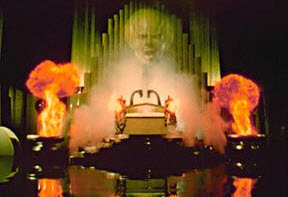
I can’t help but think of the Wizard in The Wizard of Oz. An insecure little man who stood behind a curtain projecting the face of a raging tyrant onto a huge screen. When Toto pulled back the curtain to reveal who the “Wizard” really was, and Dorothy upbraided him for being a “very bad man,” the Wizard immediately became humble and apologized profusely to the group, telling them that yes, he was just a humbug. Some people have said the Wizard was a narcissist, but I think his behavior was more typical of a borderline. A narcissist would have continued to insist on his superiority, even with his true nature having been revealed–and his true nature would not have been so benign. The Wizard’s intentions for Dorothy and her friends were also good.

While a narcissist may rage and perhaps even use tears (to manipulate others into feeling sorry for them), they will almost never admit their wrongdoing or admit they are anything other than God’s gift to the world. Doing so is far too dangerous to them.

Why Borderlines act selfishly.

BPD_cartoon

A borderline who is not under stress or in the midst of an emotional drama, or has learned to control their impulses through behavioral training like DBT–dialectical behavior training which was developed by Marsha Linehan (it does work–I can attest to its efficacy), can certainly feel empathy for others, and can be genuinely good and kind people. Genuine kindness and concern for others is rare in a narcissist and almost unheard of in a malignant narcissist. Borderlines generally have this capacity, but unfortunately, if they haven’t learned to control or regulate their emotions, their ability to feel for others or show a conscience is eclipsed by their own drama, which at the moment becomes all-important. They really just don’t know what they are doing, but if you call them out or make them suffer consequences, in most cases they will try to make it up to you.

Borderlines don’t live a lie.

cluster_b

Borderlines do not wear masks, as narcissists do. They cannot pretend to be someone they are not (or if try to, they usually fail miserably, like the wizard in The Wizard of Oz). They are not trying to fool you, even though to avoid rejection, they can be manipulative and use some of the same games (gaslighting, blame-shifting, rages, etc) that narcissists do. Borderlines, if anything, show TOO MUCH of themselves–and that includes the bad along with the good. With a borderline, it’s all WYSIWYG. They can’t wear a mask, because they lack the ability to plan things out ahead of time the way someone with NPD does. Wearing masks requires cunning and the ability to lie. While borderlines can and do lie (usually to exaggerate the pain they are facing or to idealize/devalue someone else), they can’t lie about who they are or what they’re feeling. In that sense, they’re even more honest than the average non-disordered person.

Idealization/devaluation in borderlines and narcissists.
hashtag_borderline

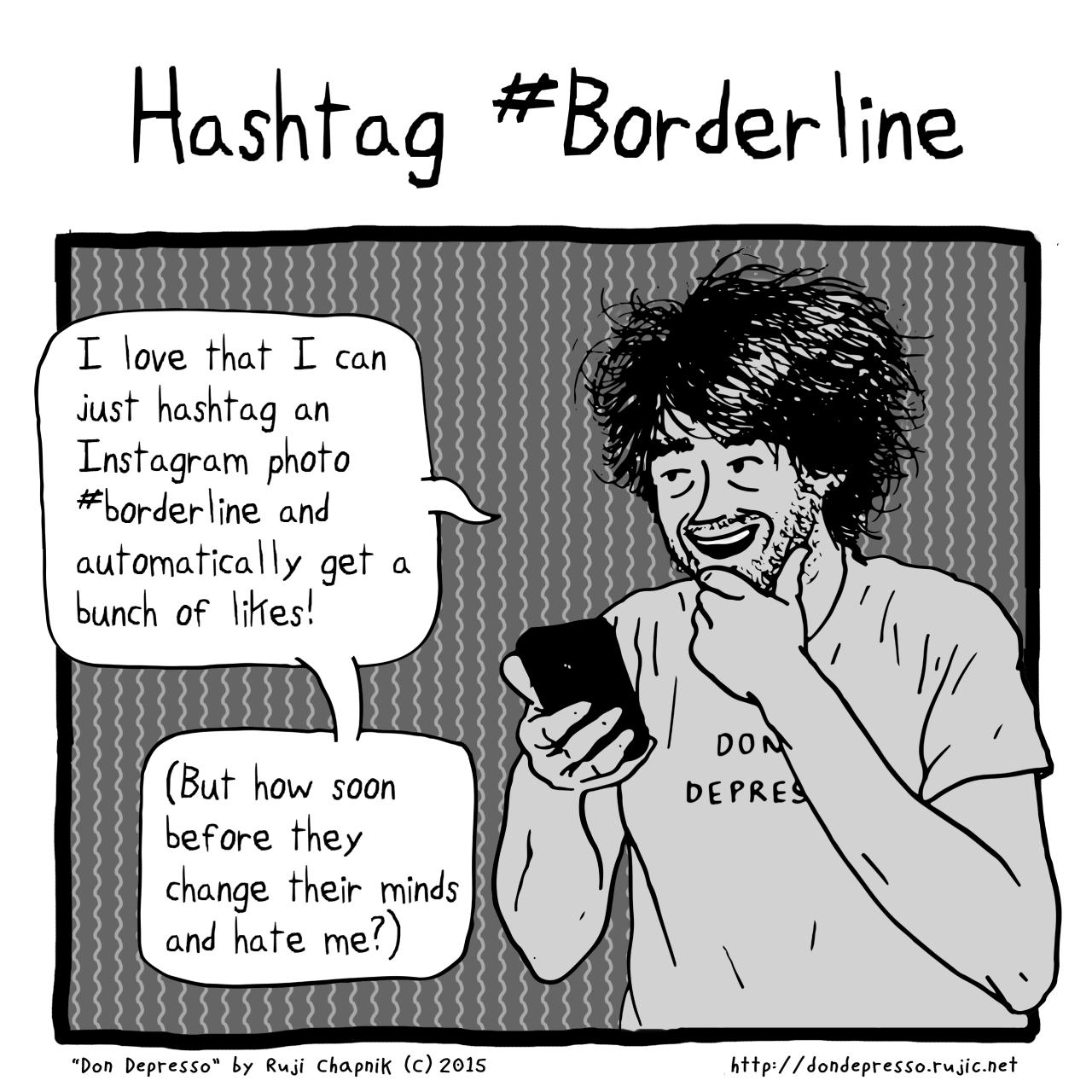
Both narcissists and borderlines do tend to idealize and devalue other people, and both are guilty of black-or-white thinking. But the motives for this behavior are different. A narcissist idealizes someone they see as a good source of narcissistic supply. They do not see the source of supply as a person, but will put them on a pedestal as long as they’re providing enough supply. Should the victim stop providing supply (or the narcissist just becomes bored and needs a new source of supply), the narcissist devalues and discards the victim, without mercy or regret.

Most borderlines idealize and devalue others based on their need for acceptance and love, not the need for supply. If they perceive another person as good and kind, and accepting of them, they will tend to idealize the person and sometimes become clingy and needy (a narcissist can be clingy and needy too, but for different reasons). If the borderline feels the other person losing interest or pulling away from them, they may suddenly, without warning, devalue the other person and reject them. They do this not to be mean, but to avoid being rejected themselves. This explains the “I hate you…don’t leave me” or “come closer…go away” behaviors many borderlines show. It’s confusing and contradictory to others, but it helps them to avoid the inevitable rejection they believe is coming to them. Borderlines live in constant fear of being rejected; narcissists live in constant fear being ignored–losing their “drug” of narcissistic supply. While their behaviors may seem similar on the surface, the motives behind them are quite different.

A borderline is not usually deliberately malicious or sadistic. It’s not their intention to hurt others or cause them misery, even though they unintentionally do it all the time because they have so much trouble controlling their impulses. They usually are not even aware how much their unpredictable and contradictory behavior is confusing or hurting others. If a borderline is made aware of what they are doing, they are far more likely to seek therapy than a narcissist, because someone with BPD wants more than anything to be loved and accepted. A narcissist just doesn’t care what you think of them, as long as you are paying attention to them. Of course, there are some low-mid spectrum narcissists who have enough self awareness and hate the fact they can’t feel the more sublime emotions (love, empathy, joy) of a normal person, and those few may actually seek help too.

BPD is maladaptive to the victim.
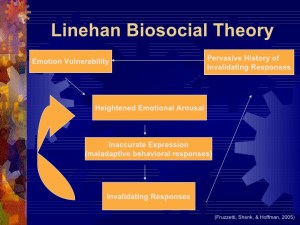
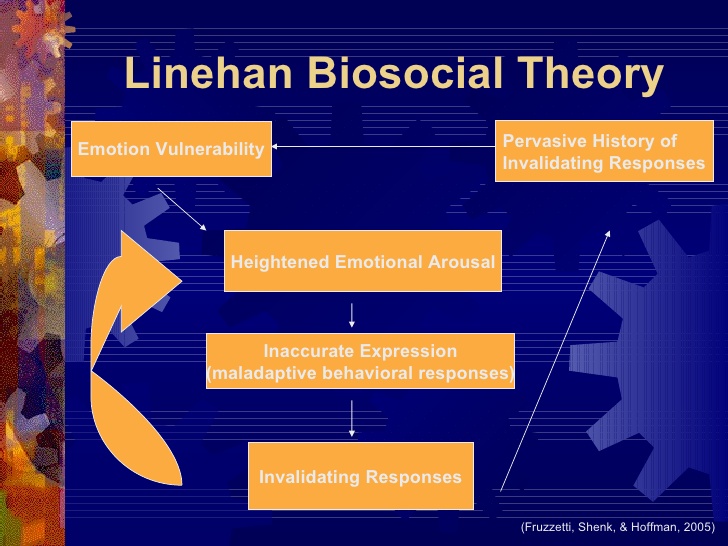
linehan_biosocial
Marsha Linehan’s diagram that shows why BPD doesn’t work well for the sufferer. (click to enlarge)

Borderline personality disorder is ego-dystonic: that is, it isn’t adaptive to the sufferer and their behaviors cause them as much or more misery than it causes others. People with any ego-dystonic disorder or mental illness–depression, anxiety, phobias, certain personality disorders such as Avoidant, Borderline or Dependent–are more likely to seek treatment because they aren’t happy with the way they behave and feel. They don’t necessarily blame others for their own misery, the way a narcissist will do.

Borderlines are also far more likely than narcissists to engage in suicidal ideation or even attempt suicide when they become depressed. They are self-destructive and more dangerous to themslves than others. A narcissist is not as likely to consider or attempt suicide, but if they do, they are more likely to attempt to “take you with them.”

Narcissistic personality disorder is ego-syntonic: that is, it usually is adaptive to the sufferer and in most cases their bad behaviors don’t bother them at all (they don’t care how you feel), they only bother others. This is why narcissists are so unlikely to seek treatment, unless they have lost their sources of supply and are undergoing severe depression (narcissistic crisis). Narcissists are miserable people, but they are far more likely than borderlines to blame others for their own misery.

Both disorders are included under the Cluster B category of personality disorders because both involve a malfunction of emotional regulation. In a narcissist, emotion is strong but is hidden and masked; in a borderline, emotion is strong but cannot be hidden or regulated at all. Both disorders cause others misery, but a narcissist lives a lie; a borderline generally does not.

BPD as a defense mechanism that arises in early childhood.

scared_child

Both NPD and BPD (and all Cluster B disorders) arise out of childhood from early attachment disorders with caregivers. Both are desperate attempts not to be hurt anymore and have their origins in abuse or neglect as young children. Most narcissists and borderlines were abuse victims as children. Both narcissists and borderlines are incredibly sensitive–so much so, they have constructed almost intractible defense mechanisms to avoid further pain and hurt. Unfortunately for the borderline, their defense mechanism of overreaction to everything is maladaptive and hurts them more than they can hurt anyone else. But due to this, they are far more likely to seek treatment.

Upcoming Post:
Later on, I plan to post an article about Marsha Linehan’s DBT and other therapies for people suffering from Borderline Personality Disorder. (They are similar to the methods used for people with NPD).

Wolves in sheep’s clothing.

wolvesinsheeps

I wrote an article about this issue a while back, but I decided it was time to write about it again because I have seen this sort of thing happen so many times online, including within the ACON community. It’s a real problem for those of us recovering from narcissistic abuse. We are fragile and it’s so hard for us to trust anyone anymore, but we want so much to trust people who have been through similar experiences and connect with them.

The sad news is that you just can’t trust everybody you meet online.

If you’re a member of the narcissistic abuse community and participate in social media groups, blogs or forums intended to help or inform victims of narcissistic abuse, remember you are engaging with a lot of hurting and damaged people. There are people in this community who may themselves have been so damaged by their abusers they developed narcissistic ways of relating to others.

Narcissism is contagious, just like a disease. If a person was raised by narcissists or were in a close relationship with one for any length of time, they can pick up what’s known in the ACON community as “fleas”–narcissistic behaviors that stick to them the way fleas stick to a dog. If the fleas stay around long enough or become severe enough, it’s possible to actually become a narcissist!

Most narcissists aren’t aware they are narcissists. In the narcissistic abuse/ACON communities, there are narcissists who you would think are anything but. Don’t be duped into thinking just because someone’s a victim of abuse and hates their narcs (and narcs in general) with the white hot heat of a thousand suns, that automatically means they aren’t one. They probably don’t even know they are.

Some people who seem holier than thou may have developed full blown narcissism. They appear to be sheep, even though they are actually wolves. Unfortunately it’s hard to tell until you cross them or disagree with them.

Narcissists project onto others traits they hate in themselves. Just because a person was abused and professes to hate narcissists does not mean they are free of their own narcissism, which they deny in themselves but project onto those they disagree with.

In particular, be very careful around anyone who uses religion to intimidate or abuse you or attacks your beliefs. There are many religious people in the ACON community who have turned to Christ after their abuse, and of course there’s nothing wrong with that. But if someone is intolerant of your religious beliefs (or lack thereof) or calls yours a “false religion,” that’s a huge red flag, in my opinion.

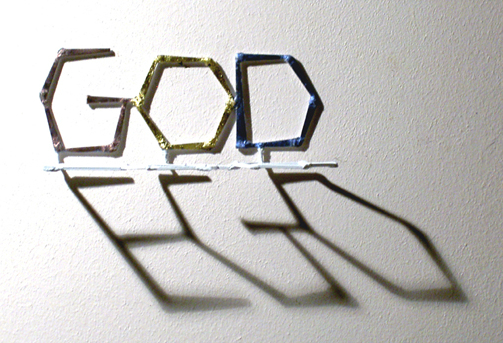
god_ego

There are unfortunately people even in this community who either pretend to be victims to exploit people they see as “weak” (I think there aren’t too many of those though, and the ones that are are usually on social media such as Facebook) or actually are victims, but have become narcissistic due to the abuse they endured. (because I am not qualified to diagnose anyone, I cannot say they actually have NPD).

But there are red flags you can be on the lookout for:

— They act “holier than thou” and use religion as an excuse to treat others badly or judge those they disagree with.
— They never seem to get any better.
— They think there is something wrong with you because you are growing and no longer wish to hang onto your rage.
— If they see someone is changing or letting go of anger, they accuse them of betrayal or worse (if they’re religious) say they are being influenced by Satan. Pathological envy? I don’t know. Maybe.
— They use personal information they were given privately against the person they are targeting. They may even state this private information in public against your wishes. Be careful what you tell people unless you know them very well.
— They attack and smear those they disagree with.
— They overreact to slights or criticism.
— They overreact to opinions they don’t agree with. You are not allowed to have a differing opinion.
— They are self righteous and never apologize.
— They talk a lot about empathy but don’t seem to really have any.
— They show no remorse for their hurtful actions.
— They ban or attack people who defend those they disagree with.
— They misquote you, twist your words, and accuse you of saying things you never said. That is gaslighting.
— They are quick to call people they disagree with narcissists or at least make obvious hints to that effect.
— They will introduce a hurtful criticism or a projection of their own narcissism onto you with a phrase such as, “I don’t mean to hurt you, but…” Bullshit they don’t mean to hurt you.
— If you object to this online abuse, they might tell you in a condescending or smarmy way that they are “only trying to help” or are “praying for you.”

level-headed

A non-narcissistic person will not do these things. Yes, they may disagree with you. Disagreement is normal and is to be expected. I certainly don’t expect everyone to agree with everything I write. I’m well aware some of my opinions are controversial and even unpopular. That knowledge won’t stop me from posting them though. But I welcome dissenting opinions, because that can make a discussion more interesting than if everyone agrees with me all the time. There is nothing wrong with a good, healthy debate. I could even learn something from you, and I’ve admitted when I’ve been wrong. Hey, I’m not perfect and never will be.

If there are disagreements, as there will be, a non-narcissist will just say they disagree with you, state their case, and possibly give their reasons why they disagree with you. If they feel especially strongly about an issue, they could stop following you or decide your blog is not one they wish to read or participate in anymore. All of that is fine. It happens. You shouldn’t take it personally if someone is so offended by something you wrote they stop following you or stop commenting. But it should stop there. A normal person will simply move on and not bother with you anymore. A non-narcissist is not going to start a smear campaign against you, talk down to you as if you’re beneath them, call your religion a “false religion,” tell you you’re influenced by the devil, call YOU a narcissist, twist what you said into something you did not say, misrepresent you, or publicly bring up a personal issue you talked to them about in private just to embarrass you.

All of us can behave narcissistically when triggered. I understand that. I do it myself. If you tell someone who has attacked you in a narcissistic way because they were angry, hurt or triggered that their actions upset you, a non-narcissist will be chastened and will apologize or try to make amends in some way. If the person fails to do that, even after they are told how much their actions have hurt you, suspect a narcissist. They don’t have empathy for how you feel. You are not a person to them. They don’t care. You are wrong, they are right, and that’s that.

judgement

The insidious thing about narcissism is it’s those you would least suspect of being narcissists who in fact may be. Sometimes the Internet can feel like a minefield, and you have to be so careful where you step to avoid detonation.

Something happened to me several months ago that was a real wake up call and made me realize how careful we have to be when engaging with people online. There as a woman on Facebook who talked about her relationship with her husband, a man she said was a malignant narcissist. She said she had found a way to make her relationship with him work. Intrigued but skeptical, I sent her a private message asking what she had found out. I also sent her a friend request.

She did not accept my friend request (saying she did not know me well enough) but sent me back a strange private message that said, “I have been wanting to talk to you.” Instead of being alarmed, I was intrigued.

We talked about her “malignant narcissist” husband and the way she “handled” him. The woman’s Facebook posts were always so heartwarming, effusively proclaiming the deep love she had for her husband. She constantly posted pictures of herself with him, along with comments about how much she loved him. I looked at the photos of this guy on her timeline, looking for anything in his face or eyes that would indicate malignant narcissism (they usually have a hard or cold look, or dead, flat eyes). I didn’t see it. If anything, I thought the guy looked weak and even a little scared. In fact, his face and body language screamed codependent. The woman always wore a huge smile, but something in those photos suggested a predator “possessing” their prey. Yes, she was larger than he, but there seemed to be a look on her face that said, “he’s mine. I can do what I want with him.”

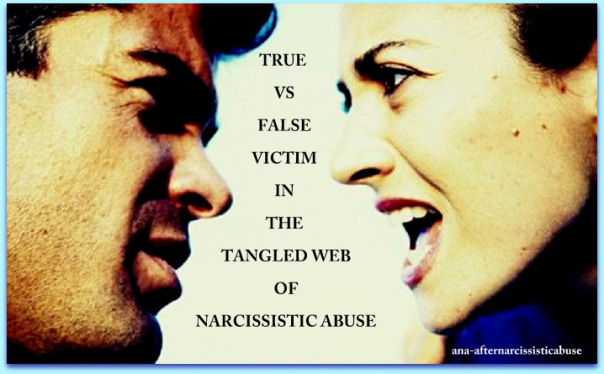
victim_abuser

I should have smelled a rat. Instead, I thought, “what a wonderful woman, who loves her husband that much in spite of his disorder.” We had several more conversations. Eventually I told her too much about myself. I told her about my psychopathic ex-husband, and how much I envied her for being able to “make things work” with her husband, but that what she did would have never worked for me because my ex was a psychopath and didn’t have enough self awareness to be able to “work with me” on controlling his narcissistic and abusive behaviors.

Shortly after divulging my own situation, I received a puzzling and upsetting private message from her. I won’t quote it here, because it was too long and I no longer have it anyway. It was a very nasty message. In a condescending, insulting way, she had the gall to let me know that my ex couldn’t have been a psychopath (really? did she know him personally?) She said, “I don’t mean to hurt you or anything, but frankly, there is something about you that is a little “off.” That hurt a lot, but was also a huge red flag. She continued, saying that she suspected I was actually the narcissist in our relationship. Oh, really? Was she a fly on the wall during our marriage? Did she have some God-like omnicience to be able to “know” all this about a person she barely knew? Then she ended her long diatribe saying that “prayer is not going to help you” and “I am trying to help you see the truth about yourself.” It was one of the nastiest messages I’ve ever received, and it was sent under the guise of “being helpful.” I could have received more “help” from a serpent.

monsters-nietzsche

The next day I got two private messages from two of my Facebook friends informing me this woman had PM’d them and told them that I was crazy and to stay away from me. The bitch was gaslighting me and triangulating against me, attempting to turn my friends into flying monkeys! I promptly blocked this woman and later found out she had done this to several other women who she envied for one reason or another. It dawned on me that she had been projecting her own malignant narcissism onto her husband, who I am sure was the real victim in their relationship. It explained the possessive, predatory way she had posed with him in their photos. It explained everything.

I want way too much to trust people in this community because so many people have experienced the same type of abuse that I have, some less so and some more. It’s natural to feel like you’ve found a haven of like-minded people who are your friends by default because of their similar stories. You simply don’t want to believe there may be wolves in sheep’s clothing lurking within the community who may have suffered devastating abuse but have actually turned to narcissism as a way to cope with what happened to them. When you realize this, it can come as a shock and you feel so horribly betrayed. You begin to wonder if anyone can be trusted.

Yes, there are people you can trust but online, as in any other community, you have to be careful. Don’t assume someone isn’t a narcissist just because they are anti-narcissist, have a blog for survivors of abuse, or have a sad abuse story of their own. That doesn’t really mean anything. Use the person’s actions and behavior–and your own intuition–as your guide. If someone makes you feel like you always have to be careful what you say around them, if they intimidate you or make you feel like you’re walking on eggshells, proceed with extreme caution. Even if they’ve shown no narcissistic behaviors (yet), be watchful and vigilant. Don’t ever give personal information to anyone you don’t know extremely well.

The Internet is a wonderful resource for abuse survivors, but remember there are wolves in sheep’s clothing online too. Please be careful.

Letter from a narcissist’s “true self”

narcissus1_caravaggio

Here is a hypothetical letter written from the point of view of a narcissist’s True (lost) Self.

The advice given here by the True Self is almost the polar opposite of whatever their False Self would tell you. That’s because their False Self is a lie and isn’t who they really are, even though they may have been wearing this mask for so long they can never access their True Self without enormous difficulty or even at all.

Always follow the advice of their True Self, no matter how much they protest and rage, unless you want further abuse. It’s actually the best thing for them if they ever decide to look in the mirror past the lies they show the world (and may have come to believe is the truth)–and of course it’s best for you.

Letter from a Narcissist’s True Self:

Dear Victim,

I have lied to you about nearly everything. I am not sorry for this behavior because I cannot empathize with you. I chose narcissism so early in my life that I never had the chance to develop a conscience or the capacity to feel remorse or empathy for the way I hurt you. Still. I know it’s wrong on an intellectual level. I just cannot feel your pain. Sometimes I wish I could, but I can’t.

I became a narcissist because as a child I felt too vulnerable. I was sensitive. I felt too much and most of it was painful. I was made to feel like I was nothing, a nobody. I was hurt, betrayed, abused, just like you. I couldn’t understand why I wasn’t loved, or why I was treated with contempt and like I didn’t matter. I was also was never given a good example of how to become a good person. I never had anyone to model in a positive way.

Life was so painful for me I had to do something about it. Something drastic. I had to become strong and never show weakness again, because my weakness was killing me. I was trained that being a sensitive person who feels compassion and remorse, a person who can love others, is a weak person. I know that isn’t really the case, but it was how I was trained. I was so young that I couldn’t see how wrong that might have been.

I reached a point where I had to make a choice. In order to survive, I had to sacrifice my humanity. I didn’t want to do it, but I felt like I had to. I didn’t want to be hurt anymore. I had to sell my soul.

In order to sell my soul, I had to shut you and everyone else out. I couldn’t allow myself to feel too much. I couldn’t allow myself to be sensitive anymore, and that meant I could no longer allow myself to love anyone, feel anyone else’s pain or joy, or feel sorry if I did something wrong.

I had to don this mask that I wear, which is a lie. In order to keep that lie intact, I had to treat others badly. I had to diminish you to prop my false self up. I had to hate you in order to “love” the mask that I show the world, because if I didn’t continually prop myself up by making you feel bad, my mask of lies might fall off and expose the real me, a powerless and vulnerable child which I had to protect at all costs, even if it meant destroying everyone else around me. I am a bully but inside I know I am nothing. I act like I love myself but I really hate myself. I only love the mask I wear. I abuse you to protect that mask.

michelle_mallon_quote
Read Michelle Mallon’s story here.

You can never get through to my true self because the lies I tell are nearly impenetrable. I have lied so often and for so long that I myself have come to believe my own lies. I am a walking lie. That is the truth.

I will never let you get close to what I really feel. I don’t even know what I feel anymore. Most of the time I feel nothing, because a lie has no feelings. But try to destroy my protective armor, and I will try to destroy you. If I must go down in flames, I am going to take you with me. I will rage and abuse you. I will gaslight you and tell you the most horrific lies about yourself.

I may seem nice at first or when I feel like the supply you give me is threatened or you may leave. I know how to get others to trust me–by acting like a nice person. I am good at acting like a nice person but I can’t feel a nice person’s emotions. It’s hard work to act nice, because that’s a lie too.

When you begin to trust me, I will start abusing you, because I must keep you at arm’s length and keep my mask of lies intact at all costs. Both the niceness I show you and the asshole I become are both lies. I cannot even access who I really am. I have forgotten. I just know that my true self is there, somewhere, and I can never, ever, let you meet them.

If you mirror back to me too much of the truth about me–if I become aware that you KNOW this mask I always wear is a fake–I will attempt to destroy you or cut you out of my life. I cannot afford to have the truth about myself revealed to me. Nothing terrifies me more than facing the truth about myself so I have dissociated myself from it. It scares me so much to realize how evil I have become. It hurts me so much that I had to choose this fake self because of what was done to me. I hate being evil. I really don’t want to be this way but I will never, ever admit that. I cannot ever show you or anyone in the world how weak and vulnerable I really am. But deep inside, I know I am.

incrediblehulk

I am still an infant. I never grew up. My emotional and moral development was arrested when I was just a very young child, so I only have the emotional maturity of a child that age. That’s why I can’t care about you. It’s why I must always have my way. Can a two or three year old care about YOUR feelings? Of course they can’t, and like a toddler, I can’t either. I am like a mentally challenged person, only my retardation isn’t mental, it’s emotional and moral. I’m emotionally retarded.

It’s hard work keeping up my false self. I am paranoid and defensive all the time that I will be discovered and exposed. It’s enormously stressful to be a narcissist. It’s stressful and often painful, and I know I have sacrificed the ability to ever feel real happiness in order to never be hurt again.

But still, I hurt all the time. You can hurt me very easily. The only way I dare show my hurt is by projecting it back onto you through my abuse and through my rages. I’m a bully because I always hurt so much. But I can’t hurt FOR you, only for myself. I cannot afford to hurt for you. I’m too busy always licking my own wounds and trying to keep the lie going. I will hurt YOU if I must to keep the lie intact.

As I age, I may soften a little but most likely I won’t. I could even become worse. Don’t wait for me to change because I most likely never will. Once I chose this life, there was no going back. I chose darkness and once that’s done, there is no going back to the light. I sold my soul and there’s no way to buy it back, but through the grace of God himself.

If you care about yourself (because I can never care about you), you must leave now. Don’t play my games. Ignore me and act like I don’t exist. Being treated like I don’t exist is the worst thing I can imagine, but if you care about your own survival it’s what you must do. I will destroy you if you don’t. Heed my warning.

There’s even a small–a very small–chance that your abandoning me and taking away the supply I get from you could make me take a look in the mirror for the first time at the lost child I left behind so long ago. If that happens, I will be in so much pain I may seek the help I need. Don’t count on it though. Even if I ever seek help, once I start feeling too much pain I will probably leave counseling. Feeling that pain is too terrifying. It’s easier to abuse my own mind (and yours) by keeping up the masks and lies.

Here is a song that describes me well.

Don’t wait for me to change. I won’t. Don’t play my games. Even if I rage, hold your ground. You’re stronger than I am. I will never let you know I know this. Don’t fall for my lies.

Better yet, leave now. Keep your soul intact. Don’t allow me to turn you into a shell of what you used to be or worse, a person like me, even though it’s what I want.

Sincerely,
Your Narcissist

Eight fun games narcissists like to play (and one they can’t play).

not_fun

Here are eight games that are lots of fun for one of the players: the narcissist who initiates them. And like the overgrown babies they are, if you refuse to play or appear to be winning their game, they will pout, whine or throw a tantrum until you concede or let them win. This is a humorous yet serious look at the many games narcissists like to play, from the website The Narcissistic Life. Don’t play these games. Let them sulk and whine all by their widdle selves. Take the ball and go home.

Games Narcissists Play
Written by Alexander Burgemeester

Narcissists are masters at playing mind games. They play to win and take no prisoners. They are poor losers and if they don’t win they will often react in a fit of rage and stomp away like a little child. The only way for the other person to win is to not play. You really have to be “on top of your game” to avoid them though. Here are some of the more common games that narcissists play:

#1 Ping-Pong:

ping_pong

When a person begins to understand how a narcissist works, he or she realizes that it’s a bit like playing ping-pong. Anytime a narcissist has to self-reflect about anything, they will immediately throw the ball back to the person they consider their opponent. Narcissists will always throw the ball back to the other person. They do this in the expectation that they won’t have to take responsibility for their behavior. Narcissists hope that by not taking responsibility for their own actions (by using blaming, shaming, projection, denial, etc.) their partner will do what they have always done-forgive the narcissist, make excuses for the narcissist’s behavior, claim the narcissist couldn’t help himself because he was having a bad day, and so on.

The narcissist is a moving target and you are always on the firing line. To get away from them (or expose them), you always have to keep an eye on the ball i.e., their actions and motives for playing their games with you. You have to stop wanting to play.

You can stop catching the ball and put it back in the narcissist’s court by setting boundaries and making him aware of his actions. He then realizes he has no one to play with anymore. He will either drop the person like a hot potato, try to punish the person, or run away.

#2 Gotcha!

gotcha

The narcissist can be a master of phony empathy. He appears to take you in, appears to understand what you are experiencing, and appears to genuinely be able to put himself in your shoes. These acts cause you to let your guard down; just when you think there is a genuine give-and-take in your relationship, he pulls a fast one on you-a “gotcha”- most often when you’re at a low point. He will suddenly tell you about his extraordinary new career move, a luxurious trip that he’s taking, or a huge shift in financial status that will make you feel even more diminished. Narcissists perfectly execute an unexpected psychological pounce; their purpose is to grind you down, to humiliate you, and make you feel small and inferior.

[My addition to this:  Covert narcissists like to play the mirror image to this game: when you’re doing well, have good news, and are in a great mood, they’ll be a Debbie Downer and tell you all about how depressed they are or about how they never get any breaks or all the awful things that have happened to them.  Or they might “caution” you about why you shouldn’t be too happy–the intention is to ruin your mood].

#3 Crazy Eights:

crazy_8s

This is a favorite game of narcissists…YOU are called crazy anytime you try to confront them, bring up past issues or behaviors, or expose them when they’re doing something appalling. The game goes like this: you are told that you have an overly active imagination, you don’t know what you’re talking about, they have no idea what you’re talking about, or that you’re simply making things up to cause problems. They’ll tell you that it’s obvious that you are the one who is crazy (and tell you that everyone around you agrees with them about you being crazy).

They will claim not to remember even unforgettable events, flatly deny they ever happened, and will never entertain the possibility that they might have forgotten. This is an extremely aggressive and infuriating tactic called “gaslighting”, a common technique used by abusers of all kinds. Your perceptions of reality are continually undermined so that you end up without any confidence in your own intuition, memory, or reasoning.

#4 Death by a Thousand Cuts:

whale_bullies

This is a really fun game that all narcissists like to play! It involves destroying your soul, your ego, your accomplishments and any belief system you have that does not agree with their beliefs. The way the game is won is for them to try to turn everything about you, and everything you do, into a complete failure. Extra points are given when they can take all the credit for anything good that has ever happened and put it all in their own pot. Double points are earned when they manage to put all blame for anything bad onto the other player.

#5 Twenty-One:

adult-children

In this popular game, you’re not allowed to ever reach the emotional age of 21. Even if you are 50 years old, you will still be treated like a child (a stupid child, a bad child, a silly child, etc.). You don’t get to have face cards and if you do get an ace, it’s only worth one point.

#6 The King/Queen Game:

royals
Artwork by Mike Reed

The most important part to remember about this game is that no one can know the rules except the king or queen. Either the king or queen gets to make up rules as they go along; they don’t have to tell the other players the new rules and they can change the rules whenever it suits them. They are the king or queen and, therefore, always win the game. You can be penalized for breaking the rules, even if they chose not to tell you the rules.

#7 Cat and Mouse:

cat_mouse

This is a kind of competitive patience (solitaire) game for two players. It is also known as Spite and Malice. The cards are arranged from low to high with the Kings being wild. Suits (the normal order of things and\or common societal rules) are irrelevant in the game. The game ends when someone wins by playing the last card of their “pay-off” pile. The game can also end if the players run out of cards, in which case the result is a draw.

Cat and Mouse (or Spite and Malice) is a perfect game for a narcissist because it is actually a form of solitaire, it requires “one upmanship”, and involves pulling out “better” cards to beat the opponent.
It involves a “payoff” and for the narcissist, that usually means hurting you somehow. They keep track of real or imaginary things you do, have done, or might do. This is their “pile” and they will pull a card from it and use it against you whenever possible.

#8 Liars Poker:

liars_poker

Individuals with narcissistic personality disorder (NPD) play this game fantastically. They are accomplished liars. Their complete persona and their entire world are totally based in lies. Their positive attributes and alleged actions are all made up in order to get other people to give them their fix of narcissistic supply-praise, adulation and accolades.

#9 Keep Away:

narc_repellant

This is a game that you, yourself, must learn to play. It is important to recognize that the narcissist will never acknowledge that any games are being played; it is up to you to stop playing. To do this, you need to stop bringing up past events/behaviors because you will always be told you’re wrong, they are right, and that you need help. Don’t try to get them to acknowledge or take responsibility for their words or actions because they will always say they didn’t do it or it never happened.

If you are in a relationship, you can walk away from the toxic narcissist in your life. If your boss is an abusive narcissist, you can find another job. You can walk away from your parents, too, if they are abusive.
If you choose to stay, one way to stop playing their game is to not respond to jabs, barbs, pleas, put-downs etc. It is difficult to stop, but perhaps thinking of it this way will help: if you’re playing a game of catch with a ball, the only way to stop the game is to not catch the ball when thrown or not pick up the ball and throw it back. It is possible to stop playing games with a narcissist but just be prepared for an onslaught of negativity, accusations and histrionics. Ignore inciting words, do not respond back to inciting words, hang up the phone (with proper notice such as “I’ve got something I need to do “-not slamming it down) or leave the location where he is at. There are many ways for you to refuse to catch the ball or put the ball down and not throw it back. This is the game of “Keep Away”-you stay away, walk away, and refuse to play.

Reference:
http://postcardstoanarcissist.wordpress.com/games-narcissist-play/