
Tag Archives: borderline personality disorder
“Borderline Personality Disorder and Narcissistic Rage”
I don’t generally like the sort of comparisons I see so often that stigmatize BPD as a less stable, “crazier” form of NPD, but it’s a fact that people with both disorders have problems with rage, and their rage can manifest in very similar ways, even though the motives behind the rage are different.
Here’s an article from Narcissist’s Wife that talks about the similarities and differences, and how you can protect yourself from the angry B’s. (sorry for the bad pun, I couldn’t resist).
Borderline Personality Disorder and Narcissistic Rage
Credit: http://www.narcissistswife.com/
Borderline Personality Disorder has many symptoms in common with Narcissism. In fact, the two disorders often overlap to some extent. This can cause a lot of confusion for the spouses and partners of these people as they go from seemingly normal and ok and you start thinking “well, maybe they aren’t a narc, maybe they were just having ________” (Insert whatever excuse you happen to go to when they’re behaving badly). Not everyone is 100% psychopathic Narcissist with the heart of a snake. As with anything in life, sometimes Narcissism comes in shades of grey.
All that said, Borderline Personality Disorder can express itself in ways very similar to Narcissism and one of the most common is in rage. The temper tantrums narcissists throw are very similar to a Borderline, though they are motivated by different things. Knowing these things may help you not only anticipate an explosion, but temper it as well.
Borderline Outburst
Unlike a Stone Cold Narcissist (who uses rages to manipulate, control, and assert his superiority) borderlines are extremely insecure and emotionally unstable. Nearly all their emotions go up and down (leading one to question Bipolar disorder) but anger is the most difficult for those around him/her to put up with. Their intense and fiery anger comes from a deep belief that you don’t care about them, are not listening to them or are otherwise not meeting their needs. They strike out in pain to punish the one who they believe is hurting them. Unfortunately, this may all be in their heads, and their pain could actually be coming from another source that they are not prepared to deal with or that they are otherwise bound to not be able to express anger at, so you become their emotional punching bag.
Those without an overlapping Narcissistic disorder may feel shame and embarrassment, and apologize when their emotions have calmed down a bit, for fear of losing you. Though they may feel remorse, their behavior will not get better unless they are in treatment. A Borderline with Narcissism though, will not make such overtures. Your perceived faults are deserving of their rage in their eyes and the punishment for your shortcomings in their eyes is their scorn and anger. They are more demeaning in their anger, and can be much more passive aggressive.
Read the rest of this article here: http://www.narcissistswife.com/borderline-personality-disorder-narcissistic-rage/#respond
Turtle.

Last night I read a blog post by a woman who has BPD that described how out of control she felt. As a fellow borderline (who is not symptomatic), I could relate, and shared something I learned with her. I hope it helps.
In 1996 when I was hospitalized for major depression (and diagnosed with bipolar I with underlying BPD) I had no idea how to regulate my emotions. I had barely any more control over my emotional state than a toddler who throws temper tantrums in public. My disorder caused me to fly off the handle at the tiniest things, especially if I felt slighted. I overreacted to things that would have caused barely a ruffled feather in a normal person–but of course being married to a gaslighting narcissist made things so much harder for me. The only reason I wasn’t more out of control than I already was was due to the introversion and reticence that comes along with my Aspergers and Avoidant PD. In a sense those disorders helped keep me sane. Even when I didn’t lose control, I often felt like I was out of my body or the world felt odd and dreamlike. I learned later on these strange feelings were really a dissociative state that is common in borderlines when they feel emotionally overwhelmed. Many borderlines use illegal drugs to self-medicate, and I smoked a lot of pot in those days.
I’ve gotten a lot better since then, and found the DBT therapy I was given during my stay there immensely helpful. I still use it. Back then I still lived with my MN abusive husband and that made things difficult but I still found the DBT exercises helpful once I returned home (things are a LOT better now that we’re not together). I believe they kept me able to just get through life on a day to day basis, even if I still barely managed it.
One thing we learned in the DBT classes was a simple little thing called “turtling.” Whenever you feel like you’re going to lose your composure and “go off,” you imagine yourself as a turtle retreating back under its shell. A turtle does this instinctively when they feel threatened; for BPD patients, “going inside your shell” teaches us to be mindful and THINK before reacting, because impulsivity is something that is a problem for us. In the classes, we made ourselves little turtles out of clay. It was fun and childlike making the turtles, and we even got to paint them and fire them in a small kiln afterwards. I remember carrying my turtle with me everywhere for awhile and pulling him out whenever I felt myself about to lose my composure. My clay turtle helped me remember to be mindful. I still have mine. Recently I found my turtle in the back of a drawer and pulled him out again.
I remember there was a young woman in those classes who used to cut herself whenever she felt her emotions going out of control. The video I posted last night talked about why so many borderlines cut themselves. Cutting is a temporary way to regulate emotions that seem out of control. Instead of “going off” and possibly attacking someone else, she would cut herself. She said she felt relief whenever she did this, like the lid being taken off a pot of boiling water. But after learning how to “turtle,” she told the group she no longer felt the need to do that. Turtling is an equally tactile but a much less self-destructive way to self-regulate.
It isn’t necessary to have a physical object like a clay turtle to be mindful and think before acting, but the tactility of it can be helpful and keep me grounded in reality.
I know this little exercise sounds kind of stupid and childish, but it really does work!
“Back from the Edge”–video about borderline personality disorder
Here is an excellent and informative video featuring three people who suffered and were successfully treated for their BPD. Marsha Linehan, a psychologist who also had BPD and developed DBT therapy for borderline patients, is also featured, as well as Otto Kernberg, an psychologist who specializes in NPD and BPD.
BPD is best defined as a severe lack of a sense of self which has its roots in abuse and often sexual abuse during childhood and adolescence but it also has a genetic component. Brain scans of people with BPD show their brains are actually wired differently. Self destructive behaviors such as cutting serve to help the sufferer regulate their emotions for the short term. Borderlines find their inability to regulate their emotions so painful and debilitating that many resort to suicide. One shocking statistic is that 8 – 10% of borderlines will ultimately either kill themselves or die of their self destructive behaviors.
Unlike people with NPD, medications that “turn off” the parts of the brain that overreact to emotional stimuli have been successful for treating and controlling BPD symptoms. Also, while people with BPD are more impaired in being able to function than people with NPD, therapy is much more likely to be successful.
Histrionic personality disorder: the other Cluster B disorder
Histrionic personality disorder (HPD) is the forgotten step-child of the Cluster B group of personality disorders, which also includes the Borderline, Narcissistic and Antisocial personality disorders.
HPD: the “other” Cluster B disorder.

NPD is of course the King of the Cluster B disorders (which is exactly the way a narcissist would have it). It’s one of the hottest topics on the Internet right now, with ACONs everywhere (adult children of narcissists) rising from the silence of abuse like vampire slayers on a mission of justice. In addition, there are probably hundreds of blogs and forums about NPD and the damage people with that disorder inflict on everyone else. If you Google the word “narcissist” or “narcissism” you will see thousands of articles, personal stories, quotes, videos and support groups for victims of narcissistic abuse (but only a sprinkling of the same for people WHO HAVE the disorder–because NPD normally hurts its victims more than its sufferers).
Borderline personality disorder (BPD) is also widely discussed on the web, and it appears to be a common catch-all diagnosis, especially for women who were victims of abuse or sexual abuse and show emotional instability resulting from that. People diagnosed with BPD may actually be suffering from an array of other disorders (such as PTSD) and labeled BPD because the experts have so little understanding of BPD and it might not even be a real disorder anyway. Or maybe it is a real disorder but is a lot rarer than you’d think because so many people (mostly women) are erroneously diagnosed with it. In any case, there are blogs, support groups and forums all over the web for people with BPD and those who love them (or must cope with them).
And finally, if you’re like me and enjoy reading about psychopathic and sociopathic murderers, serial killers, mass murderers, cult leaders, and other violent (and non-violent) criminals, you are going to find out a lot about Antisocial personality disorder (ASPD), which is actually at the top of the narcissistic spectrum if you’re of the school of thinking that believes narcissism runs on a continuum from merely manipulative to heinous beyond words. Sociopath World is an interesting website that features blog posts written by ASPD writers. If you like this sort of stuff, or are just curious to find out what the inside of a sociopath’s head is like, I recommend checking out the site.
A fourth (and rather interesting) Cluster B disorder, HPD or Histrionic personality disorder, somehow got lost in the Cluster B shuffle. You don’t hear much about it and there’s very little written about it either, except for cursory mentions in the psychological and psychiatric literature, and it’s rarely featured by itself–it’s only mentioned in articles about the Cluster B disorders in general. But while it’s not widely talked about, Histrionics (mostly women) are frequent characters in movies, novels and TV shows because they make good theater.
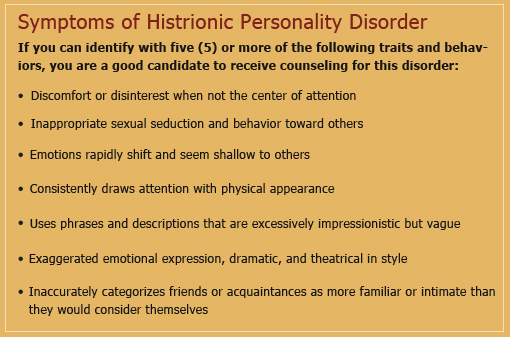
People with HPD crave attention, so much that Sam Vaknin speculates that HPD may actually be the somatic, “female” form of NPD–or at least resembles it a lot. Most (but not all) Histrionics are women. A woman with HPD will act very much like a somatic narcissist, but may show somewhat more empathy or genuine (but shallow) emotion than a true narcissist. In fact, showing emotion is what Histrionics do best–hence their name. Their exaggerated emotional displays are over-the-top and dramatic. They are the original drama queens. I’m going to go out on a limb here and speculate that a lot of male HPD’s are probably flamboyantly gay men of the type who have exaggerated feminine affectations and interests (this is certainly not a slur on gay men, just an observation). Histrionics are also easily bored and besides attention, crave constant activity or social interaction. They tend to smother those they become attached to.
For convenience’s sake (and because most histrionics are women), I’ll describe a hypothetical woman with this disorder.
Histrionic Haley.

Haley was the youngest child of her family of origin, and also the prettiest. At the age of 12, her parents divorced and her mother remarried. Haley’s stepfather appeared to love her–but that was just how things appeared. In actuality, he came into her room at night and forced himself on her, telling her how pretty she was and what a beautiful woman she was turning into. He made her strip naked and lie down on the bed while he fondled her developing breasts. When Haley questioned him about why he did this, her stepfather told her he was just “checking to see how she was developing.”
Haley was spoiled by both her mother (a narcissist who actually hated Haley for “seducing my husband” but still needed her because Haley made HER look good) and her stepfather, who constantly bought her clothes, mostly revealing outfits that showed off her adolescent curves.
Haley was never encouraged to think for herself or develop her mind or any skills other than her physical appearance and flirting ability. Her mother, a somatic narcissist, taught Haley that acting helpless and exaggeratedly feminine was the most effective way to attract a boy. Haley was spoiled rotten but abused at the same time. She was attractive, obsessed with clothes, makeup and shopping, and used her “feminine wiles” to attract boys, who she proceeded to manipulate (usually using sexy smiles, skimpy outfits, exaggeratedly demure behavior, or tears) to get whatever she wanted.
Haley was highly romantic–besides being obsessed with cheap romance novels, she was constantly “in love” with someone. Unfortunately she never learned how to love anyone on a deeper level because she didn’t know how to give, only take. She learned that sex was the best way to obtain what she wanted, and that’s all most of her lovers wanted her for anyway, so she was more than happy to oblige. Due to her immaturity and emotional instability, she was prone to drawn out, over the top tantrums when she didn’t get her way. Of course, her frequent temper tantrums, crying jags, unreasonable demands, and general high-maintenance behavior caused all her relationships to be short lived. With each breakup, Haley got worse, and upped the ante for the next relationship, believing she hadn’t asked for enough the last time. It never occurred to Haley that she might be too demanding and high maintenance. She never learned from her own mistakes, because being needy and demanding was all she had ever been taught.
Haley had good social skills, and became the life of any party she attended. While she had no close friends (due to her inability to maintain any deep and meaningful relationship), she had plenty of acquaintances and casual friends, who though of her as a dynamic, fun and exciting woman. She had lots of charm, was very pretty, and adored being the center of attention–just as she had been in her family growing up. Each year she would throw herself a huge birthday party, and expansively invite more people than she could realistically afford to entertain. But that didn’t matter because she had so many admirers, no one cared that the food and drink always ran out. Haley kept everyone entertained. Even though she’d almost always wind up sobbing loudly and theatrically at some point due to some slight during these parties, even that in itself kept her admirers around, who became protective of her. Haley basked in all the solicitous attentions she received.
Haley also used her sexuality in inappropriate ways. On several job interviews, she wore revealing see-through tops or short shorts, or allowed her bra strap to “accidentally” fall down her shoulder from under a tight spaghetti strap tank top. She openly flirted with her male interviewers. While a couple of employers fell for the bait and hired her–Haley was never taken seriously as an employee and then she’d tearfully complain to anyone who would listen about how she was treated like a sex object and got no respect.
How HPD differs from BPD

Histrionic personality disorder resembles BPD in some ways–but the Borderline is ambivalent about relationships and tends to alternately smother and abandon people–their tendency toward “splitting” (black and white thinking) causes them to idealize others followed by devaluation or pre-emptive rejection when they perceive a slight. A histrionic will just keep on smothering and making more demands. They lack the ambivalence of a borderline.
While a borderline may be sexually promiscuous or seductive, not all are–and they don’t use their sexuality or body to exclusively the way someone with HPD does. Borderlines also tend to be more self-destructive (cutting, eating disorders, drug abuse, compulsive gambling, etc.) than a Histrionic, and more prone to suicide or suicidal ideation, as well as having dissociative and sometimes psychotic symptoms that Histrionics lack.
Is BPD a real disorder or should it be eliminated as a diagnosis?

The myriad ways experts “see” borderline personality disorder. (click to enlarge)
There’s a great deal of confusion and disagreement in the professional literature about the nature of Borderline Personality Disorder. The blogger BPDTransformation (whose blog is excellent if sometimes a little on the scholarly side), who was cured of BPD, thinks the label should simply be done away with and that BPD doesn’t really exist at all–the label being merely a placeholder for a group of symptoms that are widely variable, and that experts can’t even agree on. He believes BPD is categorized as a Cluster B (dramatic/emotional) disorder only because mental health experts can’t decide where else to put it.
The stigma of BPD as a Cluster B disorder.
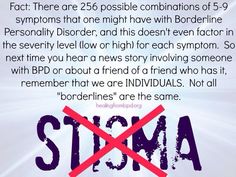
The problem with labeling BPD in the Cluster B category of personality disorders is the stigma that classification carries–that people with BPD (like those with NPD or ASPD) are evil, untrustworthy, selfishly manipulative, grandiose, dishonest, lack empathy, and really no better than people with malignant narcissism or even ASPD. (It sure doesn’t help any that an obviously sociopathic criminal like Jodi Arias has a diagnosis of BPD, when she more likely fits the criteria for high spectrum [malignant] narcissism, at the very least.) Insurance companies assume anyone with a Cluster B disorder is incurable, and therefore will not pay claims where a person is diagnosed with a Cluster B disorder. This is very damaging to those of us with BPD who have either successfully learned to modify and control our symptoms–or have even been cured, as BPDTransformation has been. People continue to believe we are lying about the success of the treatments or therapy we have received. Borderlines who have never been treated may find it difficult to find a therapist willing to work with them.
BPD is far more amenable to deep insight therapy than NPD (which is extremely difficult to cure but not impossible for non-malignants) and light years away from a disorder like ASPD (antisocial personality disorder), which can probably not be cured. Because the symptoms of BPD are so disagreeable to the sufferer (and not just to others), it is common for borderlines to present themselves for therapy, unlike people with NPD or ASPD. The vast majority or borderlines are unhappy with themselves and the way their lives have turned out. But many therapists won’t work with borderlines (other than with behavior modification treatments like DBT) because they know insurance companies will not pay such a claim.
What are borderlines on the border of, anyway?

The name “borderline” itself is confusing. What are borderlines on the border of anyway? Neurosis and psychosis? A normal sense of self and Narcissism? Mexico and the United States?
The experts are all over the map on this, with some recent theories stating that BPD is actually a less adaptive, more ego-dystonic form of narcissism. But the original term “borderline” actually referred to the belief that the disorder was on the “border” between psychosis and neurosis:
[…]It is called borderline because it was originally thought that people were on the ‘border’ of psychosis and neurosis. BPD is also sometimes called Emotionally Unstable Personality Disorder (Borderline type). Approximately 75% of people given this diagnosis are women and 50% have experienced physical and/or sexual abuse.
Because BPD is more commonly diagnosed in women than in men, it’s also been referred to as the female form of narcissistic personality disorder (which is more commonly diagnosed in men than in women).
Psychotic, neurotic, both, or none of the above?

Credit: Judgybitch/Dzhokhar Tsarnaev
The reason why BPD is sometimes regarded as the midpoint between neuroses (mild and easily treated anxiety or depressive disorders) and psychoses (disorders where the victim is out of touch with reality, such as schizophrenia and the manic-depressive form of bipolar disorder) is because people with BPD can, when emotionally upset, display psychotic or delusional symptoms such as splitting (black and white thinking), dissociation (feelings of unreality either about the self or the environment), magical thinking, severe paranoia, delusions of grandeur or persecution, and sometimes even hallucinations and disorganized speech or thought. However, for a borderline, these psychotic symptoms don’t last and as soon as the emotional crisis has passed, the borderline’s “sanity” normally returns. Antipsychotic medication can be helpful, but isn’t always necessary, as it usually is for a truly psychotic individual.
Others have speculated that BPD is really a severe form of PTSD or C-PTSD caused by trauma, and should be treated the same way as PTSD. Personally, I think it’s more long-standing than a reactive disorder like PTSD and is a true personality disorder, but it does make sense that BPD may have originally begun as a form of PTSD at an early age, often due to sexual abuse.
There is so much confusion and contradiction in the literature about BPD that I’m slowly coming around to BPDTransformation’s way of thinking that it should possibly be removed from the Diagnostic and Statistical Manual of Mental Disorders (DSM) until mental health professionals can get a better handle on what BPD actually is, and whether it’s even a valid diagnosis (or simply a group of symptoms that could indicate several other disorders). There should at least be more agreement among the professionals at any rate.
Borderlines are human chameleons.

My latest obsession seems to be the similarities and differences between people with NPD and BPD. I’ve been trying to come to terms with the idea an increasing number of mental health professionals hold that BPD may actually be on the same spectrum as NPD (for more information about this, see Alexander Lowen’s “Spectrum of Narcissistic Disorders”) but is a less adaptive (to the sufferer) form of the same disorder. What I’ve been reading is disturbing to me because I had no idea how similar BPD and NPD really may be.
The most important thing both disorders seem to have in common is that both borderlines and narcissists feel empty inside. Both feel as if they have a black hole inside them, and many try to “fill” that hole with things like substances, sex or compulsive shopping. People with both disorders are prone to abuse drugs or alcohol, or engage in other unhealthy or self-destructive behaviors (with the borderline more likely to be deliberately self-destructive and the narcissist callous or destructive toward others). Filling the inner black hole becomes so important that people with these disorders may disregard the needs of others in their need to get their “fix.”
I found an article in Psychology Today that discusses the devastating conundrum that both narcissists and borderlines have to face: the lack of an identity. It’s this absence of a true identity that make people with these disorders feel so empty and hollow, and drives them to do the kinds of things they do. The primary difference between these disorders is that narcissists adopt a false self to replace the lost true self, while borderlines–although not having a false self per se — instead become human chameleons, adapting their behaviors to a given situation (to avoid rejection)– but none of these identities are really “them.” The truth is, they don’t know who they really are. That’s why borderlines seem to change with the wind and confuse those they are close to.
The article I’ve linked to discusses these ideas in more depth. It’s extremely interesting stuff, but somewhat upsetting to people like me with a BPD diagnosis.
This article is Part 7 of a series about the differences and similarities between BPD and NPD.
The other 6 can be linked to from this one. (Of course I’ll be reading all of them.)
Who Am I? The Conundrum of Both Borderlines and Narcissists
I cannot repost the article here here without written permission from the author, so you will have to click the link to read the article.
Here is an article by the same author about the False Self the Narcissist uses to mask their lack of an identity: https://www.psychologytoday.com/blog/stop-walking-eggshells/201111/behind-the-facade-the-false-self-the-narcissist
The curse of the Aspergers/Avoidant/Borderline triad.

Today I attended a beautiful Pentecost mass that was held outdoors. The day couldn’t have been more perfect for an outdoor celebration of the descent of the Holy Spirit on Jesus’ disciples. Unlike the disciples, I didn’t experience a sudden spiritual epiphany or dramatic change in my heart, or start speaking in tongues. But as always when I attend mass, I felt God’s presence around me (if not actually IN me) and felt surrounded by peace and light.
I looked at the tall trees gently swaying in the distance, their bright spring greens illuminated in the bright sunshine against the azure blue sky, and asked God to change me, to let the Holy Spirit flow inside me and fill me with its divine gifts of empathy, unconditional love, and joy. I asked Him to make me a better person who can connect with other people on a meaningful level–and having those gifts would make it so much easier for me to do that.
The truth is, I feel that I’m lacking in all three of these gifts. I do not have NPD and therefore have no desire to act in evil or toxic ways to others, but due to my other disorders–only one of them probably not due to abuse (Aspergers)–I often feel like there’s an emotional blockage keeping me from really being able to connect with other people, to really being able to empathize and feel WITH them the way people who have not been abused and do not have these disorders can do.
This particular triad of disorders is a tragic one. Even having one of these disorders cripples you and isolates you in various ways from others and can lead to a lonely life lacking in meaningful relationships, but having all three at once is devastating. It’s so hard for me to connect with the rest of humanity except on the most abstract level and as a result I’m often so very sad and lonely.
First, being an Aspie (the only disorder I was probably born with) makes it almost impossible for me to read social cues normally and although I can socialize well enough online (because it doesn’t require me to “think on my feet”–I have time to think through what I want to say or how to respond), in the day to day physical world my Aspieness makes me appear awkward and sometimes slow when I am forced to socialize, especially with neurotypicals who don’t understand people with Aspergers, so I avoid people. Due to my awkwardness I was a frequent target of school bullies, and it didn’t take long to learn that it was best to just keep my mouth shut and say nothing. I became painfully shy, fearing ridicule and humiliation. The old adage, “Tis better to say nothing and have others believe you are daft than open your mouth and remove all doubt” has been my motto most of my life.

The other two disorders I have–avoidant AND borderline personality disorders–I am certain were due to years of abuse by my narcissistic mother and to a lesser extent, my codependent father who colluded with her most of the time (although I never really doubted his love for me). The AVPD (a Cluster C “anxious” personality disorder) only exacerbates my Aspergers. They feed off each other.
Avoidants shy away from social contact because of their low self esteem and overwhelming fear of rejection. As a result they are usually painfully shy but can even seem aloof or cold. Avoidants are not schizoid though (people with Schizoid personality disorder dislike other people and prefer a hermit-like lifestyle; they don’t care how others regard them): on the contrary, we WANT friends, we WANT meaningful relationships, we WANT romance, we WANT others to like us–but our fear of engaging with others due to possible rejection keeps us isolated and alone. We build a protective shell of aloofness around ourselves so we can’t be hurt. People with AVPD are risk-averse, and are likely to be underachievers due to their unwillingness to take risks that may expose them to social embarrassment.
An Aspie with AVPD is nearly–or is–a social hermit, but not out of choice, like a person with schizoid personality disorder. Making friends–a skill that comes so naturally to most people–is something most of us never mastered well, if at all. Even having a relaxed conversation or opening ourselves to another human is like rocket science to those of us with both disorders. It’s a wonder that I was even ever able to engage in romantic relationships and have a family. Of course, all the men I dated and of course the one I married were narcissistic, mirroring the toxic dynamics I had with my family of origin.

Like the girl in this cartoon, I can relate to all of this, even the refusal to play charades! I was always terrified of that game because it requires a level of being able to read social cues and an ability to think on your feet, two qualities I don’t possess. And of course, the fear of risk-taking and humiliation.
And that brings us to my borderline personality disorder. BPD is not usually marked by overwhelming shyness or social awkwardness; in fact most borderlines are quite socially adept. But their disorder, like an Avoidant, is fueled by a deep-seated fear of rejection and almost always has its roots in childhood emotional abuse or neglect, as do all the personality disorders.
Borderlines long for close relationships and actively seek them out, but then push others away if they sense the other person might pull away or reject them first. They overreact to slights and are highly sensitive to criticism or rejection. Like a narcissist, they can be difficult to deal with because of this type of selfish oversensitivity can lead them to engage in some of the same antisocial behaviors and game playing people with NPD or even ASPD are guilty of, though not usually to the same degree because people with BPD have a conscience (even if it’s stunted in some) and don’t normally actively seek to hurt others. There are exceptions though–I was shocked and dismayed to read that both the murderer Jodi Arias and serial killer Aileen Wournos were both diagnosed with BPD, though in Wournos’ case, she was also comorbid with ASPD. Still, most borderlines, when they are made aware of how they have hurt their loved ones, feel remorse–but their guilt and shame can make them feel worthless and lead to self-destructive behaviors. It is not a fun disorder.
Though Borderlines are more likely to be self-destructive instead of deliberately destructive to others, this self destructiveness causes huge problems in their ability to form meaningful relationships, and due to their “go away–come closer” way of relating to others, their relationships are usually stormy and short-lived.

Sometimes I feel like either Lucy or Charlie Brown (who I’m pretty sure would have AVPD), and sometimes both of them at once.
I am cursed with the overwhelming shyness and social anxiety of Aspergers and AVPD, but during the rare times I have been able to form relationships or friendships, sooner or later I push those people away in some form or another–not because I want to, but because I either become so afraid of rejection I reject the other person first–or more frequently, unconsciously do something to make the other person leave me. BPD is very maladaptive to the sufferer–it tends to bring on the very thing the Borderline fears the most–rejection.
I was diagnosed with BPD in 1996 during a three month long hospitalization for major depression. At the time, I also had PTSD from being a victim of abuse by a malignant narcissist husband, who gaslighted me constantly and even tried (but eventually failed) to turn my own children against me. During that hospital stay, I was given a copy of Marsha Linehan’s excellent manual for BPD, “Skills Training Manual for Treating Borderline Personality Disorder.” Dr. Linehan is a borderline herself (she had originally been diagnosed with schizophrenia but felt her “schizophrenia” was really a manifestation of her BPD). The techniques in the book are a form of DBT (dialectical behavioral training) which teaches the Borderline patient to act mindfully–to think before they act and consider consequences, because Borderlines (unlike people with NPD) act on impulse when they feel threatened.
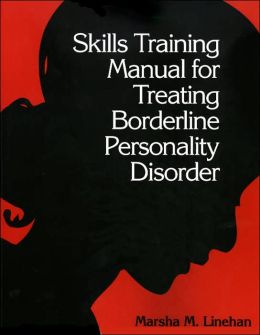
Linehan’s excellent manual can be ordered here.
Linehan’s book helped immensely and since my long-ago hospital stay, I have learned to control many of my borderline symptoms. In fact I have become so good at it I rarely fly off the handle the way I used to or overreact to the degree I used to do. I still have my copy and have recently begun doing some of the excercises again because I still know there’s a LOT of room for improvement.
Like NPD, BPD doesn’t just go away. All personality disorders are incredibly hard to cure because they have become so much a part of the individual’s personality. There are still many times I unwittingly either push other people away OR get too close (or do both at the same time); I still have problems with understanding where other people’s boundaries begin and end. I also feel like there is a wall there keeping me from really being able to empathize with other people in a normal way. I can empathize in an abstract sort of way (it’s hard to explain what I mean by that but the empathy I do feel is sincere). It’s just so hard for me to connect on a meaningful level because I fear rejection so much. I want to be a friend to others; I want to make others happy; I want to be able to fully share in their emotions, good or bad–but I find it all so hard–not just because of my BPD, but my fear of engaging with others in the first place due to Aspergers and AVPD. This triad has been a huge curse all my life. But at least I know what my problem is. I’m what you would call “complicated.” I have my work cut out for me.

Having all three disorders has made my life incredibly difficult and my relationships–when they exist at all–have been stormy or don’t last. But I don’t feel that I’m beyond hope. In fact, I’ve been feeling much better about myself since I started blogging and accepted God into my life. I do feel that He is changing me in a very meaningful and deep way. Maybe it’s not happening as quickly or dramatically as I had hoped, but it’s happening. I am feeling more ability to empathize with others and feel moments that come very close to pure joy. I have always had a great capacity to feel guilt and shame, so that has never been a problem. For a person with a Cluster B disorder, my conscience is probably TOO well-developed. I apologize for things I haven’t even done. Sometimes I feel like I’ve spent my entire life apologizing for my existence. I hate the idea of being a bad or evil person. I like it when I know I’ve made someone else happy. Those times when I can make others happy are becoming more frequent, and I think that’s a step toward healing. I’m also happy to report that my lifelong problem with envy appears to be disappearing. Envy is so toxic–mostly to the person harboring it. It’s a great relief to have that particular monkey off my back most of the time now.
So today’s celebration of Pentecost had special meaning, because even though I wasn’t knocked to my knees by the Holy Spirit, I felt a deep sense of peace, centeredness and just “being in the moment” that has always eluded me. I felt a genuine desire to become a person who can make a positive difference in the lives of others and can feel unconditional love even for those I do not know well. Now I just need to overcome my fear of engagement with others, but I have faith that in time that will happen too, and when that happens, a whole new world will open up to me as the walls I built at an early age begin to crumble and reveal the me I want to be–which is really the me God meant for me to be.
Never give up hope. Ever.
Adventures of S.K. the “Loser”: cartoon diary of myself at age 22 (one of two)
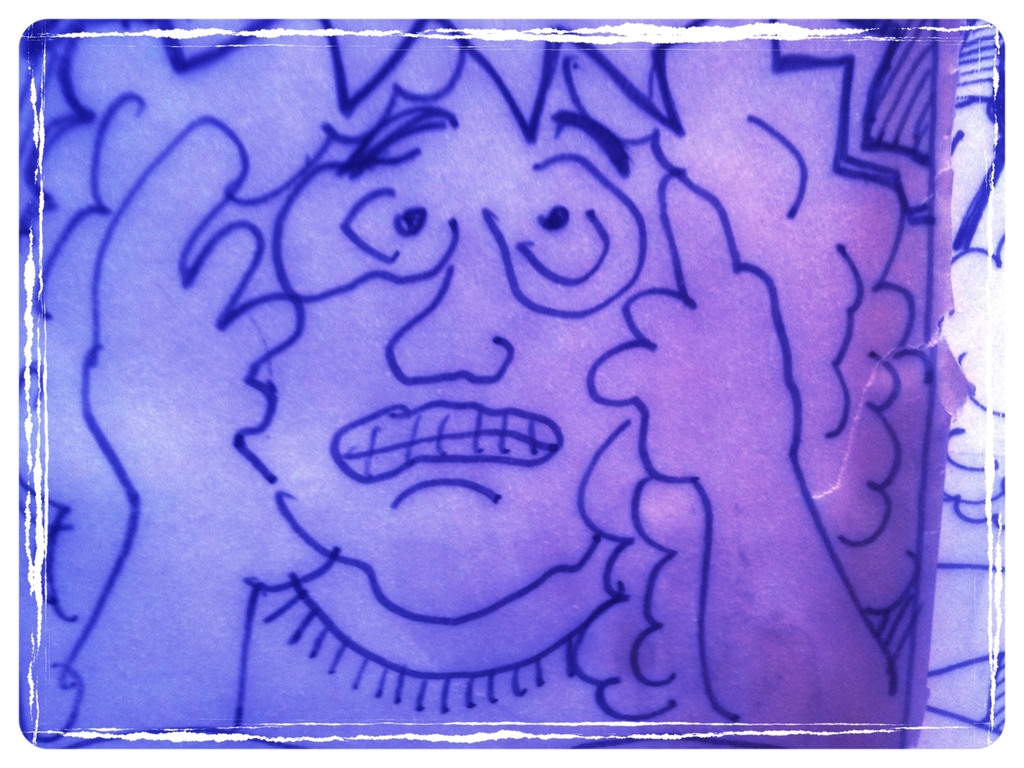
Generally, what my state of mind was like back in the day.
I found two cartoon stories I drew in 1981 that describe exactly where my head was at when I was 22–the same age my daughter is now.
At the time, I was juggling a full time job as a billing clerk (which I hated) with being a full-time college student. Believe me, even for a 22 year old, this wasn’t easy. I was a psychology major with a strong interest (minor) in art. I also liked to write, as I do now. At the time, I thought I might become an art therapist (which would have required people-skills and patience with others I simply did not possess).
But my real interests lay in romance–like most borderlines, I drifted from one intense romantic relationship to the next–and THAT will be described in the next set of cartoons, which I’ll post after these.
While a sense of humor about myself is evident in both these cartoons, my insecurity and unhappiness with myself and my overwhelming anxiety about my future (which didn’t turn out to be that great) could not have been more apparent. Of course, insecurity and identity issues are normal for anyone at age 22, but I think I was more consumed by my feelings of insecurity and lack of belonging than most. At the time, I had no idea about Aspergers or that I might be Borderline. I just thought of myself as a neurotic basketcase tormented by inner demons. I must have had some optimism however, as the outcome (at least in the first story) is generally hopeful.
It’s interesting that I referred to myself as “The Loser” but not too surprising given my background and low self esteem. “S.K.” were my actual initials. I wish I had drawn more of these. I only made two sets.
I hope these are readable; they are very old and the papers they were drawn on very large, so the print may be hard to read in some places. They are posted in order; PLEASE CLICK ON THE PANELS TO ENLARGE.
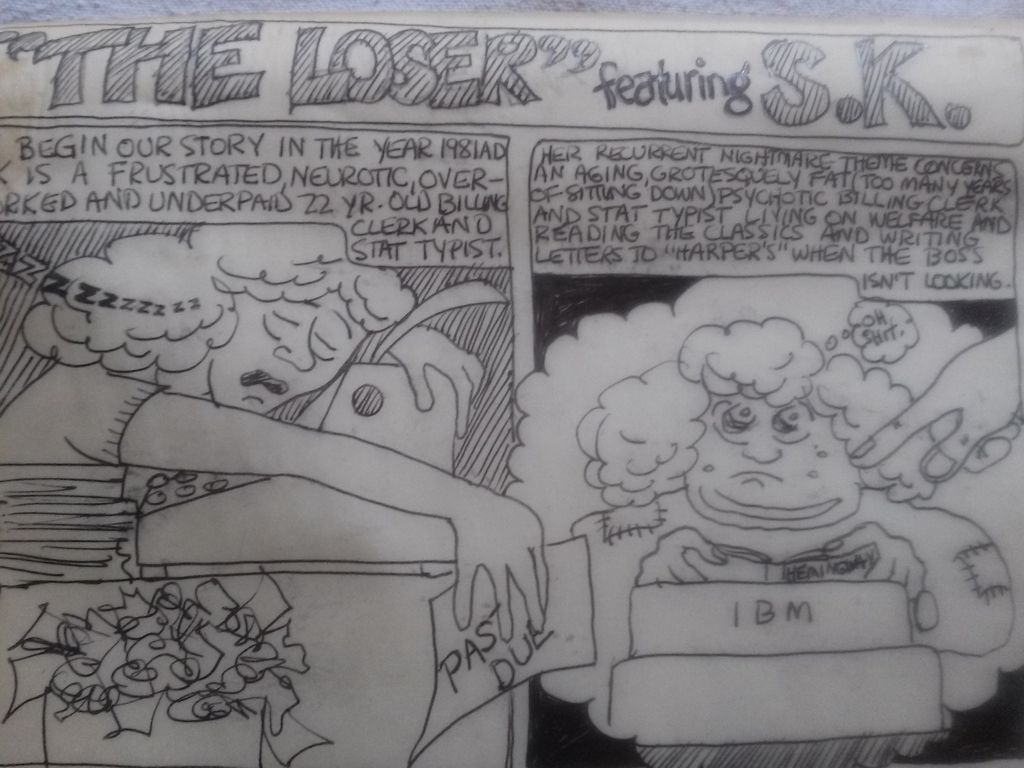

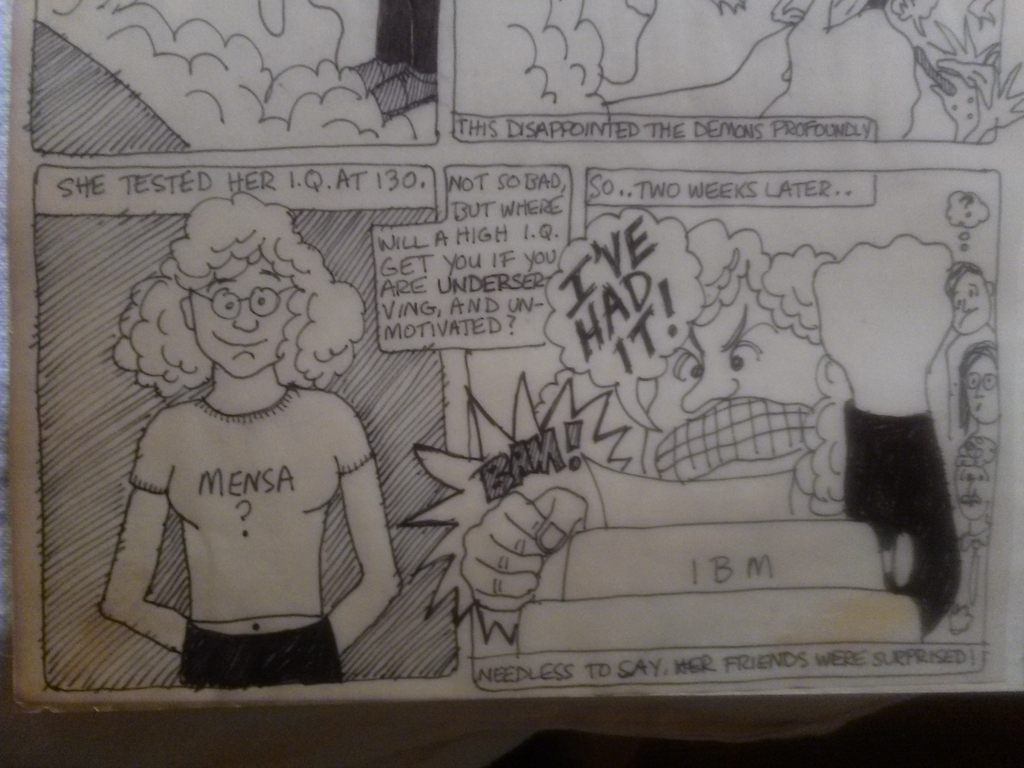
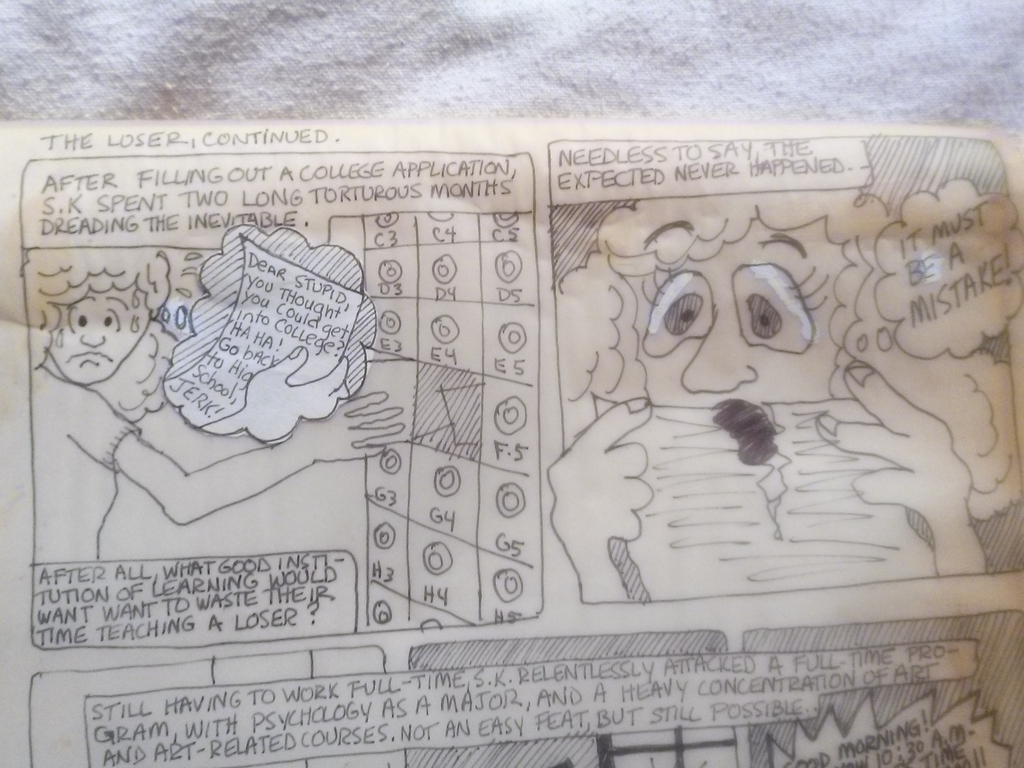
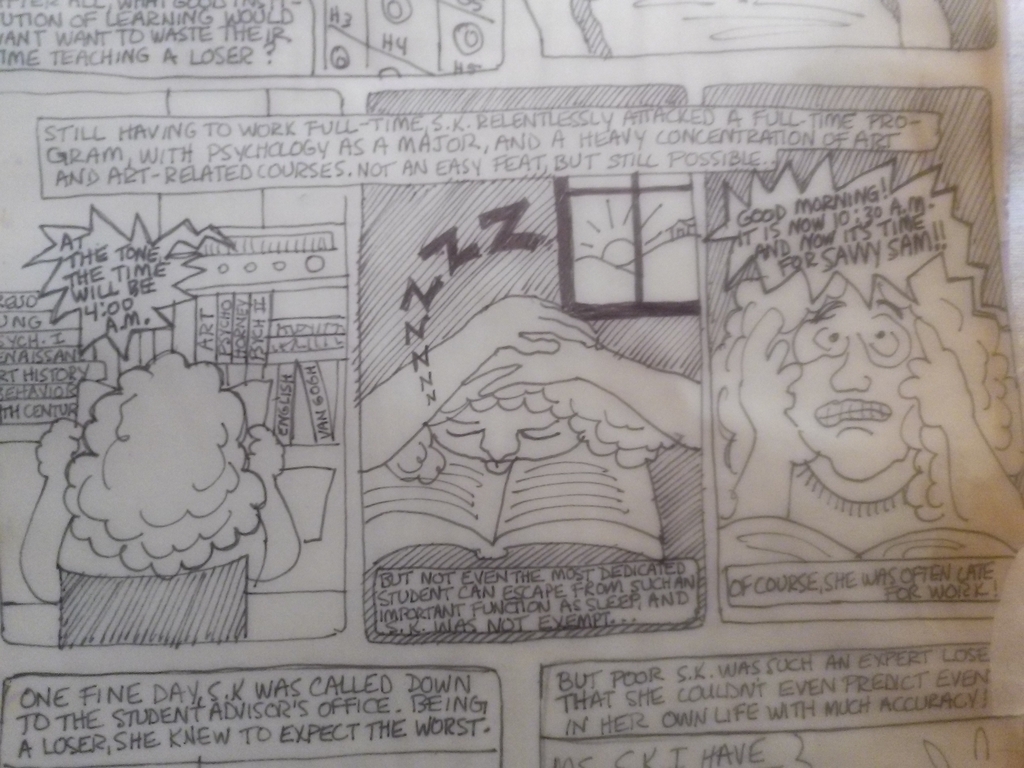
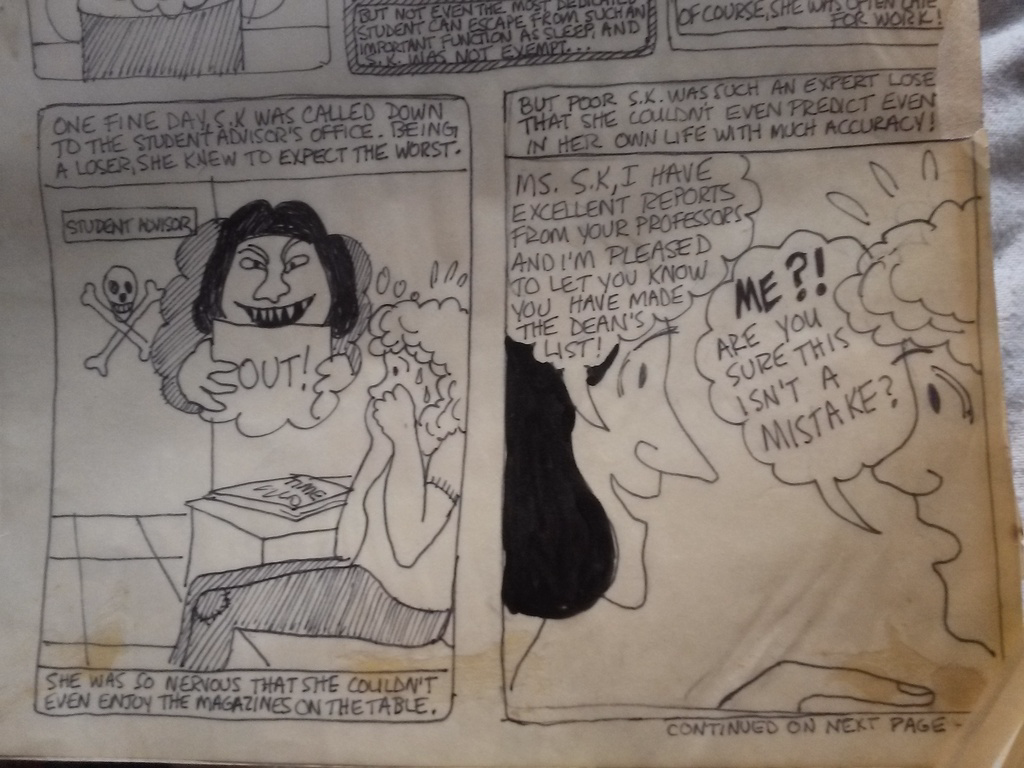
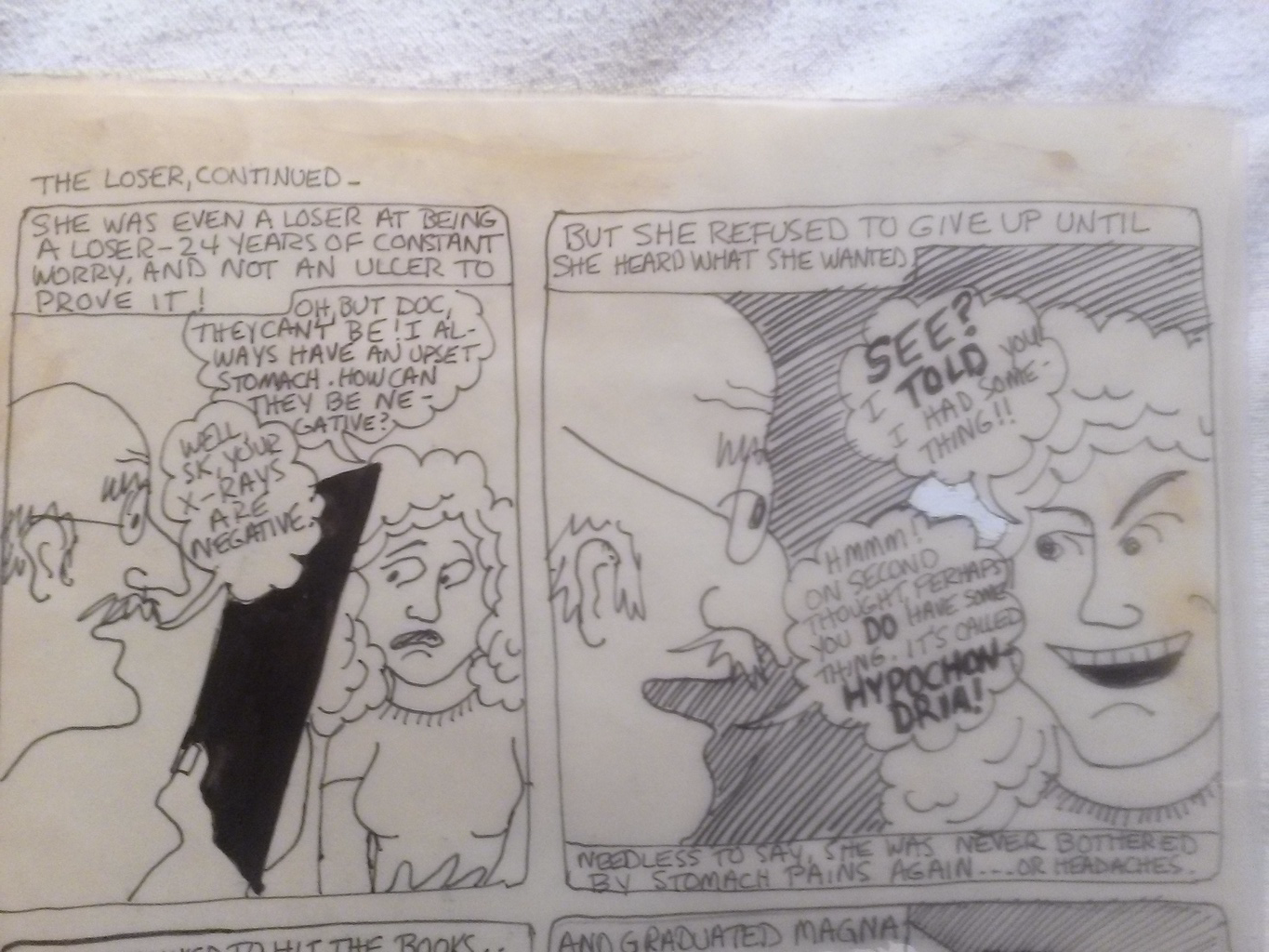
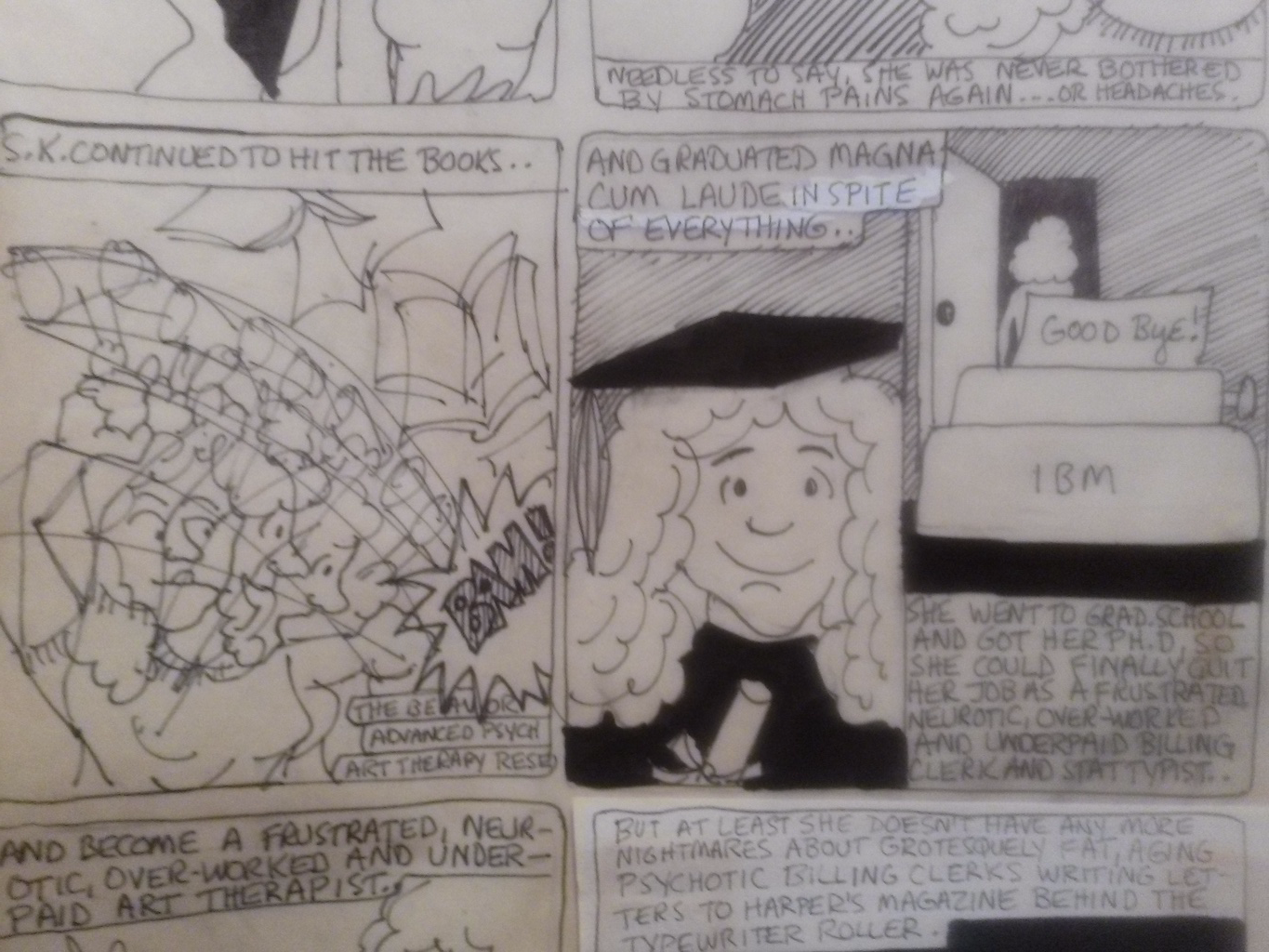
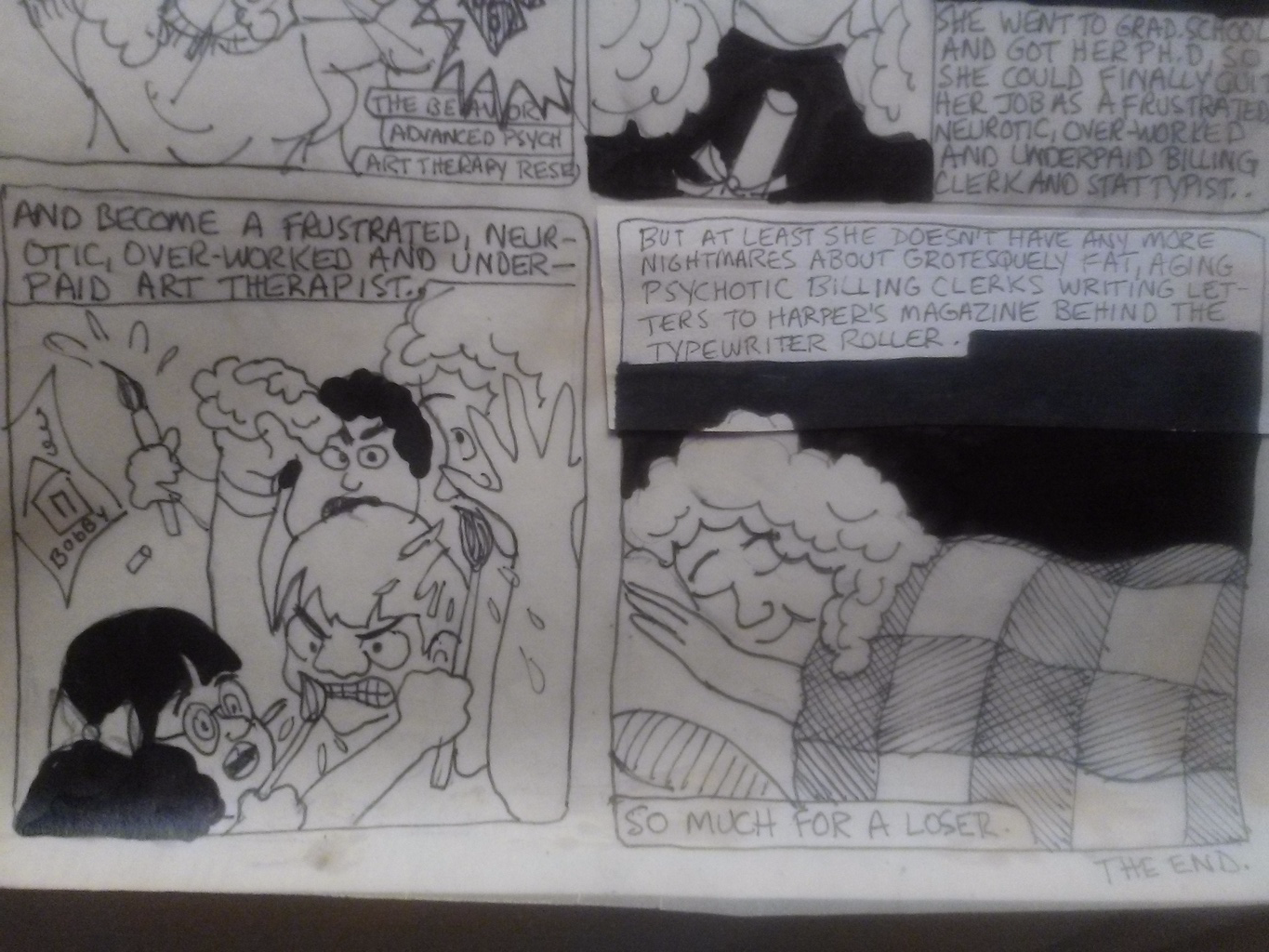
ETA: I accidentally posted this publicly with only the first six panels; I’ve added the final three so the story should make more sense now.
Read the second cartoon story here.
Clearing up some misunderstandings about BPD.

There seems to be a lot of misunderstanding about borderline personality disorder. I’ve noticed many people seem to confuse it with narcissistic personality disorder (NPD). While there ARE some overlapping symptoms (and it’s even been speculated by a number of mental health professionals that BPD is actually a less severe form of NPD), they are quite different from each other. I’d like to clear up a few of these misunderstandings and discuss both the similarities and the differences.
New DSM Criteria for BPD.
According the the DSM-V (2013), these are the diagnostic criteria for BPD (the new list of criteria is quite long and ponderous so I will not attempt to talk about each of these points here):
A. Significant impairments in personality functioning manifest by:
1. Impairments in self functioning (a or b):
a. Identity: Markedly impoverished, poorly developed, or unstable self-image, often associated with excessive self-criticism; chronic feelings of emptiness; dissociative states under stress.
b. Self-direction: Instability in goals, aspirations, values, or career plans.
AND
2. Impairments in interpersonal functioning (a or b):
a. Empathy: Compromised ability to recognize the feelings and needs of others associated with interpersonal hypersensitivity (i.e., prone to feel slighted or insulted); perceptions of others selectively biased toward negative attributes or vulnerabilities.
b. Intimacy: Intense, unstable, and conflicted close relationships, marked by mistrust, neediness, and anxious preoccupation with real or imagined abandonment; close relationships often viewed in extremes of idealization and devaluation and alternating between over involvement and withdrawal.
B. Pathological personality traits in the following domains:
1. Negative Affectivity, characterized by:
a. Emotional lability: Unstable emotional experiences and frequent mood changes; emotions that are easily aroused, intense, and/or out of proportion to events and circumstances.
b. Anxiousness: Intense feelings of nervousness, tenseness, or panic, often in reaction to interpersonal stresses; worry about the negative effects of past unpleasant experiences and future negative possibilities; feeling fearful, apprehensive, or threatened by uncertainty; fears of falling apart or losing control.
c. Separation insecurity: Fears of rejection by – and/or separation from – significant others, associated with fears of excessive dependency and complete loss of autonomy.
d. Depressivity: Frequent feelings of being down, miserable, and/or hopeless; difficulty recovering from such moods; pessimism about the future; pervasive shame; feeling of inferior self-worth; thoughts of suicide and suicidal behavior.
2. Disinhibition, characterized by:
a. Impulsivity: Acting on the spur of the moment in response to immediate stimuli; acting on a momentary basis without a plan or consideration of outcomes; difficulty establishing or following plans; a sense of urgency and self-harming behavior under emotional distress.
b. Risk taking: Engagement in dangerous, risky, and potentially self-damaging activities, unnecessarily and without regard to consequences; lack of concern for one’s limitations and denial of the reality of personal danger.
3. Antagonism, characterized by:
a. Hostility: Persistent or frequent angry feelings; anger or irritability in response to minor slights and insults.
C. The impairments in personality functioning and the individual’s personality trait expression are relatively stable across time and consistent across situations.
D. The impairments in personality functioning and the individual’s personality trait expression are not better understood as normative for the individual’s developmental stage or socio-cultural environment.
E. The impairments in personality functioning and the individual’s personality trait expression are not solely due to the direct physiological effects of a substance (e.g., a drug of abuse, medication) or a general medical condition (e.g., severe head trauma).
Is it really true that Borderlines can’t feel empathy?

BPD patient “Alice” (Kristen Wiig) in “Welcome to Me.”
The very first thing that stood out to me (and was not included in the older DSM criteria) is “lack of empathy.” Yes, it is a fact that many borderlines have difficulty feeling empathy under normal circumstances, but the reasons for this are vastly different than the lack of empathy seen in people with NPD.
Most people with BPD have the capacity to feel empathy, and can feel very guilty when they become aware (or it’s pointed out to them) that they have treated others badly, but because Borderlines have great difficulty regulating their emotional reactions and have an unfortunate tendency to lose themselves in their own drama when they perceive they are being attacked, at those times they can “forget” that others exist, and this can lead to them acting selfishly and disregarding the feelings of others. This can appear very narcissistic. It’s not that they CAN’T feel empathy though, because they certainly can. They can also feel remorseful. But it may take a disaster (such as losing a good friend or a broken relationship) for them to realize the damage their impulsive and selfish behavior has caused. If their bad behavior is pointed out to them by someone else–such as when the character Alice in the movie “Welcome to Me” loses her best friend Gina, who tells her how much she was hurt by Alice’s insults against her–they will feel remorse and try to make amends in whatever way they can.
Borderlines just want to be accepted.

Unlike narcissists, borderlines hate to be hated. Narcissists like any form of attention–negative or positive (and some even prefer to be hated!) while borderlines only want to be loved and thought of in a positive manner. Most of them WANT to be good people and WANT to be liked, but don’t always act in ways that make them seem very nice, due to their impulsivity and tendency to act out whatever emotions they are feeling at the moment.
Impulsivity is a primary issue with a borderline–a trait not shared by narcissists (but IS shared with people with ASPD)–because they fail to think ahead and consider consequences of their bad behavior.
Borderlines can act narcissistic because of their deep seated need to feel accepted. Most hate themselves (as do narcissists) and some can act grandiose and full of themselves in their attempts to be liked and admired. Deep inside, they feel worthless. It’s not hard to take down their braggadocio, however. Cut a borderline down to size and they may react with rage or tears (as will a narcissist) but are also more likely than a narcissist to admit you are right and they are really just worthless losers. They might even apologize profusely for acting so out of line.
I can’t help but think of the Wizard in The Wizard of Oz. An insecure little man who stood behind a curtain projecting the face of a raging tyrant onto a huge screen. When Toto pulled back the curtain to reveal who the “Wizard” really was, and Dorothy upbraided him for being a “very bad man,” the Wizard immediately became humble and apologized profusely to the group, telling them that yes, he was just a humbug. Some people have said the Wizard was a narcissist, but I think his behavior was more typical of a borderline. A narcissist would have continued to insist on his superiority, even with his true nature having been revealed–and his true nature would not have been so benign. The Wizard’s intentions for Dorothy and her friends were also good.
While a narcissist may rage and perhaps even use tears (to manipulate others into feeling sorry for them), they will almost never admit their wrongdoing or admit they are anything other than God’s gift to the world. Doing so is far too dangerous to them.
Why Borderlines act selfishly.
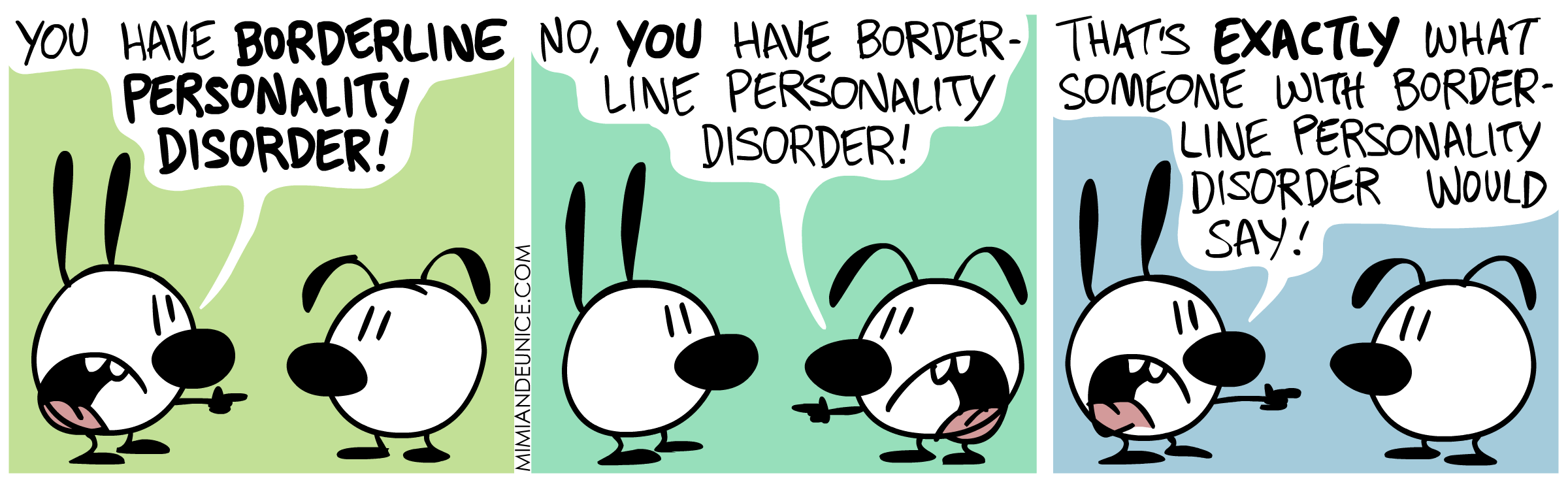
A borderline who is not under stress or in the midst of an emotional drama, or has learned to control their impulses through behavioral training like DBT–dialectical behavior training which was developed by Marsha Linehan (it does work–I can attest to its efficacy), can certainly feel empathy for others, and can be genuinely good and kind people. Genuine kindness and concern for others is rare in a narcissist and almost unheard of in a malignant narcissist. Borderlines generally have this capacity, but unfortunately, if they haven’t learned to control or regulate their emotions, their ability to feel for others or show a conscience is eclipsed by their own drama, which at the moment becomes all-important. They really just don’t know what they are doing, but if you call them out or make them suffer consequences, in most cases they will try to make it up to you.
Borderlines don’t live a lie.

Borderlines do not wear masks, as narcissists do. They cannot pretend to be someone they are not (or if try to, they usually fail miserably, like the wizard in The Wizard of Oz). They are not trying to fool you, even though to avoid rejection, they can be manipulative and use some of the same games (gaslighting, blame-shifting, rages, etc) that narcissists do. Borderlines, if anything, show TOO MUCH of themselves–and that includes the bad along with the good. With a borderline, it’s all WYSIWYG. They can’t wear a mask, because they lack the ability to plan things out ahead of time the way someone with NPD does. Wearing masks requires cunning and the ability to lie. While borderlines can and do lie (usually to exaggerate the pain they are facing or to idealize/devalue someone else), they can’t lie about who they are or what they’re feeling. In that sense, they’re even more honest than the average non-disordered person.
Idealization/devaluation in borderlines and narcissists.
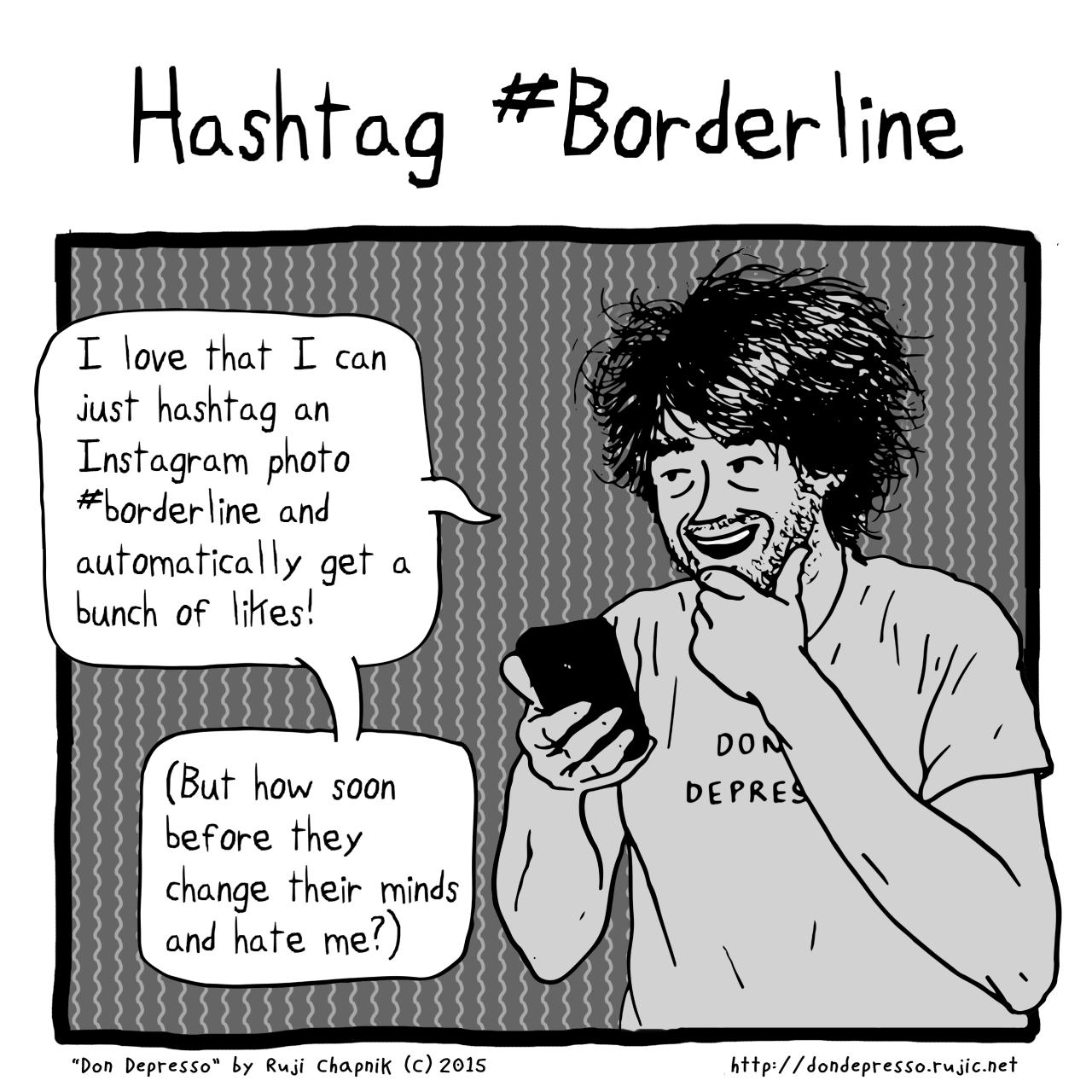
Both narcissists and borderlines do tend to idealize and devalue other people, and both are guilty of black-or-white thinking. But the motives for this behavior are different. A narcissist idealizes someone they see as a good source of narcissistic supply. They do not see the source of supply as a person, but will put them on a pedestal as long as they’re providing enough supply. Should the victim stop providing supply (or the narcissist just becomes bored and needs a new source of supply), the narcissist devalues and discards the victim, without mercy or regret.
Most borderlines idealize and devalue others based on their need for acceptance and love, not the need for supply. If they perceive another person as good and kind, and accepting of them, they will tend to idealize the person and sometimes become clingy and needy (a narcissist can be clingy and needy too, but for different reasons). If the borderline feels the other person losing interest or pulling away from them, they may suddenly, without warning, devalue the other person and reject them. They do this not to be mean, but to avoid being rejected themselves. This explains the “I hate you…don’t leave me” or “come closer…go away” behaviors many borderlines show. It’s confusing and contradictory to others, but it helps them to avoid the inevitable rejection they believe is coming to them. Borderlines live in constant fear of being rejected; narcissists live in constant fear being ignored–losing their “drug” of narcissistic supply. While their behaviors may seem similar on the surface, the motives behind them are quite different.
A borderline is not usually deliberately malicious or sadistic. It’s not their intention to hurt others or cause them misery, even though they unintentionally do it all the time because they have so much trouble controlling their impulses. They usually are not even aware how much their unpredictable and contradictory behavior is confusing or hurting others. If a borderline is made aware of what they are doing, they are far more likely to seek therapy than a narcissist, because someone with BPD wants more than anything to be loved and accepted. A narcissist just doesn’t care what you think of them, as long as you are paying attention to them. Of course, there are some low-mid spectrum narcissists who have enough self awareness and hate the fact they can’t feel the more sublime emotions (love, empathy, joy) of a normal person, and those few may actually seek help too.
BPD is maladaptive to the victim.
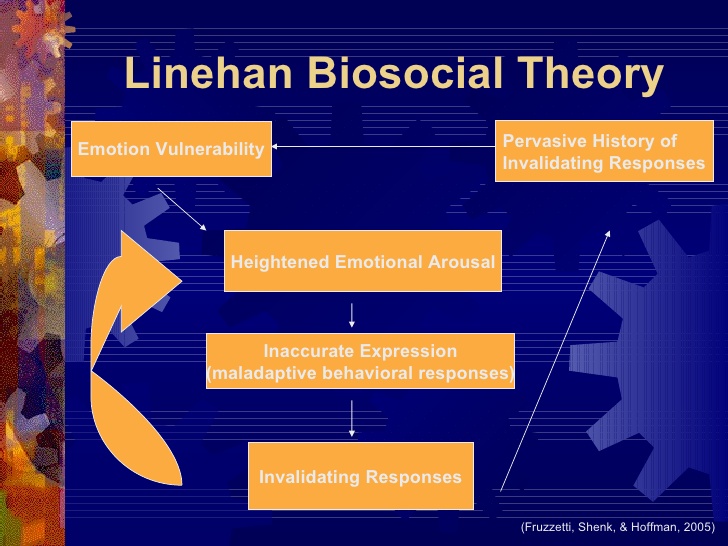
Marsha Linehan’s diagram that shows why BPD doesn’t work well for the sufferer. (click to enlarge)
Borderline personality disorder is ego-dystonic: that is, it isn’t adaptive to the sufferer and their behaviors cause them as much or more misery than it causes others. People with any ego-dystonic disorder or mental illness–depression, anxiety, phobias, certain personality disorders such as Avoidant, Borderline or Dependent–are more likely to seek treatment because they aren’t happy with the way they behave and feel. They don’t necessarily blame others for their own misery, the way a narcissist will do.
Borderlines are also far more likely than narcissists to engage in suicidal ideation or even attempt suicide when they become depressed. They are self-destructive and more dangerous to themslves than others. A narcissist is not as likely to consider or attempt suicide, but if they do, they are more likely to attempt to “take you with them.”
Narcissistic personality disorder is ego-syntonic: that is, it usually is adaptive to the sufferer and in most cases their bad behaviors don’t bother them at all (they don’t care how you feel), they only bother others. This is why narcissists are so unlikely to seek treatment, unless they have lost their sources of supply and are undergoing severe depression (narcissistic crisis). Narcissists are miserable people, but they are far more likely than borderlines to blame others for their own misery.
Both disorders are included under the Cluster B category of personality disorders because both involve a malfunction of emotional regulation. In a narcissist, emotion is strong but is hidden and masked; in a borderline, emotion is strong but cannot be hidden or regulated at all. Both disorders cause others misery, but a narcissist lives a lie; a borderline generally does not.
BPD as a defense mechanism that arises in early childhood.

Both NPD and BPD (and all Cluster B disorders) arise out of childhood from early attachment disorders with caregivers. Both are desperate attempts not to be hurt anymore and have their origins in abuse or neglect as young children. Most narcissists and borderlines were abuse victims as children. Both narcissists and borderlines are incredibly sensitive–so much so, they have constructed almost intractible defense mechanisms to avoid further pain and hurt. Unfortunately for the borderline, their defense mechanism of overreaction to everything is maladaptive and hurts them more than they can hurt anyone else. But due to this, they are far more likely to seek treatment.
Upcoming Post:
Later on, I plan to post an article about Marsha Linehan’s DBT and other therapies for people suffering from Borderline Personality Disorder. (They are similar to the methods used for people with NPD).
 Lucky Otters Haven