I love Delusion Dispeller’s videos. Follow her on Youtube.
This is so inspiring and I love the butterfly she wears on her cheek.
I love Delusion Dispeller’s videos. Follow her on Youtube.
This is so inspiring and I love the butterfly she wears on her cheek.
Schema therapy was developed by Dr. Jeffrey Young for treating personality disorders, which are deeply ingrained patterns of behavior that are not receptive to traditional therapies used for depression, anxiety, neurotic disorders, etc.
(You can read more about how Schema therapy is used for NPD patients here.)
NPD is one of the most difficult of the personality disorders to treat, and it’s rare a patient will present themselves for treatment, unless they have suffered a narcissistic crisis that led to them becoming depressed.
These three videos are part of a graduate school practicum, showing schema therapy in action on a narcissistic patient (non-pathological narcissism/low spectrum NPD).* In the first video (session 1) the patient, “Sam,” has come to therapy because he is having problems relating to his wife and feels rejected by his coworkers. He is easily irritated and shows a number of narcissistic traits, including entitlement and grandiosity. He doesn’t understand or have empathy for his wife’s complaints about feeling hurt by his “brutal honesty.”
In the second video (session 8), Sam begins to talk about himself at five years old, when he broke his arm and felt rejected because his immediate physical and emotional needs were dismissed by his mother, who took him to the babysitter instead of showing the empathy and concern she should have. Then he is asked to relate how “little Sam” feels and begins to explore the emotions he shut himself off from feeling because of his mother’s rejection.
In the third video (session 16), Sam begins to show emotional discomfort as the therapist has “little Sam” (his true self) talk to “Detached Sam” (his narcissistic mask). He admits he wants to be able to show his wife how much he loves her.
Session 1:
Session 8:
Session 16:
Schema therapy is also commonly used to treat people with Borderline Personality Disorder.
* The patient is an actor but this is still an interesting look at how this method of therapy works.
Occasionally I receive emails from people with NPD who have come across this blog and want to be cured. I posted about one of them in this post; yesterday I received another from a man who is considering reparenting therapy for his NPD.* He also plans to administer this therapy to himself due to the fact there are so few therapists willing or able to reparent a narcissist and because the few who do are extremely expensive. I’m not sure it’s possible to cure yourself of NPD, but if it is, I would love to find out more!
I have written about various healing methods in this article, but reparenting seems to be the most promising deep insight therapy that could work on someone with NPD, but only if the patient is both self-aware AND willing, as this man appears to be in his email. (I do not believe most malignant narcissists and psychopaths/sociopaths have any hope of being cured).
It always warms my heart to see a letter like his; I may just be one of those people Sam Vaknin calls a malignant optimist, but because I think NPD is really an elaborate defense mechanism adopted at a young age to protect a too-sensitive true self and may actually be a form of severe dissociation, I don’t think people like this man are beyond hope.
Here is the letter he sent. I love his analogy of curing NPD being akin to having a full skeleton transplant. 🙂
I’ve been reading your blogs on narcissistic personality. I first identified I have a problem with narcissism about six months ago and reading about it has been depressing, and very bleak. I’ve always known I’m self-centred and as a teen used to wonder why my empathy could more or less just switch on and off, often without my conscious control. But it is only since reading about NPD that I’ve realised what my issues actually are: I am convinced I have narcissistic personality disorder – I meet SO many of the criteria and as a method of getting by (or even ahead) in life I have trusted and enjoyed this system of habits and rules.
Narcissistic rage, while resulting in feelings of shame once an outburst had subsided, made me feel I was at least strong and able to defend myself from harm. It made me feel protected from being crushed or wounded, though in recent months I’ve realised it is simply an expression of me feeling crushed and wounded. One particular outburst directed at my lover left me reeling when I realised that if I stepped outside of my body and watched the argument happening, I’d have looked on myself with pity not fear. I’ve seen myself explode in senseless and bitter rage before and so it isn’t frightening to me anymore, it’s pathetic. There’s a line in the Annie Lennox song ‘Miracle of Love’ which I’ve been reflecting on a lot lately:
‘cool is the night that covers up your fears,
tender is the one that wipes away your tears,
there must be a bitter breeze to make you sting so viciously,
they say the greatest coward can hurt the most ferociously…’
I realised then, and especially when I was listening to this song lately that I am a coward, and that underneath my mask there is a scared little child who felt it must have done something wrong to deserve the feelings of being unloved I experienced in my infancy.
I have found your writing so interesting because if there was one idea I prescribed to growing up it was that we are here on earth to love, and as a huge fan of all things Celine Dion (for whom every ballad is a song of true, deep, sincere and selfless love) even the very music of my life was about loving deeply and experiencing life through love to the fullest. Something strange has been going on in the last year, I think my narcissism has reached a dangerous peak (I’m a performer so being the centre of peoples’ attention and lauded by an audience has, I think exacerbated my own self-involvement). I’ve realised through my reading that if I continue using the mechanisms of narcissism to cover up my fear and feelings of smallness, I will never be able to fully receive or give the love I grew up believing in so much. I actually think if it weren’t for all that Celine crazy love song schtick and the benefit of feeling loved unconditionally by my sister that narcissism would have swallowed me completely by now. I desperately want to avoid getting worse and so much of the online data about NPD is written from a victim point of view. The outlook is so bleak, and the process of realising that I am living this way has been almost traumatic.
Particularly difficult is the frequent assertion that because I am a narcissist, I simply cannot feel empathy for others. I will agree my empathy is not allowed to flourish or be of use much of the time because of the walls I put up around myself, but I KNOW I do feel it. Just as deep beneath my masks as my fear of being hurt, or rejected is my little boy self hiding under the bed terrified. And I believe when he sees someone upset, wounded, attacked, he wants so badly to whisper to the person ‘you can hide under here with me.’ I have had moments with friends or loved ones where I know they are sad, have wanted to reach out and hold them and comfort them but these walls I have spring up like invisible fences stopping me from reaching out. It’s as if the little boy wants to go to the friend and hug them and soothe them, but he’s just too scared to come out from under the bed. I believe that deep feeling is empathy. But my fear, learned from a young age has defeated it. It makes me sick. I don’t want fear to win. It’s a bizarre loop because victim-mentality repels me, which I know is a narcissistic trait. And yet it is partly through the fear of being a ‘victim’ and allowing myself to wallow in the bad things that happened to me as a kid which drives me to reject the negative events in early childhood and be a FULL human being, not just a narcissist who passes as one. I want to experience that Celine Dion love, of which I am sure I have felt more than just glimmers and been blessed with from others.

I believe love exists as a two-way street. I believe to receive someone’s love IS an act of love. To give love properly, we must be able to also receive and accept it. As RuPaul says ‘if you can’t love yourself, how in the hell are you gunna love anyone else.’ Well I want to learn to forgive the child inside for being so scared and angry. I want to teach him (myself) convincingly that it was not his fault he was adopted. That it was not his fault that he couldn’t protect his sister from her own demons spawned from the same young events. Or that somehow even if it possibly could have been his fault, it’s okay now. He was just a child.
I want to re-parent myself and unlearn the narcissistic coping mechanisms of devising a false self and put in place a new system. I feel like this is psychologically similar to having a full skeleton transplant, so I know it isn’t going to be easy. I am proposing to change myself in a big, lasting way. I’m choosing to become a proper adult, not ruled by the little boy anymore. It’s time for me to look after him, and I can only do that my knowing him. Knowing what it is I fear, what my true needs are, not just the needs of narcissistic supply. I must make this much clear: I reject my own narcissism. I do not want it. This system of self-aggrandisement, making myself emotionally unreachable, and of behaving so poorly to the people around me isn’t good enough. I want a better life.

Your blog has given me hope that this might be possible. Your compassion has been vital for me today. I’ve been typing this as much to organise my thoughts as to fill you in on what’s going on. I know you will receive a lot of mail, and I know you’ll be all too used to big long emails from narcissists talking about themselves 😛 But I say all this to say that your writing has been understood by me as a shared promise of hope. It’s really a wonderful thing you’ve done and I’m so glad I found your blog. I wish others would get to read it, rather than so much of the demonising bile dominating google on the subject of NPD. I believe it’s bad to try to turn people into cartoon villains. Every behaviour has a cause.
My main goal going forward is keeping mindful at all times of this little boy. I need to become his best friend and always listen to what he’s saying. I need to tell him ‘no we don’t lash out when we feel attacked,’ and help him grow up. He is, after all, me. I’ve had mild moments of self awareness where I have tried to learn more about treatment and even let my walls down from time to time to be honest and show my naked little self to those close to me. It’s hard for them to understand this stuff and unfortunately after a few weeks pass I find the walls have been slowly slowly rising again. Then it takes a big argument or event to knock ’em down and unfortunately one such event has cost me a really important relationship. The loss of the relationship, alongwith increasingly realising my charisma isn’t enough to get me by in life could be defined as my ‘narcissistic crisis.’
As you said: ‘Harnessing these moments of emotional nakedness is like trying to hold onto a dream while awake.’ My next step is to find a method, or try to invent one to keep me mindful. I think reading works like your own frequently, perhaps daily and reminding myself of exactly what my demons are might help. To hold my inner enemies close in this way may help me defeat them. You’ve helped enormously. Thank you.
* I have no idea whether he actually has NPD or has ever been diagnosed with it. He could have some other disorder. True narcissists rarely acknowledge their disorder or desire to be helped, but I’m sure there are exceptions.
Just Plain Ol’ Vic asked me to reblog this powerful post about suicide and the judgment of others about that act of desperation. I agree with him about the importance of this serious mental health issue.Every day lives are lost due to suicide and their shocked loved ones must cope with feelings of grief, shock and bewilderment. I think comments like the quoted one about suicide being a selfish act are immensely insensitive and obtuse.

This is a fascinating article in Psychology Today about what makes certain things universally annoying.
In a nutshell, the things that annoy us most are things that are both repetitive (clicking a pen over and over, for example) and unpredictable (we don’t know when it will stop).
What are the things that annoy you most? For me, the top two would have to be tailgaters and fleas.
Oh, and narcs.
Things that Annoy Us
Post published by Christopher Peterson Ph.D. on Jul 03, 2011 in The Good Life

What annoyances are more painful than those of which we cannot complain? – Marquis De Custine
I just finished reading an interesting book titled Annoying by science writers Joe Palca and Flora Lichtman (2011). The book is a free-ranging and intelligent discussion of what is known about the things that annoy us: what, who, when, why, and how.
The authors make the point that there is no single scientific field devoted to the topic of being annoyed. But plenty of scholars and researchers have weighed in on the subject, which means that such a field – were it to exist – would be multidisciplinary. Palca and Lichtman describe lots of pertinent studies by psychologists, neuroscientists, sociologists, anthropologists, audiologists, musicologists, entomologists (because the things that bug us include bugs, especially when they buzz), and others, and they convey lots of interesting facts from research. But my favorite part of the book was by far the many great examples they use of annoyances, from terrible smells to off-key melodies to repetitive spouses and coworkers.
“Annoyance” refers to whatever bugs us (stimulus) and also to the emotional state we experience when being bugged (response). The book starts with a discussion of just what kind of emotional state annoyance might be. It is akin to anger, but not identical. It is akin to disgust, but not identical. And it is akin to frustration, but not identical. The conclusion, according to the authors, is that annoyance is its own emotional thing and deserves examination in its own right. I agree.
Palca and Lichtman observe how difficult it is to find a universal formula for what is annoying, but they take a stab. Annoyances are unpleasant but not terribly so, at least not when experienced one at a time. Rather, it is when they are repetitive and at the same unpredictable (that is, when we do not know when they will cease) that they get under our skin.

A one-time explosion on the street surprises and frightens us, but it is not annoying. Our neighbor’s music, played over and over, night after night, is highly annoying. Boom boom boom.
A coworker who constantly badgers us, belittles us, and bullies us is a bad person, but he is not an annoyance. He is an asshole. In contrast, a coworker who tells us the same joke hundreds of times is not a bad person, but he is an annoyance, and his laughter after each telling becomes like a fingernail on a blackboard, not life-threatening but certainly life-diminishing.
A cancer is a tragedy, and those who deal with cancer by being courageous earn our admiration. A blister is an annoyance, and those dealing courageously with blisters earn little or no regard from anyone. Indeed, if you complain about a blister, you risk becoming an annoyance yourself.
Context matters. Our own wind chimes strike us as beautiful, whereas those of our neighbors are annoying. Along these lines, the authors cite other people’s acronyms as annoying, at least when they are unfamiliar to us, whereas our own acronyms are efficient, entertaining, and even elegant*.
Culture matters, too. Apparently there are cultures – like Yap or Japan – where one simply does not express annoyance. I suspect, though, that annoyance as a private experience nevertheless occurs.
Epidemiologists have long known that major life events – like divorce or job loss – can lead to poor physical and psychological health (Holmes & Rahe, 1967). A more recent realization is that mundane hassles – like having to take care of a neighbor’s pet – also put people at risk for poor health (Kanner, Coyne, Schaefer, & Lazarus, 1981). Indeed, because hassles are usually more common than major life events, the damage they do in the aggregate may be greater. Annoyances are a version of hassles, I think, and they too may be deleterious. Maybe hassles take a toll precisely because they are annoying.
Things that are annoying grab our unwilling attention, and that may be the reason annoyances are so … how to say it … annoying. They prevent us from paying attention to other things. Palca and Lichtman give the all-too-familiar example of an overheard cell-phone conversation to which we are subjected on a train or bus. We don’t want to eavesdrop, but we cannot help ourselves. And the fact that we only hear one side of it (what is called a halfalogue) makes it especially distracting and thus highly annoying, as it goes on and on and on. Maybe the human tendency to make sense of the world is coopted by hearing half a conversation more than it is by hearing both sides. Is this why political talk shows where “hosts” and “guests” talk over one another can be so annoying?
Why do we have the capacity to be annoyed? Maybe there is no real purpose for this capacity. It’s like an appendix or wisdom teeth. But to extrapolate from Darwin’s proposal that negative emotions like fear and anger are warning signals that lead to appropriate actions to avoid or undo pending danger, perhaps annoyances galvanize an appropriate reaction to whatever distracts us from what paying attention to what really matters, not a bad skill for people to have in their repertoire. Along these lines, Palca and Lichtman speculate that annoyance alerts us to a violation of our expectations about the way things are supposed to be. They use the example of off-key notes for people with perfect pitch.
Is there a positive emotion that corresponds to annoyance? It would be a mildly pleasant experience that results from a repetitive yet unpredictable stimulus. Psychologists have termed these uplifts (Kanner et al., 1981). The unprompted smiles or giggles of our children would qualify. Given that the origin or the word annoyance is from an Old French verb meaning to cause problems, perhaps anything that provides a solution to a minor problem would also qualify, like parking spaces that appear when we most need them.
Is being annoyed an individual difference? Relevant research has just begun, but the answer appears to be yes. There are some people who are annoyed by lots of things and others who are annoyed by very few. Indeed, some research even links the propensity to be annoyed to particular genes, those associated as well with some forms of bipolar disorder. In any event, I bet that the frequently annoyed are less satisfied with life than those who are unflappable. Palca and Lichtman speculate those who are frequently annoyed may themselves be frequently annoying.
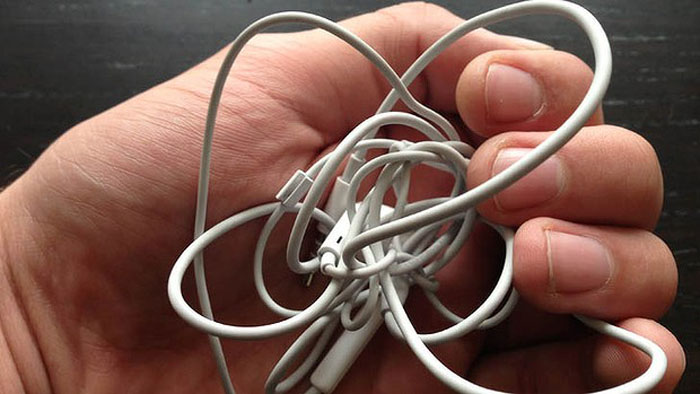
Said more positively, experiencing few annoyances contributes to the good life, for the self and others, and perhaps folks with few annoyances simply have higher thresholds. It is hard to imagine that the Dalai Lama gets annoyed very often, and maybe meditation that trains attention is a useful practice for changing one’s annoyance threshold.
If annoyance plays some useful role, though, we would not want to banish it completely. Otherwise, we would simply pay attention to anything and everything without any attempt to sort through them, which may be fine for a kitten or a puppy but not for a person.
Most of us are annoyed by some things some of the time and by other things all of the time. Whatever pushes our buttons may be as much a personal signature as the things we love or the things that we do well. Maybe personal ads should list our annoyances as well as our interests. If a shared annoyance can forge a common bond, perhaps annoyances have a silver lining. Perhaps.
Familiarity does not breed contempt, but it can breed annoyance. Maybe a sign of true love is not being annoyed by what another person does, no matter how unpleasant, repetitive, and unpredictable it might be. Rather than defining love as never having to say you’re sorry, maybe we should define love as never having to say you are annoyed.
Along these lines, several chapters of the book grapple with interpersonal annoyance, raising the intriguing point that the initially endearing traits and habits of a romantic partner may end up being highly annoying and even the source of breakups. So, we may fall in love with someone who is funny, or someone who is stolid, or someone who is attentive, only to fall out of love as time passes and the person is experienced as clownish, or unexpressive, or clinging. Nothing has changed except ourselves and the experiences that have accrued – which is to say everything has changed.

One of the standard bits of positive psychology advice for couples experiencing rough times is for each to remember what was initially attractive about the other. But in some cases, a displeased partner may not need any reminding at all. To quote football coach Dennis Green’s famous rant, “They’re who we thought they were!” Better advice would be to reframe what has become annoying or to find something else that is attractive. For lasting love, this may be an ongoing process. No one ever said that love is easy.
* It has been suggested that the US Army invented acronyms. I doubt that is true, but members of the military seem to revel in them. I have done some work with the Army over the past few years, and while I have the utmost respect and admiration for those who wear the uniform of the country, my good feelings come to a screeching halt when Soldiers start tossing out acronyms, as some are wont to do. My all-time least favorite is POV, an Army acronym for personally owned vehicle. That means car, for goodness sakes. When I meet with members of the military, I sometimes request that the meeting be a DAZ-meaning de-acronymed zone. Just say the words, sir or ma’am, at least if you want me to pay attention to the content of what you say and not be incredibly annoyed by how you say it.

The other day, I posted an article about the insidious way narcissistic parents can turn scapegoated children into lifelong victims. I was thinking more about this matter today (because I was feeling victimized at work) and I think I understand what happened to us to make us such easy targets for victimization and why we are usually shown so little respect by others.
First, there is nothing wrong with you. You are not mentally deficient, defective, worthless, or unlikeable. You deserve respect as much as anyone else does. You are no less valuable than anyone else. Later in this article I’ll explain what it is about us that makes us get treated like this so often and why.
There are ways to tell if you’re an adult victim. The abuse we get is more insidious than the treatment we got from our parents or childhood peers. As adults, we are not likely to be straight-up bullied the way children and teenagers are because most adults have learned it’s not okay to bully others. Instead, the abuse manifests as a lack of respect and being treated as if we don’t exist or don’t matter.
How to tell if you’re a victimized adult.

1. You find it difficult to make friends.
2. You are always overlooked for promotions or raises in the workplace, no matter how well you do your job. You may also be overlooked for special privileges when they are given out. If you ask why, no one ever seems to know how to answer you.
3. People leave you out of social events like parties or casual get-togethers.
4. If you were a scapegoated child (and most likely you were if you are victimized as an adult), even your FOO (family of origin) probably leaves you out of family events such as weddings, births, and reunions. You were probably disowned or written out of the will. You are the “black sheep” of your narcissistic family.
5. People talk over you or act like you are not there.
6. If you speak, people act like they didn’t hear you or ignore what you just said.
7. You are treated like a piece of furniture. People tend to physically push you aside, invade your personal space, or act like you are in the way. In a small group of people, they may shift their positions so you become shunted to the side or back so you don’t have a place in the circle. It isn’t really hostile; it’s as if they literally don’t see you.
8. People tend to treat you in a condescending manner, as if you are mentally defective.
9. People like to “mess” with you or make jokes at your expense.
10. In a work environment, even your co-workers may be more critical of you than they would be with others–even if your work is fine. You may notice people try to boss you around who have no real right to.
11. People may treat you as if you annoy them.
It is not your imagination that you are treated this way. You are not just being paranoid or over-sensitive (though people will tell you this). You really are being treated like this, and it’s because as children, we were trained that we were nothing and that we did not matter. We internalize these messages and carry an attitude of being undeserving of fair treatment into adulthood. People treat us the way we regard ourselves. If we think we are nothing, we will be treated like we are nothing, even by non-narcissists.
How being an adult victim can further damage us.

Being scapegoated by narcissistic parents is child abuse, and is thoroughly evil. It can destroy a person for a lifetime. The victimization we continue to get as adults is also very damaging, and exacerbates our already dismal self esteem. Here are the ways being a victimized adult can make you feel.
1. You feel like you have no place in the world.
2. You feel unloved by everyone.
3. You believe you have no value.
4. You feel isolated and apart from the normal world.
5. You fear you may actually be stupid, incompetent or annoying.
6. You are prone to deep depressions and extreme anxiety, especially when having to deal with other people.
7. You feel envious of others for being treated with more respect than you are.
8. You feel envious of others for having loving families who care about them.
9. You feel envious of others for having friends and an active social life.
10. You feel like you are constantly having to apologize.
11. You feel like life is unfair and the world is a hostile and unfriendly place.
12. In many situations you feel like you’re on the outside looking in.
It comes down to boundaries. As adult victims, we don’t have any, or have very weak boundaries. We never established boundaries when we were young because we were (1) never trained to do so; and (2) because our early boundaries were constantly being violated.
People can sense when a person has very weak or non-existent boundaries. That’s why we continue to attract narcissists as friends, lovers and spouses. Narcissists know easy prey when they see it.
Why personal boundaries are so important.
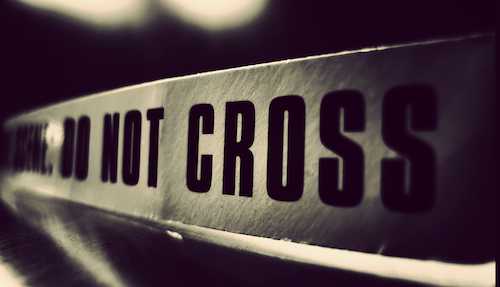
Even among non-narcissistic people people, we are seen as prey because we appear to lack boundaries. Even near-strangers are constantly stepping over the line and treating us with disrespect, even if their behavior isn’t outright abusive. It’s as if most people have an invisible line drawn around them that must not be crossed. People “see” this line–or sense it–and will respect it. But if you never established boundaries or they were destroyed by your narcissistic family, there is no invisible line drawn around you, and people will constantly step over it, because they believe it’s okay for them to do so.
The solution seems easy enough–just establish some boundaries and tell people when they are violating them. But this is much easier said than done. Most of us have such low self esteem we are terrified of letting others know it is not okay to treat you this way. We are terrified of being criticized or told we are just being “too sensitive” or paranoid. We see other people standing up to those who violate their boundaries without repercussions, but we fear that if WE do it, we will be attacked or criticized, because we were trained to believe this.
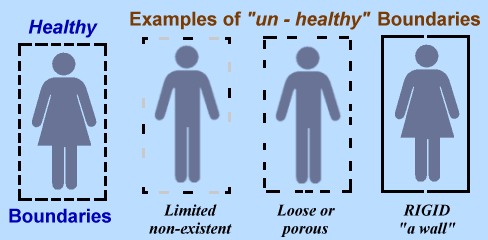
The sad news is that it isn’t incorrect to believe you will be attacked or criticized or told you are overreacting if you try to stand up for yourself. That’s because people don’t like change. If people have become used to you as a mousy, fearful person with no personal boundaries, they are not going to like it much should you suddenly point out that you have some. But it doesn’t mean you are worthless and it also doesn’t mean you must forever continue to submit to this kind of treatment.
In any group, there is usually one scapegoated (or disrespected) person, and that person is the one who is seen as having the weakest boundaries (and is probably also the most sensitive, which is why we were chosen by our families to be scapegoats in the first place). Unfortunately the human condition dictates that even for normal (non-narcissistic) people, there is going to be a pecking order. This system can be observed in most animals and even some birds, like chickens. People–and animals–feel more comfortable when there is one person around they can pile on. If you suddenly announce they may not pile on you anymore, they are not going to be happy about it and will probably take out their frustration on you. It isn’t fair, but it seems to be in our human nature.
Can anything be done?

Yes, but it may be necessary for you to start over in a new place or a new job if this is happening to you. You will need to make it clear from the very beginning that you are to be treated with respect. This means the very first time you observe one of the above behaviors directed toward you, you must nip that in the bud and let the person know it is not okay to treat you like this. Doing this will be one of the hardest things you will ever have to do, because we are so afraid to speak up for ourselves. But if we have not been established yet as a victim or at the bottom of the pecking order, letting others know (nicely, of course) that we will not tolerate this sort of behavior should help. Once your boundaries are made clear to others, you will be treated more like a human being and less like a worthless piece of furniture.
If you cannot start over (and many of us can’t, because our lifetime problems with boundaries and self esteem have made it impossible for us to be able to earn the kind of living that would enable us to move elsewhere or leave a job), then you will need to go ahead and try to speak up for yourself anyway, and risk the fallout. If you find this impossible to do, then you will need to find a support system or a group that does not know you the way you are. You can join a church group, attend group therapy, or take a class. Or you can find supportive people online. For those of us who are introverted, like myself, this may be the most effective way to have a voice and be treated the way you want to be treated: like a human being worthy of respect.

Keep telling yourself every day that you are not worthless or defective, because you are not. There is nothing wrong with you! Your only problem is that the family that raised you did not respect or love you the way they should have–not because you aren’t deserving of love or respect because every child is–but because as narcissists, they could not. You served a role for them as the family scapegoat.
A good therapist–or keeping a journal or a blog–can be a good way to help you deal with your past, the family that destroyed your sense of self esteem and boundaries, and help you overcome your fears and begin to act more like a person who is to be treated like everyone else.
You are worth it.
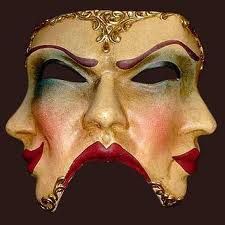
After I posted my article 12 Weird Things You Might See a Narcissist Do, I thought of a few more things so I am adding them to the list.
I also had fun writing that post, and I’m in a rotten mood so writing this might make me feel a little better.
1. They react to events inappropriately.

This is actually one of those things that’s pretty well known about narcs, but it’s so weird and disturbing I had to put it here. Narcissists don’t feel emotions the way normal people do, and often have the opposite reaction to things you would expect. They love it when something bad happens to someone else. They might laugh when someone gets fired, is dumped by their lover, or falls down and breaks their neck, but because they are also pathologically envious, they will sulk or become upset if someone shares good news. They can’t stand it when good things happen to other people and will try to ruin their moment for them. This may get them negative attention, but is effective because it takes the attention off the person with the good news. Narcs don’t care if they get negative attention–it’s still attention and that’s what they crave.
2. They cry without tears.

This is one of the weirdest things about narcissists. Narcs will shed actual tears for themselves if they’ve been hurt or denied their fix of supply (and they can shed enough tears to float the Queen Mary if that’s the case), but in a situation that calls for crying, such as a funeral or other sad event, they can only pretend to cry, and this means their eyes will remain dry even if they appear to be crying along with everyone else. To hide their dry eyes, they will probably keep their face covered. I’ve also seen psychopathic or malignant narcissist criminals on the witness stand attempt to shed tears to show remorse, but their dry eyes prove this is just an act.
3. Their laughter is strange.

Narcissistic laughter sounds forced to me, and is usually way too loud or contrived sounding. It’s unsettling to listen to and I also noticed the way everyone in the room goes silent when the narc starts to laugh. They also laugh at inappropriate times (see #1).
4. They either care too much about their appearance or don’t give a damn how they look.

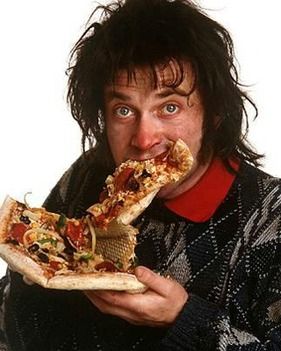
A somatic narcissist will care way too much about the way they look, obsessing over their weight, hair, clothing, health or makeup, or if a man, over their health, abs or muscle mass. But many cerebral narcissists, including women, don’t give a damn about their appearance. In fact, their personal hygiene and grooming is sometimes downright disgusting. It’s almost as if they think they’re too smart to be bothered with trying to look decent. I’m acquainted with a cerebral narcissist who has lost all his teeth because he never bothered brushing or flossing, his breath stinks, and he has terrible B.O. His clothing looks like he found it at the bottom of a trash bin and his pants are threadbare in the butt, always too big and he doesn’t bother wearing a belt so you can see the top of his butt crack. His fingernails are long and caked with black dirt. He wears flip flops even in the winter and his toenails are thick and brown with fungus. And as a bonus, he keeps a old coffee mug in his bathroom filled with his own hair and refuses to throw it away. I have no idea what he saves it for, but it’s disgusting.
5. They are either neat freaks or their homes are pig pens.


Related to the above, most somatic narcissists are neat freaks or germ-a-phobes, and live in houses that look like museums or are so sterile they look like doctor’s offices. But some cerebral narcissists live in squalor, wallowing in their filthy surroundings like a pig wallowing in mud.
My son posted this and I think it’s great. He refuses to identify with any major political party. I’m realizing I don’t really have a political affiliation either. I’ve always identified as a liberal Democrat but sometimes I’m conservative too. Maybe I’m really just in that gray area.
I try to keep an open mind about anything political and I’ve never been one to judge others by their political affiliation or religion. You miss out on meeting so many amazing people if you do that. Some of my favorite people are on both sides of the political spectrum.
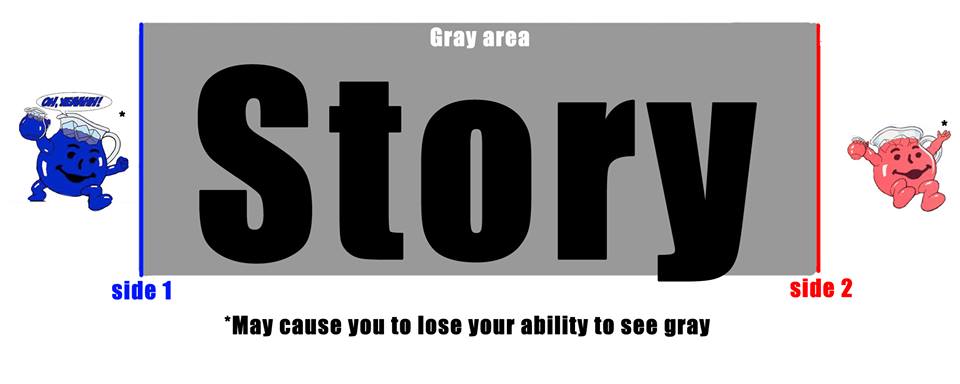
Click to enlarge.

This post is going to suck.
Today I’ve been obsessing about the hefty lump sum payment my sperm donor is getting in SSI back pay for the seven years I supported him. I have never heard of anyone getting such a large lump sum from the government nor do I know of anyone who will be getting the amount every month he will be raking in.
So now I’m having to cope with the nearly unbearable sting of envy AND righteous anger (because if I hadn’t supported him all those years he would not have been able to sit at home and go through the whole disability application process, which took almost that long; and also because his payments were increased because he’s “homicidal”).
I’m beyond enraged that I have to continue to toil away at a job I dislike, that really doesn’t suit my personality or interests and I have no health insurance, while he will be living quite well off the benefits my goodwill made possible for him without having to work. All because he’s “homicidal.” (I do not know what his diagnosis was. I’m surprised there would be compensation for something like ASPD; maybe it’s his fake “schizophrenia.”). I think he’s gaming the system.
When he was over here on Sunday collecting his belongings (and trying to take some of mine), he started talking about the pottery classes he’s going to take with some of the money and the new car he’s going to buy (I have to drive a 14 year old clunker that’s got an expired registration because I can’t afford to get the tuneup it desperately needs). I finally told him I did not want to discuss money. I didn’t want to think about it, and I’m sure he was rubbing it in on purpose.

Must be nice. Yes, I’m bitter. I hate feeling this envious. It’s bad enough on its own, but add to that the GUILT I feel over being consumed by this…narcissistic emotion. I don’t think there’s any uglier or more painful emotion than envy, in this case envy mixed with righteous anger. I’m praying for God to remove this horrible character defect before he actually gets his lump sum payment, because I have no idea what I will do when that happens.
Maybe he sold his soul to the devil or something, because no matter what, he always seems to come out on top in the end.
Where’s Karma when you need her?
Who will take care of me if I become disabled so I could apply for benefits?
I wish I could just stop feeling like this. I sound like a damned baby.
GOD, I hate this.

