Self-pity and self-compassion: there’s a huge difference!

self-compassion

I read a post yesterday on another blog that I agreed with, except there was one thing that didn’t quite sit right with me. The post said that self-pity is an important part of healing from Complex PTSD.

In his book (which I’m still reading), Complex PTSD: From Surviving to Thriving, Pete Walker says that self-compassion is an important part of healing, and I think this is what the blogger actually meant. But self-compassion isn’t the same thing as self-pity, an activity which I don’t find at all healing and in fact seems to make my problems worse. Of course we have the right to engage in self pity from time to time (and probably can’t help doing so), and no one should deny us the right to do so. But for me, it just doesn’t work. It’s an unpleasant, soul-sucking experience that seems to drive my negative programming even deeper than it already is.

The way I see it, the difference between self pity and self compassion is analogous to the difference between pity and empathy. I think this makes the distinction clearer.

Pity has an element of condescension or even contempt. You pity someone you dislike or look down on. It’s kind of like sympathy but it’s contaminated with judgment and scorn. You feel like you’re “better” than a person you pity. A wealthy banker may “feel sorry” for a homeless person without feeling a shred of empathy. The banker is glad they’re not homeless, and feels as if they’re above that anyway. If someone says “I feel so sorry for you,” or “I pity you,” you’re likely to feel offended and judged, not comforted. I hate being pitied so much I might be tempted to punch you if you do.

Superficially, empathy, compassion, or sympathy may seem like the same thing as pity, but they’re not the same at all. Sympathy means to feel sorry for someone without judgment or condescension, but it’s not quite the same as empathy, because it lacks the sharing of a feeling. It’s a shallower emotion, but it’s still better than pity. Compassion and empathy are interchangeable and both imply feeling “with” another person, or sharing an emotion with them. It’s giving your friend a heartfelt hug after a breakup, or laughing or crying with them when they’re happy or sad. It’s giving a homeless person your own sweater because you hate to see them shivering in the cold. There’s no condescension or judgment. When someone empathizes with you, they say, “I understand” or “that really must have hurt.” Doesn’t that feel a whole lot different than someone telling you, “I feel sorry for you.”
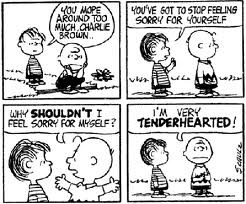
charlie_brown_tenderhearted

Self-pity is part of our toxic programming. It’s driven by shame. Self pity is when you sit around and think about how much your life sucks and how much YOU suck. There’s no self-nurturing or comfort in self pity, no self love, only self-hatred and shame. Self-pity enforces the terrible things we’ve already come to believe about ourselves. If we’ve been told time and again how stupid, bad, clumsy, ugly, or what a loser we are by our narcissists, eventually those voices become internalized and we develop a toxic inner voice called an Inner Critic. When you’re stuck in self pity, that’s your Inner Critic demeaning you and repeating to you the same lies about yourself your narcissists already drummed into you. You learn to abuse yourself, and self-pity is just self-abuse. When you say, “I suck” or “I’m a loser” or “nothing ever goes right for me,” you’re reinforcing the toxic programming and acting as a flying monkey against yourself.

Unfortunately, for those of us who suffered from narcissistic abuse, it’s common to wallow in self pity. It’s an all too familiar state of mind, but it isn’t the real you. The things we tell ourselves when we’re stuck in self pity are lies. When I get stuck in self pity, I feel just horrible. I just want to die. I usually wind up feeling resentful and angry at the world, but also ashamed of myself for being such a helpless victim and pathetic loser. I’m consumed with shame and guilt, which leads to depression. I also can’t release the negative emotion when I’m in self pity mode. I get stuck there and it drags me down and saps from me any energy or joy. I’ve had hangovers that felt more pleasant than a bout of toxic self-pity.

self-pity

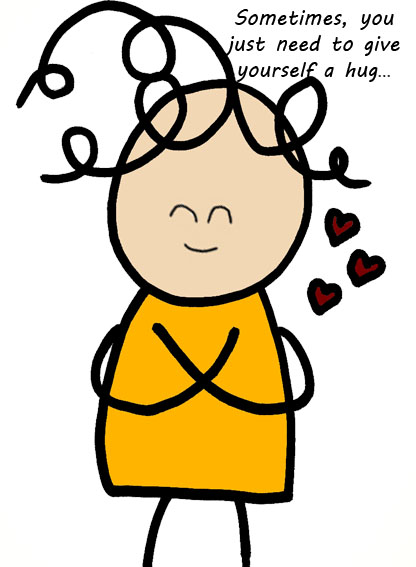
You can replace self pity with something much better that also feels a heck of a lot nicer: self-compassion. Self-compassion means acknowledging that you are a human being worthy of love, happiness and the good things in life, while empathizing with your inner child’s hurt over not having gotten those things. You give your inner child permission to feel sad or to grieve and agree with them how unfair it is that she/he got cheated or was abused. This may seem like self pity, but it’s not, because the element of judgment and shame isn’t there. You’re not beating yourself up over how terrible you think you are; you’re telling yourself you’re good and deserve better and allowing yourself to grieve. Instead of covering up your inner child with a paper bag, you’re offering her a hug.

It helps me to actually visualize my inner child. I have her talk to me and tell me what she needs and wants. I don’t judge her or try to shut her up; I just listen. If she feels sad, I tell her those feelings are valid and let her feel sad. If she feels mad, I let her express the anger (but at the same time reassure her she won’t be able to hurt anyone or anything because I won’t let her). I find that by non-judgmentally listening to what she wants and needs or how she feels, I’m eventually able to release any negative emotions and I don’t get stuck. By giving myself permission to feel without self-judgment or self-shaming, sometimes I wind up being able to cry, and as weird as it sounds, that always comes as such a relief. When I’m stuck in self pity, these healing tears never come, because the shame that’s been programmed into me won’t allow me to release them. My programming tells me the massive lie that crying is shameful and weak, when in actuality it’s sometimes the most healing thing you can do. Your Inner Critic is a narcissist who doesn’t want you to heal and that’s where all that awful self pity comes from.

The waif inside.

bigeyedchild

Tonight’s therapy session definitely made up for the one I had on Monday, which I felt wasn’t very productive because I seemed to be deflecting and avoiding talking about my feelings.   I asked my therapist to stop me if I did that again, even if I get angry.   He agreed to this and tonight I dove right in.

We were talking about myself as a little girl, especially the way I was never allowed to express my emotions, especially anger.  He wanted to know what I did with all that anger.  I thought about it for a minute, and told him I turned it toward myself, and that’s why I started to become so depressed and why I started to hate myself .  He asked me to put my mind inside the mind of “little me” and describe how she felt and what she looked like.

We came up with a picture.  I described her as a waiflike child, like those paintings from the ’60s of those sad, big eyed little kids, dressed in rags, with a gray, unhealthy pallor.  She is always sad, almost always crying.  She’s afraid of everything.  She feels completely defenseless and in fact she doesn’t have any defenses.   She was never allowed to grow up.

I was asked how I felt about her.  I said I didn’t hate her, that in fact I felt protective of her and had to keep her safe from harm.    She also makes me feel angry when she comes out without my permission because she’s too vulnerable and defenseless and that makes me feel ashamed.   I have to protect her, but I also have to protect myself by keeping her hidden away so she doesn’t embarrass me.

It was harder to talk about her feelings about me, the way she views me.   All I could come up with was that she felt like I kept her safe but wishes I’d let her out more.  I realized then that it was easier to describe my feelings toward her than to describe her feelings toward me.   I’m not completely disconnected from my true self, but dissociation is present.

He asked me what good qualities she has that I want to protect.  I said she has a kind, gentle soul and a big heart.  He asked what she wants.  I thought about it and said, “all she wants is to love and be loved, and to belong.”  I got emotional at that point and started tearing up.  I wasn’t able to describe the emotions I was feeling at all, but I knew we’d made some progress.   He wants to start seeing me more often.   Somehow I’m going to find a way to afford it.   This type of inner child work is hard, but it’s amazing.

A very unpleasant dream.

dontleaveme

I need to write this down where I’ll remember this later.

I just woke up from a dream. I must remember this one so I can tell my therapist. Right now I’m still rising up from the fog of sleep and my memory of the dream is still fresh but will fade away soon so I can’t delay in writing it.

I am waiting to see my therapist. But my therapist isn’t my therapist. He is my old therapist (the one I had when I was 22, the one who I fell madly in love with and had to leave because my emotions were too painful). But he is still my current therapist. (I know, but it made sense in the dream.)

Someone is talking to me and I’m crying. It’s not a bad cry or a painful cry. I think I’m crying in empathy. I don’t know what I’ve been told or what emotion I’m feeling, but my head is thrown back and tears are streaming from the sides of my eyes and down into my hair. My lashes stick together. I’m wearing non waterproof mascara; I’m vaguely aware the black tear tracks will be visible to my therapist even after they’ve dried. I leave them there, almost proudly, intending for him to see. We’ve been working on getting me to cry in session. I need for him to see the evidence of my tears.

His office is in some kind of art complex. Outside, patrons are walking around looking at and purchasing art. My handsome therapist comes out, as he always does in real life, to ask me kindly to give him another five minutes. But this time, his face worries me. He looks worried or concerned. He tells me there is something he needs to tell me. I feel the blood drain from my face and my heart curls up into a tight ball as if to protect itself from whatever’s coming.

“It might disturb you, but don’t worry,” he says. And then he walks away.

Of course I worry. In fact, I panic. I go back out into the art complex and walk around, pretending to look at the art. There seems to be a party going on. People are dressing in costumes. I think about what my therapist has to tell me. Is he sick? Going to dump me? Leaving town? Is he going to die? Dread and my old friend, Fear of Abandonment, holds me fast. I can’t escape. My breathing quickens and becomes shallow. My tears have dried and I can’t make anymore even as I will them to come.

Soon I see my therapist laughing with a woman, a beautiful woman. I wonder if that’s his wife.
My therapist turns, approaches me. I freeze in place, almost drop the raku vase I’m holding.
I start to cry when our eyes meet.
But pride takes over.
“You’re an asshole,” I say, rubbing my eyes with my fists like a spoiled child. I no longer want him to see me cry. I don’t want him to have the satisfaction.

He looks angry.
“I’m not going to see you when you talk to me that way,” he says. I look at him dumbly, stunned into silence.
“But what about–?”
“I’ll see you next time,” he says, and turns on his heel and walks away.

He might as well have just stabbed me in the stomach. I feel as if I could collapse onto the floor. I want to disappear. The shame and anger is overwhelming. And I have to wait to find out whatever horrible news he has to tell me. I think he’s trying to torture me.

I’m still in the art complex and people are walking around as if the world didn’t just end. All the therapists in the office are milling around too, drinking out of cocktail glasses with ridiculous little plastic umbrellas and other doodads sticking out of them. Someone has set up a cash bar at the far end. My therapist is over there, laughing with the other therapists. I feel like I don’t exist.

One of the therapists gets up on a podium and says we are having an animal costume contest. We will be dancing to “Old McDonald Had a Farm” in our animal suits. I don’t want to be there, but I feel obligated to participate. A huge box is pulled out from somewhere and everyone rushes over and starts pulling out costumes. All I can find is a chicken head and a silly cowprint suit. Somehow it seems familiar to me, as if someone in my past had worn this same costume before. I put it on and feel like I can be invisible in it. I just want to die.

I woke up and was overcome with relief when I realized it was only a dream and knew I had to post it right away. I haven’t worked out what it all means yet, but I’m pretty sure I’m skirting around the edges of the yawning black hole at my center, where my abandonment and early attachment issues live. I’m about to dive in there, I guess. It’s interesting that even though I trust my therapist more than anyone I’ve ever known, and he has given me NO reason to think he would ever abandon me, this fear I have of him abandoning me seems to be a recurring theme in our sessions. Obviously my transference toward him has been successful and I’m replaying some kind of abandonment/rejection trauma I experienced when I was a child.

Come closer…go away.

I hesitated about posting this here, but I’m going to take the plunge and do it that because I’ve never once regretted “running naked in public.” (I haven’t changed the URL yet because it costs money for me to do that so I have to wait.)

Always waiting for the other shoe to drop…

afraid-to-be-happy

I think I made a kind of breakthrough in my therapy session tonight. For years one of my problems has been this overwhelming fear that something bad will happen to one of my kids. (I don’t like to even say the D word because I irrationally believe if I say it, I’ll somehow make it happen, by putting it out into the universe or something).

Of course all parents worry about their adult kids, especially when they know they’re out there somewhere in cars, which we all know are dangerous hunks of metal capable of the most ghastly and gory deaths you can imagine and operated by countless idiots and drunks on the road who can’t drive. I think my apprehension about something bad happening to my adult children edges into OCD-type territory though, because of how overpowering and pervasive these thoughts are, intruding where and when they are not welcome, even though I know that in all likelihood, something bad will NOT happen and even if it does, worrying about it excessively is like living through it twice. I think about my hypothetical reaction to such an event and wonder how I would retain my sanity, if not my will to live. I always marvel at people who have lost a child in a sudden manner like a car accident (a long illness is more bearable because you have time to prepare for it and process it) and wonder how they can still go on with their day to day activities–going shopping, paying bills, working at a job, watching a movie, hell, even having FUN sometimes. I know that wouldn’t be me and I obsess over how I might react.

I’ve been so haunted by the remote possibility of getting THAT life-changing phone call late some night (you know the one), that it’s even been a recurrent theme in my writings. I had a dream over a year ago about losing my son, and wrote a post about it, called Losing Ethan.

fine_line

Anyway, I decided to bring up this problem because it doesn’t exactly make my life happier and it annoys the hell out of my kids. The first thing my therapist did was tell me to stop BEING those feelings, but just OWN them. In other words, he’d noticed that when I talk about bad feelings that make me ashamed or anxious, I always use the term “I am….” Instead he told me to practice saying, “I feel…” or “I have…” In this way, you create a bit of a distance between yourself and the bad feeling. That doesn’t mean you don’t feel it, but with a little distance, the emotion can be explored, almost from the viewpoint of a third person. Ironically, what happens is you feel the emotion MORE (I can’t really explain why that works but it does).

His advice was brilliant, because a few minutes later, I made a connection. In 1998, with my then-husband in jail, I was forced to learn to drive his stickshift truck. I had to teach myself and never learned to park the truck properly. So after picking up my kids from their after school program and pulling into our driveway, I set it to Neutral and the truck began to roll downhill–containing both my kids, then ages 5 and 7, straight toward a TREE. The events that played out next are described in this post, called The Tree.

The important thing is, I’d connected this traumatic event in August of 1998 to my current obsessive thoughts about tragedy striking and generally always feeling like I’m about to receive some devastating news–and I knew immediately that these unpleasant thoughts are based on guilt and shame. I started to tell my therapist that I always felt guilty that the truck had rolled and that I *could* have killed them. For about 10 years I couldn’t even talk about it, because any time I did, I’d start feeling very dissociated and anxious. My ex knew how to press all my buttons, and knew this was my biggest one. If he wanted to upset me all he had to do was remind me what a rotten mother I was to almost kill my kids that night because he knows I’m still struggling with guilt over my failure to protect them, my failure to be smart enough to know how to park a stickshift.

I’m always very mindful of my body language, voice and gestures when I’m in session, probably as much as my therapist is. These things can tell you a LOT about yourself, not just about others. And I realized as I was making these connections that my body relaxed and I leaned back but my voice became softer and sadder. I was opening up to him in a way I hadn’t before. He just listened, with what appeared to be a great deal of empathy.

somedays

And at some point I felt tears come to my eyes. My eyes just barely glistening, tears not overflowing, but there, making the backs of my eyelids feel warm. I looked off to my left like I always do when I get deep into stuff, and kept on talking. I felt myself opening up and feeling some kind of generic emotion that wasn’t sadness and wasn’t guilt and wasn’t gratitude or joy but was none of these things and yet all of these things. I wanted to share all this with him. I heard myself speak and my voice became thick and my eyes burned again.

There was more, much more, but I’ll end this here because I’m getting emotional writing this. The important thing is, I almost shed tears in front of my therapist tonight. That might not seem like such a big a deal, but for me it was a huge deal because I haven’t been able to cry in front of another human being in about 15 years–which I realized is when THAT happened. (It might have been longer than that though–my memories of the time I was in my horrible marriage are gray, shadowy and even have yawning gaps in places).

What happened tonight is only the proverbial tip of the iceberg–I was seriously fucked up for a very, very, VERY long time, at least since age 4 or 5–but it’s significant because it means the wall in my head that prevents me from really being able to connect to my emotions is developing a few weak spots.

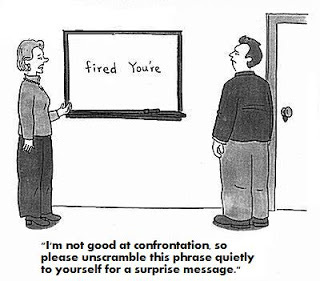
Introverts fear confrontation.

youre_fired

I came across this individual’s forum post on The Personality Cafe in a weird way. My article “Why Family Scapegoats Become Lifelong Victims,” (which has become my most viewed article ever and is still gaining momentum on the web), was linked to by this writer and there was an excerpt from their own post left in my comment folder. The blurb was intriguing enough that I decided to read it, and holy cow! It sounds like my own life story. In fact, I am going through this situation with a friend even as I write this. (If you’re a friend of mine reading this it’s not you–this “friend” doesn’t read my blog or even know I have one). I don’t want to be friends with this person anymore (who I suspect is a malignant narcissist who likes to “play” with me and make “jokes” at my expense) but instead of confronting them and telling them I want to end our friendship, I’m just avoiding this person, hoping they get the “hint.” I do that sort of thing all the time. Confrontation terrifies me, but what happens is my anger becomes seething resentment and has to come out eventually, so after weeks or months of pretending everything is fine, I’m likely to explode and say things I regret. It also comes out in other ways, like acting passive-aggressive. I’ve gotten better but it’s still a problem. Anyway, here is that article. The writer is an INFJ like me and wonders if this is common in INFJs. I’m also an Enneagram Type 4/5.

If we need to slap a psychiatric label on this sort of behavior, it’s a common symptom in people with Avoidant Personality Disorder and Covert Narcissism (which I still suspect I am, even though my therapist has said I’m only “on the spectrum” but not NPD). I think people with BPD are also guilty of this.

passive_aggression

Has anyone else had this problem in the “social environment”?

As of recently I have made a personal discovery about the origins of how and why I have a certain fear. And it also ties in with the Enneagram 4 labeled fear “that they have no identity or personal significance”. Generally, with “friends” (both close and acquaintance) I tend to hide away or become afraid of sharing my true thoughts and being completely honest with them if there’s a problem (unless they manage to hurt me to the extent that i just cut them off). I become fearful of their reaction before it even happens, so i withhold my thoughts and continue acting as if everything is okay. It’s not only the fear that they will be upset at my honesty, but the fear that I would also begin to hate myself afterwards as well. I didn’t realize there was a term for this as well (even though i knew it as a common term i never understood its meaning). And that term is “Shame”. And while shame is the major factor of why i feel guilt for wanting to speak out, as well as feeling it for not wanting to speak out, I had also come to realize this was also connected to my upbringing. I learned in the article mentioned below, that most scapegoats have high empathy and sensitivity at an early age, which causes them to absorb all of the projections of their parents, thus causing the birth of self hatred/possibly depression. It also informed me that as they continue to go into social relationships, that they will also absorb the projections of what other people think of them as well. For me this explains a helluva lot, of why i fear getting close to certain people and their impact on me if i either

A. Do something wrong.
Or
B. Be honest with them.

I’m personally terrified of being completely honest with someone i’m not sure of, as any kind of minor negative backlash towards me can cause me to go in a state of guilt for a long time. So instead I internalize everything that bothers me about them, and I simply play my part in this “friendship” until i have a reason to avoid them or doorslam. And this is different from constructive criticism, i’m talking about the consequences that may occur if they end up being hurt by my honesty. While their take of it may not be my problem afterward I still hold the shame of what I have done to another human being, even if it was the “right” thing to do rather than continue being dishonest with them and put on the fake persona. I fear hurting them..but I also fear hurting myself. It’s a double edged sword and the ending remains the same regardless of which way i act. I’m fearful of absorbing any new projections one might have of me (specifically negative) which has caused a spiral of paranoia in 2/3 of my friendships, even if they may not take it personal. And before I end this, I am not intentionally hurtful when i’m honest, as I still try to be polite and respectful of the person that i’m talking to. I am also aware that they can be positive in their response, but i’m practically crippled by my fear, especially because of social experiences that didn’t go well.

Read article on The Personality Cafe here.

Empathy and conscience are not the same thing.

Empathy-definition

I recently saw this little gem on another website.

If you feel upset, worried, and guilty that you don’t care about others enough, then you don’t lack empathy. That right there shows you you have a conscience. Also guilt is a sign of empathy. If there’s guilt, there’s empathy. There can be no guilt without empathy. No empathy, no guilt because they are part of each other.

I’d like to take issue with this paragraph. The author is stating that feeling guilty or having a conscience means you have empathy. I beg to differ.

Empathy is the ability to feel an emotion with another, to be able to “put yourself in another person’s shoes.” It has nothing to do, really, with having a sense of right and wrong, which is what both guilt and conscience are based on. It’s entirely possible to be a self-righteous, stiff-necked prick and not have an ounce of caring for the way others feel. Think of that teacher you hated. Chances are, that teacher had a very strong conscience and a clear idea of what was right and wrong (and held themselves to the same tough standards they expected you to meet), but thought nothing of making you feel like a wad of old gum on her sensible orthopedic shoes when you violated their lofty standards. It’s also possible to feel guilty over things that aren’t even your fault but be completely oblivious to the feelings of others. Think of the worst covert narcissist you know. Chances are, that person is constantly saying “I’m sorry” and flagellating themselves until they draw blood, but their over the top guilt stems from a need to prove they’re really a good person, not because they really care that they just put your feelings through a cheese-shredder. They aren’t going to feel your pain with you–they just want to redeem themselves and have you forgive them.

Empathy and conscience do often go together though–they’re like the peanut butter and chocolate of the world of emotions–and I don’t think it’s possible to be a high empathy person and at the same time have no conscience or the inability to feel guilt or shame. But to assume that a strong conscience or the ability to feel guilt automatically indicates high empathy just makes an ass of u and me. All having a strong conscience or sense of guilt means is you’re not a sociopath.

“Saving face”

saving_face

“Saving face” is the concept of avoiding facing the consequences of having been shamed, sometimes by sacrificing something you value. A perfect example is what I almost did yesterday when my irresponsibility for posting a certain article was called out elsewhere. I almost took down this blog!

Throughout my life, “saving face,” has been my usual reaction to being held accountable for choosing wrong actions. It’s never made me happier, and more often than not, I wind up regretting it later. I later wonder why I didn’t just own up to it and take responsibility. But the fear of being shamed is great enough to make you do crazy things just to avoid it. In my case that usually meant some sort of disappearing act–you know, acting on that urge to “sink through the floor in shame.” But the thing is, all it does is make you look like a coward and that in itself makes you look worse than the thing that caused it all! Please note I am not talking about situations in which you are being unfairly treated or bullied. That does happen, and it happens to the sensitive the most of all. In those cases removing yourself might be the best and smartest course of action. No, I’m talking about situations in which you know you’ve acted badly and are called to the carpet about it.

“Saving face” is a staple of some cultures. In Japan, ancient samurais adhered to the tradition of seppoku, which meant stabbing oneself through the heart with a dagger when one had been shamed.* The intent was to avoid shame, even if your life was the price. Related to this (but different) is the practice of “honor killings” some fundamentalist Muslim countries still adhere to. This means killing a family member (usually a woman) when they are believed to have brought shame to the family. In these cases, love is weaker than narcissistic pride. How else could one voluntarily kill their own wife or daughter who they claim to love?

It’s interesting to me that even the term, “saving face,” is a reference to the False Self, a mask shown to the world. Saving face isn’t about honesty or authenticity; it’s about maintaining the mask, even if all it involves is escaping consequences.

Some people see “saving face” as somehow noble. But it isn’t–it’s cowardly and narcissistic. Unfortunately it’s human nature, especially for those of us who grew up in situations where we were constantly shamed just for being ourselves and developed low self esteem. We may not be suicidal, but we’ll sacrifice things we love if the consequences of behaving badly are too embarrassing.

But why should it be that way? People are still going to talk even if you remove yourself from the situation or disappear, the way I’ve always tended to do. Wouldn’t it be better to face the consequences? Even if people aren’t forgiving, ironically your humility shows them you have self respect and the courage to own up to your mistakes. What’s so shameful about a simple “I was wrong” or “I’m sorry.”

* I understand that non western cultures differ and to call traditional practices narcissistic or selfish is probably not accurate.

An upsetting memory.

little_booklets

I remembered something today. Little by little my mind is pulling up ancient memories from dark and forgotten corners as I move further along in my recovery. This one almost knocked me over.

For years…YEARS!…I couldn’t write. This past year and a half has been the first time in my life I haven’t in under the thrall of a high spectrum (malignant) narcissist, and it wasn’t until I freed myself from them that my words began to come back.

As a child I wrote all the time. I drew pictures too. I remember my father bringing home these little blank stapled booklets in different colors with lined paper in them. There were about 50 of them, tied up in rubber bands. I used to write little stories and illustrate them. I could spend hours doing this.

I always blame my mother for everything. I act as if my father (who was codependent, and probably either covert N or borderline) had nothing to do with my disorders. I always saw him as a victim too. But he colluded with my mother; both were abusers. I remember one day when I was 7 or 8, I came home from school, and as I did every day, I went to my desk and opened the drawer to start writing my little stories. I noticed some of my finished booklets were gone. Panicking, I looked everywhere for them, and couldn’t find them. They were very personal to me, like diaries. They were for my eyes only (my Avoidant traits had already set in) . I was very upset but couldn’t tell my parents because then they’d be looking for them and they’d KNOW.

I looked all over the house for them, and finally found them in my father’s filing cabinet in a folder with my name on it. I was horrified. He stole my private creations from me! I felt so violated. My boundaries had been viciously invaded. I remember stealing them back and destroying them. I couldn’t even bring myself to look at them anymore. There was too much shame.
It was as if I wanted to annihilate myself…my true self.

After that I seemed to lose interest in drawing, although I continued to write. But my passion for even that was gone. I didn’t say anything to my dad about him stealing those booklets because to do so would be to invite critique and shame. I knew instinctively he liked them (otherwise he wouldn’t have taken them from me), but I didn’t even want to hear anything good about them. The stuff in them was just too personal. I felt like I’d been raped.

jung_quote

I wrote a novel in 2003. No one wanted to publish it. It sucked. I still have it but it’s embarrassing to read because of how bad it is. I know why though; at that time, still under the thrall of my ex, I was trying too hard to be “a writer,” to make an impression, instead of being authentic.

And now…I’ve done a 180 from when I’d hide my little illustrated books and was so horrified when they were discovered: deliberately posting the most personal stuff imaginable for total strangers all over the Internet to see (under an assumed name, of course). It’s like I’m trying to redeem my shame, somehow. It’s very hard to explain.

After being in my abusive marriage, I thought I’d lost all my ability to do anything at all. I’d sit down and try to write something, and….I couldn’t do it. I even thought I’d lost my intelligence. I was marking time until death. I felt stupid, dead. But I didn’t care either…or thought I didn’t care. I couldn’t feel anything at all. All my emotions were gone.

I was wrong, so wrong about all that.

I can’t relate to narcissists who love their disorder.

android

I read this post at Psychforums written by a person who sees their narcissism as a huge advantage.

I spent all my life trying to figure out why I felt so different from other people. A few months ago I was researching in detail narcissism for my master thesis on The Picture of Dorian Gray when I suddenly realized that I fit perfectly with all the criteria to be assessed as a high functioning, cerebral, covert narcissist. I immediately felt amazing about it. Not even for one second I believed that there is something wrong in me, but I soon realized that the rest of the world doesn’t seem to agree with my view.

The idea that my malignant tendencies have a reason to exist empowers them, and all the studies I have read on this topic instead of making me feel like I have a mental illness that should be cured provided me with the tools I need to expand my narcissism and use it in my favor. I guess this sounds like I really am sick, but bear with me: why would I, as a narcissist who feeds upon the desire of being special and unique, have a problem with being diagnosed as such? It makes me different from others for real. I am not going to stand in line with all those narcissists who fear themselves, who punish the way they are. Becoming self-aware opens infinite doors to the great potential I have.

I always deeply enjoyed manipulation, now I know why, but I also know that I have the power to bring this skill on a higher level and the more I master this “science” the less people will realize what I am doing to them. I don’t have a problem letting people know that I am a narcissist, but they never believe it – they still see me as a caring, loving, trustworthy girl who would go out of her way to help, too nice and interesting to be classified as “evil”. This discovery has given a great boost to my self-esteem which used to be pretty low. But it was low because I didn’t embrace and accept who I am. Knowledge is power. I am more functional now than before, I test my potential daily to see how far it can go, how much more I can get from it. Why would people ever want to heal from this?!

They say that a lack of empathy is a terrible thing. I don’t even know what empathy is, so why would I be concerned about owning it? They say I will never be happy with the way I am, but, let’s state the truth, people are never satisfied and fully happy anyway; they live for unhappiness because hope is far more enjoyable and stimulating. They say I cannot have fulfilling and real relationships, but that’s not true: given the right partner I can make him feel like he is the most special person in the world. Of course, all of this is done primarily to make myself feel like I have total control over them, but it can still provide them with some good things for themselves. It’s twisted, but I find unconditional love far more twisted. Self-awareness helps me regulating my depression since now I understand that it’s triggered by a lack of NS, so I just need to adjust that to feel back on track.

And when a NS is not readily available I feed my ego by trying to achieve success and praise in my work or studies. The more difficult and stressful it is, the larger my ego grows when I get there. Have you ever felt a proper ego boost? When it feels like there is something extremely warm in your chest which is expanding throughout your body? I live for that feeling.

I always wanted to become a teacher, but I was scared that I wasn’t good enough for that. Right now it has become clear that this is the only thing that I can do successfully. What’s better than a group of people who you can manipulate on a daily basis without being perceived badly? And here by manipulation I don’t mean in a bad way: you can convince them that they can be and do whatever they want in life. And they will repay you by making you feel omnipotent.

That’s a fair deal to me. Last but not least, being a narcissist made me finally forgive my mother for all the years of psychological and physical torture I had to endure. She made me the person that I am today, for better and for worse. I let go of all the grudge and hate and established a far better relationship with her.

I am human, but if my being a narcissist means that I am an evil human being, I can totally accept that and carry on. I would rather be good and be a hero for others, but I always found villains much more charming and true to themselves.

android2

This is an example of ego-syntonic narcissism and is common in high spectrum grandiose (classic, not covert) narcissists whether they’re self aware or not. It seems psychopathic to me. While on an intellectual level I can understand the logic behind it, and yes, I’ll even concede that it is possible to be devoid of empathy or a conscience and still choose to be prosocial (people with NPD and even ASPD can tell the difference between right and wrong, but usually won’t choose to do the right thing, only what suits them), I simply cannot relate to this way of thinking. It seems very machine-like to me, almost a parrot-like existence.

Sure, without a conscience you don’t suffer from guilt and shame the way most people do, but living this way just seems so cold and sterile to me. I spent years unable to feel much of anything, and am recently beginning to discover my softer emotions and wouldn’t have it any other way. Even sadness adds depth to the experience of being alive. How can a person like this be able to experience higher emotions like love, empathy or real joy? A machine can’t experience joy, sadness or love, all they can do is fake it. To me, this seems like a sterile, joyless way to live, an imitation of being a human, and I want no part of it. How can you really enjoy life when everything and everyone becomes nothing but narcissistic supply? I’m sorry, but I’m a person, not a parrot.

That being said, high functioning/high spectrum narcissists do seem to like their narcissistic traits, because they tend to be beneficial in the selfish and narcissistic society we currently live in. The enormous popularity of Ayn Rand and her philosophy of selfishness as a virtue attests to this. But such a world, run by people who feel nothing and get high off their own perceived power and superiority, is deeply frightening to me.