When the “fleas” of narcissism go too far.

flea

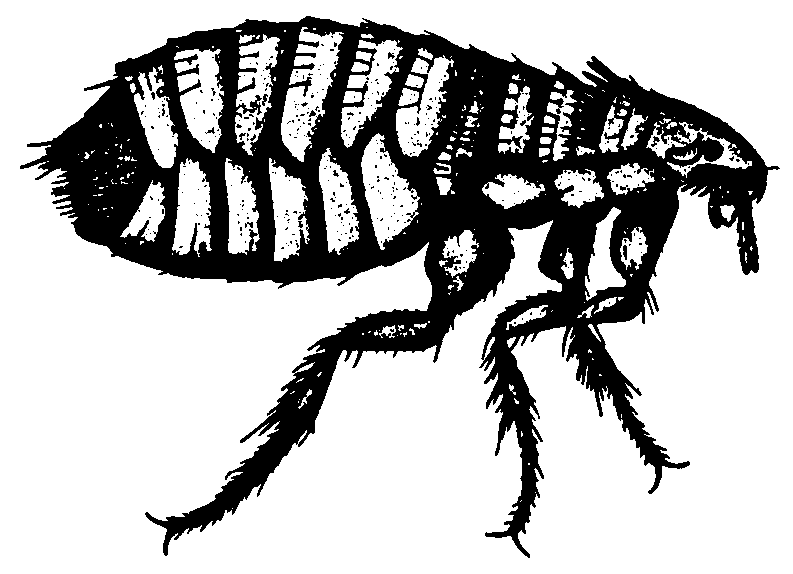
Narcissists infect people, just like a disease. They have the uncanny ability of turning people into one of them, if you’re around them long enough. That’s why, whenever it’s possible, No Contact is always the best course of action. You cannot change a narcissist or reform them. What will happen instead is you will start to take on narcissistic behaviors yourself.

Narcissists are body-snatchers and will snatch yours and before you know it, you can become one of them. It may be the only personality disorder that’s contagious. Hanging around one too long is very dangerous to your self esteem, your identity, and even your soul. It’s more dangerous than making your escape, even if you don’t have a dollar to your name.

If you were raised by them, you may have a serious problem. Many (though not all) children of narcissists become narcissists or borderlines themselves. Because narcissistic parents can’t form proper bonds with their children and either use them as supply or scapegoats, children of narcissists more likely than not develop severe attachment disorders in childhood, and attachment disorders can easily become NPD, either covert or overt, somatic or cerebral. If the child is a little luckier, she or he can develop BPD, PTSD and many other disorders that make adult life difficult.

flea_cartoon

Overt/classic/grandiose narcissism (the type that best fits the criteria in the current DSM) develops most often in golden children who were held on a pedestal and could do no wrong, or were terribly spoiled, or it can develop in child who served as the parent’s flying monkey. It can also develop in a scapegoat who wants to prove their narcissistic parents wrong. Overt narcissists are usually extroverts who are good at playing the role of a confident, aggressive leader and many of them become financially and professionally successful. They are good at maintaining their mask for as long as they need to.

Covert/vulnerable narcissism usually develops in a scapegoated child who cloaks their grandiosity in an outer cloak of deference and humility, usually as a way to avoid punishment for acting too arrogant or aggressive while growing up. It can also develop in a child who is sometimes a scapegoat and sometimes a golden child. In a way, they are worse off than an overt narcissist, because they have a double layer of masks (false selves): the grandiose mask that hides the undeveloped, atrophied true self within, and a meek, shy and deferent outer mask that cloaks their grandiosity and sense of entitlement. That’s why a covert narcissist can be easily pushed around or bullied by others, but underneath their seemingly nice, quiet image there is seething envy and anger that isn’t expressed unless they are pushed to the limit and explode in rage. Their rage and envy is also likely to come out in passive-aggressive ways. Yet a covert narcissist is easier to cure because (a) they are far more likely to want help; and (b) their lives are miserable and their brand of narcissism isn’t adaptive in today’s world.

BPD is more common in women and some female covert narcissists may actually be diagnosed with BPD, because the disorders can seem so much alike and women aren’t diagnosed with NPD as often as men are. BPD probably develops most often when there is ambiguous attachment to the mother during early childhood and the child is inconsistently rewarded and punished. They learn early that people and life are unpredictable and no one can be trusted. They fear abandonment because they were never able to tell if their parent would love them or push them away. BPD also is correlated with early sexual abuse.

Fleas of narcissism are deadly because with prolonged exposure, they can cause permanent infestation. If it’s at all possible, cut off any narcissist in your life or avoid them as much as possible. Watch for red flags so you can escape before it’s too late because escaping once they “have” you is far more difficult and can be dangerous.

If you were raised by narcissists, no matter how damaged you are, if you didn’t become a narcissist yourself, consider yourself extremely lucky. There is hope for you to eventually be able to live a normal, happy life. If you’re a non-malignant narcissist, there may still be hope but the road to becoming a normal and happy person is going to be longer and harder.
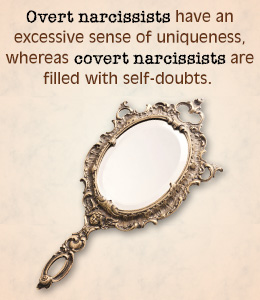
Comparing covert narcissism and BPD

covert_narcissism2

I read an excellent article (thank to Natasha!) last night about covert narcissism, which is not currently recognized by the DSM, although it’s been considered as a provisional diagnosis.

Covert (vulnerable) narcissists are essentially low-functioning narcissists who present a shy, avoidant, humble, or caring image but they also constantly struggle with feelings of inferiority, emptiness, and self hatred. Like overt narcissists, they are hypersensitive to criticism but don’t hide it as well. They can become quite parasitic, relying on the support of others, either financially, emotionally or otherwise–but never giving back, even if they try to make a show of how “giving” they are. From what I’ve read in this article, it seems that the symptoms of covert narcissism, a subtype of NPD, are remarkably similar to those of BPD, with a few glaring differences:

— The covert narcissist suffers from more pathological envy than a person with BPD. The envy stems from a hidden sense of entitlement or superiority to others that belies their false humility and actual low self esteem. BPD is not characterized by a sense of entitlement. In a way they are wearing a double mask or have two false selves: the grandiose false self (that cloaks the emptiness they really feel) which is cloaked by false humility and shame. A covert narcissist may constantly be apologizing, but they don’t really mean it.

— A covert narcissist is more likely than a borderline to seek out friends who they perceive as “beneath” them so they can feel superior in comparison. This also stands out from an overt narcissist, who will seek out anyone who can provide them with supply (and likes to be associated with those they look up to). Covert narcissists avoid people they perceive as superior or having more than they do, which is most people.

— The covert narcissist has Avoidant (or introverted) features not associated with the DSM-recognized symptoms of BPD (although it’s possible for a borderline to be introverted and socially phobic, or for Avoidant PD and BPD to be comorbid with each other, as they are for me). Covert narcissists are more socially awkward than borderlines and can seem very similar on the surface to someone with Aspergers or Social Phobia. But behind the avoidant or socially awkward traits is a fear of being discovered and a hidden feeling of superiority to other people, unlike someone with Aspergers who simply finds relating to people exhausting or uncomfortable or a person with Social Phobia, who finds relating to others terrifying.

— They have no empathy. Any “empathy” they show is false, intended to get supply by bolstering their image as a “nice” person. Borderlines usually have at least a rudimentary ability to experience empathy.

— Like a classic narcissist, a covert narcissist lives in fear of their own emptiness being exposed, while someone with BPD lives in fear of being abandoned.

— Borderlines are more likely to be suicidal or self-harm than a covert narcissist, who may do self destructive things or threaten suicide for attention (supply) but will rarely make a serious attempt.

— Borderlines are more impulsive.

http://www.researchgate.net/publication/275665641_Narcissistic_Personality_Disorder_Diagnostic_and_Clinical_Challenges

This is also a very good article comparing covert NPD with overt (classic, grandiose) NPD: http://narcissisticbehavior.net/revealing-the-two-faces-of-narcissism-overt-and-covert-narcissism/

Some people believe covert narcissists are actually more malignant than classic narcissists, because their agenda is so hidden (covert) and they can seem like such nice, humble people. Although they are harder to detect, I think they really want people to see them as “nice” even though their motives are entirely selfish. I think the reason some narcissists become covert is because early in childhood they learned that acting grandiose or entitled was too dangerous (they were likely to be punished for it) so they cloaked their grandiosity behind false humility and shame. This is why they often feel victimized by everyone but at the same time feel entitled to be treated as if they are special and separate themselves from others, who they see as morally inferior (but actually feel inferior to–yes, it’s very confusing!) At the same time, a covert narcissist is more likely to seek therapy than a classic narcissist because their lives are so unsatisfying and limited–and for the same reason also more likely to be cured if they commit themselves to getting better. In this way they don’t differ too much from people with BPD.

A person with NPD can also switch back and forth between the covert and overt subtypes. When things are going well and supply is abundant, a covert narcissist may become grandiose and aggressive, and a normally grandiose narcissist can become much more covert when their supply is running low or has been removed.

Cluster B disorders: an explanation

Informative video about the Cluster B disorders that discusses what they have in common and what causes someone to develop them. BPD has been unfairly stigmatized because of its similarity in some ways to the other disorders in this cluster, but few people recognize that borderlines don’t lack empathy or a conscience the way people with NPD and ASPD do, even though they can be difficult to deal with and even abusive when they are triggered.

The honeymoon is over.

lost

I’ve been feeling quite strange the past week. It’s the worst I’ve felt in about a year. It started with feelings of anxiety and panic, racing and morbid thoughts and a feeling of unnamed dread. I’d try to nap and my heart would start racing so I’d give up. DBT skills didn’t work and some of my BPD (or PTSD) behaviors returned–negativistic behavior, feeling offended easily, sulking, fits of anger (not directed at anyone but expressed in imaginary conversations with myself in the car or at home), low frustration tolerance, paranoia. I’ve been less motivated to write. I’ve been neglecting housekeeping and eating right. Getting up in the morning is excruciating.

It was all I could do to make it through work. I was feeling sorry for myself all day and at the same time felt guilty for feeling that way. The anxiety has lessened but it’s been replaced by despair and some kind of deep sadness.

I don’t cry easily, but I started crying a few hours ago and couldn’t stop. It feels good to cry, but the feelings are so painful. I feel unworthy. I feel impotent. I feel angry at my parents for training me to be such a good little victim. I hate my ex. I hate myself. I suck at everything. I can’t relate to people. I hate people. I want to connect but I just can’t. I think people will hate me if I let them get too close. My world is so small and constrained and unsatisfying because of my fear of relating to others and reaching out, and because I never have enough money to do anything or go anywhere anyway. The summer’s slipping away and it reminds me of all the lost opportunities and all the doors that have slammed shut, never to reopen. That’s where my head is at. It’s a bad place to be. I feel like I’m losing control. It’s like a war inside my head. I hate all this wallowing in self pity but maybe it’s an opportunity to nurture myself.

I need to find a therapist. This blog is a wonderful tool for healing and it’s something I won’t let go of. It’s brought me a lot of joy. A lot of frustration too, but mostly joy. So I’ll keep blogging. I’d still rather do this than anything else.

But something, I don’t know what, has been triggered–by what I don’t know–and I’ve reached a point where just writing isn’t enough. I need someone to talk to who can help me sort out whatever’s going on in my head right now. I think journaling every day may have brought me to this point.

I’m not giving up. The good thing is that my emotions, while not really under my control at the moment, are there for me to feel. I’m not depressed in the apathetic, almost zombie-like way I used to get depressed when I was living with my narcissist ex. This is an active depression where my emotions are accessible to me and I can sort of name them and I just have to let myself feel them. I’m grateful for that at least. This is what I wanted. But what do I do with them? Can they make me a better, kinder, happier, more empathetic person? That’s what I really want. I need to find someone who can show me what to do with all these emotions.

I guess this means the honeymoon is over, and now the real work begins.

Raw nerve.

everything_is_fine

Over the past few days I have been extremely anxious, even panicky. I can’t focus enough to write anything or do much of anything else either. I really have no idea why or what might have triggered it.

Last night instead of writing anything, I poked around on nostalgia sites, reminiscing about the things of my childhood, particularly the snack food. My childhood was terrible, but I have fond memories of the various sugary and salty foods I ate (why in %$#& did Buitoni ever stop making those awful but delicious toaster pizzas? Where’s a chalky, non-chewy Giant Sweet-Tart when you need one?) and the toys I played with (those over 45 or 50 or so will remember that Fuzzy Wuzzy soap that grew “hair” just like a Chia pet and had a small but high quality prize inside). These memories bring me a measure of comfort. Things seemed so much simpler before everything started going to hell about 30 years ago and hearts began to harden and greed became good because a movie character named Gordon Gecko said so. Life has just become way too complicated and stressful for someone like me (although I couldn’t live without the Internet, which for someone like me is the best thing that could ever have happened).

Sometimes I feel like I just can’t cope anymore. I’m so tired. I’m getting old. I have too many unresolved psychological issues. I worry about the future constantly. I have a pervasive feeling of nameless dread, as if something terrible is about to happen.

I don’t know where these feelings come from or what might have triggered them, but I feel like a raw nerve and even at work have been jumpy, quick to take offense to everything, and paranoid. I have too many disorders to function well at a job for any length of time, especially when it comes to dealing with others. Sometimes I just wish I could go off by myself and live as a hermit, never having to deal with anyone, but for that you need money and I have no money. I’m caught in a no-win situation.

The job might be part of the problem. I’m burned out; I hate my job. There. I said it. I hate the politics at work, and the favoritism. I’m not a favorite. I have never been a favorite at any job. I can’t play the game; I have never been able to play the game. I wish I didn’t have to work, or could just write and make a living that way. But I can’t, not yet anyway. I don’t want to look for a new job because I know it will be as crappy as the one I have, that I’ll still be forced to deal with people I dislike and who dislike me just as much. I’ll still feel like the odd one out, the employee who is most expendable and always overlooked. I’m so ill suited for the service industry but I can’t get my foot in the door for anything else. I burned all my bridges a long time ago, and now I’m well past 50 and it’s too late to start over in an employment situation or going back to school. My only hope left is to become a professional writer.

The DBT and self-soothing tools I normally use to focus and center are not working. My thoughts are racing and my hands are shaking. My sleep has been fitful. Maybe it’s the heat but I think it’s more than that. I feel like my head will explode. I don’t know what’s really going on with me right now. I need to find a good therapist. I need to be in a relationship but am too scared. I need to write more.

One thing that might be contributing to my high anxiety is caffeine. I’m addicted to coffee. I’m craving some right now, but I don’t think I should make any. I might have to cut down on my favorite beverage–a prospect which itself causes me anxiety.

I spend most of my free time holed up inside the house on this laptop, which is fine when I’m actually being productive, but last night all I did was poke around on random nostalgia sites and Facebook and wrote absolutely nothing. And then felt guilty about it.

I know what I need to do is go out, do something outside the house, get off the computer, but I don’t have the motivation.

Finally I got the idea to just write about my panic-stricken state. After all, this blog was intended to be my therapy, so what have I got to lose?

Pick your battles.

small_stuff

One of the things we borderlines need to learn is to pick our battles. Not everything is worth fighting over or getting upset about. Sometimes it’s best to just accept someone else is not going to agree with you or do things your way, and we can agree to disagree. I’ve gotten pretty good at that. I didn’t used to be. I’d rather have harmonious relationships than always be “right.” It’s not important that I’m always right or always win.

So what if your adult daughter wants to get a lip piercing or your husband always leaves the toothpaste cap off. So what if your best friend likes a different presidential candidate than you do. You can tell your adult daughter you would prefer she doesn’t get the piercing, or remind your husband to put the cap back on, or tell your friend (nicely) you disagree with her choice in candidates, but after that let it go. Don’t keep harping on it. Do these things really matter? Are they worth the emotional investment of fighting over? Ask yourself those things before “going off” on them.

I’m not encouraging you to let people walk all over you. If someone is abusing you, you need to get away from them because they are not going to stop by you telling them to stop. There are situations where it’s worth standing up for yourself and your loved ones and fighting for your rights. If someone is violating your rights or abusing or bullying you or someone you love, then you should definitely make a stand or take appropriate action. But in most cases when people merely disagree, that’s all it is–a disagreement. Sometimes it’s best to “turn the other cheek” (after sharing your own opinion if you want to) if you want harmonious relationships and the behavior or actions you find offensive are more a matter of annoyance to you than anything truly serious. Choose your battles, unless you want your life to become a battlefield.

winston-churchill-quote

Free associating about narcissism.

narcstare

In reading and writing so much about narcissism, sometimes it seems like more questions are raised than are answered. Here are some of the random questions and thoughts I’ve had that I can’t really explain. Some of these random thoughts may seem crazy, but they are still questions and I’m still looking for answers.

Why is it that so many of us narcissistic abuse survivors don’t realize what happened to us or even have a name for it until so late in life? Most of the people I’ve met who have realized they were raised by narcissistic parents, married to narcissistic spouses or have gone No Contact are in their 40s, 50s and older. It seems so unfair to discover this at such a late age and realize how many years have been wasted or lost.

Related to this, I wonder why there seem to be so few male victims? Is it because men are more likely to have NPD and thus be the perpetrators, or is it because in our culture, men are more reluctant to express their feelings and write about them on public blogs or message boards?

Why is it the more I read about narcissism the more narcissistic traits I see in myself and the more I want to be rid of them? Sometimes it’s like looking into a mirror. Overall though, I’ve learned even more about myself than I have about the narcissists in my life, and I think that’s a good thing, even if I’m too hard on myself and am seeing narcissism that isn’t really there.

Why is it that one of the warmest, emotionally open, and seemingly most compassionate people I’ve met in the narcissistic abuse community is a woman who believes herself to be a psychopathic (malignant) narcissist? Is her warmth and openness faked and I’m a fool for falling for it, or is her “narcissism” a delusion? I’ve looked for red flags and I simply haven’t seen any, but it’s easy to misrepresent yourself online. I have pretty good sixth sense and I don’t get any “evil” vibes or feelings of discomfort from socializing with this person, and I normally do when dealing with even the “nicest” narcs IRL.

What exactly is borderline personality disorder? Is it a form of complex PTSD not recognized by the psychiatric and medical community, is it a dissociative disorder, or is it a form of narcissism where the person never constructed a viable False Self? Should it even be in the Cluster B category of disorders or is it something else altogether?

narcissist_continuum

For that matter, is NPD a form of complex PTSD so deeply ingrained in the personality so early in life it’s almost impossible to eradicate? After all, almost all narcissists were abused and that’s why they became narcissists. Should “personality disorder” labels just be scrapped completely the way BPD Transformation suggests?

Is malignant narcissism what happens when an HSP (highly sensitive person) “goes bad”? I wrote about that in this article, but I still wonder.

Can a psychopath (or a narcissist) ever do good things intentionally (and not just for supply)? I wrote about this too, and understandably, the ire of a few ACONs was raised from that particular article. I agree it seems like a stupid question because a psychopath or narcissist has no empathy. But they still have “cold empathy” which means they can know exactly how you feel but only in a cold, intellectual way. Are there any narcs or psychopaths who simply choose not to do wrong? I haven’t ever met any, but I still think it’s something worth asking. On the other hand, wouldn’t “not doing wrong” negate their “psychopathy,” even if they lack that quality called empathy? Maybe some of them just want to be seen as good, and it’s really just a way to get supply.
Here’s a fascinating interview with Dr. James Fallon, a diagnosed psychopath who chooses prosocial behaviors over antisocial ones (although his attitude in the interview does seems quite narcissistic). I think he comes off much like a cult leader so I’m very skeptical.

I’ve seen the “black eyes” many people talk about in malignant narcissists, especially when they rage. It’s very scary to see and it’s very real. Does this indicate a spiritual deficit in which part or all of their soul is corrupted (or even missing) or is there some medical reason for this? I do remember reading something describing this phenomenon in medical terms; unfortunately I’ve lost the link to that article. Personally I think there is a spiritual element involved and a malignant narcissist has chosen evil over good, even if there is a medical or scientific reason for the strangeness of their eyes. Most abuse survivors have seen this and find it as terrifying as I do.

Why would anyone in their right mind choose to be a narcissist, even if done unconsciously as a young child? Why would anyone want to shut themselves off from the ability to feel love, empathy and joy, even if the payoff means they can protect themselves from being hurt anymore? It makes no sense because most narcissists are still incredibly sensitive (about themselves) and are constantly fending off or reacting to insults. It seems like a horrible way to live.

Are all narcissists “evil”? Or is that a blanket judgment? I’m kind of torn on this. I think the higher you go on the spectrum (and I do believe narcissism is a spectrum disorder), the more evil the narcissist will be. I’ve met some low spectrum narcs who are merely full of themselves and difficult to deal with, but I wouldn’t call them evil. Maybe those people don’t really qualify as narcissists though. I think the point at which a person becomes “evil” coincides with their willingness to change. The higher you go on the spectrum, the less likely it is the narcissist will ever become self aware or willing enough to get better. There are some high spectrum narcissists who are aware of their disorder, but don’t think of it as a disorder and are unwilling to change, so self-awareness by itself is meaningless. Willingness must also be present.

Do narcissists ever have moments of being non-narcissistic or even feeling empathy? I’ve known many narcissists who care nothing about the feelings of those around them, but cry like babies when they watch a sad or touching movie, listen to music, or when their pet dies or becomes ill. Have they simply shoved all their original empathy into one or two “safe” outlets, such as the ability to feel the emotions of a fictional character who doesn’t actually exist?

Why are some of the most religious people I know also the most narcissistic? Is their faith real?

How can you really tell if a victim of abuse may actually be the real narcissist and the “narcissist” the real victim? I know this can and does happen.

These are just a few of the things I wonder about. I’m sure I’ll think of others.

Why narcissists and borderlines are drawn to each other.

narc_borderline

I’t’s uncanny how often people with NPD and BPD seem to find each other. Every one of my boyfriends (except for one, who was severely bipolar) and my ex-husband were narcissists. I know a lot of other borderlines who say they have the same problem–they simply are not attracted to a man or woman who is not a narcissist. There are reasons why this happens.

Both BPD and NPD are included in the category of Cluster B personality disorders in the DSM-V (along with Histrionic and Antisocial personality disorders). Cluster B disorders are all characterized at their root by problems establishing an identity early in childhood and integrity of the Self which causes people with these disorders to act out toward themselves or others in destructive ways and to have problems either accessing or developing prosocial emotions like empathy. All are prone to lie excessively and manipulate others.

All Cluster B’s are easily offended and quick to anger, which can be expressed either covertly or overtly. Here’s a quick description of these personality disorders.

Antisocial personality disorder (ASPD or psychopathy) is the most likely to break the law and violate the rights of others (many are in prison), act impulsively, and have no empathy at all. People with ASPD who aren’t lawbreakers will be ruthless in business or their chosen profession, and feel no compunctions about hurting others to succeed and may even take pleasure from it.

Narcissistic Personality Disorder (NPD) is less likely to break the law (but this is not a given–some narcissists will break the law if they think they can get away with it) due to wanting to present a good image to others, but have little, if any, empathy, and act out toward others and manipulate them to protect the False Self they use in place of their true one which cannot be accessed. They act arrogant, entitled, paranoid and touchy. Think of the most spoiled or brattiest child you know. If you saw that same behavior in an adult, that’s what NPD looks like to others.

Histrionic personality disorder (usually found in women) is a somatic form of narcissism where there is obsession with physical appearance and emotions are expressed dramatically but the emotions themselves are shallow. Histrionics of both sexes are often sexually promiscuous.

Borderline Personality disorder is the most baffling of the four, because it’s a disorder of contradictions. BPD is characterized by black and white thinking, overpowering emotions, impulsivity, self-destructive behavior, and idealization/devaluation of others. People with this disorder oscillate rapidly between opposites–feeling love and hate for others, pushing others away and smothering them, and accepting or rejecting them. They do this because of their fear of abandonment. Unfortunately, borderlines in their desperate attempts to not be abandoned, cause others to abandon them, or are self sabotaging–they may reject others in order to avoid being rejected first. Borderlines, unlike the other Cluster B disorders, are able to feel empathy, but because they can get so overwhelmed by their fear of rejection and their overpowering emotions and drama, they can “forget” others exist. They can feel remorse and guilt when they realize they’ve behaved badly but it sometimes must be pointed out to them.

Borderlines are chameleons who don’t have a False Self per se, but instead adopt whatever “identity” will suit the moment and whatever person they are interacting with–to make the other person accept them. In some borderlines, this rapid switching from one persona to another can appear to others similar to DID (Dissociative Identity Disorder). Not only their behavior, but also their emotions (which they have trouble regulating or controlling), opinions, or even their appearance can change from one moment to the next. This differs from bipolar disorder, where dramatic mood changes oscillate much more slowly.

narc_borderline2

Of all the Cluster B disorders, people with BPD have a Self that is the most fragmented and least likely to have integrated into something called an identity (even a narc has a False Self so that’s a kind of identity). As a result BPD’s are the most prone to experience dissociative or even psychotic episodes, where the person loses touch with reality. Ironically, although Borderlines are “sicker” than narcissists, they are more likely to seek therapy (because their disorder is ego-dystonic and most are not happy with the way they behave and feel) and they are also more likely to be cured.

Because borderlines are chameleons,* they make perfect supply for a narcissist. They lack an identity of their own, so they “become” whatever others expect them to be. It’s not really a mask in the same sense as a narcissist, but they can wear a sort of temporary mask that can change from one moment to the next or disappear completely, leaving the borderline in a depressed or near-psychotic emotional state. A borderline can be whatever the narcissist wants them to be, and as a result are easily manipulated and can become very codependent.

Borderlines can be very manipulative themselves, but because their personality is less integrated and and the narcissist appears to have an integrated self (even though it’s a false one), they are no match for a narcissist. Unless the narcissist is very low on the spectrum (or is a covert and vulnerable one), they cannot be overpowered by a borderline and will always get their way over the borderline’s needs.

Borderlines (like narcissists) never felt loved or valued, but the borderline hasn’t shut out their need to be loved and craves it more than anything else. A narcissist (in the beginning of a relationship) can appear to be highly passionate and attentive, promising the borderline all the love he or she needs–and be convincing enough they capture the heart of a borderline, who thinks they’ve met the perfect mate.

Relationships between narcissists and borderlines may be stormy and “unhealthy,” but when they work, they work well, with the narcissist giving the borderline a kind of identity as a codependent to the narcissist, and the borderline giving the narcissist the supply they need.

I think there’s often a familial aspect too. Cluster B disorders tend to occur in families, in varying configurations. If one or more parents is a narcissist (or a borderline), they are far more likely to raise narcissistic or borderline children, because both disorders are due to abuse and Cluster B parents tend to put their own needs ahead of their children’s, even if (in the borderline) their selfishness isn’t intentional. Therefore, borderlines and narcissists who were raised in abusive families tend to be attracted to people who unconsciously remind them of other members of their families, especially the parents. This type of connection is called a trauma bond because the connection is due to shared trauma and a conscious or unconscious willingness to to be abused or to abuse a partner. A relationship between a borderline and a narcissist is not what anyone would call functional, and yet in a way it can work for both of them, if they don’t wind up killing each other first. Some of these trauma bonds are examples of Stockholm Syndrome, where the abused identifies with their abuser.

Going No Contact with a narcissist is the best gift an abused borderline can give herself (or himself), but separating may be especially hard for them and they are likely to be drawn to another narcissist, so they need to stay on guard and be especially vigilant of red flags.

* I think their ability to be emotional chameleons is the reason why the entertainment, film and television industries seem to have a plethora of actors who have BPD.

Is there a connection between BPD and PMS?

pms_bpd

Most psychologists believe personality disorders are very difficult, if not impossible, to cure, because they are a core part of the personality. But I’ve noticed something interesting about BPD, at least in women diagnosed with it (including me)–it tends to improve or disappear with age.

Maybe this is a little TMI, but I used to get terrible PMS. For a few days before my period started, I was cranky, moody, stressed, and more prone than usual to fly into unreasonable rages or burst into tears for no reason. I was hell to be around. I was also more prone to engage in risky or self destructive behaviors when I was premenstrual. All this behavior was very borderline, and it continued this way for years, but once I reached menopause a few years ago, I seemed to stabilize and have not had the type of crazy mood swings or displayed any of the outrageous behaviors I used to. My borderline behaviors, when they do come out at all, tend to be more passive aggressive than aggressive.

I’m a member of a closed group on Facebook for people with BPD, and I’ve heard other women (and it’s mostly women who are diagnosed with BPD anyway) say the same thing happened to them once they reach a certain age. Their symptoms seem to improve or even disappear once they are no longer undergoing monthly fluctuations of female hormones. It may worsen temporarily as menopause hits due to the sudden drop in estrogen (that causes a woman to experience hot flashes and other unpleasant menopausal symptoms), but once a few years have passed they say they have never been better. There’s one younger woman in the group who suffered from painful cramping and migraine headaches during periods and was put on birth control pills to control the physical discomfort, and said she was surprised about the added benefit–her BPD symptoms got better too.

So I’m wondering if there’s a connection between BPD and the hormone fluctuations of the menstrual cycle, since it’s mostly younger women who display the more dramatic and unpredictable BPD behaviors. The fact that the symptoms of BPD (unlike those of the other personality disorders) can be improved with drug therapy makes me wonder if BPD is really a personality disorder at all. Some experts believe BPD is really a form of PTSD established at an early age by abuse (which I agree it may be), but is there a biochemical component involved too?

I’m not the only one who’s noticed a connection between BPD and PMS. Here are two articles on the subject:

PMS/PMDD and Borderline Personality Disorder
Does PMS Ignite Your BPD Symptoms?

Just something else to add to all the confusion surrounding the baffling disorder of BPD.

This TV movie about child abuse was way ahead of its time.

Today I was thinking about a TV movie I saw back in the 1980s that has haunted me ever since. I decided to watch it again tonight (you can watch the entire movie on Youtube–it’s in seven parts; I have posted the first part). It’s called Mary Jane Harper Cried Last Night and was first aired in 1977. Susan Dey (of Partridge Family fame) played an abusive, alcoholic mother to a 4 year old girl and she becomes completely unhinged. The movie is extremely triggering and may be upsetting to some.

There are several things about this movie that I found quite interesting.

— Rowena (Susan Dey) seems to have every symptom of Borderline Personality Disorder–but a case could also be made that her symptoms could well be untreated severe PTSD caused by the abuse she suffered at the hands of her own parents. This movie illustrates why I think BPD is really severe PTSD caused by chronic childhood abuse and could make a good case for that.

— Rowena’s parents are both textbook examples of malignant narcissists. Her mother is cold, rejecting, gaslighting, and blames her daughter for her unhappiness, as well as pathologically envious of the attention she receives from her father, who sexually abused her (and apparently still does).

— Rowena’s psychiatrist is a narcissistic jerk who coldly dismisses her from a breakthrough therapy session at the moment she recalls and re-experiences a long forgotten memory of being locked in a closet as a small child. This turned out to be an extremely cruel (and unwise) thing for him to do.

— In the almost 40 years since this film was made, not much has changed. The child protective system is still hit and miss at best and often tragically incompetent.

— It’s a fascinating and convincing study of the way the pathology of abuse infects succeeding generations.

The movie, being made for TV, isn’t perfect. There are a few holes in the plot and certain scenes just seem contrived. I also can’t help thinking of “Dean Wormer” from the movie Animal House whenever John Vernon (the head doctor) is onscreen. But the acting, especially by Susan Dey and the little girl who plays her daughter Mary Jane (Natasha Ryan), as well as the caring doctor who stands up to the Powers That Be and tries to protect Mary Jane, is top notch.