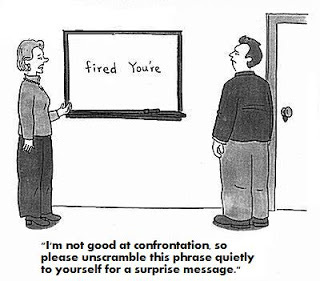
I came across this individual’s forum post on The Personality Cafe in a weird way. My article “Why Family Scapegoats Become Lifelong Victims,” (which has become my most viewed article ever and is still gaining momentum on the web), was linked to by this writer and there was an excerpt from their own post left in my comment folder. The blurb was intriguing enough that I decided to read it, and holy cow! It sounds like my own life story. In fact, I am going through this situation with a friend even as I write this. (If you’re a friend of mine reading this it’s not you–this “friend” doesn’t read my blog or even know I have one). I don’t want to be friends with this person anymore (who I suspect is a malignant narcissist who likes to “play” with me and make “jokes” at my expense) but instead of confronting them and telling them I want to end our friendship, I’m just avoiding this person, hoping they get the “hint.” I do that sort of thing all the time. Confrontation terrifies me, but what happens is my anger becomes seething resentment and has to come out eventually, so after weeks or months of pretending everything is fine, I’m likely to explode and say things I regret. It also comes out in other ways, like acting passive-aggressive. I’ve gotten better but it’s still a problem. Anyway, here is that article. The writer is an INFJ like me and wonders if this is common in INFJs. I’m also an Enneagram Type 4/5.
If we need to slap a psychiatric label on this sort of behavior, it’s a common symptom in people with Avoidant Personality Disorder and Covert Narcissism (which I still suspect I am, even though my therapist has said I’m only “on the spectrum” but not NPD). I think people with BPD are also guilty of this.
Has anyone else had this problem in the “social environment”?
As of recently I have made a personal discovery about the origins of how and why I have a certain fear. And it also ties in with the Enneagram 4 labeled fear “that they have no identity or personal significance”. Generally, with “friends” (both close and acquaintance) I tend to hide away or become afraid of sharing my true thoughts and being completely honest with them if there’s a problem (unless they manage to hurt me to the extent that i just cut them off). I become fearful of their reaction before it even happens, so i withhold my thoughts and continue acting as if everything is okay. It’s not only the fear that they will be upset at my honesty, but the fear that I would also begin to hate myself afterwards as well. I didn’t realize there was a term for this as well (even though i knew it as a common term i never understood its meaning). And that term is “Shame”. And while shame is the major factor of why i feel guilt for wanting to speak out, as well as feeling it for not wanting to speak out, I had also come to realize this was also connected to my upbringing. I learned in the article mentioned below, that most scapegoats have high empathy and sensitivity at an early age, which causes them to absorb all of the projections of their parents, thus causing the birth of self hatred/possibly depression. It also informed me that as they continue to go into social relationships, that they will also absorb the projections of what other people think of them as well. For me this explains a helluva lot, of why i fear getting close to certain people and their impact on me if i either
A. Do something wrong.
Or
B. Be honest with them.
I’m personally terrified of being completely honest with someone i’m not sure of, as any kind of minor negative backlash towards me can cause me to go in a state of guilt for a long time. So instead I internalize everything that bothers me about them, and I simply play my part in this “friendship” until i have a reason to avoid them or doorslam. And this is different from constructive criticism, i’m talking about the consequences that may occur if they end up being hurt by my honesty. While their take of it may not be my problem afterward I still hold the shame of what I have done to another human being, even if it was the “right” thing to do rather than continue being dishonest with them and put on the fake persona. I fear hurting them..but I also fear hurting myself. It’s a double edged sword and the ending remains the same regardless of which way i act. I’m fearful of absorbing any new projections one might have of me (specifically negative) which has caused a spiral of paranoia in 2/3 of my friendships, even if they may not take it personal. And before I end this, I am not intentionally hurtful when i’m honest, as I still try to be polite and respectful of the person that i’m talking to. I am also aware that they can be positive in their response, but i’m practically crippled by my fear, especially because of social experiences that didn’t go well.
I just had an especially vivid and detailed dream and posted it over at Psychforums immediately on waking so I didn’t lose the details and “feel” of the dream. I asked people to try to interpret it for me so I’m going to include those responses too.
I just woke up very upset and angry from a very intense and vivid dream. I’ve been trying to figure out what it means because I feel like it’s important but there are parts that just make no sense if the central theme is correct.
It started out wonderfully. I was in some psychiatric hospital program and had a received a great deal of help in it. Later in the dream it seemed I was an inpatient but at the time the dream started I was an outpatient because my son had to drive me there (for some reason I wasn’t driving my own car or maybe he just wanted to drive) to attend some awards dinner where I was going to receive an award. I was incredibly popular among the other patients and I had a bearded psychiatrist (aren’t they all bearded?) that I loved. I felt like he had saved my life.
So my son and I made several trips, first to a cheap chain restaurant (I don’t know why I was eating dinner twice) and then to another store, then finally to the hospital awards dinner, where he dropped me off. I got a lot of hugs and congratulations and support from everyone. I had many friends in the program. I had no idea what sort of award I’d won and none were given out but I was having a great time. At one point two of my friends (both dx’d BPD) pulled me up on the stage to join them in an impromptu song and dance from a musical. I kept along as if I’d been rehearsing for weeks. At one point it became a medley and we broke into the theme from “Hair” (why?!?) and started throwing flowers everywhere and at each other. It was a great deal of fun and I wasn’t at all self-conscious even though I was dressed in a hospital gown (like an inpatient?). I’d never felt freer or happier. I felt love all around me from the audience and the other people on stage.
My son came to get me later but when I got in the car I realized I couldn’t find my purse. As in real life when this has happened, I panicked. My purse is like my life–and I had special medications in there that eased my psychiatric symptoms too (and that had been hard to obtain), as well as my house keys, car keys, credit cards, ID, money, and the zillion other important things women keep in their purses. I didn’t remember having it at all at the hospital function so we first went to the store and the first restaurant to ask if they’d seen it. They hadn’t so we went back to the hospital and asked the woman at the front desk if she had seen it. She said she had to go talk to someone and to wait a few minutes. After a little while, my psychiatrist came out and said they had found it, but couldn’t just give it to me. I would have to pass a “character test,” of the type they sometimes give candidates applying for jobs to make sure they’re honest or aren’t going to steal or lie or whatever.
I looked at the test, which was about 40 pages long. None of the questions had anything to do with my purse or even with being “honest.” The questions made no sense and I couldn’t think. I was too upset by not having my purse and angry that I had to pass a stupid irrelevant test to get my own property back. I kept getting distracted by other things and couldn’t focus. After about an hour my psychiatrist asked me if I was done yet but I had only answered 4 questions. I was almost in tears by now and told him how upset and hurt I was that he didn’t trust me. He said he didn’t make the rules and could do nothing. He said don’t worry about passing, just answer the questions the best you can. One of the questions was a multiple choice “story problem” like an elementary school math test and the story was about someone with both my first and last name. I was impressed by that and showed everyone around that my name was used on the test letting them know I’m the only person in the country that has my name. I still couldn’t focus and the questions still didn’t make sense. I finally gave up and took the mangled sheets of paper with holes from too much erasing and rewriting to the person who was scoring, a cold woman in charge of testing. I was so angry and upset I ran down a long hallway into the psych unit and saw people there–really crazy people–dressed in straitjackets and lying around on gurneys and in wheelchairs. They were making strange sounds and babbling incoherently and didn’t seem like they knew what was going on. But then I saw one of my friends and told her what happened, then started crying hysterically. I knew the crying was mostly to get attention and sympathy. It was definitely manipulative, but I was extremely angry and upset so it was a way to vent my frustration too. My friend held me and the other people didn’t even seem to notice or care about my OTT behavior, because they were so out of touch with reality or what was going in.
I went off running to look for my psychiatrist to beg him to let me go and take my purse, after all he knew me and I was the recipient of an award. I finally found him and stood there in the doorway of his office in my hospital gown, sobbing but without tears. He looked at me coldly and said there was nothing he could do, it was hospital policy, and they were still working on the results.
Finally he and the woman who did the scoring came out together and told me I’d failed. I screamed at them that they told me I didn’t have to “pass.” They just looked at me. “What am I supposed to do?” I screamed in frustration. They told me I’d have to keep taking the test (and paying $100 each time to take it) until I passed before they could give me back my purse. I told them I didn’t have the time or the money for doing that and they had my car keys too. Again, they just looked coldly at me. They showed no empathy for my situation whatsoever. I felt so betrayed by this psychiatrist who I’d thought cared so much about me.
In frustration and rage, I ran out of the building and found myself in a slum area of a large city. I was running the wrong way. I’d apparently forgot my son was supposed to wait for me but I’d been in there for hours and maybe he’d left. I wasn’t thinking straight. I ran the other way and suddenly was running through a dark garage but that had neon-sparkly floors and walls and there were young gang members in there just hanging out. They looked threatening but I was too enraged to be afraid. I ran right past them and kept running. I jumped into a hole in the ground and found myself in someone’s slum apartment in the projects, cockroaches running everywhere. I kept running through and climbed out the window on the other side and ascended the fire escape. More gang members were sitting around but I kept running. I don’t even know where I was running; I wasn’t thinking at all, but I just had to run.
I woke up feeling incredibly angry and sad at the same time and decided to write all this down before it dissolved away the way dreams tend to do. I have no idea what it all means but I’m getting a few ideas.
My “purse” could have been my false self I’d recently shed in therapy (in the dream) and have had moments without through blogging and even at random times in real life, but that doesn’t explain why my therapist turned out to be such an asshole and betrayed me. It doesn’t explain the ridiculous test I had to take to get it back. I can certainly understand why I would have wanted the purse/false self back though, because although in the hospital I felt happy and free without it, in the real world I felt naked and victimized and crazy.
My psychiatrist could have represented my family, my mother in particular, who I felt betrayed me a long time ago. The slums represented a bleak and impoverished future that I fear so much. I always feel like I’m running frantically–but never sure if it’s toward or away from something.
I’m going to be thinking a lot more about the dream today, but I wanted to write it down while I was still in the dream-feel that follows awakening from such a vivid dream. I feel like this was really important and I need to understand what was really going on.
Here are the two responses I’ve received so far.
1. What I get from it is that you are wanting a healing and are proud of yourself for recognizing your problem and work toward the healing, but it isn’t coming. You sometimes say you wish you could go to a facility, and your purse can’t afford it(?) Or, like me, sometimes you feel more normal, your true identity which your purse contains (but you can’t quite hold reliably). The trouble or conflict you are having is reaching the emotions (or cognitive acceptance) which you still haven’t, which is the test with your name on it. It perplexes you. You recognize it but can’t understand what it is you’re still controlled by (what you haven’t accepted yet).
I think the running through the ghetto(?) is your fear of an impoverished future without even the healing (if you give up trying because you leave the hospital, throwing away the test, living without your identity)?
There was a new video [Spartanlifecoach] which you might relate to. It is about he lizard, monkey and human parts of the brain and how the human part can become constricted (his theory, I don’t believe this is science.). And, it is unable to process emotions/memories. The monkey part of the brain (amygdala) being more reactive controls us. (Which matches my self-perception.). He says the human part can be exercised and process more easily things that it couldn’t. Maybe like re-parenting. But, he gives examples. And, mentions how it doesn’t have to be an emotional breakdown, just an acceptance “yeah, that happened.” There could simply be things you couldn’t realize. They were out of your view, yet when you realize them they’re relatively simple?
(I think that’s what happened to me a few months ago when I realized I had been projecting my mother at my ex. I thought it was going to be the worst thing I had realized yet — and it immediately turned into “yeah, that is it.” It seemed anti-climactic compared to what I braced myself for.).
Maybe it *is* just a cognitive test that you need to take. Not the emotional breakdowns (which sound like what I call dysphoria, and have come to see as not healthy to my TS. They can be fake, I think, where I’m sucking emotions out of myself for an unproductive purpose. Which sounds like after you threw the test away, and went to another ward where you spoke to a friend and cried, but not genuinely.).
*****
2. First of all the dream is symbolized in splits, the hospital is the same as the slums, the “two friends” are the same as the psychiatrist and the nurse. it is unclear who the son is, it does seem important though that he drove the car. same goes for the hospital and store. The contents of the purse seems to be your identity, on a deeper level a purse seems to be quite an obvious womb symbol.
So the dream goes from narcissistic perception of a family home, being in the phase of being praised and happy about your good looks (Hair, god.) and awesome achievements to this break with the restaurants and the purse and then suddenly your identity is lost and your parents have (found) your identity, but only want to give it to you when you prove to them that you are “honest”.
You have to pay them for giving you (back) your identity, you feel instead of enriching, they impoverish you. so when you cant pass this mysterious honesty thing you give up and land in an inner world with neither the narcissistic sparkle, nor an identity. everything seems impoverished and youre just running aimlessly.
I’m actually not in a negative mood right now, but I was yesterday for awhile and I desperately wanted to vent. It’s great to try to be positive and look at the bright side of things, but to deny the shit in our lives is like denying that sometimes you just have to get it out, whether it’s emotional shit or the other kind. Holding it in is bad for you.
So I’m getting it all out here right now and then moving on.
1. I hate the fact I’m over 50 and make poverty level wages. Being poor does seem to be a common complaint among those of us who were trained to be victims by narcissistic families. We just never learned how to navigate the world and lack the confidence to do it very well.
2. I hate the fact I have a job that has nothing to do with what I really love and don’t really know how I can parlay writing into a career.
3. I hate that I love the beach, live so far away from it, and can’t afford to go. I haven’t been to the beach in six years.
4. I hate the fact I want to date again but am terrified of that prospect too. I don’t want to die alone but worry no one would want to stay with me.
5. I hate the fact I have no health insurance and can’t afford to buy any. I don’t qualify for Obamacare because my income is too low and this state won’t allow me to get Medicaid. We do have a free medical clinic in town but I hate the condescending way they treat you there.
6. I sometimes wonder why the hell I ever moved to this state, although it’s really not so bad.
7. I hate the way I acted when I was younger and cringe in embarrassment and shame thinking about it sometimes. I want to divorce my younger self sometimes and pretend she never existed, even though I know that to heal, I need to make peace with her and learn to love her.
8. Sometimes I feel like a huge loser in life. Of course this idea has been drummed into me by my narcs and I’ve internalized it. It’s not an easy belief to let go of.
9. I hate the fact I sometimes doubt my faith.
10. I hate the way I sometimes still hurt people without meaning to.
11. I hate feeling like I’m always guilty of something and always have to apologize.
12. I hate that I’m so socially awkward that people sometimes think I’m daft. Having hearing issues on top of Aspergers and Avoidant PD sure doesn’t help with this.
13. I hate how fair I am. I can’t tan anymore (I could as a child and teenager) but at least I don’t have wrinkles.
14. I hate that I had an abortion and never got to meet the son I would have had (it was male and would have been born in March or April of 1999 so he’d be 16 now). At the time I didn’t feel like I had a choice.
15. I hate the fact I spent three months in a mental hospital in 1996 and at the time didn’t take the DBT training very seriously. I kept the books and do now though.
16. I hate the fact I wasted my young adult years chasing men and obsessing over finding the perfect man instead of focusing on my education and training for a real career in journalism.
17. I hate the fact I don’t have any close friends IRL. I won’t let anyone get close to me because I’m afraid if they found out too much about me they would hate me.
18. I hate the fact my family of origin sucked and have never been supportive of me or loved me unconditionally and judge me so harshly.
19. I hate the fact my family thinks my mental disorders are just an excuse and take no interest in them or why I have them.
20. When push comes to shove, I still can’t say I’m really a very happy person. I’ve gotten better but I wonder if I’ll ever really be happy. I’m looking into getting a therapist.
21. I wish I had been a better mom when my kids were young. I still beat myself up over not having been there for them when they needed me most.
22. I hate that I haven’t seen my son in two years because he lives 700 miles away and I can’t afford to travel to see him.
23. I hate it that I still have so much trouble speaking up when I’ve been hurt or standing up for myself when my rights have been violated.
Yesterday I decided to take myself to the movies for a change, and chose to see “Inside Out,” the Disney Pixar animated summer fantasy blockbuster.
Seeing “Inside Out” was a serendipitous choice, because I just happened to have enough money to afford a ticket (which is a rarity for me), and also because, although I didn’t know it right away, this movie has a beautiful message about the way Sadness and Joy, though seemingly polar opposites, when working together make human connection and unconditional love possible. Just as the light can’t exist without darkness, or good without evil, joy cannot exist without sadness. When working in sync with each other, these two emotions create a beautiful life affirming thing called Empathy, and that’s what connects us to each other and keeps the human race from becoming extinct.
Official Trailer
Sneak Preview–Teaser Clips
Riley Andersen is a young girl of 11 who becomes severely depressed after her parents’ decision to move from Minnesota to San Francisco. The movie begins at the moment of Riley’s birth in Minnesota, shown from Riley’s point of view. Her first Emotions (depicted as loveable anthropomorphized characters) are Joy (feeling secure in her parent’s love) and Sadness (when she needs something or feels ignored or in pain). As Riley grows into early toddlerhood, sometimes her needs and desires are thwarted and Anger takes over and she throws a tantrum. Around the same time she is also capable of feeling Fear or Disgust (both necessary for her survival), and it’s at those times those characters become dominant in Riley’s growing mind.
When the five Emotions work together in harmony, not overstepping each other’s boundaries and only doing the jobs assigned to them, this teamwork manifests in Riley as a well-adjusted little girl able to feel all her emotions at the appropriate times.
The five Emotions work in Headquarters, which is the conscious part of Riley’s young mind. Joy is responsible for making sure Riley’s short term memories are sent to Long Term Memory deep in Riley’s subconscious. Her memories are depicted as glowing colored orbs containing a ghostly image of the actual memory. The color of the orbs represent the dominant Emotion Riley felt at the time of the event. Transporting Short Term memories into Long Term Memory happens during Dream Production as Riley sleeps, and sometimes the other Emotions are needed to help Joy do her job getting the memories there (and sometimes discarding certain irrelevant or painful ones.) Occasionally the other Emotions (as well as Riley’s imaginary childhood friend, Bing Bong, who is a jokester) like to play little jokes–and certain irrelevant memories like an annoying gum commercial jingle are sent to Long Term Memory along with the important memories, which causes Riley to occasionally hear the gum jingle in her head at random times years later.
At the center of Headquarters is the vault which contains Riley’s Core Memories–important but happy long term memories that are responsible for Riley’s happy go lucky personality. The orbs that represent these are colored gold (Joy’s color) and for Riley’s continued mental health, these core memories must not be contaminated by the other Emotions, which is why they are kept locked in a vault. Each of the Core Memories has a long glowing tube that leads to one of Riley’s Five Islands of Personality: Family, Goofiness, Hockey (which she loves to play), Friendship, and Honesty. Maintaining these islands is necessary for Riley’s continued normal psychological development.
The crisis in Riley’s mind is set off when her family moves from her beloved Minnesota to San Francisco. Moving away is always a traumatic event for even the most loved child. Feeling isolated from her old friends and lonely in a place she doesn’t know, Riley’s Emotions begin to make mistakes and not work in sync. Joy and the other Emotions have never been sure of Sadness’s purpose because she just seems to be a Debbie Downer who is always in the way and always making mistakes. It’s Joy’s job to keep Riley’s happiness intact, but one day shortly after the traumatic move, Sadness goes around touching Riley’s happy memories, turning them blue (sad). Joy frantically tries to undo the damage but the memories already touched cannot be repaired. Desperate, Joy tries to isolate Sadness to prevent her from doing any more damage.
On Riley’s first day at her new school, Sadness takes over and Riley begins to cry in class, which creates a new but painful core memory. Joy frantically tries to keep this new core memory from reaching the central vault, but in her struggle with Sadness, who seems to keep contaminating more memories, she accidentally knocks out some of Riley’s untouched happy core memories, which fall off into the abyss. These memories are almost impossible to retrieve once lost to Riley’s Unconscious. Worse yet, both Joy and Sadness are sucked through the Long Term Memory Tube themselves, and are both lost deep in Riley’s vast and labyrinthine Unconscious.
During Joy and Sadness’s absence, Anger, Fear and Disgust attempt to run Headquarters in their place and make a holy mess of things. They attempt to provide “joy” but of course it’s faked now, rather than genuine. Sadness too is absent, so Riley can no longer longer cry or even feel grief over her loss. Anger, Fear and Disgust manifest in Riley’s new insolent and angry attitude toward her parents and loss of interest in the things she used to love. With the core memories now missing or contaminated, one by one the Five Islands of Personality crumble and fall into the abyss of the Memory Dump, a place deep in Riley’s mind where old memories are forgotten. The first Island to crumble into oblivion is Goofiness (Riley’s sense of humor), followed by Hockey (which she quits), and then Friendship (she no longer has any desire to make new friends).
Joy and Sadness find themselves adrift after falling through the Long Term Memory tube deep into Riley’s unconscious mind.
Desperate, Anger decides to insert in Riley’s mind the idea to run back to Minnesota. He plugs this into the Control Console, in the belief this can produce new happy memories. This requires Riley to steal money from her mother’s purse in order to fund her trip back to Minnesota, and then she lies about the theft. As a result, the second to last Island left, Honesty, falls away in ruins into the Memory Dump.
Back in the abyss of Riley’s deep Unconscious, Joy and Sadness run into Bing Bong, Riley’s long forgotten childhood imaginary friend. Bing Bong wants to reconnect with Riley, so he tells Joy and Sadness they can all get back to Headquarters by riding the Train of Thought. After a series of failed attempts, they eventually catch the train, but it becomes derailed when the last personality island, Family, falls into the Dump.
At this point, giving any more away would be spoiling the plot, but gradually Joy and Sadness, who have always been at odds with each other, realize that in order for Riley to return to her normal happy state of mind, they must work together as a team and Sadness has the biggest job of all. Riley must be able to experience–and receive–empathy and love (which comprise both joy and sadness) to heal from her near-catatonic depression.
As a blogger about narcissism and personality disorders, I see Riley at this point in grave danger of suicide or developing a personality disorder, even NPD or BPD. Her trauma-induced depression has caused her to become apathetic and unable to feel anything at all. What happens next is so magical and touched me so deeply I sat there in the darkened theater with tears running unchecked down my face and my nose running. I wasn’t alone–I heard sniffles and nose blowing all over the theater, and there’s a safety and sense of connection with total strangers that comes from that, and that’s why going to see a good movie never gets old. There’s something wonderfully liberating about being able to cry in a public place yet unseen by others and unjudged for it because everyone else is crying too. I think that’s why “heartstring tugging” movies are so popular. But the emotions elicited in “Inside Out” feel real–there’s no sappiness or fake sentimentality in this film that make you feel manipulated by the producers.
The five Islands of Personality.
But for all its poignancy, “Inside Out” has plenty of humor too, and all the jokes are clever and well timed. At times during the movie I was both laughing and crying at the same time. The Five Emotions are all funny characters with their own unique charm. Even Anger is loveable and hilarious in his own irascible way, and the Tinker-Bell like Joy, who could have been incredibly annoying for all her upbeat perkiness, has a depth you don’t expect and over time you realize she is the only Emotion who can feel all the other Emotions. I pictured Joy and Sadness as really being the same person–the two sides of Riley’s True Self–and when they were lost in Riley’s memory dump, Riley’s behavior became quite narcissistic. It wasn’t lost on me that both Joy’s hair color and her “aura” are colored blue–Sadness’ color.
Pete Doctor, the film’s director and screenwriter, was inspired to develop “Inside Out” while trying to come to terms with his own daughter’s psychological changes and mood swings as she approached adolescence. To give the complex psychological concepts presented credibility, well-known developmental psychologists were consulted during pre-production. It’s obvious that a deep knowledge of the way the human mind works fueled both the story and the landscape of Riley’s mind. Kids will adore “Inside Out” because of its lovable characters, fantastic animation, humor, its engaging story about a regular girl, and impressive special effects. In the theater I saw it in, there were plenty of children there, and all of them were rapt in the story.
But adults will love it just as much because of the movie’s deep message of Empathy being born from pain and loss, and the necessity of “negative” emotions to exist in a healthy person’s psyche, working in tandem with “positive” ones. Understanding the movie at this level requires an ability to think in an abstract way about the mechanisms behind personality development and psychological disorders. “Inside Out” is a rare movie that celebrates the human ability to feel, and to love, cry, connect, and laugh. It tells kids that all their emotions are okay, and experiencing them is normal and just part of growing up.
Parents, if you have children ages 4 to early teens, please take them to see “Inside Out.” Both you and they will leave the theater feeling great, and the ideas presented in the story can open up honest discussion about emotions between parents and their children. I’d even go so far as to suggest teachers show this movie to their students, and engage them in discussion afterwards.
I find it encouraging and heartening that such an honest and touching movie with a positive message about genuine emotions and empathy has become the hit of the summer, instead of the usual mindless dreck that passes for summer blockbusters.
“Inside Out” is rated PG. I would not recommend it for children age 3 and younger, due to several quite scary moments that could give a young child nightmares.
Riley with her concerned parents at the dinner table.
“Inside Out” is a 2015 American 3D computer-animated comedy-drama film produced by Pixar Animation Studios and released by Walt Disney Pictures. Directed and co-written by Pete Docter, the film is set in the mind of a young girl, Riley Andersen (Kaitlyn Dias), where five personified emotions—Joy (Amy Poehler), Anger (Lewis Black), Disgust (Mindy Kaling), Fear (Bill Hader), and Sadness (Phyllis Smith)—try to lead her through life as she moves with her parents (Diane Lane and Kyle MacLachlan) to a new city. The film was co-directed and co-written by Ronnie del Carmen and produced by Jonas Rivera, with music composed by Michael Giacchino.
Docter first began developing Inside Out in 2009 after noticing changes in his daughter’s personality as she grew older. The film’s producers consulted numerous psychologists, including Dacher Keltner[6] from the University of California, Berkeley, who helped revise the story emphasizing the neuropsychological findings that human emotions are mirrored in interpersonal relationships and can be significantly moderated by them.
After premiering at the 68th Cannes Film Festival in May, Inside Out was released on June 19, 2015. It received universal critical acclaim, with many film critics praising the voice performances (particularly for Poehler, Smith, and Richard Kind), its concept and poignant subject matter. The film grossed $90.4 million in its first weekend—the highest opening for an original title, besting Avatar ’s previous record.
I don’t generally like the sort of comparisons I see so often that stigmatize BPD as a less stable, “crazier” form of NPD, but it’s a fact that people with both disorders have problems with rage, and their rage can manifest in very similar ways, even though the motives behind the rage are different.
Here’s an article from Narcissist’s Wife that talks about the similarities and differences, and how you can protect yourself from the angry B’s. (sorry for the bad pun, I couldn’t resist).
Borderline Personality Disorder has many symptoms in common with Narcissism. In fact, the two disorders often overlap to some extent. This can cause a lot of confusion for the spouses and partners of these people as they go from seemingly normal and ok and you start thinking “well, maybe they aren’t a narc, maybe they were just having ________” (Insert whatever excuse you happen to go to when they’re behaving badly). Not everyone is 100% psychopathic Narcissist with the heart of a snake. As with anything in life, sometimes Narcissism comes in shades of grey.
All that said, Borderline Personality Disorder can express itself in ways very similar to Narcissism and one of the most common is in rage. The temper tantrums narcissists throw are very similar to a Borderline, though they are motivated by different things. Knowing these things may help you not only anticipate an explosion, but temper it as well.
Borderline Outburst
Unlike a Stone Cold Narcissist (who uses rages to manipulate, control, and assert his superiority) borderlines are extremely insecure and emotionally unstable. Nearly all their emotions go up and down (leading one to question Bipolar disorder) but anger is the most difficult for those around him/her to put up with. Their intense and fiery anger comes from a deep belief that you don’t care about them, are not listening to them or are otherwise not meeting their needs. They strike out in pain to punish the one who they believe is hurting them. Unfortunately, this may all be in their heads, and their pain could actually be coming from another source that they are not prepared to deal with or that they are otherwise bound to not be able to express anger at, so you become their emotional punching bag.
Those without an overlapping Narcissistic disorder may feel shame and embarrassment, and apologize when their emotions have calmed down a bit, for fear of losing you. Though they may feel remorse, their behavior will not get better unless they are in treatment. A Borderline with Narcissism though, will not make such overtures. Your perceived faults are deserving of their rage in their eyes and the punishment for your shortcomings in their eyes is their scorn and anger. They are more demeaning in their anger, and can be much more passive aggressive.
If we are survivors of narcissistic abuse, we are all at different stages of our recovery. If we are just coming out of a relationship with a narcissist or in the process of going No Contact (which is the best gift we can give ourselves), it’s natural to feel anger and even hatred toward our abusers. Our anger overrides the fear they instilled in us and makes it possible for us to take the actions necessary to disconnect from them.
When I started this blog, I too was extremely angry at my narcissists, particularly my psychopathic ex. As an ACON, I railed on about my parents too, particularly my MN mother. Early posts of mine on this blog have a much more bitter and angry tone than my more recent posts, some of which attempt to understand why my narcissists did what they did to me and about what makes narcissists tick in general. I don’t regret making those early, angry posts, because that’s where I was at emotionally on this recovery journey. I NEEDED to feel that anger and hate. It served a survival purpose. But anger is a survival emotion and is meant to be temporary, not become a psychological and spiritual forever-home.
I am no longer in a situation where I am in close contact with malignant narcissists, and I was finding that holding onto all that rage was turning me bitter. When a person is filled with rage, the body’s cortisone levels rise and blood pressure rises. These are physiological changes that make “fight or flight” possible. But over prolonged periods of time, being in such a physiological state is bad for you and can lead to physical illness.
Besides being unhealthy for the body, holding onto rage way past its expiration date makes it impossible to move forward to a place of real healing. If you feel rage all the time, you simply cannot move forward. It blocks you from opening your heart to all the good things that life can offer. Frankly, I was just becoming bored with it. There had to be something better beyond it–and there is!
I see this unwillingness or inability to let go of chronic rage and hatred in many survivors of narcissistic abuse, especially ACONs who were raised by narcissistic parents. Of course it’s perfectly understandable to feel an almost overwhelming sense of injustice and betrayal when you realize your own parents didn’t love you and in fact probably hated you and set you up to fail in life. It’s understandable to hate the people who were supposed to nurture you and give you the tools you needed to have a happy life but instead attempted to murder your soul. I get it, I really do. I felt that way about my mother for many years.
Some of these chronically angry abuse survivors have embraced a mentality of perpetual victimhood, using their rage as a sort of trophy “proving” how abused they were. They can’t or won’t let go of their rage because it makes them feel vindicated. I remember reading a comment from one angry ACON who said if he/she were to let go of their bitterness and hatred, they would have let their abusers “win.” But this person is wrong. Because paradoxically, remaining stuck in misery, rage and hatred is making it impossible for this person to heal and live a happy life, and isn’t being miserable exactly what their narcs want? Holding onto rage and wallowing in all the ways they victimized us vindicates the narcissist, not the victim. If our rage destroys or kills us (because eventually it can), the narcissists will be throwing a party to celebrate.
I think the best revenge is to live well. If a victim of abuse moves into a place of peace where healing is possible and can learn to become happy and even successful in life and stop using their victimhood as a kind of trophy, their narcissists will HATE that! Nothing enrages an abuser more than seeing their victims become happy and successful (and not bitter or angry). So how does healing ourselves and letting go of our “trophies” of rage and hate let the narcs win? It doesn’t. In fact, WE win and THEY lose.
But if I were to say this to them (and I have), I would be accused of “victim blaming” and even “narc hugging.” They would say my blog is “dangerous” to abuse survivors (and they have!) They would accuse me of having no empathy for their plight and am in fact taking the side of those who abused them! None of that is true. They just don’t get it. They think that because I’m suggesting they move away from their hatred, this means I’m blaming them for their misery and making excuses for the narcissists who abused them. This is a dangerous and tragic misunderstanding because they can’t even see the way they have been turned against themselves by their own narcissists! They can’t allow themselves to ever feel happy or let go of the bitterness that continues to hold them hostage to their narcissists even after they’ve gone No Contact.
Narcissism is the “gift” that keeps on giving if you let it. You can’t be happy if your default setting is rage. All that rage will eventually destroy your body AND your soul. In fact, living in a state of perpetual rage can turn a person narcissistic themselves. It’s a fact–I have seen it happen and it’s a horrible and scary thing to witness.
I read a post on Constant Supply: The Narcissist’s Wife about the very same thing I’m talking about here, and their post is what inspired me to write this article. I’d been wanting to write about this, but due to the nasty pile-on I experienced from several ACON bloggers a few weeks back due to an article I posted suggesting we stop hating on all narcissists (the message of which was taken WAY out of context–in no way did I EVER suggest we condone what narcs do or engage with them in any way), I’ve been reluctant to post any more articles even touching on this touchy matter.
Reading this blogger’s article gave me the courage to express my feelings about this apparently controversial issue. I’m prepared to be attacked again, but at least I know what to expect now and can arm myself accordingly. While the blogger I mentioned in the previous paragraph does talk about “forgiving” her narcissist, I wouldn’t go that far myself. I don’t ‘forgive’ my narcissists for the way they held me back all my life and nearly destroyed me, but I no longer choose to hate them either. My attitude about them is that they simply do. not. exist. They are no longer an important part of my life and I refuse to give them any more space in my brain than they deserve. Don’t forget that narcissists crave attention–ANY attention–and that includes negative as well as positive attention. To act as if the narcs don’t even exist is what they hate and fear more than anything in the universe.
Living well and healing yourself without reacting to our narcissists either negatively or positively is the sweetest revenge possible. The narcs will hate you for it.
We are all at different points of our recovery journey, and those who seem stuck in the “rage” setting (which is normal and necessary early in recovery) and have thereby not been able to move forward to real healing should not pass judgment on those who may be farther along the road and have reached a place where holding onto all that hatred was becoming burdensome and harmful.
I chose to jettison all that negative baggage to make my progress along the rocky road of recovery easier, and I have seen many others do it too, and actually become happy people. I hope and pray eventually ALL abuse survivors can reach a point when they realize holding onto their baggage is self-destructive and is holding them back from true healing–and is keeping them trapped in their own identity as “victims.”
I’m prepared to be disagreed with for posting this, but frankly I don’t care. If you are one of those who choose to hang onto your chronic rage, that’s your choice, and I respect that choice. I have no right to judge you or condemn you for doing so. But I don’t think it’s helpful or healthy. Hopefully, some people who have this problem might be able to take away something positive from this article and be able to extricate themselves from the quicksand of rage and continue to move along the road to recovery.
It’s become clear to me that not all ACONs and abuse survivors are on the same page when it comes to their attitudes toward narcissists.
Because we all are abuse survivors you would think there’d be more solidarity among us, but this is not necessarily the case.
It seems there are four distinct types. In spite of things I may have alluded to in the past, I don’t think any one group is worse or better than any other. They are different, and each has their reasons for having the attitudes they do. I’ll explain why I think the attitudes are different among the four groups. There is definitely a pattern I’ve noticed.
1. The Narc-Hating Group.
These ACONs usually underwent the worst abuse as children, or had two narcissistic parents instead of just one. Having abusive parents seems to instill the greatest anger in victims–more so than having been with an abusive spouse–and this anger isn’t easily let go of. This group has a warrior mentality: to them, ALL narcissists are evil, bad seeds, or demonic, and have no hope whatsoever of recovery or healing. They may acknowledge a continuum or spectrum among narcissists, but it’s not important to them. A narc is a narc is a narc, and they are all considered impervious to change and anything they do is suspect. Some ACONs of this type are ultra-religious and believe all narcissists are seared souls destined for hell.
2. All Cluster Bs are the Same Group.
This group goes a step beyond the first one, in that they believe anyone with a Cluster B disorder–Borderline, Histrionic, Narcissistic, or Antisocial–is character disordered and manipulative, and therefore all pretty much the same and to be avoided like the plague. They do not make exceptions even for Borderlines–the least “malignant” of the four disorders. People who subscribe to this view were as damaged by their malignant narcissistic parents as the first group. One of their parents may have been Borderline or Histrionic, rather than narcissistic– but people with those disorders don’t always make very good parents either. It’s unfortunately all too common for narcissists to collude with Borderlines in the abuse of the child, with the Borderline in the more codependent, subservient role.
3. Not all Narcs are Hopeless Group.
This group may be in the minority among ACONs (at least among bloggers), but it’s the group I’m evidently in–which has raised the ire of some of the Narc-Hating ACONs. People in this group aren’t going around singing the praises of narcissists and in fact the vast majority strongly encourage No Contact (just as the other two groups do). They do not tolerate or enable narcissistic manipulations and abuse, but they hold that because narcissism may be a spectrum disorder, that those at the lower end of the spectrum (non-malignants) may be redeemable under the proper circumstances and with the proper treatment. They may show more sympathy or empathy for people with narcissism than the first two groups, but they aren’t enablers either. Most do not believe malignant narcissists and psychopaths/sociopaths are redeemable, however.
Many people in this group were part of the Narc-Hating group when they were trying to disengage or go No Contact with their abusers. They used their anger to give them the courage and motivation to disconnect and stay disconnected. But because their hatred and anger toward narcissists isn’t as deeply ingrained as in the first two groups (I’ll explain why in the next paragraph), people in this group eventually can no longer hold onto their anger and prefer to try to understand the motives of those who abused them, while at the same time remaining disconnected from their abusers and not enabling narcissistic behavior. Their desire to let go of anger is very difficult for ACONs of the first two groups to understand, and people of the third group may be seen as betraying the ACON cause, even though this isn’t really the case at all. They’re just handling things differently.
Another reason a person may hold that some narcissists are redeemable is they may have a narcissistic child, and it’s an extremely difficult thing for a parent to accept that their own child may be beyond hope.
It’s been my observation that people in this group may have suffered less severe abuse as children, or had only one narcissistic parent instead of two. One of the parents (usually a codependent spouse) may have actually loved their child, and this love tempered the abuse inflicted on them by the narcissistic parent even if they were forced to collude with the abuse at times. Some people in this group may have even had normal childhoods with non-narcissistic parents, but got involved in relationships or marriages to narcissists (which technically means they are not ACONs at all). It’s been my observation that people who suffered most of their abuse at the hands of a narcissistic spouse or lover rather than a parent never developed the deep hatred toward all narcissists that the first two groups tend to do.
4. Codependents.
Codependents are often (but not always) personality disordered in some way, and many of them are Borderlines or covert narcissists. They are usually victimized by their narcissists, but also identify with and collude with their abusers. Most codependents were abused by narcissistic parents, and are drawn to narcissistic relationships where they are compelled to re-enact their abusive childhoods. This is the group that may never acknowledge they are being abused or reach out for help. They continue to defend and enable their abusers and may believe they are the ones at fault for anything that goes wrong. If a Codependent leaves their narcissist and realizes they were actually being abused, then they are no longer Codependent and join one of the first three categories.
Most of us know mean people–people who always seem grouchy, grumpy, snappish or who rarely smile. They may be sarcastic, biting or negative. Mean people are easy to dislike, and if we’re well acquainted with the topic of narcissism, it may be tempting to label people we don’t like narcissists.
But they may not be narcissists at all. Grumpy, negative people may just be…grumpy and negative.
They could be depressed (depression often manifests as irascibility or quickness to anger), going through a hard time in their lives, in constant pain, or just having a bad day. Some people are just more anger-prone than others. They could seem cold and unfriendly because of another disorder, such as a schizoid personality, Aspergers, or OCD.
They are not wearing a mask. They are not showing you something they are not. Some people just feel bad all the time and don’t bother to try to put on a nice front to impress you.
Most (though not all) narcissists come across (at first) as the nicest people you could ever hope to meet. They are friendly, welcoming, effusive, and greet you with their most winning smile. They are likeable, outgoing and charming.
Let’s say you work in an office with a woman who is sarcastic and negative all the time. She is quick to criticize and complain. No one really likes her. There’s a man there who is much more pleasant to deal with. He’s always smiling, joking, patting you on the back. Everyone at work likes him.
Quick: who’s the narcissist?
Answer: it’s probably not the grouchy woman. Narcissists work hard to impress you, which means pouring on the charm to get you to trust them. The angry woman isn’t wearing a mask. She is showing how she really feels. She doesn’t care what you think of her because she has stopped caring about much of anything.
You hear through the grapevine what her problem is. Her husband left her and took the kids. He’s dating a woman 20 years younger than she is, and left her with practically no money. She also suffers from constant migraines. She’s too embarrassed to talk about all this in the office, but she feels terrible every day and takes it out on everyone else. No, she isn’t a nice person but she isn’t a narcissist (in fact, her ex-husband is).
It may not be the nice, friendly man either, but if one of them is a narcissist, it’s more likely to be him. If so, he’s far more toxic than the woman, but he doesn’t want you to know this. He’s biding his time, reeling you in with his phoney charm.
So don’t assume someone is a narcissist just because they have an unpleasant personality. You may want to call that person a narcissist because you don’t like them, but sadly, it’s more likely to be a person you like. Be careful who you pin the N label on.
This post is probably going to make some of you angry or upset. I understand that. After all, many of us were badly damaged by the narcissists in our lives. Anger and even hatred is an understandable and very human reaction to their abuse.
The blood sport of “narc bashing.”
There are a lot of people these days writing about narcissism and the sentiments found on the Internet about “narcs” and “N’s” is overwhelmingly negative:
— They can never change.
— There is no hope for them.
— They are monsters.
— They are demons.
— They aren’t human.
— God hates all narcs.
— They all deserve to burn in Hell.
— There is nothing good about them. Everything they do is evil.
— They were born evil. They are bad seeds.
— They never tell the truth.
— They have no emotions. They are machines.
— They all deserve to die.
Pretty ugly, isn’t it? This attitude is fueled by hatred and behind hatred is fear. Again, I understand this. I’ve experienced that hatred and fear myself. We have a right to be angry if we were badly treated by a narcissist. People with NPD aren’t pleasant to be around. But here’s the rub: unchecked fear and anger lead to hatred, and hatred accomplishes nothing. Hatred builds walls and leads to a refusal to even try to understand people with a devastating mental disorder. Hatred is itself evil–and narcissistic.
Hatred also leads to bigotry and intolerance. There is already too much of that in the world. People with NPD are mentally ill. We don’t malign people with schizophrenia or bipolar disorder the way we malign people with NPD, but people with those disorders can also be very unpleasant to deal with. If someone started a blog that spewed hatred toward people with schizophrenia, there would be outrage. That person would be called a bigot and possibly evil.
Narcissists are abuse victims too.
It’s true that people with NPD are extremely unpleasant to deal with. But all mental disorders are unpleasant. People with NPD weren’t born that way. There is no such thing as a “bad seed.” In almost all cases, a person became a narcissist because of severe abuse or neglect as children. In most cases, they were raised by people who were themselves malignant narcissists or psychopaths.
Pastor David Orrison, who writes about narcissism from a Christian perspective in his “Narcissist Friday” posts, illustrates this well in this sad story. He is rightfully critical of the disorder and its manifestations but his posts are always written in a way that attempts to understand narcissism and people with NPD the way Jesus would have done–holding them accountable without hatred.
Some of you have said, “but they don’t count because they made a choice to be narcissists.” Yes, that is true, it was a choice. But that choice was almost invariably made when they were young children, as a coping mechanism to protect themselves from being hurt anymore. Narcissists are people who started life with too much sensitivity, maybe more so than those of us who identify as HSPs (because we still found a way to cope with life without constructing a protective False Self). Narcissists felt too vulnerable and naked. They were born without any natural coping mechanisms at all. They knew they couldn’t survive without this protective natural armor, so they had to construct a False Self to cope. The False Self is a lie, but it protects the True Self from further harm. The reason they act so mean is because they live in terror of the False Self being damaged and exposing the too-vulnerable True Self. Like the rest of us, they wanted to survive. This was the only way they knew how.
This doesn’t give them an excuse to act as they do. It doesn’t mean we have to tolerate their manipulations and abuse. I’m not condoning abusive behaviors and that applies to anyone. But we don’t have to spew hatred against people suffering from NPD all over the web either. We don’t have to be so judgmental. We don’t have to pat ourselves on the back because we are “better” people. Only God can judge us that way. We can try to have compassion without giving in to abuse or allowing narcissistic behaviors to destroy us.
A serious dissociative illness.
Narcissists suffer. They are deeply unhappy people. They don’t know how to feel empathy, or experience joy or love for others. They never learned how–or they dissociated themselves from those feelings at an early age because it hurt them too much to be that way. They are not without emotions. In fact, their emotions are so strong they feel like they must always be on the defensive, 24/7, 365 days a year. Imagine how stressful it must be to go through life in mortal terror of your facade of invulnerability being ripped off, of constantly having to act a part in a play, of never being able to show your pain to others, of never being able to risk loving anyone else or feeling empathy, of being bitter and envious of everyone all the time? It must be hell.
Narcissists, in spite of their name, don’t love themselves. They only love their False Self, and will do anything to protect it from exposure as the mask it really is. Because the False Self was constructed when they were so young, they don’t even know themselves most of the time. How can you love someone you never got to know? If anything, they live in deep shame of who they really are so they hide from the world behind their masks.
Some mental health experts believe NPD should be classified as a severe dissociative disorder. You can read about that here and here. It’s not that narcissists don’t have any goodness in them, but that they have “split” from their good (true) self to avoid further harm–even to the point where they can no longer access who they really are. But the pain they feel still comes through and if we listen closely enough, we can hear what they are really saying: “please love me.”
Narcissists never got to grow up. Their true self is at the emotional stage of a very young child. Inside every narcissist is a little boy or girl of 3 or 4, sitting in a dark corner crying because they feel so lonely and unloved. Their reactions are at the level of a young child too. They never learned how to experience more mature emotions, because the False Self was constructed when they were too young to feel the emotions of an older person.
NPD is a spectrum disorder running from mild all the way to psychopathy and sociopathy at the top of the spectrum. Most narcissists are not psychopaths (who actually have Antisocial Personality Disorder rather than NPD and have built a wall so impenetrable even they can never access it and will never be able to admit they are the ones with the problem). Even malignant narcissists (just under psychopathy on the spectrum) may have rare moments of insight and regret for the way they behave. It’s my belief that NPD is as much a spiritual disorder as a mental one, but that doesn’t automatically make all narcissists “evil.” Who are we to assume that God hates all narcissists and can’t help even the most malignant ones? I believe God can perform miracles should He choose to do so. To speak for God this way is itself narcissistic.
Art allows the True Self to find expression.
The pain and hurt that fuels narcissistic behaviors can find honest expression. I’ve noticed many or even most narcissists have a talent in one or more of the arts–William Shakespeare, Ezra Pound and even Michaelangelo (who probably had NPD) come to mind, to name a few. Good art is about Truth and is one of the greatest blessings God can give. It’s through these artistic endeavors that a narcissist’s true self comes through, that they dare give that vulnerable hurting child a means to express the truth of how they really feel. Having a creative ability–whether in the visual, literary, or performing arts–is all the proof I need that people with NPD are still loved by God. Through their art, they are crying out through their mask. They want to be loved and they want to feel love. I can think of many examples of this, but the other day I received an email that really stood out to me and made me take a second look at my own negative attitude toward “narcs.”
The email was from a young man who admits he has NPD. He expressed a strong desire to try to heal himself. He hates his disorder because of what it has done to his life and the ways it has caused his relationships with others to suffer. He wants to know how to feel empathy and genuinely love others. I have no doubt his words were sincere and came from his True Self.
This young man said he was a singer-songwriter so I checked out some of his stuff on Youtube. (I can’t post it here right now because I have not asked for permission to do so). I was blown away by his talent. The words of the songs he writes express emotions almost too deep for words. His powerful emotions of pain and the desire to love and feel connected with others come through in his beautiful voice–and in his face when he sings. I have no doubt his music comes from his True Self, not his false one. Through music, he’s able to break through his wall of narcissism and allow himself to become vulnerable, to cry out in the darkness.
Insight and willingness: ingredients for change.
I don’t know if this young narcissist can heal himself. It’s a difficult enough disorder to treat by professionals, but he says he can’t afford a therapist and can’t find one willing to treat NPD anyway. Most narcissists won’t present themselves for therapy because their disorder is so deeply ingrained they have no insight and think it’s everyone else who has the problem, not them. Some narcissists may have insight into their disorder and know they aren’t well but still not be willing to change because their mask has become too adaptive or they are too afraid. But insight is the first step toward redemption–it’s not possible to have willingness without insight. This man has both the insight and the willingness. With both present, I think there is hope for him.
Tough love, not hate.
Just because we should stop spewing hate against people with NPD doesn’t mean we have to tolerate their manipulative and abusive behaviors. It also doesn’t mean we can’t leave a narcissist or go No Contact. In fact, doing so may be the most loving thing we can do for them. Going No Contact removes the source of supply we have been giving them, and in rare cases may cause a narcissist to seek help or at least begin to question their own motives. Going No Contact is also the most loving thing we can do for ourselves. Refusing to have further contact with a narcissist isn’t an act of hatred. It’s an act of self-love and survival.
St. Augustine said, “hate the sin, love the sinner.” Jesus inspired this quote because He hated no one but was no pussy either. We can hate the behaviors without hating an entire class of people with a severe mental and spiritual illness that causes them even more misery than they cause those they attack. Going No Contact or refusing to play their narcissistic games isn’t an act of hatred. It’s an act of survival and is just plain common sense. It may even be a way we can show them love–“tough” love.
I realize this post may be controversial because we ACONs have gotten so used to thinking of “narcs” as evil. Their behaviors may be evil, but people with this disorder are still human beings who have feelings–even if they don’t know how to show them properly or keep them under wraps. Except for the most malignant narcissists and psychopaths at the top of the spectrum–who probably can’t ever change–I think calling narcissists evil, or referring to them as demons, monsters, or machines is a form of bullying a group of very sick people and is just as hurtful to them as what they have done to us.
I also realize I may sound like a hypocrite. I’ll be the first to admit I’ve engaged in the popular sport of “narc bashing,” and recently too. While the anger and rage we feel toward people with this disorder may be adaptive while we are trying to disconnect from an abusive narcissist, when these emotions no longer serve a practical purpose (after we have gone No Contact or disengaged from our abusers), they become bitterness and hatred, emotions that eat away at our own souls and can even turn us into narcissists.
One surprising thing about narcissistic rage is that anger in general is narcissistic, even from non-narcissists. I don’t agree with this writer (who writes about narcissism every Friday from a Christian perspective), that ALL anger is narcissistic (for example, righteous anger can even be altruistic, if we are angry on behalf of someone else), but most anger probably is.
The other surprising thing about narcissistic rage is that it doesn’t always look like rage. It can appear in many forms in a narcissist (such as the silent treatment), who often plan out their attack in advance. Read on to find out how you can protect yourself and avoid reacting with rage yourself.
The anger is always there. It lies just under the surface, almost waiting to erupt. When it is finally released, it will be dedicated to burning and destruction. Sometimes there are warning signs. Other times the rage explodes in an unexpected instant. But even with the warning signs, there is little you can do to stop it.
Narcissistic rage has been discussed in the psychological community for many years. Freud wrote about it. The reference to narcissism is not a reference to the person, but to the type of anger. It is an exclusive anger, designed to hurt or push others away. And it may not look like rage. It may be very subtle, under-handed, or even childish.
A man I know was getting a ride from another man. As he waited for the other to unlock his door, he put his briefcase on the roof…



















 Lucky Otters Haven