A Charlie Brown Christmas

Here is my favorite Christmas movie ever. I’ve watched it almost every year since I was a small child. I always felt like I could relate to Charlie Brown–self doubting, a worrywart, a little avoidant–basically an introvert who tries hard to be liked. He’s never mean to anyone but often seems to be the butt of jokes and pranks.

Charlie also sees all the commercialism around him every holiday season (yes, it was bad even in the ’60s, when this was made) and yearns to know the true meaning of Christmas. Linus, always the philosopher and deep thinker, has the answer.

It’s refreshing that the story of Christ’s birth is central to this movie, which is still shown on network television today.
So here’s my Christmas gift to my followers. Enjoy!

The opening seems to have been cut from this movie (I couldn’t find a full version on Youtube), so here is that too. I always loved the jazzy piano music used in the Peanuts specials.

The famous Christmas dance, also not in the video above:

“If Looks Could Kill: Anatomy of a Borderline”

littlegirlwithacurl

People with BPD, like all the Cluster B disorders, can at times seem demonic, especially when raging. I used to have these episodes of uncontrolled rage, in which I’d dissociate pretty severely. It was as if an actual demon inside me was unleashed and I couldn’t control my actions or my words, even though I knew I’d wind up regretting it and apologizing profusely hours later, hanging my head in shame. I think these rage episodes scared me as much as they scared everyone else, but there didn’t seem to be anything I could do about them. They were far too big for me to handle. Although no one ever told me I looked “evil,” I probably did during these episodes.

DBT and mindfulness tricks helped me get things under control, but I do seem to have mellowed in general with age. That seems to happen with some BPD women (some even become spontaneously “cured” after their childbearing years end), which makes me wonder if BPD is really a personality disorder at all, or something more biochemical. Since abuse or neglect in childhood is almost always present in Borderlines, maybe abuse causes brain chemistry to change for people who develop it, and this affects the female hormones in some way.

The emotional numbness is still there, but that’s nothing new–and it could be my PTSD rather than BPD. “Zombie” used to be my default setting in between rages so severe I seemed possessed. With increasing self awareness I’m becoming more able to access real emotions without losing control. The emotional numbness is lessening but the rages of my younger years have not returned. I’m not sure which emotions are still under wraps but I think it’s closer to sadness over some undefinable loss than rage.

This article accurately describes the Borderline’s ever-shifting emotional extremes and just how black their dark moods really can be.

If Looks Could Kill: Anatomy of a Borderline

By Shari Schreiber, M.A.
GettinBetter.com

There was once a little girl who had a little curl, right in the middle of her forehead. When she was good, she was very, very good–but when she was bad, she was horrid.

My other articles on Borderline Personality Disorder speak to elements in the Borderline that seduce you and keep you enraptured, despite their push-pull emotional gymnastics, disruptive come here/go away cycles, and confusing, crazy-making behaviors. This piece exposes the volatile, frightening dark side of this individual who has gotten you under their spell and won’t let you go, but also uncovers the root cause of these issues. There’s a comprehensive list of features/traits at the bottom, which can help you determine if you’re involved with someone who has BPD–or it may serve as a self-diagnostic tool.

While many BPD people have killer looks, not all Borderlines are beautiful or handsome–but that doesn’t make them any less seductive or diabolical. It’s much easier for a great looking man or woman to find continuous streams of narcissistic supply via adulation and romantic pursuit from others, and until this ego fuel isn’t obtainable, they won’t consider therapy. Why should they? Humans don’t change, until what they’ve been doing doesn’t work for them anymore–or they’re in enough pain, to re-direct their energies and efforts toward seeking the help they need to get truly well.

Read the rest of this article here.

“Fun and easygoing” me.

damn_imgood

I’ve noticed something strange lately. People are treating me differently. People actually seem to like being around me. Someone at work told me everyone who sits at our table says they love working with me because I’m fun, easygoing, and know what I’m doing.

Of course I know what I’m doing but fun and easygoing? Me? I’ve also noticed people–even total strangers–smiling at me more. I always used to think everyone was scowling at me.

Has something in me changed that makes me nicer to be around, or is it just that my perception of how others view me has changed? I always used to worry that I was somehow unacceptable and probably acted the part. If you believe you’re worthless, people will treat you that way. Or is it just that when you hate yourself,  you just perceive people treating you badly when they really aren’t?

I don’t know the answer to that, but I do know I’m worrying a whole lot less about what people think of me, and that’s making me able to act a little more confident and genuinely interested in others.

Storyteller.

storytellers

My therapist told me I’m a good storyteller.
This was one of the most validating things anyone ever told me. He likes my stories. I keep him entertained. I make him laugh and keep him on the edge of his seat.
Yay me!

Maybe I really could write that novel and keep millions entertained and become rich and famous after all. Why not? Its never too late. Hell, Grandma Moses didn’t become a famous painter until her 90s. There’s nothing wrong with being a late bloomer.

I always thought of myself as a pretty boring person and an even worse storyteller, because I didn’t think I had any stories worth telling. But I’m finding out that’s not the case.
We all have a story to tell. We’re all actors on this stage called life.

But feeling complimented isn’t really the reason I’m over the moon about what he said. It doesn’t matter if I have the capacity to entertain anyone. I don’t really care if I can make people laugh or keep them quaking in suspense or move them to tears. That’s not my reason for being here.

It means a lot because I feel like he cares. I keep him entertained because he cares about me or at least does a pretty good job pretending he does (but I don’t think it’s pretending). He’s very good at what he does, but more importantly, after four sessions, I feel like we have established trust and a good working relationship. He’s one of the few people who ever showed me any real empathy. I feel like I could tell him almost anything.
Except one thing.

I realized this week I’ve developed strong transference feelings. That’s supposed to happen in psychodynamic therapy. It’s like limerence but without the sexual aspect. I just want to be cared for and protected by him, as if he’s the nurturing and caring surrogate parent I should have had. These feelings can be intense. They replicate ancient attachments from early childhood. You’re supposed to work through them. Right now I just feel incredibly excited to be seeing him again tomorrow.

I know this euphoria won’t last. It might even become painful. I’m prepared for that. I’m idealizing someone I don’t even know. All he is is a mirror, in which I can see whatever I want–or see aspects of myself I can’t own yet. I went through this when I was 22 and wound up walking out on my therapist because I couldn’t handle the intensity of my feelings anymore. But I’m older and more mature now, and know a lot more about how this stuff works than I did back then. Therapy isn’t easy. It’s work, hard work, and I’m prepared to roll up my sleeves and get busy instead of slacking off and expecting to just suddenly not have any problems anymore.

He doesn’t know yet. I don’t know if I’m ready to tell him. He may figure it out even if I don’t say anything. Maybe I can tell it like a story.

Thrift shopping.

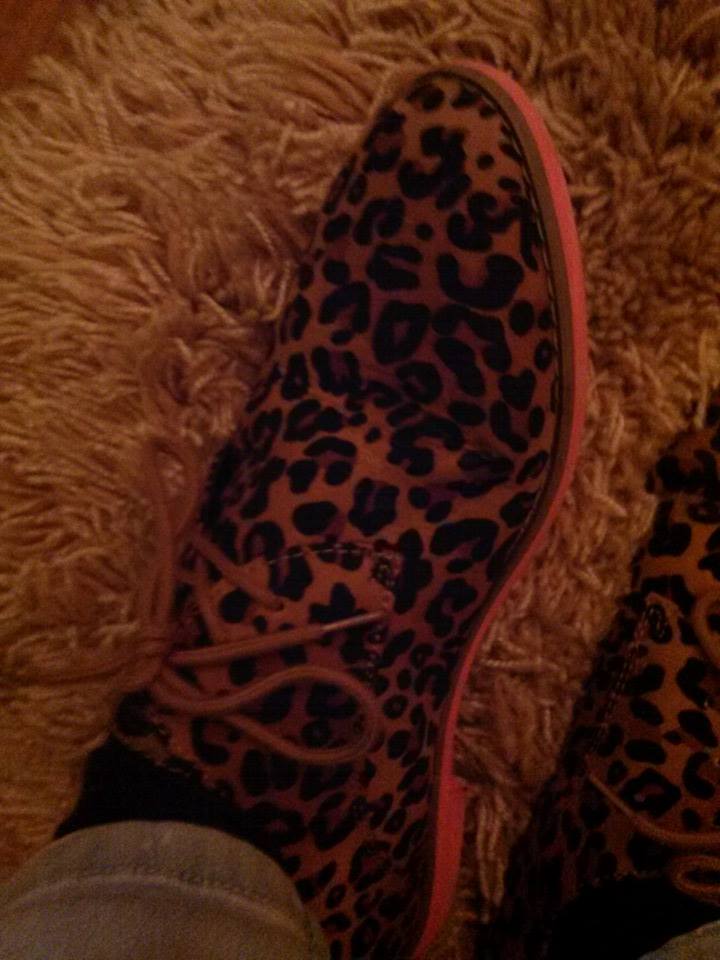
Look what I found at Goodwill!

shoes1 shoes2

I ❤ them!

Take your office Christmas party and shove it.

Tonight I have to attend the annual office Christmas party, so I think it’s time to throw this rant up here again.

The article, which was written a year ago, states I have Aspergers, which for over a decade I believed I had but I found out I do not. It’s most likely my avoidant PD masquerading as Aspergers.

luckyotter's avatarLucky Otters Haven

officeparty
Get out of my face with your absurd fake smiles and stupid Santa hats.

So tomorrow night is the annual office Christmas party. I will not be attending. It’s not like I have some high level job where my presence is expected or necessary anyway. I doubt anyone will even notice my absence or care.

As an Aspie, I have never been able to tolerate the forced upbeat perkiness and all the small talk and chit chat about nothing in particular that abounds at these events. Too much social input coming in from all directions overwhelms my oddly wired brain, causing it to short circuit. I wind up in a state of near panic and to compensate, I become mute to avoid reading a social cue wrong and say something out of context that causes people to look at each other knowingly and roll their eyes at my social ineptness.

View original post 511 more words

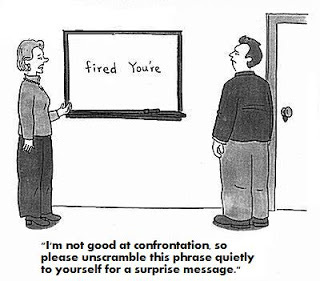
Introverts fear confrontation.

youre_fired

I came across this individual’s forum post on The Personality Cafe in a weird way. My article “Why Family Scapegoats Become Lifelong Victims,” (which has become my most viewed article ever and is still gaining momentum on the web), was linked to by this writer and there was an excerpt from their own post left in my comment folder. The blurb was intriguing enough that I decided to read it, and holy cow! It sounds like my own life story. In fact, I am going through this situation with a friend even as I write this. (If you’re a friend of mine reading this it’s not you–this “friend” doesn’t read my blog or even know I have one). I don’t want to be friends with this person anymore (who I suspect is a malignant narcissist who likes to “play” with me and make “jokes” at my expense) but instead of confronting them and telling them I want to end our friendship, I’m just avoiding this person, hoping they get the “hint.” I do that sort of thing all the time. Confrontation terrifies me, but what happens is my anger becomes seething resentment and has to come out eventually, so after weeks or months of pretending everything is fine, I’m likely to explode and say things I regret. It also comes out in other ways, like acting passive-aggressive. I’ve gotten better but it’s still a problem. Anyway, here is that article. The writer is an INFJ like me and wonders if this is common in INFJs. I’m also an Enneagram Type 4/5.

If we need to slap a psychiatric label on this sort of behavior, it’s a common symptom in people with Avoidant Personality Disorder and Covert Narcissism (which I still suspect I am, even though my therapist has said I’m only “on the spectrum” but not NPD). I think people with BPD are also guilty of this.

passive_aggression

Has anyone else had this problem in the “social environment”?

As of recently I have made a personal discovery about the origins of how and why I have a certain fear. And it also ties in with the Enneagram 4 labeled fear “that they have no identity or personal significance”. Generally, with “friends” (both close and acquaintance) I tend to hide away or become afraid of sharing my true thoughts and being completely honest with them if there’s a problem (unless they manage to hurt me to the extent that i just cut them off). I become fearful of their reaction before it even happens, so i withhold my thoughts and continue acting as if everything is okay. It’s not only the fear that they will be upset at my honesty, but the fear that I would also begin to hate myself afterwards as well. I didn’t realize there was a term for this as well (even though i knew it as a common term i never understood its meaning). And that term is “Shame”. And while shame is the major factor of why i feel guilt for wanting to speak out, as well as feeling it for not wanting to speak out, I had also come to realize this was also connected to my upbringing. I learned in the article mentioned below, that most scapegoats have high empathy and sensitivity at an early age, which causes them to absorb all of the projections of their parents, thus causing the birth of self hatred/possibly depression. It also informed me that as they continue to go into social relationships, that they will also absorb the projections of what other people think of them as well. For me this explains a helluva lot, of why i fear getting close to certain people and their impact on me if i either

A. Do something wrong.
Or
B. Be honest with them.

I’m personally terrified of being completely honest with someone i’m not sure of, as any kind of minor negative backlash towards me can cause me to go in a state of guilt for a long time. So instead I internalize everything that bothers me about them, and I simply play my part in this “friendship” until i have a reason to avoid them or doorslam. And this is different from constructive criticism, i’m talking about the consequences that may occur if they end up being hurt by my honesty. While their take of it may not be my problem afterward I still hold the shame of what I have done to another human being, even if it was the “right” thing to do rather than continue being dishonest with them and put on the fake persona. I fear hurting them..but I also fear hurting myself. It’s a double edged sword and the ending remains the same regardless of which way i act. I’m fearful of absorbing any new projections one might have of me (specifically negative) which has caused a spiral of paranoia in 2/3 of my friendships, even if they may not take it personal. And before I end this, I am not intentionally hurtful when i’m honest, as I still try to be polite and respectful of the person that i’m talking to. I am also aware that they can be positive in their response, but i’m practically crippled by my fear, especially because of social experiences that didn’t go well.

Read article on The Personality Cafe here.

What’s really wrong with the world.

One of the best quotes I ever saw (click to enlarge):

peopleandthings

“Narcissist Apocalypse”

roman_warriors
Photo credit: unknown.

I want to share this fascinating article about societal narcissism from The Telluride Daily Planet I found via Sam Vaknin’s Malignant Self-Love Facebook page.

Narcissist Apocalypse
http://www.telluridenews.com/opinion/columnists/article_34238512-9e09-11e5-9aad-e33827f8673e.html
By David Brankley, Being There

Lately I’ve been intrigued with the topic of narcissism. Maybe it’s the current election cycle with its clash of giant egos, the sparring of would-be megalomaniacs. Maybe it’s the book I’m reading, “Narcissistic Supply: The Narcissist’s Drug” by Sam Vaknin.
Turns out its author is no psychologist, but his leading credential is that he is himself a narcissist, twice diagnosed by experts. Nevertheless, this book seems rich with insight into the condition, containing plenty of food for thought.
Narcissism is not a single phenomenon. There is the clinical form, recognized generally as a personality disorder referred to as Narcissistic Personality Disorder. Even that takes many forms. I wish I had the space here to describe them. They are all fascinating.
Instead, let me offer a simple definition. NPD is extreme self-centeredness. It’s characterized by an inflated sense of self-importance and a deep and overwhelming need for admiration. Lack of empathy is also present. The confident exterior of the narcissist is a false mask. Underlying it is a very fragile sense of self worth that is vulnerable to the slightest criticism. There is also a more general, less extreme form of narcissism that some call “societal narcissism.”

Read the rest of the article here.

The narcissistic spectrum according to Lucky Otter

Man looking at reflection in mirror

A friend and I were talking about where exactly different levels of narcissism would fall on the N-spectrum. Of course narcissism (or any psychological topic) isn’t an exact science so giving the different levels numerical values seems a little silly, but in my mind this is how I view the different levels on the spectrum, starting with a Baseline of O (on most narcissism spectrums, “healthy” narcissism is at baseline) and the transition to NPD at around 5, which is smack dab in the middle. Narcissism becomes pathological (causing the person or others problems) at around 4.
Please note these are just my own subjective ideas.  I’m a geek who likes to classify things.

The Narcissistic Spectrum according to Lucky Otter

9-10:
Sociopathy:
A person at this level is almost indistinguishable from someone with ASPD (antisocial personality disorder), but an NPD sociopath is more concerned about image or obtaining supply than a pure ASPDer. Most cult leaders fall here. (Psychopathy appears similar to sociopathy in behaviors, but describes a condition that a person is born with instead of one that was acquired; many psychopaths were never abused and were always like that, but sociopaths were made).

8-9:
Malignant Narcissism:
A person at this level has severe NPD with antisocial traits. A person at this level will show more emotion (usually rage) than a narcissistic sociopath. Usually fits all the DSM criteria or most of them.

7-8:
Severe NPD:
Not malignant because there is no sadism present, but person is still highly dangerous and manipulative. Fits most or all of the 9 criteria and symptoms are severe.

narcissist-bird

6-7:
Moderate NPD:
A person at this level may be barely tolerable, if contact with them is casual or seldom. Fits more than 5 of the 9 criteria.

5-6:
Mild NPD:
A person at this level fits 5 of the 9 DSM criteria for NPD but symptoms are not too severe and they may have moments of acting like a decent human being. NPDers at this level may occasionally respond well to therapy or seek it out.

—Pathological—

4-5:
Narcissistic Personality (Destructive Narcissistic Pattern disorder or DNP):
  A person here fits fewer than 5 of the 9 NPD criteria in the DSM but has at least three.  Symptoms may not be that severe and the person at this level is more in touch with their true self and may seek therapy.  They usually have the capacity to feel empathy but it’s limited.

3-4:
Non-Pathological Narcissistic Personality:
Your garden variety self-centered jerk but may genuinely care about those they love.  Not particularly dangerous. Has moments of insight into themselves or empathy for others, especially their loved ones.

0-3:
“Healthy” narcissism.
Most normal people can be found here.

O (Baseline) and lower:
People down in the negative digits might as well be wearing a “KICK ME” sign. They are almost always victims of narcissists and sometimes even normal people give them a hard time or take advantage of them.

npd_spectrum
The simplified spectrum. Psychopathy does not belong here at all.

Covert (“fragile”) narcissists may be found anywhere on the spectrum, but because their narcissism is more hidden and arrogance and grandiosity may be absent, a covert narcissist at any level is harder to identify. They may appear to have BPD, Avoidant PD, or Aspergers Syndrome instead (these are the three disorders most often confused with Covert Narcissism).

High-functioning (successful) narcissists are more likely to be found high on the spectrum, and sociopaths are often extremely high-functioning. There are many sociopaths (and psychopaths, who were generally born with a different brain structure and may not have been abused) in politics, religion, and heading huge corporations. Sociopathic traits and most NPD traits are generally sought after in the higher echelons of business, politics and entertainment. A person with just the “right” combination of antisocial behavior and arrogance, entitlement, grandiosity, and fake confidence can be a devastating adversary or competitor, and they will have no scruples about crushing you into the ground to achieve their goals.

Most high-functioning narcissists tend to be the Grandiose (classic, or overt) type that best fits the DSM criteria.

Covert and overt narcissists all have the same disorder, but for most, one form or the other is dominant. That said, they can and do switch back and forth in the same person. I think temperament is partly to do with whether someone is overt or covert (the more timid or fearful types leaning toward covert narcissism), but I also think circumstances (such as a sudden loss or gain of supply) can cause a switch from overt to covert or vice versa.

Low-functioning narcissists are much more likely to be covert.  They tend to receive less supply than overt narcissists, so their false self is weaker (the “deflated” false self, according to Masterson). Because of their discontent with their lives and general lack of success, covert narcissists are more likely than overt ones to seek help. If a covert narcissist suddenly begins to receive a lot of supply, they can become much more overt-acting (grandiose, entitled and arrogant). If an overt/grandiose narcissist suffers a huge loss of supply, they can sink into depression and become covert (at which point they are more likely to seek help).