George Carlin was a brilliant comedian who wasn’t afraid to bring up uncomfortable truths, as he does in this standup routine in New York City some years ago.

George Carlin was a brilliant comedian who wasn’t afraid to bring up uncomfortable truths, as he does in this standup routine in New York City some years ago.
My friend Mary’s ’90s-style hard rocker, “It’s In Your Head,” a song about narcissistic abuse, is now up on Youtube! (I posted the soundcloud version a few weeks back).
Please listen! She and her band are great. More new music from them will be coming soon!
Mary is a huge inspiration to me because since she left her abuser(s), she has come out of her shell and had the confidence to finally discover her musical talents and put together her band.
The two mirror images of Mary with her guitar form two white owls. You might have to look at the graphic from a distance, but it’s clear as day once you see it. Mary assured me this was COMPLETELY unintentional. So eerie!
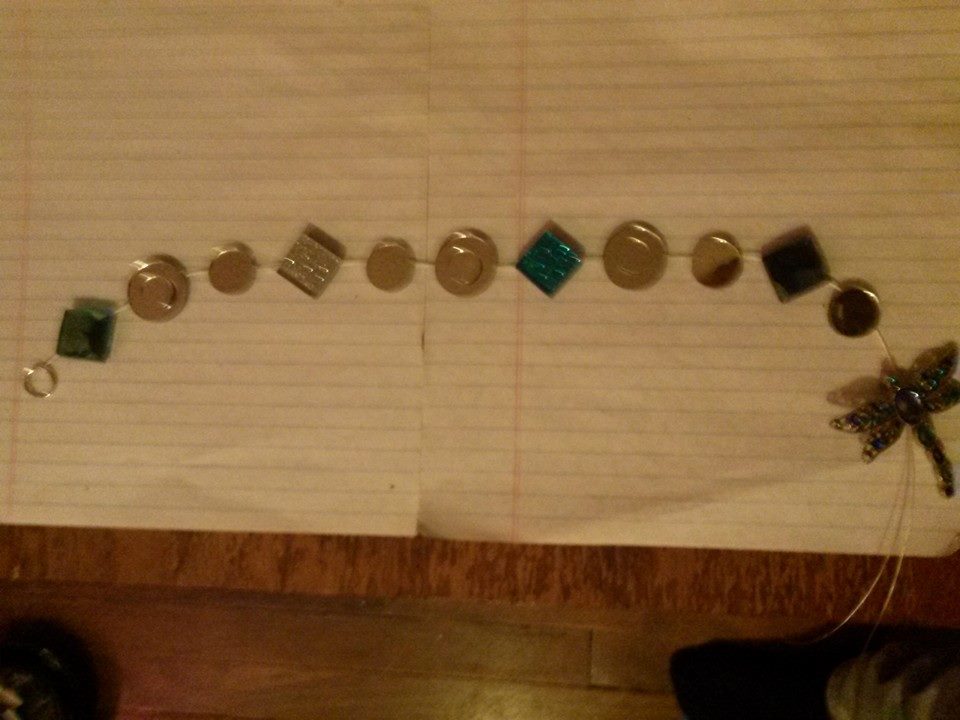
Dragonfly suncatcher.
I’ve had only four sessions so far with my therapist, but I already feel there is trust building between us. I don’t normally feel comfortable talking about my problems with people I don’t know well but his gentle and quiet (but humorous) manner puts me completely at ease and he also appears to have a high level of empathy. I’ve made a few amazing discoveries about myself in this short time and wanted to give him a special Christmas present to show how much it means, so I made this dragonfly suncatcher today. Dragonflies symbolize change and freedom, and this pendant from Michael’s was just gorgeous.
Also, just from observing the way he has his office decorated (he’s into artsy-craftsy stuff), this looks like the sort of thing that would fit in with his decor.
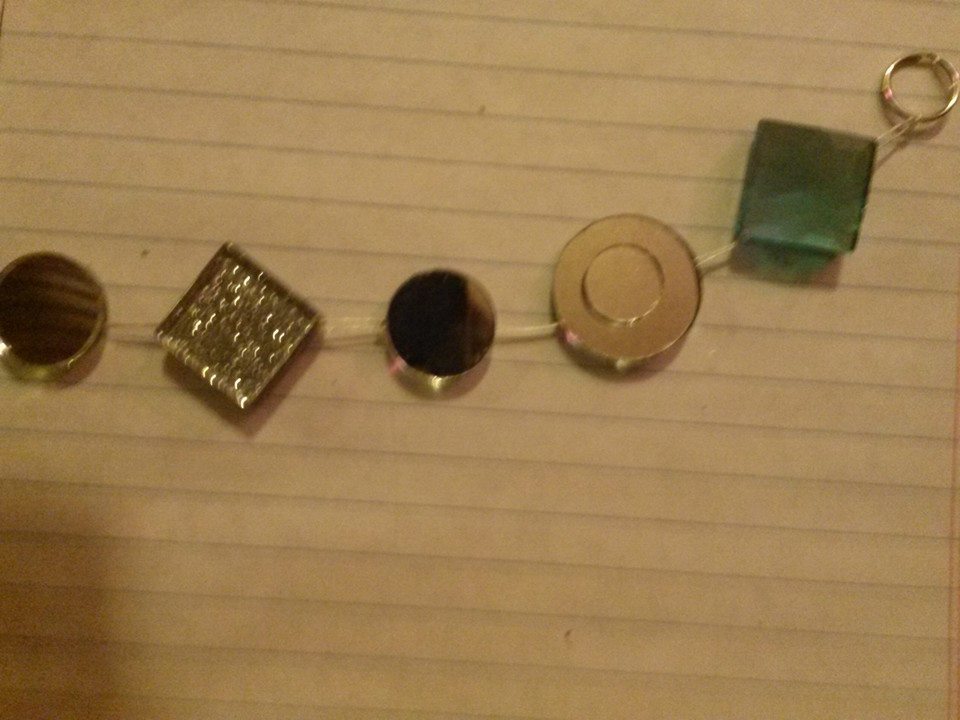

Two closeup views.
The colors are much more brilliant than the photographs show. Those are little mirrors strung between the bits of glass, and that seemed appropriate too.

Good morning, fellow bloggers! I’m taking a page out of Opinionated Man’s book of tricks and asking you to share your blog, favorite post, or most recent post here. I also feel like it’s time to pay it forward for all the help I received when I was new to blogging. This blog gets enough traffic now that posting your link here should give you a small boost in hits.
If I’m really impressed by your article or blog, I may reblog it or write a short post about your blog. So let’s see what you’ve got.
If this experiment has a good turnout I may do more of these in the future.

Many of us who were raised in narcissistic families or come from abusive backgrounds don’t have good associations with Christmas and the holidays in general. On top of this, Christmas has become overcommercialized and even people from normal, happy families get stressed. Everywhere you go, there are messages telling you to be cheerful and “jolly” and ads telling you to buy, buy, and buy some more. People who don’t have families (or have dysfunctional families) or don’t have a lot of money often feel marginalized, as if they’re defective because they can’t fully participate in all the hoopla or be as happy as the wealthy, perfect (and annoying) people they see in TV commercials. The days are also short and gloomy. No wonder depression is so common this time of year.
Even if you dread the holidays, it’s still possible to enjoy them. I used to stress myself into a frenzy every Christmas. When you have small children, it’s easy to do this if money is tight, which it almost always was for us. After all, children are expecting Santa to come with his bag of gifts, and they will not understand if gifts are few. But kids being around also make Christmas fun. Now that my kids are adults, I’ve learned to not stress so much about Christmas. It’s still not my favorite time of year, but here are some ways you can make the most of it. Even though I still dread the holidays, I almost always wind up having a great time.
1. Treat Christmas like a second Thanksgiving.

Thanksgiving is probably the least commercialized holiday. In fact, it’s so underrated that now it’s been nearly co-opted by Black Friday, and stores remain open on Thanskgiving so people can get a head start on their Christmas shopping.
On Thanksgiving, the focus is on food, eating, and football. For the past few years, I’ve focused on the food at Christmas rather than the gifts. I give a few inexpensive or homemade gifts, but I spend more of my time and energy on cooking. My spinach-meat lasagna has become a family tradition rather than the usual turkey (I’m usually turkey’d out after a month of eating turkey, turkey soup, and turkey sandwiches) and the lasagna I make has all the Christmas colors too. (I’ll post my recipe later on). Add a salad and some garlic bread and some kind of pie (usually apple for us), and we’re good to go. Everyone’s so busy enjoying the food they barely register the fact the gifts are few.
2. Bake cookies (or other baked goods) and give them as gifts.
You don’t need to spend a fortune on presents. Everyone loves cookies and they can be wrapped in attractive and creative ways and given as gifts. If you’ve baked the cookies yourself, it can be a more thoughtful and personal gift than something you got from the store. If you prefer, bake a pie and wrap it like an Easter basket in red and green cellophane with a bow on top. Even a prettily wrapped basket of fruit can make a thoughtful gift.
3. Give handmade gifts.
I make suncatchers made of bits of glass, stone and small mirrors and they make terrific gifts. I haven’t made any in about a year, but I have several still around that I plan to give as gifts this year. Each one is unique and everyone appreciates them. Years ago, when I had a kiln, I used to paint ceramic tiles. People loved those too. If you paint, make jewelry, knit, or do any other kind of arts and crafts, think about making your gifts instead of buying them. People will appreciate the time and effort that went into making such a personal and unique gift.
4. Remember that the days are now becoming longer.

If you’re like me (I suffer from SAD), the short days of this time of year can get you down. But there’s an upside too. Starting the first day of winter, the days start growing longer! Christmas was originally a pagan holiday to celebrate the “return of the sun”–the winter solstice. Remind yourself of the lengthening days and try not to think about the cold months ahead.
5. Do something special for yourself.
If you’re not blessed with a big, boisterous family–or even if you have no one to spend Christmas with, you can still enjoy the day. Make it special: give (or make) yourself a gift, go to a movie, take a long walk, or a long luxurious bath. Also, you can remind yourself that sometimes big family get-togethers can turn into unpleasant drama fests. Remind yourself that you’re spared from that.
6. Volunteer.
Most churches sponsor Christmas dinners. Other organizations do too. If you don’t have a family to spend the day with, or you have negative memories associated with this time of year, consider donating your time to preparing or serving food to take your mind off your woes. You might even meet others in the same boat and wind up making new friends and having a great time.
7. It’s only one day.
Even though the Christmas season can seem endless, it’s all leading up to one day, and then it’s all over for another whole year.
8. Skip Christmas this year.
I’m serious. If Christmas really stresses you out, consider skipping it altogether. Explain to your friends and family that you need a break from the stress and assure them it’s nothing personal. If they’re true friends they will understand. If you’re a Christian, you will not offend Jesus if you skip Christmas. The Bible doesn’t tell us we have to celebrate his birthday.
9. Remember what Christmas is really all about.

Three Kings Behold the Star of Bethlehem
In spite of what all the commercials tell us, Christmas isn’t about the trees, Santa Claus, reindeer and gifts. It’s about the birth of Jesus Christ. Most churches have some sort of Christmas service. Consider attending and focusing on the true meaning of Christmas instead of all the material trappings. Watch “A Charlie Brown Christmas,” always a treat for me.
My daughter posted this on her Facebook today. That’s her kitten Zelda up there at the top of the tree. Maybe she thinks she’s an angel. NOT! Click to enlarge.

😆

Just thought I’d throw this out there. I’m sure it’s a phase and will pass. Occasionally I get obsessed with random things and for a few days or weeks those things take up all my time and energy. My obsessions tend toward the strange: what the higher dimensions look like, how languages evolved, the function of the pineal gland, universes with different laws of physics, why time goes by faster as you age, remote places in the world like Antarctica, books I loved as a child, dragonflies…and the Illuminati. (Cue Twilight Zone theme).
Anyone else have weird obsessions they want to share?
Even scarier than that, here’s an “official” Illuminati commercial. It looks real, but it could be a hoax. Has anyone seen this commercial on TV? If it is real, we are in big trouble.
They also have a website. I won’t link it here though. The URL is in the above video if you’re curious. I looked at it and it doesn’t tell you much more than the commercial does. It seems you have to “join” to get any more information, which isn’t something I care to do.
Frankly, I’m surprised they’d be making themselves so publicly available, which is why I’m skeptical about this being a real commercial or the site being real.

What I’m learning is that everything isn’t always about me.
I used to always assume people were obsessing in a negative way about me and would interpret, say, a neutral expression or a lukewarm greeting as “that person must be upset with me/hate me/is mad at me/disapproves of me” etc. Sometimes I have to make a conscious effort not to let my mind go in this direction if someone acts in a way other than thrilled to see me. Sometimes they’re just having a bad day, are angry at someone else, or angry in general, or are generally just an asshole to everyone. Sometimes it’s nothing at all other than my choosing to perceive a neutral expression or body language as something negative. It takes a lot of practice to get out of that habit of paranoia and hypervigilance and I always have to remind myself to stop taking every little thing personally and think outside myself instead. I think this is a prerequisite to being able to empathize–being mindful that someone else might have a problem that has nothing to do with me.
I know the labels don’t really matter, but I’ve been wanting to know for months. I also wanted to know if I’m really a covert narcissist. I got my diagnosis on Friday.
Trust..

Before I talk about that, I just want to say that I know I picked he right therapist and it’s because of the way he showed me his empathy and got me to trust him.
Modeling empathy.

We originally had our appointment for Thursday but he forgot. It turned out it was a mixup in his calendar due to the confusion over Thanksgiving week. The first thing he did when I showed up and he realized his mistake was to apologize. He said he would make it up to me. I felt a niggling of rejection (how did he forget??? How could he possibly make it up? I had important thing to tell him!)
I worried that maybe he didn’t really like me and was trying to get rid of me.
He must have known this because I think he saw the look on my face (that I was trying to hide with laughter and “no problem” reassurances) but he knew that was an act, I think.
“Why don’t you swing by tomorrow?” he said. This guy saw how I felt, and empathically addressed the situation and in so doing, removed my worries that he might be trying to get rid of me. I told him that I was glad he remedied things so quickly because, I admitted, if he hadn’t done that I would have continued to feel rejected.
His quick remedy showed he had a lot of empathy and was concerned how I felt. That made me trust him. I also realized he was modeling empathy for me, something I never got from my parents and very few other people growing up.
The Diagnosis.

He knows I have a BPD, PTSD and AvPD diagnosis, but from the very first session I told him I think I’m also a covert narcissist. I explained what that was in case he didn’t know (since it’s not recognized officially). This session, which was my third, I finally worked up the courage to ask what he’d diagnosed me with.
“Well, I don’t really believe in the medical model,” he said. “Also, the Axes have been removed from the DSM-V.” This was news to me.
He was staring at me. “What?” I said.
“Do you want me to give you a diagnosis?”
I stared back and looked away, licking my lips nervously and giggled a little.
“What’s going on?”
“Uhmmm, nothing.”
“Why is it important to you to have a diagnosis?”
“It isn’t, really…” But it was, and I didn’t know why or how to explain it. “I’m just curious, I guess.”
“I won’t give you a diagnosis but you do appear to have symptoms of PTSD and some borderline traits….”
His sentence hung in the air.
“and…?” I asked, waiting.
“Well, you wanted to know, so I’ll tell you. I don’t think you have NPD, but you do have narcissistic traits and are probably on the spectrum.” That’s about where I thought I was. I was relieved I didn’t have NPD.
But it was like I went down the rabbit hole all over again, feeling dissociated and lightheaded but only for a minute. This time I had my emotional water wings on and floated back into reality. I was so overcome with relief that my eyes watered.
I think it was the relief of having some kind of closure. I’ve been so confused for so long. Well, I guess I’m sort of in limbo between narcdom and non-narcdom, which doesn’t clear things up a whole lot more than they were before, but somehow now the confusion makes more sense.
 Lucky Otters Haven