The crazy history of my other blog.
I know what my real diagnosis is: CPD (Confused Personality Disorder). Enjoy!
Tag Archives: narcissistic personality disorder
Shattered Dreams Poetry and Book.
A reader of this blog wanted to share some of her poetry with me and I asked her if it was alright to share the poems with my readers because they really resonated for me and I think other readers of this blog who have been married to or divorced narcissistic men could definitely relate to her writings.
Rina Lynn has her own blog of poetry (Shattered Dreams Poetry) about coping with the emotional fallout of narcissistic abuse and divorcing a narcissist. Please take the time to visit her site.
She also has a book, Shattered Dreams: Poetry for Women Divorcing a Narcissist, by Rina Lynn and Kay Gardner, which is $4 on Amazon.

Here are some of her poems.
The Great Escape
There was a chick
Who pecked and chipped
A window in the wall
Scrunched she sat
Tightly packed
Smooshed into a ball
The shell seemed swell
She knew it well
But her heart knew it was time
She peered outside
While hard she tried
To pretend her life was fine
Then cracks began
To rip and span
The whole of the world she knew
She closed her eyes
And tried to hide
Spinning her lies anew
It’d be ok
If she stayed
She’d lived here all her life
Her life was hell
Inside her shell
But she was just a wife
One piece fell
From off her shell
She began to be quite frantic
She tried so hard
To fix the shards
You should have seen her antics
Then with a glance
She saw her chance
And knew it had to be
With one great heave
The halves did cleave
And all at once she’s free

The Puppet Master
He picks his victims carefully
Then reels them in
With hateful glee
Gives them all their heart desires
Inflames their senses…..
…..ignites a fire…..
Tells them all they wish to hear
Then he owns them…..
…..this puppeteer……
He speaks a word
And they try their best
His every whim
To manifest
It becomes a daily thing
Dangling his prey
Upon his strings
Their individuality begins to dim
Disappears into the world of ‘him’
Soon they are just instruments
Who live to make his life content….
……where did their will go?
……why do they stay?
…..why don’t they escape…..
……and leave the fray?
A war of attrition is being fought
They respond…..
…..the way they ‘ought’…..
Doing their best to please another
While their identity is smothered
You can’t see the forest
For the trees
You can’t escape
Till you ‘see’ the strings
And understand it’s just a game
…..to enslave you …..
…..and drive you insane…..
The thrill of the sport…..
…..a manipulative zest….
To prove to him
He is the ‘best’
All you are…..
…..is another conquest…..
Swelling his appetite
…..and selfish greed…..
On hurt and control
…..his evil heart feeds…..
If only his dupes
Could really see
They hold the scissors…..
……to cut the strings…..
Then……they could truly be free…..
Living a life…..free of his deeds
The Feces Inspector
I had a job i did
For fully half my life
I examined feces
In my role as a wife
My husband produced
It freely
It seemed to roll right out
I followed him discretely
Trying not to shout
I knew this wasn’t normal
it couldn’t be ok
I wondered just what caused it
Each and every day
So I began a quest
The origin to explain
I set up a lab
The truth to explicate
I wore rubber gloves
To scrutinize his manure
I checked out what I fed him
His routine & DNA
Puzzling perceptions
Grew more enormous
By the day
When digging thru the dung
Looking back it seems
The stench that it created
Stifled all my dreams
I smeared it on the slides
Peered into my microscope
The closer that I looked
The more I lost my hope
The manufactured crap
Continued all the while
When picking thru the pile
It was really hard to smile
So I resigned the job
Gave up my inspector hat
Someone else can have it
I’m not doing more of that
I cleaned up the counter
Swept & mopped the floor
Threw away my samples
Walked out and locked the door
…….then beamed with satisfaction

Anger Has Been Banished. It’s Time to Go Away
There’s another person
Who lives inside of me
She’s so very bound
That she can’t get free
Her given name is anger
And she’s very strong
She stands up to deal
With the things that’s wrong
When my voice is silent
Her voice rings out loud
She can speak to bad guys
She truly makes me proud
Others do not like it
When she’s in control
But I gave her permission
To protect my soul
Until she was allowed
My life was filled with pain
I needed her assistance
My self-esteem to gain
Now my life is better
The perpetrator’s gone
But anger just won’t leave me
She feels this is her home
She’s overstayed her welcome
Now she needs to leave
Unfortunately we’re at odds
We’ve really disagreed
I think I can manage
She thinks I’ll be deceived
Serenity won’t visit
If she stays around
She says she’s rude and ugly
And wears a constant frown
I really need the comfort
Of tranquility
Poise, content, composure
And equanimity
They say that she can visit
When there is a need
But for them to live here
Anger must concede
Backbone, strength, and power
Will take her place today
Anger has been banished
Peacefulness can stay
Honor says it’s time
And I will be ok
Anger you must listen
It’s time to go away
The Scapegoat
It’s your fault!
…..from the very first…..
No matter who is punished…..
……yours will be the worst…..
Everyone else is perfect
But.….you are very bad…..
You try your best
To please the rest
But…..somehow you just can’t
You talk too loud
Or not enough
Or leave dishes in the sink
Someone else messed them up
But, it’s your job to see they’re cleaned
You’re too big
Or too small
The opposite of what is best
You work the hardest
Try the most
But never please the rest
Their evil deeds
…..are swept under the rug
…..or simply attributed to you…..
Then you’re screamed at
…..and penalized…..
For what you didn’t do
Chastised, reproved
Castigated, reprimanded
Disciplined each day
The weight of someone else’s deeds
Is placed upon your plate
The lies that are their alibis
Sound grand to all who hear
No sympathy
Will come your way
Only boos, and sneers…..
After all……who would tell…..
….such outrageous things?
No one in their right mind
Could really be so mean
So…..to others….it has a
Truthful ring
Embarrassment…..humiliation
Becomes your garment donned
There’s no way
To convince the audience
That by a NARC they have been conned……
You hang your head
Accept the shame
….while more blame is piled on……
The scapegoat……
…..who bears the sins of the home…..
…..so no one else needs to atone…..

Shame
Shame is that feeling
That you aren’t enough
You feel as if
You should be
Made of stronger stuff
It’s hard to hold
Your head up
It’s like you don’t belong
No matter what you do
It seems to be all wrong
People laugh and whisper
Or.….that’s what you believe…..
To be on equal footing
Is something
You just can’t perceive
But you must remember
We are all alike
Made in God’s image
So stand right up and fight
Most of the time
When shame has held you down
Worn you to a frazzle
Esteem’s been tightly bound
It’s because of something
You’ve taken on yourself
You didn’t even do it
It was done by someone else
Maybe it’s your family
That has done the deed
Maybe it’s somebody
Else’s lifetime creed
You believe that you
Must measure
Yourself by their thoughts
But you can’t accomplish
All the things you ‘ought’
You deem yourself ‘guilty’
Picking up the weight
Shame brings upon you
It seems it is your fate
But look at this whole thing
From a different view
Why must you pay?
For things you didn’t do?
Throw off that fault
Break that felon’s thong
The offense wasn’t yours
You did nothing wrong
Let others stand in their corruption
And shame will slide right off
You didn’t do the crime
You mustn’t pay the cost!
A Little Girl
A little girl
Whose life was hell
Tried to be so good
She washed her face
And combed her hair
And did everything she “should”
And as she grew
Her “oughts” did too
The load grew hard to bear
As others refrained…
She accomplished great things…
So they handed her their cares
She took on blame…
She took on shame…
The people round her knew she would
They used
Abused
And taunted her
Because she was so good
Talented
Proficient
An expert at so much
Alone each day she waited
For a single loving touch
As life passed by
She began to cry
But none had time to listen
The family left
She felt bereft
With tears her eyes did glisten
With deep despair
She combed her hair
And did the daily chores
The song was gone
She carried on
Alone
As each day before
Finally, a clearer understanding of Narcissism & how it relates to CPTSD
WARNING: THIS VIDEO MAY BE TRIGGERING (I found it extremely so).
Why narcissists are more hated than psychopaths.

All four Cluster B disorders are vilified, especially on the Internet, but for a long time I wondered why NPD seemed to be even more demonized than ASPD (antisocial personality disorder) and psychopathy and seemed to be regarded as the most “evil” disorder to have. After all, most narcissists are not going around breaking the law, murdering people (not physically, anyway), and most at least pretend to be nice to you, at least if your relationship is only casual. They make a good impression and most have families and respectable jobs. They go to church, teach second grade, and volunteer at the food pantry. If you’re just acquaintances or casual friends with a narcissist, they can even be a lot of fun. They also provide a lot of our entertainment, as narcissism (including NPD) is over-represented among celebrities, and what would we do without our movie, sports, and pop stars? Antisocial people are far more likely to be in prison and most aren’t making a mark in the creative arts. So why is it that narcissists are hated more than anyone else, at least on the Internet? I think I finally figured out the answer to this, and there are a few reasons.
1. Narcissists are more likely to have raised us.
Not too many people with antisocial personality disorder become parents, or are allowed to keep their children for very long of they do. They don’t need to have children for narcissistic supply since they don’t require that, and if they do have kids, their bad behavior is so obvious that their kids are usually taken away from them at a young age. They don’t pretend to be good parents but secretly abuse their child the ways narcissists do. They may even voluntarily give up a child because raising it is too much bother and gets in the way of their antisocial activities.
2. Narcissists are more likely to have been a lover or a spouse.
Psychopaths and people with antisocial personality disorder tend to be loners, or run in packs (gangs). They tend to dislike commitment and because they don’t require supply from other people, they usually have no use for a close relationship. If they marry, it could be for financial reasons since all they care about is what works and what is practical. As a result, while they can’t really love, they may not really be that emotionally abusive.
3. Psychopaths and people with antisocial personality disorder (ASPD) seem like rare, exotic (and often caged) creatures.

There’s a common perception of antisocial and psychopathic types being somehow apart from the rest of humanity, maybe not even quite human. As a society, we are drawn to and fascinated by serial killers (though technically, a few, like Ted Bundy, have had an NPD diagnosis) and a sort of cult has grown around psychopathic mass murderers, bank robbers, and serial killers. They make good entertainment. They’re also cool (something narcs are not). In the movies, TV, and novels, the anti-hero is a “rebel without a cause” who usually fits the criteria for ASPD or psychopathy. Even if they’re not committing crimes, they seem like exotic free agents who do whatever they want, whenever they want, and don’t give a damn what anyone else thinks. Think of Ferris Bueller. Ferris was more antisocial than narcissistic but he became a role model for millions of teenagers in the 1980s because he was just so cool. If he was a narc he would have been cast as the villain. Compare Ferris with Nellie Olson, the spoiled, bratty rich girl in Little House on the Prairie. Any questions?
4. What you see is what you get.
While psychopaths and people with ASPD lie well and often, it’s usually to avoid getting in trouble. They can be manipulative, but only to get what they want from you (and what they want isn’t narcissistic supply but more practical things that help them achieve their goals). They don’t lie just for the sake of lying. Gaslighting, triangulation, and other types of emotional abuse that involve vicious lies about another person’s character aren’t really their thing.
5. Narcissists are sneaky.

Related to the above, narcissists are always trying to undermine or even destroy you behind your back. Essentially, they are huge cowards. Psychopaths and antisocial people don’t care about such “niceties” and tell you what they really think of you right to your face. No, they don’t have any empathy either and they don’t give a damn if they hurt your feelings, but they usually won’t be pretending to be your best friend either (unless you can be of practical use to them in some way) .
6. Narcissists wallow in self pity.
Psychopaths and antisocials don’t feel sorry for themselves or waste other people’s time whimpering about how everyone hates them or how they never get any breaks. That’s because they don’t care what you think of them and they make their own breaks, even if they have to break the law to do it. Narcissists are not only hypersensitive, they are very dependent on other people. People with ASPD pretty much operate alone. They’re too cool for such narcissistic shenanigans as wanting to be liked and admired.
7. Narcissists are high maintenance.

Psychopaths and antisocial people do not require narcissistic supply, therefore they don’t demand too much emotional sustenance from other people. Narcissists constantly require being blown up like a punching clown doll (and make you want to punch them).
8. People assume most psychopaths are in prison.
It’s not true, of course (some are running huge multinational corporations or running for political office), but most people assume anyone with ASPD/psychopathy is in prison and therefore no danger to the rest of us. In contrast, narcissists seem to be lurking behind every tree and lamp post and hiding under every bed.
NPD mood cycles can mimic Bipolar disorder.

I remembered something about my NPD ex tonight. He used to have mood swings that seemed in many ways reminiscent of Bipolar disorder. It was only later I realized what they really were–cycles of of grandiose entitlement and dejected self-pity. Whenever supply was abundant–such as when he was promoted at work–he became puffed up with pride and this resulted in an attitude of entitlement and grandiosity which he lorded over his subjects, namely me. He also seemed somewhat manic when he was in one of these grandiose phases. These were the times he was the most likely to become overtly abusive, both emotionally and physically. Instead of being happy the way a normal person might when thingsa are going well for them, my ex became hostile and prone to pick fights. I learned to dread the times in which good things happened to him, because that was when his narcissism seemed to go into overdrive.
When his supply was running low, he sank into deep depressions, in which he lost all his motivation and energy and spent most of his time staring dejectedly into space or sleeping (or pacing the house frantically at night). His “manic” behavior disappeared and he talked very little when he talked at all. When he did speak, it was to moan endlessly about how terrible his life was and how everyone had it in for him (nothing was ever his fault, and he was still assigning himself Center of the Universe status). He acted helpless and needy, and wallowed in self pity like a pig in mud. He sometimes threatened suicide (but never attempted it–narcissists generally don’t). As annoying as his depressed moods were, I preferred him that way because he was less overtly abusive (though still abusive in a covert, manipulative way). He acted a lot “crazier” in his depressive states and suffered terrible panic attacks on a regular basis. This actually fits with an NPD diagnosis: when a narcissist isn’t getting any supply and their victims aren’t cooperating, they begin to feel like they don’t exist, and can become very depressed and dissociated. The dissociation can lead to severe panic attacks and even psychotic episodes.
The terms “covert narcissism” and “overt narcissism” aren’t mutually exclusive. A covert narcissist (the depressed, “fragile” type) will usually become more overt (grandiose) when supply is high. A grandiose (overt) type will sink to a more covert form of narcissism when supply is low. The two types of narcissism are really just two halves of the same personality disorder. Grandiose narcissists are thought of as being high achievers, but that may be because since they get more positive supply to begin with, they have more reason to act grandiose.
Before I put two and two together and realized my ex’s bizarre mood swings were in direct proportion to how much praise and recognition from others he was getting, I was sure he had Bipolar disorder. Unlike most narcissists, he did see a psychiatrist (mainly to get meds for his depressions and anxiety; there was little to no desire on his part to improve himself), who actually gave my ex a Bipolar diagnosis.
The most common type of Bipolar disorder is what used to be called Manic Depression. During a manic phase, the patient is likely to be extremely hyper, grandiose, testy, and quick to anger. They have an unrealistic sense of their own invincibility that doesn’t line up with reality. This is very similar to the grandiose phase of someone with NPD.
The covert (depressed) phase of NPD can look extremely similar to the depressive phase of Bipolar disorder. The main difference is, a narcissist will generally not follow through on suicide threats (because they are intended to manipulate and garner sympathy, a form of supply) while someone who is Bipolar is in grave danger of suicide. A bipolar patient can also be helped by medication, while there is no effective medication for NPD (although antidepressants and anti-anxiety drugs can help with some of the symptoms).
Further reading:
A list of useful blogs and books about NPD, narcissistic abuse, and BPD.
These are all listed under my “Resources and Support” tab in the header, but I wanted to call attention to them. I have added some new ones. My apologies if you don’t see your blog listed here. Unfortunately, I can’t list them all but if you want me to add yours, please comment and I’ll be happy to add it.
Here are some websites, books and blogs focusing primarily on Narcissistic personality disorder (NPD), narcissistic abuse, and Borderline personality disorder (BPD), though some touch on other personality disorders as well. This is only a small sampling of what’s available. The Internet is loaded with websites about NPD and narcissistic abuse; a quick Google search will bring up many that I have neglected to list here. BPD is not so widely covered, but is becoming more so.
Blogs, Websites and Forums
Dealing with Manipulative People — Dr. George K. Simon’s excellent blog about Cluster B personality disorders (Narcissistic, Borderline, Antisocial, and Histrionic Personality Disorders) with a focus on NPD. Dr. Simon is also the author of several books, which are listed below.
Out of the Fog — excellent support forum for people dealing with those with personality disorders and other mental health problems (or who have a disorder themselves). Every personality disorder recognized by the DSM (Diagnostic and Statistical Manual of Mental Disorders) is covered. I never posted here myself, but I’ve lurked there a lot and found the site very interesting and helpful.
Narcissists Suck — Anna Valerious is a survivor of psychopathic parents, and her blog is excellent. It can also be irreverent and hilarious. Her take no prisoners style may take some getting used to, but she has a lot of heart and a LOT to say about narcissists. Valerious is a Christian, and she sometimes quotes from the Bible, but for the most part, you don’t have to be a Christian or any sort of believer to appreciate her blog. She hasn’t posted in it for awhile, but the articles are still relevant, entertaining, and useful.
An Upturned Soul — longer articles than average, but well written, intelligent, and always fascinating to read. There was no way I could leave this one off this list, since I have reblogged several of her articles already.
PsychopathyAwareness Blog — good blog about psychopathy right here at WordPress. The blogger really knows their stuff.
What Makes Narcissists Tick?— This blog was created by Kathy Krajco, an author about narcissistic abuse who was well respected in the community of narcissistic abuse victims, until her untimely death several years ago. Due to that, the blog hasn’t been updated in a long time, and many of the links don’t work, but it still contains both practical and fascinating information about narcissists and why they are the way they are and why they do what they do.
NarcissisticMother.com is a website focusing on self help for the adult children of narcissistic parents (ACONs), particularly mothers, since in our culture, mothers still have the strongest influence on their children.
SociopathWorld is an intriguing website from the point of view of sociopaths (not exactly the same as psychopaths but very similar). It’s interesting to “get inside their heads” to help understand why they act the way they do. It’s creepy and fascinating how dissociated from emotions, themselves and others they often feel and some explain it surprisingly well.
Similar to SociopathWorld is Psychopathic Writings, a blog written by a psychopath whose articles are interesting and well informed. If you like sites like these, please also check out Kiasherosjourney.
Country of Liars: a website by and for the victims of sociopaths and psychopaths. The blog’s owner, like so many other similar blog owners was the scapegoat of a family of such people. Well written blog.
Lady With A Truck’s Blog: Like so many survivors of narcissistic abuse, LWAT struggles with poverty. Our abusers ruin us on every level, even our ability to earn a living. This is a wonderful blog by a lady with an attitude and a heart. Her writing draws you in like a novel, she’s inspirational, and she’s often quite funny too.
Constant Supply: The Narcissist’s Wife. A blog by a woman married to a malignant narcissist.
Faces of Narcissism: a fairly new blog written by Joanna Moore, a narcissistic abuse survivor. She was married to an abusive, sociopathic man who she is No Contact with today. A good mix of practical, no nonsense advice and personal stories.
Grace for My Heart: Although this blog written by a Christian pastor isn’t specifically about narcissism, it’s a popular topic on his blog (he writes about narcissism every Friday in his “Narcissist Friday” posts) because of all mental disorders, NPD (along with Antisocial Personality Disorder) is the most likely to have a spiritual component. Interesting and uplifting blog for Christians and those interested in God’s grace and spirituality. One of my favorite blogs.
Worldly Annoyances — ACON blog with a biblical Christian perspective. Sue can also be extremely funny at times. I don’t always agree with her literal Biblical views, but I agree with much of what she has to say just the same. Her posts are short and sometimes make me smile.
Galesmind: Blogger who writes about narcissism and a lot of other topics too. Often funny and entertaining. Gale also writes a lot about Internet abuse (bullies, trolls and other sociopaths roaming the web).
Narcwriters: a listing of personal blogs about narcissism and blogs by psychologists with a focus on NPD. A good resource that lists many blogs that I have overlooked here.
The Narcissistic Continuum: This blog is great. It differs a bit in format from most other narcissism blogs because of the way its articles are ordered according to severity across the narcissistic spectrum, from “healthy narcissism” (narcissism is good in very small doses–just like heavy metals in the blood are necessary but become poison if excessive) all the way to psychopathy/sociopathy. CZBZ’s blog is also very easy on the eyes, in my opinion.
TNC’s owner also has a forum, Web of Narcissism (WoN), which is inactive but there’s still a lot of great information there.
Lenora Thompson — Psychcentral/narcissism: Lenora Thompson is a survivor of narcissistic abuse who writes a blog about narcissism on Psychcentral. Check her out!
No! It is Not Your Fault! A blog about narcissism and narcissistic abuse from an unlikely writer who himself has an NPD diagnosis but is unusual because of his self-awareness and desire to heal from his disorder (he is in treatment). Ruud’s blog is definitely worth a follow. Reading his story brought me to tears and I don’t cry easily. He also gives good, practical advice to narcissistic abuse survivors.
Psychforums: Online support for anyone with a mental disorder and those trying to understand and help loved ones who have them. Active section on NPD and other personality disorders, and includes posts from people suffering from NPD as well as their victims. I posted here for awhile, and the narcs and “nons” (as they are called) seem to co-exist here quite nicely.
Discussing Dissociation: Thoughts from a Trauma Therapist — Although this site focuses on those suffering from DID (dissociative identity disorder), there is much information and help here for anyone suffering from other mental disorders caused by abuse and trauma, such as C-PTSD. The symptoms of C-PTSD can closely mimic those of Borderline Personality Disorder and include dissociative features.
BPD Transformation — Blog written by a former sufferer of BPD who was cured. Ed’s posts are sometimes a bit scholarly but incredibly educational for those who like a bit of meat in their blog posts and dislike things being dumbed down the way they so often are on the web. This blogger probably knows more about the Cluster B disorders and their treatment methods than most mental health experts. But it’s not all graduate-level reading. Some of his articles are quite hilarious too.
Make BPD Stigma Free! — a blog devoted to getting BPD recognized as a form of complex PTSD and taking away the harmful “crazy” and “evil” stigmas a BPD diagnosis carries.
Healing From BPD is a good website for people suffering from BPD with information about DBT and other treatments.
Borderline Bella is a university student from England who has struggled with both having BPD and the stigma it often carries. She is a new blogger here on WordPress and her writing is always honest and heartfelt. Her blog is definitely worth a follow!
Ramen Noodle Nation: Humans Need Not Apply: This blog is not specifically for ACONs and survivors of narcissistic abuse, but because so many of us struggle with poverty (either after being taken for everything we own or just because we were trained to be “failures” by our parents and never given the tools to do well in life), I think this website can be helpful and validating to those of us struggling with poverty or even just living on a very tight budget. Definitely on the fiscally liberal side of the political fence, this blog calls out the malignant narcissism inherent in our culture of greed and low empathy for the poor.
There are also many other personal blogs of survivors of psychopathic abuse on WordPress. There’s way too many to list here! If you have a blog that focuses on narcissism or BPD that you don’t see listed here, let me know and I will add it to the list. Also, if you know of any other websites you would like to see listed, let me know and I will add them.
Books
Malignant Self-Love — You can purchase or download the free eBook by Sam Vaknin. Vaknin is a narcissist who wrote this extremely detailed book about NPD. You can read part of it free online (PDF format). It is also available for purchase. There’s been a lot of controversy surrounding Vaknin’s credentials but it can’t be denied he definitely knows a lot about this subject and gives advice on how to deal with people like himself. Vaknin is unusual–a narcissist who has enough insight to know his own motives and warn people accordingly. However, given that insight is a characteristic narcissists generally don’t have, is Vaknin really a narcissist at all? Well…yes, he is.
Vaknin is also the subject of the documentary, I, Psychopath. He may or may not actually be a psychopath, but he does act pretty narcissistic in the film most of the time and bullies the filmmaker. Definitely worth watching even if you don’t bother with his book.
People of the Lie: The Hope for Healing Human Evil, by M. Scott Peck, MD: First published in 1983, this is probably the first book that accurately described the malignant narcissist. I wrote a review of this book in this post. While not perfect, this book holds a special place in my heart because it was the book that allowed me to first identify my mother as an “evil” narcissist. Ironically, my narc-enabler father sent it to me (even though he always defended my mother’s behavior).
Dr. George K. Simon (mentioned above) is the author of several self help books about “character disorders,” especially NPD. I have read his In Sheep’s Clothing: Understanding and Dealing with Manipulative People, and Character Disturbance: The Phenomenon of our Age (longer and goes into much more detail about psychopathy and malignant forms of narcissism than In Sheep’s Clothing but both books are excellent.
Without Conscience: The Disturbing World of Psychopaths Among Us, by William Hare, MD. Extremely readable and informative book about psychopathic behavior, from everyday psychopaths who try to make our lives miserable through the worst serial killers and other criminals who show no remorse for their deeds. Hare describes the different types of psychopaths, and the possible origins of their psychopathy, whether it’s genetic or acquired later through their environment and learning. Many quotes from psychopaths are included, and some of these are chilling. Hare sums up by discussing what may be done to help the psychopath (not much!) and for those who must deal with them, advice for handling them better. I definitely recommend this book.
Skills Training Manual for Treating Borderline Personality Disorder by Marsha M. Linehan. This is a workbook of practical exercises to help people suffering from Borderline Personality Disorder better cope with their unstable emotions and learn how to regulate them better. It was a great help to me while I was hospitalized in 1996 for Major Depression and was at that time also diagnosed with BPD. I still have my copy and recently dusted it off and started using it again.
Martha Stout’s “The Sociopath Next Door,” is more about antisocial personality disorder (ASPD) than narcissism, but as ASPD is also marked by an inability to feel empathy or have a conscience (and may be on the same spectrum as NPD), so it fits here.
I also recommend Dr. James F. Masterson’s “The Emerging Self,” a scholarly manual on treating narcissistic disorders of the self, complete with case histories from therapy sessions. He has successfully treated people with both the Borderline and Narcissistic personality disorders. If you like something a little less scholarly, his excellent book Search for the Real Self: Unmasking the Personality Disorders of Our Age, about BPD and NPD, also contains case histories from his practice and tools for understanding these disorders and what causes them.
Borderlines: incurable demons or trauma victims?

The symptoms of Complex PTSD are almost identical to those of BPD.
Something has come to my attention during the time I’ve been blogging, which I think is important enough to merit another post about it.
Borderline Personality Disorder (BPD, DSM code 301.83) is classified by the Diagnostic and Statistical Manual of Mental Disorders as a Cluster B (emotional/dramatic/erratic) personality disorder having many similarities to character disorders like Narcissistic Personality Disorder (NPD) and Antisocial Personality Disorder (ASPD). Both NPD and ASPD are characterized by a lack of empathy, entitled behavior, and disregard for the rights or feelings of others. It’s also true that some Borderlines act out in ways harmful to themselves and others. Hence, “Cluster B” has become a pejorative category and some ACONs (adult children of narcissists) and others have demonized people with BPD as being amoral, immoral, and almost inhuman, nearly or as bad as as people with NPD or ASPD. Some even go so far as to lump all borderlines in with the “narcs” and barely make a distinction between them. In their minds, if you’re a Borderline, you’re no better than a “narc” and that’s all there is to it. You’re a bad person and to be avoided.
To make matters even worse, many mental health professionals refuse to treat people with BPD, believing them to be troublemakers, incurable, or both. I remember one therapist I saw years ago for an intake session and seemed to connect well with, called me a few days later after he received my psychiatric records, and told me he couldn’t take me on as a patient. “I don’t work with borderlines,” he said.
It’s true that there are some similarities between the Cluster B disorders, and both BPD and NPD/ASPD have roots in childhood abuse or neglect. But the similarities don’t run very deep. What I mean by that is while both a borderline and a narcissist cn be manipulative or abusive to others, the reasons are very different. There’s also the matter of intention. Borderlines, if they act out against others, aren’t usually aware they’re being abusive and/or manipulative. If their bad behavior is brought to their attention, they normally become very upset and feel terrible about it (unless they have a comorbid NPD or ASPD diagnosis). They act out because of overpowering emotions that they haven’t learned how to control. In contrast, a narcissist or person with ASPD acts out because they can. If their behavior is brought to their attention, they’re likely to become angry and rage against the accusation, make excuses, blame-shift it onto someone else, or deny it. Unlike most borderlines, they don’t feel remorse, guilt or shame for hurting others.
In addition, many borderlines are much more harmful to themselves than to other people. If they do act out against others, most are as frightened by their own outbursts as others are and sometimes more so. In a nutshell, people with BPD know they have a problem and wish they could be different. Untreated BPD makes a Borderline’s life miserable, while people with NPD or ASPD are usually not bothered by their disorder. That’s why, even though Borderlines can act “crazier” than narcissists, they can get better and are much more responsive to therapy or behavioral treatments such as DBT or CBT.
But we’re still caught in a gray zone, neither here or there. The stigma against borderlines (in my observation) has grown worse, and most narcissistic abuse sites pretty much regard people with BPD as the “female or over-emotional version of NPD.” (actually, Covert/Fragile NPD or Histrionic Personality Disorder would come closer). If we’re narcissistic abuse victims suffering from complex PTSD, it takes a great deal of courage to admit you also have a BPD diagnosis. It took me a few months to come out about it on this blog. Fortunately, I haven’t received too much (or really, any) flack about it.

Click to enlarge graph.
The good news is, a number of BPD bloggers are helping to reduce the negative stigma that we’re “bad seeds” with an untreatable disorder just because we’re OMG “Cluster B.” Think about this: have you ever noticed that there aren’t too many people with NPD (or ASPD) blogging about their challenges and insecurities, or fighting to reduce the stigma against their disorder? If they blog about their narcissism or psychopathy, it’s usually to brag about how NPD/psychopathy makes them superior or allows them to have control over others and be successful in the world. That’s because they don’t think they have a problem (They just cause others to have problems). Most Borderlines know they have a problem and struggle with it constantly, since it makes them feel so crazy and lowers their quality of life. I can only think of ONE blogger with NPD who was unhappy with his disorder and successfully treated for it (or so he says). That man probably had low-spectrum and probably covert NPD; a person with malignant or high spectrum grandiose-type NPD will never have enough insight or willingness to admit that THEY are the ones with a problem. In contrast, I can think of about 20 bloggers with BPD who are in treatment or therapy or have even been healed! I’m sure there’s many more that I don’t even know about.
BPD also seems to co-occur a lot with complex PTSD or PTSD. Most BPD bloggers I can think of also have complex PTSD or are in treatment for it. The symptoms of BPD and Complex PTSD are almost the same. The DSM does not recognize Complex PTSD as a diagnosis; it only recognizes PTSD, which is not caused by chronic trauma over a long period of time (such as having been abused as a child), but by one traumatic incident (such as fighting in a war or being raped). Therapeutic treatments for complex PTSD and BPD are also almost the same (for that matter, NPD and other personality disorders are treated almost the same way). Both BPD and Complex PTSD have a higher cure rate than NPD. Since Complex PTSD isn’t recognized as a valid diagnosis, I think a lot of people (especially women) who might have been diagnosed with complex PTSD if it was recognized get slapped with the “Borderline” label instead. Although I accept my BPD diagnosis (and have even become a little attached to it), I wonder if I might never have been diagnosed with it at all had Complex PTSD been recognized by the psychiatric profession. I think in some cases, BPD may not really be accurate, or could even be the same thing as C-PTSD due to their many similarities. At least one blogger (BPD Transformation, who used to comment here but stopped for some reason), doesn’t even think BPD is a valid diagnosis and shouldn’t exist at all.
Further reading:
Are BPD and Complex PTSD the Same Disorder?
Is BPD a Real Disorder or Should it Be Eliminated as a Diagnosis?
Ripped to shreds by an alcoholic malignant narcissist.

I think I know one of the reasons why I’ve been hating my job more than usual lately. Two people–a customer and a coworker, both malignant narcissists, have targeted me, deciding I’d make a particularly tasty meal.
Malignant narcissists have a certain look about them. They seem to all have beady, penetrating eyes. They seem to be able to see right inside your soul, but there is no warmth there. If their eyes are dark, they look black and bead-like. You can’t see their irises. If their eyes are blue, they are cold and steely, sometimes with constricted pupils. I don’t know if others are able to see this, or if it’s just my imagination. I don’t think it is though. The problem is, I’m usually not paying attention to their eyes until after they’ve already decided to turn me into their prey.
They always seem to go after me. I’m an HSP and they seem to have an uncanny way of zeroing in on me and choosing me as their target. I feel so special! 🙄
I have a lovely job cleaning houses. I’m being sarcastic of course. Sometimes it’s okay, though. It’s a good job for a writer because you see just about everything and meet the strangest people you could ever hope to meet. I’ve done whole posts telling anecdotes about the people I meet on this job and the crazy things I see.
About half the time I work by myself. I prefer it that way. As an avoidant introvert, it’s exhausting and stressful to have to adapt my personality to someone new every day, but lately I’ve been being partnered with a random array of newer people, I suppose to “train” them. They never tell you that’s what you’re doing though. We don’t even get yearly evaluations. You get no feedback at all by management. The only “feedback” you get is through the customers, who sometimes call the office to complain or give compliments. But of course customer’s opinions are going to be biased more often than not so it’s not a fair way to evaluate employees.
Last week I was sent with a new girl to go do a “first time in” at the house of a former employee, who I will call Doris. I knew this woman; I never liked her much but I couldn’t quite put my finger on why. I didn’t like the way she looked at me with those beady black laser-like eyes, and I found her manner vaguely condescending. I remember how much Doris had hated her job. She complained constantly about the customers, and she was one of the laziest people I ever met. She skipped doing things because she wanted to go home. She was always complaining about how sick she was (probably hungover). She thought the customers weren’t paying enough (to be fair, some of them aren’t). She also had a serious drinking problem. Sometimes you could smell the alcohol on her breath in the morning.
I was surprised when I got my sheet with Doris’ name and address on it, listing the rooms she wanted cleaned. I thought to myself, she’s either going to take sympathy on us because she used to do this and hated it so much, or she’s going to be hell on wheels. Guess which one she was.
Doris’ house was a disaster. It hadn’t been cleaned in at least six months. Dog hair and dust were everywhere. Empty wine glasses sat on tables. Doris saw me and my partner and the first thing she did was hug me. It was like being hugged by a snake. Then she offered water. But the niceties didn’t last. We looked around her house and realized there was no way we could finish it all in the three hours she was paying for. I told Doris I thought it might take closer to 4 or 5 hours and asked her if that was alright. She would have to pay more though. I told her the office could work things out with her about the price.
She whirled around and stared daggers at me. I felt like a cornered animal.

“I asked for four ladies, not two.” I looked at my partner, who was giving me that “uh oh” look. “Oh, but don’t worry,” Doris purred sweetly, dripping poison honey. “I know that’s not your fault. I’m sure you two can get this done in three hours.” Uh, right.
I called the office and was told they didn’t have enough people to send two more, so let the woman know this and apologized for the mix-up. The office is disorganized and has always been. “You remember how they are,” I said.
Apparently she didn’t. She was the customer now. It was as if she never worked there and her memory went AWOL. She showed no empathy for our plight at all.
I got busy dusting and vacuuming. My partner started on the bathrooms. For the first twenty minutes or so, Doris stayed out of our way. But soon she was back, breathing down our necks, especially mine. She glanced briefly at the bathroom my partner had cleaned and crowed on and on about how perfect it looked. Then she started dusting the bedroom, which I had just finished.
She proceeded to tell me all the spots I missed. Then she started telling me I was using the wrong equipment and should try doing it a different way. I felt myself bristle. I’ve been on this job for two years and I know how to do my job. I resented this nasty, drunk woman doing my job for me and saying I was doing it wrong.
For the next four and a half hours (which is how long it took to clean her filthy house), I had to put up with Doris breathing her alcohol-and-cigarette infused breath down my neck as she continued to get drunker and meaner. She made me do everything over at least twice. She obviously had it in for me, not my partner, who she left alone. For some reason, I had become her prey. I was to be her Cinderella for the day.
You are not allowed to be rude to a customer, even one who used to be an employee, so I bit my tongue the whole time. I put on my best fake-polite self and “yes-ma’am”ed this narcissistic bitch and smiled until I thought my face would crack. I inquired about Doris’ family, her dogs, her new job. I tried my best to be accomodating and friendly, but she was having none of it.
She had told us not to clean the kitchen, only to vacuum and mop it, because there wouldn’t be enough time. So AFTER I finished vacuuming her kitchen, this awful woman changed her mind and started scraping black crud off her stove and sweeping it onto the clean floor. Of course I had to go behind her and vacuum the kitchen again.
Our time was already up. But Doris chose that moment to stand in front of the foyer chandelier that had about 40 removable glass panels, actually tapping her foot and making tsk-ing noises. Cleaning that would take about an hour, and we had already agreed all I would do was dust it with the high duster, not actually remove the panels and wash them individually. But high-dusting them hadn’t removed the yellowish nicotine film from the panels (Doris is a chain smoker). She asked me why I had “skipped” dusting it. I explained that I had done what she asked, but that the panels would have to be washed but it would have to be on another day.
Doris’ mouth formed a thin white line and she hissed, “get the stepladder.” I did. She stood there watching me like a disapproving schoolteacher as I removed each panel one at a time and handed them to her while she rubbed them with a dirty rag and handed them back to me to re-hang. We were way past our time limit. Cleaning those panels took about another half hour and they looked no cleaner than they did when she was standing there tapping her foot and tsk-ing. I don’t know how I managed to hold onto my rage without exploding or walking out because by now I wanted to take a baseball bat to her damn chandelier and maybe Doris’ head too.
My partner had missed something in the half bathroom by the kitchen, and Doris KNEW my partner had cleaned that bathroom but she still started blaming me. “Lauren, you missed this spot on the side of the sink!” I couldn’t say, “it was my partner” without sounding petty and childish, so I just went and re-cleaned what she asked. I was shaking with rage by now.
A few minutes before we were about to leave, Doris told my partner how wonderful her cleaning was and that she hoped she’d come back. She said no such thing to me. Right in front of me, she handed my partner a $20 tip. I got nothing, of course.
As we were leaving, Doris stood in the doorway weaving, holding a wineglass with one hand and the other one clutching the side of the door for support.

“Oh, I just want to say I’m really not very picky,” she slurred. “It’s my husband. He was in the military and you know how they can be. He will be inspecting everything.” Sure, right. If her husband was so picky, why did he let her house get in that condition in the first place? The bitch was lying and projecting onto her husband.
The next day, Doris called the office to complain about how I “missed everything” but fortunately they didn’t take her complaint seriously. They know I do my job well and that I don’t normally get complaints. It still bothered me though.
I found out today that my partner went back to Doris’ house again yesterday (who, by the way, hated Doris as much as I did) with the person I worked with today. Doris was drunk again, and spent the first ten minutes complaining loudly about what a horrible job I had done and that everything I’d cleaned would have to be done over. The woman who told me this said that it looked to her like the other girl had skipped a lot of things, and what I’d done looked fine. She said, “I think Doris just had it in for you.” They always have it in for me.
I was going to talk about the narcissistic coworker too (a covert narcissist), but I’m saving that for another post due to how long this one became, and also because in writing this I’ve re-triggered my anger and need to think about something else.
Do borderlines have a “false self”?

One of the takeaways I got from my therapy session tonight, was that as someone with BPD, I do have a false self, but it’s not the same kind of false self a person with NPD has.
Actually, almost everyone has a false self. Whenever you’re polite to someone you don’t like, tell a “white lie,” put on your “best face” in a job interview, or act happy at the dreadful office Christmas party, that’s your false self in action. In the non-disordered, it’s called a social self, and is necessary to be able to function in the world. People who have no social self self at all are people who have no idea how to act in social situations, and just say whatever is on their mind. They care nothing about making a good impression or sparing someone’s feelings. There are people like this, but they’re usually living on the edges of society. Most people aren’t very comfortable having to wear this social self, but know they must in order to function in the world.
Narcissistic Personality Disorder and Borderline Personality Disorder are both Cluster B (emotional, dramatic, erratic) disorders and both involve serious disruptions in a person’s sense of self. In both disorders, the true self was compromised at an early age because the parents or caregivers failed to mirror the child’s growing sense of self. The false self is a defense mechanism and stands in for the compromised true self, which in the case of someone with NPD, can no longer be accessed.
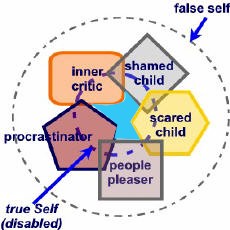
But there are differences. In a person with NPD, the false self is an intractable, permanent structure and is stable. What this means is that a person with NPD has become someone else. The mask they wear becomes who they are, and any threat of exposure by another for the lie it really is will be viciously attacked or the perpetrator devalued. That’s why you can never criticize a narcissist.
The NPD false self is also stable, meaning it doesn’t change much. For example, a somatic, grandiose narcissist has built an entire identity around their physical appearance and uses every opportunity to make sure everyone knows how physically perfect they are. Because so much effort has gone into building this identity, the narcissist is unlikely to have developed any other abilities or strengths. A person with NPD pretty much lives full-time as their false self, and rarely, if ever, show others any glimpses of their true self, which in the worst cases, is so inaccessible to them it may as well not exist. If the false self is ripped away (this can be done by denying a narcissist any supply), and there is no more supply to be had (this sometimes happens to elderly narcissists, who can no longer rely on looks, youth, career or financial success to boost their egos), what is revealed is a person so empty, depressed, or dissociated they may require hospitalization or may even attempt suicide. Some may voluntarily enter treatment, but if their fortunes change, they start to feel better and are likely to quit therapy. Schizophrenic symptoms in a degraded narcissist isn’t unusual.
NPD is difficult to treat because the false self is so intractable and all-emcompassing, the person has little to no insight into themselves or even realize it’s they who have the problem. Because they tend to project their unacceptable emotions onto others, they’re far more likely to blame others for things they have really brought on themselves.
In Borderlines, the false self manifests more as a series of temporary masks, adapted to suit certain situations or people. People with BPD are emotional chameleons. Their dramatic mood swings and changeability are due to constant mask-switching and the stress this causes them. The BPD false self is not well developed and it often fails them, causing them emotional distress. The BPD false self (really false selves) is unstable, permeable, and easily shattered, frequently revealing the empty, dissociated, depressed true self. Because it’s not a permanent structure, BPDs don’t require narcissistic supply to keep it “alive” (they’re more likely to become codependent to a narcissist). They can seem “crazier” than people with NPD, but they are more easily treated because they spend at least some of the time without their masks on.
Further reading:
Derealization and Depersonalization in NPD and BPD
Comparing Covert Narcissism and BPD
“No one will ever love you like I do”: NPD men in love.

With Valentines Day coming up in a few days, I think it’s time to talk about narcissistic men in love. I think I have enough experience with such men to be able to write about them and talk about some of the red flags to look for in a new relationship.
Narcissistic men can make the most ardent lovers and define the cliche, “he swept me off my feet.” Relationships with narcissistic men, in the beginning, can be truly fairy-tale like, and a narc man who’s chosen you as his prey will stop at nothing to make sure you know he’s the most romantic, giving, attentive, unselfish, committed man you’ve ever met. He’ll profess his eternal love for you, wine and dine you, present you with expensive chocolates and roses, never forget your birthday or Valentines Day, take you on weekend getaways to romantic locations, and talk about marriage and even “making babies with you” early in the relationship. Narcissistic men can be intense and women who are drawn to emotionally intense relationships (often Borderlines) are like putty in their hands. Narcissistic men are often drawn to BPD women too, because a BPD woman is most likely to give them exactly what they need, at least in the beginning. Occasionally, a narcissist man who has proposed to you might actually stay true to his word and marry you. But that doesn’t mean you’ll live happily ever after–anything but, in fact.
An NPD man’s intensity, which can be incredibly alluring to certain types of women, is exactly what makes them so dangerous. Their “love” for you is feigned. They are not capable of love. They are predators. All you are to them is supply. Every last one of my lovers, including my ex-husband, was a narcissist, and almost all of them seemed incredibly romantic. A couple of them eventually D&D’d me (devalue and discard), with no explanation or reason, shattering my heart into a million bits, while others became increasingly possessive to the point where I felt like I was suffocating and couldn’t wait to get away.
One of two of these narc men were covert, but most of the ones I knew were more the overt, grandiose type. Pretty much all my relationships with men followed this same sorry pattern, which I am going to outline for you.
The storybook romance.

The narcissist is very insistent about getting to know you, and wastes no time making his first date with you. You will notice how intensely he gazes at you and that can make you want to swoon, but make no mistake–it’s really the look of a predator stalking his next meal.
He takes you out to an intimate, expensive restaurant and buys you anything you want on the menu, no matter how expensive. Typically, he’ll offer you bites of food from his own plate, sometimes feeding you. (He’s luring you in, setting you up for the kill later on).
He calls you daily, always seems to have time for you, seems like the most romantic, understanding, sympathetic man you’ve ever known. He always listens to your problems, and seems to empathize. (He is anything but these things, but he is a very good actor).
He is always buying you gifts, sometimes very expensive ones. He can seem like the most generous man on the planet. (Keep an eye on your finances here–mine bought all those gifts for me using MY credit card).
He tells you he loves you early in the relationship, maybe even in the first few weeks. He may even get tears in his eyes while he tells you this (blech). He might tell you you’re the only woman he’s ever loved, and how lonely he was before he met you. (WATCH OUT.)
Sex with him is emotional and intense. (Oh, honey, he’s got you trapped in his lair now).
He begins to complain and berate his former girlfriends, and talks about how deeply they’ve all hurt him (right, because nothing is ever his fault). If he never seems to take any responsibility for the demise of his former relationships (or if he’s the type that gloats about how HE dumped THEM), that’s a huge red flag. Don’t ignore it. He’s telling you something.
He may propose to you at this point, or talk about what beautiful babies you’d have together (any man who doesn’t really seem to like children, but still wants to “have babies with you” because the combination of your genes would be “so beautiful” is almost certainly a narcissist). Blargh.
The narc begins to show his true colors.

At this point, he may suddenly start seeming colder or pulling away. He stops calling you as often, or seems annoyed when you call him, giving you some vague reason why he’s “too busy” to see you or scolding you for bothering him when he’s in the middle of an important meeting. This is the beginning of the discard, which means that you’ve sated his supply and he’s grown bored. He needs the challenge of the hunt again, and will probably dump you soon. There is nothing more he needs from you.
Other narcissists tighten their hold on you. If he senses you beginning to pull away, he’ll up the ante and take you on vacation or bring you roses every night. This is called “hoovering.” He’s sucking you back into his den of doom like a Hoover vacuum cleaner. Most likely you will fall for it, and once you’ve reassured him you still adore him and think he’s the smartest, handsomest, sexiest man you’ve ever known, the abusive behavior begins.
The dream becomes a nightmare.

If the narcissistic man you’re in love with doesn’t D&D you, then it’s common for them to begin to abuse you once he’s certain you will stay. Often, this begins on your wedding night, when it’s too late for you to escape without enormous expense and inconvenience. I don’t have to go into the various forms of abuse he could use–they could be mental, financial, emotional, and sometimes physical. The man who seemed like the most understanding, romantic, empathetic, attentive man you’d ever known has transformed into a coldblooded, unfeeling, abusive monster.
Early red flags.

There are many red flags I haven’t listed here, but the following tend to be the first ones you’ll notice before any real abuse begins.
- He complains about his exes and seems to blame them for everything that went wrong in their relationship, without ever admitting anything was his fault.
- He moves in too fast, declares his love or proposes marriage too quickly for your comfort
- His intense look unsettles you a little.
- He has mysterious “meetings,” friends and “family matters” that he doesn’t discuss with you or seems annoyed when you ask about them.
- After seeming to want to be with you all the time, he suddenly seems to lose interest in you, and never explains why. If you try to pin him down, he becomes angry or irritated.
- He’s always talking about what a perfect couple you are or how beautiful the two of you look together, sometimes even wanting to look at both of you together in the mirror.
- The intensity of his ardor or attention overwhelms, scares or disgusts you.
- He brags about how many women have fallen in love with him (overt N).
- He moans about how no other woman has ever loved him (covert N).
- He begins to question your whereabouts or why you don’t spend more time with him.
- He accuses you of looking at or flirting with other men.
- He uses tears to get sympathy or get his way.
- He likes to play cruel jokes on you, just for fun of course.
- He acts jealous or seems upset when you want to spend time doing anything that doesn’t include him.
Further reading:
The Narcissistic Lover’s Playbook
 Lucky Otters Haven