This is a common ploy narcissists use to control, manipulate or punish their “prey.” It can be as crazymaking as their other tools of trade, such as gaslighting, Hoovering, projection, blameshifting, boundary violation, and triangulation.


This is a common ploy narcissists use to control, manipulate or punish their “prey.” It can be as crazymaking as their other tools of trade, such as gaslighting, Hoovering, projection, blameshifting, boundary violation, and triangulation.
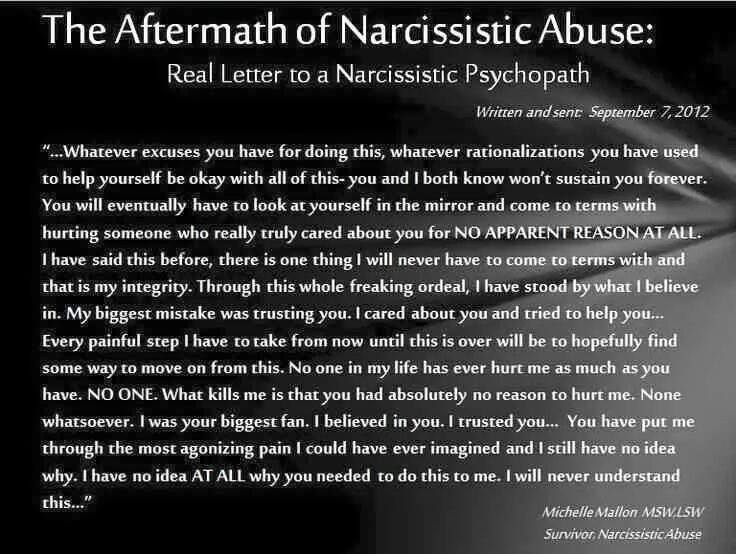
Click to enlarge.
ETA: Here is an essay by Michelle Mallon, who wrote this letter. I’m not entirely sure, but I think the psychopathic therapist she writes about here may be the person she wrote this letter to.
http://www.naswoh.org/?page=mallon
It’s prudent to be careful who we choose as a therapist. So many of them are narcissistic or even psychopathic. They’re drawn to the field of psychotherapy because it allows them plenty of narcissistic supply and the opportunity to hurt vulnerable people. In a professional setting, it’s hard to see the red flags, especially if the therapist seems sympathetic.
If you begin to feel used, gaslighted or abused in any way by your therapist, or just feel uncomfortable around them, LEAVE.

Sure, this cartoon is funny, but is also worrisome. If this is true, then we are raising a generation of narcissists. It also shows how little teachers are respected these days.

I realized I have so many articles about or that reference healing techniques for people suffering from NPD that I decided to devise an easier way for people to find these articles by creating a sort of “Table of Contents” listing them.
The possibility that NPD could be healed in some cases (I don’t think malignant narcissists or psychopaths/sociopaths can be healed) is important to me because I would love for everyone, even narcissists to be able to realize their full human potential they were born with.
It also sure would be a nicer world for the rest of us to live in if somehow NPD could be exterminated from our planet, wouldn’t it?
A Narcissist in Therapy (Kohut’s Self Psychology Model)
Healing Narcissism: Stephen’s Story
Attitudinal Healing: A Cure for Narcissism?
Free Association: Thoughts on Gratitude, Pride and Healing
On Narcissists Who Want to be Cured
Can Sam Vaknin be Cured of NPD? Or is That Pie in the Sky?
Do Narcissists Cry? (see the part about lucid dreaming as a possible tool in therapy)
Could “Reparenting” Actually Cure a Narcissist?
Comment from a Narcissist Who Wants Help
I’m making this a permanent page in the header which will make it much easier to find these articles.
If you’re a narcissist who wants help and don’t want to post on this blog, please feel free to email me (see “Contact Me” in the header) and I may be able to help you find resources and point you in the right direction to get help.

On November 22, 2014, I wrote an article about my daughter Molly (not her real name), who I suspected of having NPD due to having been used as a flying monkey by her father for many years. I prayed it was “just” BPD.
Last month she was evaluated and her Axis II diagnosis was Borderline Personality Disorder (BPD). While BPD is a Cluster B disorder and shares a number of traits with narcissism, it’s more amenable to treatment because a Borderline does have a conscience and the ability to feel empathy–but their tendency to fly off the handle, their insecurity/neediness, and propensity to engage in self destructive activities that sometimes hurt others masks the fact they really aren’t bad people. My daughter actually has a huge heart and cries when she sees someone suffering or in pain, so it fits that NPD wasn’t her diagnosis. Still, I’m relieved she’s been officially cleared of it.
I was diagnosed with BPD myself in 1996. I have been hesitant to call attention to it on this blog or talk about it much, because of its close association with NPD and other “character disorders” like ASPD. At the time I was diagnosed I was in an inpatient psychiatric setting, where I was also diagnosed with Bipolar I (major depression with fewer or no manic episodes), generalized anxiety, PTSD, Avoidant PD (I didn’t know you could have two PD’s at once back then), and substance/alcohol abuse. At the time I was not diagnosed with Aspergers (that was much later, and I was self diagnosed at first).
I definitely had all the traits of a borderline, but in the hospital and in outpatient therapy following my stay, I learned ways to control my BPD traits, such as my tendency to fly off the handle easily, act impulsively without thinking how it would harm others, idealize/devalue people (black or white thinking), abuse drugs and alcohol, and generally coming off as being very self centered and oblivious to the needs of others.
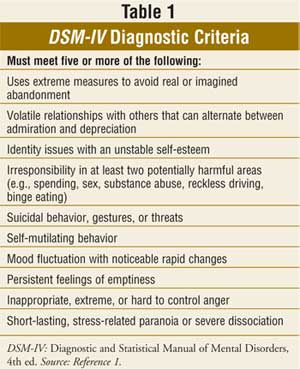
Click to enlarge.
For a time back in the early 1980s I even test drove narcissism, but as an essentially empathic person who suffers from a lot of guilt and shame, and has no desire to hurt others, narcissism didn’t work for me, and I am so grateful for that (even though I became a codependent doormat instead).
In therapy, I remember a method we were taught called “turtling”–which basically means to imagine yourself as a turtle when you feel yourself about to act/react in Borderline, impulsive, or self destructive ways. Turtling calls for enough insight to recognize your feelings prior to acting on them. You imagine going inside your shell to think about things before you act. I remember in the hospital we made “turtle” totems to keep as reminders to always think before we acted and ask ourselves why we felt the way we did. I still have the little clay turtle I made. I remember also being given a workbook for people with BPD with many helpful exercises and activities to help us recognize and control our behavior. It did help me a lot.

Today I don’t think I display many BPD traits, but I don’t think I’m cured either. When I’m very depressed, frightened or angry, those BPD traits pop back up like unwanted pimples. I still remember the lessons from my therapy and still look at my little turtle or a picture of a turtle to remind myself to go inside myself and not react until I think things through and process my feelings.
Because this is a blog for survivors of narcissistic abuse and many (if not most) survivors think of narcissists as demons or monsters, I was hesitant to talk about my BPD much, because it’s a Cluster B disorder and is so close to NPD in many ways. The disorders are easily confused with each other. A person with full blown BPD can seem very much like one with NPD, but for the Borderline, the motive behind their unpredictable and sometimes destructive behavior is fear of abandonment and insecurity. For the narc, it’s for obtaining supply. Some people seem to think of people with BPD as almost as bad as narcissists. Some of them are.
So that’s why I’ve been reluctant to talk about this. But again, from Day One I committed to honesty and I hope I won’t be judged too harshly for “coming out” as a person with BPD.

Borderline personality disorder.
My daughter, I’m happy to say, knows almost as much about narcissism as I do now, and has been reading my blog. She came across the above article where I speculated she might have NPD and she was so worried about that it made her cry. We had a long discussion about that. Since then, she has been improving a lot and says my blog has helped HER! She says she’s proud of me for having the courage to start this blog. And I have to say, I’m just as proud of her. Here’s my article describing how healing and emotional that talk we had was. I think we will both be just fine.
My next article, which I will write later today, will be about how malignant narcissists can transform a good person into an evil one. They can infect you with their illness. That’s another reason why they’re so dangerous.


I can’t deny it anymore. My roommate, a woman I found on Craigslist back in September to share my house with me and help pay the bills, is another G.D. narcissist. She is one of he most annoying people I’ve ever known, outside my ex who was probably a little more so.
At first she seemed very nice. She gave a good impression. She has some health issues, including near-deafness, so she receives disability. She has one cat who gets along well with mine. She seemed almost too helpful and accommodating in the beginning. She actually wanted to pay me more than the rent I was asking, and kept offering to buy me things or do me favors I didn’t need or want.
She’s still paying her rent on time and hasn’t done anything really horrible, like set fires to the curtains or steal my things, so for now I’m allowing her to stay, until I figure out what else I can do to earn enough money to not have to share my home (which I would prefer), or find another roommate (who could be worse than she is, especially if I find them on Craiglist).
But she’s become almost intolerable to live with. Her personality repels me. I’m at the point where I just want to leave the room if she’s in it. Her voice and even looking at her annoys me.
That is precisely the way I felt about my ex husband before I kicked him out a year ago. I couldn’t stand the sight of him and his voice and everything he did was like nails on a chalkboard. Even the sound of his breathing bothered me. And listening to him eat made me want to puke.
I hated him and everything he did so much there were times I could completely understand how someone could be driven to kill. I never entertained that thought of course, but I could understand why some people could. I also realized I no longer even cared what happened to him. In fact, I kind of wanted him to die, if truth be told. I feel like I’m a horrible person for ever feeling that way, but it’s the truth.
It’s a bad sign when you’re having these kinds of ugly thoughts and feelings about someone you’re living with. The thing about narcs is they turn you just as mean as they are eventually. During the last months I lived with my ex, I was downright nasty to him. It wasn’t right, but it felt like some sort of justice before I worked up the courage to make him leave.
My roommate has gradually shed the “nice” act–that was just the love bombing phase. I knew there was something a little fishy about her over the top displays of affection and insistence on doing things for me I didn’t need or want. I should have paid attention to those red flags.
After awhile, she started guilt tripping me if I didn’t profusely thank her for these unasked-for favors. For instance she liked to clean the house, which I appreciated, since she doesn’t work and really doesn’t do anything all day. I’m too tired when I get home to clean anything and just want to write. I certainly wasn’t going to tell her not to do it (and she probably would have been insulted if I had).

She’s very needy and entitled. She accused me of not being appreciative enough: “I spent all day cleaning the house FOR YOU (emphasis mine) even with my bad back. I didn’t have to do this FOR YOU, all I want is a little gratitude.” I’d already THANKED HER about ten times, for the love of God. Every time she does me a favor, no matter how small, or buys me something (which I don’t ask for), she gets all angry and butthurt if I don’t act like she’s Jesus Christ Incarnate for doing it. She keeps repeating herself over and over, announcing all the wonderful and kind things she does, to make sure you notice how perfect and wonderful she is.
Lately she’s been attempting to triangulate and gaslight using my daughter. But my daughter tells me everything, has read this blog (and knows a lot about narcissists now) and she told me what my roommate has been saying to her. The games aren’t working, and my roommmate’s getting mad. My daughter even told me she thought we were dealing with a narcissist. I was proud of her for that.
Two weeks ago my roommate’s car broke down. A couple weeks before that, she had allowed me to drive her car for two days while my transmission was being rebuilt. That was because she was too tired and sick to drive me to work (I never asked to borrow her car, although I preferred that to having to ride with her). Now she’s acting pissy and hateful because I won’t drive her all over town, even at night (I don’t see well on the road at night). A few days ago, she actually had the gall to suggest I call in late to work so I could take her to the doctor. I refused to do it. I don’t let narcs push me around anymore. I told her about the bus lines, but of course she made excuses why she couldn’t take a bus.
She is getting more hateful, telling my daughter how selfish I am. It’s almost funny, how obvious it is that she’s projecting her own narcissism on to me. It really creeps me out that my ex behaved THIS EXACT SAME WAY and said THE VERY SAME THING. She’s gaslighting me and attempting to use my daughter as a flying monkey. It’s really incredible. It’s like they all read from the same script. They probably do.
She whines nonstop about how generous and kind she was to me when she let me drive her car for two days (when she herself didn’t want to drive me), implying that I never do anything for HER.
She’s extremely nosy and butts into conversations I am having with my daughter or other people, as well as asking me constantly what I’m doing online. Like it’s any of her business. She needs constant attention and validation.

If I buy takeout for myself and my daughter, my narc roommate gets upset that we didn’t get anything for HER. She’s 52 years old, but she acts like she’s 3. She also whines constantly that no one likes her here, and we aren’t nice to her, which is a total lie. But it’s becoming a self-fulfilling prophecy. I no longer like this woman, and neither does my daughter.
Last night we finally got into it. She said I wasn’t a nice person. I reminded her that I have only been as nice to her as she’s been to me, and furthermore that she ought to not act so entitled because I was giving her a really good deal with the very cheap rent I am charging. I challenged her to try and find something as cheap as the room I rent to her somewhere else. Asheville and Buncombe County in general is expensive. I guarantee she won’t be able to find as sweet a deal.
She started crying because she thought I was kicking her out. Complete with rubbing her eyes with her fists like a three year old who dropped her lollipop. I tried to be nice and not roll my eyes or sigh in frustration. (It’s getting harder to be nice.) I assured her I was not kicking her out but just letting her know how I felt–how entitled I think she acts, and that her gaslighting, triangulating, projecting, whining, wheedling self pity, negativity, nosiness, and absolute absence of any respect for anyone’s boundaries was annoying and crazymaking.
She makes fun of things I like. She puts down my interests (she has never seen this blog, as far as I know and probably wouldn’t read it, even as nosy as she is). I told her one time I was going out to buy orange juice and for some odd reason she found this extremely funny, and to this day keeps making jokes about my “obsession” with orange juice. It’s not funny. It’s damned annoying. I can’t explain it, but it’s that nails on a chalkboard thing, like the way I felt about my ex’s breathing and eating sounds.

I know this can’t turn out good. I know at some point I will have to ask her to leave, but right now I really need the money and don’t feel like taking out another damn ad in the paper. I’ve had worse roommates than her in the past–at least she pays her rent on time and doesn’t do hard drugs (as far as I know).
I know it must be difficult for her to be disabled and have a car that isn’t running (she can’t afford to have it fixed) and be pretty much housebound. That would drive me crazy too. So I can understand a little grumpiness or depression.
But what I’m seeing isn’t just a bored and stir crazy person taking out their frustrations and anger on me. What I’m seeing is pure, unadulterated, 100% genuine, 200 proof NARC.
This post is intended to open a discussion about narcissists and narcissistic roommates, etc. I don’t want or need advice to get rid of her. I already know that. I’m willing to wait things out for awhile because the extra income is worth it–for the moment.
If I ever feel like she’s starting to have a negative effect on my growth or my healing, then she’s out. If she starts finding reasons not to pay her rent, she’s out. For now, she’s just incredibly annoying. Narcs can irritate the living shit out of you.
But I can live with that, at least for now.
Why do they always find me? They’re only 1% of the population, but it seems like they’re everywhere.

I’m not angry or upset and I don’t hate you. I don’t pity you anymore either. Pity is a wasted emotion and does nothing but condescend to the person you are pitying. In spite of our differences, I have the utmost respect for you.
You probably will laugh at me for saying this, but I think God used you to show me who I am
and how I fit into this world. When you allowed me to peer for brief moments inside your labyrinth-like beehive (and sometimes hornet’s nest) of a mind, in retrospect I understood on a gut level that you helped me understand how to read and cope with others with your illness, and help others like myself. I learned to be more empathic and more aware (not wary) at the same time. I developed an insight into myself that had always eluded me.
I used to have empathy for you, and in a way I still do, but I no longer of the belief you can get well so I had to let go of most of that empathy, for it would have been wasted.
Being the kind of person I am, it was so hard for me to do that, but I had no other choice.
Try as I might, I never was able to solve the puzzle of you. I had to give that up too. But I solved at least a little bit of the puzzle of me, and that’s so much better.
You more than anyone, know how damaged and broken you are, and I know you’re fully cognizant that you probably can’t ever escape your self created prison that one day will annihilate you.
But in spite of that–and no matter what your true motives, for the means here don’t matter, only the end–I need you to know you did and do and will continue to touch some lives in spite of being what you are. You might hate knowing you did good, but…you did good. Deal with it.
I’m a better person than I was because of the perspective I was given. So I wanted to thank you for that. And for your support of this blog. Everything happened just when it was needed.
Nothing happens without a reason. There is a time and purpose for everything. No one exists without some reason to be here. Everything under God is connected.

Serendipity. Kismet. Miracles. Or coincidence?
We’ve all heard that God works in strange and mysterious ways. Here is a beautiful example of how a perfect storm of events can sometimes happen that seems anything but coincidental.
I just received an email from a follower I will call “Ana,” who found this blog when she was looking up a recipe for Merrimints candies and wasn’t looking for anything at all about NPD or Aspergers.
But it turned out that when she found her recipe on this blog, she realized the primary subject matter was exactly what she needed because she is an Aspie dealing with narcissistic abuse.
Here is her lovely email (I hope she doesn’t mind if I repost it here, but I have changed her name).
Somehow this must be kismet. My name is [Ana Rodriguez]. I too am a self diagnosed high functioning aspie who has had a lifetime of bullied existence and parents from hell. I was looking for a recipe and info on the mints and stumbled on this page. I am a member of “it’s all about him.com” and baggage reclaim and read them daily. I am currently just off surviving a npd relationship that has me twisted. My father was the narc-a much beloved town doctor-and drug addict. Crazy doesn’t even cover this-dickensian nightmare, oh god ! My mother was only concerned about him. She was obsessed with him and his moods. We children were nothing but irritants. Neither of them should have had children.
Welcome, Ana and I hope you find some support here. ❤
I don't believe in coincidences. I think everything happens for a reason and God orchestrates these little miracles that happen every day and we see them if we are paying attention. Every day he shows us his presence in small but profound ways.

Laughter and crying are biologically very similar, and while they seem like opposites, both are methods the body uses to relieve stress, and they involve similar movements of the same groups of muscles. Both can involve tears.
Stress isn’t necessarily bad–it can even be present in overwhelming positive emotions such as joy, gratitude, or love–or in that moment when something strikes us so funny we double over with peals of laughter. Sometimes very intense laughter can bring on tears and even lead to sobbing; the opposite can happen when a big breakthrough happens in therapy. The laughter comes because the patient feels an immense sense of relief.
I decided it would be interesting to categorize the various types of crying and then talk about laughter, because they really are so very different but similar in some ways, and both are good for us.
Crying

I’ve said it before and I’ll say it again. Crying is underrated in western society. In our culture, tears are still thought of as a sign of weakness and something that’s only okay for women to do, and even then only in certain situations. A man is only allowed to cry if he wins the lottery or his team won the Super Bowl or his dog died. And that’s a crying shame! (pun intended).
But being able to cry is the most effective way to get better if you’re in therapy trying to heal from a mental disorder or recover from psychological trauma such as PTSD. It can be liberating and feel great. Many people have problems crying though, but there are ways to make it easier.
There’s also the unfortunate stereotype that crying always means a person is sad. Not so. I don’t know the exact percentage, but I believe I read that 50% of emotional tears are caused by positive or ambivalent emotions, not negative ones.
Not all tears are the result of actual crying: Irritant tears are shed by animals as well as humans, and are a physiological response to an irritation of the eye, such as the tears we shed when slicing an onion. Even though tears are shed to rid the eye of the foreign object, there is nothing emotional about this form of “crying.”
From here on, the types of crying will be listed from the shallowest and least emotional type of crying to the deepest and most emotional. The farther we get up the scale, the more pleasurable and similar to genuine belly laughter crying becomes.
1. “Crocodile” tears/fake crying.
This category possibly shouldn’t even be on this list, because it’s not genuine and sometimes doesn’t even involve tears. There are two types of false crying, both common among narcissists and sometimes people with other Cluster B personality disorders such as BPD or HPD.
The first type does involve actual tears being shed, but the person is usually a good actor who is able to squeeze them out at will to manipulate, get pity, show fake “empathy” or other emotions meant to make them look good or less malignant than they are. During his trial and police investigation, the psychopathic murderer Scott Peterson was expert at making copious tears run down his face when questioned about his wife’s disappearance. But he still had an odd blank look and a hint of a smirk between questioning–and Peterson’s odd speech patterns and hesitations made it obvious he was lying.
The second type is more common since most people aren’t very good actors and cannot generate tears at will. This is the embarrassing fake sobbing some narcissists use to get pity or attention. Don’t fall for it if they hide their faces so you don’t see their bone-dry eyes.
2. Manipulative, childish crying.
Narcissists who cry do so for the same reason a baby does: to get what they want. Older children cry this way too, and it can involve loud sobbing and whining. Adult narcissists (especially the “needy” types) may not sob like a child, but if they don’t get their way expect a display of waterworks, especially if the narcissist is of the somatic type and is female. Some somatic female narcissists do try to make their crying displays as dramatic as possible, in order to manipulate their target and get their way. It works too, especially if the woman is attractive and seductive, and this type of narcissist usually is.
3. Crying from frustration, fear, or anger.
Many people cry when they become frustrated, frightened or angry, but the tears tend to be scant and watery, and any sobbing is minimal. Breathing tends to be very shallow.
None of these first three types of crying are cleansing or healing, and because the tears shed are mainly just salt water and don’t include oils and other substances that come from truly emotional tears, they aren’t as effective in releasing toxins from the body and the person will not feel better afterwards.
The next forms of crying are all healing and cleansing, and the tears associated with them are full of oils and hormone like substances that make them heavier and more likely to cling to the skin and leave more visible streaks after drying.
4. Bereavement/grief.
Most people, after suffering a devastating loss such as death of a family member or close friend, or being left by a long time partner or spouse, at some point, if not immediately, will cry. Crying arising from tragic loss is usually convulsive, cathartic, intense, and involves deep sobbing that causes spasms in both the diaphragm and stomach muscles, copious amounts of tears and a loosening of mucus from the sinuses. A person undergoing such convulsive crying may gag or even vomit. The crying is so intense it can be physically painful as well as emotionally excruciating, and it may go on for a long time. But the tears are healing and the crying is cathartic. If the painful emotions are held inside and not released, a person experiencing grief or loss will take much longer to get better, and may become very ill.
In some cultures, such crying is formalized into a social event after the death of a family member, with special times set aside for family members to engage in grieving together and this can go on for weeks. This is probably a very healthy thing. In our society, group grieving is primarily reserved for funerals, and the bereaved are expected to get on with business as usual in a fairly short time, after all the casseroles have been eaten or have gone bad.
5. Cathartic crying in psychotherapy.
Most if not all psychodynamic therapies consider the moment the patient breaks down and cries in the therapist’s office a breakthrough for the patient. Because painful emotions from the past are being released, this type of crying can be as intense and convulsive as the crying of a bereaved person. A good therapist will not judge, and if a limited touch waiver has been signed in advance, it may be beneficial for the therapist to hold or stroke the patient in a nonsexual way during their breakdown. There may be more than one breakdown, with each one bringing the patient closer to healing. Laughter may sometimes follow a session of crying as the patient realizes a huge emotional burden has been lifted.
6. Shock/surprise crying.
These are not true tears of joy, but the kind of tears you shed if you find out you won the lottery, your team won the Super Bowl, or you were just presented with a great honor or gift. They are tears of surprise and shock as much as they are of happiness. They can tie in with tears of gratitude–for example, a movie actor who just won an Academy award may thank her supporters profusely as she chokes back sobs and tears stream down her cheeks. This type of crying isn’t particularly intense, but it does come on very suddenly and the tears can be copious. It’s short lived though. Smiling or even laughing usually accompanies the tears.
7. Crying from the heart.

This type of crying is never seen in narcissists, because it involves an opening of the heart that connects people to each other and narcissists cannot connect on any level. Tears from the heart exist on the spectrum of love–and involve positive, pro-social emotions like empathy, overwhelming joy, spiritual or religious experience, feelings of connectedness with humanity, the arts, or nature; or overwhelming love. These are all emotions narcissists are incapable of feeling.
The emotions felt can be overwhelming even if very pleasant. Crying serves two purposes here. First, it helps the body release the excess stress that comes with an overload of such euphoric feelings. It’s also nature’s way of connecting us with each other and tears tend to generate even deeper feelings of love among those who cry together. A good example of this is a couple so overwhelmed by their love for each other that they find themselves in tears during lovemaking, and this opens their hearts to each other even more.
Laughter.

There aren’t as many types of laughter (giggling and polite laughter don’t really count), but the best kind is the belly laugh–the kind of deep and convulsive laughter that explodes almost uncontrollably when we see or hear something we think is hilarious.
Belly laughter, though it doesn’t usually involve tears (but it can), can be just as cathartic and cleansing as a good long cry. Different types of things make different people laugh, and it’s hard to say what exactly will strike just the right part of your funny bone to send you into uncontrollable, convulsive, rolling on the floor shrieks of laughter.
The process of laughter is physiologically almost identical to crying–both involve gasping intakes of air, convulsive movements of the diaphragm or stomach muscles (hence the term “belly laugh”), and animal-like vocalizations similar to sobbing. But we can all tell the difference. A person enjoying a good belly laugh will never be mistaken for someone who is crying, even if there are tears.

Laughter usually involves a form of surprise. We laugh when we see something unexpected in a situation that doesn’t call for it or where its placement is ludicrous. A baby will laugh when her dad makes funny faces, because it’s unexpected. If you’re told something is funny, it probably won’t be as funny to you as if you discovered it on your own. It’s also the reason why a good joke can be ruined by bad timing or getting to the punch line too soon (or the punch line being spoiled by someone else). The surprise factor must be there for a joke to be funny.
Narcissists can laugh, but as with their crying, it’s usually shallow, exaggerated for effect (narcissists may be laughing louder than anyone in the room, but their eyes will remain flat and their laughter joyless and forced sounding).
As for what makes them laugh, narcissists are likely to find the misfortunes of others funny, or enjoy belittling forms of humor such as jokes that negatively stereotype an ethnic or other group, mean sarcasm, insults, or embarrassing practical jokes. Few narcissists have any sense of the absurd or any kind of subtle or sophisticated humor, and of course they can never laugh at themselves. They really have almost no sense of humor, unless it’s at someone else’s expense. If a narcissist’s mean “joke” at your expense offends you, you may be accused of being “too sensitive” or having no sense of humor, even though it is really they who are challenged in the humor department.
For the rest of us, it’s always a great thing to have a sense of the absurd as adults, because that sense of humor can get us through all the rough times. That’s why I keep a page of narcissist jokes, because when we can laugh at something that is threatening to us, some of its power over us is taken away and we can see the absurdity of what scares or upsets us.
 Lucky Otters Haven