No conscience, no empathy.

no soul

Once again, my MN/ASPD sociopath ex has proven what a conscienceless shell of a person he has become.  Maybe he’s always been this way but it seems to become worse the older he gets.    Maybe he just masked his true nature better in the past, and pretended to be a decent person, or maybe he’s really gotten a lot worse.  He used to have some emotions; now he appears to have none at all.   He doesn’t even bother pretending to be a decent person anymore.  He’s a man who is so cut off from all feeling and whose heart has turned so black that he can’t even squeeze out any empathy or drum up any human decency to his own children. To him, they are just objects to use for his convenience and maybe, for a few lulz at their expense.

Unlike some lower spectrum narcissists, this man is so malignant he’s beyond redemption.  He has zero self awareness and never will have it.   He’s way far too gone.   If the Dark Triad had a poster boy, he would be it.   A long time ago, he sold his soul and it’s never coming back.    One of his favorite forms of abuse is financial abuse.  He used to abuse me financially all the time, mostly by freeloading and refusing to work, although he used to steal from me too.

As most of you know, my daughter has been staying with me while she tries to save enough money to move into a place of her own.  She’s been working hard–faithfully going to her job every day where she works long, grueling hours,  and she’s saving money diligently, adding something to her apartment fund every time she gets paid.    Since she doesn’t make a lot, I don’t charge her rent so she is able to save more easily.    Her saving money and not spending it all is an improvement for her.  It’s a good sign that she’s becoming more mature and less impulsive–and she told me the other day how proud she is of herself for being able to resist impulse buys and save money instead.

But she made a mistake.  She didn’t put the money in a bank account.   She keeps it in a box next to where she sleeps.  She trusts me and knows neither I nor my housemate would ever dream of stealing money or anything else from her.

My daughter is a very codependent sort of person, and still thinks of her dad as her sun, moon and stars.  She loves him dearly, although he doesn’t deserve her love.  She knows how sociopathic and narcissistic he is, but loves him because he’s her father and the concept of family actually means something to her.

Today, while I was at work, she let him come over to the house for ten minutes, because they had been somewhere this morning and she wanted to change her clothes.  She was going to make him some coffee before he left.

I don’t allow this man into my house and she knows how I feel about him.   But at least she was honest.  She texted me and said he was only staying for ten minutes and then leaving.   I told her I wasn’t pleased, but that fine, make sure he leaves in ten minutes and watch him.  Don’t take your eyes off him for a second. He’s a thief and a snoop.

Right then she got a phone call from someone she’s dating and went into the bathroom to take the call, not thinking her father would have time to do anything.  When she returned, he told her had to leave.   She said fine, but before he left, she told me she had the urge to  go look in the box where she’d been keeping her apartment savings fund.   Unfortunately the box had been right next to her father the whole time.  She opened the box, and it was empty. All the money was gone.

She burst into tears of hurt and betrayal.  She told him she’d been saving money in that box so she could get a place of her own.  She didn’t want to accuse him of anything, but she knew he’d taken it.   She told him how hard she’d worked for that money, and how hard it was to save.  It wasn’t that much (only about $225) but it had taken about three months to save, being that she can only save about $20 a week.   Her tears didn’t move him.  She told me later she saw a flicker of something that might have been remorse or guilt, but that look quickly disappeared and was taken over by his usual expressionless, cold, flat stare.

“I didn’t take your money,” he said.  “You must have misplaced it,” he continued, gaslighting her.  “Or maybe your mother took it.”  Of course, there he went blaming me, even though I wasn’t even there.    She kept crying, but he showed no empathy, didn’t offer any words of comfort or a hug or anything.  He just started talking about the election instead, and then said he had to leave.    This is a man who doesn’t need financial help.  He gets over $2,000 a month in SSDI and gets food stamps and Medicare.   He has very few expenses and sits at home all day long trolling political websites and painting miniature lead soldiers.    He took her money because he could.  Because he’s a conscienceless POS.

I told her she needed to go No Contact with him. She knows it’s worked for me.  But she’s too softhearted and can’t do it.  “He’s still my dad,” she said.  She loves him even after this. I know she won’t let him in the house again.  She learned her lesson.  She knows how dangerous he is.   Maybe one day she will cut ties from him completely.   I can only pray for this.  She’s going to keep saving her money, starting from scratch, and put it in a bank this time.

How my ASPD/NPD control freak ex used a dog to gaslight me.

This makes me laugh now, but at the time I was doing anything but laughing.

luckyotter's avatarLucky Otters Haven

jack_russel_puppy

In 2011, when my parasitic MN/ASPD ex was still living on my couch, he decided he wanted a dog.

We already had a dog, Dexter, who was an awesome black lab mix (he lives with my daughter and her fiance now). The house I live in (and lived in then) is tiny. At the time, we had Dexter and 5 cats. Far too many animals for a two bedroom house, but these were pets I cared about, so I wasn’t too bothered by the overpopulation problem in the house.

But oh no, a dog and five cats wasn’t enough for the Parasite (which is his new name as far as I’m concerned so that’s who he’ll be from now on). No, he had to have his OWN dog, one that HE picked. I told him we had no room for another pet, and it was already too expensive feeding and…

View original post 1,317 more words

Pot…kettle…karma!

pot_kettle

In 1996 and again in 1997 I was hospitalized for episodes of clinical depression and near-psychotic, self destructive behavior.   For several years I’d had severe mood swings, shifting from near-mania to near-catatonic depression.  During these depressions I’d sleep all day, not even bothering to eat some days.   I was sure I had Bipolar Disorder, but it turned out I didn’t have that.    The first hospital stay was where I first got my BPD diagnosis.  I was also diagnosed with Major Depression, alcohol abuse (not alcoholism), and PTSD.

My sociopathic MN ex loved to use these diagnoses against me, especially the BPD one.  I guess he already knew BPD had a terrible reputation.   He used this diagnosis to demean me and discount anything I said, and also used it to turn our friends against me.   He’d always say things like:

“No one will take you seriously because you’re certifiably crazy, even the doctors say you are crazy!”

“You have BPD and we all know all Borderlines lie and can’t tell the truth more than they can tell their mouth from their a-hole”

“You’re a Borderline which means everything you say is a delusion and a lie.”

“No one believes you because you’re batshit crazy and even have the BPD diagnosis to prove it.”

Years later, after being arrested for domestic violence and public drunkenness (he had a pillhead girlfriend at this time), he was diagnosed with both NPD and ASPD, which makes him a certified Malignant Narcissist.   I find the irony of that pretty funny.  I wouldn’t trade my BPD diagnosis for his in a million years.

Where does this silly idea that covert narcissism is the most malignant come from?

evil_queen

I used to believe malignant narcissism was at the top of the narcissistic spectrum, but after learning and reading more,  I’ve changed my opinion somewhat.  I think malignant narcissism is actually a hybrid of NPD + ASPD (antisocial personality disorder) or NPD with sociopathic traits. So it’s not really “higher” on the spectrum than “normal” NPD, it’s NPD that crosses over into the psychopathy or sociopathy spectrum.    They are narcissists that possess all three of the “Dark Triad” traits–narcissism, psychopathy, and Machiavellianism.   I wrote about the Dark Triad in this post.

For some stupid reason, the web is filled with declarations of covert narcissism being the “most malignant” form of NPD. I call BS on that! Covert narcs are the most likely to be self aware and their NPD is less ego syntonic than the overt type.  They are far more likely than overt narcs to feel guilt and shame and want to change their behaviors and even present for therapy.    I used to frequent a forum where a number of diagnosed and self-avowed narcissists posted about their disorder, and the vast majority were the covert, fragile type and were definitely not happy being narcissists (if that’s what they were at all).  Covert narcissists, being non-aggressive, are (much like borderlines, who they resemble in many ways) likely to become codependent to an overt or malignant narcissist.    They are often victimized themselves (a malignant narcissist would never become a victim!).   I’m not defending covert narcissists.  They are still narcs and are still dangerous.   They should be avoided whenever possible. But it’s time to set the record straight.   The only reason covert narcissism might be more “malignant” is because their disorder is harder to see. Covert narcissists don’t wear a neon sign announcing they are narcissists.

Due to their sociopathic/psychopathic traits, malignant narcissism is ego-syntonic and the afflicted person will almost never think they are the ones with a problem. Even if they become self aware, they will still be “happy” with their disorder and tend to blame everyone else when things go wrong–and enjoy doing so.

Because of this, malignant narcissists will never present for therapy (unless they are forced to) and if they do, they can never get better, because the willingness to isn’t there. Non-malignant NPD, while difficult to treat, may be curable IF the patient is self-aware and willing and their disorder is ego-dystonic (which it often is in the covert subtype) .

There is a cruelty and sadism to malignant narcissists that’s missing in garden variety narcissists. Most narcissists don’t set out to deliberately hurt others, but malignant narcissists do. While they’re getting their supply, they also get a thrill from making others suffer.  Like vultures, they feed off your pain.   In contrast, some “benign” narcissists might even feel guilt when it’s called to their attention they hurt someone, even though they still keep doing it because they can’t help themselves and like a drug addict, getting their fix of supply is more important than the feelings of their victims. But malignant narcissists actually want to see their victims suffer, or at the very least, don’t care.   Malignant narcissists are almost always the overt, grandiose type.   It’s virtually impossible for a covert narcissist to become malignant, because they are generally not happy with themselves, even if they aren’t aware of their own narcissism.

There’s another difference too.    The malignant narcs I have known have a cold deadness to their eyes that’s not as evident in people with garden variety NPD.   Their eyes can also be very predatory, seeming to bore right through to your soul. That’s their one saving grace: their eyes warn you of how dangerous they are.

Why narcissists are more hated than psychopaths.

narcissism_vs_psyhopathy

All four Cluster B disorders are vilified, especially on the Internet, but for a long time I wondered why NPD seemed to be even more demonized than ASPD (antisocial personality disorder) and psychopathy and seemed to be regarded as the most “evil” disorder to have.   After all, most narcissists are not going around breaking the law, murdering people (not physically, anyway), and most at least pretend to be nice to you, at least if your relationship is only casual.  They make a good impression and most have families and respectable jobs.  They go to church, teach second grade, and volunteer at the food pantry. If you’re just acquaintances or casual friends with a narcissist, they can even be a lot of fun.    They also provide a lot of our entertainment, as narcissism (including NPD) is over-represented  among celebrities, and what would we do without our movie, sports, and pop stars?   Antisocial people are far more likely to be in prison and most aren’t making a mark in the creative arts.   So why is it that narcissists are hated more than anyone else, at least on the Internet?  I think I finally figured out the answer to this, and there are a few reasons.

1. Narcissists are more likely to have raised us.

Not too many people with antisocial personality disorder become parents, or are allowed to keep their children for very long of they do.   They don’t need to have children for narcissistic supply since they don’t require that, and if they do have kids, their bad behavior is so obvious that their kids are usually taken away from them at a young age.   They don’t pretend to be good parents but secretly abuse their child the ways narcissists do.  They may even voluntarily give up a child because raising it is too much bother and gets in the way of their antisocial activities.

2.  Narcissists are more likely to have been a lover or a spouse.

Psychopaths and people with antisocial personality disorder tend to be loners, or run in packs (gangs).   They tend to dislike commitment and because they don’t require supply from other people, they usually have no use for a close relationship.   If they marry, it could be for financial reasons since all they care about is what works and what is practical. As a result, while they can’t really love, they may not really be that emotionally abusive.

3.  Psychopaths and people with antisocial personality disorder (ASPD) seem like rare, exotic (and often caged) creatures.

hannibal_lecter

There’s a common perception of antisocial and psychopathic types being somehow apart from the rest of humanity, maybe not even quite human.   As a society, we are drawn to and fascinated by serial killers (though technically, a few, like Ted Bundy, have had an NPD diagnosis)  and a sort of cult has grown around psychopathic mass murderers, bank robbers, and serial killers.  They make good entertainment.   They’re also cool (something narcs are not).  In the movies, TV, and novels, the anti-hero is a “rebel without a cause” who usually fits the criteria for ASPD or psychopathy.   Even if they’re not committing crimes, they seem like exotic free agents who do whatever they want, whenever they want, and don’t give a damn what anyone else thinks.  Think of Ferris Bueller.  Ferris was more antisocial than narcissistic but he became a role model for millions of teenagers in the 1980s because he was just so cool.   If he was a narc he would have been cast as the villain.   Compare Ferris with Nellie Olson,  the spoiled, bratty rich girl in Little House on the Prairie.  Any questions? 

4.  What you see is what you get.

While psychopaths and people with ASPD lie well and often, it’s usually to avoid getting in trouble.  They can be manipulative, but only to get what they want from you (and what they want isn’t narcissistic supply but more practical things that help them achieve their goals).   They don’t lie just for the sake of lying.  Gaslighting, triangulation, and other types of emotional abuse that involve vicious lies about another person’s character aren’t really their thing.

5.  Narcissists are sneaky.

stabintheback

Related to the above, narcissists are always trying to undermine or even destroy you behind your back.  Essentially, they are huge cowards.  Psychopaths and antisocial people don’t care about such “niceties” and tell you what they really think of you right to your face. No, they don’t have any empathy either and they don’t give a damn if they hurt your feelings, but they usually won’t be pretending to be your best friend either (unless you can be of practical use to them in some way) .

6.  Narcissists wallow in self pity.

Psychopaths and antisocials don’t feel sorry for themselves or waste other people’s time whimpering about how everyone hates them or how they never get any breaks.   That’s because they don’t care what you think of them and they make their own breaks, even if they have to break the law to do it.   Narcissists are not only hypersensitive, they are very dependent on other people.  People with ASPD pretty much operate alone.  They’re too cool for such narcissistic shenanigans as wanting to be liked and admired.

7.  Narcissists are  high maintenance.

high_maintenance

Psychopaths and antisocial people do not require narcissistic supply, therefore they don’t demand too much emotional sustenance from other people.  Narcissists constantly require being blown up like a punching clown doll (and make you want to punch them).

8.  People assume most psychopaths are in prison.

It’s not true, of course (some are running huge multinational corporations or running for political office), but most people assume anyone with ASPD/psychopathy is in prison and therefore no danger to the rest of us.    In contrast, narcissists seem to be lurking behind every tree and lamp post and hiding under every bed.

Borderlines: incurable demons or trauma victims?

complex_ptsd
The symptoms of Complex PTSD are almost identical to those of BPD.

Something has come to my attention during the time I’ve been blogging, which I think is important enough to merit another post about it.

Borderline Personality Disorder (BPD, DSM code 301.83) is classified by the Diagnostic and Statistical Manual of Mental Disorders as a Cluster B (emotional/dramatic/erratic) personality disorder having many similarities to character disorders like Narcissistic Personality Disorder (NPD) and Antisocial Personality Disorder (ASPD). Both NPD and ASPD are characterized by a lack of empathy, entitled behavior, and disregard for the rights or feelings of others. It’s also true that some Borderlines act out in ways harmful to themselves and others. Hence, “Cluster B” has become a pejorative category and some ACONs (adult children of narcissists) and others have demonized people with BPD as being amoral, immoral, and almost inhuman, nearly or as bad as as people with NPD or ASPD. Some even go so far as to lump all borderlines in with the “narcs” and barely make a distinction between them. In their minds, if you’re a Borderline, you’re no better than a “narc” and that’s all there is to it. You’re a bad person and to be avoided.

To make matters even worse, many mental health professionals refuse to treat people with BPD, believing them to be troublemakers, incurable, or both. I remember one therapist I saw years ago for an intake session and seemed to connect well with, called me a few days later after he received my psychiatric records, and told me he couldn’t take me on as a patient. “I don’t work with borderlines,” he said.

It’s true that there are some similarities between the Cluster B disorders, and both BPD and NPD/ASPD have roots in childhood abuse or neglect. But the similarities don’t run very deep. What I mean by that is while both a borderline and a narcissist cn be manipulative or abusive to others, the reasons are very different. There’s also the matter of intention. Borderlines, if they act out against others, aren’t usually aware they’re being abusive and/or manipulative. If their bad behavior is brought to their attention, they normally become very upset and feel terrible about it (unless they have a comorbid NPD or ASPD diagnosis). They act out because of overpowering emotions that they haven’t learned how to control. In contrast, a narcissist or person with ASPD acts out because they can. If their behavior is brought to their attention, they’re likely to become angry and rage against the accusation, make excuses, blame-shift it onto someone else, or deny it.  Unlike most borderlines, they don’t feel remorse, guilt or shame for hurting others.

In addition, many borderlines are much more harmful to themselves than to other people. If they do act out against others, most are as frightened by their own outbursts as others are and sometimes more so. In a nutshell, people with BPD know they have a problem and wish they could be different. Untreated BPD makes a Borderline’s life miserable, while people with NPD or ASPD are usually not bothered by their disorder. That’s why, even though Borderlines can act “crazier” than narcissists, they can get better and are much more responsive to therapy or behavioral treatments such as DBT or CBT.

But we’re still caught in a gray zone, neither here or there.   The stigma against borderlines (in my observation) has grown worse, and most narcissistic abuse sites pretty much regard people with BPD  as the “female or over-emotional version of NPD.”  (actually, Covert/Fragile NPD or Histrionic Personality Disorder would come closer).   If we’re narcissistic abuse victims suffering from complex PTSD, it takes a great deal of courage to admit you also have a BPD diagnosis.  It took me a few months to come out about it on this blog. Fortunately,  I haven’t received too much (or really, any) flack about it.

complex-ptsd-and-bordeline-personality-disorder-36-728
Click to enlarge graph.

The good news is, a number of BPD bloggers are helping to reduce the negative stigma that we’re “bad seeds” with an untreatable disorder just because we’re OMG “Cluster B.” Think about this: have you ever noticed that there aren’t too many people with NPD (or ASPD) blogging about their challenges and insecurities, or fighting to reduce the stigma against their disorder? If they blog about their narcissism or psychopathy, it’s usually to brag about how NPD/psychopathy makes them superior or allows them to have control over others and be successful in the world. That’s because they don’t think they have a problem (They just cause others to have problems). Most Borderlines know they have a problem and struggle with it constantly, since it makes them feel so crazy and lowers their quality of life. I can only think of ONE blogger with NPD who was unhappy with his disorder and successfully treated for it (or so he says). That man probably had low-spectrum and probably covert NPD; a person with malignant or high spectrum grandiose-type NPD will never have enough insight or willingness to admit that THEY are the ones with a problem. In contrast, I can think of about 20 bloggers with BPD who are in treatment or therapy or have even been healed! I’m sure there’s many more that I don’t even know about.

BPD also seems to co-occur a lot with complex PTSD or PTSD. Most BPD bloggers I can think of also have complex PTSD or are in treatment for it. The symptoms of BPD and Complex PTSD are almost the same. The DSM does not recognize Complex PTSD as a diagnosis; it only recognizes PTSD, which is not caused by chronic trauma over a long period of time (such as having been abused as a child), but by one traumatic incident (such as fighting in a war or being raped). Therapeutic treatments for complex PTSD and BPD are also almost the same (for that matter, NPD and other personality disorders are treated almost the same way). Both BPD and Complex PTSD have a higher cure rate than NPD. Since Complex PTSD isn’t recognized as a valid diagnosis, I think a lot of people (especially women) who might have been diagnosed with complex PTSD if it was recognized get slapped with the “Borderline” label instead. Although I accept my BPD diagnosis (and have even become a little attached to it), I wonder if I might never have been diagnosed with it at all had Complex PTSD been recognized by the psychiatric profession. I think in some cases, BPD may not really be accurate, or could even be the same thing as C-PTSD due to their many similarities. At least one blogger (BPD Transformation, who used to comment here but stopped for some reason), doesn’t even think BPD is a valid diagnosis and shouldn’t exist at all.

Further reading:

Are BPD and Complex PTSD the Same Disorder?

Is BPD a Real Disorder or Should it Be Eliminated as a Diagnosis?

Cluster B disorders are not cool.

uncool

Although Cluster B disorders (the dramatic, emotional, erratic group of personality disorders), are largely demonized on the Internet by narcissistic abuse survivors, there’s another growing attitude online that’s pretty much the opposite–that having a Cluster B disorder somehow makes you an uber-cool badass.

This is a dangerous delusion.  Take it from me, having a Cluster B disorder like BPD (in my case) is NOT fun. Nor is it cool. In fact, it really really sucks. 😦 Both for yourself and everyone else.

This growing attitude of “Cluster B coolness” I’ve been seeing more of goes something like this:

NPD:

bad_sport
This is what your narcissist is really all about.

The Myth:  If you have Narcissistic Personality Disorder (NPD), you’re a self-confident, go-out-and-knock-em-all-dead, ambitious, and highly intelligent badass who Gets. Things. Done. Psychopaths are similarly glorified, but they’re basically the reason why everything’s wrong with the world and empathy is seen as a “weakness.” The narcissistic woman is regarded as a diabolical yet seductive Jezebel who turns strong men into whimpering slaves at the snap of her pretty fingers and who every other woman strives to be. The narcissistic man is regarded as a buff, handsome, masculine, virile, successful go-getter who all women melt for (and that’s how they regard themselves, of course).

The Reality:  In actuality, if you have NPD, you’re a negative, selfish, deluded, demanding, envious, entitled, whining crybaby with no real sense of self who everyone hates (and who hates everyone) but are afraid to say so because it might set off one of your infamous rages or you giving them the even more crazymaking “silent treatment.” People are always walking on eggshells around you because you’re really so unstable, hypersensitive to criticism,  and deluded by and drunk  with your own “greatness.”  You’re a sore loser too and can’t stand to see anyone else do well or get any attention.   No one really likes you and you’re probably right that people are talking about you behind your back, but frankly you deserve it. Also, many narcissists are just plain stupid and have no emotional intelligence.  As for their reputed skillfulness in bed,  many narcs (especially the cerebral types) hate sex and can’t or won’t perform.  Or, as with everything else, they only care about their own needs and to hell with yours.

BPD:

mommie_dearest2
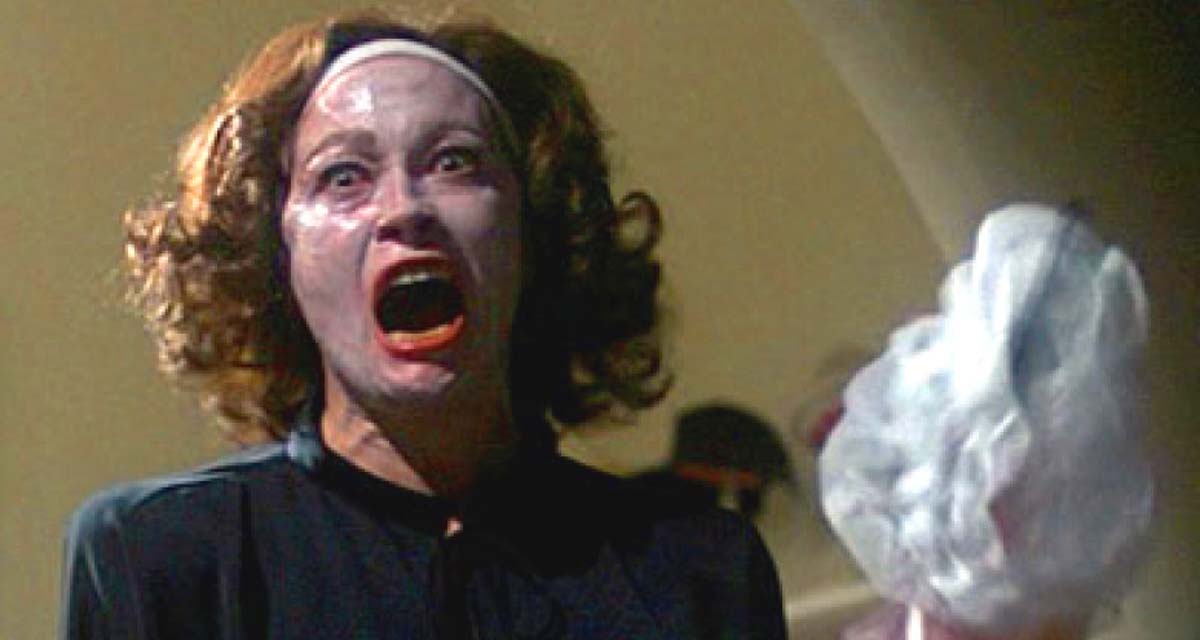
Joan Crawford had a BPD diagnosis. Is this sexy, alluring, and “quirky” to you?

The Myth: If you have Borderline Personality Disorder, some people think this means you’re a sexy beast or babe who’s alluring, unpredictable, passionate, always charming and “quirky”, and never boring. Your chameleon-like abilities to match the attitudes of those around you is seen as evidence of potential Oscar-winning ability. It’s always pointed out how many actors and musicians suffer from BPD.

The Reality:  Let’s be honest.   If you have BPD you’re emotionally unstable, volatile, almost crazy (the original term “borderline” referred to the disorder being on the border between neurosis and psychosis), out of touch with reality, unable to take a firm stance on anything (or conversely, switching back and forth between two extremes, which just makes you look insane) due to your terror of being rejected or abandoned, prone to be an addict, (drugs, booze, gambling, shopping, cutting, eating and/or dieting, other people), clingy,  codependent, insecure, high-maintenance,  and fickle. The borderline doesn’t really have a false self per se like the narcissist, but they can’t access their true self either, so they wind up “taking on” the attitudes and emotions of those who happen to be around them like some kind of emotional bodysnatcher (in contrast with true empathy, their feelings overwhelm them and are out of control), and they just plain overreact to every damn thing so you feel like you’re always walking on eggshells.

HPD:

clown_makeup
You think you look seductive. Everyone else thinks you look like a clown.

The Myth: Although Histrionic Personality Disorder (HPD) isn’t widely talked about, its reputation is similar to that of BPD (but is really the stereotypically feminine form of Overt NPD): usually female, a sexy, seductive siren, dramatic, highly social, loves parties and being the center of attention, and is never, ever boring. You’ll fall madly in love with this bewitching seductress due to their many charms and their great looks.

The Reality: The real truth about people with HPD is that they’re insincere, emotionally labile to the point of being embarrassing (but their over-the-top “emotional displays” are largely an act), shallow, materialistic, and emotionally retarded. They often overdress (or underdress!) or are overly made up for an occasion, are sexually promiscuous, and are inappropriate in social situations, but they don’t care if you’re cringing in embarrassment for them because even negative attention is still attention and that’s what they crave more than the air itself.

ASPD:

aspd
Nuff said.

The Myth:  So here we are at the juggernaut of the Cluster Bs, the baddest badass of them all, Antisocial Personality Disorder (ASPD). Often confused with Psychopathy (and often overlapping with it), the antisocial or psychopathic badass is a sexy and fearless rogue, unconcerned with how others feel about them, possessed of an arresting and penetrating gaze (actually a predatory, creepy stare) that makes you feel like they are really listening to you, determined to get what they want (whether it’s their latest kill or their latest corporate takeover) and never giving up or allowing themselves to be intimidated, by anything. They’re the Rebels Without a Cause, the self-confident Ferris Buellers, the Coolest of the Cool, the celebrated anti-heroes of novels and films socially sanctioned to serve as a receptacle for the Shadow Self that resides within us all. The ASPD badass gives us permission to mentally “act out” our darker impulses, without actually hurting anyone, and that’s why we all love serial killers so much, and why the Ted Bundys and Charlie Mansons of the world get more marriage proposals than any football or film star.

The Reality:  The antisocial badass is really just a heartless and criminally minded horse’s ass, who has no capacity for empathy, isn’t even socially constrained by their need to impress others to garner narcissistic supply (because they don’t require any), and is frequently in prison or has a rap sheet the size of War and Peace. This is a guy (or gal) who will make your life a living hell, beat you to a pulp any chance they get and leave you in a heartbeat and not even remember your name.

If they’re high functioning, they’re the people who are responsible for everything that’s wrong in the world today and the reason why you work 3 jobs and can’t afford a vacation or health insurance.

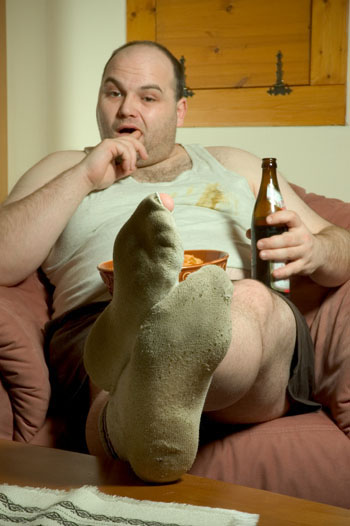
If they’re low-functioning, if they’re not straight up criminals, they’re flabby, pasty Basement Dwellers who dishonestly leech off the system or their family members so they never have to work and spend all their time trolling Internet forums to get a rise out of random strangers.   Just like my ex.


basement_dweller

Ah, what a studly, irresistably dangerous heartbreaker you are.

If you’re a psychopath or sociopath, you operate more like a machine than a human. Is that something we should be aspiring to?

So there you have it. Cluster B disorders are not cool. They are serious mental (and some believe, spiritual) illnesses, and they are pathetic.   And let’s not forget that people suffering from Cluster B disorders are not happy people.  In fact, most of them are pretty miserable.  They are to be pitied (and avoided) rather than emulated.

A rebuttal in defense of Cluster B. 

The narcissistic spectrum according to Lucky Otter

Man looking at reflection in mirror

A friend and I were talking about where exactly different levels of narcissism would fall on the N-spectrum. Of course narcissism (or any psychological topic) isn’t an exact science so giving the different levels numerical values seems a little silly, but in my mind this is how I view the different levels on the spectrum, starting with a Baseline of O (on most narcissism spectrums, “healthy” narcissism is at baseline) and the transition to NPD at around 5, which is smack dab in the middle. Narcissism becomes pathological (causing the person or others problems) at around 4.
Please note these are just my own subjective ideas.  I’m a geek who likes to classify things.

The Narcissistic Spectrum according to Lucky Otter

9-10:
Sociopathy:
A person at this level is almost indistinguishable from someone with ASPD (antisocial personality disorder), but an NPD sociopath is more concerned about image or obtaining supply than a pure ASPDer. Most cult leaders fall here. (Psychopathy appears similar to sociopathy in behaviors, but describes a condition that a person is born with instead of one that was acquired; many psychopaths were never abused and were always like that, but sociopaths were made).

8-9:
Malignant Narcissism:
A person at this level has severe NPD with antisocial traits. A person at this level will show more emotion (usually rage) than a narcissistic sociopath. Usually fits all the DSM criteria or most of them.

7-8:
Severe NPD:
Not malignant because there is no sadism present, but person is still highly dangerous and manipulative. Fits most or all of the 9 criteria and symptoms are severe.

narcissist-bird

6-7:
Moderate NPD:
A person at this level may be barely tolerable, if contact with them is casual or seldom. Fits more than 5 of the 9 criteria.

5-6:
Mild NPD:
A person at this level fits 5 of the 9 DSM criteria for NPD but symptoms are not too severe and they may have moments of acting like a decent human being. NPDers at this level may occasionally respond well to therapy or seek it out.

—Pathological—

4-5:
Narcissistic Personality (Destructive Narcissistic Pattern disorder or DNP):
  A person here fits fewer than 5 of the 9 NPD criteria in the DSM but has at least three.  Symptoms may not be that severe and the person at this level is more in touch with their true self and may seek therapy.  They usually have the capacity to feel empathy but it’s limited.

3-4:
Non-Pathological Narcissistic Personality:
Your garden variety self-centered jerk but may genuinely care about those they love.  Not particularly dangerous. Has moments of insight into themselves or empathy for others, especially their loved ones.

0-3:
“Healthy” narcissism.
Most normal people can be found here.

O (Baseline) and lower:
People down in the negative digits might as well be wearing a “KICK ME” sign. They are almost always victims of narcissists and sometimes even normal people give them a hard time or take advantage of them.

npd_spectrum
The simplified spectrum. Psychopathy does not belong here at all.

Covert (“fragile”) narcissists may be found anywhere on the spectrum, but because their narcissism is more hidden and arrogance and grandiosity may be absent, a covert narcissist at any level is harder to identify. They may appear to have BPD, Avoidant PD, or Aspergers Syndrome instead (these are the three disorders most often confused with Covert Narcissism).

High-functioning (successful) narcissists are more likely to be found high on the spectrum, and sociopaths are often extremely high-functioning. There are many sociopaths (and psychopaths, who were generally born with a different brain structure and may not have been abused) in politics, religion, and heading huge corporations. Sociopathic traits and most NPD traits are generally sought after in the higher echelons of business, politics and entertainment. A person with just the “right” combination of antisocial behavior and arrogance, entitlement, grandiosity, and fake confidence can be a devastating adversary or competitor, and they will have no scruples about crushing you into the ground to achieve their goals.

Most high-functioning narcissists tend to be the Grandiose (classic, or overt) type that best fits the DSM criteria.

Covert and overt narcissists all have the same disorder, but for most, one form or the other is dominant. That said, they can and do switch back and forth in the same person. I think temperament is partly to do with whether someone is overt or covert (the more timid or fearful types leaning toward covert narcissism), but I also think circumstances (such as a sudden loss or gain of supply) can cause a switch from overt to covert or vice versa.

Low-functioning narcissists are much more likely to be covert.  They tend to receive less supply than overt narcissists, so their false self is weaker (the “deflated” false self, according to Masterson). Because of their discontent with their lives and general lack of success, covert narcissists are more likely than overt ones to seek help. If a covert narcissist suddenly begins to receive a lot of supply, they can become much more overt-acting (grandiose, entitled and arrogant). If an overt/grandiose narcissist suffers a huge loss of supply, they can sink into depression and become covert (at which point they are more likely to seek help).

Psychopathy may not be what you think.

gearhead

I’ve been doing some reading about psychopathy and have found out some surprising things. I always was a little confused as to how psychopathy differed from sociopathy and have used those terms interchangeably on this blog due to my confusion. I’ve also used the term interchangeably with Antisocial Personality Disorder (ASPD) and sometimes even malignant narcisissm. It turns out it’s probably something completely different from the other three disorders and may not even be a disorder at all!

Before you start laughing, hear me out.

It all started with this colorful, humorous description someone wrote on a forum I’ve been active on, describing how a Psychopath differs from a Narcissist:

When I picture a Psychopath, I think of someone who at bedtime bounces around from one thing to the next, essentially a high-energy, happy person. When I picture a Narc at bedtime, I imagine someone wearing long pajamas and a nightcap (yes, a nightcap), walking around a 19th Century house, holding a candle, checking for ghosts.

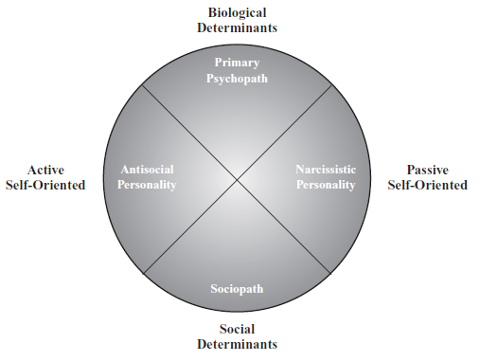
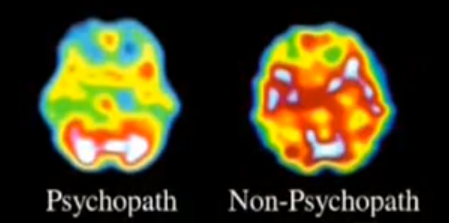
At first I thought this was a weird (but funny) analogy. But it really isn’t. According to psychologist Theodore Millon, Primary Psychopathy is something you are born with and is not due to abuse, unlike NPD or ASPD. Studies have shown that the limbic system (emotional center) of primary psychopaths is simply less active than in normal people. So they don’t experience empathy or have a conscience regardless of how they were raised, but they also don’t have very deep emotions in general.

Millon

Because they lack deep emotions, primary psychopaths tend to be fearless risk takers. They also aren’t moody because they don’t experience anxiety or depression the way others do–if they experience those states at all. But psychopathy has become associated with sociopathy and/or ASPD or malignant narcissism because a born psychopath may be more prone to developing personality disorders than the normal population, if they are abused. Because they don’t have the capacity to develop a conscience or empathy, if they do develop a personality disorder, it’s likely to be Antisocial Personality Disorder, where the right of others are callously violated. That’s why so many psychopaths are also antisocial and dangerous.

But there is nothing wrong with the cognitive functioning of a psychopath. They are able to learn the difference between right and wrong, and if they do not develop a personality disorder, theoretically they can choose to do what’s right. Only the limbic system is impaired, so any decisions a true psychopath makes are cognitively based. Emotion simply doesn’t play into it at all. They do “whatever works.” They lack a conscience because conscience is emotion- or shame-based, and a psychopath isn’t capable of much emotion in general.

So a primary psychopath can theoretically be a good person who is just extremely unemotional and only uses logic and reason to make decisions. Unlike narcissists, who actually have deep emotions but have turned all their emotions inward toward themselves and require “supply” to bolster their fragile egos, a non-disordered psychopath has no need for supply. They simply don’t care what anyone thinks. What you think is simply not something that even occurs to them. In contrast, a narcissist cares very much what you think and falls apart like wet toilet paper if supply in the form of approval or adoration is not forthcoming.

Primary psychopathy seems analogous to the Myers-Briggs ESTJ (Extroverted/Sensing/Thinking/Judging) personality type. In other words, a psychopath is an outgoing, sensation seeking, hedonistic thinker who happily jumps around from activity to activity like someone jacked up on Red Bull, yet they don’t have ADHD either because the J(udging) aspect means their high level of activity always has a goal or purpose. Such a person would be easily bored (which could also lead to antisocial behavior), never worry about things or experience (or even understand) guilt, and unafraid to try and experience new things. Their lack of emotionality would suit them well for the business world. In fact, people who have become very successful in business tend to score high in psychopathic traits.

two-brains

While many high level executives do abuse the rights of others and callously close entire departments and treat their employees like so many pieces in a chess game (whatever works, right?), because psychopaths can tell the difference between right and wrong, some will try to do the right thing just the same. The difference is, they are using cognition rather than emotion to back any prosocial decisions.

Looked at this way, primary psychopathy may not be a disorder at all but a personality variation. Of course, the term “psychopathy” has negative connotations because most of us associate it with antisocial criminals, shady con artists, and serial killers. And in fact many of them are, but not all.

Sociopathy differs from primary psychopathy because (according to Millon, above), it’s antisocial behavior that may develop in a person with ASPD or NPD and is always due to abuse somewhere in the person’s past. A primary psychopath can become a sociopath if they become disordered, and that’s where you would find the serial killers and criminals (and these people usually have ASPD). But a sociopath isn’t always (or even usually) a psychopath. Sociopaths who aren’t psychopathic are usually very malignant narcissists (high spectrum NPD + ASPD) or sometimes even Borderlines, and they differ from psychopaths because there is no logic or rational thinking behind their antisocial or destructive behaviors, only unhealthy, toxic emotion. They seem to have no empathy because all their empathy–and most of their other emotions except anger–are turned inward toward themselves. The false self is what they present to others instead of their real emotions. Narcissists have plenty of empathy but it’s all for themselves–that’s why they are prone to wallowing in self pity. A psychopath would never wallow in self pity. They simply don’t care what you think.

Our twisted society.

impoverished

There’s already been enough written about the narcissistic society we live in that rewards greed and selfishness (even ruthlessness) and thinks of corporations as people. There’s something deeply wrong with any society where CEOs are making hundreds of times more than the workers at the bottom of the totem pole, who are trying to subsist on minimum wage and sometimes having to work 2 or 3 jobs just to make ends meet. There’s something evil about any society where the working poor still may not be able to afford a place to live, and cannot even go to the doctor when they get sick. And then on top of that, they are accused of being lazy, stupid, or shiftless. These victims of the system are blamed for all of society’s ills by–you guessed it–the Tea Partiers in their sterile, gated communities and the ultra wealthy who drive new Lamborghinis and own four vacation homes.

But the insane disparity between the ultra-rich and the poor is an issue that’s well-known and finally beginning to be talked about more in the media, and that’s a good thing. I don’t want to get on a political soapbox though. I actually want to talk about something else that’s related but rarely discussed: the way a few people are rewarded for being leeches on society and sucking the life out of hardworking, deserving people who are left with nothing. Ironically, it’s liberal politics, rather than conservative, that’s responsible for what I’m about to rant about. In my opinion, neither of the major political parties have anyone’s best interests at heart. They’re both funded by mega-corporations who only have their own interests in mind and care nothing about the people who live under their dominion.

I’m referring here to my ex. I know I’ve talked about this lifesucking parasite before, but someone brought it up and I’ve been triggered again, so I’m going to rant. I also realize I’ve had issues with those who hold onto a victim mentality, but sometimes things just get to be too much and there’s no escaping our victimization. Sometimes you just have to rant.

Our sick society is rewarding a man richly for having antisocial personality disorder. This conscienceless jerk used and abused me for 27 years — freeloading off my already strapped circumstances for 7 of those years and refusing to work or lift a finger during the time he stayed glued to my couch while I worked my ass off so that he could qualify for disability (SSI). He was always lazy as f*ck and even though was capable of a limited amount of labor, he always made the excuse that he couldn’t work and still qualify for disability (physically, he has diabetes and knee problems).

He expected me to give him a free place to stay, drive him to his doctors appointments, and never even bothered to clean the house or even clean up after himself. This leech stayed on my couch, leaving a dent in it from his constant hateful presence, left his dirty dishes and cigarette butts all over the coffee table, threw trash on the floor, brought in a dog that almost got me kicked out of my house, and expecting me to buy his cigarettes and lottery tickets. He complained about the inexpensive but healthy food I bought. He thought that because he was diabetic, he was entitled to steak every night. He blasted his horrible music when I was trying to sleep and raged at me whenever I asked him to turn it down. He spent all his time trolling political websites, cruelly bullying people he disagreed with. He insisted I hand him over a third of my tax returns, but now that he has money he won’t give me a dime (not that I would ask because technically I’m NC with him).

useless_bum

He was rejected 4 times for SSI, and a year after I got a restraining order on him (for threatening my daughter), he finally got his booty–-which included $31K in back disability pay for the years he freeloaded off me. (Yes, I know I was stupid to allow this but whenever I threatened to kick him out, he’d threaten to commit suicide and make it look like a murder, and I was so beaten down I felt like I didn’t have a choice).

That was bad enough, but a few months ago I learned that his SSI income was DOUBLED because his psychiatrist diagnosed him with ASPD because he’s unemployable and “possibly homicidal.” Thats right–he’s being PAID not to work because he’s an antisocial POS. With the $31K (which is already spent–God knows how he accomplished that in just two months) he bought himself a brand new truck, a huge flat screen TV and a collection of new swords, and no doubt enough weed to last him for months. To his credit, he did buy our son (who he bullied and scapegoated throughout his childhood) some expensive camera equipment, but I suspect there was self-interest involved in this–buying my son over to his side so he can gloat about how I’m too poor to ever buy him anything.

rich_and_poor

The original $700 a month he was to be getting per month in benefits was increased to $1200 after he was diagnosed with ASPD! He also gets almost $400 a month in food stamps and full medical coverage. He still sits around watching TV and trolling political websites all day and sleeping. Meanwhile I have to keep slaving away at a grueling job that’s slowly killing me and have NOTHING to show for it. I can’t afford cable and don’t even own a TV, have no health insurance, and can’t even get my ancient car fixed. Yes, of course I’m envious. 😡 I get so mad just thinking about it that it can and has ruined my day, so that’s all I’m going to say because it’s unhealthy for me to dwell on it.

I’m trying to let go of this bitterness because there’s nothing I can do about it. I might write an anonymous letter to the paper describing the injustice of this state of affairs, but then again, I might not because I know nothing will be done. I can’t dwell on these bitter feelings even if they’re justified. It’s a very sick society where dangerous and useless people like him get to live high off the hog and honest people who try to play by the rules have to slave away at 2 or 3 jobs just to have food on the table–AND we still have to pay taxes to keep human cancers like him enjoying their creature comforts.

I only have one thing left to say:

fucking_insane