Meet my pets

I meant to post earlier about my pets, but I had to make some space on my phone to take new photos. This morning I finally got the opportunity. I have 5 kitties and a dog, Dexter. Each of them has their own unique personality and hopefully these photos capture some of that. I’m posting the cats in the order I acquired each one.

Chunks:
chunks2 chunks1 chunks3

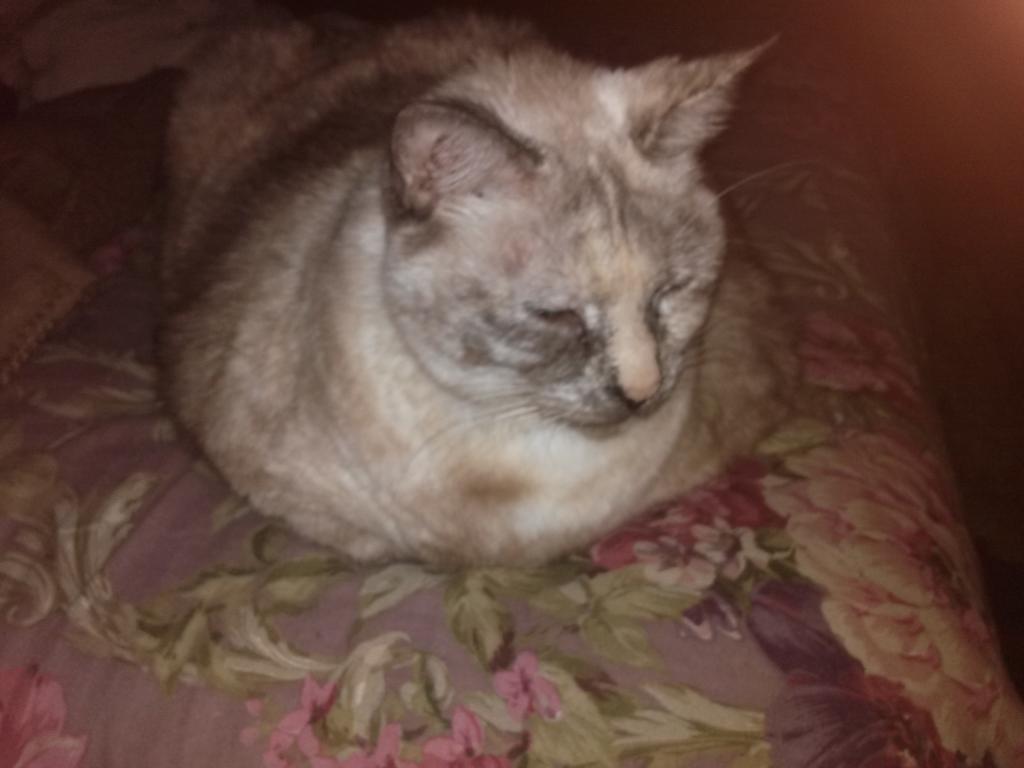
Chunks is about 9 or 10, so she is the oldest of the group. Her original name was Ione, but it didn’t stick and Chunks is who she became, and from these photos you can see why. She looks like a meatloaf! Chunks spends most of her time sleeping, and (surprise!) eating. At night she likes to sleep at the foot of my bed and sometimes licks my fingers. I think she must be part Siamese because of her bright blue eyes and and loud meow.

Babycat:
babycat1 babycat2 babycat3

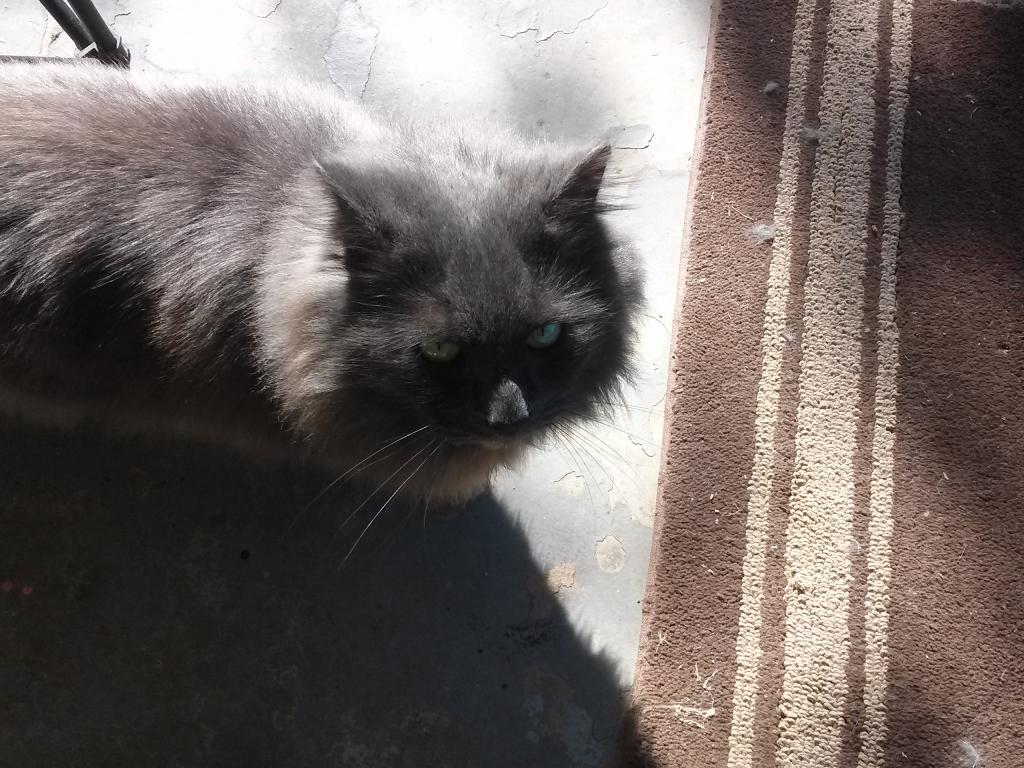
Babycat is 5. She was adopted by my daughter as a tiny kitten whose mother had been killed by a car. You can’t tell from these photos, but Babycat used to look like a Maine Coon and had gorgeous semi-long fur and a bushy tail. But she is very nervous and jumpy, and has a habit of chewing her fur until she pulls it out. I think she also may have a skin allergy because she is also missing fur in places she can’t reach, like the back of her neck. When I have the funds I plan to take her to the vet and find out what can be done so she grows back her beautiful fur. But Babycat is also very friendly and affectionate, as long as you don’t pick her up (she will squirm to get loose). She gets along well with Chunks, but seems to prefer to keep her distance from the other kitties.

Sheldon:
sheldon1 sheldon3 sheldon4

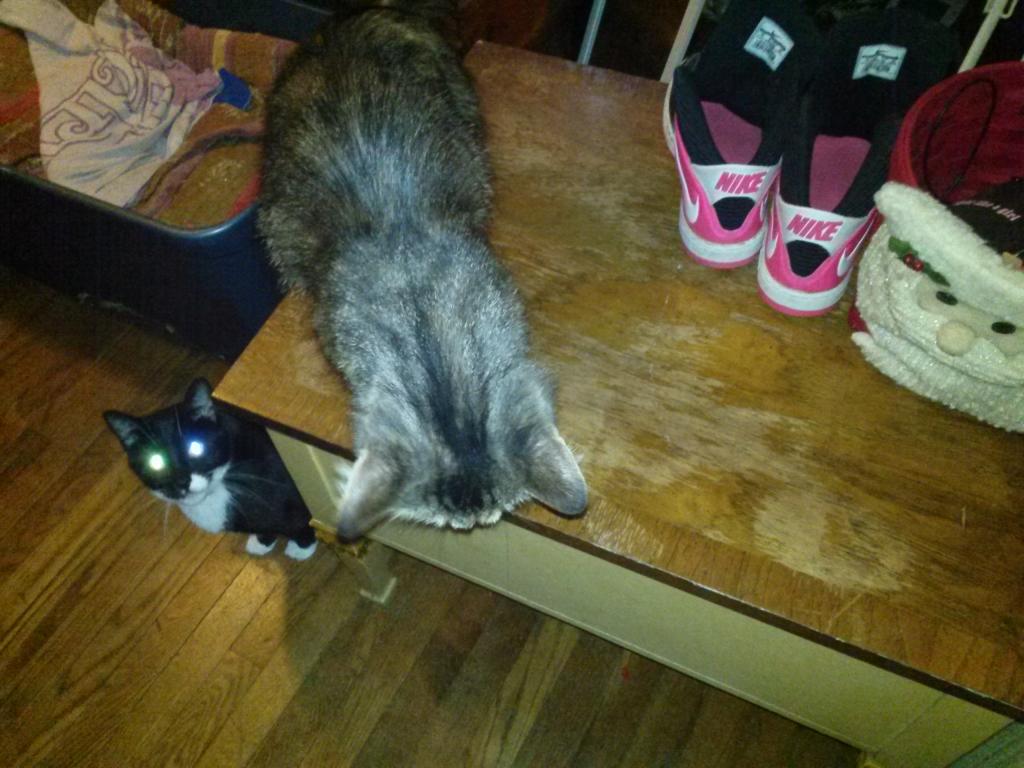
Sheldon, my black and white tuxedo cat, came to my home at the same time as Cleo, but they aren’t from the same litter. He and Cleo are about 4. Of all the cats, Sheldon is the most people oriented and can be downright doglike in his demands for attention! He will follow you around meowing and he announces himself when he walks into a room, chirping and trilling like a bird. He loves my dog, Dexter the most and wrestles with him more like a puppy than a cat. Sheldon’s also the most likely to get into trouble, knocking things over (for attention I think!) or scratching the furniture. He’s a funloving guy who loves to go out, and will not leave you alone until he gets his way. The first two photos show him begging to go outside. It was very hard to get him to stay still long enough to get a good photo!

Cleo:
cleo cleo1 cleo2

Cleo is an easygoing kitty and very small. She still looks like a kitten. But don’t let her delicate appearance fool you. She is a world class hunter and often brings home a “surprise.” She has even captured rabbits and other animals much bigger than a mouse! She can run up a tree faster than you can say “Boo” and knows how to get herself back down too. She gets along well with everyone and while not as affectionate as Babycat and Sheldon, doesn’t mind being pet and occasionally even carried around. Sometimes she jumps down from a perch on the cat tree and rides around on my shoulders. The first photo is one I took of her during the summer.

Mr. Biggles:
mrbiggles1 mrbiggles2 mrbiggles3 mrbiggles4

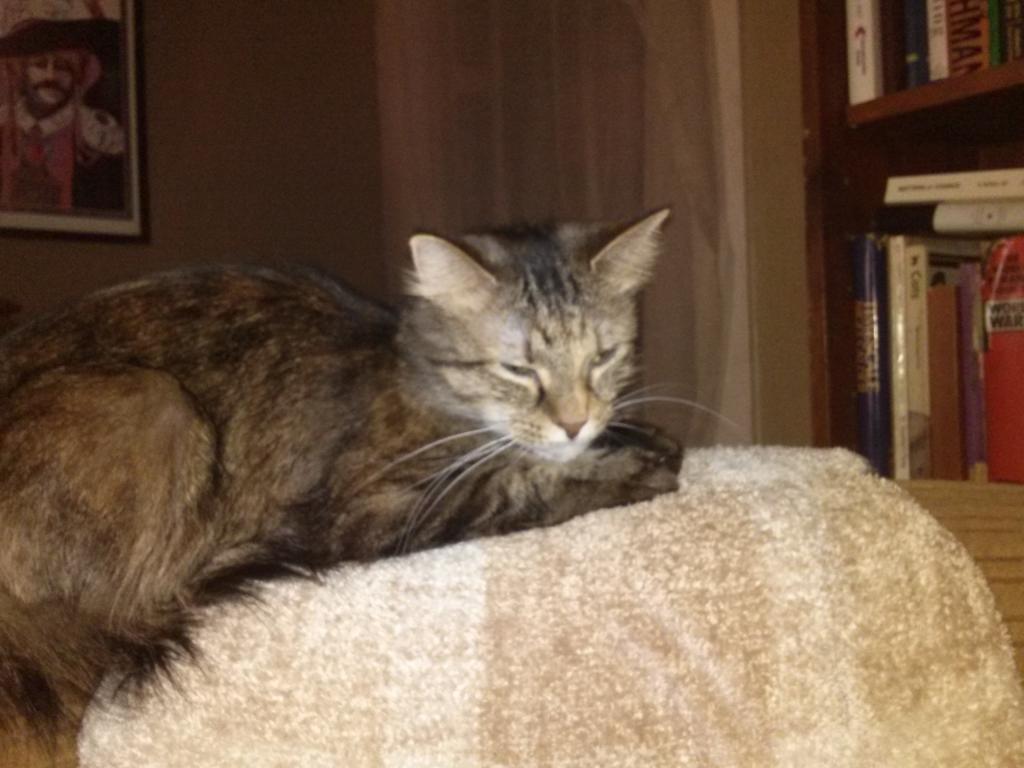
Mr. Biggles is about 3. He is a handsome guy and as you can see, he’s the most photogenic of all the kitties. He knows how pretty he is because he’ll actually stop and stay still for the camera. He’s an easygoing, chill guy who gets along well with everyone but he’s terribly clumsy, and often misses when he tries to jump to a high surface. Nothing phases him though, and pretty soon he’ll try again. He’s fearless. He also loves his beauty rest.

Dexter:
dexter2 dexter3

Dexter with Mr. Biggles:
dexter1 dexterbiggles

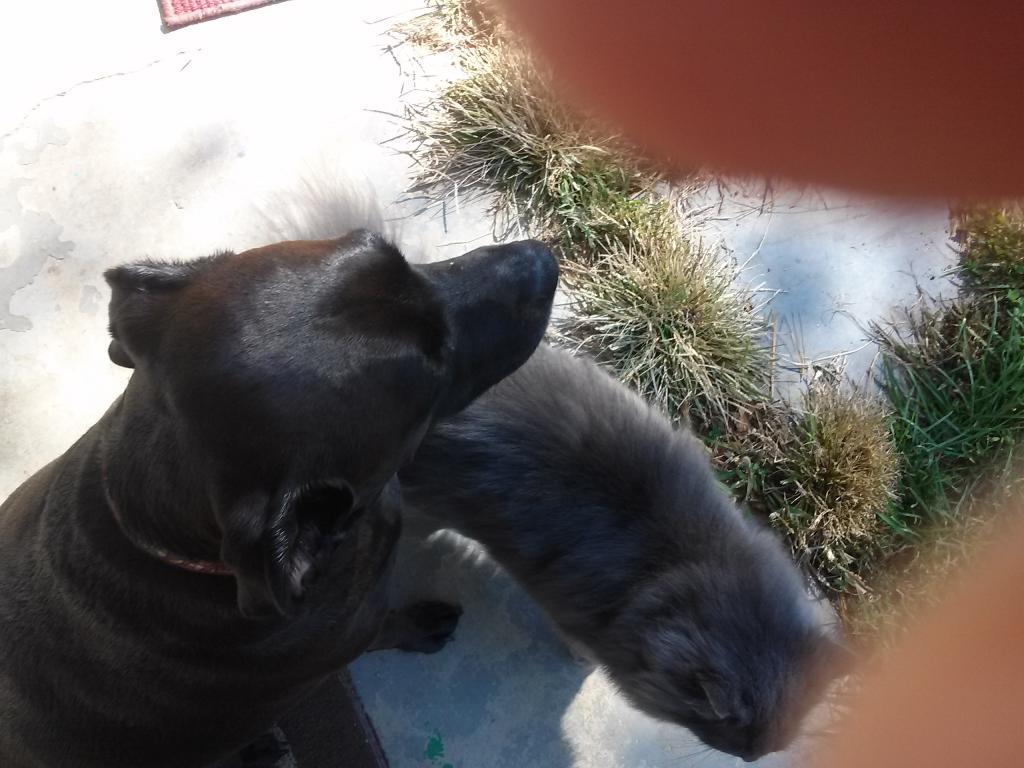
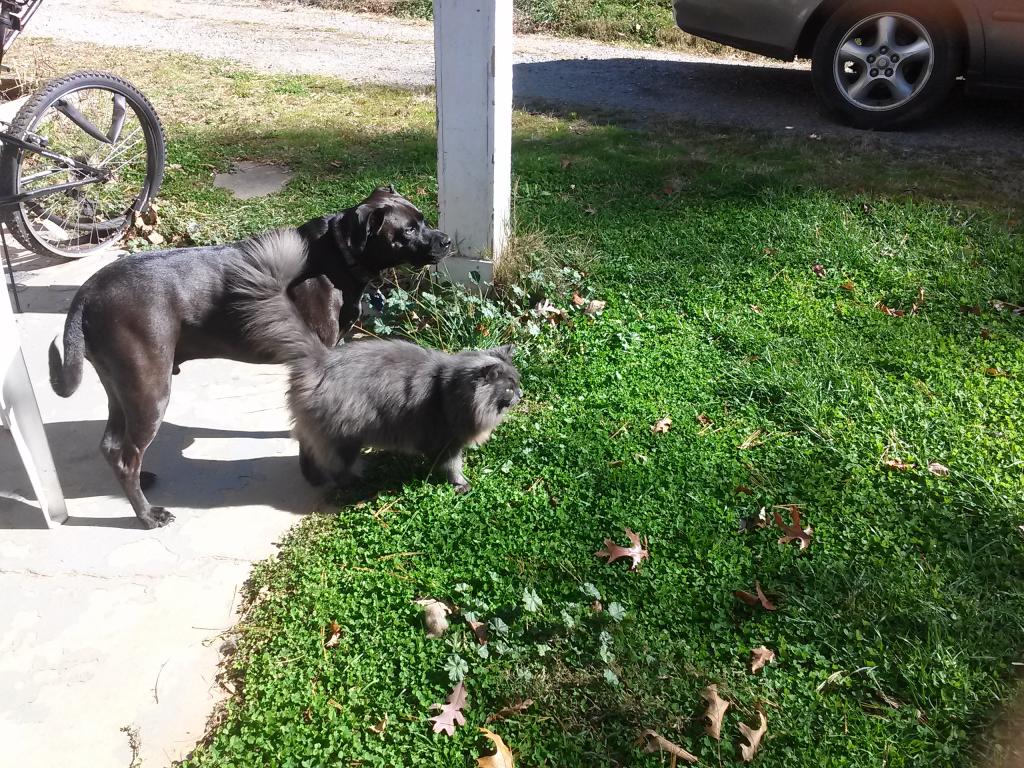
Dexter is a very pretty black lab/Dachsund mix (he mom was a Doxie) who we adopted from a neighbor when he was about 4 or 5 months old. He’s a very sweet, affectionate boy and loves car rides more than anything. He likes all the cats, especially Mr. Biggles and Sheldon. He will whine for attention and loves to run. He’s a terrible watchdog though, and rarely barks unless he is playing.

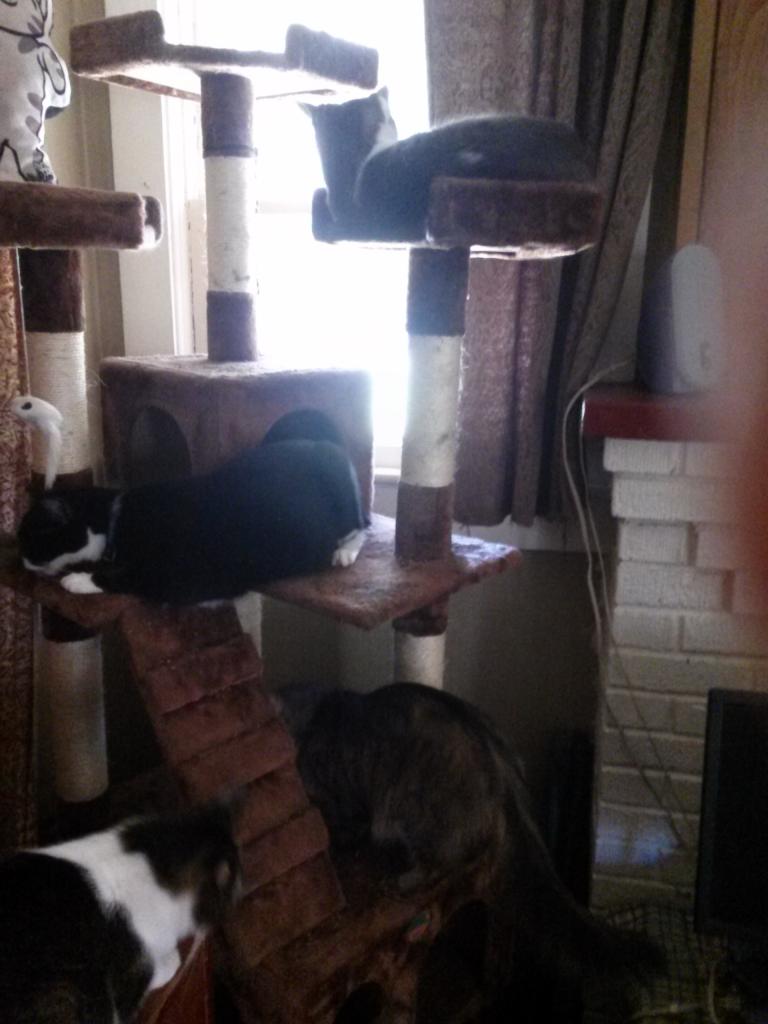
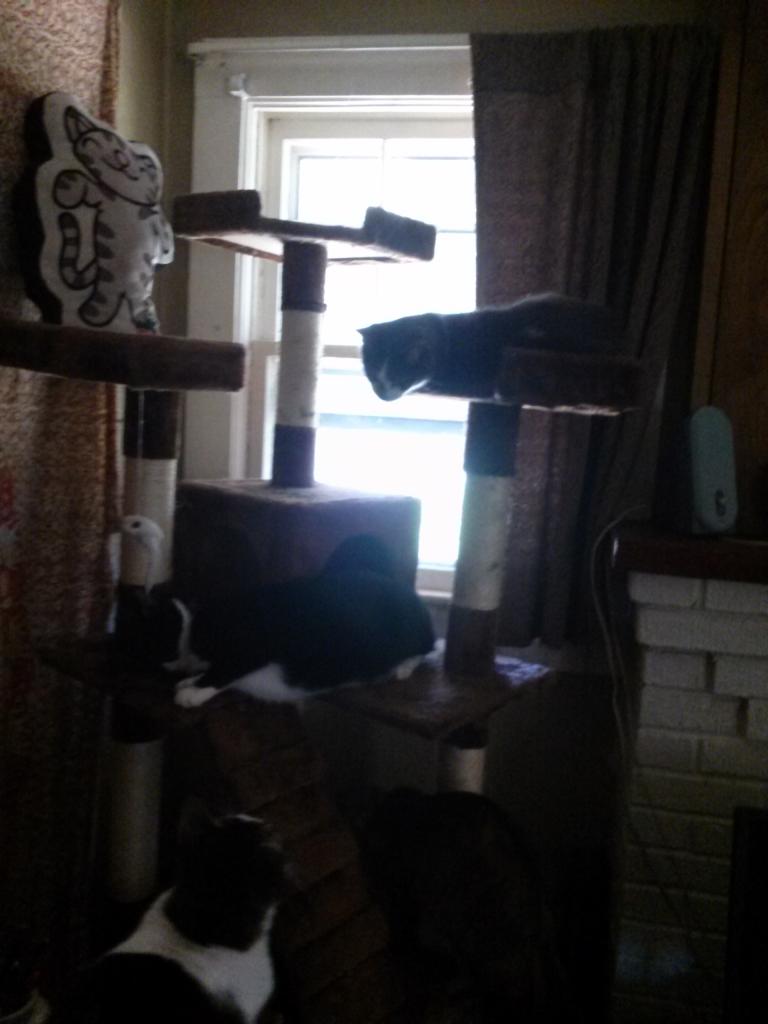
Here’s a couple of bonus photos I took of the cats on the cat tree in the living room, after I sprinked some catnip on it. The brown and white cat in the bottom left side of the photo is Isaiah, a friend’s cat we are watching while he is away.
cattree1 cattree2

Click on the photos to enlarge.
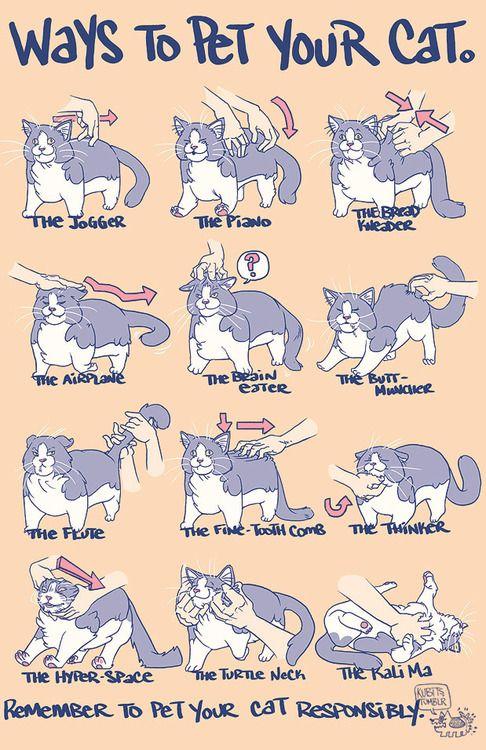
Ways to pet your cat.

I’m going to try some of these on my cats.

petyourcat

Click to enlarge.

How my mother became a narcissist.

housework

I’ve said a lot of negative things about my mother, but I don’t hate her. Today I was thinking about how she got to be the way she is. While most narcissistic psychopaths are probably genetically predisposed to this condition and are missing the part of the brain that causes them to have empathy and compassion for others (actually it’s just not functioning properly), in most cases there are also psychological factors. Many psychopaths and narcissists were abused or neglected children, whose own parents failed to mirror them adequately as young children. So as unpleasant as they may be, their condition is not their fault. It was done to them.

I’ve already described my mother as a vain, self-centered, image conscious woman who almost always put her own needs ahead of those of her children and husbands, and chose me (as the youngest) to be her scapegoat. At times I was also her golden child, especially prior to my teen years when I started to rebel, and she loved to make me in her own image, dressing me up like I was a little doll. She expected me to act like one too, and flew into a rage if I ever had an opinion of my own or dared to challenge her.

The story I’m going to tell is gleaned from the scant bits and pieces I heard over the years, most of it described by people other than my mother. Like most narcissists, my mother is stunningly lacking in introspection. She almost never talked about her past or her childhood, and the few times she did, it was negative. Most of her anger seemed to be directed toward her mother, who she spoke of with contempt the few times she did mention her.

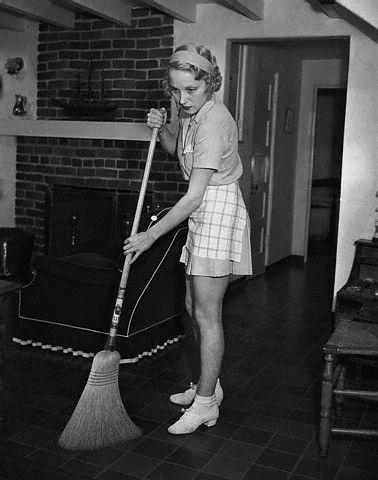
Ginny was a beautiful child with big blue eyes and light red hair. Somewhere in my mother’s home there’s a photo of her at about age two, and she is dressed in a pink and white dress with a Peter Pan collar, her bright hair is done in a 1930s bob, and she’s sitting in an oversized chair holding a large teddy bear on her lap. On her feet are brown high top shoes, and her little feet are sticking straight out toward the camera. Ginny’s expression is solemn, almost sad. In fact, she looks close to tears. I will probably never see that photo again, as I am not in contact with my mother and she’s in her 80s and probably won’t be here too much longer, even though she’s in good health for her age and still looks younger than her years. I wonder if at the time that photo was taken, Ginny’s narcissism was already ingrained, or if she could have still become a normal, loving woman had her circumstances been different. The sadness in her face tells me she was hurting. It’s the most vulnerable I’ve ever seen my mother.

Ginny was the fourth and youngest child born to a naval academy officer and second generation Irishwoman. The family was middle class, lived in a nice house in a safe neighborhood outside Annapolis, Maryland, and raised all their children as Roman Catholics. Because Ginny’s father was in the military, when the Depression hit, the family didn’t suffer too much financial hardship and his job remained secure. But Theodore (her father) was a heavy drinker, probably an alcoholic, and started drinking almost the moment he got home from work. Anna Marie (Ginny’s mother) suffered from melancholia (what we now know as major depression) and after Ginny was born, took to her bed and stayed there for most of her childhood and teen years. She may have been suffering from postpartum depression, but in those days, no one knew about such a thing. Anna Marie started to neglect her duties as a housewife and mother, saying she was “too sick” and had to lie down.

Ginny was the most attractive of the four children, and the only one with blue eyes. She was obviously Theodore’s favorite child, and he constantly told her how beautiful and special she was. Anna Marie began to resent all the attention he showered on his favorite child, and became even more depressed (she may have been a narcissist herself). Theodore was a faithful husband (from all accounts) but his wife’s demands were wearing him down and he began to drink even more. Sometimes he came home from work already drunk and often he would pass out after eating dinner, so that no one was running the household but the children.

By this time Ginny was about six, and her older sisters (who were in their teens) and brother (who was about 11) weren’t interested in keeping the house clean or taking care of their exhausted, drunk father and depressed, ill mother. Ginny hated dirt and disorder, and took it upon herself to keep the house clean and cook the family meals (Anna Marie was a bad cook). Her sisters were always out at parties or on dates and of course her brother was a boy so he wasn’t interested in keeping up the home or taking care of the family. Soon Ginny was the sole caretaker and became her father’s young surrogate wife. (I don’t know whether or not she was sexually abused, but it would not surprise me and I assume she probably was). Anna Marie developed a hatred for Ginny, who seemed to be everything she was not and also got all her husband’s attention. Theodore’s adoration of Ginny increased, and he began to depend on her for everything, including confiding his problems in his marriage. Ginny seemed sympathetic, but was already plotting to leave the home.

At age 15, Ginny had become a drop dead gorgeous young woman. She left her family and dropped out of high school to marry a young man from the naval academy who was studying to be a Methodist minister. She took a job modeling for the local newspaper to help makes ends meet. By 18 she was pregnant and gave birth to her first daughter, and a few years later she had her second child, also a girl. But Ginny was tired of the church dinners and the drudgery of family life. She was bored and longed for excitement that her two young daughters and minister husband couldn’t provide. So when her daughters were just 7 and 2, she left them to marry my father. It was the late 1950s, and a woman leaving her husband and children just wasn’t done, but she did it without a second thought.

Although her older daughter had abandonment issues and hated Ginny for years for leaving, today my mother lives in her home and my sister’s become Ginny’s most loyal flying monkey. I barely ever knew my sister, but I was told several years ago that I was not welcome in her home because my sister didn’t want me there. Either my mother didn’t want me there and blamed it on my sister, or my sister is a sheep who believed all Ginny’s lies about me. Ironically, my sisters were much better off than if she hadn’t left them because the woman who married her jilted husband and raised them was a kind, nurturing woman, almost the polar opposite of my mother.

Another irony is that even though my mother, as a malignant narcissist, is completely lacking in compassion, both her father and my father were taken in by Ginny’s fake “sympathy.” Ginny listened to her dad talk about his marital problems when she was a teenager and offered him kind words and a ready ear; and recently my son told me how my father fell in love with Ginny (my father never told me this story but he told him): my father’s 3 year old son from his first marriage had been hit by a train and died, and my mother offered him a shoulder to cry on and a sympathetic ear and soon he was madly in love with her.

I clearly remember when my grandmother suffered a major stroke at age 57 when I was only 7, my mother’s comments after seeing her in the hospital. All she could talk about was how helpless and disgusting she was (the stroke had left her paralyzed from the waist down and incontinent) and how she couldn’t wait to get out of there. Even at that young age, I was horrified by my mother’s callous remarks about her own mother.

Even though I don’t use my real name or their real names, sometimes I think it’s just a matter of time until she discovers this blog. I had to go inactive on Facebook because of her extended family all finding me there.

Things I’ve learned lately

In writing this blog I’ve learned a lot about myself and my FOO and how it has affected my life and relationships. In reading back over this blog and thinking about narcissism so much, I’m shifting my views on some things. Not all of these discoveries are easy to swallow and I’ve been in denial about a few of them.

— My mother is by far the most malignant narcissist in my family with the most profound effect on me and others who have had the misfortune to be in a close relationship with her. She has managed to recruit almost all of her extended family and even some on my father’s side to do her bidding as her flying monkeys. I am her prime target, although not the only one. She is a powerful psychopath without a soul. If she could get away with murder, I think she would.

— My ex, asshat and parasitic loser though he may be, is a drug addict and alcoholic and though definitely a narcissist, is less malignant than I had thought (or at least not as bad as my mother). I’m not making excuses for him because there is no reason to, but being at a safe distance now, I can see him as a sort of hybrid of a narcissist and a mentally ill victim of one (is this possible?) This realization is based on some of his behaviors that do not indicate narcissism but rather, plain old mental illness and addiction (although narcissists are likely to become drug addicts and alcoholics). One thing that definitely doesn’t fit the narc profile is the fact he has always sought therapy (although his motives for doing so might have to do with narcissism). His diagnosis of PTSD and Bipolar aren’t entirely off base. His mother was a malignant narcissist though, and he learned a lot of those behaviors from her. I’ll write a longer post about him at a later time.

— My father is also on the narcissist spectrum, and he has always been in thrall to malignant narcissist women. At times he has been their victim, but mostly he enables and makes excuses for what they do. I feel sorry for him.

— I was set up to fail.

— I am pretty sure my daughter is on the narcissist spectrum but she is also an intractable drug addict. It really hurts to realize her “conscience” may be fake and she really doesn’t care about anyone but herself, because I love her so much, but I can’t hide from what some of her behaviors point to. Drug addiction can cause a person to act in narcissistic ways, too, especially if they’re desperate for a fix. I’ll write more about this another time. It’s pretty hard to deal with.

— I wasn’t a very good mother. I put my own needs first a lot of the time, and always treated my son like the golden child, and still do. Of course, he is making better choices than my daughter, so I don’t have to worry about him as much. Ten years ago I was much less self aware and more self-involved than I am now. I think that was because I was under my ex’s thrall (even though he’s not as high on the spectrum as I had thought).

— I have a lot of narcissistic tendencies, but I used to be worse. Envy is something I have struggled with my entire life. But even though I may envy people who seem to have more life blessings and sometimes (secretly) feel bitter about feeling so deprived in comparison, it’s never occurred to me to sabotage them or try to take what they have from them. I’m not proud of having this character flaw. Narcissists don’t feel shame about being envious, and think nothing of trying to take away what others have. I also deal with feelings of guilt and shame a lot in general so that reassures me I’m not on the spectrum.

— I find it hard to be 100% candid about my feelings on this blog. I’ve noticed I write in an intellectual way and seem to avoid emoting on this blog too much. Some of my posts sound like I’m writing about someone else. Distancing myself and intellectualizing everything is how I’ve managed to remain fairly sane. This isn’t really a good thing though because it blocks me from digging deeper to the source of my pain and in so doing, keeps me trapped in a state of numbness and ineffectuality. Multiple Personality Disorder and other dissociative disorders are just more extreme ways of distancing from “I.” This probably indicates PTSD. I’ve become too good at hiding my sensitivity behind a mask of detachment. When I was younger, everyone said I was too sensitive, now no one does. Even my mother has gone from calling me “too sensitive” to calling me much worse (and I always hear about this second hand from her flying monkeys and other family members she has “confided” in). In real life, I don’t trust anyone and am painfully shy. Hardly anyone knows anything about me. I hardly ever cry and smiling doesn’t come naturally either. I blend into the scenery because I’m so quiet and people assume I’m just not very friendly. Some people think I am stupid because I never have much to say and because I’m too afraid to take a side in any argument and also because I get so lost in my head I don’t always seem to be aware of what’s going on. I long to reach out, but my Aspergers, PTSD and lack of trust combine to make me almost mute in social situations.

–I took the Myers-Briggs test online on two websites and came out as INFJ on one, INTJ on another. Both of these seem to fit. But I think inside I’m definitely leaning more to (F)eeling but use (T)hinking as a mask.

Can a psychopath ever be cured?

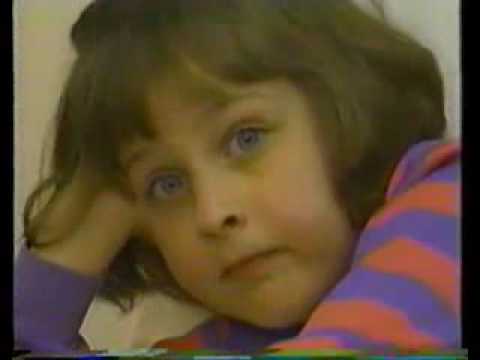
beththomas1

I watched a fascinating documentary, about a 6 year old girl (Beth Thomas) who had been severely sexually abused and neglected and was diagnosed with Reactive Attachment Disorder, a precursor of psychopathy. The little girl is remarkably callous when she speaks about wanting to kill her younger brother and her adoptive parents and shows little emotion. However, because she is only six, she is also honest and candid. She is shown a few years later and has become a normal, loving child.

Psychopaths generally cannot be cured, but in some cases like little Beth’s, early intervention combined with removing a young child from an abusive home can reverse the course of psychopathy before it’s too late. Today, Beth Thomas is in her 30’s and is a registered nurse who works with her adoptive mother, Nancy Thomas in her company Families By Design, which promotes Attachment Therapy to improve the parent-child relationship.
From all accounts Beth shows no signs of narcissism or psychopathy. This is what she looks like today:

beththomas2

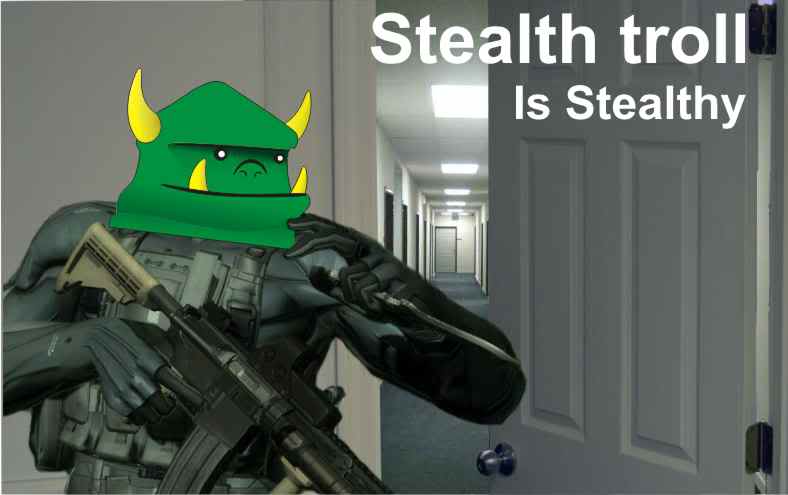
Two kinds of stealth trolls

stealthtroll

In two earlier posts I wrote about online bullies and trolls (not exactly the same thing, but close enough). I won’t explain here how they differ and are the same (you can read the articles which I’ve posted links at the end of this article), but I neglected to mention stealth trolls. Stealth trolls seem benign, but can wreak havoc on web forums and social media. I will describe two types of stealth trolls. There are probably others.

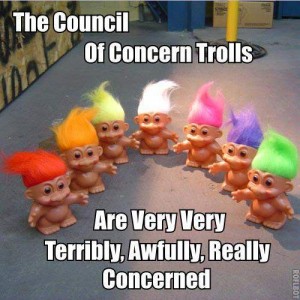
The Concern Troll

concerntrolls

The Urban Dictionary defines a concern troll as:

A person who posts on a blog thread, in the guise of “concern,” to disrupt dialogue or undermine morale by pointing out that posters and/or the site may be getting themselves in trouble, usually with an authority or power. They point out problems that don’t really exist. The intent is to derail, stifle, control, the dialogue. It is viewed as insincere and condescending.

A concern troll on a progressive blog might write, “I don’t think it’s wise to say things like that because you might get in trouble with the government.” Or, “This controversy is making your side look disorganized.

The concern troll’s M.O. is stealth. They appear harmless. In the guise of “concern,” the troll infiltrates the website, seeming helpful, but their true intention is not to help, but to disrupt the community, dialogue or morale on the site. They probably know little if anything about the subject matter and their complaints are of a general nature. Their “concern” makes them feel superior. Concern trolls are probably narcissistic or even psychopathic, and their self-righteous “concern” makes them feel superior. Any attempt to pin them down and explain their “concerns” in greater detail or a request to explain the topic being discussed will usually cause them to disappear, but they’re likely to reappear under a “sockpuppet” account (another handle). The sockpuppet may be more aggressive in their trolling behavior and may even bully individual members or make openly hostile remarks about the site or its subject matter. A troll’s goal is to destroy the online community in the usual manner: by making its members leave the site.

The Triangulator.

triangleman

This is a dangerous troll who who pits people against each other by sending private messages containing lies about another user. It’s an online form of the triangulating that psychopaths and narcissists do. They are almost always found on social media and forums. I’ll give a hypothetical example of what a Triangulator does. Let’s say Lisa and Brian are online friends. The Triangulator (let’s call him John) befriends both Lisa and Brian. One day John sends Lisa a PM saying Brian told him that Brian thinks she’s dumb (he never said this). Lisa gets mad and sends Brian a PM saying her feelings are hurt that he went behind her back and told John she was dumb. Brian says he never told John he thought she was dumb, and he doesn’t think she’s dumb anyway. Lisa isn’t sure who to believe, so the trust between her and Brian is compromised. John then sends Brian a PM telling him Lisa thinks Brian acts like a know it all (she never said this). When Brian talks to Lisa and she tells him she never said this, he isn’t sure who to believe and the trust between them is compromised. The Triangulator can destroy a friendship this way, and that’s exactly what he wants to accomplish. By using this tactic, Triangulators can totally break down communication on a site and cause regular users to defect.

Don’t feed the trolls.

Trolls are simply narcissists who derive pleasure upsetting and destroying a healthy online community. If you can’t ban them yourself, the best way to deal with a troll is to report them to the admin or if that isn’t possible, ignore them.

Earlier articles about online bullies and trolls:
Internet Psychopaths: the difference between Trolls and Bullies
Internet Trolls are Psychopaths

Important update for my readers

I’ve just updated the “Info and Support” section that appears in the green bar in the header, with a few short book reviews. I will keep updating this list as I get new information and read new books on NPD and related disorders.

I love “demotivational posters”…

…and I just found this website that lets you create your own. Here’s one I just finished that fits with my latest concerns.

themosttoys

Click to enlarge.

It’s all about image: the skewed values of narcissistic families

monopolyguy

Last night I read a blog post by another survivor of narcissistic parents , and was astounded by how similar her parents’ values were to mine.

She writes that her father criticized her for being too idealistic. Now that would normally be a compliment, but because her family valued nothing but money, class and image, it was meant to be an insult. My father (who I don’t think is a narcissist, but has always been a huge narcissist apologist and enabler), said exactly the same thing to me.

We live in a narcissistic and materialistic society, that increasingly values traits that are narcissistic and exalt the individual over the community. In fact, studies have shown that a high percentage of CEOs, top executives, Wall Street tycoons, and others of the “One Percent” have narcissistic personality disorder. It’s a disorder that is very adaptive in modern society and whose traits are rewarded with money and material goods. Especially since the 1980s, with its “Greed is Good” ethos, we reward those who act in their own self interest over those who act in the interests of the community and want to help the less fortunate. There’s even a meme that’s become especially popular with narcissistic Baby Boomers: “I’m spending my children’s inheritance,” as though this is something to be proud of.

inheritance

My family bought right into this ethos. Image was everything to my parents, especially my mother. My parents looked down on our blue-collar neighbors and relatives, and my mother in particular constantly made jokes at their expense and talked about how much better we were because we had nicer things and my father had a better (meaning white collar) job in the city. Appearance mattered, and our clothes had to come from the best department stores, never Sears. We had to live in the most exclusive neighborhoods. To not have a college degree was considered a mortal sin, and even then, it was far better to be successful in the cold-hearted business world than to be a successful teacher, social worker or a nurse. Such things were regarded as jobs for those who couldn’t do anything else, and of course they required a level of idealism that my parents just couldn’t relate to. When my parents split up when I was 14, my extremely image-conscious mother took up public relations as a career, which is all about image. She had so many face-lifts that today her face looks like a mask.

Whenever my parents, my mother in particular, complimented someone else, it was always on their visible, tangible qualities–things like their appearance, home decor, financial status, and taste in clothes. Table manners were of utmost importance, but being a good person was not. I can’t remember a time when my mother ever complimented anyone for qualities such as sweetness, generosity, friendliness and altruism. I do remember her putting down others for having these qualities, calling them “insipid” or accusing them of having no backbone.

My values never matched those of my immediate family, and when I became poor as an adult (because I was never given the tools and self esteem that would have led me to make better choices) I was shunned and rejected by them. I don’t think it’s any accident that when narcissistic parents choose a scapegoat, they usually choose the most sensitive child–the one most likely to be empathetic and have idealistic values. To a narcissist, idealism and empathy are weaknesses. They truly believe that the poor deserve to be poor, and they make no exception for their own child. The child with traits that cause them to become a scapegoat (and who all too often are also bullied at school) would probably become successful if they were raised in a loving, nurturing home, but in a narcissistic home, having these traits is a curse because that child is led to believe they are worthless and this leads to cowardly, “safe” choices that are more likely to lead to poverty. They are constantly told they will fail, that nothing they do is good enough, and then are usually “tossed out to the wolves” at a young age, with no family financial or emotional support to help them get a foothold in the larger world. I have read so many blogs by the scapegoated children of narcissistic families, who were forced to make their own way in the world with no family support, even if their parents could have afforded to help them, and even when other children in the family (who were not scapegoated) did receive support when they entered adulthood.

superiority

What is so ironic about all this is we scapegoats are rejected and hated for the very traits that were instilled in us as children! Scapegoated children are not encouraged to think independently or have ideas of their own. In fact, having a mind of one’s own is reason for punishment and abuse. We were trained to be deferent and obedient–and very much afraid. Deference, obedience and fear are not traits that lead to success in modern life. I think this training is deliberate, in that an evil narcissistic parent needs and wants someone they can use as the family trashcan–someone who can take and absorb all the family pathology and carry its burden. This child is then blamed for everything that goes wrong both within the family and in their own lives. When a scapegoated child becomes an adult, their low self esteem and fear almost inevitably leads to a life of material and financial lack, and this gives the narcissist parents an excuse for rejecting that child and refusing to help–for “violating” their materialistic, self-centered values. I think another reason narcissistic parents train HSP (highly sensitive) children to be scapegoats is because they know an HSP child must be silenced: this is a child who sees through their lies and can use the light of truth to blow the whistle on them. If they are encouraged to think and act independently, they might “out” the narcissistic parent and that is a prospect that terrifies them.

Of course, the best revenge for a scapegoated child is to become successful in spite of their upbringing–and of course there are those who have. Even then, narcissistic parents will find reasons to put that child’s accomplishments down as somehow not “good enough.” The few times in my adult life where I had some legitimate tangible success, I was never praised for it, but given some sort of left-handed compliment or told why it didn’t really count. I was also always compared with my more financially successful older half-siblings, who of course never had been designated the family scapegoat.

Narcissistic parents also don’t care if you have a mental disability. I’m a self-diagnosed Aspie (this was later confirmed by a psychiatrist) and suffer from intermittent major depression, but when I tried to tell my parents these were the reasons why I had so much trouble making the social connections necessary to become financially successful, these diagnoses were dismissed. I was told I was “making excuses.” Both my parents are convinced my poverty is my own fault because of the stupid choices I made. While I don’t deny having made dumb choices, these choices were based on the way I had been raised–to be afraid of taking any risks or challenging myself.

The only way to break the narcissist/scapegoat family dynamic (and it is probably the most toxic parent-child combination imaginable) is by cutting off contact with the abusive parent, because as long as you keep trying to please them, they will continue to attempt to break you down and make you feel insignificant. Nothing will ever please them, even if you dare to become more successful than they are. And if you somehow manage to do this without sacrificing your idealistic and empathetic values, that’s the biggest threat to them of all.

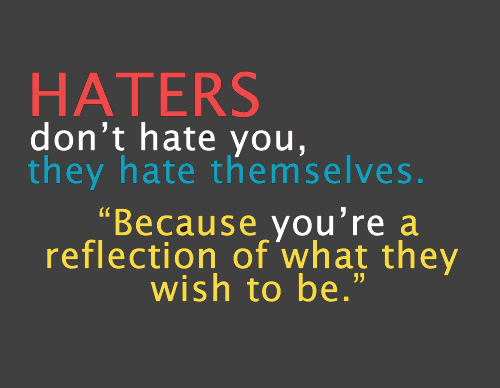
Make no mistake: your narcissistic parent doesn’t love you and never will, but it isn’t your fault. They hate you because they envy those qualities you have–empathy and humanity–that elude them. Be a good parent to yourself. Love yourself. You deserve it.

haters

Narcissists don’t change

snowwhite

I read a lot of blogs written by ACONs (Adult Children of Narcissists) and without exception, all these survivors yearned (or still yearn) for the parental love they were entitled to but never received.

Narcissists can’t feel love. Sure, they might pretend they love you when others are present (they’re great at wearing masks and keeping up appearances), but their true nature doesn’t even know the meaning of the word love.

For many years into adulthood, I wanted nothing more than for my narcissistic mother to approve of me. Like most narcissists, she was all about appearance and image. When I was young, she was obsessed with my weight and physical appearance, and always insisted on making me into her own image. She herself was vain, and seemed incapable of discussing deep topics or ideas. Narcissists have an uncanny ability to never show any vulnerable side of themselves, and this includes sharing any dreams with you. I’m not talking about the kind you have when you sleep, but the kind of dreams that give us hope for happiness in this life. I can’t remember one time when my mother ever shared a dream with me. She was already perfect–she didn’t need to have a dream. She also never, not once, ever shared a true emotion with me. She was incapable of being vulnerable or showing anyone (especially me) any vulnerability. And in keeping with that, she was incapable of empathy. She could never understand my feelings or hurts, and was usually more than happy to add to my hurts. I remember once, she made fun of me after she said a particularly hurtful thing, and then mocked the sad expression on my face–you know, pouting in an exaggerated way and drawing fake tears down her cheeks.

She was part of the positive thinking tyranny. (For more on how some people misuse the positive thinking movement, see this article.) Many narcissists use the positive thinking movement as a way to shame others for having feelings or to avoid taking responsibility. They’re big fans of positive thinking slogans, such as “your feelings are your own responsibility, not mine” or “you have chosen to be poor because of your negative attitude.” I remember once when I was being treated unfairly at my job (by a narcissistic boss, of course) instead of showing support and offering words of comfort, my N mother made my boss the victim, essentially telling me I probably caused him and my coworkers to dislike me because of my “negative attitude.” This is the sort of “love” you’ll get from a narcissist.

Narcissists also have an odd way of dismissing sentimentality. My mother never kept family photos around the house (because they were too “tacky”) and all the family photos were stashed into albums and boxes and packed away in the attic. A few years ago, I told my mother I would like to have some of the family photos, but she avoided the issue and changed the subject. About a year later, annoyed at being asked about them for the umpteenth time, she told me she had thrown them away. Who throws away family photos?! I was gobsmacked, but at the same time, I thought how typical that was of her. She could have sent them to me if she didn’t want them, but no, that would have made me happy, so throwing them away was better.

Back in those days, I hadn’t gone No Contact yet, and whenever in my mother’s presence, I felt small and belittled. Even when she didn’t actually say anything mean, there was always that condescending, withering look. I always felt nervous before having to see her or talk to her, without quite knowing why.

Now I know why (even though she always told me I was the crazy one who was being paranoid), and I’ve been No Contact now for almost three years. She sends me a birthday card every year, with phony mass produced Hallmark messages of love. When I get these cards, I just toss them in the trash. Coming from her, they mean nothing. She won’t ever change, because narcissists can’t. Trying to please a narcissist won’t work, so don’t waste your time. It will only wind up causing you frustration and hurt. They only want you on their side so they can use you. If they’re nice to you, it means they probably sense you pulling away from them. They can’t have that.

Of course I regret not having a loving parent or extended family. I regret not being able to see my mother (and her various flying monkeys, most of whom are also relatives) on big holidays like Christmas and Thanksgiving. I regret not ever having had the experience of a real heart to heart talk with my own mother. I can’t help feeling sad when others ask me where I’m going for holidays and have to tell them, “nowhere.” Because you see, my mother turned just about everyone in her extended family against me. Most of them barely know me, but narcissists are usually persuasive people who could sell ice to an Eskimo, and my mother’s “sold” me as a horrible, ungrateful, unsuccessful loser who doesn’t deserve happiness.

In my family, only visible evidence of success and physical attractiveness is acceptable. If you’re fat, unattractive, poor or disabled, you’re a “nothing” or a “nobody,” even if you’re a great person. My mother has actually used those words to discuss a cousin of mine, who is morbidly obese. “Laura’s a nothing.” She overlooks the fact that Laura is an accomplished artist who has won awards in several art shows, and also volunteers at her local food pantry. As for me, I am not rich or successful (because I was never given the tools and the self esteem to become successful as an adult), and so I’m a “nothing” too. She looks down on my poverty, and blames me for it.

I don’t need narcissistic people in my life, and one by one I have been weeding them out. And as I do so, I am growing, finding out what Lucky Otter is really all about. I’m finding out that I’m a pretty great person who is just blooming late in life.

Too bad my N mother won’t ever know the real me. Not that she’d care.

If you have a narcissistic parent, the most loving thing you can do for yourself is to make it impossible for them to hurt you anymore. They aren’t going to change. In fact, they get worse with age. As their looks and health begin to go, they feel extremely threatened by the reality of becoming vulnerable or needy, and rage takes over. They will no longer even pretend to be “nice.” You have to go No Contact, no matter how much it hurts. Rest assured though, you are not hurting them by doing this. They are incapable of feeling hurt. You’ll only hurt yourself if you remain in their thrall.