Addicted to being a Victim

I can relate to this article by OM so much right now. There are people who wear their victimhood as if it’s a trophy and for that reason can never move on from their past and heal from abuse. I feel sorry for them because they don’t realize they are letting their abusers win. The best revenge is to reject your victimhood, because that’s exactly what your abusers DO NOT want to see. They want you to remain a victim all your life because they know their toxic message to you became internalized and is eating your soul to shreds. You being happy and well will drive them insane.

For the record, I am not anti-victim, having been one myself for most of my life, but it shouldn’t become a way of life either. There’s a time to put it to rest and focus on becoming happy in spite of your past. Tragedy and abuse should never define who you are. The past can be used as common ground to connect with others who have suffered but then we should move on from it by learning from it and helping each other, but you are not your past. You weren’t born to suffer in spite of what your abusers have told you.

If you want to hang onto your victimhood forever, that’s your right of course, but it’s wrong to judge those who reject such a depressing and unhealthy philosophy.

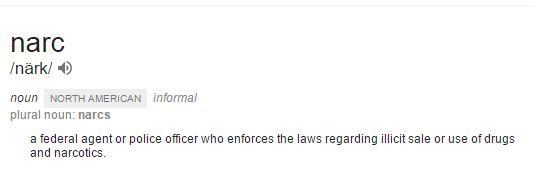
Narcs?

Most people still think of this when they hear the word “narc.”

narcs_dea

narc_def

What I believe about No Contact.

no_contact1

Apparently a few people are under the mistaken impression that I don’t believe in No Contact because they believe I am a “narc hugger.”

I may never have been clear about where I stand about No Contact, so now is the time to clear up any misunderstandings.

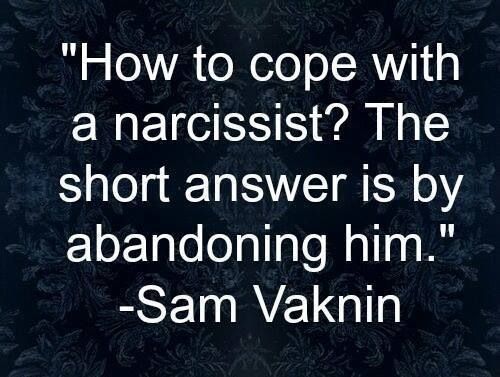
I definitely believe No Contact is the ONLY viable way to “handle” a narcissist. I don’t hate narcissists per se, but I hate what they do. Even if you sympathize with the “lost true self” living deep inside every narcissist, that doesn’t take way from the fact they are extremely dangerous people and will use everything in their power to destroy your reputation, your self confidence, your sanity, and even your life if you allow one to get too close to you. Going No Contact is not an act of hate or retribution; it’s an act of survival for yourself and your children if you have any.

no_contact2

While there are some situations where going completely No Contact may not be possible (for example, if you have children with a narcissist), then go for the next best thing–Very Low Contact. That’s the kind of relationship I have with my ex. I only have dealings with him when I must–when information about our two adult children needs to be communicated. Other than that, I refuse to deal with him at all.

But I think in most situations, No Contact is not only possible, but is necessary for your recovery and happiness. It doesn’t matter if it’s your mother or other close relative. Don’t feel guilty. Hell, they never did when they abused you!

So that’s where I stand on the matter, in case there were ever any doubts.

No Contact is always best.

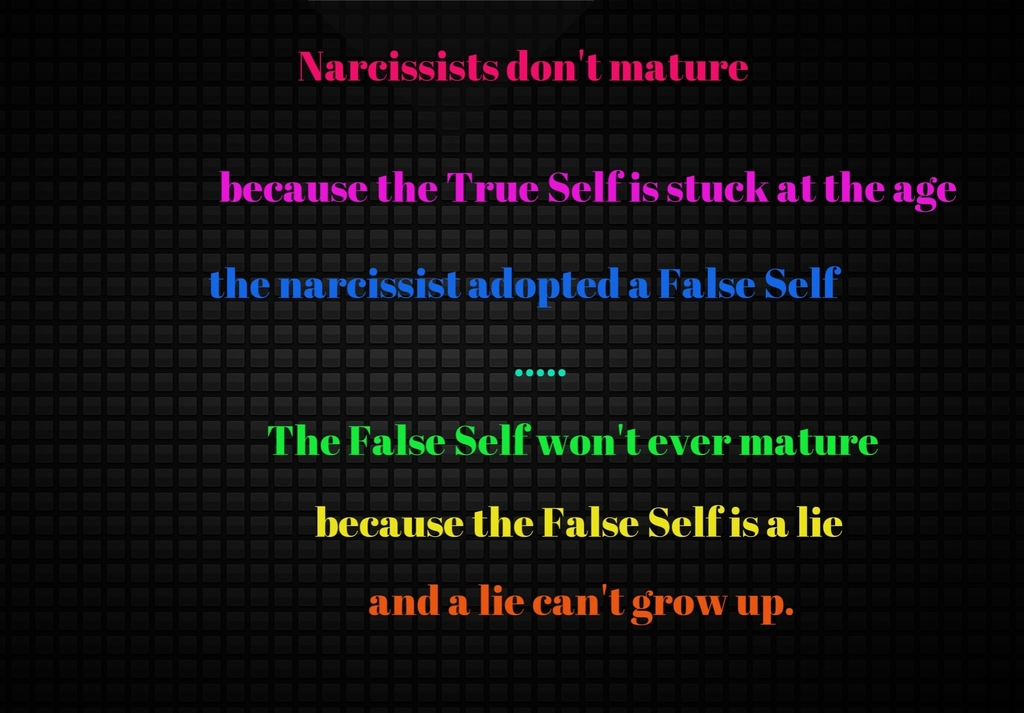
Why narcissists will never grow up.

I just created this meme. Feel free to use it, but please credit me.

narcs_dont_mature
Click to enlarge.

“Splitting” and idealization/devaluation.

splitting1

Splitting–more commonly known as black and white or all or nothing thinking–is a primitive defense mechanism used by both narcissists and borderlines when they observe a threat–that someone doesn’t agree with them or is challenging them in some way, or when they fear abandonment (borderlines) or exposure/loss of supply (narcissists). In narcissism, splitting is usually referred to as idealization/devaluation, but other than the unconscious motive (fear of abandonment for borderlines, fear of losing a source of supply for narcissists), the phenomenon is really the same thing.

Splitting is normal in a very young child. When Mommy is present and hugging the child, Mommy is perceived as “good.” When she denies the child another cookie or she goes to work, the child throws a tantrum, and Mommy is now “bad.” Because the child still doesn’t see himself as a completely separate person from Mommy, when Mommy does something that makes the child unhappy or fearful, the child rejects her and thinks of HER as all-bad. The child is not yet capable of the concept that Mommy is an individual who can be both good and bad at different times and to different degrees depending on the situation.

The fairy tales we read to young children engage them at a level they can understand: fairy tale characters are all-good or all-bad, heroes or villains, with no in between. Only an older child can fully understand that people come in varying shades of grey, and pure black or pure white in one person is exceedingly rare. Realizing that most people are both evil and good at the same time is a sign of maturity and indicates the child has come to see himself as a completely separate person with his or her own identity who can afford to see others as individuals too, rather than one-dimensional cardboard cartoon characters.

Narcissists and borderlines never make that transition. Due to early attachment issues arising from neglect, abuse, or sometimes maternal smothering, they continue to see others as extensions of themselves, not separate people with their own identities, interest and opinions. If someone is an extension of yourself, of course the other person must be seen as “all good.” If the other person fails to provide adequate supply (for the narcissist) or disagrees with them or has differing opinions, they are perceived as a threat and must be rejected, devalued, and demonized as “other.” The only way a narcissist or borderline can see another person as a separate entity is when they have become “other” and are demonized and seen as “all bad.”

splitting

Splitting is common in today’s political landscape. Candidate A believes in health care reform, the legalization of marijuana, the cessation of the outsourcing of jobs, raising taxes on the wealthy–and that a woman has the right to choose whether or not to terminate a pregnancy. Candidate B believes in health care reform, the legalization of marijuana, the cessation of outsourcing of jobs, raising taxes on the wealthy–and that abortion should be outlawed. Candidates A and B, rather than focusing on what they have in common and using that to help improve people’s lives, instead go on smear campaigns against each other focusing on the only thing they don’t agree on: abortion. Candidate A accuses Candidate B of being a throwback to the “unenlightened” 1950s, while Candidate B accuses Candidate A of wanting to legalize murder. Neither acknowledges the many things they agree on–all either can see is that the other is a “murderer” or a “throwback troglodyte.” (Notice too how the accusing labels have become exaggerated and more abusive). That many politicians are narcissistic by nature makes splitting come second nature to most of them. Unfortunately, splitting has become standard in political campaigning and is intended to garner more votes (narcissistic supply) for the accuser while taking them away from the opposing party.

Robin and Tim are madly in love with each other. Robin idealizes Tim–she thinks he is the most perfect man she ever met, and she can’t imagine a life without him. He is the most handsome, smart, funny, sexy, and interesting man in the world, and she can’t believe her luck in having met him. Recently they have started talking about getting engaged. Tim thinks Robin’s wild mood swings are rather charming–but he hasn’t been the target of them yet.

On Tim’s birthday, Robin cooks him a lavish dinner and has a bottle of champagne ready to pop open and enjoy. He is supposed to be home by seven. Eight o’clock comes, and he isn’t home yet. At eight-fifteen, Tim calls and says he got held up. He is in the door by nine, apologizing profusely about his lateness–he was called into an emergency meeting by his boss and couldn’t get out of it. Rather than accepting his apology at face value and proceed to have a nice dinner together, Robin goes on a rampage. She accuses Tim of having a lover and never having loved her. The champagne bottle gets smashed against the wall and the dinner thrown in the trash. After fighting for hours, Robin tells Tim to leave and that she never wants to see him again and that he’d make a terrible husband to any woman who would have him anyway.

In the course of two hours, Robin has turned Tim, a normal man who really did love her but couldn’t get out of a meeting, from “the most perfect man in the world” into an unfeeling monster who is cheating on her and would “make any woman miserable.” Because he disappointed her and she couldn’t handle it or see him as a separate person with his own life and his own needs, she must demonize him and make wild accusations against him, accusing him of doing things he never did and saying things he never said. She has turned the good into the evil, and rejected Tim because he is “all bad” now. Both the “angelic” Tim and the “evil” Tim are creations of Robin’s all-or-nothing, black or white, thinking. Both are fiction.

Splitting is really a kind of blindness–the failure to be able to see any shades of grey in an individual, situation, religion, ideology, belief system, or really, anything at all. It destroys relationships, creates hate and discord, kills community spirit, leads to war and killing, and ruins lives.

2015 is already half over!

time

Time really does seem to fly by faster the older you get. It seems like this year just started but according to my WordPress clock (it’s 4 hours off and I don’t know how to fix it) it’s already July 1, which means we are six months into 2015. In six more months it will be 2016. Where did a whole half a year go?

5 reasons why you should never tell a narcissist they’re a narcissist.

narcissus

In my dealings with narcissists, it’s sometimes been tempting to tell them to their face that they’re narcissists, thinking maybe it could be the wake up call they need. It’s a nice fantasy to think they might take a look at their obnoxious, abusive, insufferable selves and try to make some changes, but unfortunately that’s just a fantasy. It won’t work, because narcissists cannot feel remorse for their actions or empathy for hurting you. In fact, they may take pleasure from it.

The following reactions are far more likely if you “out” a narcissist to their face:

1. They might rage. Or give you the silent treatment. Or laugh at you. Or deny it. Or abuse you. Or call you names. Or tell you you’re crazy or deluded. Narcissists hate the truth, and if they know you have their number, they feel threatened and will attack like a cornered rattlesnake. It’s in their nature.

2. It might give them twisted narcissistic supply. Some narcissists may actually take a perverse pride in being called narcissistic. Rather than making them feel shame and remorse, telling a narcissist they’re a narcissist may flatter them and inflate their ego even more, which could lead to them becoming even more narcissistic and abusive than they already are.

3. They might project it back onto you. This is surprisingly common. Projection (attributing their own bad behaviors to their victims) is one of the more common red flags of a narcissist, so if you call a narc a narc, don’t be too surprised if they start telling everyone YOU are the narcissist.

4. They might learn more to hone their weapon. Taking #2 a step further, some bright narcissists may actually decide to learn more about their disorder–but not to learn how to control it or improve the way they treat people, but rather to educate themselves about abusive narcissistic mindgames they haven’t already tried in order to use them against you. I actually know someone this happened to when she called her ex a narcissist. He started reading every book he could get his hands on about NPD and narcissistic abuse, and systematically started using the information to “prove” his girlfriend had NPD and that he was the real victim (see #3).

5. They might not be a narcissist. There is always a possibility (even if small) that the person you think is a narcissist really isn’t. If you’re not a mental health professional qualified to make a diagnosis based on standardized testing and interviews, your own bias, lack of knowledge, or just plain dislike of a person could be influencing your judgment of them. Perhaps they are having a bad day (or a bad life), or suffer from some other disorder that can mimic narcissism. Even non-disordered people can act like narcissists at times. All of us can. So if you’re certain someone is a narcissist, you may be right, but it’s still best to keep that information to yourself–or only tell your close friends.

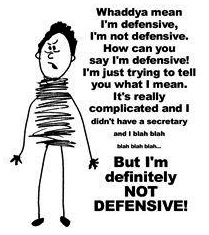
So tired of always feeling on the defensive.

Judge-Less1

Sigh.

Maybe I didn’t know what I was getting into when I started blogging publicly. Someone who used to be active here but disagreed with me about several points is calling me out on their blog again. This person is obviously still reading this blog, because if they weren’t they wouldn’t have known about my “psychopath” post the other day.

This person once again completely misunderstood what I was trying to say (which I ranted about earlier today and will not rehash again) and assumed things about me that are not true. Worse yet, this person has proven to be incredibly judgmental of me, and appears to be using me and this blog as target practice. If they hate this blog so much, why not simply ignore it? Just stop reading it! Wouldn’t that make their life–and mine–easier? But no, things just don’t work that way. People are so quick to judge someone else based on nothing. Some people just like to act like assholes.

But that isn’t really the problem. The problem is me. As a blogger, having critics and haters is inevitable. Even if I was writing about something as benign as cake decorating, someone would have a problem with it. Maybe someone is diabetic and can’t eat sugar, and my posting cake recipes that use sugar could be taken as discrimination against diabetics. If I wrote about flower arranging, someone might think it’s wrong to kill plants for ornamental purposes and attack me for it.

I write about narcissism. Narcissism by nature is a controversial topic. It’s not a pretty topic. It’s a topic that is very triggering to many people, and there are many different theories about it. It’s not an exact science either, so it can’t be backed up with “facts,” only theories. Nothing anyone ever said about narcissism is a fact. All of it is theory, conjecture, and opinion.

I have my own opinions and theories. Sometimes people agree with them and sometimes they don’t. Whenever you have a theory about something, people might misunderstand it or they might disagree with you. When I decided to blog about narcissism, I didn’t realize how emotionally strong I had to be. I didn’t think about the fact there would be those who would judge me based on an opinion, or project bad intentions onto me because they didn’t understand something I was trying to say.

defensiveness-judy-nelson1

All my life I’ve tried too hard to people-please, due to the way I was raised. I wasn’t allowed to have my own thoughts and feelings or to speak up for myself. So when I’m unfairly attacked, I feel very hurt and go on the defensive. In a real life situation, when I’m attacked, I’m likely to clam up and say nothing (but I seethe inside). Online, I feel more comfortable speaking up for myself, but I try not to make waves or be confrontational. But why not? Why do I feel like I have to make peace with everyone? Why do I feel like everyone has to like me? That’s unrealistic and childish. Some people just cannot be pleased. Some people are not going to like you, and it’s pointless trying to get them to. Blogging means you are going to have haters and critics. It means some people will judge you unfairly and make unkind remarks. It takes a bold person to write a blog about dark and controversial subject matter and an even bolder one to not allow negative remarks or blog posts by others to ruin their day.

Being an HSP I take everything to heart. I let destructive criticism bother me too much. My skin is too thin and I brood when someone says something unkind about me or something I wrote. I hate being misunderstood and I hate being judged. Being judged unfairly is very triggering for me. But it happens. It will continue to happen, because that’s what happens when you have a public blog. I need to stop feeling like I’m on the defensive all the time and like I have to apologize for my existence. I am not a bad or stupid person just because someone else says (or implies) I am.

So from now on, as hard as it is for me to do this, I am going to stop reading destructive criticism on other sites. I know it’s out there but I’m just not going to look at it. Because when I do look at it, it inhibits me and turns me back into a fearful child terrified of my mother’s wagging disapproving finger. I know I have far more friends and supporters than enemies and detractors. Unfortunately I focus too much on the detractors. There isn’t much I can do about them. If they have decided to hate, they are going to find something to hate no matter what. So I need to simply ignore them because they don’t matter, and focus on my supporters instead.

It’s just a matter of seeing the glass a three-quarters full instead of one quarter empty. Focusing on and ruminating about the few haters I have is just stupid. Going to their sites to look when I know there are unkind remarks there is just going out of my way to be hurt and that’s incredibly stupid. Why is it so hard to resist doing it though?

I am not defending psychopaths.

Someone has accused me of defending psychopaths because of the question I posted the other day wondering if there might be any “good” psychopaths. In case there’s any question, I think I need to explain a couple of things because I don’t believe that at all.

1. It was simply a random thought that popped into my head. I do not, and never have, thought of ANY psychopaths as good people, and I have never known one.

2. It was a question, not a statement or even an opinion. I just wanted to know what other people thought.

I have strange thoughts at times. Sometimes they even border on crazy. You can take that or leave it. I don’t mind constructive criticism (in fact I welcome it), but I dislike being pigeonholed and blanket judgments being made about me based on one random post. I never once said or even implied that psychopathy is a good thing. I don’t think it is.
Some people really misunderstand my motives. I guess I shouldn’t let that get to me but it does. People are too quick to judge.

Going insane: how I got diagnosed with BPD

going_insane

I thought I should explain how I got diagnosed with BPD. Although my out of control behaviors in 1995-1996 were due to prolonged emotional and mental (and some physical) abuse at the hands of my ex (on top of having been a victim of narcissistic abuse growing up), the focus of this article isn’t on narcissistic abuse or the way my ex behaved, but rather on my reactions and how out of touch with reality I actually became.

My memory of this time is sketchy and fragmented, almost dreamlike, so what I’m about to write may not flow together well. I believe my fuzzy memories of these two years were due to 3 things: (1) intermittent substance abuse, including alcohol; (2) being so out of touch with reality; and (3) I may have blocked out some of these incidents or partially blocked them out so they seem sort of grey when I think about them now, like a dream.

In 1995 my ex’s mother could no longer live alone so she came to live with us. At first things went smoothly, but she had Alzheimers and was deteriorating fast, and soon her care was left entirely to me. At the same time I was the stay at home mom to a 2 and 4 year old. My ex had started drinking a lot during this time, and said it was because he hated his mother (a malignant narcissist herself) and his behavior toward her was very abusive. He justified his abuse by saying she deserved it because of the way she had treated him. My children saw this behavior but in my emotionally weakened state due to his constant gaslighting, projecting and triangulating (he had turned most of our friends against me) as well as isolating me from those who could help me, I began to collude in his abusive behavior toward his mother. I didn’t physically attack her (he did) but in my frustration with things like her wetting the bed I would yell at her whenever he did and sometimes even when he wasn’t there. I also didn’t try to stop him when he used to spank her like a naughty child.

My ex was drinking heavily and smoking a lot of pot, and I joined him. At night, after the kids were asleep, we would often both be drunk and high. Sometimes his friends came over, who were all younger than we were (my ex’s friends were always younger than him). Sometimes things got wild. I was no longer attracted to my ex by this time due to his constant emotional abuse, so when I was drunk I openly flirted with his friends. I was unfaithful too, but so was he (I am definitely not proud of any of this, especially because I had young children at the time).

We fought constantly. One night, drunk, he threatened me with a gun. I ran down the street screaming and went and hid in a grove of trees for hours in the freezing cold. On several occasions I called the police and they would show up to fund us both drunk and didn’t know who to believe so they would leave and tell us to sober up. At this time I had no control over my reactions or my emotions. I acted more immature than my own kids sometimes.

I used to sleep during the day and wasn’t as good a mother as I could have been. I was testy, impatient and neglectful. I loved my kids dearly, but just didn’t have the emotional stamina or energy to deal with them more effectively or lovingly. (I tried to make up for that later).

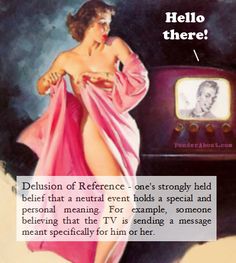
Soon the dissociative episodes began. Sometimes things looked weird. People looked like they weren’t real and they seemed demonic. I began to have delusions of reference. I had the weird sensation of unrelated events or conversations somehow referencing exactly what I was thinking. I felt like I was outside my body a lot, as if I was watching the events of my life unfold instead of being in them. This began to happen when I started distancing myself from my emotions into a “comfortable numbness.” (This is common in PTSD and BPD). But it wasn’t comfortable–it was horrifying. I think I was unconsciously protecting myself from feeling too much emotional pain. The abnormal had become normal, the insane had become sane, the evil had become good. I walked through my days in a sort of fog, but not all the time. Occasionally, when triggered, I would come back into myself and “go off” on my ex and experience a tidal wave of unbelievably painful and intense emotions. Instead of spending my evenings doing quiet things with my family, I spent that time on the computer in chat rooms, talking to men. I imagined I fell in love with one or two of them. My emotional reactions to these online entities I had never met were as intense as if they were actual relationships, but all of it was fantasy. To me it felt real.

I couldn’t sleep at night, but would sleep most of the day away. I didn’t take care of the house and only did the rudimentary necessities for the kids, in between taking care of my ex’s mother’s almost constant needs. I lost patience with both her and the kids easily. We ate cereal and yogurt most nights for dinner because I didn’t have the energy or wherewithal to cook anything.

I started a job after awhile at a hotel. I had a short affair with the disc jockey/maintenance man there. I wasn’t in love with him but I enjoyed the kindness he showed me, that my husband wasn’t giving me. One night he confronted me about it and I confessed everything. He didn’t seem upset but admitted he was having an affair too. Strangely, we did not fight about this. I really didn’t care whether he loved me anymore; I was convinced he hated my guts.

I quit my job on a whim even though we needed the extra income, because my ex had squandered over $100K we got from the sale of his mother’s house. One day I just decided not to go in anymore. I didn’t even bother to call, which normally is out of character for me. I started doing really crazy things. One night after a really bad fight I went into the closet in the master bedroom and sat on the floor crying for what seemed like hours. My ex didn’t seem concerned and went out instead. I don’t know why I was doing this; I felt like I had lost my mind and there was no reason for doing this. I had no idea what I was doing; I was just reacting to my pain like a wounded animal. The episodes of dissociation and delusions of reference became worse. I imagined everything–even voices on TV or songs on the radio–were coded messages that referenced something in my life. This is impossible to explain if you haven’t experienced it but it was very strange and disorienting.
delusions_reference

One day shortly after the closet incident, I left the kids in the house with him and decided to go driving. I had no idea where I was going or what I was doing, but I suddenly thought it would be a good idea to drive at 90 mph (the speed limit was 65 mph). Normally I’m a very cautious driver but during this time I had thrown all caution to the wind. I wasn’t suicidal in the sense of making a conscious effort to kill myself and I didn’t even contemplate suicide, but I was taking huge risks with my life. Miraculously, nothing happened, not even a pullover by police. I returned home feeling exhilarated from my crazy drive, but immediately that feeling disappeared and I was hit with the horror of my reality and started screaming irrationally and throwing things against the wall just to hear them break. I don’t even know what set this tantrum off–probably nothing at all, but I had this overwhelming desire to act out my excruciating emotional pain. I had no control over myself at all. When I thought about my behavior later on, I was horrified. I wasn’t even drinking anymore by now, so I wasn’t drunk. I was just insane.

My ex told me I was crazy. He always did anyway. But I really was crazy. He told me I should commit myself to a mental institution–or he would. To his surprise (and mine) I agreed. In that moment of clarity, I realized how crazy I had become (due to his emotional abuse of me, but that didn’t make me any less crazy). I allowed him to drive me to the mental hospital, which turned out to have an excellent program and engaging activities. I felt relief in entering that hospital and spent the next three months there. My Axis 1 diagnosis was Major Depression and anxiety, and my Axis 2 diagnosis was BPD, as well as substance abuse. I was also diagnosed with PTSD. I received daily therapy–both individual and group, as well as DBT classes–and I was put on Depakote (a mood stabilizer), Prozac (for the depression) and Klonopin (for anxiety). I stabilized during my stay but I wasn’t as committed to using the DBT tools I learned there as I became later on. I remember calling my mother from the hospital and telling her what was wrong with me, and her attitude was like, “so what? You need to be a mother to your children.” She didn’t even know I was in the hospital. So much for maternal support.

I had mixed feelings about returning home. I was overjoyed to see my children, but wasn’t too happy to see my husband at all. I really just wanted to stay in that hospital for the rest of my life. I didn’t want to face reality.

Fortunately, my mental state never got that bad again, but his abuse was to get much worse. He used my descent into the madness of severe BPD and major depression as an excuse to punish me for “having gone batshit insane” when I should have been a better mother and wife to him.

I still have a lot of guilt and shame over the way I neglected my children when they were so young and helpless. I wonder sometimes how much my not being there for them may have damaged them.

When I look back even earlier at my life, I can remember similar incidents of being totally unable to control my emotional reactions to stressors and triggers, with periods of almost robotic numbness and dissociative episodes in between outbursts. It was a pattern I was familiar with, but it reached its pinnacle in 1995-1996. I had a relapse in 1997 and spent a week in the psych ward at the regular hospital, and got the same exact diagnosis as the year before. Over the next several years, while I was still married to my ex, I spent most of my time in a state of emotional numbness, living on “automatic pilot.” It wasn’t until I finally got the POS out of my life that I felt safe enough to begin to let myself feel emotions again–but this time with mindfulness and acceptance instead of allowing my emotions to control me. I still have a long way to go.