My “crazy” dream.

wishes

No, not a dream of the sleeping kind, but I have this crazy pipe dream, a strong but probably a little out-there wish.   It isn’t very realistic on several levels, but my life would be complete if I could…help someone heal from NPD.    If I could be a therapist to an NPD patient and help them find their true self within–if it’s still reachable.  To  watch a hardened, manipulative, cold, almost soulless narc reclaim their emotions and vulnerability; to help them be able to love, really love, someone else–not for the supply they can bring, but for themselves.  To help them come to terms with their own  past, to help them discover why narcissism was the only path they believed was available to them.

Going back to school at my age is a daunting and probably not realistic goal, and even if I were to go get an advanced Psychology degree, NPD is one of the most difficult, if not THE most difficult, disorder to heal anyone of.   Even getting one to cooperate with therapy and stay long enough for any progress to be made  is like making a cat love the water.  Even so,  it’s a powerful desire of mine.  I think about it a lot.  Sometimes I even wonder if ultimately this is what God wants me to do.  Yeah, I know.  Crazy.

Other bloggers and some of my readers have taken issue with the fact I care about narcs who want to change themselves.*  I see them as abuse victims too.  I don’t think they are all hopeless.  Narcissism is a spectrum disorder, and those who aren’t very high on the spectrum haven’t completely jettisoned their humanity.

Not everyone agrees.  I have lost followers and gotten hate because I don’t hate narcs.  I hate the things they DO.  Make no mistake, I don’t believe in enabling or having contact with them.   The best way to help a narc (and of course, yourself),  is to withdraw supply, which means making yourself unavailable.

I’ve been called a narc-hugger.  I’ve actually been called evil because of my unconventional views.  I’ve  been mobbed for having these views.   But I don’t care.   I feel strongly about this and I don’t think I’m evil or crazy.  As someone who had BPD and no longer does, I know from personal experience that healing from a Cluster B disorder is not impossible.  It’s  hard, frustrating, scary, excruciating work, and you’re left with residual PTSD that must be worked through (the basis, in my opinion, of all PD’s), but for many, Cluster B doesn’t have to be a life sentence.

If this dream ever came true, if I could help someone heal from NPD, I think it would change me profoundly.   As for the question of why any of us who were narcissistic abuse victims, didn’t turn to narcissism ourselves, all I can say is (much as I dislike this expression because of how condescending it sounds): “There but for the grace of God go I.”  We were the lucky ones.

Here’s an article written today by a friend of mine, a Christian, who is thinking along the same lines as me.   I agree with her post.

Why Hating a Narc Harms Their Victim: https://dreamsofabetterworldblog.wordpress.com/2016/04/17/why-hating-a-narc-harms-their-victim/

* I don’t think a cure is possible for narcissists who have become malignant/sociopathic or for those on the psychopathy spectrum.

Further Reading:

Paper Tigers: Why I Choose Understanding over Rage


Guest Post #11: Life with Complex PTSD

Alexis Rose has a blog about Complex PTSD (C-PTSD) called A Tribe Untangled.  Her C-PTSD was brought about by a family tragedy (a terrible accident that befell her young daughter, something every loving parent fears with every fiber of their being) and it opened up a Pandora’s box of long repressed years of abuse and torture. Alexis Rose also has written a book, Untangled: A Story of Resilience, Courage and Triumph.
coverimage

From her Book information page:

Recalling her life, the author takes us on a journey of unimaginable abuse with continued explicit threats that eventually led to her being sent overseas on an impossible mission.  She repressed the memories of her past until a family tragedy forced her to face what her life had been. A history of abuse, torture, and threats to maintain her silence or be killed could no longer be denied.

This is the story of facing the truth and risking the consequences of breaking the silence. The author learns to accept the effects of the trauma that echo through her daily life as PTSD.

Through years of self-exploration, she learns to live her life fearlessly, with eyes wide open. Ultimately this book is about resilience; hope for victims who have suffered trauma and for the people who support them.

Alexis is an experienced speaker on the topics of living with courage and resilience in the face of Post-traumatic Stress Disorder. She has also presented multiple interactive workshops titled, Using One’s Innate Creativity (writing and drawing) as a Tool for Healing and Personal Growth.

For more information about Untangled, A Story of Resilience, Courage, and Triumph, to request a book signing, or to ask Alexis to speak to your group or lead a workshop, email alexis@atribeuntangled.com.

Alexis has been kind enough to write a guest post for this blog, which when I read it brought me to tears because I could relate so much to so much of what she wrote.   She is one strong woman.  Here is her wonderful post.  Please follow her blog: https://atribeuntangled.com/

Life with Complex PTSD

strong_quote

I was diagnosed with complex post-traumatic stress disorder about eight years ago, after a family tragedy. My daughter was hit by a van at 30 miles an hour as she was crossing the street on her way to school.

The year following Aria’s accident I was busy with tending to her health, taking her to appointments, trying to work full time, and keep our house hold running as normal as possible. And at the same time, I kept having these experiences that were making me feel crazy. I had worked so hard to keep my life, my family and their world so protected that the instant Aria got hit, my controlled snow globe world came crashing down. In fact when my son and I were talking the day of the accident, he looked at me and innocently said, “things will never be the same again.”  Extremely prophetic words, that at the time myself nor my family had any idea what they would come to mean.

I was becoming anxious. I started losing time, I was called into meetings at work because my performance was terribly erratic. I was physically sick all the time, and kept having these bizarre memories leaving me feeling crazy.  I knew something was seriously wrong with me so I made a call to a psychologist who agreed to see me the next day.

When I started working with my first therapist, I was so anxious to tell her everything all at once so I could just feel better and get back to work. I didn’t understand that I was having flashbacks, or that I was living in a constant state of crisis. I was writing her letters from a dissociated state which made no sense to me when she would read them aloud. I would lock myself in my room for hours for fear that I was going to hurt myself and I didn’t want to be around my family.

My first therapist diagnosed me correctly but neglected to start my therapeutic process by teaching me any kind of safety or distress tolerance tools.  I was out of control, thinking I was losing my mind, feeling like I had failed my family, and spiraling down a very slippery slope. She did the best she could but was way over her head and within nine months of seeing her, I knew intuitively that I had to find another therapist. I have been working with my current therapist for seven years.

When I first started seeing my therapist I was dissociated most of the time. I was in crisis, I was anxious, confused, and convinced I was going crazy. After a couple of sessions, it became apparent to him that we had to get some safety plans in place. Once that was in place we could begin the process of working on and processing my trauma.

I (sort-of) started to come to terms with the idea that my erupting memories were in fact true. I was so overwhelmed by my memories and what we would process during session that I would remember, forget, remember, forget; until I started to turn a corner and forget how to forget. That’s when I found I could really start taking the baby-steps towards health.

Not only was my therapy about processing the memories, I also had to start accepting that there were some pretty intense effects of the trauma and that influenced how I saw and reacted to the world.  I knew I had some pretty deep-rooted trust issues. I also had large, thick, almost impenetrable walls holding back any feeling or emotions that I was willing to let the world see. I also began to understand that because of my trauma I had a pretty significant attachment issues, which for me, has been one of the hardest things to learn and accept. For some reason the attachment issue fed into my very low self-esteem and it’s something I still work on.

I also had to face down how my trauma effected my relationships with my family, friends, parenting style and career. In the midst of dealing and coping with the trauma, there were a lot of AHA moments, when I saw how my behavior and ways of coping with life, had been a direct result of my trauma and not because I was a bad person.

Eight years later and one of the biggest reasons I write is because my PTSD symptoms still have a pretty good choke-hold on me. As with many mental illnesses PTSD can be invisible on the outside. I had always been the master of wearing many masks, and deflecting any conversation away from me, all with a supportive smile for everyone else. But when I couldn’t hide my illness any longer my friends began to ask me, what does it feel like inside. I couldn’t really explain it, so I wrote a poem and shared it with my friends and family. I found that by writing I found a way to share with others and begin to understand what PTSD means for me, and find a way to cope with my fear that I would be plagued by the symptoms forever.

My symptoms include (not limited too) flashbacks, concentration issues, becoming overwhelmed and my brain shutting down, not being able to make choices, anxiety/depression, and sensitive to the triggers that start the whole shebang of symptoms. We use the term, triggers, triggers everywhere. The wind can blow a certain way, or fireworks, or a car back-firing, even the moon can bring on flashbacks.

Unfortunately, my symptoms have left me with the inability to work. I went from having a wonderful career with the fringe benefits that provided me with some comfort for the future and the ability to provide for my family. I’m only able to work about 2 hours a day…on a good day.

It seems as if my symptoms (depending on the time of year) can start a chain reaction, so I needed to learn to work within my deficits. This isn’t easy or comfortable for me and because I’m still pretty new at learning how to work within my symptoms, I can find myself becoming frustrated and angry at my PTSD! Actually most days, if I’m going to be honest I am VERY angry at my PTSD. But then I settle down and think about what I want for my life and try to rest and reset.

The inability to concentrate can be over-whelming for me. I know what I want to do, what I want my brain to do but I simply am unable to do it. Making choice at the grocery store, or a restaurant can be so uncomfortable that I will just simply lose my interest in eating and shut down. Sometimes as night approaches it feels overwhelming because I know that its highly likely that sometime during the night I will have nightmares. Even practicing good sleep hygiene listening to podcasts, all the tricks can’t stop the nightmares sometimes and it gets overwhelming. And sometimes I’m overwhelmed because I’m a survivor of trauma and have PTSD and that’s just the way it is, even though I wish it was different.

Writing gave me the courage I needed to address the pain I was feeling. I would write even when I thought I had nothing to write about. At first, I strictly used it for bilateral stimulation. I would write and send what I wrote off to my therapist. I started to find that I was able to write down what I couldn’t say aloud.  It provided distance from having to use my voice at first, but then I found it actually gave me a voice.

What I hope to convey as I move forward: Try to remember to notice those perfect moments. Celebrate each step on the path towards health, know that it is a long and never linear process, and that it really is just one foot in front of the other, you need to do a lot of resting, a lot of just sitting and metabolizing.  And even though healing can feel like be a lonely process, through a blogging community and other support systems, we realize that we are not alone.

I’ve been hurt, I’ve been threatened, I’ve been abandoned, but I wasn’t going to let the effects of what happened to me keep me from trying to have the life I wanted. I never lose sight of my goals. They are to live with my past, live in the truth, and recognize and relish in the feelings of internal contentment. Some days those goals seem as far away as the furthest star, and other days I can see them just through the clutter, almost there. I still need a lot of therapy to manage my symptoms, and I may need a lot of assistance for the day-to day grind, but I’m motivated to keep moving forward, spurred on by the hope for a better life. A life where I am living, not just surviving.

http://atribeuntangled.com
Happy cat.

Our pets know how to be happy. They never worry about the past or the future; they always are completely in the moment, which I think is the key to happiness.

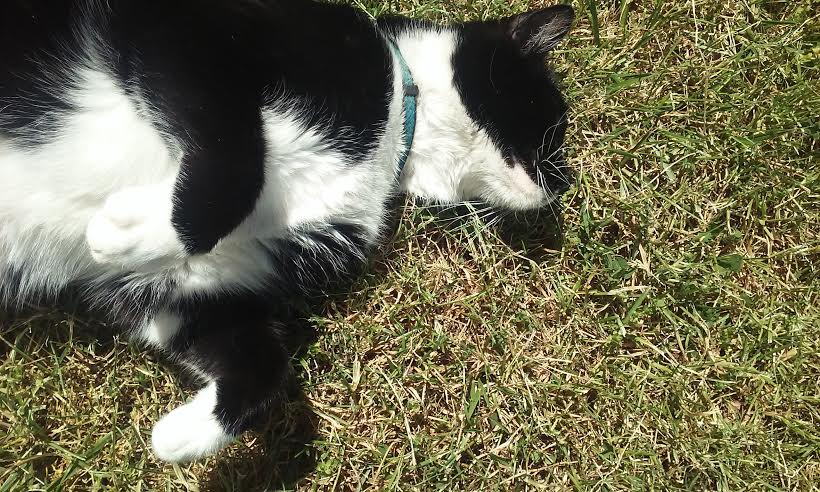
Here’s my tuxedo cat, Sheldon, enjoying the scratchy spring grass. I think if he was physically capable of smiling, he would be doing just that.  You can click on the photos to get a closer look at this goofy little guy.

sheldon_2016_1 sheldon_2016_2

sheldon_2016_3 sheldon_2016_4

sheldon_2016_5 sheldon_2016_6


Accepting limits, part 2

Remember BoxingandBallet’s guest post, “Accepting Limits?” Well, here is her Part 2, written for her own blog, but I will reblog it here too for my readers.
Thanks, BoxingandBallet!

Comments have been disabled; please leave comments under the original post.

Making your inner judge work for you.

heal_meme
Credit: Me (click to enlarge image)

I’ve recently met my Inner Critic, who from now on I’m going to call my Judge, because it’s funnier and seeing the Critic as cartoon-like helps me be able to make him seem  (I think of the Critic as male for some reason) less intimidating and scary.

I mentioned that the Judge, while keeping me trapped on a very thin tightrope, making me afraid of a lot of things, really is trying to protect me. Unfortunately the Judge’s overbearing manner can be abrasive and downright abusive, attempting to keep me trapped in old shaming thinking patterns (which apparently it thinks are best because it’s a big clueless dummy).

You need your Inner Judge, because it keeps you moral and doing the right thing. It also gangs up on you when you’ve let others step on your boundaries or abuse you (“how could you be so stupid to let that person take advantage of you AGAIN?”) The problem is, the voice isn’t very nice and feeds into your already low self-esteem. It makes you feel like a bad person–or a pathetic loser. As a result, you can be afraid to take any action.

For me, although I’ve used all the Four F’s, my primary defense has been and still is Dissociation.  Pete Walker talks about the Four F’s of C-PTSD–Fight (narcissism), Flight (obsessive-compulsiveness and workaholism to escape), Freeze (dissociation; withdrawal from humanity, self-isolation), and Fawn (being codependent).

The trick is to make your Inner Judge work FOR you instead of against you. My therapist had me try to think of “him” as being afraid rather than mean and judgmental. By having compassion for your Judge, you can actually change the way the Judge talks to us.

Changing the Judge’s script.

My Judge used to (and often still does) tell me things like:

1. You are worthless. You never accomplished anything of any value.
2. Who would listen to you? You think you’re some kind of expert? What sort of credentials do you have?
3. You’re over the hill and it’s too late for you. You will die poor, miserable and alone.
4. All your friends and everyone in your age group are making more money than you, own their own homes, can go on vacations, have real careers, etc. What’s wrong with you?
5. All your friends are still married or re-married, but you don’t have anyone and will never find anyone else. You’re too old to find anyone now.
6. You’re so weak and such a pushover.
7. You are too crazy to have a good life. You have too many mental issues.
8. You made bad choices, that’s why your life is like it is.
9. You’re embarrassing to be around and are socially awkward so it’s best if you keep your mouth shut.
10. Your accomplishments aren’t real, they don’t really count, so bragging about them makes you look like a narcissist.

And finally…
11. What is wrong with you?

These are lies, the same lies my abusers used against me as long as I can remember. These lies became internalized and now that I’m NC with my abusers, my Inner Judge still does their dirty flying monkey work. But unlike my abusers, my Judge can be trained to change the unhelpful, judgmental statements to things that can be more helpful, like:

1. You are worthwhile. You have accomplished as much as you have been able to, and that’s enough for right now.
2. Many people enjoy your blog and tell you how much it’s helped them. You have friends who love talking to you and like your insight about things. Just because you don’t have a piece of paper deeming you as an “expert” doesn’t mean you don’t know what you’re talking about.  You have the expertise of life experience, which is more valuable than any degree.
3. You’re never over the hill. Age is just a number. We evolve with age and get wiser. Getting old isn’t bad, but society likes to tell you it is.  even if you remain “alone,” you can still have friends, happiness, and a full life.
4. You might feel envious, but many people are doing worse than you. You have many blessings, and you also shouldn’t compare yourself to others. You should only compare your accomplishments to previous accomplishments, not those of others. We are all different and have different reasons for being here.
5. Being alone doesn’t have to be lonely. What’s so bad about being single? You could still find someone anyway. In the meantime, cultivate your skills, talents, self esteem and friendships. Those count for just as much if not more than “being part of a twosome.”
6. You’re strong and are getting good at setting boundaries that work but are also permeable enough to let others in sometimes.
7. You are not crazy. You have PTSD, which isn’t a mental illness, but a normal reaction to a series of abnormal events. And you’re getting better every day.
8. Yes, you made some bad choices, but who doesn’t? You also made those bad choices because you didn’t have a choice but to make them (you were programmed to always make the choice that kept you from taking any real risks or chances–which usually meant not making a choice at all–and this is what kept you from growing emotionally). This was NOT YOUR FAULT.
9. You are smart and a lot of people like you. You have a right to express what you feel.
10. You should be proud of your accomplishments. Talking about them sometimes isn’t bragging, it’s showing healthy self esteem.
11. What happened to you to make you believe such outrageous lies?   There was something wrong with the people who told you these lies.

I feel the earth move under my feet.

grass_feet

These aren’t my feet. 

Carole King had it right.   Sometimes feeling different textures under your feet can not only feel great, but also is spiritually grounding.

If you’re prone to dissociation and anxiety, like I am (I’m a “Freeze” 4F C-PTSD type–which means my primary defensive reaction is dissociation (the “freeze” subtype) and that keeps me alone and isolated from others (dissociative types tend to be shy hermits).    When dissociated,  sometimes we feel disconnected from our bodies, our emotions, from other people, from the whole world.   Dissociation in its various forms (derealization and depersonalization) can feel so weird, disorienting and surreal (like a bad drug high) that it can throw me into a panic attack if there’s nothing around to ground me or bring me “back to earth.”   The intense anxiety these episodes cause only seems to make the dissociation even worse, which leads to more panic and anxiety. It’s a positive feedback loop, but it’s anything but positive!

I wasn’t exactly looking forward to mowing the grass today, but it was a beautiful day and the grass needed a haircut.   My usual impulse would be to procrastinate–another way I avoid having to make decisions or do something I don’t want.

So I got out there and cranked up the old mower, and soon I was falling into the rhythm and exertion of this necessary task.   After a while, as usually begins to happen, my thoughts slowed and sped up at the same time.   That just means when I get into this state, my mind begins to think quickly and creatively.  These are the times when I usually get an inspiration for a new blog post, the kind I just itch to write.  These have been some of my best posts.   At the same time, the pace of my thoughts is slowed down.  Random snippets of thoughts aren’t racing all over the place, smashing into and bouncing off of each other and causing my head to hurt and my heart to race.  Instead,  I’ll mosy down a creative or philosophical tangent and then think deeply about it, looking at all its facets and hidden crevices.   Then I can draw all kinds of inferences and hidden meanings–both insane and profound–that wouldn’t have been there when I was in my normal hypervigilant, anxious, scattered state, when I can barely think at all.

This slowed down but more profound way of thinking has an awesome grounding effect, but it’s also at these times I become hyper-aware of my body (a type of mindfulness) — what it’s doing and any sensations it’s taking in from the world around it. When mowing, the repetition and exertion of it combine with the sharp, sweet smell of fresh-cut grass, and this stewpot of sensations combine to send me into a Zen-like state.

After mowing, I like to kick off my Crocs (I hate Crocs but they make good mowing and gardening shoes), stretch my feet and toes out  as far as they will go, and wiggle them.   My feet have always been one of the most sensitive parts of my body (This is not an invitation to any foot fetishists lurking around!).  This is good because my feet are what grounds me to the earth and staying grounded has always been one of my biggest problems.  It’s why my most basic “survival skills” are so poor (I live inside my head most of the time).  Focusing on my feet on the ground and the feelings of the different textures under them have a way of kicking dissociation’s butt like a kung fu master.

The freshly cut grass still had its spring softness, but it is dry like alfalfa, which makes it soft and scratchy at the same, and it felt unbelievably good!  Then I stepped onto the front porch and walked around on the smooth, worn cement and felt its coolness and smoothness under my feet, a wonderful contrast to the soft but dry grass.    Then I walked on the grass again. Then on the cement again, which was warmer this time from the sun.      A sense of well being and groundedness came over me, and the residual anxiety I had been feeling before mowing the grass was gone.

Going a step further, you can step on pinecones.  No, I’m not joking.


Mood Swing

Perfect day.

perfect_day

I don’t know what to write about, so I’ll just mention what a perfectly gorgeous day it is.  It’s warmish (60’s right now) and the sun is shining.    That’s a picture of the view outside my front door.  It’s the kind of day you can’t believe anything bad could ever happen in the world.

I have no special plans, but it seems like a good day to take a drive and see where I wind up.  Surprise me!  I love being able to take pictures at a moment’s notice with my Smartphone.  You never know what you might see.  Later I have to mow the lawn and do the laundry, which is piling up.    But I’ll think about that later.

Last night I watched a really good independent movie called “Ever” that you can watch online free of charge.  No big stars in it but the writing and  acting is excellent and it made me cry.  I’d link to it but I can’t find the link now.  If you can find it it’s definitely worth a couple hours of your time.   It was on Vimeo.

I have three new guest posts that were emailed to me at the same time, so I’ll pick one to put up tonight or early tomorrow.  I’ll work on that later.  The day is too pretty to waste time indoors.

Meet & Greet! When You Grow Up

Another blogger is hosting a Meet and Greet this weekend. Come share your link or just find new blogs to follow.

Comments have been disabled.

“Take Her Home”: song about homelessness and PTSD by NarCissistic Mary

I’ve posted a number of songs written and recorded by my friend Mary Pranzatelli and her band NarCissistic Mary for this blog before, but I think this one’s my favorite. It’s called “Take Her Home” and is about a homeless veteran woman suffering from PTSD who gets raped and beaten on the streets of LA. Sad lyrics but with an important message and the music sounds great!

In Mary’s own words,

[“Take Her Home” tells the story of] a female Vietnam veteran who served in the Medics in the Navy. She told me she lived on the streets in LA, and that she was raped and violently beaten.
She told me the statistics for homeless in Tent City.

African American women are homeless at a higher rate and I learned at my National Organization for Women PAC meeting that South Jersey social services neglects African American women and most often picks up white homeless women when they have shelter available. I also was told that at Tent City in LA the police sweep away the few personal belongings of these women and the often brutally take them off and incarcerate them often late at night.

Here is the song.

Follow NarCissistic Mary’s Facebook Page:
https://www.facebook.com/NarCissistic-Mary-1109482479067945/?pnref=lhc