Lucky Otters Haven

Ruminations, ramblings, and rants about narcissism and trauma, politics, human nature, religion, pop culture, writing, and almost everything else

Lucky Otters Haven

Prince is dead….what?

I’m in shock.  I just now found out Prince was found dead today.    He died of complications of the flu.    I can’t believe it.  He always seemed like a paragon of good health to me.

There have been way too many great artists passing on way too soon.

RIP Prince.  You will be missed.


Using StumbleUpon to boost your traffic.

stumbleupon_Logo (1)

About a month ago, at the suggestion of another blogger,  I added a Stumble Upon sharing button to this blog.  This blogger said they got a huge upsurge in traffic just from sharing on StumbleUpon.  I didn’t believe it though.  I never thought of SU as being one of the “big” social media sites, but apparently it’s a bigger player than you think.

stumble

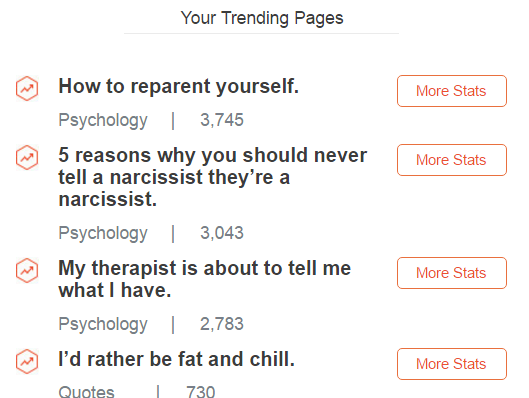
My  “trending pages” from StumbleUpon.


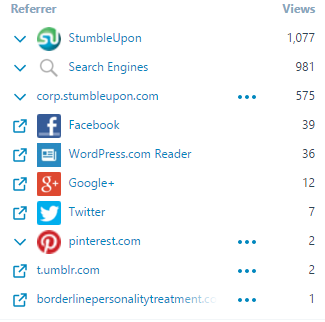
WordPress used to make the SU sharing icon available, but discontinued it for some stupid reason last year.  But it’s possible to make your own custom sharing button, which is what I did.   You can do this by saving the SU icon to your media file and resizing it, and then go to Sharing –> Custom Sharing and following the instructions there.  Now I “stumble” all my posts, as well as sharing to Twitter, Facebook, Tumblr, Google +, and LinkedIn.   And I have to say, my blogger friend was right.  I’m actually getting the most activity from StumbleUpon.  It’s actually trumping Facebook and Twitter for views.   Don’t believe me?  Here are my “referrer” stats from today:


stumble2


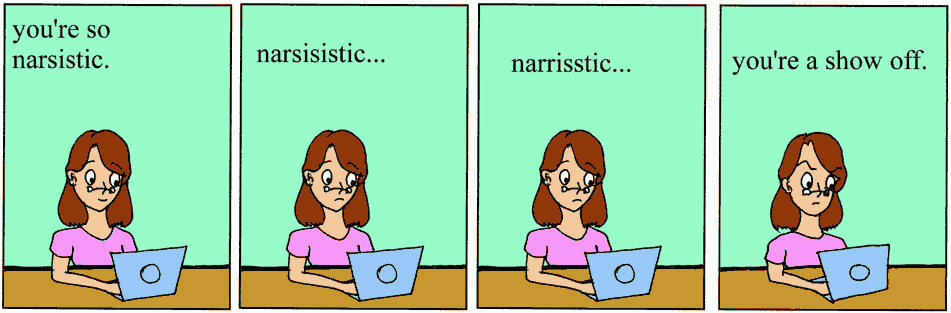
Show-off.

Image

showoff

NPD “alter” in a DID patient.

dissociative_identity_disorder

I have to admit I know next to nothing about this, but I found this fascinating and wonder if anyone else ever heard of anything like it or knows anything about it. Someone who comments on this blog described a woman they know who has Dissociative Identity Disorder (DID). Like C-PTSD and the personality disorders, DID is caused by abuse during childhood. If you’re not familiar with DID, it’s one of the Dissociative disorders. It used to be known as Multiple Personality Disorder (MPD). DID is when a person has one or more “alters” in addition to their base personality, and switches from one alter to another, usually in response to a trigger. The core self usually has amnesia for the the time spent as an alter (many people with DID present because of frequent “blackouts”–gaps in memory where the person can’t remember anything they did as an alter), but there may be some awareness among the various alters of each other’s existence.  Each alter may have their own name, set of interests, likes and dislikes, etc.  They may even have opinions about the other alters as if they were actual people. Adopting different alters is how the DID person copes with trauma-related stress. DID usually first presents during childhood.  It’s a fascinating disorder in its own right.

Like almost everyone with DID, the woman this commenter described had been horrifically abused. One of her alters had Narcissistic Personality Disorder, maybe more than one. I don’t know how many alters the woman had, and I don’t know whether or not she was NPD at her core (usually the core personality is a rather passive and victimized character, and I would think that adopting NPD as a dominant coping mechanism would negate the “need” to develop DID). I found it fascinating that one of her alters had NPD and she was able to switch it off whenever she left that alter. The human mind is an amazing and mysterious thing.

What I really think about having children.

babies

When I was in my twenties, I used to dream about having a big family–four children to be specific. Raised as an only child, and having friends who came from big families that seemed a lot happier than mine, I foolishly thought that if only I had siblings, my childhood would have been happier (in actuality, it probably would have made things even worse!)  Entering my late teens, unlike most of my peers, I didn’t have any real career goals or ambitions. My only real desire was to marry and have a bumper crop of babies. This wasn’t exactly fashionable in the late 1970s and early 1980s, when my desire for domestic bliss was at its most intense. Back then, if you were a woman who preferred starting a family over having a career, you were seen as some kind of throwback to the 1950s.

In retrospect, I understand why my desire to have a family–preferably a large one–was so strong. I never felt like my family was a “real” family. Because of the toxic family dynamics that made me feel like an outsider in my own home, I had a strong desire to “make up” for what I perceived to be a non-family, and create the kind of ideal family I wanted to be a part of so badly. But it doesn’t work that way.  Having kids won’t cure a toxic, abusive, lonely childhood.   The number of children you have doesn’t matter; what matters is how able you are as a parent.

Adult children of narcissists seem to come in two flavors: those who never want to have children at all because they don’t want to foist their own issues onto any potential offspring; and those who, like me, want to “make up” for what they didn’t have, who want a childhood “re-do.”

I never had those four children. I didn’t even marry that young. I married at age 27, and didn’t have children until I was in my early 30’s, and then I only wound up having two. In 1999, I became pregnant for a third time, but had an abortion because my then-husband’s abuse was at its peak and we were struggling badly financially too. There was no way he would have accepted another child and I knew in my bones this third child would wind up being abused far worse than either of the previous two were, so abortion was the only choice I felt I had. Sometimes I wonder what that child would have been like and I sometimes have regrets, but I still think I made the right choice. There really wasn’t another choice under the circumstances.

I remember the day I went in to have the abortion, I asked the nurse to show me the ultrasound (I was right at the end of the first trimester–12 weeks–so it was almost too late to end the pregnancy). She said, “are you sure?” I said yes, that seeing it and knowing the sex would bring closure. She turned the screen around toward me. It was a boy. I stared at the image for a few minutes and cried a little. The nurse was very kind and empathetic. She said, “are you sure you still want to go through with it?” I wiped my eyes and said, “yes.”
motherhood

Although my religion opposes abortion I don’t regret my decision, even though I sometimes think about what that little boy might have been like. I know he would have been abused by his father. I also was pretty mentally ill myself at the time (I had just been hospitalized twice not too long before that pregnancy). I highly doubt I could have coped with a new baby, with no support from anyone, not even my husband. It was hard enough for me with the first two. I think that poor baby would have had a miserable childhood.

Over the years, I realized something surprising about myself. I really don’t care all that much for children. Of course I loved my own two kids dearly and would have done anything (and would still do anything) for them, but I wasn’t a very patient mother and I found I really didn’t enjoy too many of the tasks associated with motherhood. I was disappointed to discover how mind-numbingly dull and frustrating much of parenting can be. It can also be extremely triggering for someone who came from an abusive background, but I had no awareness of this.

I realized too late that I’d idealized parenthood, seeing it as if it was a Vaseline-lens commercial, not the sometimes ugly and painful reality it actually is. Maybe if I’d had younger siblings to tend to, I might have had a more realistic view of what motherhood actually entailed, but as I did not, I entered adulthood with a romantic, idealized picture of perfect motherhood and the perfect mother I would become–when in reality, I never had the right emotional tools to be that ideal mother. I do care about children in a general way; I hate hearing about children being abused or neglected and I want what’s best for them, but when it comes to dealing with babies and young children on a personal level, well, I’d rather not.

kids_dog

If I had to do it over again, yes, I’d still choose to have my kids. They’re the best thing that ever happened to me, even though raising them was much more difficult than I’d anticipated. I’d try to be a better mother to them and a lot more patient with them. I’d also set better boundaries. I would have taken them away from their father when they were much younger, instead of remaining in a doomed, toxic, abusive relationship that only proved to be as detrimental to them as to me. I would have made different choices in other ways too. I wouldn’t have allowed my 11 year old daughter to live with her father just so she wouldn’t hate me. I would have been strong enough to say, “Hate me all you want, but you will not live with your father.” I’d also go into parenthood knowing that it would be a job and not a Pampers commercial all the time.

When I was in my twenties, I couldn’t understand why anyone wouldn’t want to have children. To me, it seemed like the most important and exciting thing anyone could do. I remember a friend told me she was thinking of having her tubes tied (she was 24 at the time). I was horrified and begged her not to do it. She didn’t (but not because of anything I said) and several years later had a daughter. Today I don’t think I would have told her not to do it though. I can certainly understand why some people choose to remain child-free. Parenthood is a hard job and it’s definitely not for everyone. Some people just aren’t cut out to be parents and there’s nothing selfish about making the choice not to be a parent. It’s a lot more selfish, in my opinion, to bring a child into the world for selfish, narcissistic reasons. I also get tired of all the baby-worshipping I see on Facebook and everywhere else. Frankly, I’d rather look at pictures of people’s pets than people’s babies. I really don’t know why that is, but I know a lot of people feel the same way. Babies just aren’t that appealing to me anymore. A lot of my peers are becoming grandparents but I have no particular desire for grandchildren. Of course if I have grandchildren, I know I’ll adore them, but the idea of having them isn’t something I care about one way or another.

When I was young, I think I liked the idea of having children more than the reality of it. I was trying to make up for something I lacked in my childhood. That’s never a good reason to have kids. Liking children and enjoying their company is really the only good reason to have them. Any other reasons–extending the family line, appeasing the relatives, duty, pressure from a spouse, wanting a mini-me, wanting a childhood do-over, wanting someone to care for you when you’re old–none of those are good reasons to have children. But I wonder how many of us actually had our children for the “right” reasons. Most of us probably didn’t, and still did the best job we could because we fell in love with our kids when we met them and wanted the best for them, in spite of everything.
What to do the next time you can’t think of what to blog about.

sleepy_snoopy

Take a nap. It works for me about 90% of the time. Usually I wake up with at least one great idea for a blog post.

When I got home from work tonight, I had no idea what to write about. I was tired so I took a nap and now I have two ideas–this post and the one I’m about to write, which will be a lot longer.

Your brain is like a computer. While you sleep, your brain performs maintenance tasks–the biological equivalents of defragmenting and disc clean-up. More space is allotted in your conscious mind for ideas to bubble up from your unconscious mind that were trapped there before and you couldn’t access.

It always surprises me how often I’ll wake up from a nap with some idea I’m just itching to write about, but before I went to sleep it just wasn’t there.

So next time you can’t think of any ideas to write about, try taking a nap. I bet it will work for you too.

Monday Melody #2: Whiter Shade of Pale (Procol Harum)

monday_melody

While watching the video for this week’s Monday Melody, “All the Young Dudes,” Youtube directed me to this song (which in some ways is very similar, at least in sound). I played it of course, and couldn’t get it out of my mind, so I’m posting it as a second entry this week. For me, this song has a story attached to it.

cape_code_sandbars

It’s a song that brings me back to one of my few happy childhood memories. It was the summer of 1967 (the Summer of Love to those of you about a decade or more older than I was). I was about 7. My parents and I were spending a couple of weeks living in a rented house on Cape Cod Bay (East Brewster, Mass.), where every day I’d be able to walk out about a mile onto the sandbars and collect shells and hermit crabs in a plastic bucket.  I wouldn’t return until the tide began to come back in (and it came in so quickly sometimes I had to run back!)   Before outracing the tide I’d set the hermit crabs free.  My 12 year old half-sister, who I idealized as some kind of goddess (she was everything I was not), had joined us for those two weeks (she was my mother’s daughter but she only lived with us for one year in 1971).

At the end of a busy and carefree day on the beach, I remember the two of us sitting out on the screened porch that overlooked the bay, our skin still hot to the touch with sunburn (and in my case, covered with mosquito bites), drinking Coke from tall frosted-plastic tumblers and eating potato chips.  A tinny transistor radio was tuned into the local Top 40 station. The water of the bay gleamed like molten bronze under the setting sun, and a Citronella candle burned on the metal mesh table. Mosquitoes bounced against the rusted screen that separated us from the salty sea air and occasionally fried themselves in the bug zapper that hung from the worn wooden rafters that had turned gray with salt and age. Procol Harum’s “A Whiter Shade of Pale” emanated from the tinny radio. I was in heaven. To this day, whenever I hear this song, I’m taken back to that long ago summer. What a different world it was back then.

Monday Melody: All The Young Dudes (David Bowie/Mott the Hoople)

monday_melody

The late David Bowie, who died early this year, was a musical visionary, way ahead of his time musically.  “All The Young Dudes” was recorded by Mott the Hoople and released in 1973 and became a radio hit that year. I can’t listen to it now without feeling a little sad that Bowie left this earth so soon.

This video includes both versions–Bowie’s original and the hit by Mott the Hoople. Mott the Hoople’s is the one I’m most familiar with.

No, you’re NOT being judged and watched constantly.

Lenora Thompson, who writes a blog for Psychcentral, wrote this post that I’d like to share.    I think most of us who were narcissistic abuse victims are hypervigilant and even paranoid–always looking over our shoulder for the next attack.  We assume everyone is watching and judging us all the time, but they’re not.  We’ve just been programmed to think they are because we were surrounded by narcissists during our formative years who did.


No, You’re *Not* Being Watched and Judged Constantly

3550755709_d8be7ba08b_zWhen you’ve been surrounded by narcissists all your life, naturally you assume everyone thinks like them. Judges you like them. Hey! It’s self-protection. But they don’t, you know.
Holocaust survivor, neurologist and psychiatrist Viktor Frankl is renowned for saying, “An abnormal reaction to an abnormal situation is normal behavior.”

Being constantly watched is abnormal. Being chronically judged for anything and everything is abnormal. Hell, narcissism is abnormal, hence the name of this blog: Narcissism Meets Normalcy.

Unfortunately, abnormalcy breeds abnormalcy. It’s abnormal to be hyper-vigilant, but we developed it for self-preservation. Thus it’s normal…for us.

It’s abnormal to constantly self-criticize. But we learned to self-criticize, to anticipate every possible criticism that might be hurled our way. We learned to practice clairvoyance (thinking with the narcissist’s brain.) It was simply less painful than being blind-sided. Thus it’s normal…for us.

Read the rest of this article here.

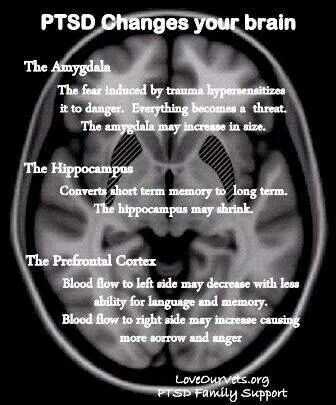
PTSD is a real physical injury.

ptsd_info_1

ptsd_info_2