Why I changed my blog’s description.

I just changed this blog’s header description slightly.  It now says “Confessions of a Recovering Borderline.”  There are two good reasons for this.

  1. This blog has always has been (and probably always will be) confessional in nature.
  2. In my last session, my therapist gave me some more information about my current diagnosis (he said he had to think about it for awhile before he was sure).  The verdict is that I used to have BPD but no longer qualify for that label!   How cool is that! This is a huge, HUGE deal for me.     I wrote more about it in this post, which I decided not to put on this blog.  Blogging (among other things) had a lot to do with this “impossible” achievement.  Now I just have residual PTSD (actually C-PTSD if you’re not a DSM purist, which he is not, thank goodness) and that’s what I’m still working through and imagine I will be for some time.

I wanted to keep BPD somewhere in the blog’s header but don’t want to misrepresent myself by calling myself something  that no longer applies.  So that’s why I changed it a little.   Like me, this blog has been through many changes since I started it in September 2014, and it will keep growing and evolving with me.   I have no plans to ever take it down.


Self-pity and self-compassion: there’s a huge difference!

self-compassion

I read a post yesterday on another blog that I agreed with, except there was one thing that didn’t quite sit right with me. The post said that self-pity is an important part of healing from Complex PTSD.

In his book (which I’m still reading), Complex PTSD: From Surviving to Thriving, Pete Walker says that self-compassion is an important part of healing, and I think this is what the blogger actually meant. But self-compassion isn’t the same thing as self-pity, an activity which I don’t find at all healing and in fact seems to make my problems worse. Of course we have the right to engage in self pity from time to time (and probably can’t help doing so), and no one should deny us the right to do so. But for me, it just doesn’t work. It’s an unpleasant, soul-sucking experience that seems to drive my negative programming even deeper than it already is.

The way I see it, the difference between self pity and self compassion is analogous to the difference between pity and empathy. I think this makes the distinction clearer.

Pity has an element of condescension or even contempt. You pity someone you dislike or look down on. It’s kind of like sympathy but it’s contaminated with judgment and scorn. You feel like you’re “better” than a person you pity. A wealthy banker may “feel sorry” for a homeless person without feeling a shred of empathy. The banker is glad they’re not homeless, and feels as if they’re above that anyway. If someone says “I feel so sorry for you,” or “I pity you,” you’re likely to feel offended and judged, not comforted. I hate being pitied so much I might be tempted to punch you if you do.

Superficially, empathy, compassion, or sympathy may seem like the same thing as pity, but they’re not the same at all. Sympathy means to feel sorry for someone without judgment or condescension, but it’s not quite the same as empathy, because it lacks the sharing of a feeling. It’s a shallower emotion, but it’s still better than pity. Compassion and empathy are interchangeable and both imply feeling “with” another person, or sharing an emotion with them. It’s giving your friend a heartfelt hug after a breakup, or laughing or crying with them when they’re happy or sad. It’s giving a homeless person your own sweater because you hate to see them shivering in the cold. There’s no condescension or judgment. When someone empathizes with you, they say, “I understand” or “that really must have hurt.” Doesn’t that feel a whole lot different than someone telling you, “I feel sorry for you.”

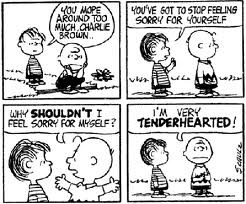
charlie_brown_tenderhearted

Self-pity is part of our toxic programming. It’s driven by shame. Self pity is when you sit around and think about how much your life sucks and how much YOU suck. There’s no self-nurturing or comfort in self pity, no self love, only self-hatred and shame. Self-pity enforces the terrible things we’ve already come to believe about ourselves. If we’ve been told time and again how stupid, bad, clumsy, ugly, or what a loser we are by our narcissists, eventually those voices become internalized and we develop a toxic inner voice called an Inner Critic. When you’re stuck in self pity, that’s your Inner Critic demeaning you and repeating to you the same lies about yourself your narcissists already drummed into you. You learn to abuse yourself, and self-pity is just self-abuse. When you say, “I suck” or “I’m a loser” or “nothing ever goes right for me,” you’re reinforcing the toxic programming and acting as a flying monkey against yourself.

Unfortunately, for those of us who suffered from narcissistic abuse, it’s common to wallow in self pity. It’s an all too familiar state of mind, but it isn’t the real you. The things we tell ourselves when we’re stuck in self pity are lies. When I get stuck in self pity, I feel just horrible. I just want to die. I usually wind up feeling resentful and angry at the world, but also ashamed of myself for being such a helpless victim and pathetic loser. I’m consumed with shame and guilt, which leads to depression. I also can’t release the negative emotion when I’m in self pity mode. I get stuck there and it drags me down and saps from me any energy or joy. I’ve had hangovers that felt more pleasant than a bout of toxic self-pity.

self-pity

You can replace self pity with something much better that also feels a heck of a lot nicer: self-compassion. Self-compassion means acknowledging that you are a human being worthy of love, happiness and the good things in life, while empathizing with your inner child’s hurt over not having gotten those things. You give your inner child permission to feel sad or to grieve and agree with them how unfair it is that she/he got cheated or was abused. This may seem like self pity, but it’s not, because the element of judgment and shame isn’t there. You’re not beating yourself up over how terrible you think you are; you’re telling yourself you’re good and deserve better and allowing yourself to grieve. Instead of covering up your inner child with a paper bag, you’re offering her a hug.

It helps me to actually visualize my inner child. I have her talk to me and tell me what she needs and wants. I don’t judge her or try to shut her up; I just listen. If she feels sad, I tell her those feelings are valid and let her feel sad. If she feels mad, I let her express the anger (but at the same time reassure her she won’t be able to hurt anyone or anything because I won’t let her). I find that by non-judgmentally listening to what she wants and needs or how she feels, I’m eventually able to release any negative emotions and I don’t get stuck. By giving myself permission to feel without self-judgment or self-shaming, sometimes I wind up being able to cry, and as weird as it sounds, that always comes as such a relief. When I’m stuck in self pity, these healing tears never come, because the shame that’s been programmed into me won’t allow me to release them. My programming tells me the massive lie that crying is shameful and weak, when in actuality it’s sometimes the most healing thing you can do. Your Inner Critic is a narcissist who doesn’t want you to heal and that’s where all that awful self pity comes from.

Viral post shows why early attachment is so important.

A few weeks ago, a Facebook post written by a new mother, Dayna Mager, went viral. I’m reposting it not only because I found it so touching, but also because the message it conveys is so important.

A baby will NOT become spoiled if you what this mother did. In fact, quite the opposite. A child who is mirrored this way will grow up self-confident and able to empathize with others without losing themselves in the process. Infants abandoned in orphanages and never interacted with (even though all their physical needs are met) will develop severe attachment disorders which could lead to complex PTSD or worse, personality disorders like Narcissistic or Antisocial Personality Disorder. It’s why so many of the children adopted from places like Russia, Africa, and Eastern Europe have had so many problems adjusting to their new families or developing healthy attachments to anyone else. It may be too late for some of them, because the “critical period” during infancy when they should have been closely bonded with their mothers or other caregivers was missed.

The part I have bolded in the post shattered me as I read it.

Here is Dayna’s post and the accompanying photo.

dayna_mager_photo

This was from several weeks back, yes, I climbed in the crib in hopes to soothe my screaming, teething, blushed faced, and tear soaked little girl. My husband came home to this, and I am re-posting because this captures the essence of my heart, and my “why…” There I was in the heat of this exhausting, beautiful thing we call parenthood, and I remembered a promise I made to her.

One of the first times Matt and I left Luella, was to a worship concert. At that conference, a missionary shared his story, and it shook me to the core. A moment that would forever be burned in my fragile, hormone raging, new mommy heart that had already become 100xs more fragile after meeting her.

That missionary was in an orphanage in Uganda, and he has been in many before, but this one was different. He walked into a nursery with over 100 filled cribs with babes. He listened in amazement and wonder as the only sound he could hear was silence. A sound that is beyond rare in ANY nursery, let alone a nursery where over 100 new babes laid. He turned to his host and asked her why the nursery was silent. Then , her response to him is something I will never, ever forget. EVER. This was my “why” moment.

She looked at him and said, “After about a week of them being here, and crying out for countless hours, they eventually stop when they realize no one is coming for them…”

…They stop crying when they realize no one is coming for them. Not in 10 minutes, not in 4 hours, and maybe, perhaps, not ever…

Broke.

I broke. I literally could have picked up pieces of my heart scattered about the auditorium floor. But instead, it stirred in me a longing, a hunger.. A promise in my spirit.

We came home, and that night as Luella rested her tiny little 10lb body against mine and we rocked, I made a promise to her. A promise that I would always come to her.

Always.

At 2:00am when pitiful desperate squeals come through a baby monitor, I will come to her.

Her first hurt, her first heartbreak, we will come to her. We will be there to hold her, to let her feel, to make decisions on her own, and we will be there. We will show her through our tears and frustrations at times, that it is okay to cry, and it’s ok to feel. That we will always be a safe place, and we will always come to her.

Related to this, here is a post I wrote a few months ago about a very interesting experiment, The Still Face Experiment, which graphically shows the devastating effect lack of mirroring can have on young children.

The Still Face Experiment.

I’d guess that most of us who suffer from C-PTSD, BPD or other trauma/attachment based disorders had mothers who believed it was best to let a baby “cry it out.” Back in the 1950s and 1960s, letting a baby cry it out in their own room was the fashion.

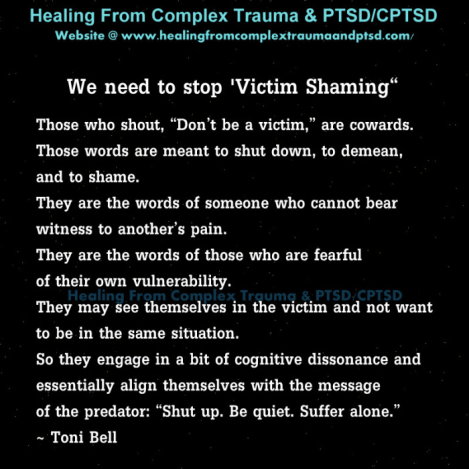
Victim-shaming and blaming.

victim-shaming

Credit: Healing from Complex Trauma and PTSD

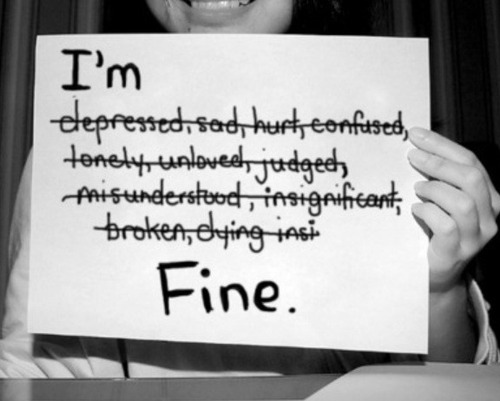
Triggered.

Depression (1)

Some days are better than others. Overall, they are getting better and better, but there are days where I feel like I took three steps back and get trapped in my old toxic emotional thinking patterns. At those times I feel like I’m trapped inside a dark, moldy prison with no one but my own demons to talk to and will never be able to escape. I know that’s not true, and tomorrow will probably be better, but right now, at this moment, I’m in immense emotional pain.  I feel like if I died and went to hell, it wouldn’t much worse than this. I can’t just turn the pain off with a switch, the way the narcissists in my life seemed to expect me to be able to do.

I got triggered. At least I know what the trigger is. Today is my daughter’s birthday, and we were planning to drive up into the mountains and have lunch together. She was supposed to be here around 10 AM. But by eleven AM I still hadn’t heard from her. I began to panic and imagine some kind of catastrophe befell her, the way I always do because the world has always seemed incredibly dangerous to me and no one can be trusted.     You never know when you’re going to get bad news or when the other shoe will drop.  It’s a horrible way to live and I definitely don’t recommend it.   But it’s in my programming.   People think I’m nuts but I can’t help being this way.   It’s hard to change the programming.

Around noon, I finally got hold of her and she hadn’t gotten out of bed yet. She was hung over from a night of partying and she was also depressed. All I could think about was myself and what SHE was doing to ME. I told her I’d been looking forward to this and I’d taken the day off work to spend with her. She told me I was putting her on a guilt trip and she was right–I was. I apologized and told her to try to have a nice day and we’d get together another time. But I still felt triggered  and ornery.  I’d written a nice, positive post this morning about the fun day I was anticipating having with her, and what a great daughter she was, but I couldn’t bear to keep it up, so I removed it.

I spent the rest of the day alternately feeling sorry for myself and being angry. I did nothing but sit on the couch, switching channels mindlessly but not really watching anything, and poking around online but not really paying much attention to what I was looking at. I tried to read a little, but couldn’t focus and would keep reading the same sentence over and over, not comprehending the words. I yelled at my cat for no good reason. I snapped at my housemate. I thought about how much my life and everything in it sucks and how I’m not getting any younger and will probably be dead in the next 25 or 30 years with nothing to show for it.   I thought about how most people my age and even much younger are doing much better than me emotionally, financially, and every other way. They have healthy, real relationships because they were given the emotional tools to have those things.  My programming cut me off from having access to those things.   Of course I was constantly reminded of my inferiority by my unsupportive narcissistic family (I was rejected and labeled “the black sheep” for my failure to attain the “success” in life my very programming denied me) until I cut off almost all contact with them.  I was cruelly told to “sink or swim” but never given any swimming lessons and in fact spent most of my childhood with my head forcefully held under the water. That’s the sort of mindfuck you get when you’re the child of narcissists. You can’t win. You can only lose–and then you’re callously blamed for it. Sometimes you’re even disowned for it. I’ve been treading water–barely–for years, in constant fear of drowning.

The rain stopped and the sun is shining but I have no motivation to even go sit outside on the porch. All I want to do is stew in self pity and self hatred. Why? What good does it do? I hate it. Angry and bitter? You bet. But I refuse to drown in those feelings because I still hold onto hope that I can be a real person someday. I won’t give up on me, even though the people who were supposed to love me unconditionally did.

Finally I got a call from my daughter apologizing to me. She was crying. I felt so terrible. She told me how depressed she was and it sounded a lot like my own depression. She was talking about all the bad choices she’s made. She feels badly because some friends she went to school with are starting families or are getting advanced degrees or have careers and she has none of those things. But she’s just 23.  She blames herself. I could relate. I tried to be empathetic and not think about the way I feel very much in the same boat–only I’m a lot older and don’t have my whole life ahead of me or the options she still does. I assured her that she may be a late bloomer but that she is blooming and to be patient with herself. I may never be a perfect mom, but I will never give up on her or abandon her the way my family did to me, because it’s not something you ever get over. It ruins you. It murders your soul. I won’t let her soul be murdered.

Sorry this post wasn’t more upbeat. But I’m just really depressed today and needed to write about it. It doesn’t help to keep this crap inside.  

How to reparent yourself.

This short post went viral on my other blog, although I really have no idea why because not a whole lot of thought went into it and I wrote it on the fly, but it seemed to resonate, so I’m reblogging it here too. (Chair Girl is the name I give to my inner child in therapy).

Monday Melody: Pretty Pimpin’ (Kurt Vile)

monday_melody

The Monday Melodies are intended to pay homage to songs I like from the past, but I’d like to make an exception this week and include a new song. Lately I’ve been hearing some good and interesting indie rock and pop on a local radio station that doesn’t play the usual Top 40 hits.

Kurt Vile‘s “Pretty Pimpin'” is musical crack. His style is like a cross between Tom Petty (who he names as one of his influences) and ’90’s alternative such as Beck. The video features Kurt, appearing disheveled and either confused, high, or severely dissociated, possibly in a fugue state. The lyrics describe what sounds like a very unpleasant dissociative experience, in which the protagonist looks in the mirror and doesn’t recognize himself. Yet Kurt’s delivery is oddly unemotional and disconnected, as if he’s describing the experience of someone else, which is exactly what dissociation feels like.

I’d like to include this comment from the lyrics page, which I think nails the meaning of the song:

The song’s narrator likely suffers from Depersonalization Disorder, a dissociative mental disorder in which one feels disconnected or estranged from one’s body, thoughts and emotion.

The song uses subtle changes in its repeating verses, progressing through different manifestations of this disorder. As the narrator interacts with himself in the mirror, he begins with the first person pronoun “I” and later moving toward more uses of the third-person “he.”

The upbeat song ends with a gradual fade-out, which you don’t hear much anymore in modern music.

I woke up this morning
Didn’t recognize the man in the mirror
Then I laughed and I said, “Oh silly me, that’s just me”
Then I proceeded to brush some stranger’s teeth
But they were my teeth, and I was weightless
Just quivering like some leaf come in the window of a restroom

I couldn’t tell you what the hell it was supposed to mean
But it was a Monday, no a Tuesday, no Wednesday, Thursday, Friday
Then Saturday came around and I said “Who’s this stupid clown blocking the bathroom sink?”

All he ever wanted was to be someone in life that was just like
All I want is to just have fun
Live my life like a son of a gun
I could be one thousand miles away but still mean what I say

Then I woke up one morning
Didn’t recognize the man in the mirror
Then I laughed and I said, “Oh silly me, that’s just me”
Then I proceeded to not comb some stranger’s hair
Never was my style

But I couldn’t tell you what the hell it was supposed to mean
Because it was a Monday, no a Tuesday, no Wednesday, Thursday, Friday
Then Saturday came around and I said “Who’s this stupid clown blocking the bathroom sink?”
But he was sporting all my clothes
I gotta say I’m pretty pimpin

All he ever wanted was to be a man
But he was always a little too cute to be admitted under “marbles lost”
He was always a thousand miles away while still standing in front of your face

Then he woke up this morning
Didn’t recognize the boy in the mirror
Then laughed and said, “Oh silly me, that’s just me”
Then I proceeded to brush some stranger’s teeth
But they were my teeth, and I was weightless
Just quivering like some leaf come in the window of a restroom

And I couldn’t tell you what the hell it was supposed to mean
Cause it was a Monday, no a Tuesday, no Wednesday, Thursday, Friday
Then Saturday came around and I said, “Who’s this stupid clown blocking the bathroom sink?”
But he was sporting all my clothes
I gotta say pretty pimpin

I woke up this morning, didn’t recognize the boy in the mirror [x6]

Guest Post # 10: Narcissistic Abuse in 12-Step Programs

12_step_cult
Artwork by Danny Jock

Ceetee, who wrote this post, writes an interesting blog about the darker side of 12-step programs, called Quicksand: The Darker Side of 12-Step Programs. Be sure to click on the link and pay a visit.

Ceetee writes about a little-known problem in 12-step programs like Alcoholics Anonymous– some members of these programs adopt a cult-like mentality and “take your inventory” for you, even though one of their slogans is “don’t take my inventory.” I have known people, including family members, who treat AA and other 12-step programs like a religion. You must follow their Commandments (the 12 steps) to the letter, and if you disagree with old-timers’ “assessments” of what your problem is, they tell you you are resisting or are on a “dry drunk.” Not all members are like this, but many of them are, and they can be cause psychological trauma to those who are new in these programs. Others have also written about the religious cult-like atmosphere often present in the meeting rooms.

Don’t get me wrong. AA and other 12-step programs have helped a great many people, and are one of the most effective (and cheapest) ways a person can get clean or sober. They have saved many lives. They also have a spiritual aspect, which adds another dimension that goes deeper than just “curing addiction.” They also tell you that once you’re addicted, you’re always addicted and should refrain from using or drinking, one day at a time. This is excellent advice and works for many people. But the dangers of these programs is that many people with addictive disorders who join them are narcissists, and use their “knowledge” or “experience” to make themselves feel superior to others. They think they know you better than you know yourself and don’t hesitate to lord it over you as if you’re nothing. You are told to “shut up and listen” because they are the “old timers” and have a right to tell you what you’re doing wrong. Since 12 step programs are run by the members themselves, there are really no safeguards against narcissistic abuse within these programs. One must proceed with caution.

Another problem with 12-step programs is that for some people, they seem to become another addiction.    I suppose that’s fine as far as if goes (going to meetings beats drinking or drugging), but too often , recovery stops there, and the member never attempts to address the roots of the problems which caused them to abuse alcohol or drugs in the first place.  From what I can tell, disorders such as NPD and BPD seem to run rampant in these programs, and people with these disorders often do become addicted to substances, in their attempt to fill the emptiness they feel inside.  Getting clean or sober is great, but it’s only treating one symptom of a deeper problem, and their disordered, grandiose, gaslighting, entitled behavior remains the same or even becomes worse.

Here, Ceetee writes of her own experience with certain narcissistic individuals in a 12-step program she joined, whose toxic “help” she had to recover from. It almost destroyed her life, but she has quite a story to tell.

NARCISSISTIC ABUSE IN 12-STEP PROGRAMS

zombie-steps-fix

Nearly twenty-two years ago, I made a mistake that destroyed my life and my family. In the middle of an ongoing battle with my mother that I had no idea how to resolve, I took the approach that perhaps total strangers could be objective and would have a solution. It began with pen-pals; I’ll call the first pen-pal “Marie.” Marie offered hope for a better life; but she said what I must do is “work the Twelve Steps.” And without any drug or alcohol problems, that’s how I became involved in 12-Step programs. It didn’t even occur to me until much later that after I was immersed in ‘the programs,’ the actual problem was never addressed again.

Throughout the years, I knew many good people who participated in programs. However, I also met those who took the slogan “If you want what we’ve got–and are willing to go to any lengths to get it” to mean targeting and destroying others. And while there is plenty of information around the web describing all sorts of crimes members commit, this particular subject is rarely addressed: “rewriting your life history” to include false memories of childhood sexual abuse. I feel it is necessary to address it, as I’ve known many individuals who have had similar experiences–no memories of abuse until they were ‘worked on’ by old-timers in the Programs.

I was ‘worked on’ by three different members–each in a different location. Each had something they wanted from me, and this scam was the most destructive tactic they took to achieve it. They tried to cause me to doubt my own mind and memories; but more destructive, took the approach to other people ‘See how crazy she is–she does not even know what happened in her own life!’

I dismissed many “red flags,” because I didn’t understand what they were about. One example was (as the older generation would have called it) being “too familiar”–a total stranger would act like he/she was your dearest best friend, your confidante. Second, total strangers pushing the attitude that they know more about you and about your life than you yourself know. Third, the attitude that they and only they know ‘the truth’–everyone else and everything else is ‘wrong.’

Each began with a different approach. Individual #1 took the approach that he was an expert on everything related to drugs. Individual #2 basically rewrote the English language to suit her agenda–which is a common thing in 12-Step programs. Individual #3 claimed virtually everything about me were signs and symptoms of repressed trauma. None of these individuals were professionals in any capacity. All I could figure was they ‘read a book’ or ‘saw something on the Internet,’ as much was aligned with what memory experts said decades ago: the ability to create false memories, and to plant seeds of doubt, are almost limitless. Between the three of them, they attempted to get me to believe virtually everybody in my childhood had ‘sexually abused’ me. Individual #1–the first I actually met in person–demanded I give him all my family photographs; he tossed them in a wastebasket, set fire to them, and smugly remarked “You’ve gotta mark ’em all as Perpetrators.”

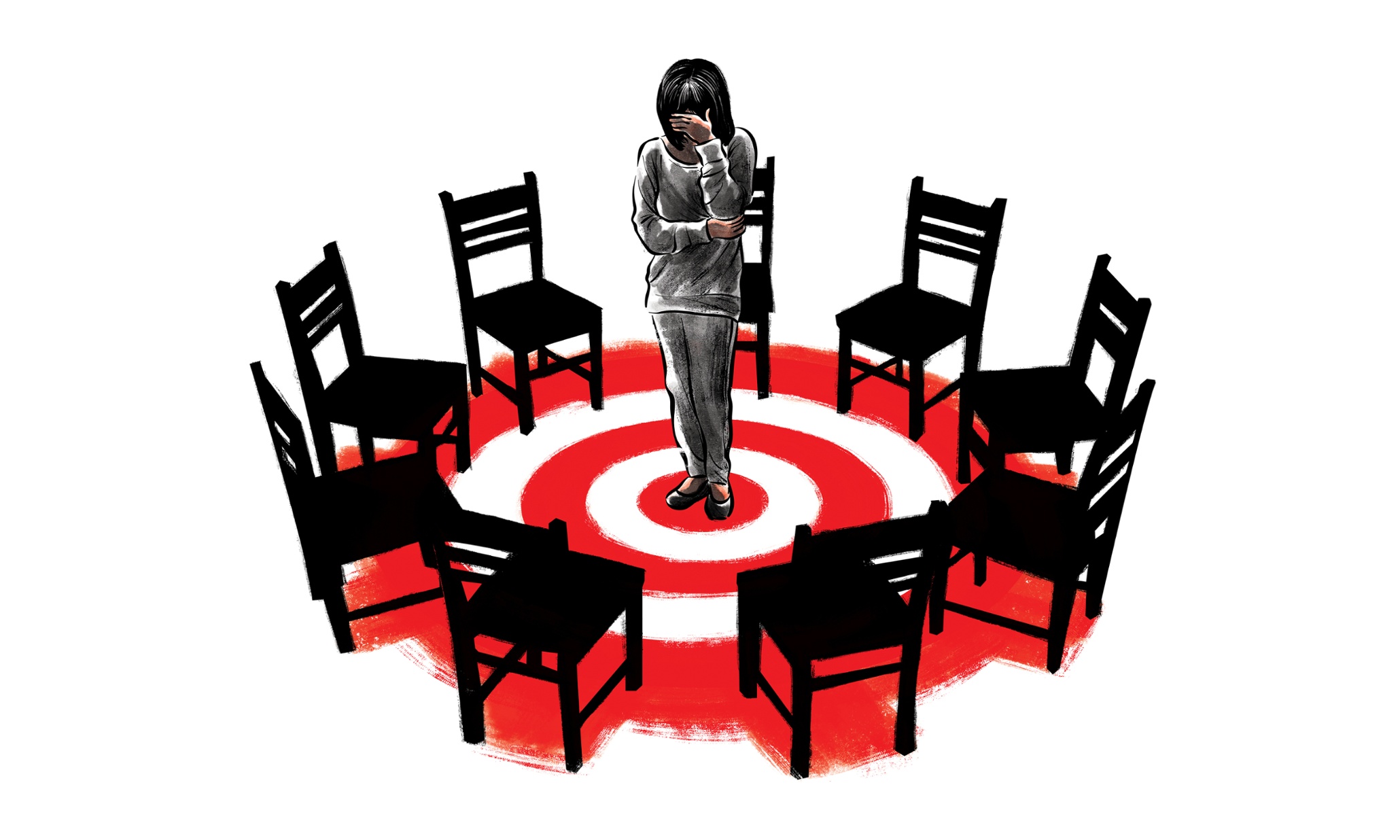
target_cult
Artwork: Chloe Cushman for The Guardian

Another red flag that bears noting: while Marie and most others focused on their programs, the present, and looking toward the future, these three were much different. Their entire focus was on “The Past” and “Abuse.” And yet another red flag: looking for any ‘crack in the armor’ that they could exploit as ‘proof’ that their assessments were correct.

Hopefully it won’t sound too ludicrous taking it all out of context, but some examples:
One, upon learning I’d had a minor medical problem as a small child that required prescription medication, assessed: “Your parents lied to you! They were drugging you so they could Abuse you!”
Noticing I’d run outside to see what the commotion was when police cars arrived at a neighbor’s house: “What is it from Your Past that caused you to Fear the police?” Individual pressed me to search my early childhood to see if I’d known any police officers that may have sexually abused me.

Upon learning I’d never gotten along with my mother, another individual dismissed the fact that it was nothing more than personality conflicts, and claimed I was an incest survivor and had post-traumatic stress disorder because of it. This individual said anything you dislike is sexual abuse, and must be called ‘rape.’

In one instance, I had a minor cold; when this did not require a visit to a doctor, this individual asked, “What is it from Your Past that’s caused you to Fear doctors?” This individual pressed me to think about the doctors I knew in my childhood, and asked if either of my parents were in the profession.

Vertigo attacks from an inner-ear infection; migraines from hypoglycemia; and my habit of watching where I’m going when barefoot so I don’t step on sharp objects were pounced on as proof that I had ‘traumas in the past that I just don’t remember.’ Also, a person does not have personal preferences, likes or dislikes, or objections to anything–they’re all proof of sexual abuse.
Similar to the tactics used when the so-called recovered memory movement was in full swing, I was pressured to consider every thought and dream as a ‘memory,’ any ache or pain to be a ‘body memory,’ etc.

The only incident that actually did occur was blown way out of proportion: when I was four years old, a neighbor of indeterminate adult age exposed himself, and then told me a ‘scare story’ so I wouldn’t tell my parents or brothers what he’d done. The incident was confusing, but it was not ‘traumatic.’ However, one of these members claimed it was a matter of “delayed stress,” that I “only had a cap on it,” and at some point without warning my mind would blow apart. Note I was told this asinine nonsense more than forty years after the incident.

The reason I was vulnerable to this nonsense: I’d never heard of this crap before. For years I knew something was fishy, but didn’t know what to make of it. My first breakthrough came when I met a 12-Step member who was pointing at nearly everyone she’d ever known and accusing them of sexually abusing her. I knew for a fact some of the people she was accusing hadn’t even been in her life when she was growing up.

The second breakthrough: I did some research, and found the ‘drug’ I was told my parents had given me wasn’t even available in the United States when I was a young child. In addition, while the member went by my description of the medication (size, shape, color), the two drugs bore no resemblance to each other.

Fortunately, these breakthroughs occurred before individual #3 intruded into my life against my objections, tried to “convince” me that I was “insane” because of my “past,” and destroyed my reputation and my life because I didn’t fall for it.

This is a widespread problem in 12-Step programs. I’ve known many people who had similar experiences–both male and female in all age groups. And while this is only the tip of the iceberg of what I went through, I’m hoping that exposing this issue can help others avoid these problems. First, if someone you don’t even know gets too familiar, too close, too intrusive, take whatever steps necessary to get that person away from you, your life, your family. Second, if you’re pressured to believe things happened that you don’t remember, keep in mind that this ‘information’ is not coming from within you, yourself, but that it is being placed there by outside sources.

Further Reading:

Narcissists Who Use 12-Step Programs to Further Their Agenda

“First”–Cold War Kids

Where I live, we’re lucky enough to have a good indie rock station that plays both old and new indie and alternative rock. Most of the new stuff isn’t getting radio airplay on the more commercial stations, but that doesn’t mean it doesn’t exist. There’s still good rock music being made but you have to look a little harder for it. Here’s one new song I can’t get enough of. I’m posting the lyric video–is this song a good candidate for my lists of songs about narcissism, or is it just about the end of a normal relationship?

A nice surprise.

I just got this WordPress notification. Thank you!

most_likes