The Narcissist’s Fan Club

Grey-rocking: if you can’t go No Contact.

grey_rock

Lately I’ve been hearing a new term in the narcissistic abuse community: grey rocking.  I don’t know if it’s a new term or not, but I haven’t heard it before.

How to Grey Rock a Narcissist.

It’s always best to go No Contact (or Very Low Contact) with the narcissists in your life, if it’s at all possible.   But sometimes it isn’t.    For example, you may have underage children with your narcissist and shared custody of them.  Or your boss or a coworker may be a narcissist and you’re not willing to leave your job.  Or you may be in a marriage or relationship with one, have no options for leaving right now and are biding your time until you can save enough money to leave.    Or perhaps you’re still living at home with narcissistic parents and don’t have a place to go yet.

In these types of situations, you probably are not able to go completely No Contact (or even VLC in some cases) but you still need a way to keep the narcissist and their manipulations at bay.    Fortunately there is a solution.   It’s called grey-rocking.

Grey rocking means acting like a grey rock: being completely boring and uninteresting.   It means going emotionally No Contact even if you can’t physically do so.   It isn’t the silent treatment though.  Giving a narcissist the silent treatment will send them over the deep end and they may up the ante.  You have to be more sneaky (you have to think almost like the narcissist!)

So when the narcissist is trying to get information from you or is love bombing or trying to hoover you, what you do is talk about something boring, like the weather, or how much your car needs an oil change, or how expensive milk is these days.  Change whatever sensitive or personal subject they bring up to something unrelated, impersonal, and dull.   If you can, try to make a getaway.  You can tell them you have an appointment and can’t stay around to chat.  If the narcissist has been eyeing you as potential prey, grey rocking them will make them lose interest and they will move on to greener pastures.   After a quick and boring exchange, POLITELY make your exit.

If you’re already prey (for example, if you’re living with a narcissist), grey rocking will be trickier and may take longer to work.  Don’t lose patience or give up.  Keep at it and eventually your emotional unavailability will frustrate them to the point they may throw a temper tantrum initially, but you’re not actually being mean or ignoring them so they can’t rage too much without seeming childish and unreasonable (yeah, I know, they already are).  Don’t allow them to push any of your buttons.  Show no emotional reaction to anything they say, no matter how hard this is to do.   If you keep at this, eventually they’ll grow bored, give up and discard YOU as they begin to look for a new source of supply (you have to be prepared for that).

Here are two examples of grey rocking in two different types of exchanges.

In a work/casual situation:

Narcissist Coworker (looking for a juicy tidbit to start a nasty rumor about you using triangulation):   So, how did you and Tim like working together?  Personally I can’t stand him.  I think he’s an idiot in over his head.    I hear he likes you though.  (winks on the word “likes”)

You:   Oh, do you know if it’s supposed to rain tomorrow?  I completely forgot to check the weather forecast this morning.

Narcissist Coworker:  (shrugs) I dunno…So, anyway, Martha was saying…

You:  Hey, listen, it was great talking to you.  (looking at your watch) But I have to run because I’m already late for my appointment.

Narcissist Coworker (perking up): Appointment? What kind of appointment?

You:  (pulling out phone and pretending to look for a number):  It was great chatting but I gotta make sure they hold my appointment.  (Wave cheerfully, turn around and walk away and start talking into the phone as if someone’s on the other end).

****

In a more intimate relationship:

Narcissist Husband:  You know, you really act crazy sometimes.   Even our neighbors noticed the way you acted at that dinner party last night and asked me if you had a “problem.”  I didn’t know what to say.

You:  Oh, really?   Well, listen, I’m on my way out to a meeting so I can’t stay and chat with you about this.

Narcissist Husband: Wait just one minute!  I’m not finished.  Why are you avoiding the issue.  This is very important!

You:   I feel just fine.  Don’t worry about me.   I really have to go to that meeting.  Let’s talk about this later.

Narcissistic Husband (projecting):  There you go, denying you have a problem.   Always thinking it’s me with the problem saying I’m worrying too much.  I don’t worry too much.  I love you.  I’m only trying to help you. You act like you’re afraid of me.

You: I know you love me.  But seriously, I’m required to be there in 15 minutes.  You know how much my boss hates it when anyone is late.  I don’t want to get chewed out.  (you turn to go out the door).

Narcissist Husband: Wait! (running after you).  I’m not finished!

You (getting in the car and waving): See you later!

Narcissist Husband turns around and storms back into the house, slamming the door.

Obviously, the second situation is a lot more tricky and you will have to face him later.  The “meeting” you’re attending is bogus, but it will give you a chance to get out and think about how to deal with him later. (You can also use these escapes to plan your permanent escape!)

When you get home, keep changing the subject or “getting distracted” by other things so he never has a chance to make any headway and eventually the subject will be dropped (saying you’re tired and going to bed is a good distraction–be sure to yawn a lot!).  Talk about things you know bore him, like your book club or the cute shoes your friend wore at lunch.  Always keep them impersonal–for example, don’t mention how much YOU want those cute shoes.

Naturally he will try to upset you or press your buttons. Count to a thousand if you must, but show no emotional reaction (remember, your reactions are his fuel).   Try to remain as calm and cheerful as you can (even if you want to throttle him, which is probably the case)–you don’t want him to suspect anything!   Remind yourself this is only temporary until you find a better solution (a way to leave).     Of course, this scenario will play itself out many times before he gives up on you.  But he isn’t going to stick around too long if you’re not giving him any opportunity to feed off your emotions.  But by the time that happens, you may already be gone.

****

Further Reading:

Going Grey Rock With a Narcissist
Narc chuckles.

Admit it, narcissism can be funny!   I found a few new cartoons I haven’t seen before and thought I’d post ’em here.   Enjoy.    If you find them offensive, get over yourself 😉

narc_cartoon1

'Are you googling your own name again?'

‘Are you googling your own name again?’

narc_cartoon3

'That's enough about me, now let's concentrate on you. What did you think of my performance?'

‘That’s enough about me, now let’s concentrate on you. What did you think of my performance?’

narc_cartoon5

narc_cartoon6

narc_cartoon7


HSPs and empaths, take heed! You cannot heal a narcissist!

sad_angel

In my readings and observations of people in the narc-abuse community, I’ve become aware that Highly Sensitive People (HSPs), empaths in particular, are highly attracted to narcissists. The reverse is also true–narcissists see an empath and smell blood.  As an HSP myself (though not an empath), I have always been drawn to narcissists as friends and romantic partners.   This has gotten me into a world of trouble and almost destroyed me until I finally learned to resist their “charms” and go No Contact whenever possible.

Why Empaths are so attracted to Narcissists.

empaths_narcs

It’s a psychological truism that we tend to be attracted to people similar to the people who raised us.  For those of us who were the most sensitive child in the family and as a result, became the family scapegoat, developed codependent personalities, or even developed a form of Stockholm Syndrome toward our abusers, we continue to carry our legacy or “people pleasing” into adult life and find ourselves drawn toward other narcissistic people, who are very good at promising us the world and vowing to solve all our problems.   But getting involved with a narcissist is the ultimate bait and switch–they make a lot of empty promises to love you unconditionally and never betray or hurt you, but they don’t deliver.  Not even close.  All they care about is feeding off of your love and generosity in order to keep their false self inflated like a balloon toy.

Not only are we fooled into believing the narcissist will be the answer to all our woes and fill our own inner emptiness, HSPs and empaths are also drawn to the “hurt inner child” inside every narcissist.  Most people can’t see the emotional void and deep unhappiness at the core of an NPD; they just see the narcissist as either a likeable charmer or a huge A-hole (depending on their role to the narcissist or stage of the relationship), but empaths see beyond the “false self” to what really lies beneath the carefully constructed facade.    This is why empaths and HSPs were so often scapegoated as children–because they were children who could see the ugly truth and sometimes even blew the whistle on the narcissistic parent–and nothing terrifies a narcissist more than being exposed as living a complete lie.

I’ve talked to quite a few empaths who actually seek out narcissists to love, in spite of having been educated about narcissistic abuse and the very real dangers they pose both spiritually and emotionally.  Empaths who choose to love a narcissist and think “this one is different” really ought to know better.   They look at a narcissist and don’t see a predatory, toxic individual who only seeks to use and abuse for their own gain; instead they see only the “hurt inner child” living in darkness beneath the bright, cheerful facade.

Their observations and feelings are actually not wrong.   Because empaths can see the truth about people, the damaged person they take so much empathy on is real.  Narcissists are indeed hurt, damaged, deeply unhappy people, although some abuse victims prefer to think of them as inhuman devils without souls at all.   Narcissists are definitely human, but they are dangerous, and especially deadly to an empath, because of how much such a person tends to give of themselves and how codependent they can become.

Like moths drawn into the flame.

moth-to-the-flame-3

Narcissists are drawn to empaths because (even though an empath can see beyond the false self, which scares narcissists), they give them everything they want.   Deep inside, what every narcissist really wants is someone to love them unconditionally, and empaths are more than capable of doing that.  They are also deeply envious of the empath’s ability to feel with no shame, even if they deny and hide their own feelings.   Empaths are compassionate, patient, self-denying, always willing to listen without judging, and generous with their time, money, possessions, emotions, and everything else they have to give, both tangible and intangible.  An empath’s love for a narcissist will cause them to stick by them no matter how much abuse gets dumped on them in return.   Empaths are perfect candidates for Stockholm Syndrome.   They will keep giving and giving, while the narcissist gives nothing in return except heartache and pain.

Some empaths may seem masochistic because everyone else can see that the narcissist is sucking the empath’s lifeblood away, turning them into a dried up husk of the whole person they once were, but the empath, like a moth driven to a flame, continues to give and give and give until they have nothing left to give.   It’s not masochism that drives an empath to stay with the narcissist and allow this abuse, though–it’s the deep belief empaths have that their unconditional love alone can heal the narcissist and make them whole again.

It’s a beautiful idea, that unconditional love can heal a narcissist and transform them into loving, authentic human beings.  It would be nice if things really worked that way, but only in fairy tales and movies do such things happen.   The Beast is won over by Beauty’s love and is transformed into a loving prince;  the miserly Scrooge is transformed into a generous and compassionate philanthropist;  The Grinch grows a huge heart out of the hard little stone in his chest when he hears the Whos singing down in Whoville in spite of having all their Christmas presents stolen;  Jerry McGuire changes overnight from a selfish, materialistic jerk into a nice guy.  Usually it’s the love of someone else–often a woman or child–who is the catalyst in getting the narcissist to change their evil ways.  These movies and stories touch our hearts and bring tears to our eyes because we wish life were really that way.

grinch_heart grinch_heart2

It’s tempting, if you’re an empathic type of person, to want to reach that hurt inner child inside your narcissist and through your unconditional love alone, give them the courage to jettison their false self and let that inner child out, and finally learn how to love.   But what’s far more likely to happen is that in spite of your best efforts, the narcissist will not change and will resist or even attack your efforts to transform them.   They will just keep taking from you, for they have no idea how to give of themselves or how to love.  You become drawn deeper into their web of misery and darkness, and eventually have nothing left to give and finally, your soul is destroyed beyond repair.

The only way to help a narcissist.

You cannot help a narcissist by giving them your love.  The best way to help a narcissist is to stop giving them narcissistic supply–in other words, going No Contact.   Only then is there a small chance that without that fuel, they will be forced to confront their own emptiness and pain, which could lead to them seeking professional help.   But don’t count on it.  Most likely, they will just move on to a new source of supply or try to hoover you back in.

I’ve stated many times that I don’t think most narcissists are beyond hope.  I’m one of the few narc-abuse bloggers that holds to that view, and sees narcissists as a different, more dangerous type of abuse victim.   It’s not a very popular view, but it’s mine and I’m not likely to change it.  A few weeks ago, I wrote about Apostle Paul, a malignant narcissist if there ever was one, who was changed by the Holy Spirit into a righteous (if still slightly arrogant) devoted follower of Christ.    I know of NPDs who are in therapy or treatment, or were in therapy and have actually been deemed NPD-free or are at least working hard to change their ways and become more authentic, loving people.  NPDs  are sad people who know their lives are empty and shallow and essentially meaningless, even if they never admit it.  Some even become consciously aware of how exhausting and essentially unfulfilling their dependence on others to feel good about themselves (and what they feel good about isn’t even who they really are) really is.

I’ve always believed that with both self-awareness (knowing one is a narcissist) and willingness to change (disliking what one has become), that healing becomes possible.  But change isn’t something that can magically happen through an empath’s unconditional love.   If it’s going to happen at all, it takes years and years of difficult and grueling therapy by a trained professional who knows exactly what works for this disorder (and what doesn’t)–and because they are trained in this, are not going to get pulled down into oblivion by allowing the narcissist to feed on their heart like a predatory animal.   Healing can also come through an act of God, as it did with Paul.    We can love a narcissist (but from a safe distance!), and we can ask God to help him or her–and maybe that will turn out to be God’s will too.  You never know.  God may have a special mission for them and decide to remove the scales from their eyes.   But please, empaths and HSPs, never try to cure a narcissist yourself through your unconditional love.   It won’t work.  You don’t know how to do it.  Leave it to the professionals and God.

I don’t want to become bitter and full of hate.

No-Lord-No
Credit: lynnmosher.com

I’m dealing with a lot of conflicting emotions right now in the wake of my dad’s passing, and rage is probably the dominant emotion I’m trying to process. Not rage at my dad per se, but rage at every narcissist I ever knew starting from the time I was a small child, making my life hell. For those of you who have read my recent posts, you might have noticed the increase in anger I’ve been expressing toward narcissists in general. My posts this week sound a lot like my early posts on this blog, during the first few months after I went NC with my ex.

Rage, anger, and even hatred can be useful, even necessary, when you’re going No Contact. Your survival is at stake. Your anger gives you the courage to escape and overrides any fear that may keep you in thrall to your narcissist. But beyond that, it begins to eat away at your soul and eventually can turn YOU into a narcissist. I’ve seen that happen so many times and it’s tragic. I’ve written about this phenomenon numerous times on this blog so I won’t do so again.

I bring this up because my writing lately seems to reflect a return to a narc-hating mindset. I don’t find hating narcissists helpful, personally. I find it more helpful (for myself anyway) to think of them as a different kind of victim, a type of victim that other victims have trouble understanding because their behavior is so predatory and sometimes incomprehensible. Thinking of them in this way seems to give them less power over me and makes me less afraid.

I don’t want to become an embittered, angry, hate-filled person. I don’t want hatred to take over my battered but still intact soul. I don’t want narc-hatred to turn me into a narcissist. This doesn’t mean I forgive the narcissists in my life for what they have done to me; but I do want to attempt to understand why they do the things they do. I want to understand how and why they became that way. It’s important for me emotionally to do this; being able to understand or at least try to helps me heal.

I know the rage and hate I feel right now is out of character for me, but all my emotions are in turmoil following my father’s passing. I pray that this too will pass and I can return to understanding narcissists without condoning or enabling. I still pray for their deliverance and always will.

Matthew 5:43-48:

“You have heard that it was said, ‘You shall love your neighbor and hate your enemy.’ But I say to you, Love your enemies and pray for those who persecute you, so that you may be sons of your Father who is in heaven. For he makes his sun rise on the evil and on the good, and sends rain on the just and on the unjust. For if you love those who love you, what reward do you have? Do not even the tax collectors do the same? And if you greet only your brothers, what more are you doing than others? Do not even the Gentiles do the same? …

The Ten Commandments of the Narc Cult family.

angry_god

Narc families are like cults.   They swarm with Cluster Bees (sorry, couldn’t resist!) particularly Narcissists, and there is usually one Leader who is a Malignant Narcissist that rules over the Lesser narcissists and their supporters. There is always one member who serves as a sacrificial lamb who all imperfections can be dumped on. The Narc-family Cult has a set of unwritten Commandments. If you break these Commandments, you will be turned viciously against.  Oh, no one tells you about the Commandments; there is no Holy Book or Bible; it is just assumed that you know them and you had better learn them well and not break any if you want to keep your place in the Cult.

  1.  Thou shalt not “enable” anyone down on their luck.   Everyone should be able to take care of themselves and not expect help.   To help someone means you’re a “codependent” or “enabler” and indicates your own unfitness to remain a Cult member.
  2. Thou shalt not be weak.  Weakness means financial, emotional, physical, or mental vulnerability of any kind.   Weakness also means showing empathy or true (as opposed to fake) kindness and charity. (see above).  You are to pull your self up by your own bootstraps no matter what challenges confront you, not cry or whine, and be a self-made man or woman. Do not expect financial, emotional or any other kind of support because such support is only for weak people.
  3. Thou shalt not ask for help.  Ever.  You are to pick yourself up even if you’re bleeding to death and not expect help from others because only weak people do that.  If you die of your wounds, oh well, you were too weak to deserve to live anyway.  If you do commit the sin of asking for help, expect to be judged, scolded and criticized for daring to be so “entitled” to expect help from others.   Each man out for himself.
  4.  Thou shalt value monetary and material success above everything else.   Be a self made man or woman and have lots of material goodies to show what a strong and successful person you are.   Qualities like empathy, compassion, and kindness are only for the weak.
  5. Thou shalt never become poor.  Becoming impoverished is proof of your weakness and unfitness to live in this world.   Poverty is a heinous sin, brought on by your own unfitness, stupidity, and incompetence and is evidence of your worthlessness.   Go die somewhere, loser.  You brought this on yourself.
  6. Thou shalt keep a perfect “Temple.”   Becoming fat, even a little overweight, or having any physical flaws you do nothing about (even if you are not able to do anything about them) or not dressing fashionably  is a mortal sin punishable by rejection and shunning.   You are not worthy of a place in the Cult if your Temple shows any cracks or imperfections.
  7. Thou shalt not expect support after age 18.   When a Cult member turns 18,  he or she is expected to fully support themselves, expect no help from any Cult member, and not ask questions.  Our responsibility to you ends on your 18th birthday.    Exceptions may be made for the Golden Child.
  8. A proper Cult family must keep a Sacrificial Lamb for ritual abuse.  A Sacrificial Lamb, or Scapegoat is a necessary accessory in any proper Cult family to carry any shame the more worthy family members want to be rid of or deny.   All unsavory or shameful traits can be unloaded and projected onto the Scapegoat, since a worthy Family member must be perfect at all times.  This Scapegoat should be banished when their purpose has been fulfilled or when they are no longer of any use.   There are no restrictions on how badly a Scapegoat can be treated.  They are fair game for any kind of abuse anyone wishes to  inflict on them.  Should the Scapegoat protest this treatment or attempt to blow the whistle, they are to be banished forever.  If they die, even better.  Their souls must be destroyed.
  9.  A proper Cult family must have its Golden Child.  The golden child is a Cult Leader in Training.  Every Cult family must contribute to the causes of the Cult by presenting its best and brightest (and most obedient) member and holding that child to lofty standards and a bright future.  The Golden Child should be trained to project any undesirable traits of their own onto the Scapegoat because they too must be perfect at all times and show no imperfections.
  10. Thou shalt learn the Rituals of the Cult.   Worthy Cult members must learn the ancient and sacred techniques of Gaslighting, Blame-Shifting, Triangulation, Recruitment of Flying Monkeys, Manipulation, Faking Emotion (for personal gain), Silence (for both punishment and control), Devaluation (and Discard), Denial, Smearing, and Character Assassination (to be used against the Scapegoat).  Any Cult member who fails to learn these techniques or refuses to use them is committing a heinous sin and risks demotion to Scapegoat status.

Is narcissism caused by nature or nurture?

narc_child
Credit: davidwolfe.com

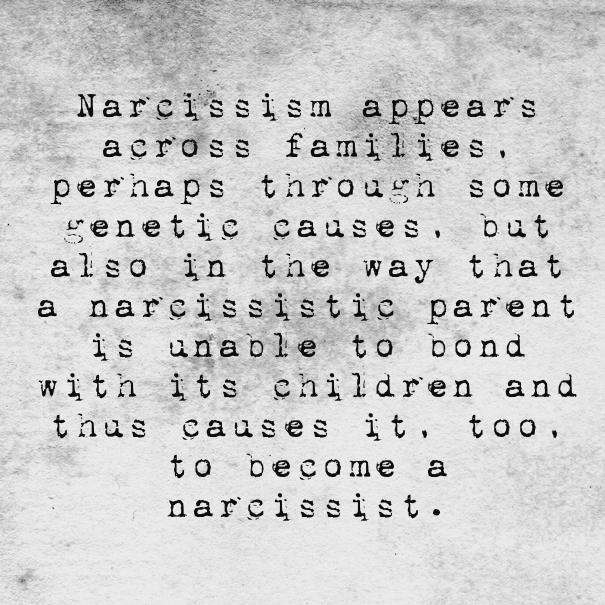
Although the consensus seems to be that narcissism or NPD (clinical narcissism) is a result of abuse or neglect during childhood, there may also be genetic factors involved.   An article from The Narcissistic Life cites several studies and concludes that narcissism results from a combination of nature and nurture, describing it this way:

These factors include biological vulnerability, social interactions with early caregivers, and psychological factors that involve temperament. There are studies that suggest that a gene (or genes) for narcissism can be inherited but that a person also needs the “right” environment for narcissism to be manifested.

What this means is that while a child may be born with a predisposition to becoming a narcissist, they won’t unless environmental factors are also fulfilled.  If the parents do their job well and give the child a secure emotional foundation, they will not develop NPD even if they are predisposed to it.    In this way it works a lot like alcoholism:  alcoholics are probably born predisposed to becoming alcoholic, but if they don’t take their first drink until they are well past adolescence or if the culture they are raised in discourages heavy drinking (or drinking at all), they will not develop alcoholism.

Some babies are born more demanding or needy than others.   These may be “difficult” children who are easily hurt or upset and have trouble learning self-soothing.   Such a temperament doesn’t necessarily indicate the child will become a narcissist, but they are probably more likely to than a calm baby who can soothe themselves, if the parents fail to mirror them properly or don’t attend to their emotional needs.

Most children whose parents were abusive or neglectful do not become narcissists.  They may develop some other problem like C-PTSD or BPD or be prone to depression or anxiety instead.  These are probably children who have a calmer, less sensitive or less demanding temperament than children who grow up to be narcissists.  Personally I think people who develop narcissism were children who were especially sensitive and had no emotional defenses at all so they sent the true self into exile and replaced it with a false one.   No other mental disorder causes a person to completely reject their own vulnerability and authenticity.

geneticNPD

It’s not always abused children who become narcissists.  Some are children who are spoiled by their parents. Spoiling may actually be a form of abuse, because it’s a lie and doesn’t acknowledge the child’s real self.  It still fails to mirror them properly.  The child is constantly told how perfect they are and showered with gifts and praise for being so “perfect.”  As a result, they feel like they must always be perfect which of course is a lie.  They feel entitled to whatever they want because of this belief in how perfect they are, and they never learn how to deal with criticism or setbacks when they get out into the real world.

I also think the nature of the abuse and role in the family plays a big part in whether a child develops narcissism and what type of narcissism they develop.   Golden children, who are essentially spoiled children, are more likely to become narcissists than scapegoats are.   Children who serve as both scapegoats and golden children (common in only children) can also become narcissistic, but I think they’re more likely to become Borderlines.   If a scapegoated child does become a narcissist, it’s more likely they’ll become the covert, fragile type of narcissist than the grandiose, overt type.

Some studies have also shown that narcissists’ brains have less grey matter in the left anterior insula region of the brain, thought by researchers to be involved with both the regulation of emotion and the generation of empathy.   But the jury is out on whether these brain differences are genetic or if the brains of narcissists fail to develop properly due to being raised in a narcissism-inducing (abusive or spoiling) environment.

Further reading:

Does Excess Praise and Spoiling Create Narcissists?


A dicey situation.

dicey_situation_by_johnnycorduroy
“Dicey Situation” by Johnny Corduroy, Deviantart

I always hesitate before posting anything about my N mother, because I know she reads this blog. But then I think about two things: 1. what can she do? and 2. no one ever asked her to read this blog. It’s mine. If you don’t want to get burned, keep your hands off the stove. So here goes.

Yesterday when I talked to my mother about my dad, she said she wants to come visit me in the fall. She cannot afford a hotel room, and I can’t afford to put her up in one. She pretty much invited herself, saying, “Well, I will have to stay at your place.” Immediately I felt my self-protective shackles kick in: Danger! Danger! Boundary violation!

In most families, letting your mom stay with you fore a few days wouldn’t be a problem. But my family isn’t most families.  My mother is very judgmental of me and my lifestyle, which, although I’m satisfied with it, is less than glamorous and I know she would not/does not approve of the way I live (which really isn’t my fault anyway because I don’t have the financial resources to live better).  Even if she says nothing about my mismatched furniture, the sagging, stained couch, the buggy old-fashioned kitchen with its tiny 1970s electric stove, an old summer camp steamer trunk used as a coffee table, the box TV in the living room, the ancient windows that don’t open, and the black mold on one side of the house (which my landlord has yet to do something about), I know she will go back to her extended family and tongues will wag. I know she has devalued me to the rest of the family and puts me down, disapproving of the way I live. She cloaks these criticisms with “concern,” saying things like, “I just don’t know why Lauren always makes such bad choices,” or “it’s so sad the way she lives but she made her own bed.”  Or she talks about how mentally unstable or immature I am. Even though my mother is far from wealthy and even borders on as poor as I am, she has always put on airs of being of a higher social status than she actually is, and to be fair, she does a good job of it. Even if I was of a social class she approved of, our tastes and interests are vastly different. I’m far too “bohemian” for her liking and I’m pretty sure I still would be even if I was rich.

I also know she wouldn’t approve of my housemate, and they would get in each other’s way. The idea of the three of us having to share a roof, even for a few days, gives me the willies.   I wouldn’t be able to tolerate feeling like I have to apologize for the things I do while she is here.   If I tell her no, she can’t come, I know she will go back to the extended family and tell them I’m “hiding something.” She seems to think I still have my ex living with me and am saying nothing about it. This is of course ridiculous, but I know it’s what she’ll tell everyone. She can’t understand why I wouldn’t be thrilled to put her up on my couch for several days and I don’t have the courage to be honest with her. The fact she reads this blog and knows I’ve pegged her as a narcissist (even though I don’t think she is malignant, she is a textbook example of a woman with intractable NPD) doesn’t seem to faze her in the slightest. Being the narcissist she is, she simply is incapable of understanding why I wouldn’t be jumping for joy for the “opportunity” of putting her up on my couch for a few days.

I had no time to prepare for this, so I said weakly, “well, you will have to sleep on the couch then, because my roommate has the other room.” She responded with, “oh, you have a roommate?” As if this is some life choice of mine and isn’t a matter of financial necessity.  It’s also interesting to me that I have never been invited to see her where she lives.  The one time I suggested going to visit her there, she told me my half sister didn’t want me there (they share a townhouse).   I think she was lying, because my half sister barely knows me.  I haven’t seen her since 1986.   I think it’s actually my mother who doesn’t want me to come there, because I would “embarrass” her in front of the family, so she put words in my sister’s mouth.    Even if my sister doesn’t want me there, it was probably my mother who turned her against me.

I’m in a dicey situation, and I’m praying she changes her mind about coming. Just in case she isn’t, I guess I’ll have to start saving enough money between now and then to put her up in a local motel, which I should be able to do given the time frame. Then all I need to do is think of some reason why she can’t stay at my house (repairs? haven’t cleaned it?) She would like a motel better anyway with its pool, sterile rooms, flat screen TV, and a real bed. The fall is still a few months away but it will be hard for me to save the money because I’m trying to save enough money to go see my son in Florida in September. I think she might know this too, but she doesn’t care.

The Toxic Attraction Between an Empath and a Narcissist.

empath_narcissist

I have my own ideas about the complicated dynamics between narcissists and empaths, but I’ll just let this excellent article (written by an empath) speak for itself.  These two apparently opposite types of characters do often seem to be drawn to each other.

The Toxic Attraction Between an Empath and a Narcissist. 
By Alex Miles

We know that “narcissist” has become a bit of a buzzword recently, and some folks are quick to apply it to an ex-lover or family member or friend. While awareness of this concept is healthy, so is remembering that it is, in a mental health context, a serious condition that shouldn’t be applied to someone you’re mad at because they stole your mirror. ~ Eds. 

I am an empath. I discovered I was an empath after I got involved in a very deep and highly destructive relationship with a narcissist.

I am writing this article from the perspective of an empath, however, would love to read the view from the opposite side if there are any narcissists that would like to offer their perception on this.

Through writing about the empath personality type I have connected with many other people who class themselves as an empath and time and again I have heard people tell me how they have also attracted relationships with narcissists. There is a link. So, I decided to explore it further.

This is my theory…

From my own experience and studies on the narcissist personality type, there is always one core trait: A narcissist is wounded.

Something, somewhere along the line, usually stemming from childhood causes a person to feel worthless and unvalued and, due to this, they will constantly and very desperately seek validation.

Here comes the empath, the healer. An empath has the ability to sense and absorb other people’s pain and often takes it on as though it were their own. If an empath is not consciously aware of boundaries and does not understand how to protect themselves, they will very easily and very quickly bond with the narcissist in order to try to fix and repair any damage and attempt to eradicate all their pain.

What the empath fails to realise is that the narcissist is a taker. An energy sucker, a vampire so to speak. They will draw the life and soul out of anyone they come into contact with, given the chance. This is so that they can build up their own reserves and, in doing so, they can use the imbalance to their advantage.

Read the rest of this article here.

Forever an orphan.

orphan_begging

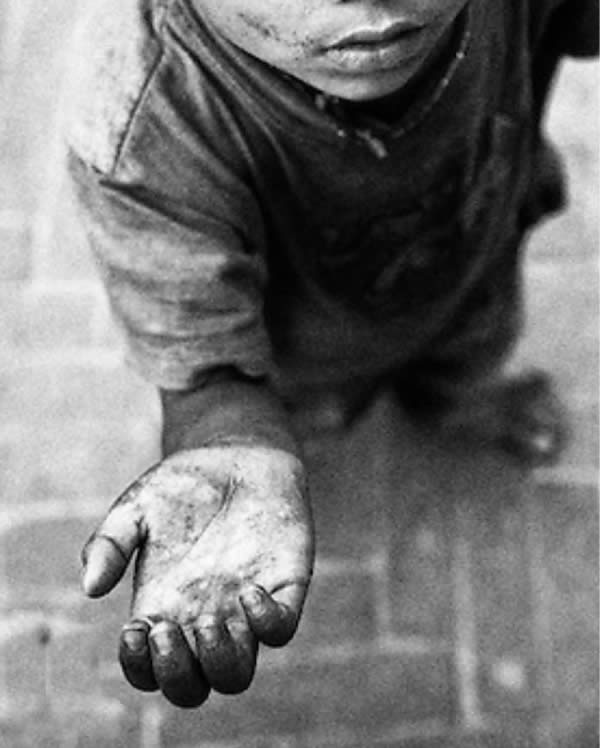
Those of us who were scapegoated and rejected by our own families often feel like orphans in life, forever being buffeted to and fro by the winds of a seemingly heartless world and hanging on to what seems like a brittle tree branch for our lives. We were trained and groomed by our families of origin to continue to be victimized throughout our lives, always treated as though we were less than everyone else, deficient in some way. We were not given the tools other children in our families, or the children of normal, loving families were given to do well in life. We were tossed out “with the wolves” so to speak, and told to “sink or swim.” Unfortunately, too many of us sink–into abject poverty, drug or alcohol addiction, eating disorders, abusive marriages, and mental and physical illness of all types. Everything that others seem to obtain with ease–a wide circle of friends, financial success, material goods like houses, cars or vacations; respect and closeness within their families, a relatively easy climb up the corporate ladder–seems to elude those of us who grew up programmed to believe we were defective.

We may not have literally been orphaned by our parents, but functionally we are no different than orphaned children. Children who lost their parents young to death or abandonment also grow up without any sense of belongingness and no loving, close attachments to anyone. How can you when you are treated like a number at some orphanage (more so in the past or in foreign countries like Romania) or are constantly being sent from one foster home to another, where the foster parents may mean well (but sometimes not) but have too many other charges to take care of to fulfill your need to belong and be loved. Orphans learn not to get too attached to anyone because any attachments they may form are impermanent. Getting close to others hurts too much, so they learn not to get close to anyone, not to trust anyone.

When orphans become adults, they are sent out into the world ill-prepared for adulthood with no emotional or financial help to guide them in their journey. With no one to truly care for them, and no families to turn to in times of need or crisis, they must either sink or swim. Those that swim do so at a cost. They may become successful in life, obtaining the trappings like money or status, but they never really know what love or real self esteem is. They don’t even know who they are. They just know they must survive–at any cost. It’s my belief that orphaned kids who take the swim route become narcissistic–how could they not? Adopting a false self and a fighting mentality is the only way they know to survive in a harsh, uncaring world where they seem to have no place.

tiredandalone

Although narcissistic abuse survivors may have been raised in actual families, we were emotionally and spiritually orphaned due to rejection and emotional abuse. We were compared unfavorably with siblings, other family members, or just about anyone else. We were raised to believe we had no rights. We were punished for having opinions. Our boundaries were constantly being violated; we weren’t even allowed to have boundaries. We were called names, belittled, gaslighted, threatened, and stunted and stifled in every imaginable way. Our efforts to be approved of and small victories were belittled or sabotaged. We were refused financial or emotional help where other children or young adults from normal families (or even our own families) would have received it (my family refused to pay for my college education although they could have afforded it). We were trained to believe we were undeserving of success or love. We developed a strong Inner Critic who continued to live on inside us long after we left our families of origin, continuing the abusive message that we are less.

We become adults who are afraid to take any risks, afraid to speak our minds, afraid to stand up for ourselves, afraid to just be. We feel guilty if we do succeed in something and sabotage ourselves just like our own families sabotaged us. If we were bullied by our families of origin, we develop dismally low self-esteem and internalize the message that we deserve nothing and are nothing. We develop a victim mentality that makes sure the bullying and rejection continues throughout our lives. We develop C-PTSD and are handicapped on almost every level for finding our rightful place in the world. We were programmed by our narcissistic families to be targets for other abusers and narcissists, who smell our vulnerability and our lack of emotional defenses. I can’t tell you how many childhood victims of narcissistic abuse were also bullied in school or even as adults in the workplace, were always passed over for promotions or raises, or married narcissistic spouses who continued the abuse, sometimes taking it to new levels of cruelty. I know because I was one of them.

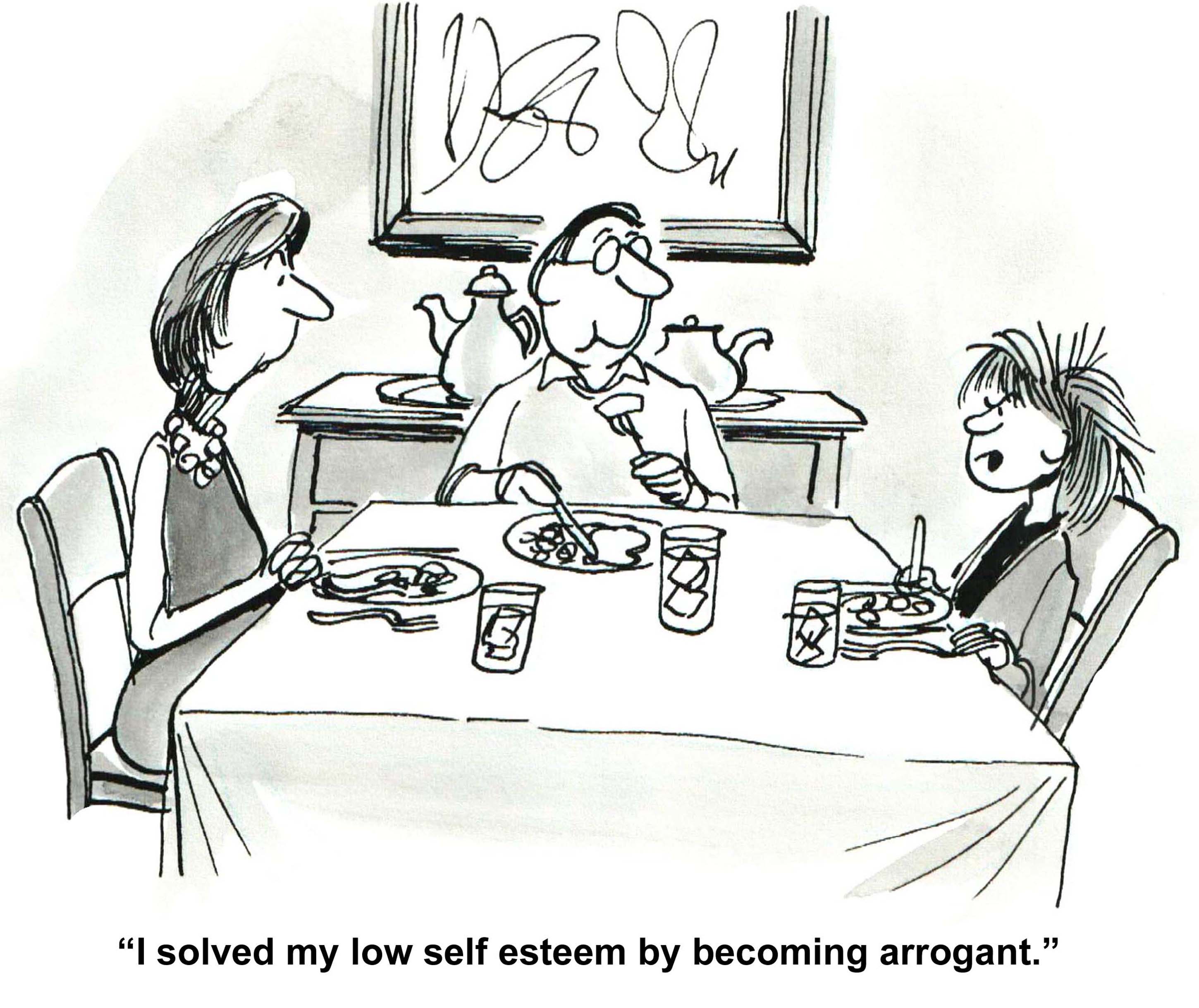
Even if we somehow managed to find some small place in the world, we still feel like we don’t belong. We still feel isolated from the rest of the world, different in a bad way. We feel like we don’t deserve to have anything good. In their desperation, some narc-abuse victims sell their souls and turn to narcissism as a way to cope. They escape the enemy by becoming the enemy. Their attitude is fake it ’til you make it (or just pretend you made it). Their self esteem isn’t real; inside their prison of narcissism they are screaming in agony, but God forbid anyone ever know. They’d destroy you first to avoid being exposed as vulnerable and defenseless as they really feel. They sacrifice their very souls to survive.

Pain_ends

For those of us fortunate enough to have escaped narcissism, there is more hope. Although we may appear to have much less than someone who turned to a narcissistic defense, spiritually we have so much more. We haven’t jettisoned our souls to survive. We may have lost everything else–we may have poor physical or mental health, live in poverty, feel isolated from everyone, have difficulty getting close to others, always seem to have less than others–but spiritually we remained intact. Our quest to reclaim our humanity is a hard journey, filled with pain, but the moments of self-discovery and emotional and spiritual growth are so worth it. In the process of healing from narcissistic abuse, I finally found the family I know will always accept me unconditionally: God’s family. There is always a place at His table, where you will never be judged and always accepted for the person you are, instead of the one you can never be. In God’s family you are never an orphan.

Sometimes something as simple as music helps you get there. Here is a song that helped me (and at least one other narcissistic abuse survivor I can think of) in the early days of starting this blog:

Further reading:
Why Family Scapegoats Become Lifelong Victims
We Were The Lucky Ones
(I wrote this over a year ago, and I’ve changed a lot since then, but I think it still fits)
Adult Poverty and Scapegoathood: A Connection? 
The Reason We Became Adult Victims: What Can Be Done?
It’s All About Image: The Skewed Values of Narcissistic Families