“Some days I just want to crawl into a hole and make myself very small.”

This article embarrasses me now, but I think it’s a great example of how narcissistic I can be sometimes, even online. I just thought I ought to call myself out about this whiney, self-pitying, falsely-humble, yet grandiose post that’s like wearing a neon sign flashing the words “I can’t take criticism! Waaaaahhh!” This is covert narcissism and BPD in a nutshell. Narcissistic injury. We’re always so butthurt over everything.

It’s interesting. At the time I wrote it, someone called me on this post being very narcissistic, and that upset and angered me (of course!) I actually couldn’t see anything wrong with this self-indulgent post and thought the person was being a bully. They were, but that doesn’t mean the article wasn’t narcissistic.

Seeing myself this way is like having glasses after years of being almost blind.
But I’m being careful not to beat myself up either. The past can’t be undone, but you can make your own future.

luckyotter's avatarLucky Otters Haven

internet_fame

DISCLAIMER:
I feel like a disclaimer is needed, though the above photo should be enough of a disclaimer, because it says it all. Someone made a sarcastic remark about how I think I’m a celebrity because of this post, so I let their comment make me set this post to private, because I don’t have a thick skin and am too chicken to come out with a snappy or snarky comeback. I always think other people can get away with doing that, but I won’t be allowed to. It’s because of my past. I was never allowed to speak my mind or have a voice. Now I’ve internalized that and don’t allow myself a voice sometimes. I’m getting better but I’m not out of the woods yet.

In no way do I put myself in the same category as celebrities (who are just people who get wrinkles, have morning breath…

View original post 1,301 more words

How does avoidant PD differ from covert (vulnerable) narcissism?

avoidant_pd_bagoverhead

Covert (vulnerable or fragile) narcissism (cNPD) can, on the surface, look an awful lot like Avoidant Personality Disorder (AvPD–not to be confuse with AsPD!), which I have been diagnosed with, along with BPD.

But appearances are only skin deep.

I found an article on Psychforums (in the Avoidant PD forum) that describes the differences very well. Because covert/vulnerable narcissism is not an officially recognized diagnosis, and is not included in the DSM (yet), covert narcissists are frequently (if not almost always) diagnosed BPD comorbid with AvPD, as I am. Aspergers can also be easily confused with cNPD, and has been by many. But this article focuses on Avoidant PD, not Aspergers.

“Vulnerable narcissism could be misdiagnosed with at least two other distinct DSM personality disorders: Avoidant Personality Disorder (AVPD) and Borderline Personality Disorder (BPD). In the diagnosis of AVPD, there are several criteria that may overlap with vulnerable narcissism. First, avoidant individuals are observed as appearing shy and being fearful of developing close relationships with others. Second, individuals with AVPD may meet criteria for experiencing fears of feeling humiliated, rejected, or embarrassed within individual relationships. Finally, Millon (1996) proposes that the use of fantasy in individuals with AVPD is a major element in the presentation and perpetuation of this disorder. This is striking in the fact that the use of fantasy has long been denoted as primary to the realm of narcissistic pathology.The vulnerable narcissist will likely exhibit significant interpersonal anxiety, avoidance of relationships, and use of fantasy, but this is guided by a core of entitled expectations. That is, vulnerable narcissists may avoid relationships in order to protect themselves from the disappointment and shame over unmet expectations of others, in contrast to fears of social rejection or making a negative social impact typical of AVPD.

Another false positive diagnosis that may occur as a result of misinterpreting vulnerable narcissismis in the diagnosis of BPD. Masterson (1993) forwarded this issue in an elaborate discussion about the potential for misdiagnosis of the closet narcissistic personalitywith BPD. Misdiagnosis can occur because of a clinician’s attention to the overt presentation of the emotional lability in the individual to the exclusion of an understanding of the cognitive and socio-emotional experience that guides the lability. As with social avoidance, the emotional lability of the vulnerable narcissist is influenced by his or her covert entitlement and difficulties managing disappointment and self-esteem threat. In contrast, the emotionally lability of the individual with BPD is a byproduct of unrealistic anaclitic needs (e.g., the need for a strong caretaker to manage his or her fears of being independent).

avoidant personality

Both the AVPD and the vulnerable narcissistic character will likely report difficulties with feeling self-conscious in interpersonal situations, along with the tendency to avoid situations in which they expect to be ridiculed. The difference between AVPD and vulnerable narcissistic characters lies in their expectations for themselves and others. Individuals with AVPD have needs to be liked and accepted by others, but fear they will fail to be acceptable to others. In contrast, vulnerable narcissistic characters need others to respond favorably to them and to admire them regardless of their behaviors, beliefs, skills, or social status, but fear that others will fail to provide them with narcissistic supplies. For vulnerable narcissistic characters, it is not mere concern about being liked or not. Rather, the vulnerable narcissist’s fear is that he or she will not be admired. Furthermore, vulnerable narcissistic individuals experience significant injury and anger in response to perceived slights. Their avoidance of relationships is based upon their fear of not being able to tolerate the disappointment of their unrealistic expectations.

The assessment of entitled expectations and exploitative motivations are important variables that would guide how an individual approaches and experiences relationships, including a therapeutic relationship. Not acknowledging narcissistic entitlement when it is present could lead to important misinterpretations of clients’ experiences that either reinforce their sense of entitlement or lead to unrecognized self-esteem threat in the therapeutic relationship (Gabbard, 1998).”

From “Interpersonal analysis of grandiose and vulnerable narcissism” Dickinson, Kelly A; Pincus, Aaron L

My scarlet letter.

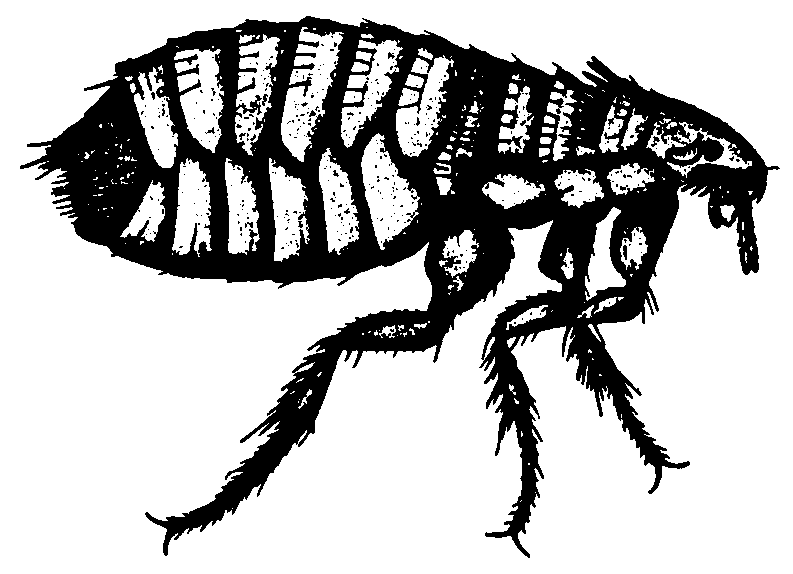
When the “fleas” of narcissism go too far.

flea

Narcissists infect people, just like a disease. They have the uncanny ability of turning people into one of them, if you’re around them long enough. That’s why, whenever it’s possible, No Contact is always the best course of action. You cannot change a narcissist or reform them. What will happen instead is you will start to take on narcissistic behaviors yourself.

Narcissists are body-snatchers and will snatch yours and before you know it, you can become one of them. It may be the only personality disorder that’s contagious. Hanging around one too long is very dangerous to your self esteem, your identity, and even your soul. It’s more dangerous than making your escape, even if you don’t have a dollar to your name.

If you were raised by them, you may have a serious problem. Many (though not all) children of narcissists become narcissists or borderlines themselves. Because narcissistic parents can’t form proper bonds with their children and either use them as supply or scapegoats, children of narcissists more likely than not develop severe attachment disorders in childhood, and attachment disorders can easily become NPD, either covert or overt, somatic or cerebral. If the child is a little luckier, she or he can develop BPD, PTSD and many other disorders that make adult life difficult.

flea_cartoon

Overt/classic/grandiose narcissism (the type that best fits the criteria in the current DSM) develops most often in golden children who were held on a pedestal and could do no wrong, or were terribly spoiled, or it can develop in child who served as the parent’s flying monkey. It can also develop in a scapegoat who wants to prove their narcissistic parents wrong. Overt narcissists are usually extroverts who are good at playing the role of a confident, aggressive leader and many of them become financially and professionally successful. They are good at maintaining their mask for as long as they need to.

Covert/vulnerable narcissism usually develops in a scapegoated child who cloaks their grandiosity in an outer cloak of deference and humility, usually as a way to avoid punishment for acting too arrogant or aggressive while growing up. It can also develop in a child who is sometimes a scapegoat and sometimes a golden child. In a way, they are worse off than an overt narcissist, because they have a double layer of masks (false selves): the grandiose mask that hides the undeveloped, atrophied true self within, and a meek, shy and deferent outer mask that cloaks their grandiosity and sense of entitlement. That’s why a covert narcissist can be easily pushed around or bullied by others, but underneath their seemingly nice, quiet image there is seething envy and anger that isn’t expressed unless they are pushed to the limit and explode in rage. Their rage and envy is also likely to come out in passive-aggressive ways. Yet a covert narcissist is easier to cure because (a) they are far more likely to want help; and (b) their lives are miserable and their brand of narcissism isn’t adaptive in today’s world.

BPD is more common in women and some female covert narcissists may actually be diagnosed with BPD, because the disorders can seem so much alike and women aren’t diagnosed with NPD as often as men are. BPD probably develops most often when there is ambiguous attachment to the mother during early childhood and the child is inconsistently rewarded and punished. They learn early that people and life are unpredictable and no one can be trusted. They fear abandonment because they were never able to tell if their parent would love them or push them away. BPD also is correlated with early sexual abuse.

Fleas of narcissism are deadly because with prolonged exposure, they can cause permanent infestation. If it’s at all possible, cut off any narcissist in your life or avoid them as much as possible. Watch for red flags so you can escape before it’s too late because escaping once they “have” you is far more difficult and can be dangerous.

If you were raised by narcissists, no matter how damaged you are, if you didn’t become a narcissist yourself, consider yourself extremely lucky. There is hope for you to eventually be able to live a normal, happy life. If you’re a non-malignant narcissist, there may still be hope but the road to becoming a normal and happy person is going to be longer and harder.

The honeymoon is over.

lost

I’ve been feeling quite strange the past week. It’s the worst I’ve felt in about a year. It started with feelings of anxiety and panic, racing and morbid thoughts and a feeling of unnamed dread. I’d try to nap and my heart would start racing so I’d give up. DBT skills didn’t work and some of my BPD (or PTSD) behaviors returned–negativistic behavior, feeling offended easily, sulking, fits of anger (not directed at anyone but expressed in imaginary conversations with myself in the car or at home), low frustration tolerance, paranoia. I’ve been less motivated to write. I’ve been neglecting housekeeping and eating right. Getting up in the morning is excruciating.

It was all I could do to make it through work. I was feeling sorry for myself all day and at the same time felt guilty for feeling that way. The anxiety has lessened but it’s been replaced by despair and some kind of deep sadness.

I don’t cry easily, but I started crying a few hours ago and couldn’t stop. It feels good to cry, but the feelings are so painful. I feel unworthy. I feel impotent. I feel angry at my parents for training me to be such a good little victim. I hate my ex. I hate myself. I suck at everything. I can’t relate to people. I hate people. I want to connect but I just can’t. I think people will hate me if I let them get too close. My world is so small and constrained and unsatisfying because of my fear of relating to others and reaching out, and because I never have enough money to do anything or go anywhere anyway. The summer’s slipping away and it reminds me of all the lost opportunities and all the doors that have slammed shut, never to reopen. That’s where my head is at. It’s a bad place to be. I feel like I’m losing control. It’s like a war inside my head. I hate all this wallowing in self pity but maybe it’s an opportunity to nurture myself.

I need to find a therapist. This blog is a wonderful tool for healing and it’s something I won’t let go of. It’s brought me a lot of joy. A lot of frustration too, but mostly joy. So I’ll keep blogging. I’d still rather do this than anything else.

But something, I don’t know what, has been triggered–by what I don’t know–and I’ve reached a point where just writing isn’t enough. I need someone to talk to who can help me sort out whatever’s going on in my head right now. I think journaling every day may have brought me to this point.

I’m not giving up. The good thing is that my emotions, while not really under my control at the moment, are there for me to feel. I’m not depressed in the apathetic, almost zombie-like way I used to get depressed when I was living with my narcissist ex. This is an active depression where my emotions are accessible to me and I can sort of name them and I just have to let myself feel them. I’m grateful for that at least. This is what I wanted. But what do I do with them? Can they make me a better, kinder, happier, more empathetic person? That’s what I really want. I need to find someone who can show me what to do with all these emotions.

I guess this means the honeymoon is over, and now the real work begins.

Pick your battles.

small_stuff

One of the things we borderlines need to learn is to pick our battles. Not everything is worth fighting over or getting upset about. Sometimes it’s best to just accept someone else is not going to agree with you or do things your way, and we can agree to disagree. I’ve gotten pretty good at that. I didn’t used to be. I’d rather have harmonious relationships than always be “right.” It’s not important that I’m always right or always win.

So what if your adult daughter wants to get a lip piercing or your husband always leaves the toothpaste cap off. So what if your best friend likes a different presidential candidate than you do. You can tell your adult daughter you would prefer she doesn’t get the piercing, or remind your husband to put the cap back on, or tell your friend (nicely) you disagree with her choice in candidates, but after that let it go. Don’t keep harping on it. Do these things really matter? Are they worth the emotional investment of fighting over? Ask yourself those things before “going off” on them.

I’m not encouraging you to let people walk all over you. If someone is abusing you, you need to get away from them because they are not going to stop by you telling them to stop. There are situations where it’s worth standing up for yourself and your loved ones and fighting for your rights. If someone is violating your rights or abusing or bullying you or someone you love, then you should definitely make a stand or take appropriate action. But in most cases when people merely disagree, that’s all it is–a disagreement. Sometimes it’s best to “turn the other cheek” (after sharing your own opinion if you want to) if you want harmonious relationships and the behavior or actions you find offensive are more a matter of annoyance to you than anything truly serious. Choose your battles, unless you want your life to become a battlefield.

winston-churchill-quote

Why narcissists and borderlines are drawn to each other.

narc_borderline

I’t’s uncanny how often people with NPD and BPD seem to find each other. Every one of my boyfriends (except for one, who was severely bipolar) and my ex-husband were narcissists. I know a lot of other borderlines who say they have the same problem–they simply are not attracted to a man or woman who is not a narcissist. There are reasons why this happens.

Both BPD and NPD are included in the category of Cluster B personality disorders in the DSM-V (along with Histrionic and Antisocial personality disorders). Cluster B disorders are all characterized at their root by problems establishing an identity early in childhood and integrity of the Self which causes people with these disorders to act out toward themselves or others in destructive ways and to have problems either accessing or developing prosocial emotions like empathy. All are prone to lie excessively and manipulate others.

All Cluster B’s are easily offended and quick to anger, which can be expressed either covertly or overtly. Here’s a quick description of these personality disorders.

Antisocial personality disorder (ASPD or psychopathy) is the most likely to break the law and violate the rights of others (many are in prison), act impulsively, and have no empathy at all. People with ASPD who aren’t lawbreakers will be ruthless in business or their chosen profession, and feel no compunctions about hurting others to succeed and may even take pleasure from it.

Narcissistic Personality Disorder (NPD) is less likely to break the law (but this is not a given–some narcissists will break the law if they think they can get away with it) due to wanting to present a good image to others, but have little, if any, empathy, and act out toward others and manipulate them to protect the False Self they use in place of their true one which cannot be accessed. They act arrogant, entitled, paranoid and touchy. Think of the most spoiled or brattiest child you know. If you saw that same behavior in an adult, that’s what NPD looks like to others.

Histrionic personality disorder (usually found in women) is a somatic form of narcissism where there is obsession with physical appearance and emotions are expressed dramatically but the emotions themselves are shallow. Histrionics of both sexes are often sexually promiscuous.

Borderline Personality disorder is the most baffling of the four, because it’s a disorder of contradictions. BPD is characterized by black and white thinking, overpowering emotions, impulsivity, self-destructive behavior, and idealization/devaluation of others. People with this disorder oscillate rapidly between opposites–feeling love and hate for others, pushing others away and smothering them, and accepting or rejecting them. They do this because of their fear of abandonment. Unfortunately, borderlines in their desperate attempts to not be abandoned, cause others to abandon them, or are self sabotaging–they may reject others in order to avoid being rejected first. Borderlines, unlike the other Cluster B disorders, are able to feel empathy, but because they can get so overwhelmed by their fear of rejection and their overpowering emotions and drama, they can “forget” others exist. They can feel remorse and guilt when they realize they’ve behaved badly but it sometimes must be pointed out to them.

Borderlines are chameleons who don’t have a False Self per se, but instead adopt whatever “identity” will suit the moment and whatever person they are interacting with–to make the other person accept them. In some borderlines, this rapid switching from one persona to another can appear to others similar to DID (Dissociative Identity Disorder). Not only their behavior, but also their emotions (which they have trouble regulating or controlling), opinions, or even their appearance can change from one moment to the next. This differs from bipolar disorder, where dramatic mood changes oscillate much more slowly.

narc_borderline2

Of all the Cluster B disorders, people with BPD have a Self that is the most fragmented and least likely to have integrated into something called an identity (even a narc has a False Self so that’s a kind of identity). As a result BPD’s are the most prone to experience dissociative or even psychotic episodes, where the person loses touch with reality. Ironically, although Borderlines are “sicker” than narcissists, they are more likely to seek therapy (because their disorder is ego-dystonic and most are not happy with the way they behave and feel) and they are also more likely to be cured.

Because borderlines are chameleons,* they make perfect supply for a narcissist. They lack an identity of their own, so they “become” whatever others expect them to be. It’s not really a mask in the same sense as a narcissist, but they can wear a sort of temporary mask that can change from one moment to the next or disappear completely, leaving the borderline in a depressed or near-psychotic emotional state. A borderline can be whatever the narcissist wants them to be, and as a result are easily manipulated and can become very codependent.

Borderlines can be very manipulative themselves, but because their personality is less integrated and and the narcissist appears to have an integrated self (even though it’s a false one), they are no match for a narcissist. Unless the narcissist is very low on the spectrum (or is a covert and vulnerable one), they cannot be overpowered by a borderline and will always get their way over the borderline’s needs.

Borderlines (like narcissists) never felt loved or valued, but the borderline hasn’t shut out their need to be loved and craves it more than anything else. A narcissist (in the beginning of a relationship) can appear to be highly passionate and attentive, promising the borderline all the love he or she needs–and be convincing enough they capture the heart of a borderline, who thinks they’ve met the perfect mate.

Relationships between narcissists and borderlines may be stormy and “unhealthy,” but when they work, they work well, with the narcissist giving the borderline a kind of identity as a codependent to the narcissist, and the borderline giving the narcissist the supply they need.

I think there’s often a familial aspect too. Cluster B disorders tend to occur in families, in varying configurations. If one or more parents is a narcissist (or a borderline), they are far more likely to raise narcissistic or borderline children, because both disorders are due to abuse and Cluster B parents tend to put their own needs ahead of their children’s, even if (in the borderline) their selfishness isn’t intentional. Therefore, borderlines and narcissists who were raised in abusive families tend to be attracted to people who unconsciously remind them of other members of their families, especially the parents. This type of connection is called a trauma bond because the connection is due to shared trauma and a conscious or unconscious willingness to to be abused or to abuse a partner. A relationship between a borderline and a narcissist is not what anyone would call functional, and yet in a way it can work for both of them, if they don’t wind up killing each other first. Some of these trauma bonds are examples of Stockholm Syndrome, where the abused identifies with their abuser.

Going No Contact with a narcissist is the best gift an abused borderline can give herself (or himself), but separating may be especially hard for them and they are likely to be drawn to another narcissist, so they need to stay on guard and be especially vigilant of red flags.

* I think their ability to be emotional chameleons is the reason why the entertainment, film and television industries seem to have a plethora of actors who have BPD.

Is there a connection between BPD and PMS?

pms_bpd

Most psychologists believe personality disorders are very difficult, if not impossible, to cure, because they are a core part of the personality. But I’ve noticed something interesting about BPD, at least in women diagnosed with it (including me)–it tends to improve or disappear with age.

Maybe this is a little TMI, but I used to get terrible PMS. For a few days before my period started, I was cranky, moody, stressed, and more prone than usual to fly into unreasonable rages or burst into tears for no reason. I was hell to be around. I was also more prone to engage in risky or self destructive behaviors when I was premenstrual. All this behavior was very borderline, and it continued this way for years, but once I reached menopause a few years ago, I seemed to stabilize and have not had the type of crazy mood swings or displayed any of the outrageous behaviors I used to. My borderline behaviors, when they do come out at all, tend to be more passive aggressive than aggressive.

I’m a member of a closed group on Facebook for people with BPD, and I’ve heard other women (and it’s mostly women who are diagnosed with BPD anyway) say the same thing happened to them once they reach a certain age. Their symptoms seem to improve or even disappear once they are no longer undergoing monthly fluctuations of female hormones. It may worsen temporarily as menopause hits due to the sudden drop in estrogen (that causes a woman to experience hot flashes and other unpleasant menopausal symptoms), but once a few years have passed they say they have never been better. There’s one younger woman in the group who suffered from painful cramping and migraine headaches during periods and was put on birth control pills to control the physical discomfort, and said she was surprised about the added benefit–her BPD symptoms got better too.

So I’m wondering if there’s a connection between BPD and the hormone fluctuations of the menstrual cycle, since it’s mostly younger women who display the more dramatic and unpredictable BPD behaviors. The fact that the symptoms of BPD (unlike those of the other personality disorders) can be improved with drug therapy makes me wonder if BPD is really a personality disorder at all. Some experts believe BPD is really a form of PTSD established at an early age by abuse (which I agree it may be), but is there a biochemical component involved too?

I’m not the only one who’s noticed a connection between BPD and PMS. Here are two articles on the subject:

PMS/PMDD and Borderline Personality Disorder
Does PMS Ignite Your BPD Symptoms?

Just something else to add to all the confusion surrounding the baffling disorder of BPD.

This TV movie about child abuse was way ahead of its time.

Today I was thinking about a TV movie I saw back in the 1980s that has haunted me ever since. I decided to watch it again tonight (you can watch the entire movie on Youtube–it’s in seven parts; I have posted the first part). It’s called Mary Jane Harper Cried Last Night and was first aired in 1977. Susan Dey (of Partridge Family fame) played an abusive, alcoholic mother to a 4 year old girl and she becomes completely unhinged. The movie is extremely triggering and may be upsetting to some.

There are several things about this movie that I found quite interesting.

— Rowena (Susan Dey) seems to have every symptom of Borderline Personality Disorder–but a case could also be made that her symptoms could well be untreated severe PTSD caused by the abuse she suffered at the hands of her own parents. This movie illustrates why I think BPD is really severe PTSD caused by chronic childhood abuse and could make a good case for that.

— Rowena’s parents are both textbook examples of malignant narcissists. Her mother is cold, rejecting, gaslighting, and blames her daughter for her unhappiness, as well as pathologically envious of the attention she receives from her father, who sexually abused her (and apparently still does).

— Rowena’s psychiatrist is a narcissistic jerk who coldly dismisses her from a breakthrough therapy session at the moment she recalls and re-experiences a long forgotten memory of being locked in a closet as a small child. This turned out to be an extremely cruel (and unwise) thing for him to do.

— In the almost 40 years since this film was made, not much has changed. The child protective system is still hit and miss at best and often tragically incompetent.

— It’s a fascinating and convincing study of the way the pathology of abuse infects succeeding generations.

The movie, being made for TV, isn’t perfect. There are a few holes in the plot and certain scenes just seem contrived. I also can’t help thinking of “Dean Wormer” from the movie Animal House whenever John Vernon (the head doctor) is onscreen. But the acting, especially by Susan Dey and the little girl who plays her daughter Mary Jane (Natasha Ryan), as well as the caring doctor who stands up to the Powers That Be and tries to protect Mary Jane, is top notch.

“Splitting” and idealization/devaluation.

splitting1

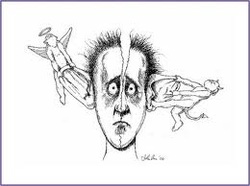
Splitting–more commonly known as black and white or all or nothing thinking–is a primitive defense mechanism used by both narcissists and borderlines when they observe a threat–that someone doesn’t agree with them or is challenging them in some way, or when they fear abandonment (borderlines) or exposure/loss of supply (narcissists). In narcissism, splitting is usually referred to as idealization/devaluation, but other than the unconscious motive (fear of abandonment for borderlines, fear of losing a source of supply for narcissists), the phenomenon is really the same thing.

Splitting is normal in a very young child. When Mommy is present and hugging the child, Mommy is perceived as “good.” When she denies the child another cookie or she goes to work, the child throws a tantrum, and Mommy is now “bad.” Because the child still doesn’t see himself as a completely separate person from Mommy, when Mommy does something that makes the child unhappy or fearful, the child rejects her and thinks of HER as all-bad. The child is not yet capable of the concept that Mommy is an individual who can be both good and bad at different times and to different degrees depending on the situation.

The fairy tales we read to young children engage them at a level they can understand: fairy tale characters are all-good or all-bad, heroes or villains, with no in between. Only an older child can fully understand that people come in varying shades of grey, and pure black or pure white in one person is exceedingly rare. Realizing that most people are both evil and good at the same time is a sign of maturity and indicates the child has come to see himself as a completely separate person with his or her own identity who can afford to see others as individuals too, rather than one-dimensional cardboard cartoon characters.

Narcissists and borderlines never make that transition. Due to early attachment issues arising from neglect, abuse, or sometimes maternal smothering, they continue to see others as extensions of themselves, not separate people with their own identities, interest and opinions. If someone is an extension of yourself, of course the other person must be seen as “all good.” If the other person fails to provide adequate supply (for the narcissist) or disagrees with them or has differing opinions, they are perceived as a threat and must be rejected, devalued, and demonized as “other.” The only way a narcissist or borderline can see another person as a separate entity is when they have become “other” and are demonized and seen as “all bad.”

splitting

Splitting is common in today’s political landscape. Candidate A believes in health care reform, the legalization of marijuana, the cessation of the outsourcing of jobs, raising taxes on the wealthy–and that a woman has the right to choose whether or not to terminate a pregnancy. Candidate B believes in health care reform, the legalization of marijuana, the cessation of outsourcing of jobs, raising taxes on the wealthy–and that abortion should be outlawed. Candidates A and B, rather than focusing on what they have in common and using that to help improve people’s lives, instead go on smear campaigns against each other focusing on the only thing they don’t agree on: abortion. Candidate A accuses Candidate B of being a throwback to the “unenlightened” 1950s, while Candidate B accuses Candidate A of wanting to legalize murder. Neither acknowledges the many things they agree on–all either can see is that the other is a “murderer” or a “throwback troglodyte.” (Notice too how the accusing labels have become exaggerated and more abusive). That many politicians are narcissistic by nature makes splitting come second nature to most of them. Unfortunately, splitting has become standard in political campaigning and is intended to garner more votes (narcissistic supply) for the accuser while taking them away from the opposing party.

Robin and Tim are madly in love with each other. Robin idealizes Tim–she thinks he is the most perfect man she ever met, and she can’t imagine a life without him. He is the most handsome, smart, funny, sexy, and interesting man in the world, and she can’t believe her luck in having met him. Recently they have started talking about getting engaged. Tim thinks Robin’s wild mood swings are rather charming–but he hasn’t been the target of them yet.

On Tim’s birthday, Robin cooks him a lavish dinner and has a bottle of champagne ready to pop open and enjoy. He is supposed to be home by seven. Eight o’clock comes, and he isn’t home yet. At eight-fifteen, Tim calls and says he got held up. He is in the door by nine, apologizing profusely about his lateness–he was called into an emergency meeting by his boss and couldn’t get out of it. Rather than accepting his apology at face value and proceed to have a nice dinner together, Robin goes on a rampage. She accuses Tim of having a lover and never having loved her. The champagne bottle gets smashed against the wall and the dinner thrown in the trash. After fighting for hours, Robin tells Tim to leave and that she never wants to see him again and that he’d make a terrible husband to any woman who would have him anyway.

In the course of two hours, Robin has turned Tim, a normal man who really did love her but couldn’t get out of a meeting, from “the most perfect man in the world” into an unfeeling monster who is cheating on her and would “make any woman miserable.” Because he disappointed her and she couldn’t handle it or see him as a separate person with his own life and his own needs, she must demonize him and make wild accusations against him, accusing him of doing things he never did and saying things he never said. She has turned the good into the evil, and rejected Tim because he is “all bad” now. Both the “angelic” Tim and the “evil” Tim are creations of Robin’s all-or-nothing, black or white, thinking. Both are fiction.

Splitting is really a kind of blindness–the failure to be able to see any shades of grey in an individual, situation, religion, ideology, belief system, or really, anything at all. It destroys relationships, creates hate and discord, kills community spirit, leads to war and killing, and ruins lives.