The Male Borderline Waif

This is a good article about an overlooked subject–the male borderline. BPD is usually associated (and diagnosed) in women; men are more often diagnosed with NPD. But they aren’t the same disorder, and this article explains what a man with the introverted/fragile sort of BPD can be like. (The more aggressive types of male Borderlines are often mistaken as having Antisocial Personality Disorder due to their impulsivity and acting-out behavior, which sometimes gets them in trouble with the law). There’s a lot of gender bias in the diagnosis of mental illness and BPD is one of the most stigmatized and misunderstood of all the disorders.

MJ's avatarOut of the Mire

I’ve written a lot on borderline personality disorder (BPD) on this blog largely because my mother has the disorder.  It is not something I wish to vilify, and I don’t want to verbally mistreat people who have been diagnosed with it either.  Of all the personality disorders, BPD is the most stigmatized.  Many therapists refuse to treat it or see clients who carry the diagnosis altogether.  That is a hard road to walk when one has the disorder, and it’s also a very difficult situation if you love someone with it.  Where do you turn? What resources are available to you when there are so little available to your loved one with BPD?

Another inherent problem is that of diagnosis.  Many people struggling with BPD are never diagnosed and, therefore, never treated due to 1) treatment resistance 2) refusal to seek help.  The other factor? Gender bias within the clinical…

View original post 1,665 more words

Film about limerence.

limerence_movie

A filmmaker, Dan Pedersen on Twitter asked me about my opinions about limerence for a short film he’s working on for Glass City Films. It’s about a “fragile young woman who experiences all the irrational terror of falling into obsessive love.” The clips look intriguing.

Dan Pedersen and Glass City Films hope that the film will help increase awareness of this condition, and offer a bit of hope for people who have a predisposition to it.

Donations are being taken for this project. While I’m not able to make a donation at this time, I do want to spread the word about the film so maybe others can contribute to this project.

Here is the website where you can read more, or make a donation if you wish.
http://www.limerencefilm.com

Distraught, depressed, and confused.

In spite of the hopeful, positive dream I had early this morning where I seemed to discover my own power over my inner demons, I actually have been feeling very bad.   For the past week or two, I’ve been much more stressed than usual, more depressed, more nervous, more negative, quicker to anger, less mindful, and generally just feeling a lot more triggered by small things.   I feel like I’m on the verge of tears a lot too, even though I can’t actually cry. People at work have noticed too, and I got asked a couple of times this week if I was “alright.”   I hate the fact that people can tell and I’m so bad at hiding the way I feel (it pisses me off–but am I pissed at them for noticing or am I pissed at myself for being unable to maintain a false front of good cheer?  I don’t know).   People have always thought I was a little “off.”  But they are right.   I am not “alright.”

The only explanation that makes sense is that because I’ve been looking more closely at my early life, and at my family’s behavior toward me, it’s triggering a lot of unpleasant feelings and making me feel dangerously vulnerable and also angry at the same time.   All this negative emotion could mean I already dived into the void and if so, then that’s a huge step toward healing (which the dream seemed to be about).    I don’t know.  I always email my therapist what I want to talk about and have him print a copy so I can remember (I like doing things that way), but I think I might have to talk about this instead.   Thank God I see him tonight.   I’m going to ask if I can see him twice a week while I’m going through whatever emotional crisis  I’m in right now.   I’m just feeling really…bad right now.  Is it normal to feel better at the beginning of therapy and then start feeling a lot worse later on?   I know we’re starting to dig up things I wanted to leave buried before.   Maybe its sort of like giving birth–and these are emotional “labor pains.”  I don’t know.

The Town From Hell

In an increasingly narcissistic, selfish society, this sort of callous behavior is becoming the rule rather than the exception. This is horrible.

Joyful dancing.

dancing_ballet
Credit: Omar Z. Robles photography

I just had had another dream. I feel like this is important too. It started out terrifying and turned positive.

I’m living in a large, unnamed city that seems a lot like 1970s-1980s New York. Dirty and dangerous. I’ve decided to learn how to dance. It’s very important that I learn to dance, in fact, it’s a matter of life and death. I see a newspaper ad for an excellent dance studio and call them to enroll in their program. The only problem is, the studio is in a walkup tenement in the most dangerous part of town.

I’m afraid but know I must make it there. I try to stay on the main avenue, but obstacles on the sidewalk keep getting in my way. Areas with bombed out buildings, ripped up sidewalks, mountains of trash and rubble. The only way past is through a long, dark alley. Cautiously, I enter. I look around and see shadowy figures in the distance. They look male. Probably gang members or rapists or even murderers. I turn around and find another way. The alley is wide and has other openings, like a maze. I go through another alley and see more sinister male figures in the distance.  I feel alone and vulnerable and scared.  I look around frantically, trying not to look too afraid.  The figures are getting closer.  What if they can smell my fear, like wild dogs?  Finally I find another way. I begin to run, determined to make it out of there and back to the avenue.

Somehow I don’t get lost. Soon I’m back on the main avenue. I run past a tenement building with a rusted fire escape. It’s covered with snow, even though there isn’t any snow on the ground. An old black man asks me for assistance climbing it. He says he has to get into his apartment but the steps are too slippery. I stop, hesitate, think about helping him. But I don’t have time. With my foot I kick some of the snow off the first few metal steps, apologize for not being able to do more, and begin to run again.

Soon I realize I’m not just running, I’m floating about two feet off the ground. I become aware all I need to do is will myself to get where I’m going. Without thinking, I begin to dance. Gravity doesn’t seem to exist anymore. I leap and bound and spin and do pirouettes in the air. I bound weightlessly through another long, dark alley. There are gang members there too. They stop and watch me and soon they are dancing too. Everyone who looks my way begins to dance.

I’ve forgotten all about making it to my dance lesson. Everyone is flying through the air, leaping and spinning and throwing our arms in the air. There’s no fear or despair or fatigue or worry. The whole world is dancing, and it began with me.

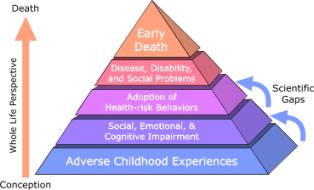
The Adverse Childhood Experience study (CDC)

Under my post Adult Poverty and Scapegoat-hood: A Connection?,  one of my commenters (katiesdream2004) mentioned a study conducted by the Centers for Disease Control (CDC) in the mid-late 90’s that researched the connection between adverse childhood experiences (which includes emotional abuse by parents and early caregivers) and ill health and general low quality of life in adulthood.  I decided to Google it and here’s what I found.

From their webpage:

ace_study

The Adverse Childhood Experiences (ACE) Study is one of the largest investigations ever conducted to assess associations between childhood maltreatment and later-life health and well-being. The study is a collaboration between the Centers for Disease Control and Prevention and Kaiser Permanente’s Health Appraisal Clinic in San Diego.

More than 17,000 Health Maintenance Organization (HMO) members undergoing a comprehensive physical examination chose to provide detailed information about their childhood experience of abuse, neglect, and family dysfunction. To date, more than 50 scientific articles have been published and more than100 conference and workshop presentations have been made.

The ACE Study findings suggest that certain experiences are major risk factors for the leading causes of illness and death as well as poor quality of life in the United States. It is critical to understand how some of the worst health and social problems in our nation can arise as a consequence of adverse childhood experiences. Realizing these connections is likely to improve efforts towards prevention and recovery.

A correlation was found:

Childhood abuse, neglect, and exposure to other traumatic stressors which we term adverse childhood experiences (ACE) are common. Almost two-thirds of our study participants reported at least one ACE, and more than one of five reported three or more ACE. The short- and long-term outcomes of these childhood exposures include a multitude of health and social problems.

The ACE Study uses the ACE Score, which is a total count of the number of ACEs reported by respondents. The ACE Score is used to assess the total amount of stress during childhood and has demonstrated that as the number of ACE increase, the risk for the following health problems increases in a strong and graded fashion:

Alcoholism and alcohol abuse
Chronic obstructive pulmonary disease (COPD)
Depression
Fetal death
Health-related quality of life
Illicit drug use
Ischemic heart disease (IHD)
Liver disease
Risk for intimate partner violence
Multiple sexual partners
Sexually transmitted diseases (STDs)
Smoking
Suicide attempts
Unintended pregnancies
Early initiation of smoking
Early initiation of sexual activity
Adolescent pregnancy

None of this should be surprising. Abuse early in life, whether emotional or physical, takes a huge toll on a person’s sense of self-worth and these people tend to enter adulthood lacking the emotional, financial and practical tools others have to create a healthy and successful life. They also lack the support systems others do, and I would guess the enormous stress of facing challenges that others get help with also has ill effects on health and wellbeing.

I did notice the list mainly includes unhealthy life “choices” such as smoking, illicit drug taking, and early pregnancy. However, I also see depression and general health problems on the list too. I’d include other mental illnesses such as PTSD, Complex PTSD, Borderline Personality Disorder, Avoidant Personality Disorder, and Social Anxiety, all which interfere with a person’s ability to function well in the working world and in interpersonal relationships. These mental disorders could also cause a person to make “bad choices” such as smoking or sexual promiscuity.  Some, like Social Anxiety or Avoidant Personality Disorder, could cause a person who doesn’t engage in unhealthy behaviors, to be afraid to take any risks in life, limiting their opportunities and setting them up for failure.

More research needs to be done, particularly on the connection between emotional/narcissistic abuse during childhood and poverty later in life.

You can read more on their website:
http://www.cdc.gov/violenceprevention/acestudy/

Shouting at cars

I can relate to the “exaggerated startle response” and always being told by everyone to “relax” and “chill out” that this blogger describes. People suffering from PTSD and C-PTSD have to deal with the impatience of other people who don’t understand what it’s like to walk through life feeling like you might get ambushed any second.  You feel constantly in danger and become hypervigilant about everything. It’s not like we want to be like this, you know!

My fractured memory.

FracturedMemory2
“Fractured Memory,” by Hanna Trussler, 2012

I’ve been doing a lot of thinking about my early years–childhood and adolescence. As many of you know, my parents were active alcoholics, narcissists (my dad more likely covert NPD or maybe Borderline), and that I spent almost all of that time miserable and lonely due to emotional (and sometimes physical) abuse both at home and at school (because I was already trained to be a good little victim and had no self esteem or the ability to defend myself, I was bullied a lot).

The problem is, most of these early memories are fractured, hazy, or both. I remember snippets of traumatic events, but in most cases I can’t remember the entire event, or it’s spotty. Some of my memories seem more like dreams than reality and therefore I can’t remember the specifics of what happened. The same is true of my abusive marriage. I can only remember fractured pieces of that time. The two and a half decades I spent with him don’t seem like a cohesive whole, but more like a photo album with many of the photos missing. But this post isn’t about my early adult years.

I think something happened when I was 12 that was significant and a kind of turning point for me–it was when I stopped trusting anyone, I think. It was the moment when I realized how truly alone I really was and that no one cared and anyone who said they cared was probably lying. I’m not 100% sure, but I think this is when I stopped reaching out to others and began my avoidant pattern of behavior. Of course, this coincided with puberty, so maybe that had something to do with it too.

Here’s what I do remember. My parents and I had taken a two week trip to the beach. Another couple and their two children came along with us and rented the cottage next door. That couple was friends with my parents. I didn’t know my father was sleeping with the wife at the time, and my mother probably didn’t either, but I remember how jealous she was of that other woman because she was younger and blonder than she was and my father paid a lot of attention to her. Their daughter was a year older than me and was adopted. She was from India and was a close friend of mine at the time.  I envied her beautiful long, glossy black hair, permanent tan, and huge soft brown eyes.  Her little brother (her parent’s natural child) was an adorable little blond-headed boy of about 5 or 6. To me, they seemed like the perfect family. It may have been an illusion (for all I know, they were putting on appearances too), but to my 12 year mind, they seemed like they were in love with each other and their kids were both well loved and well-adjusted. My friend always seemed happier, more focused on a future (she eventually became a doctor) and much more emotionally stable than I was. I loved her and envied her.

My parents at the time were drinking heavily and fighting almost daily. Some of their arguments became physical, and I remember lying silently in my bed at night listening to these arguments as they escalated. I was both fascinated and terrified. What if they divorced? What if they abandoned me?  What if they killed each other?  What if I became an orphan?  I seemed to be the cause of an awful lot of their problems (and they did fight over me a lot).

This beach vacation didn’t put a stop to their constant fighting, and one night, my father left. I don’t know where he went, but my mother and I were left alone. My mother didn’t speak to me about this and her demeanor toward me was cold, as if I was an annoyance to her. I was terrified my father was never coming back, and I remember crying myself to sleep the next night. I don’t think my mother ever came in to comfort me. She was probably getting drunk, but I don’t remember.

Desperate for someone to talk to, I pulled the father of my friend aside, and asked him if I could talk to him in private. He always seemed like a warm and sympathetic person to me, someone who loved kids. We sat down outside on a bench near the parking lot, with the sound of the waves crashing behind us on the beach,  and I spilled out all my worries, all my pain, and all my fears.  I talked for about an hour.  He just held my hand and listened. I started to cry and he held me.  He told me everything would be alright. He didn’t say he was going to talk to my parents.

sad_child_beach

He must have talked to them, because that night I was told by my mother that my father was returning to talk to me. She said he was not happy and was in fact enraged.
He came back as promised, and that’s where my memory gets all hazy and fractured. I remember snippets, like quick-flashing frames from a movie: getting beaten severely (but I was always beaten in a way that bruises didn’t show), being told I was a troublemaker and was the reason the family was falling apart. That I was nothing but a problem to them and never knew when to keep my mouth shut. I don’t remember the rest but I know there’s even more. I just can’t access it.

I also don’t know if my friend’s father had told my parents what I’d said to him because he was concerned about me and thought they might listen to him, or if he was just another participant in the abuse against me.

I realized even then my parents were drunk and probably not fully in control of what they said and did, but I think behind their alcoholism was narcissism. I think a lot of narcissists become alcoholics or addicted to drugs, and even after they become sober or clean, refuse to look any deeper into the core issues that caused them to drink or use in the first place. But that’s a subject for a later post. One thing that did occur to me, was that the only time my parents seemed to come together as a team and weren’t attacking each other, was when they joined forces to attack me. Only then were they the unified couple I dreamed of, unified in their abuse of their only child.

I don’t remember much of what happened after that beating and berating. I’m pretty sure our vacation ended at that point. I might have been sent to stay with relatives for a week or two, or left with a babysitter, so they didn’t have to deal with me. I feel like something important got blacked out, but I can’t remember what it was. But it was around this time that I stopped being able to confide in anyone at all. I remember one of the nuns who taught me in 8th grade, a woman who seemed to favor me for some reason, once called me aside and asked me if I was abused at home. I thought to myself, how can she tell? Of course I told her I wasn’t, that everything was fine. But nothing was fine in my life anymore.  I think my emotional growth stopped that summer.  At age 12.  But it might have stopped even earlier than that.  How in the name of God was I ever supposed to grow into a happy successful adult, able to form healthy attachments to others, when I never grew beyond the age of 12?

The next summer I was sent to sleep-away camp for the entire summer, and while I did enjoy it for the most part, I couldn’t help but feel that it was a rejection, a way for my parents to get rid of ‘the problem child’ so they didn’t have to deal with my “issues.”

Wow. Suddenly I feel like crying. The pain is getting real.

I’m asking the little girl who still lives somewhere inside me to tell me everything she knows.
Lifestyle Links Part 10

Look what I just got in the mail!

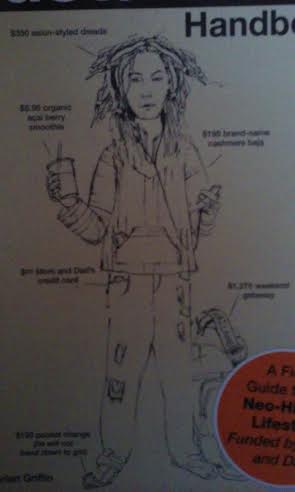
trustafarian

My friend just sent me a copy of this book. I didn’t go to work today but I woke up still feeling moody and out of sorts and I sure could use a few laughs. To get in the right mood, I’m drinking a blueberry-pomegranate-banana smoothie and nibbling on some dark-chocolate covered espresso beans (both pictured above). Arranged on the 1970s-looking shag rug, along with its props, I think my new book feels right at home.

Maybe I should be listening to some White Stripes or Simon and Garfunkel to get the entire multi-sensory Hipster experience.

I sure wish I was a real Trustafarian, but at least I can pretend I’m one for today.

Here’s a closeup of the cover. I’m not sure if you can read the captions or not.

trustafarian_closeup