I write like William Gibson, Arthur C. Clarke, and David Foster Wallace.

William_Gibson_Zero_History_signing_at_Forbidden_Planet_London
William Gibson book signing at Forbidden Planet, London, UK.

According to this very cool website, which analyzes a writing sample and then tells you who your style resembles, I write exactly like William Gibson, a contemporary author of the cyberpunk genre.

2 factoids:
1. William Gibson coined the term “cyberspace.”
2. I never read anything by William Gibson. I guess now I should.

ETA: I took the test again, using a longer writing sample (both samples were from this blog)–and got science fiction author Arthur C. Clarke, whose books I love.

…and even later:
I tried this with 3 more writing samples, and got David Foster Wallace all three times! So I guess that’s who I really write the most like. I haven’t read his books either. Now I will.

df_wallace
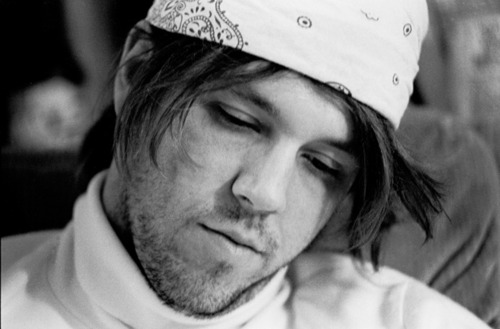
David Foster Wallace. Should this man be my muse?

MENTAL HEALTH – Shared Psychosis

This is a really great article about the way psychopaths can manipulate others by inducing a “shared psychosis” with their victim(s) — otherwise known as trauma bonding or Stockholm Syndrome. Psychopaths are way too far gone to ever be cured. Don’t try to help one; you can’t. This well written article really drives home the evil and creepiness of psychopathy–and most are not even criminals. They achieve their desire to completely destroy another person or group of people (such as the followers of a cult leader) using perfectly legal means. No Contact is the only way to handle a psychopath (NC here could be expanded to to include malignant narcissists who are just under psychopaths on the narcissism spectrum, most garden variety narcissists, and yes, even a few very sick borderlines too).

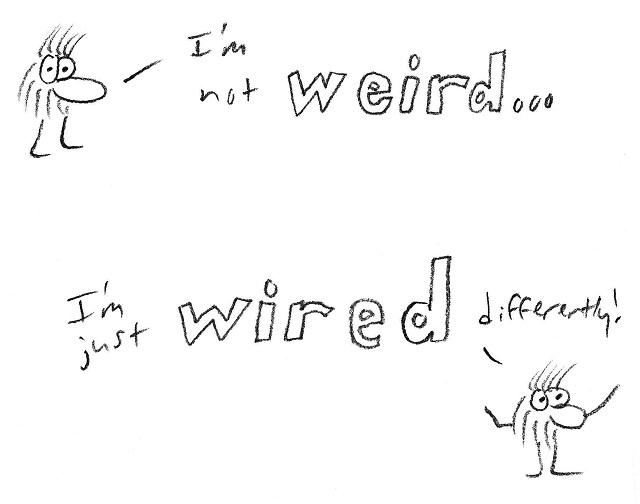
Why I warn people I have Aspergers.

wired_differently

At the time I wrote this post, I thought I had Aspergers.  I don’t.  But I still think this is good advice if you do or even if you don’t.  It could get you out of a lot of awkward situations.   

Most neurotypicals don’t get Aspies. Although there’s a certain cachet now for Aspies on the Internet (because so many of us feel more at home online than in the real world), in the neurotypical world, we’re still socially awkward oddballs who don’t fit in.

I noticed if I say nothing about having this disorder, people tend to treat me like I’m stupid, snobbish, or annoying, or sometimes all three! As Rodney Dangerfield (who probably didn’t have Aspergers) used to say, “I can’t get no respect!”

On top of my Aspergers, I’m also avoidant — AND I have hearing issues. As a child, I had a lot of ear infections so I have only 10-20% hearing in my left ear. My Avoidant personality and hearing deficit both tend to exacerbate my Aspie traits, so when it comes to being able to interact normally in a social setting, I just plain suck at it. I usually just stay quiet but people still think I’m probably a cold and unfriendly person, if not stupid.

assburgers
I didn’t make this graph but it made me laugh.

I found a sort of solution to this problem, and found that it does improve the way people treat me. It’s a very simple solution. I TELL people I have Aspergers (and hearing problems). No further explanation is generally required. If they know in advance that my brain is differently wired and keeps me from reading social cues well and that I also don’t hear very well (from my left side), then they tend to be more patient and become less annoyed at me for asking them to repeat things, saying something awkward, or saying nothing at all.

At first it embarrassed me to tell near-strangers that I have a mental disorder differently wired brain (I don’t tell them about the Avoidant PD–it’s not necessary and no one know what it is anyway), but it’s a lot less embarrassing than being thought of as an idiot, a snob, or an annoying person. Doing this gets easier over time. Now, telling someone I barely know I have Aspergers and can’t hear well out of my left ear feels no weirder than telling them I don’t care for shellfish. And it’s usually met with a knowing “Ah, okay then.”

There’s an additional benefit too. If someone doesn’t know much about what Aspergers is, it gives me the opportunity to tell them. Since it’s something I know a lot about, and I like to talk about psychology anyway, telling people I have Aspergers acts as a sort of icebreaker. It disarms them, and sometimes they share something personal with me.

How I spent my break today.

I took photos!

woods_1

woods_2

woods_3

woods_4

woods_5

woods_6

woods_7

woods_8

woods_9

Would a narcissist who lost their memory “forget” how to be a narc?

Memory-Loss

I saw this posted on Psychforums in the NPD forum:

I’ve long thought what might happen if an N suffered complete lose of memory. Would he remember he was narcissistic? There is a novel in which this happened. Ursula Brangwen in D H Lawrence’s “The Rainbow” falls gravely ill and recovers as a near as damn it normal person.

I know it’s a weird question but it’s interesting. I’ve read that sometimes people who suffer head trauma (without severe brain damage or damage to only a small part of the brain) that produces complete amnesia occasionally display dramatic personality changes when they awaken–even to the point of seeming to have a completely different type of personality than they did originally. It’s as if they are forced to use a different part of the brain and form a new personality — and new brain connections — from scratch.

In most cases, language and other basic life skills are left intact, but I have read of rare cases where even though the brain is left largely undamaged, the person must literally “grow up” and relearn basic skills. This learning usually happens at a much faster rate than it would for an actual child growing up, because the individual already has the brain of an adult.

Think of the System Restore function on your computer. Your computer gets a virus or has some other serious issue. You set the computer back to an earlier date before the problem started. Yes, you lose important files and other saved information (which can be replaced later) but the problem is gone. It’s the same concept — a traumatic brain injury that results in amnesia could work like “system restore” for a narcissistic brain. You could also erase the hard drive and re-install it. (That would be analogous to a more severe injury where the narcissist would have to start out again as a virtual infant–and receive the sort of nurturing they never got when they were a real infant.)

In either case, is it possible that a narc who suffered complete amnesia and could remember nothing of their past, might “wake up” with the capacity to learn empathy and become a non-narcissist?

If so, it gives new meaning to the idea that the best cure for a narcissist is a kick in the head.

Is BPD a real disorder or should it be eliminated as a diagnosis?

bpd_treatments
The myriad ways experts “see” borderline personality disorder. (click to enlarge)

There’s a great deal of confusion and disagreement in the professional literature about the nature of Borderline Personality Disorder. The blogger BPDTransformation (whose blog is excellent if sometimes a little on the scholarly side), who was cured of BPD, thinks the label should simply be done away with and that BPD doesn’t really exist at all–the label being merely a placeholder for a group of symptoms that are widely variable, and that experts can’t even agree on. He believes BPD is categorized as a Cluster B (dramatic/emotional) disorder only because mental health experts can’t decide where else to put it.

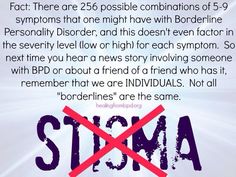
The stigma of BPD as a Cluster B disorder.

borderline_stigma

The problem with labeling BPD in the Cluster B category of personality disorders is the stigma that classification carries–that people with BPD (like those with NPD or ASPD) are evil, untrustworthy, selfishly manipulative, grandiose, dishonest, lack empathy, and really no better than people with malignant narcissism or even ASPD. (It sure doesn’t help any that an obviously sociopathic criminal like Jodi Arias has a diagnosis of BPD, when she more likely fits the criteria for high spectrum [malignant] narcissism, at the very least.) Insurance companies assume anyone with a Cluster B disorder is incurable, and therefore will not pay claims where a person is diagnosed with a Cluster B disorder. This is very damaging to those of us with BPD who have either successfully learned to modify and control our symptoms–or have even been cured, as BPDTransformation has been. People continue to believe we are lying about the success of the treatments or therapy we have received. Borderlines who have never been treated may find it difficult to find a therapist willing to work with them.

BPD is far more amenable to deep insight therapy than NPD (which is extremely difficult to cure but not impossible for non-malignants) and light years away from a disorder like ASPD (antisocial personality disorder), which can probably not be cured. Because the symptoms of BPD are so disagreeable to the sufferer (and not just to others), it is common for borderlines to present themselves for therapy, unlike people with NPD or ASPD. The vast majority or borderlines are unhappy with themselves and the way their lives have turned out. But many therapists won’t work with borderlines (other than with behavior modification treatments like DBT) because they know insurance companies will not pay such a claim.

What are borderlines on the border of, anyway?

tightrope

The name “borderline” itself is confusing. What are borderlines on the border of anyway? Neurosis and psychosis? A normal sense of self and Narcissism? Mexico and the United States?

The experts are all over the map on this, with some recent theories stating that BPD is actually a less adaptive, more ego-dystonic form of narcissism. But the original term “borderline” actually referred to the belief that the disorder was on the “border” between psychosis and neurosis:

[…]It is called borderline because it was originally thought that people were on the ‘border’ of psychosis and neurosis. BPD is also sometimes called Emotionally Unstable Personality Disorder (Borderline type). Approximately 75% of people given this diagnosis are women and 50% have experienced physical and/or sexual abuse.

Because BPD is more commonly diagnosed in women than in men, it’s also been referred to as the female form of narcissistic personality disorder (which is more commonly diagnosed in men than in women).

Psychotic, neurotic, both, or none of the above?
bpd (1)
Credit: Judgybitch/Dzhokhar Tsarnaev

The reason why BPD is sometimes regarded as the midpoint between neuroses (mild and easily treated anxiety or depressive disorders) and psychoses (disorders where the victim is out of touch with reality, such as schizophrenia and the manic-depressive form of bipolar disorder) is because people with BPD can, when emotionally upset, display psychotic or delusional symptoms such as splitting (black and white thinking), dissociation (feelings of unreality either about the self or the environment), magical thinking, severe paranoia, delusions of grandeur or persecution, and sometimes even hallucinations and disorganized speech or thought. However, for a borderline, these psychotic symptoms don’t last and as soon as the emotional crisis has passed, the borderline’s “sanity” normally returns. Antipsychotic medication can be helpful, but isn’t always necessary, as it usually is for a truly psychotic individual.

Others have speculated that BPD is really a severe form of PTSD or C-PTSD caused by trauma, and should be treated the same way as PTSD. Personally, I think it’s more long-standing than a reactive disorder like PTSD and is a true personality disorder, but it does make sense that BPD may have originally begun as a form of PTSD at an early age, often due to sexual abuse.

There is so much confusion and contradiction in the literature about BPD that I’m slowly coming around to BPDTransformation’s way of thinking that it should possibly be removed from the Diagnostic and Statistical Manual of Mental Disorders (DSM) until mental health professionals can get a better handle on what BPD actually is, and whether it’s even a valid diagnosis (or simply a group of symptoms that could indicate several other disorders). There should at least be more agreement among the professionals at any rate.

What happened to Opinionated Man’s site?

It’s been marked to Private!?! WTF? I wonder if it has anything to do with that troll that’s been harassing him. I understand the troll is also going after other bloggers who are supporters or friends of OM.
Or is WP mad at him again and made him take it down?

I can’t believe it. Has anyone else had trouble getting on his blog?

Borderlines are human chameleons.

chameleon

My latest obsession seems to be the similarities and differences between people with NPD and BPD. I’ve been trying to come to terms with the idea an increasing number of mental health professionals hold that BPD may actually be on the same spectrum as NPD (for more information about this, see Alexander Lowen’s “Spectrum of Narcissistic Disorders”) but is a less adaptive (to the sufferer) form of the same disorder. What I’ve been reading is disturbing to me because I had no idea how similar BPD and NPD really may be.

The most important thing both disorders seem to have in common is that both borderlines and narcissists feel empty inside. Both feel as if they have a black hole inside them, and many try to “fill” that hole with things like substances, sex or compulsive shopping. People with both disorders are prone to abuse drugs or alcohol, or engage in other unhealthy or self-destructive behaviors (with the borderline more likely to be deliberately self-destructive and the narcissist callous or destructive toward others). Filling the inner black hole becomes so important that people with these disorders may disregard the needs of others in their need to get their “fix.”

I found an article in Psychology Today that discusses the devastating conundrum that both narcissists and borderlines have to face: the lack of an identity. It’s this absence of a true identity that make people with these disorders feel so empty and hollow, and drives them to do the kinds of things they do. The primary difference between these disorders is that narcissists adopt a false self to replace the lost true self, while borderlines–although not having a false self per se — instead become human chameleons, adapting their behaviors to a given situation (to avoid rejection)– but none of these identities are really “them.” The truth is, they don’t know who they really are. That’s why borderlines seem to change with the wind and confuse those they are close to.

The article I’ve linked to discusses these ideas in more depth. It’s extremely interesting stuff, but somewhat upsetting to people like me with a BPD diagnosis.

This article is Part 7 of a series about the differences and similarities between BPD and NPD.
The other 6 can be linked to from this one. (Of course I’ll be reading all of them.)

Who Am I? The Conundrum of Both Borderlines and Narcissists

I cannot repost the article here here without written permission from the author, so you will have to click the link to read the article.

Here is an article by the same author about the False Self the Narcissist uses to mask their lack of an identity: https://www.psychologytoday.com/blog/stop-walking-eggshells/201111/behind-the-facade-the-false-self-the-narcissist

Sometime it’s little things like this that matter most.

My wonderful son sent me a link to this song, and here is what he said:

If there was a song I could dedicate to my mom, it’s this one:

This made my day. ❤ ❤ ❤

I'm also adding it to my Inspirational Songs list.

Eskimo Sociopaths

inuit_man
Lone Inuit man.

Here is a very interesting article that discusses how Eskimo (Inuit) hunters historically handled sociopaths and narcissists in their midst.

Eskimos probably had the right idea. In our modern culture today, we look up to narcissists and even sociopaths as role models.

In order to survive in their harsh, cold climate and procure enough food, Eskimo hunters had to work together as a group. Individualism, a we know it today, wasn’t even on the radar and wouldn’t have benefited the group. Cooperation–not individualism–was necessary for survival.

Not anymore. Today, individualism (and thus narcissism) has become adaptive because those people who only have their own self-interest as a priority tend to be the most successful. There’s something very wrong and evil about a society that glorifies individualism over cooperation.

ownyourcrazy101's avatarconfessionsofacrazybitch101

A stranger who I had a conversation with, had a beautiful mind and heart and we talked for an hour about everything. He told me a story about sociopath/narcissists from Eskimo ages….

Eskimos worked together. That’s how they survived was through hunting and team work. But, when they unmasked a sociopath in their pack, this threw off their hunting. This sociopathic Eskimo couldn’t work alongside the others, so they figured out a way to cure NPD/sociopathic Eskimos.

They would invite the sociopath along with them, in a group of three, to hunt. They gave the sociopath their own weapon and everything just as he was apart of their group. They would then venture far far out, to a place only two of them knew around and how to get back to their grounds from. They then told the suspected sociopath to sit on a bolder and wait for the prey…

View original post 196 more words