One way to peg a narcissist you probably never heard of.

finger-pointing

It may sound ridiculous but I think this is a good way to judge a person’s character without their suspecting anything.

Chatter about movies, books, and other forms of entertainment is a standard ice breaker (and is part of the dreaded “small talk” we introverts hate so much), usually used to make polite conversation with someone you don’t know that well (of course, these things can be discussed more in depth too with closer friends and loved ones).    Movies, books, TV, and public figures are safe conversation starters.   You can talk to people about these things without seeming to cross anyone’s boundaries or getting too personal.

But such seemingly innocuous conversations can also help you peg whether or not a person is a narcissist or sociopath–without them suspecting a thing.  When you meet a new person, ask them the way you would ask anyone about movies they’ve seen and books they’ve read, and then ask them whose side they were on, or which characters they most identified with.   Of course, you must be familiar with the movie or the book, including its main characters.   Television personalities and other public figures will also do.

Narcissists can feel empathy for other narcissistic characters–characters that are like themselves.   I’ve noticed they will often feel empathy for the villain, rather than the hero/heroine.   A narcissist woman, for example, will feel simpatico with a villain like Beth Jarrett from Ordinary People, and think her behavior toward her son wasn’t that bad–she may even think he deserved it and find Jarrett’s justifications for abusing him valid.    My mother found nothing wrong with her behavior and was puzzled as to why I found it so triggering and upsetting.  (Of course I didn’t tell her why).

My mother also couldn’t understand why the the “Queen of Mean” hotelier Leona Helmsley was given such a hard time in the press over her arrogant statement, “We don’t pay taxes, only the little people pay taxes.”   She also identified with Sherman McCoy, the narcissistic, selfish, and greedy investment banker in the novel Bonfire of the Vanities, who wound up losing everything due to a chain of events stemming from a hit and run accident which McCoy was involved in.  I remember her lamenting almost tearfully about how “his beautiful life was ruined” by the events that played out in the novel.    She also couldn’t stand good, sweet Melanie, from Gone With the Wind.   I suppose Melanie could come across as a tad simpering and holier-than-thou, but my mother hated her.   The heroine of that same movie, Scarlett O’Hara, is more than a little narcissistic (or possibly Histrionic?)–charming, flirtatious, manipulative, entitled, and possessing very little empathy.  She didn’t even seem that upset when her own daughter, Bonnie, died after falling off a horse.    I never understood why Scarlett has been such a huge role model for generations of women.   She really didn’t have too many redeeming qualities when you think about it.

A  man (or woman) with NPD or psychopathy might identify or sympathize with any of Ayn Rand’s psychopathic heroes–Howard Roark from The Fountainhead or John Galt from Atlas Shrugged come to mind.   Of course, these are popular books, especially among conservatives–but holding these two highly narcissistic men up as worthy of worship might be a red flag.   Be wary of such a person.

My ex, a sociopath who has been diagnosed with Antisocial Personality Disorder (but is really a malignant narcissist) always liked villainous characters, especially if they broke the law.  He often rooted for the bad guy (or sometimes, girl) and the more ruthless or cruel they were, the more they seemed to enthrall him.   He likes Charles Manson.   He watched South Park because he thought the sociopathic Eric Cartman was so cool.  He also rooted for the alien in Aliens.   In addition to that, he likes satanic and demonic imagery, which always disturbed me, even when I was agnostic.     We all have a touch of schadenfreude and many normal people (including yours truly) have a fascination with serial killers and other outlaws–according to Jung, that’s because we all have a shadow self that’s drawn to dark things.  But there’s a difference between fascination or morbid curiosity and actually liking these things or identifying with or sympathizing with villains, malignant narcissists, and antisocial people.

So if you’re on a date with a new person, have them take you to a movie (or take them to a movie) and see who they seem to identify with or sympathize with the most (or who they seem to dislike the most).   It could tell you a lot about that person’s character.

Narcissists and instant gratification.

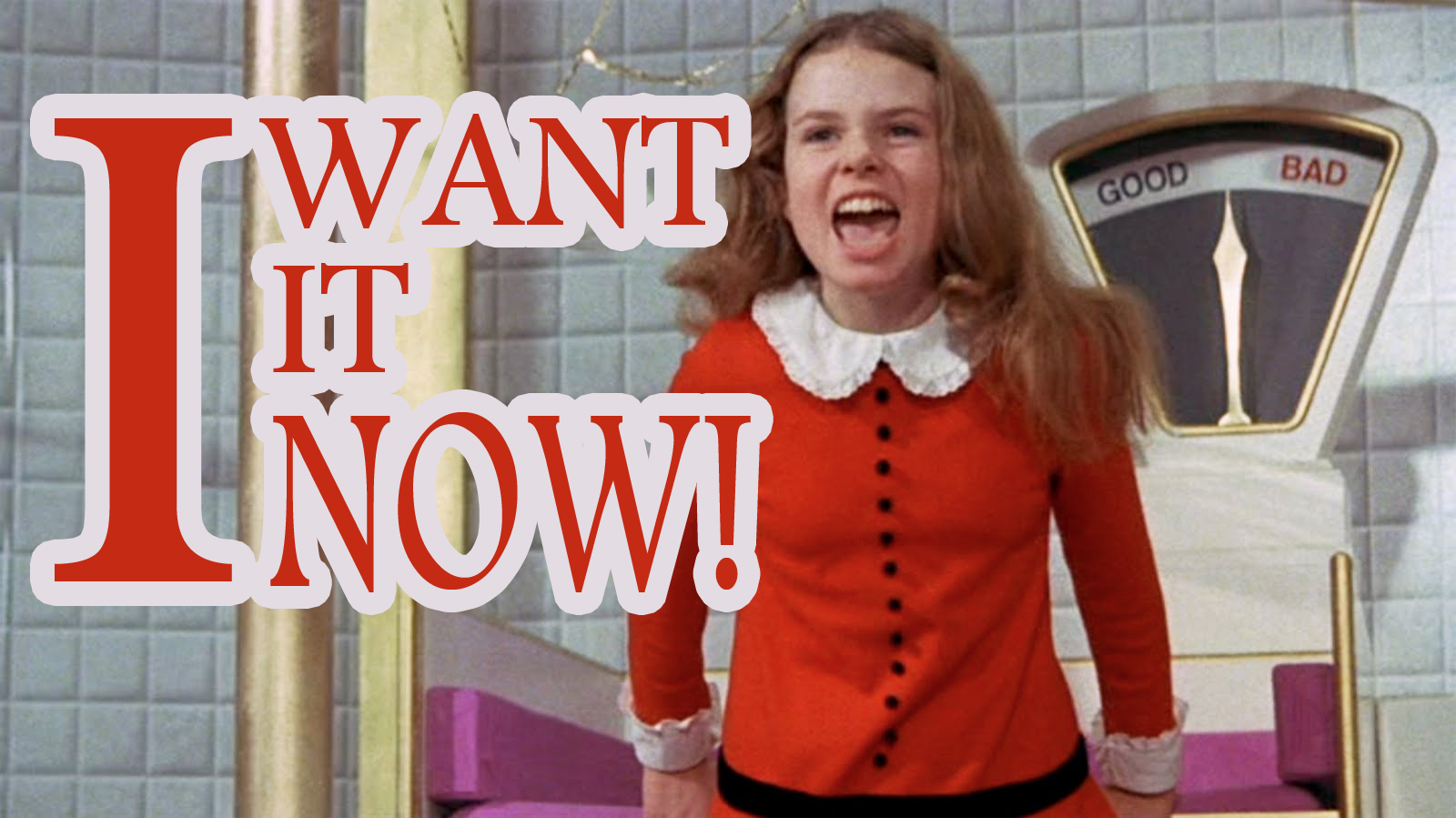
Veruca-Salt

My MN ex always had to have what he wanted, right that second.   During those seven years he freeloaded off me and refused to work (AFTER the divorce), he’d interrupt me at the most incredibly inconvenient times to take care of some minor need, and he’d become very petulant or even angry when you refused to jump when he said jump.    He used to wake me up in the middle of the night, knowing I had work in a few hours, saying he needed a pack of cigarettes.   Or when I’d go shopping, if I didn’t get him exactly what HE wanted (remember, he didn’t work and I paid for all the groceries myself) he’d rage and hurl insults at me until I went back to the store to get him what he wanted.   He never even thanked me for going out of my way for him.   He assumed this was his due and that I existed to carry out his bidding.   Boundaries meant nothing to him–unless they were HIS boundaries (woe be to you for crossing over THOSE!).   He’d never return the favor if you wanted something from HIM.   He just kept taking and taking and taking, draining me of my sanity, my money, and even my looks and my health.  If I hadn’t kicked him to the curb in early 2014, it probably would have killed me.  He was like a giant baby living on my couch, only not at all cute or funny.   Maybe more like a giant cancerous tumor attached to my couch and wallet would be a better description.

My mother, also a narcissist, used to call me at any old time.  You were not allowed to refuse.  You were supposed to drop whatever you were doing.  When I’d tell her I was in the middle of work, or busy, or on another call and could I please call her back later, she’d pour on the guilt:  “I’m your MOTHER, you can certainly spare a few minutes to talk to me!” followed with an ultimatum: “Tell them you’ll call back later.”   How DARE I have priorities over taking a call from her?  How DARE I make her wait?    She wanted what she wanted when she wanted it, and did NOT want to wait.  No narcissist does, because waiting for something requires a degree of empathy–that the person you want something from may have needs at the moment that override your own.

Instant gratification isn’t something that’s usually associated with Narcissistic Personality Disorder; more often it’s associated with Antisocial Personality Disorder.  I think for a narcissist, the inability to wait for anything is part the entitlement problem they have.  To make a narcissist wait means you’re not putting them FIRST, which means they’re just not important enough to you otherwise you’d jump when they tell you to.  To make one wait is a narcissistic injury.   A baby can’t wait when it’s hungry; he cries and screams until Mom comes to feed him–that’s because he doesn’t realize yet that Mom is a separate person.  To the baby, they are one, and Mom exists only to serve him.

babycrying
Right up there, that’s your narcissist.

A narcissist is an overgrown adult baby. They never learned to differentiate other people from themselves.  Due to something going terribly wrong during their early childhood when they were supposed to be learning that they existed separately from others, they are stuck at a pre-verbal level of emotional development, where other people exist only to serve their needs.   If their immediate needs aren’t gratified, and you don’t put yours on the back burner or sacrifice your needs completely, to the narcissist it’s tantamount to annihilation.  They feel as if they don’t exist.   Hence, they must punish you–their rages and abuse are the equivalent of a two year old’s temper tantrum when they can’t have their ice cream RIGHT NOW.

Don’t enable a narcissist by letting them invade your boundaries this way.   If you can’t go No Contact, stick to your guns and let them get mad–and get away as soon as you are able.

*****

Thanks to My Child Within for the idea for this post, which arose from a conversation in the comments.

Are narc abuse blogs a wake up call for some NPDs?

empty_mirror_by_dred8667

I’ve sometimes been critical of ACON bloggers who seem trapped in hatred and over-the-top narc-bashing, but that’s because I think of hatred as a dangerous emotion that eventually hurts its bearer (and I think can even turn the victim narcissistic themselves), not because narcissists don’t deserve the vitriol (even though admittedly I have some empathy for ego-dystonic, low-spectrum narcissists, who are pretty rare).

Besides the obvious benefits of such blogs that preach No Contact and have probably saved a lot of victims’ sanity as well as lives, there’s another, unintentional advantage of ACON blogs that harshly call out narcissists and the things they do.

Sometimes I get emails from lower spectrum, ego-dystonic NPD’s who want to change or have been shocked into self-awareness by reading the victim blogs.   I got one such email from a recently diagnosed NPD.   I won’t post the whole thing because it was long, but there was this:

I didn’t even know what NPD was until my diagnosis, but since then I’ve been reading lot about it on some of the victim boards.  Am I really like that?  I hate to think that’s what I’m really like.  I always thought I was a person who cared about others and has lots of empathy, I never thought I was manipulative or god forbid, an abuser.   I don’t know…I think it’s true though.  I don’t know why I couldn’t see these things about myself before.   I always did wonder why people said I was so selfish. Why my relationships always fail. Why I get fired from all my jobs.  Why I can never finish anything.  Why people avoid me.  Why I’m always so angry and depressed.  But I can see why now, kind of.  It’s horrifying.  I never thought I was evil but my readings on these boards have made me realize how badly I treated my friends and my family, and my coworkers, and so many other people.  I hate the idea I treated people like that.  It’s like looking at myself in the mirror for the first time and seeing how ugly I really am.   How was I so deluded?  I am very depressed over this.   I need to get rid of this.  I don’t want to be this way anymore…

I don’t know how many narcissists read the victim blogs, but probably quite a few.  Most narcissists–especially malignant ones–are probably secretly pleased that they have so much power and control over their victims, and that might be why you don’t see many of them fighting against the stigma, the way BPDs do.   Malignant narcs LIKE the stigma because it makes them seem big and bad and dangerous, which is how they want to be seen.

But for narcissists who had no self-awareness before, perhaps reading these blogs is a sort of wake up call, like a mirror being shoved in their face.   Of course, some like what they see and it’s a kind of validation, but a few do not.   The ones who are shocked and dismayed by the image being reflected back at them might even, like the person I quoted above, begin to take steps necessary to change their behaviors.

Guest post: 7 Red Flags of a Nasty Narcissistic Personality (By Richard Grannon aka SpartanLifeCoach)

red_flag

I’m honored to feature an original post by SpartanLifeCoach, Richard Grannon.  His website can be found here.

7 RED FLAGS OF A NASTY NARCISSISTIC PERSONALITY
By Richard Grannon

Here are tips for the modern human seeking to avoid becoming entangled in personality disordered unpleasantness.

Here’s the LOW DOWN:

Many psychologists think we may be facing a full blown narcissism epidemic.

And NO, this doesn’t just mean middle aged baby boomers whinging about girls at the gym loading up their Instagrams with selfies. We are talking a full blown narcissistic personality disorder epidemic on the real. Academics and clinicians are (quietly) holding seminars and conferences about it as we speak.

The difference between a touch of vanity and malignant self obsession?

According to Freud a narcissistic phase is vital to the healthy psychological growth of infants. If people are traumatised at a certain age in a certain way they “get stuck” in a rather infantile phase of development giving them the morality and compassion of a 4 year old toddler tyrant.
This very overbearing “me, me, me” phase is essential to the development of self regard and boundaries in a young child. It is extremely toxic when still present in a fully grown adult.

Lets clear up some confusion: Having pronounced narcissistic traits can be an advantage in certain situations, yes. Many people think the essence of narcissism is self love and/or vanity, if you are talking about narcissism with a little “n” then perhaps. You want to look your best, dress well and take of your self, this is normal.

However, Malignant Narcissism is a world away from a little dose of narcissism.
A full blown NPD has experienced a dramatic and long lasting break from reality as a result of trauma. This trauma is usually from being objectified by a highly narcissistic parent who has used that child as a kind of narcissistic supply by proxy (a bit more complicated to explain, I’ll get into that elsewhere).

Malignant NPD means a shell personality has been constructed around the authentic self as a defense mechanism to a hostile environment. Onto that shell the NPD projects a false, idealised self. They really are living inside “their own little bubbles” of narcissism. Their relationship with reality is by definition, warped.

Make no mistake–being vain and self-interested does not Narcissistic Personality Disorder make!

What this means for you:

If the psychologists are right and full blown narcissistic personality disorder is both currently under-diagnosed and on the rise then you might want to be extra careful you are getting intimate with a new partner.

Take more precautions, learn what the red flags of NPD are and if you see it, disengage, disengage, disengage.

Always? Yes, always.

Can’t I just dip my toe in? Can’t I save them? No and no.

narcissist_redflag

The risk:

Getting involved with a full blown NPD can be disastrous and can leave the partner with PTSD-like symptoms that seem at first to be a kind of intense heartbreak but actually signal a crisis of self identity and of the individuals relationship with reality itself. Yes, that’s how dangerous and damaging a relationship with an NPD can be. Look online and you will see countless stories of people losing money, property, jobs, businesses, self worth and sanity all at the hands of an NPD.

How can this happen?

Someone with NPD could be considered to be an un-personality. Instead of an individual with feelings, wants and desires there is only a shell who is hell bent on garnering certain types of emotional responses and attention from those around her/or him.

Because of this unique (and previously very rare) condition they are excellent actors and superb social chameleons who can tune in to their selected victims dreams, fears and desires and then be exactly what the victim thought they had been looking for their whole life.

Clue 1: If its too good to be true, it probably is.

Nobody is perfect, thankfully, what a dull world it would be if it were not so. If you meet a girl or a guy and they seem to be weirdly PRECISELY what you think you were looking for then stop and go back and check again.

Clue 2: Too fast, waaaay too fast.

The NPD accelerates the relationship at lightning speed. They instantly will want there to be zero boundaries between the two of you.

Most of my clients tell the same story: whirlwind romance, we moved in together within a matter of weeks, she told me she wanted to spend the rest of her life with me and I was the love of her life, soul mate and or perfect life partner…and so on…

Why? The NPD is a close cousin to the well known Psychopath (Anti-social Personality disorder). These are personality disorders defined by a lack of boundaries. Between themselves and others, between what they think, perceive and what they feel, and their fantasies and reality.

So why is that such a big deal, wouldn’t that make a person a bit of a dreamy, artistic, creative type? Fundamentally good natured if a little frustratingly scatter brained at times.

No.

Why?

Because of the essential traits of this cluster of personality disorders: exploitativeness, entitlement and a strong urge to punish.

I wont get into whether NPDs are truly sadistic or not here, but Cluster B disorders (malignant Borderlines, Narcissists and people with Anti-social Personality Disorder) are very focused on power dynamics and maintaining the upper hand at all times. It is an expedient way to exert power over someone, to simply hurt them and make them feel distress.

They want to be intimate rapidly with you, not because they love you “SO MUCH” (sorry to bring what will be to many, very painful news) but because it makes them feel significant, indispensable, powerful.

And the Cluster B has little to no impulse control, so why not just get all the way inside your life straight away? It feels sooooo good.

Clue 3: Love Bombing.

The harder and more fiercely they love you at first the more savagely they will treat you when the axe falls. And it always falls.

Why?

Intimacy terrifies the NPD. It’s a loss of control. If they “lose themselves in the game” they may start feeling their authentic feelings for you. This will make them frightened and angry and then they will give way to their “talionic impulse” (look it up, see how well this shoe fits!) and punish you for making them feel feelings for you.

If the girl or guy you just met is mauling you with adulation and love, be advised: step away from the relationship.

Take a few days to cool off and clear your head. In the early phases of a relationship this should be fine and they should not be upset by “taking a breather”, if they freak out about it and get angry (NPD) or pour scorn on you/make dramatic displays of self pity (BPD) or threaten to kill your dog (ASPD), that’s a MAJOR red flag that we are not dealing with a sane boundaried adult looking for an equal relationship. Amiright? (See Clue 4)

Why?

Even cults have figured out that the human condition is fragile and insecure and that if you “love bomb” (literally bomb someone with compliments, gifts, adulation) it makes the target feel really intense feelings of happiness and recognition all associated in their brain with YOU. Or the guru of the cult. This gives them the initial hook into you. Kind of like a crack dealer letting you have your first few hits for free.

Why are they always mean afterwards?

It’s fuelled by the mechanism called the “talionic” urge, and it’s preconscious. It’s likely that they know they are doing it, but it’s very unlikely they actually know why. These are not people who spend an awful lot of time on genuine introspection, questioning their own motives!

Its called the “cycle of idealisation and devaluation”. They put you, or rather their fantasy of you, up high on a pedestal, because it makes them feel good to do so. When you, eventually, refuse to be the fantasy they want and are annoying enough to be the real person you are, you inflict an outrageous insult against them and they are disproportionately angry (this is called narcissistic injury and narcissistic rage) and will fling you into the gutter with total savagery.

To say they are cruel is an understatement. They have a sense of your suffering but simply do not care one bit if you are totally destroyed by their cruelty. In fact they would prefer it. It would be further proof of their power and uniqueness if you were crushed by their dismissal.

Clue 4: Does not respond well to the word “no”

Or indeed to any boundaries being set.

At all.

If you tell another sane, adult, who is being truly honest with you and doesn’t have an ulterior motive the word “no” politely and they have a major emotional response to that, or indeed you just try to set a boundary and they get very angry or upset, well, you don’t need a psychology degree to see that that just is NOT healthy.
boundaries600

Why? A boundary being set is them being locked out. A boundary being set is them losing controlling. The NPD experiences a boundary or a “no” as a hugely outrageous insult to their assumed superiority and they will respond with rage or an uber-sulk session that will last for days. Both have the same intent: to punish your disobedience.

Clue 5: Jealous and/or Controlling Behaviour.

Come on, I know that he or she is really hot and they are great in bed and funny and charming (the NPD as a great actor and social chameleon can really turn on the good stuff when its getting them what they want) but are you really going to ignore another sign of them being moody, bratty, bossy, petulant, jealous or just plain manic control-freakish?

Why do they do this?

The NPD is an infant trapped in an adult body. They think they have a right to everything, all the time, all of you, every part of you. NOW.

Clue 6: You Don’t Feel So Good

One of the symptoms of being with an NPD is a dysregulated HPA axis. Sounds fancy, in this context it essentially means that your brain systems “threat assessment software” has gotten out of whack as your frontal lobes and limbic system have gotten into a fight with each other about how dangerous this person is. This means you will feel exhausted, depressed, anxious, hyper vigilant and prone to over react to stress you can normally deal with. If it goes on long enough you will experience adrenal exhaustion.

Why?

One part of you is sending a signal saying: WARNING! This person is dangerous. And another part of you, encouraged by the NPD is saying: no, no, she is lovely and she loves me and I want this to carry on.

This creates a split in you in which two opposing versions of reality fight for dominance and that’s very, very stressful. Watch out for the insomnia and bad dreams!

Clue 7: You Become A Detective

You start checking their social media profiles. Maybe a sneaky peak on their phone checking whatsapp, facebook messenger and even emails. You aren’t proud of it, but goddamn it its becoming an obsession. There is an alarm ringing in your head that you are missing something and if you could just find the missing link you would know for sure and then you could relax. You being to obsess over the person. This has swung from a dream come true to a waking nightmare.

Why?

Because you aren’t stupid, your intuition is functioning and is telling you that you have been the victim of a con, ripped off, lured by a classic bait and switch. But if you face that reality you face catastrophic loss. So like any good addicted gambler you double down and pray for the best by day. And by night you are guiltily stalking your own girlfriend or boyfriend on social media or checking their phone, or looking at receipts in their wallet looking for some clue, ANY clue that proves your suspicion waiting for the other shoe to fall.

Sounds like being a tragic character from a Poe story doesn’t it? Doomed to slow death by Gin and melancholy.

The light at the end of this gloomy tunnel? I’ve helped thousands of people overcome the effects of being emotionally abused by an NPD so I know that it is possible. But it leaves scars and it changes people. Sometimes it changes them for the better, sometimes though they are left simply bitter.

Don’t let this be you.

It would be much more effective if people could learn to avoid the narcissists altogether. Learn these clues. If you have any doubt or suspicion take a big step back.

A normal sane person can permit you a few days breathing room where the NPD cannot, so doing so gives you an effective test of sanity and emotional stability. Attributes which are, according to the psychologists, sadly on the demise.

Be well, stay safe!

Richard Grannon (SpartanLifeCoach)
https://www.youtube.com/user/SPARTANLIFECOACH

The tears of a clown.

It’s old post night, so this one’s getting recycled again too. Ever watch a narc having an emotional meltdown after a narcissistic injury? It’s not a pretty sight.

luckyotter's avatarLucky Otters Haven

clown1

Here was one of yesterday’s search terms:
vomiting after seeing ex.narcissist begging me back

Really now? The narc’s begging you back actually made you puke?
But yes, I can definitely understand it though.

Sometimes those over the top emotional displays when you take away a narc’s source of supply by leaving them are pretty nauseating to say the least. I don’t know if it’s “acting” or desperation or what, but I know it’s not “love.”

I remember back in my 20s, witnessing the incredible reaction of a malignant narcissist boyfriend when I finally worked up the courage to tell him I was leaving him.

This was a verbally and sometimes physically abusive man who treated me like dirt most of the time, made fun of me, tried to turn my friends against me, and cheated on me as well. I had waited far too long to disconnect from him. I…

View original post 316 more words

How my ASPD/NPD control freak ex used a dog to gaslight me.

This makes me laugh now, but at the time I was doing anything but laughing.

luckyotter's avatarLucky Otters Haven

jack_russel_puppy

In 2011, when my parasitic MN/ASPD ex was still living on my couch, he decided he wanted a dog.

We already had a dog, Dexter, who was an awesome black lab mix (he lives with my daughter and her fiance now). The house I live in (and lived in then) is tiny. At the time, we had Dexter and 5 cats. Far too many animals for a two bedroom house, but these were pets I cared about, so I wasn’t too bothered by the overpopulation problem in the house.

But oh no, a dog and five cats wasn’t enough for the Parasite (which is his new name as far as I’m concerned so that’s who he’ll be from now on). No, he had to have his OWN dog, one that HE picked. I told him we had no room for another pet, and it was already too expensive feeding and…

View original post 1,317 more words

Mr. Stingy.

An oldie but goodie about a complete tool and malignant narcissist I dated for a short time.

luckyotter's avatarLucky Otters Haven

stingy
I remember one of my narcissistic lovers. He was a textbook example of a malignant narcissist, and a mean one at that. Although he never became physically violent, I think he would have if I hadn’t ended that relationship.

One of the strangest things about him was the way he gave me gifts. The guy had plenty of money–he had a trust fund, for heaven’s sakes and owned his apartment free and clear, and he was always traveling. He never asked me to go with him though. Instead, he’d bring me back “gifts” from his road trips. I remember he’d make a big show out of presenting me with these gifts as if he was giving me the keys to a new car. They were never wrapped nicely, but always stuffed in a paper or plastic bag.

So what sort of gifts did this narcissistic trust fund jerk give me?…

View original post 401 more words

Am I am empath?

sad_angel

I’m a little scared to post this, but I’m going to anyway. I’ve never regretted posting anything I’ve felt shy about posting.

Until very recently, I always thought people who say they’re empaths sounded a bit grandiose or even a little narcissistic. I never thought I was an empath, but as some of the toxic thinking patterns I was so trapped in begin to fall away (this is a very slow process!), I find that I’m better able to “see” things I couldn’t see since I was a small child. The “things” I see are what lies behind the facade all of us have to some degree or another, a facade which narcissists have become so effective at building that their real selves are all but obliterated (but they’re not really).

I was very emotional as a child and felt everything around me intensely. My sensitivity made me not only prone to being a target for bullies, but also physically vulnerable: I spent a lot of time sick and I had many allergies.   I had terrible ear infections that left me nearly deaf in my left ear.  The doctors said I was healthy and couldn’t figure out why I was always so sick.

Abused by my narcissistic family and the bullies at school, I gradually learned that it was too dangerous to fully feel my emotions or to connect with people on an emotional, meaningful level. I was made fun of or punished in some way. So I shut myself off from feeling anything but the most banal or self defeating emotions, only those that concerned myself or ensured my survival: fear, anger, jealousy, frustration, boredom, sexual desire, and a pseudo-love known as limerence.  Rarely could I feel true sadness, joy, love, contentment, friendship, connection with God or nature, or caring deeply for another.  I felt like I couldn’t connect with other people meaningfully but was still always quick to take offense to insults. This manifested in unpleasant ways like “going off” on people or losing control.   I often scared people with the intensity of my rages and low frustration tolerance.   Fear–a survival emotion–remained dominant.   My programming told me I needed that fear to survive, but it sure hasn’t made for a pleasant time of things, and made me afraid to take any risks at all.

Worst of all, my heart became closed.  I stopped being able to laugh or cry with abandon or with another person.  I loved the idea of getting close to others and having meaningful relationships, but the reality was just too scary and the relationships I did have were either meaningless and shallow or unhealthy and toxic.   I learned to isolate myself from others and avoid other people because other people meant pain.  I isolated myself not only physically, but by making it difficult for people to be around me.   I couldn’t stick with anything.  I couldn’t finish anything.  I couldn’t achieve anything.     I was afraid to fail because failure meant certain rejection.  This is what my narcissistic family taught me.  This comprises the genesis of my BPD (which I think is finally beginning to fall away).

Five things have led to my ability to begin to let go and to reconnect with the self I lost as a child and young adult, listed in order of their importance to me.

1. My relationship with God
2. Therapy
3. Blogging and writing (self-reflection)
4. Music — it’s incredible how powerful it is!
5. Time spent in nature, including time with animals (they teach us so much)

I won’t describe the means by which these five things are working for me, since I have done that elsewhere and it would turn this post into a book. But what’s beginning to happen is I’m realizing I genuinely care about others. I never thought I did. It wasn’t that I didn’t care before, it was because I was so protective of myself I couldn’t let those feelings of caring be consciously felt. Now when I hear a fellow victim talk about a lifetime of abuse or scapegoating, I feel true empathy for them because I’m more able to allow myself to experience my own pain and process it and that makes it easier to relate to the pain of someone who went through similar trauma. So I can no longer say I’m really empathy challenged. I always had it in me.

Something even more amazing is starting to happen. I’m becoming somehow able to see the lost child in the people I talk to on both my blogs. I may have always had this ability. From the time I was a young child, I could pick up the emotions of others around me. When I picked up my mother’s emotions, she told me to stop “acting spooky.” I think my X-ray vision scared her.

But I couldn’t just throw up a false self and become a narc.  I lacked the right temperament.  It was always so hard for me to hide the way I felt. So I went into hiding instead–emotionally and sometimes physically–becoming a near hermit. I stopped being able to have any deep relationships, even real life friendships. I stopped being able to feel the higher emotions that bring us joy and deep connection with others.  These are symptoms of Avoidant Personality Disorder, which I had/have along with BPD and C-PTSD.

My life became drained of any joy or color. But now, I can see the hurt inner child in others, which is ironic since I still have so much trouble connecting with my own hurt child. This ability to see the real selves in the people who come to my blogs (or post on other blogs) even extends to people with narcissistic personality disorder. When I look at a narc now, I don’t see someone to hate or be terrified of, I see someone who didn’t get enough love and has no idea who they are.  I think of my parents and feel so sad that they spent their lives spiritually asleep instead of awakening to the authentic people they could have been.  But I don’t think they chose narcisissm–no child ever makes such a choice, at least not consciously.

I believe in No Contact. I don’t think any lay person can fix a narcissist and it’s always best to get away for your survival and sanity. But that doesn’t mean things are hopeless for a narcissist, should they sincerely want to connect with their real emotions.  More therapists are needed who have the courage to work with these difficult and often infuriating people. Therapists who can help them realize the potential to love and feel the real emotions they were born with, who can help them break down the strong fortress they have built around themselves to keep everyone out.   This must be done by professionals, and it can take a long time and it won’t be an easy road. I think there must also be a spiritual component, an acceptance that there is something–if not God, then some Intelligence or Presence–that is greater than all of us and is always healing and benevolent. I think the stigma is so bad that therapists either won’t treat them or give up when the going gets rough. Yes, some narcissists will leave. But some won’t, if the therapist is empathic and skilled enough and the narcissist wants change bad enough.

Both narcissism and C-PTSD and other problems caused by abuse all have their roots in childhood trauma. Why only focus on healing for the victims? Narcissistic abuse is a terrible thing. But it will continue as long as there are narcissists walking around allowed to get away with turning people into victims. If we can get to the root of the problem and help the narcissists themselves, then narcissistic abuse will end and there will be no more victims either. It’s analogous to alleviating crime in a city by addressing the problem of poverty that led to it. As long as you ignore poverty, crime will continue and there will always be crime victims.

I seem to have an uncanny ability to see the real, lost self behind a narcissist’s facade. This surprises me, because it seems like a quality an empath would have and I never thought I was one–just a run of the mill HSP.   But through therapy, prayer, being in the natural world, music, and writing, I feel like my heart has opened and with that, a kind of X-ray vision. I’ve actually had self aware and some diagnosed narcissists come to me (mostly on Down The Rabbit Hole) telling me the blog has helped them and they are learning from it, or admitting they want help.  A few have emailed me because they’re too ashamed of their narcissism to post on a public blog.  Right now, all I can do is try to offer encouragement and direct them to other resources. I feel empathy for them, just as I feel empathy for the abuse victims on Lucky Otter’s Haven and here too.   I wish I could help them more than I can right now.

robert_frost_quote

I think I’m being called to something–working with people with NPD (as well as other trauma victims)–that’s going to take a lot of strength and courage and could even be emotionally and spiritually dangerous if I’m not very careful or don’t know exactly what I’m doing. It’s going to take a lot of training, and right now there are a lot of logistical problems (lack of money or time to go back to school; getting older; not liking confrontation and being socially awkward in general). But I feel like God has a plan and some doors will begin to open. I can work on my awkwardness and fear of confrontation in therapy (and these things are a result of low self esteem, not an “introverted” temperament). Working with people with NPD is something very few people dare venture into.  It’s also something a lot of narc-abuse survivors have trouble understanding.  A few even think it’s wrong.   I don’t believe it is.   I’m not ready to do it yet. But I feel like this is the shape my life is taking and the reason why everything happened the way it did. It was the reason for all my suffering.

Born an empath to narcissistic parents, they could not handle my ability to absorb the feelings of those around me and “see through” facades. They worked day and night to disable my gift because they were so afraid of it. But in spite of everything, I still have the gift and I want to use it to help people like my parents, even if my parents rejected the illumination of truth that gift had the power to reveal.

There should be no “shame” in having a Cluster B diagnosis.

noshame

Yes, another potentially controversial post.  Please hear me out before judging.

There are some (actually, many) people in the blogosphere who believe that people with disorders like Borderline or Narcissistic Personality Disorder made some kind of conscious choice to have their disorder.   With unusual exceptions (which I’ve discussed in others posts), I think this is wrong.

Bad seeds?

People with Cluster B disorders, in spite of what you probably read or heard, aren’t inherently evil or “bad seeds.”   Certainly, some become evil, because they’ve been programmed for a psychological need to obtain narcissistic supply in order to feel like they exist.  In order to get that supply, they became abusive and manipulative.   People addicted to drugs or alcohol are also abusive and manipulative, in order to get their chemical fix.

People with psychopathy may have been born without the brain capacity to feel empathy or have a conscience, but I don’t think Psychopathy should even be categorized as a Cluster B disorder at all, since it seems to have its roots more in brain chemistry than in early trauma.   Plenty of psychopaths came from normal, loving families.  The jury’s out as to whether Antisocial Personality Disorder is the same thing as psychopathy.  I think they may coincide often and their symptoms are similar, but I’m not at all sure they’re the same thing.    I don’t know a whole lot about ASPD, but I think it, too, usually has its roots in trauma as a child.   I know almost nothing about its treatability, but it’s my understanding it’s very difficult to treat, even more so than NPD.    But I digress:  talking about ASPD or psychopathy is not the point of this post.

Another blogger who commented on a post of mine today mentioned that she may have undiagnosed, recovered BPD.   I sensed from the tone of her admission that this might be something she’s  ashamed to admit.   I wondered why.   BPD, like NPD, has a terrible stigma, although in its favor, there’s a movement in the BPD community to reduce its stigma as “evil” and “incurable.”    Their efforts seem to be working, because BPD is seen today as being less of a “mark of the beast” than NPD is, although the stigma certainly still exists.

Why no anti-stigma movement for NPD?

I’m not sure why there is no grass-roots movement among narcissists to change the stigma against NPD, but from everything I’ve read from self-aware narcissists (and you’d be surprised how many of them there are online), they’re either: (a) proud that they are narcissists and wear the “evil” stigma like a badge of honor (these tend to be malignant, overt narcissists with antisocial or sociopathic traits), or (b) *this is a shocker* so ashamed of their narcissism that although they hate the stigma, they seem resigned to it and and seem to hang their heads in shame, quietly accepting how “bad” they are.  “I deserve it,” they say.   It may seem hard to believe, but some of them even defend the narc-haters.  Remember we are talking about self-aware narcissists.  Most narcs never get to that point.   Their grandiosity keeps them from having enough insight to do that.

Ego-dystonic vs. ego-syntonic.

Because people with BPD are almost always ego-dystonic about their disorder (they aren’t happy with themselves), and because generally BPD doesn’t lend itself to self-delusions  (in other words, having a false self) the way NPD does, BPD has a higher cure rate than NPD,  which also helps reduce its stigma.    NPD is usually more ego-syntonic, but not always.  Narcissists who are ego-dystonic (usually covert narcissists) tend to be frustrated, lonely, and depressed, and although they can be highly manipulative, entitled acting, and lack empathy, they lack the grandiosity and false pride that keeps them stuck in the delusion that their narcissism has worked for them.

I don’t see a whole lot of difference between BPD and C-PTSD.  Actually, BPD is like C-PTSD on steroids.  I’ve written about this subject before–the symptoms of both are nearly identical, and both Borderlines and people with C-PTSD are very prone to become codependent to malignant or overt narcissists.   They are also prone to self-harm, wild mood swings, and are sometimes suicide risks.  People with C-PTSD–especially women–often get slapped with the stigmatizing BPD label simply because the DSM doesn’t recognize C-PTSD as a legitimate disorder (and PTSD, while similar, applies more to those who suffered a single, intense trauma rather than the victims of chronic, long term abuse starting in childhood, so the treatments for someone with PTSD would be different).

Moving back to narcissism…

Many people believe NPD cannot be successfully treated, much less cured.   I admit I’m skeptical about its curability, though I do know there have been a few cases where it’s happened.   I also know there are narcissists who are ego-dystonic and unhappy with what they’ve become, once they realize they are narcissists.   I don’t think the adage that “if you think you have NPD, then you don’t” is necessarily true.    I have met a few here and on forums who desperately want to change their behaviors, usually because they’ve realized that they’ve missed out on things like knowing how to love and receive love, or having a healthy relationship with their spouse or children.   They want to know what love and vulnerability in a relationship feels like.  They want to know what real joy and empathy feels like.   They forgot how.   They’ve come to realize their lives are empty and shallow, and they are constantly under the stress of always having to act a part in a play.   They forgot who they were a long time ago.   Most narcissists did not have happy childhoods and most had parents who either abused or spoiled them (spoiling is a form of abuse because it fails to mirror who the child actually is, so the “love” they get is conditional).

As a mental illness.

I’m in no way defending narcissists or the way they act.   But as a cluster B disorder,  it started as a defense mechanism to cope with unbearable pain and feelings of emptiness. Many people believe narcissists love themselves, but nothing could be further from the truth.  They only love their false self.  Scratch any narcissist and you find a person who doesn’t even know who they are.  BPD is much the same that way, except Borderlines don’t have a functional or strong false self.    I’m not suggesting sympathizing with active, unrepentant narcissists or condoning their toxic behaviors. I’m not suggesting staying with one either!   But I think the stigma against NPD has hurt those people with the disorder who sincerely want to change.  These people do exist!  I don’t think they’re lying when they say they want to become non-narcissists–why would they? What would be their motive in doing so?   Much as with people with BPD, therapists refuse to treat them, insurance won’t cover them, and they are frequently demonized as non-human creatures or worse.

Maybe the treatment rate for NPD is so abysmal because they are given up on so easily by therapists who lose patience with someone who doesn’t show immediate improvement or acts aggressively or in a confrontational way.    NPD is a very difficult disorder to treat, but that doesn’t mean it isn’t possible.  Even if a narcissist can’t be cured, CBT and other mindfulness therapies have had good results on some narcissists who really want to change the way they treat others and have more mutually fulfilling relationships.  DBT (dialectical behavioral training), a mindfulness therapy similar to CBT traditionally used on people with BPD, has also been shown to be effective on some people with NPD.

As a Borderline myself (my therapist thinks I’m recovered, but I’m not at all sure about that), and having personally experienced the stigma against Cluster B, I have a great deal of empathy for anyone with a Cluster B disorder who is self aware and genuinely sorry about the way they’ve treated others or the choices they’ve made, and who sincerely wants to do the hard work needed to make changes in themselves.   People with Cluster B disorders didn’t choose to become that way; like people with C-PTSD, they have a mental illness caused by trauma and C-PTSD is almost always at the core of any cluster B disorder.

While it’s true that some will never get to the point of self awareness or even if they do, may not be interested in finding new and better ways of relating to others and the world, there are many who do, and we shouldn’t judge them or hate them just because of their stigmatic diagnosis (and the diagnosis could be wrong anyway!).  That’s why I don’t run a “narc free” blog.  I allow people with Cluster B diagnoses–including NPD–to post comments on this blog and share their experiences along with others who do not have those disorders and were abused by people who do.  As long as they don’t attempt to upset or trigger non-Cluster B abuse victims and remain civil and add to the conversation, they are always welcome here.

The Narcissist’s Fan Club