I love Roz Chast.

roz_chast_book

Since she first started drawing her childish little cartoons with their random humor about everyday truths we all take for granted in the New Yorker back in the early 1980s, I’ve been a fan. I have all her books of cartoons, and have used several on this site, including this one, which is one of my favorites (and is typical of her brand of humor):

roz-chast-narcards

I feel like Roz Chast and I could be BFF’s. She has the same sense of humor I do and in some ways her life reflects what I would have wanted to become had I not been held back by my abusers (and self sabotaged any chances I had to make a living doing something I loved). Chast also thinks about a lot of the same weird things I think about that I imagine no one else thinks about–or I get met with a blank look when I do verbalize these weird thoughts.

I bet she was raised by narcissists.

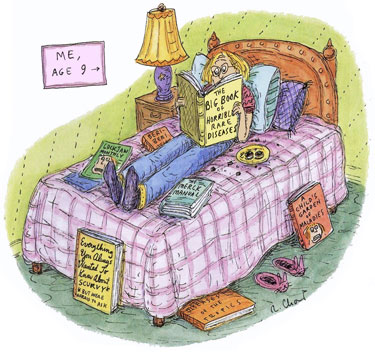
roz_chast_reading
I used to do this exact same thing! As an 8-12 year old, I was a hypochondriac and read my endocrinologist uncle’s medical texts for “fun.” I was fascinated by them but usually wound up worrying myself sick imagining I had the symptoms of some rare disease I’d read about.

So…I just found out today about Roz Chast’s new book, “Can’t We Talk About Something More Pleasant?” Amazon says it’s basically an autobiography told in pictures and cartoons.
I can’t wait to get this.

“Some days I just want to crawl into a hole and make myself very small.”

This article embarrasses me now, but I think it’s a great example of how narcissistic I can be sometimes, even online. I just thought I ought to call myself out about this whiney, self-pitying, falsely-humble, yet grandiose post that’s like wearing a neon sign flashing the words “I can’t take criticism! Waaaaahhh!” This is covert narcissism and BPD in a nutshell. Narcissistic injury. We’re always so butthurt over everything.

It’s interesting. At the time I wrote it, someone called me on this post being very narcissistic, and that upset and angered me (of course!) I actually couldn’t see anything wrong with this self-indulgent post and thought the person was being a bully. They were, but that doesn’t mean the article wasn’t narcissistic.

Seeing myself this way is like having glasses after years of being almost blind.
But I’m being careful not to beat myself up either. The past can’t be undone, but you can make your own future.

luckyotter's avatarLucky Otters Haven

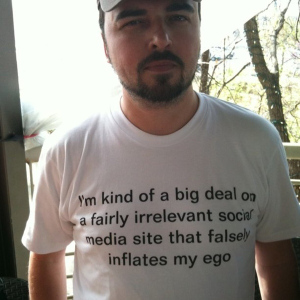
internet_fame

DISCLAIMER:
I feel like a disclaimer is needed, though the above photo should be enough of a disclaimer, because it says it all. Someone made a sarcastic remark about how I think I’m a celebrity because of this post, so I let their comment make me set this post to private, because I don’t have a thick skin and am too chicken to come out with a snappy or snarky comeback. I always think other people can get away with doing that, but I won’t be allowed to. It’s because of my past. I was never allowed to speak my mind or have a voice. Now I’ve internalized that and don’t allow myself a voice sometimes. I’m getting better but I’m not out of the woods yet.

In no way do I put myself in the same category as celebrities (who are just people who get wrinkles, have morning breath…

View original post 1,301 more words

Blogging 101: you don’t need to pay for SEO

google_logo

If you’re like me and want to increase your visibility on the web, you might be tempted to take advantage of those email ads promising instant visibility for a fee: search engine optimization. If you’re not familiar with the term, search engine optimization (SEO) is a service provided by individuals and companies that will put your blog or website and its articles on the top of Google and other search engines. But commercial SEO is expensive and unnecessary. You can optimize your own blog, using some simple tricks, and it costs nothing. All you need is a little patience.

I’ve written other articles about how to write a post people want to read, so here I won’t be focusing so much on how to write interesting and engaging articles, because that’s really another topic. Of course good writing and good looking posts are important, but here I’ll be focusing mainly on how to get the most out of things like social media share buttons, tags, categories, pingbacks/trackbacks, linking, and other tricks that generate maximum traffic to your blog.

1. The title is everything.
Make your titles short and catchy–and maybe a little sassy or controversial too.
This is really part of writing an engaging article but it belongs here because the title is SO important. Titles that are too long and sound like the title of a Ph.D thesis get ignored. It doesn’t matter how interesting or well written your article is. If the title is boring or pretentious, people assume what you have to say is boring or pretentious, and will skip over it. Try to be creative but not so creative your title has nothing to do with the article.

2. Use the Share buttons.
I can’t tell you how important this is. If you’re a WordPress blogger, the share buttons are available through the Dashboard, and include almost all the most popular and well known social media sites. You can also add your own, if the site you want a share button for isn’t available. Even if you can’t stand social media, other people reading your article will use the buttons and do your dirty work for you. I’ve had articles that reached 1K+ shares to Facebook, which would not have been possible without the share buttons. If the buttons aren’t there, chances are no one will bother to share them, even if they enjoyed your article.

share_buttons

3. Use tags and categories.
Be careful with this. I have a bad habit of using too many tags and categories per post. It’s best to choose tags that are relevant to the post, but are no more than one or two words long. Categories are more general and you should use fewer of them than tags. For example, if you wrote an article about why cats shouldn’t be declawed, the categories you would use should be something like: cats, animals, pets, veterinary medicine. The tags could be more specific–unethical veterinary practices, declawing a cat, pets, animals, cats, animal cruelty. It’s okay to repeat your tags and categories, but the tags would be more specific, while the categories are more general. The reason why tags and categories are important is because when someone is doing a Google (or other search engine) search, the tags will refer to your article so it will be listed on the search engine page. Using too few tags means your article may get fewer hits (because people use more than one word or phrase to search for something), but using too many isn’t good either (though I’m not sure what the reason is, and I’m guilty of it).

4. Post every day.
If you’re a serious blogger, you should write at least one article a day. If you only post once a month or once a year, people aren’t going to bother to keep checking your blog for new material (of course, not all bloggers care about visibility and are writing primarily for themselves and that’s okay too, but if you’re that kind of blogger, you have no use for this article anyway).

There will be days you can’t think of anything original or are just too tired to write, so then it’s okay to reblog someone else’s post, post a video you like, a funny or attractive photograph, a joke, a meme, or what have you. But make sure you do post original material often. People will lose interest in a blog that’s nothing but a compendium of other people’s material.

5. Use Twitter #hashtags.
Even if you dislike Twitter (many people do, because of the 140 character limit), if you want to promote your blog, every so often you should choose articles you want to promote or think may generate interest and post it to Twitter with hashtags. If your blog is set up to automatically share to Twitter (as mine is), you can’t add hashtags to the initial share, but later on you can reshare it and manually use hashtags. Hashtags act like tags, and will generate more traffic because when people search for a term using a hashtag, your article will come up in the list if you have tagged it that way. For example, an article about baking chocolate chip cookies could have hashtags like #baking, #cookies, #desserts, #sweets. Unfortunately, hashtags can be one word only, unless you put two or more words together as one, such as #chocolatechipcookie. You should do this only if it’s a term you think people will actually search for. #chocolatechipbananacookies probably won’t work. Keep in mind that due to the 140 character limit on tweets, you can’t use more than 2 or 3 hashtags, so choose them wisely.

Here’s what I do. Every few weeks or so, I pull up my stats page and check which articles are getting the most views and shares (sometimes the most popular ones surprise me!) Since these articles are already getting a lot of hits, I’ll reshare them to Twitter, this time using hashtags, to capitalize on the article’s popularity and generate even more hits. Also, if there’s an article I really like but it seems to be getting ignored, I’ll give it another chance by hashtagging it. Sometimes this works too, and the article suddenly gets noticed even though it didn’t the first time around.

6. Be a necromancer.
Every so often (but not too often!), you can give an old article new life by resharing it. You might want to do this for an article you’re especially proud of or ones that are already getting a lot of hits since those articles are resonating with people anyway. By resharing an article that resonates, your hits will reach the stratosphere.

When you reshare a post to Twitter, you should also reshare to other social media as well. On Facebook, be sure to set it up so anyone can see it, on or off Facebook, not just your friends. At the top of each post, there’s an option for this. The little globe means anyone on or off Facebook can see it.

Set up accounts on other social media too, just to share your articles. I have a Tumblr account I never use other than to share my articles.

necromancer_concept_by_denjinprime
Credit: Necromancer / Deviantart

7. Link to other blogs or websites.
Not only will other bloggers like you (and maybe follow you back) if you give them credit or quote them in your posts, linking to their article generates a trackback or a pingback, which appears on their site under the article itself or in the comments section. The curious may click on the pingback, which will take them to your article.

8. Love your haters.
You might hate having haters (I sure do and will probably never be comfortable with it), but having haters also means your blog is getting noticed. Haters generate traffic. A controversial article will get noticed and that means more hits for you, and your haters and detractors might even share it too. My haters have actually unintentionally brought me new followers, so I do appreciate them for that. That doesn’t mean you should write something controversial or incendiary just to get hits (because that’s basically just being a troll), but it does mean you should be able to write about what YOU want, even if it’s an unpopular opinion or idea.

Since I run ads on this blog, I like to tell my haters that I make money off them every time they visit (it’s only pennies, and I don’t do this for the money anyway, but saying that usually shuts them up).

9. Self-generating hits.
If you do all or most of the above things, there probably will come a time when certain of your articles become self-promoting. That allows you to rest on your laurels a little bit (but only a little). An example is my “20 Songs About Narcissism” list, which was split into two articles so I didn’t have to put too many videos in the same article. If you Google “songs about narcissism” these two articles now appear at the top of page one! That wasn’t the case when I posted them. I think they were on page 16 or something. It happened because as those articles’ Google rank began to rise over time (due to my promoting them), their higher placement generated even more traffic, without my having to do anything. Since there are a lot of people apparently Googling songs about narcissism, and my articles are the first thing they see, they continue to get a lot of hits, and I don’t have to do anything at all to promote them!

So that’s basically how SEO works. All you need is patience and the willingness to pimp your blog in the ways I’ve outlined and watch your Google rank rise and the hits start popping like Jiffy Pop.

Of course, if you’re not patient and can’t do without “instant gratification,” you can always pay for SEO too.

Also see 12 Ways for Non-Lazy Bloggers to Get More Hits.

For even more of my articles about writing and blogging (and how to handle trolls and bullies), see “The Art of Blogging” topic in the header.
“This is the Real Me” (music video)

My son starred in and created this video while he was attending Megaplex 2015 in Orlando a few weeks ago. Enjoy!

How does avoidant PD differ from covert (vulnerable) narcissism?

avoidant_pd_bagoverhead

Covert (vulnerable or fragile) narcissism (cNPD) can, on the surface, look an awful lot like Avoidant Personality Disorder (AvPD–not to be confuse with AsPD!), which I have been diagnosed with, along with BPD.

But appearances are only skin deep.

I found an article on Psychforums (in the Avoidant PD forum) that describes the differences very well. Because covert/vulnerable narcissism is not an officially recognized diagnosis, and is not included in the DSM (yet), covert narcissists are frequently (if not almost always) diagnosed BPD comorbid with AvPD, as I am. Aspergers can also be easily confused with cNPD, and has been by many. But this article focuses on Avoidant PD, not Aspergers.

“Vulnerable narcissism could be misdiagnosed with at least two other distinct DSM personality disorders: Avoidant Personality Disorder (AVPD) and Borderline Personality Disorder (BPD). In the diagnosis of AVPD, there are several criteria that may overlap with vulnerable narcissism. First, avoidant individuals are observed as appearing shy and being fearful of developing close relationships with others. Second, individuals with AVPD may meet criteria for experiencing fears of feeling humiliated, rejected, or embarrassed within individual relationships. Finally, Millon (1996) proposes that the use of fantasy in individuals with AVPD is a major element in the presentation and perpetuation of this disorder. This is striking in the fact that the use of fantasy has long been denoted as primary to the realm of narcissistic pathology.The vulnerable narcissist will likely exhibit significant interpersonal anxiety, avoidance of relationships, and use of fantasy, but this is guided by a core of entitled expectations. That is, vulnerable narcissists may avoid relationships in order to protect themselves from the disappointment and shame over unmet expectations of others, in contrast to fears of social rejection or making a negative social impact typical of AVPD.

Another false positive diagnosis that may occur as a result of misinterpreting vulnerable narcissismis in the diagnosis of BPD. Masterson (1993) forwarded this issue in an elaborate discussion about the potential for misdiagnosis of the closet narcissistic personalitywith BPD. Misdiagnosis can occur because of a clinician’s attention to the overt presentation of the emotional lability in the individual to the exclusion of an understanding of the cognitive and socio-emotional experience that guides the lability. As with social avoidance, the emotional lability of the vulnerable narcissist is influenced by his or her covert entitlement and difficulties managing disappointment and self-esteem threat. In contrast, the emotionally lability of the individual with BPD is a byproduct of unrealistic anaclitic needs (e.g., the need for a strong caretaker to manage his or her fears of being independent).

avoidant personality

Both the AVPD and the vulnerable narcissistic character will likely report difficulties with feeling self-conscious in interpersonal situations, along with the tendency to avoid situations in which they expect to be ridiculed. The difference between AVPD and vulnerable narcissistic characters lies in their expectations for themselves and others. Individuals with AVPD have needs to be liked and accepted by others, but fear they will fail to be acceptable to others. In contrast, vulnerable narcissistic characters need others to respond favorably to them and to admire them regardless of their behaviors, beliefs, skills, or social status, but fear that others will fail to provide them with narcissistic supplies. For vulnerable narcissistic characters, it is not mere concern about being liked or not. Rather, the vulnerable narcissist’s fear is that he or she will not be admired. Furthermore, vulnerable narcissistic individuals experience significant injury and anger in response to perceived slights. Their avoidance of relationships is based upon their fear of not being able to tolerate the disappointment of their unrealistic expectations.

The assessment of entitled expectations and exploitative motivations are important variables that would guide how an individual approaches and experiences relationships, including a therapeutic relationship. Not acknowledging narcissistic entitlement when it is present could lead to important misinterpretations of clients’ experiences that either reinforce their sense of entitlement or lead to unrecognized self-esteem threat in the therapeutic relationship (Gabbard, 1998).”

From “Interpersonal analysis of grandiose and vulnerable narcissism” Dickinson, Kelly A; Pincus, Aaron L

The Cluster B stigma and the nature of evil.

evil_face

I don’t care if what I’m about to say is controversial or unpopular.

There are some folks in the ACON community who think ALL narcissists are evil, and some think all BPDs are evil too. (In fact there are some BPDs who are worse than some narcs).
It’s understandable why people feel that way (and I did for a time myself), but the people who abused them were usually high spectrum malignant narcissists or sociopaths so they think all narcissists (and even all Cluster Bs) are as bad as the abusive or rejecting parents who raised them.

cluster_b

The stigma against Cluster B disorders is very pervasive and it’s getting worse. NPD used to just be a psychiatric diagnosis. Now it’s a condemnation to hell. Even if a low-mid spectrum narc or a borderline is self aware and wants to get better, they’re still put in the “evil” box along with the malignants, psychopaths and sociopaths. It’s always assumed they “have an agenda” or are “full of shit” and everything they say is a lie. I wondered why hearing people say this used to bother me; now I know why. It hurt my feelings because inside, I already knew I was one. I’m self-identified now and really, really want to change and every word I say on my blogs is my reality and truth. It’s my true self speaking, always. I think.

Cluster B’s are cut no slack by some ACONs. We are told we deserve no sympathy even though we were abused too and were victims too. This is extremely damaging to those of us who want to be rid of our Cluster B disorders.

The Cluster B stigma also makes it hard for those of us who want treatment to find it. Many therapists won’t get near someone with NPD or BPD with a 100 foot pole. I remember one therapist I had an intake session with, who I felt comfortable with, but said he’d need to order my psychiatric records before we could go any further.
A few days later he called me and said, “I’m sorry but I don’t treat Borderlines.”
Even if a therapists is willing to see someone with a Cluster B disorder, most insurance companies or government-funded health insurance like Medicaid or Medicare won’t pay a claim for a “Cluster B diagnosis” because it’s assumed they’re incurable. So we are given some other diagnosis instead and treated for THAT disorder (such as depression or anxiety) which doesn’t get to the root of our real problem but only treats symptoms.

victim_badge

People who judge and demonize all narcissists are doing exactly what NPDs and BPDs are so well known for-–engaging in black and white thinking. They don’t believe or realize that narcissism is a spectrum disorder and those in the bottom half of the spectrum probably aren’t evil, even if they’re usually PITAs.

I know there will be some of you who will disagree. That’s fine and we can agree to disagree. I’ll hold to my belief that narcissism is a spectrum disorder with many shades of gray ranging all the way to black (evil).

So what is evil? Evil to me means a person who wants to bring harm to others and has no remorse over what they do and doesn’t care about the suffering they cause–and even enjoys it. It’s a person who goes out of their way to hurt others. It’s a person who tries to destroy the reality or the soul of another human being. It’s a person who never feels guilt or shame over their actions and has no empathy for the pain they cause. All evil people (as far as I know) are of the Cluster B persuasion and most are narcissists (or ASPDs), but not every narcissist or borderline is evil.

To really get a handle on what evil is, Dr. M. Scott Peck’s book “People of the Lie” is the best analysis out there. Most of the stories in his book describe people who would today be called malignant narcissists (high spectrum narcissists with antisocial traits).

Cognitive dissonance and NPD.

narcissism_childhood

I’ve been thinking a lot about the concept of cognitive dissonance and its role in creating a narcissist or turning a narcissist into a malignant one.

Cognitive dissonance is the mental stress or discomfort experienced by an individual who holds two or more contradictory beliefs, ideas, or values at the same time, or is confronted by new information that conflicts with existing beliefs, ideas, or values.

–Wikipedia

A computer will crash or stop working when given conflicting sets of instructions. Although people are not computers (because we have emotions and a soul), if we receive conflicting sets of “instructions” or information about ourselves, it causes so much mental distress that a personality disorder can develop if the conflict appears very early in life.

A child who is constantly invalidated by narcissistic parents tries to correct the cognitive dissonance by “becoming” what the parents tell them they are. If the parents tell them they are evil, bad, always misbehaving, etc. they may become aggressive, overt narcissist themselves to “match” the parents’ assessment of them. If they are told they are incompetent, a loser, stupid, etc. they may develop covert narcissism or BPD instead.

Golden/spoiled children.

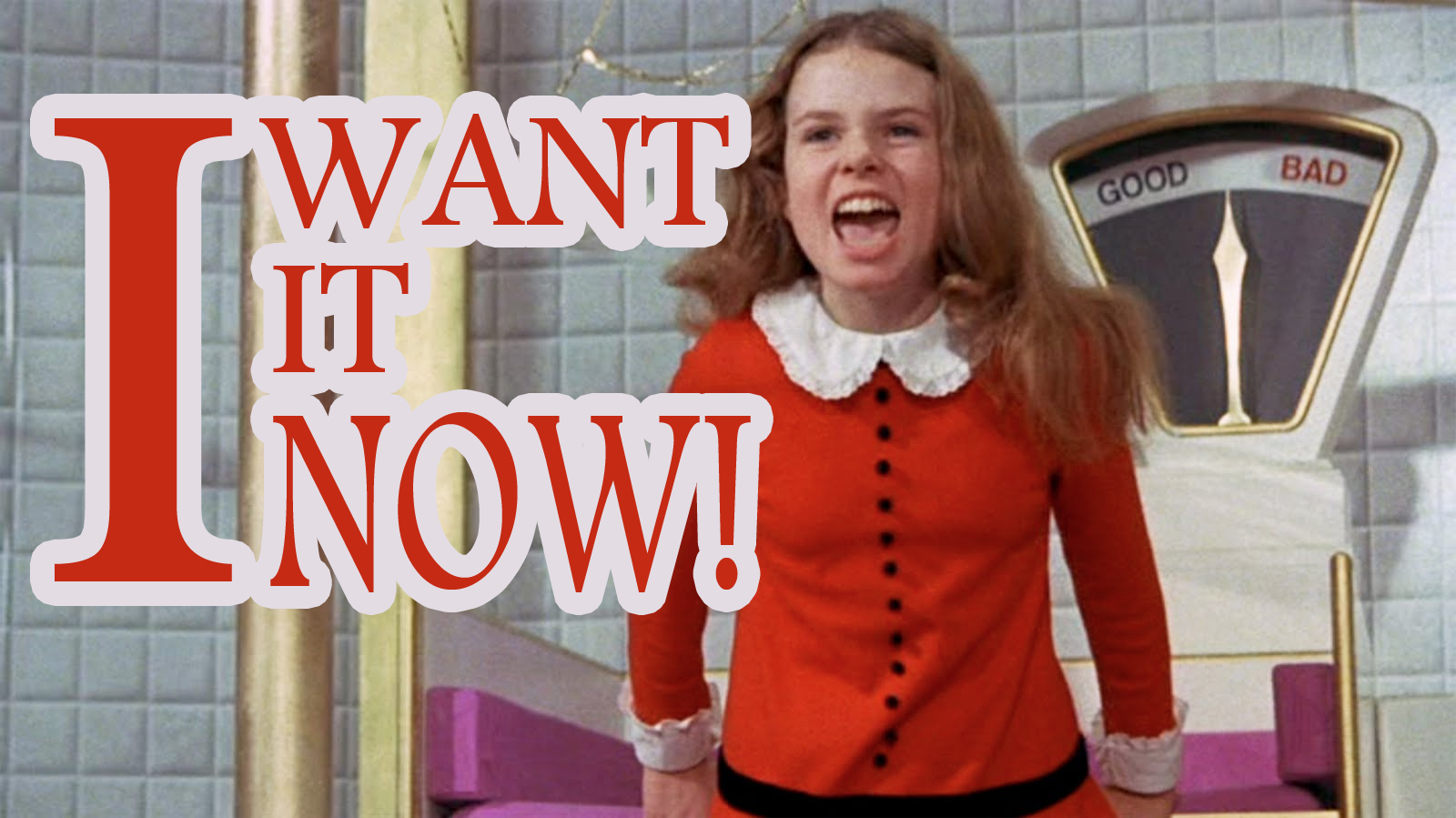
Veruca-Salt

Spoiling a child is actually a form of abuse, because being a golden child negates the child’s own reality that they are human and less than perfect. The spoiled, golden child will either try to be as “perfect” as they are told to match their parent’s unrealistic assessment (and a grandiose false self develops from that) or they know they can’t ever be the image of perfection their parents insist they be, and to correct the cognitive dissonance they may become rebellious or adopt covert narcissism (in which the child believes they are worthless and the parents are wrong) as a coping strategy.

Other personality disorders.

Borderline personality disorder (BPD) is also a way to correct cognitive dissonance. I think BPD develops in many children who were both golden children and scapegoats (which is often the case with onlies) who were given inconsistent parenting, sometimes abused, sometimes treated like little gods. That’s why they’re so conflicted and seem to act in contradictory ways that confuse themselves and those around them.

Not all abused children develop narcissism or BPD, but it’s my belief almost all children of narcissists develop personality disorders, all of which are the adult incarnations of childhood attachment disorders.

Malignant Narcissism.

monsters-nietzsche

Malignant narcissism is NPD that is high on the spectrum and mixed with antisocial (ASPD) traits. A low-mid spectrum narcissist (or even a non-narcissist!) can turn malignant during adolescence or even as an adult. I think this is almost always due to some choice they made or action they were forced to engage in that went against their conscience. Let me explain how this works.

M. Scott Peck in his book, “People of the Lie,” (the book that popularized the concept of malignant narcissists as “evil”) told the story of a man who narrowly escaped becoming evil/malignant. The man, a non-narcissist who loved his family dearly, suffered from debilitating panic attacks when crossing a certain bridge on his drive to work. Even though he didn’t believe in the devil, one day while suffering a severe panic attack he made a “deal with the devil”–he told the devil he could take his favorite son’s life in exchange for allowing him to cross the bridge without having any more panic attacks. Of course nothing happened, and the son was fine. The man, filled with remorse over having these thoughts, told Dr. Peck about it, and was told he did the right thing to repent, because otherwise he would have become evil himself, especially had something actually happened to his son. If he had turned to darkness and narcissism, it would have been to correct the cognitive dissonance between what he had done and his internal moral compass. He would have had to discard his previous moral standards and embrace darkness.

A person forced to engage in something they find morally reprehensible, such as a soldier forced to kill innocent civilians, can turn toward darkness. Many veterans return suffering severe PTSD and in some cases seem to have lost the souls they went to war with. Many, who have committed atrocities in war, correct the cognitive dissonance created by doing something that went against their conscience, by discarding their conscience altogether. This isn’t a conscious choice usually, but is the end result of severe PTSD. (I think all personality disorders are, in fact, manifestions of severe PTSD caused by chronic abuse starting when the personality was still forming.)

It’s my opinion that adolescence is when malignant narcissism is most likely to develop, because adolescents are by nature risk-takers and trying to establish a separate identity from their their parents. This usually takes the form of some type of rebellion, and rebellion is normal as long as it doesn’t go too far. Some adolescents may be “dared” by their friends to engage in antisocial activities. Adolescents are so eager to be accepted in a group of their peers that sometimes their desire for acceptance overrides their conscience, which isn’t fully developed yet. If these antisocial activities hurt others (such as robbing someone’s house on a dare), the teenager’s fledgling conscience is halted in its growth, and may be discarded altogether. It’s at this point an adolescent can turn to malignant narcissism. This is why the choices kids make are so important. Here’s an excerpt from my article, “Healing Narcissism: Stephen’s Story,” in which a fictional boy I called Stephen turns to narcissism as a coping strategy, and it all began with a dare.

The Choice.

bullied_child

Stephen recalled a dare when he was 8 years old. A group of boys who had bullied him dared him to set a paper bag of dried dog poop on another boy’s rickety wooden front porch and set it on fire. The boys promised him that if he did this, they would no longer bully him and they would be his friend and protect him against any further bullying. Stephen knew that doing this could set the other boy’s house on fire and at first he protested, explaining what could happen. At this point he still had a conscience. But the boys threatened him and told him if he didn’t do it, their bullying would become worse and they would kill his pet rabbit. Stephen believed them, so against his will, he complied.

They set out after dark for the targeted house. The boys watched from the darkened yard as Stephen lit the paper bag on fire and hesitantly walked up the front stairs of the boy’s porch and set it next to a dead potted plant. The deed done, all the boys ran away before anyone saw them. Stephen looked back in time to see the flames ignite the plant, and quickly start to spread over the railings of the rickety old wooden porch. He felt awful and considered going to the police, but he didn’t dare. He went to bed that night and had terrible nightmares.

The targeted boy’s house burned down and he, his baby sister, and his mother had to be taken to the hospital to be treated for smoke inhalation. Soon after, the family moved away, never to be seen again. No charges were pressed because no one knew who the culprit was.

To protect himself from his unbearable feelings of guilt and shame, Stephen shut off his painful emotions of guilt and conscience. From then on, the group of bullies accepted him as one of them, and they continued to engage in tormenting other children and even petty crimes.

This is an example of cognitive dissonance. Stephen would not have been able to live with himself had he not turned to narcissism as a coping strategy. The irony here is that, the more intense the child’s guilt or shame over committing an act that goes against their morals (or the more heinous the act), the more likely it is they will turn malignant, because to do otherwise would mean the overwhelming shame they feel could likely cause them to become severely depressed or even suicidal. This isn’t an excuse for anyone to turn to narcissism (or malignant narcissism) as a coping strategy, but is an unfortunate reality.

Acquired narcissism.

narcrealityshows

Sometimes people who become extremely successful, such as celebrities, sports stars, business leaders or politicians, can become narcissists, even if they were not narcissistic before their success. It doesn’t happen to all of them, but if it does, this is another example of how cognitive dissonance tries to “correct” things. In order to close the mental gap between their actual assessment of themselves as imperfect humans and the adulation they receive from the outer world that treats them as if they’re somehow more than human, a successful person can turn to narcissism to align their self-assessment with the way they are regarded by others. This is why some celebrities become so full of themselves or manipulative. It’s a form of acquired narcissism, but because it’s acquired fairly late in life and isn’t due to a choice, this type of narcissism may be temporary and only last as long as the person remains famous or very successful. If they fade into obscurity, the person faces a narcissistic crisis, but after that I think they can return to a non-narcissistic way of being in the world.

What It FEELS Like to Live This Way

Incredible description of covert narcissism. This is exactly what it feels like to be one.
I can’t even express how glad I am that now I know. Things have already shifted and my whole perspective is changing. I’m so glad I “came out” about it too. Doing so was TERRIFYING!

healingnarc's avatarFrom Narcissism to Nirvana

There is a wonderful NPD research paper available at: http://ps.psychiatryonline.org/data/Journals/AJP/3874/08aj1473.PDF

It is my personal opinion that this is the most scientifically accurate description of NPD and its subtypes.

My NPD falls under the ‘fragile’ category.

According to their Q-factor analysis, the following traits are typical of the fragile narcissist experience. In order to add the actual viewpoint of a fragile narc, I am including the ranked list of traits and how they manifest in my life.

Please note that it is difficult for me to separate my current sense of awareness from my history. I may use past and present text in some places, but my general intent here is to describe what my life has felt like for the past 35 years.

Maybe it can be useful to help self identify if you think this is what you have!  Just be sure to confirm with a trained and licensed…

View original post 3,326 more words

False self vs. true self.

wolf

UPDATE: I wrote this post during a four-month period of time when I thought I had covert narcissism.   I don’t (BPD + Avoidant PD in the same person can look a LOT like C-NPD and even confuses some professionals), but I think this still applies because Borderlines do indeed have a “false self” (and to some extent, everyone does) which is just less developed than someone who has NPD.  

Like the wolf graphic above shows, all human beings have a good self and a bad self. But in a narcissist, the good (true) self is dissociated and split off from the bad (false) one, where in normal people all these feelings are integrated into One Self.

I’m beginning to see the woman I can become. The woman I would have been had I not been so abused and allowed myself to fall under the thrall of a malignant narcissist/ASPD man for 27 years.
That woman is taking shape in my mind and all I need to do is find a way to reconcile this new vision with my reality.
She’s someone I like very much–the adult version of the sensitive little girl that brought me so much shame and humiliation because no one mirrored her positively.

My True Self…

Enjoying the sun

Enjoying the sun

–Is in touch with her feelings but doesn’t fly into BPD rages or seethe with envy, bitterness and resentment. She’s in control but can feel appropriate emotions at appropriate times, and isn’t ashamed to show them.

–Is naturally introverted (INFJ) but not shy. People don’t intimidate her but as an inward-looking person, she often prefers solitude to pursue activities and interests she loves. (I’m already halfway there).

–Is creative–she uses her ability to write to purge her past and her emotions (I’m already doing this) and sometimes just for fun (my other blog has a lot of silly or humorous posts). She also loves photography, art, music and wants to learn to play the guitar to accompany herself singing. She’s not a talented singer, but sings for the joy of it. Music feeds her soul.

–Is quietly confident and not afraid to let someone know when her boundaries or rights are being violated.

–Is able to make and keep close friends, not just acquaintances she keeps at arm’s length.

–Is an HSP with possible empathic abilities. (I’m not there yet).

–Is authentic and nurturing, and truly wants to help others discover who they are (I actually do want this now, but I’m mainly doing it for myself. If I help others along the way though, it makes me feel good).

–She feels attractive and even sexy, but appreciates the beauty in others and in the world around her too. She feels beautiful by knowingly and mindfully being a part of beauty (and almost everything has a certain beauty).

–Is able to parlay her love for writing into a career as a published author. No feelings of, “but I’d fail at it.” She isn’t afraid to take smart risks to turn her desire to express her insights and emotions into her life’s work.

My False Self…

false_self

–Is selfish and demanding, always complaining about how badly she’s treated or disrespected.

–Always thinks everything’s about her. If someone looks at her the wrong way, she lets that ruin her entire day and thinks everyone hates her. If she walks into a room and everyone smiles, she focuses and ruminates about the one person who is scowling.

–Overreacts to slights and occasionally flies into rages (this may be more due to BPD; my DBT skills have mostly got this under control though the rage is still present).

–Is envious; can’t be genuinely happy for someone else’s good fortune (except for my kids).

–Sometimes secretly gets a thrill on hearing someone else’s bad news (I’m really ashamed of this and it’s really hard to admit this). I don’t feel that way all the time though. I don’t try to cause pain to others. I hate being the perpetrator and have a lot of guilt and shame when I know I’ve caused someone pain. I’m a passive sadist, I guess. Isn’t schadenfreude the term for this? I’ve read that everyone experiences it, but I think I have it more than most people.

–Feels secretly superior under a self-loathing exterior. Of course I loathed myself to the core (not so much now), but to correct the cognitive dissonance between what I was and what I wanted to be, I’d denigrate others and put my own actions on a pedestal. For example, when I thought I had Aspergers, I felt “superior” for not being a neurotypical and used to feel contempt for people who had a lot of friends or an active social life, or the ability to feel comfortable in a group setting. I actually envied their ability to connect with and not fear the judgment of others , but I convinced myself I was somehow “better” because I didn’t have to engage in stupid small talk and my mind was probably superior to their anyway.

–No matter what the situation, I always think about how it’s going to affect *me* first.

–Fearful of getting involved in a romantic relationship, yet at the same time I long for one. (This is probably more due to my BPD).

I’m happy to say a lot of these FS behaviors are diminishing, just through the self-discovery I’ve achieved through blogging for the past year. A couple of my FS traits have nearly disappeared. I seem nice now, and I am nice (I don’t think I present my false self on this blog), but I wasn’t always so.

I just noticed I wrote most of this list in the third person–isn’t that something narcissists are known to do? :/

Fear breeds narcissism; the antidote is vulnerability.

I think this article applies to anyone trying to heal from any personality disorder, PTSD, or the fallout of narcissistic abuse, so I’m posting it here too.