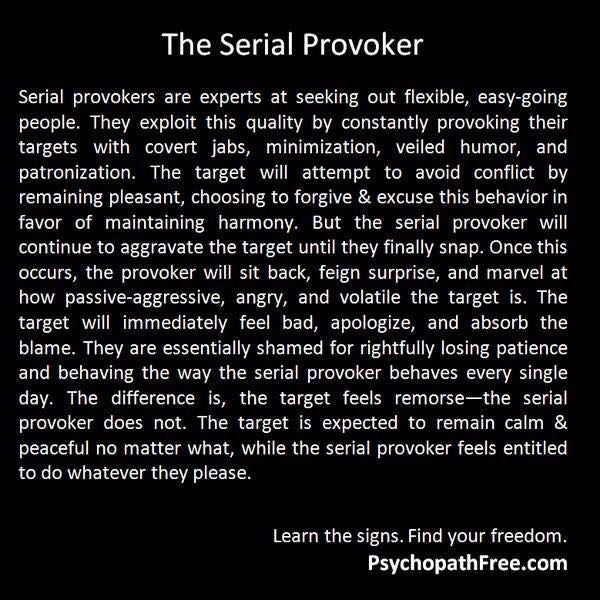
Serial provokers.

This is my ex to a T.

serial_provoker

“Reclaiming My Life”– Michelle Mallon’s Story of Healing

after_narc_abuse

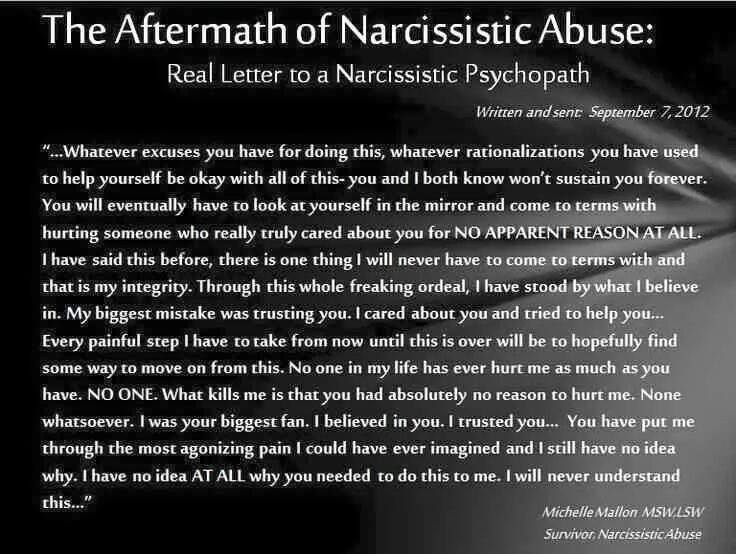
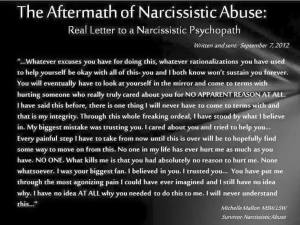
The following is a followup article to the one I linked to in my post After Narcissistic Abuse, in which Michelle Mallon talked about how her psychopathic therapist almost destroyed her life and stole her soul.

This is an important topic, because malignant narcissists, sociopaths and psychopaths are so often in the “helping” professions, especially psychotherapy. They prey on vulnerable people who come to them in desperation, hurting and wanting to trust someone. These “mental health” professionals know this. After gaining a patient’s trust, evil-intentioned and sadistic therapists like Michelle’s therapist use the things their client told them in confidence against them, or even use them to threaten or gaslight them.

I’ll only post the first part of the article, which is long. But the journey back to feeling normal from PTSD caused by abuse is sometimes a long and arduous journey. There’s no way to describe this process in just a few words or even a few paragraphs. To read the rest, you will need to click on the link to Michelle’s article, which appears at the end of this post.

Reclaiming My Life
By Michelle Mallon, MSW, LSW
In this article, Michelle Mallon discusses her healing journey following abuse by a psychopathic therapist.

Recovering from therapist abuse is hands-down the most painful experience I have ever gone through in my entire life. Healing was incredibly difficult for so many reasons, some of which make me very angry and some of which have brought me great insight. Because of the impact healing from therapist abuse has had on my life, I find it impossible not to want to reach out to others who have been hurt by mental health professionals. Some people have told me that this is because I am unable to “get over” what happened. I explain to them that there is a difference between “getting over” something terrifying and callously moving on, leaving so many others behind knowing that you were very lucky to have ever healed. (I usually say this right before I tell them what they can go do with themselves.) The reality is that for most of us trying to overcome therapist abuse (regardless of whether it is sexual, emotional, spiritual, etc.), very few other people have any idea what we are going through (even the mental health professionals we finally get up the courage to see after the abusive ones to try and pull ourselves back together). And because of that, healing can be significantly more difficult than it should be.

Just recently, I began reading the Your Stories page on this site. I was immediately reminded of the isolation and fear I felt as I tried to find my way through the aftermath of therapist abuse. I drafted a message for the Your Stories page and then I immediately felt like it was just not enough. I then asked Kristi if I could write a piece that would hopefully reach more survivors. I have found the path to healing. I don’t really know how I ever found it because, looking back, I can see just how carefully hidden the path is. I don’t know if my path to healing will be similar to yours. In the hopes that there will be some similarities, I want to identify the things that helped me find my way through this in case it can help even one survivor.

This time last year, I was just beginning to feel my “old self” returning. I was finally able to leave my house for short periods of time without having panic attacks or near panic attacks. I was beginning to be able to focus on something other than what had happened in the years before. And I have to tell you, I couldn’t have been more relieved. The truth was that for a very long time before this, I wasn’t sure I would EVER recover from what I had been put through. In fact, I truly believed I was broken beyond repair. It was the most frightened I have ever been in my life.

nurse-ratched
Nurse Ratched, the sadistic psychopathic nurse/therapist in the movie “One Flew Over the Cuckoo’s Nest.”

This year, my life is very different. I look back at the woman I was a year ago and I can see tremendous growth. However, I can also see that even as I was beginning to re-find myself under all of the manipulation and destruction I had been through, I still had a long way to go. There were times when I first started out on this journey where I was making progress, but I didn’t realize I was making progress. I would frequently begin to feel stronger only to be dealt a cruel blow of fear and confusion that would set me back for days, sometimes weeks. If I would have known then that this was how the process went, I don’t think the journey would have been nearly as frightening. And perhaps, this time next year, I will look back and see that I have continued to grow, even from this year. It’s impossible to say. This journey to healing has been nothing short of miraculous. Just when I think I have “uncovered” all of the insight this journey has to offer, I am humbled by another incredible phase of insight. I don’t know if this growth and self-discovery will ever stop. Perhaps if I viewed all of this more as a journey and not as simply reaching a destination, I would have found more peace in the whole process. But to be perfectly honest, as I started out on this journey there was nothing peaceful at all about any of this.

The truth is that the very start of my journey, like many of yours, was incredibly painful—almost unbearable at times. I felt completely lost. I really didn’t know how I had gotten to where I was, and I really had no idea how the hell to get back to where I was before. Some of the worst parts of the journey to healing after therapist abuse had to do with trying to make sense out of what happened with the abusive therapist. And because I still missed him, I was convinced there must be something wrong with me. For almost a year after I refused to see him any longer, I replayed everything that happened during the time that I knew him, trying to make sense out of what happened. I tried desperately to understand what I could have done differently to prevent the relationship from crumbling the way it did. I would look at certain aspects of what happened and think, “He must have cared about me and just lost sight of what he was doing.” And I would be at peace with that thought for a few days. And then nagging doubts would creep in, “But if that were true, why did he just leave me to fall apart on my own? Why, after I told him just how much this had harmed me, did he choose to remain silent and not help me find closure?” A person who cares doesn’t leave someone they hurt (even if it was unintentional) to self-destruct in the aftermath. It seemed like no matter which way I looked at what happened, I could not come up with a “reason” for what happened that made any sense at all. And for that reason alone I was doomed to continue to replay the events in my head, searching for an answer I might never ever find. How else could I feel safe against something like this happening again in the future? The only way I could move on was if I understood what happened and why. And the person who needed to help me understand all of that made it very clear that he had no intentions of ever helping me get to that point. And because of that, it felt like he completely controlled my recovery from this.

evil_inside

And then it happened. Driven by a relentless desire to understand WHY, I had searched tirelessly online for something that would help me understand what the hell happened. I had been seeing a new therapist for about nine months (and I have to tell you, doing that took all of the courage I had in my body!). There were so many times that she seemed just as confused as I was about what happened with the abusive therapist. I was trapped in a cycle of reliving everything that happened over and over again, searching for answers. It was driving me to the point of insanity. As I learned more and more about this thing called “Narcissistic abuse” I began to realize that there was a reason why I had been spinning my wheels trying to understand what happened. There are people who exist who lack any ability or desire to feel any empathy or remorse. Even worse, they lack a conscience. They can cruelly destroy people who are loving, caring and honest and not feel a bit guilt or sorrow for having done so. In fact, in many ways they appear to be “annoyed” by the fact that the people they have hurt are making such a big deal out of what happened. Even worse, they are masters at making themselves out to be victims. Oftentimes, people like these leave behind them a trail of broken bodies and wounded souls as they continue on their destructive paths.

I began to learn new words—words like grooming, gaslighting, trauma bonding and soul murder. These were words that I either had never heard before or had never truly understood until I lived them. These words—words that described things that I experienced but couldn’t put into my own words—were a vital part of my healing. Suddenly I felt a lot less alone. I knew that if someone came up with these words and the definitions that explained my story, somebody, somewhere understood.

But learning these words and reading about Narcissistic abuse was really just the start of my journey. Taking all of it in was a different story. I would frequently find myself wanting to read as much as I could about Narcissistic abuse and then I would experience times where I didn’t want to look at anything at all about it. At first I would get angry at myself because I thought I needed to go through this process a specific way and it was not always the same way that I was feeling. I would get so frustrated with myself as I would read pieces that helped me begin to move forward in my understanding of what happened, but then feel like I was moving backwards. I remember thinking that maybe I was just making myself believe that I was feeling better and that I was really not making any progress at all.

It turns out that understanding and reprocessing what I had been through happened in phases. This wasn’t like any learning I had done before. In the past, if I wanted to understand something I would read about it and integrate it into my way of seeing things. With Narcissistic abuse, there were so many “layers” of understanding that were essential to my healing that this linear process of learning that had worked for me in the past was ineffective with this. There were many times where I would read an article or a book about healing from Narcissistic abuse and feel as if I had taken all of the important insight that the piece had to offer. And then later, I would stumble upon the work again and be shocked that there was insight in it that I hadn’t noticed before. It wasn’t that the piece had been edited. It was because my brain was allowing me to take in more of the picture of what I had been through. That brain of mine, that part of me that I thought had surely been destroyed in the abuse, was actually guiding me carefully through the process of slowly taking in what I could handle. In fact, I can remember times where my brain would almost “compel” me to read more about Narcissistic abuse and times where it would want to do anything other than reading about Narcissistic abuse. I slowly learned to listen to my brain and do what it seemed to be urging me to do whenever it would do this.

And there was another aspect to understanding what I had been through. As I began to understand what my abusive therapist had put me through I began to realize that I had seen this kind of abuse before in my life. In fact, many adult survivors of Narcissistic abuse eventually come to learn (if they can find the path to healing) that they have been primed by previous Narcissistic abuse to tolerate later Narcissistic abuse. For me, like so many other survivors of this type of abuse, I found myself not only healing from one emotionally destructive relationship, but several. The grief was overwhelming.
warning_sign9
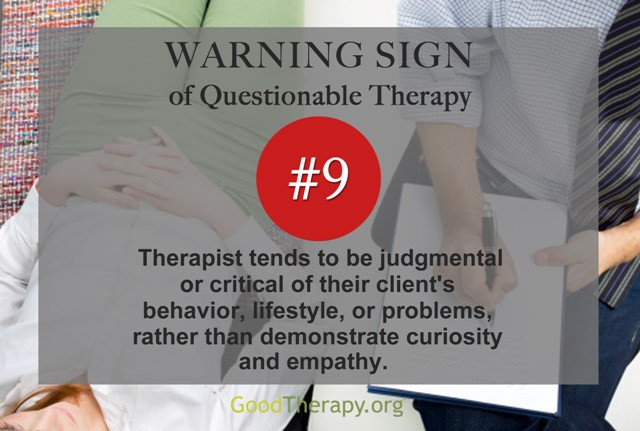
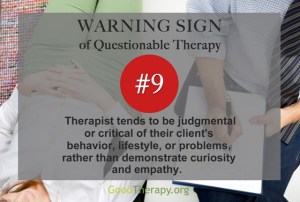
From 50 Warning Signs of Questionable Therapy or Counseling.

Perhaps one of the more difficult aspects of the abuse that I had tried to understand was where in the relationship with the abusive therapist that things went wrong. For a while, I believed that the therapist had somehow changed, since he seemed so competent for a long time before the abuse actively began. And I found myself searching for some point in time where I should have stopped trusting him. I think I believed that knowing this was important so I could have understood at what point my “screaming gut” was right. It wasn’t until a good friend of mine pointed something out to me that I hadn’t thought of before. He told me that there wasn’t any point in time when I should have trusted the abusive therapist. He said to me, “Michelle, he’s a predator. The only reason why he seemed so competent and trustworthy for so long at first was to gain your trust so he could effectively lure you away from your comfort zone. Tell me, would you have allowed him to say many of the things he said to you if he had started the relationship out doing that? No, your inner alarm bells would have been going off like crazy.” This was a pivotal moment for me because I had not given any thought at all to this possibility. I would never imagine hurting someone like that. It was finally starting to click in my head that I didn’t understand what happened for a reason. In fact, I never saw any of it coming because I never imagined anyone would ever treat another human being like this. My own profound compassion and deep empathy for others was something I assumed everyone else had. I am finding that many survivors of this type of abuse “suffer” from the same naiveté because of their own inner compassion and empathy.

Read the rest of Michelle’s story here: http://www.survivingtherapistabuse.com/2015/03/reclaiming-my-life/

Also, please read this article: 50 Warning Signs of Questionable Therapy or Counseling.
If your therapist does any of these things, they are red flags. Be wary or find another therapist.
I am not your dream.

noones_dream

From the Facebook page Narcissistic and Emotional Abuse.

My son’s father turned from a loving dad into a monster.

ian_9months
My son at about 9 months. His dad doted on him then.

Turning on a child who was initially loved and doted on is not unusual for malignant narcissist parents. If the child proves to be sensitive, highly intelligent, or can see through the parent’s agenda, they may find themselves suddenly turned into scapegoats. Betrayal of a child means nothing to a narcissistic parent. The child was never a child even before the betrayal, just supply.

My son (who I’ve been calling Ethan on this blog but that is not his real name) was born in October 1991 and initially was very much wanted by his father. During his infancy his father appeared to love him very much and it wasn’t unusual to find my beautiful little boy snuggled up against his dad’s chest. Though Michael (also not his real name) was showing signs of the abuser he would soon become, the abuse was directed at me, and didn’t happen often enough in those days that I was that concerned.

By the time Ethan was 3 or 4 he was showing signs of being a highly sensitive (and very creative) child. He cried frequently and was given to tantrums when he sensed discord, anger or chaos around him. He was always very sensitive to his environment and didn’t react well to everyone and he hated change. He still remembers himself as being an extremely nervous child, but those nerves were due to his high sensitivity. I was much the same way when I was his age. I could always identify with my son.

I remember when he was two, when we were moving from New Jersey to North Carolina. Because we didn’t have a lot of money for a long distance mover, we moved most of our stuff (except large pieces of furniture) in a U-Haul and a car over five separate trips. During the time the house was being slowly emptied, Ethan began to act very strange. He stopped eating, looked pale and his eyes looked too big for his face. He hadn’t really started talking much yet, but did this strange “parroting”–he’d repeat “Hi Mommy! Hi Daddy!” over and over, in a strange high pitched voice. It was creepy. His doctor said not to worry, but he just wasn’t himself. Then it finally dawned on me: a very young child sees things disappearing and doesn’t understand why (he hadn’t come on the moving trips to see where the things were going). His two year old mind deduced that eventually his parents and baby sister would disappear too, leaving him alone, so the nervous parroting of “Hi Mommy, Hi Daddy,” was to make sure we were still there and weren’t going to leave him. To a sensitive child like Ethan who hated change as much as he did, watching the things in his environment disappear must have been traumatic for him. I asked him about this recently and he still remembers it. He told me my suspicions had been correct. He was afraid we would disappear!

ian_age3
Third birthday. He received a cake with a blue toy car on it.

Michael saw this high sensitivity as soon as it became apparent, and suddenly his affection toward his son came to a screeching halt. He began to pick on and belittle him, calling him names such as stupid, idiot, “faggy,” pussy, baby, and loser. As young as Ethan was, I could see how his self esteem was already taking a beating. Soon he became nervous and awkward around his father but of course this just fed the abuse.

Soon Michael began to physically abuse Ethan, spanking him almost every day just for being who he was. Whenever I criticized or questioned Michael about why he was treating Ethan this way, he just said he was trying to “toughen him up.” (this from a man who called himself a feminist–go figure that one out!) I told him his aggressive behaviors toward Ethan to “man him up” were not working because Ethan wasn’t built that way, and besides they were very unloving. I told him I was afraid Ethan would think his father hated him, but of course my concerns were dismissed and I was called wrong, stupid or crazy. We had many fights about this, but the abuse never stopped. In fact it kept growing worse.

Michael constantly made fun of Ethan, imitating his speech, his walk, his awkwardness. Ethan was bullied at school for a time, just as I was, and my heart broke for him. I loved my son so much, and couldn’t bear to see the way his father treated him.

ian_age8
Ethan at about age 8, around the time his father destroyed his car collection.

The incident that I remember with the most anguish occurred when Ethan was about 8. He had a collection of about 15 or 20 collectible cars his grandfather had given him over several years and Ethan was very proud of them. He displayed them on a 5-tiered shelf in his room. One evening Michael came raging into his room for one reason or another (he was often drunk and some of his rages seemed to be caused by nothing) and knocked over the stand, sending all the beautiful and expensive replicas crashing to the floor. All of them were destroyed beyond repair. Ethan burst into tears and begged him to stop, but Michael was relentless and began pounding on him, calling him a stupid faggot crybaby, and demanding to know why he couldn’t “man up.” I was in the room at the time, desperately trying to push him away from Ethan but to no avail, because Michael was much stronger than me, and by then I was myself afraid of his rages.

This incident haunts me to this day. It’s hard for me to think of it without my heart breaking, because of how painful it was to see my brilliant, creative, sensitive little boy’s car collection destroyed for absolutely no reason at all — and my son’s self esteem taking such a beating from the man who had once seemed to love him so much during his first few years.

Fortunately, Ethan was always much stronger than he seemed, and smart too. He chose to live with me after we divorced instead of his father. Kung Fu lessons paid for by my father (which he stuck with for 3 years and got as far as brown belt) and an Outward Bound expedition for his 8th grade trip began to change him and help him rebuild his self esteem.

ian_age15
Age 15.

He came out as gay at age 17, and since then has become a happy and well liked young man with many interests and talents who is making good choices in life. (He also chose to live hundreds of miles away from the family but I can’t say I blame him for that). While it’s sad he lives so far away, I’m happy that he’s happy now and that after everything he went through, he may be the most mentally stable member of the immediate family. He is the only one of us who doesn’t appear to have a personality disorder.

ian_age23
Today at age 23, living on the Gulf Coast of Florida.

Not all children who were turned on and scapegoated by a malignant narcissist parent were so lucky. Many were psychologically destroyed or even killed. Ethan was one of the lucky ones.

See also:
My Son Didn’t Escape Unscathed: https://luckyottershaven.com/2015/05/11/my-son-didnt-escape-unscathed/
My MN Ex’s Weird Attitude to His Son: https://luckyottershaven.com/2015/02/24/my-mn-exs-weird-attitude-to-his-son/

My son didn’t escape unscathed.

leavinghome
This is not a photo of my son, but it looks a little like him.

My 23 year old son was scapegoated and bullied by his father when he was a child and teen (which I’ve written about before). As the most sensitive and nervous child in the family who was able to see through his father’s malignant narcissism, his father began to target him for abuse when it became clear to him my son had a good built-in bullshit detector.

When he was 17 he moved out of our home to stay with a female police officer who worked at his school. She was very supportive but after awhile he decided to move back in with us briefly. When he turned 18, he moved to another state and has not been back, although he does talk to me on a regular basis. Due to lack of funds, I’ve only seen him 3 times since he moved out in 2010. He is doing well though–working two jobs, one as a management trainee for a chain of convenience stores in the Tampa, Florida area, the other as a Carraba’s server where he sometimes pulls in as much as $700 in a single weekend.

He has many interests and talents, including dancing, animation, and filmmaking (which is what he really would love to do). He came out as gay when he was 17. After that happened, he transformed from being a nerdy, nervous teenager with few friends to a very popular young man with a geeky, eccentric sort of cool and many friends. He doesn’t do drugs or smoke. He drinks, but doesn’t appear to have an alcohol problem.

ianrowan3
Photo of my kids in Texas in 2001.

I thought he somehow emerged unscathed from the family dysfunction. He shows no signs of having any personality disorder, although he has reported having panic attacks and he tends to be obsessive in his thinking. He’s also prone to depressions.

Tonight we talked to each other on the phone for awhile and he described his obsessive thinking. He worries about locking the door, for example, and has to keep going back to check to make sure he locked it. He hates having anything dripped on him, and that can set off a rage attack. They are like panic attacks, but instead of panic, he feels rage. He doesn’t act on the rage, but he feels it. Then he feels guilty for feeling that way. He doesn’t like people approaching him from behind and is jumpy and wants to attack when that happens. He worries incessantly about the impression he makes on others and suffers from occasional paranoia, and thinks others are out to hurt him, even when there is no rational reason for him to think this.

kelphead
Sporting kelp “hair extensions.”

It sounds to me like he suffers from a severe anxiety disorder, and probably has OCD. He can afford health insurance now, so I told him to please see a therapist who can find out if what he has is OCD or something else, and possibly give him some medication and therapy. He’s willing to do this. I still think he’s the most mentally healthy person in the immediate family, and the only one who is doing well financially and doesn’t appear to have a personality disorder, but he’s far from unscathed from the abuse inflicted on him, and his hypervigilance and anxiety is no doubt due to that (though there could be a biological component too).

The “red flag” you should never ignore.

red_flag

When it comes to narcissism, there’s a lot of talk about red flags: behaviors that are associated with narcissistic abuse, such as lying, gaslighting, lack of empathy, grandiosity, and refusal to admit wrongdoing.

But there’s one red flag that’s underrated because it’s so subjective: your own intuition.

When you first meet a narcissist, they may seem like the nicest person you ever met. You might not see any of the usual “red flags” immediately. Before you know it, you’re involved with a person who only has ill will and will make you feel like you’re going insane. When you finally realize what you are dealing with, they may have already wreaked havoc in your life–stolen your time, your patience, your trust, your money, your self-esteem, your job, your spouse, your sanity, your identity, even your soul.

Pay attention to the way you feel around someone you just met. If you feel inexplicably on guard, intimidated, wary, or feel like you’re walking on eggshells, if the person comes off as insincere or smarmy, or you just get the heebie jeebies around the person, don’t dismiss these feelings as only your imagination. Your unconscious mind is picking up signals you may not be consciously aware of and is warning you. Listen to your feelings and if possible, get away from this person. Or at least watch them carefully.

It’s easy to dismiss intuition as irrational and a product of an overactive imagination. You’re a nice person and want to give your new acquaintance the benefit of the doubt. If you’ve been a victim of narcissistic abuse in the past, you may have learned not to trust your own feelings. But these early feelings can serve as warning signals before you see any actual red flags. Don’t question them. They are trying to tell you something.

Chicken soup for abuse survivors.

I love Delusion Dispeller’s videos. Follow her on Youtube.
This is so inspiring and I love the butterfly she wears on her cheek.

Letter from a narcissist’s “true self”

narcissus1_caravaggio

Here is a hypothetical letter written from the point of view of a narcissist’s True (lost) Self.

The advice given here by the True Self is almost the polar opposite of whatever their False Self would tell you. That’s because their False Self is a lie and isn’t who they really are, even though they may have been wearing this mask for so long they can never access their True Self without enormous difficulty or even at all.

Always follow the advice of their True Self, no matter how much they protest and rage, unless you want further abuse. It’s actually the best thing for them if they ever decide to look in the mirror past the lies they show the world (and may have come to believe is the truth)–and of course it’s best for you.

Letter from a Narcissist’s True Self:

Dear Victim,

I have lied to you about nearly everything. I am not sorry for this behavior because I cannot empathize with you. I chose narcissism so early in my life that I never had the chance to develop a conscience or the capacity to feel remorse or empathy for the way I hurt you. Still. I know it’s wrong on an intellectual level. I just cannot feel your pain. Sometimes I wish I could, but I can’t.

I became a narcissist because as a child I felt too vulnerable. I was sensitive. I felt too much and most of it was painful. I was made to feel like I was nothing, a nobody. I was hurt, betrayed, abused, just like you. I couldn’t understand why I wasn’t loved, or why I was treated with contempt and like I didn’t matter. I was also was never given a good example of how to become a good person. I never had anyone to model in a positive way.

Life was so painful for me I had to do something about it. Something drastic. I had to become strong and never show weakness again, because my weakness was killing me. I was trained that being a sensitive person who feels compassion and remorse, a person who can love others, is a weak person. I know that isn’t really the case, but it was how I was trained. I was so young that I couldn’t see how wrong that might have been.

I reached a point where I had to make a choice. In order to survive, I had to sacrifice my humanity. I didn’t want to do it, but I felt like I had to. I didn’t want to be hurt anymore. I had to sell my soul.

In order to sell my soul, I had to shut you and everyone else out. I couldn’t allow myself to feel too much. I couldn’t allow myself to be sensitive anymore, and that meant I could no longer allow myself to love anyone, feel anyone else’s pain or joy, or feel sorry if I did something wrong.

I had to don this mask that I wear, which is a lie. In order to keep that lie intact, I had to treat others badly. I had to diminish you to prop my false self up. I had to hate you in order to “love” the mask that I show the world, because if I didn’t continually prop myself up by making you feel bad, my mask of lies might fall off and expose the real me, a powerless and vulnerable child which I had to protect at all costs, even if it meant destroying everyone else around me. I am a bully but inside I know I am nothing. I act like I love myself but I really hate myself. I only love the mask I wear. I abuse you to protect that mask.

michelle_mallon_quote
Read Michelle Mallon’s story here.

You can never get through to my true self because the lies I tell are nearly impenetrable. I have lied so often and for so long that I myself have come to believe my own lies. I am a walking lie. That is the truth.

I will never let you get close to what I really feel. I don’t even know what I feel anymore. Most of the time I feel nothing, because a lie has no feelings. But try to destroy my protective armor, and I will try to destroy you. If I must go down in flames, I am going to take you with me. I will rage and abuse you. I will gaslight you and tell you the most horrific lies about yourself.

I may seem nice at first or when I feel like the supply you give me is threatened or you may leave. I know how to get others to trust me–by acting like a nice person. I am good at acting like a nice person but I can’t feel a nice person’s emotions. It’s hard work to act nice, because that’s a lie too.

When you begin to trust me, I will start abusing you, because I must keep you at arm’s length and keep my mask of lies intact at all costs. Both the niceness I show you and the asshole I become are both lies. I cannot even access who I really am. I have forgotten. I just know that my true self is there, somewhere, and I can never, ever, let you meet them.

If you mirror back to me too much of the truth about me–if I become aware that you KNOW this mask I always wear is a fake–I will attempt to destroy you or cut you out of my life. I cannot afford to have the truth about myself revealed to me. Nothing terrifies me more than facing the truth about myself so I have dissociated myself from it. It scares me so much to realize how evil I have become. It hurts me so much that I had to choose this fake self because of what was done to me. I hate being evil. I really don’t want to be this way but I will never, ever admit that. I cannot ever show you or anyone in the world how weak and vulnerable I really am. But deep inside, I know I am.

incrediblehulk

I am still an infant. I never grew up. My emotional and moral development was arrested when I was just a very young child, so I only have the emotional maturity of a child that age. That’s why I can’t care about you. It’s why I must always have my way. Can a two or three year old care about YOUR feelings? Of course they can’t, and like a toddler, I can’t either. I am like a mentally challenged person, only my retardation isn’t mental, it’s emotional and moral. I’m emotionally retarded.

It’s hard work keeping up my false self. I am paranoid and defensive all the time that I will be discovered and exposed. It’s enormously stressful to be a narcissist. It’s stressful and often painful, and I know I have sacrificed the ability to ever feel real happiness in order to never be hurt again.

But still, I hurt all the time. You can hurt me very easily. The only way I dare show my hurt is by projecting it back onto you through my abuse and through my rages. I’m a bully because I always hurt so much. But I can’t hurt FOR you, only for myself. I cannot afford to hurt for you. I’m too busy always licking my own wounds and trying to keep the lie going. I will hurt YOU if I must to keep the lie intact.

As I age, I may soften a little but most likely I won’t. I could even become worse. Don’t wait for me to change because I most likely never will. Once I chose this life, there was no going back. I chose darkness and once that’s done, there is no going back to the light. I sold my soul and there’s no way to buy it back, but through the grace of God himself.

If you care about yourself (because I can never care about you), you must leave now. Don’t play my games. Ignore me and act like I don’t exist. Being treated like I don’t exist is the worst thing I can imagine, but if you care about your own survival it’s what you must do. I will destroy you if you don’t. Heed my warning.

There’s even a small–a very small–chance that your abandoning me and taking away the supply I get from you could make me take a look in the mirror for the first time at the lost child I left behind so long ago. If that happens, I will be in so much pain I may seek the help I need. Don’t count on it though. Even if I ever seek help, once I start feeling too much pain I will probably leave counseling. Feeling that pain is too terrifying. It’s easier to abuse my own mind (and yours) by keeping up the masks and lies.

Here is a song that describes me well.

Don’t wait for me to change. I won’t. Don’t play my games. Even if I rage, hold your ground. You’re stronger than I am. I will never let you know I know this. Don’t fall for my lies.

Better yet, leave now. Keep your soul intact. Don’t allow me to turn you into a shell of what you used to be or worse, a person like me, even though it’s what I want.

Sincerely,
Your Narcissist

Why family scapegoats become lifelong victims.

If you were scapegoated by your family, two things can happen. You can become a narcissist yourself (narcissism being an elaborate defense mechanism to avoid further hurt and abuse) or you will internalize the early message that you’re worthless, defective and have no rights. I’m going to talk about the second scenario because that’s what this video is about and it’s what happened to me.

As a scapegoat, you are trained to live in fear. You become afraid to defend yourself, express your opinions, or demand fair treatment. This attitude of worthlessness, fear and shame is carried into adult life. Other people can immediately sense you are a pushover and a magnet for abuse, rejection, and bullying, and you become a target for abuse by others well into adult life.

You can become a lifelong victim unless you find a way to break the pattern. It’s difficult to unlearn, because it was established so early in life by the narcissistic parent.

Golden children, who more closely resemble the narcissistic parent or provide them with narcissistic supply (adulation), are more likely than scapegoats to become narcissists themselves. They will often become the aging narcissistic parent’s flying monkeys against the scapegoated adult child, continuing the family pattern of abuse.

Scapegoated children are the family shock absorbers. They are the children who have been assigned to absorb and internalize the narcissistic parents’ rage and to mirror back what has been projected onto them.

scapegoat_child

This is exactly what happened to me. Although because I was an only child I sometimes served the Golden Child role, for the most part I was the scapegoat. My Aspergers and high sensitivity made me even more perfect for that role.

Today I’m the black sheep and the “loser” of my family. I’m never included in family functions because of my poverty and the fact I’m “different” than the rest of them. Although they disapprove of me, I really became exactly what they needed me to be. My becoming a “loser” ensured they would always be winners.

I’ve been disinherited because they believe I’m undeserving, a shameful blemish on the family’s “good name,” further guaranteeing I will always remain poor and therefore powerless–unless I hit the lottery (which I don’t play) or write a book, which I plan to do. The irony of all that is the book may very well be one that exposes the people who raised me for what they really are.

I’ve always been a risk-averse, avoidant underachiever. My dealings with others have suffered because of my fear of the judgment of other people. I was often bullied as a child and teenager.

I married a narcissistic man and continued to live with him and allow his abuse even years after we were divorced.

Although as an adult I’m no longer bullied (and am Very Low Contact with my ex), people still try to push me around, treat me like a mental defective, leave me out of conversations, overlook me for promotions or raises at work, or just talk over or look through me as if I’m not there at all. When I say something, people act like they don’t hear me. It’s very hard for me to make friends or fight back when I need to because I was trained from an early age to be so very afraid of everyone. I’m the proverbial shrinking Violet and wallflower–the kind of woman my mother used to mock for being so “insipid.” I seem to have the opposite of charisma.

For many years I walked around as if ashamed to be alive. I carried shame with me like a heavy burden that affected the way I spoke, the way I related, the way I thought (all the negative self-talk and self-hate), even the way I moved and carried myself. I embarrassed myself.

Since I started writing, I’ve learned that I wasn’t put on earth as an example to others of how not to be (I actually used to believe this), but that God gave me these challenges and this life to teach me valuable things about myself–but that waking up to who God meant for me to be was going to be hard, painful work. I don’t live in self-pity: my narcissists have been my teachers.

One day I dream that people offline will know who I really am. That I have a personality. That I’m funny and intelligent. That I have opinions of my own, and that I am actually good at things. But more than anything else, that I have a finely tuned bullshit detector–a gift unintentionally bequeathed to me by my narcissists, and it’s a gift more priceless than any amount of money I may have inherited.

The following video will explain why what narcissistic parents do to their own offspring is nothing less than soul murder. Unfortunately, the original video I had posted here (which I preferred) was the best one to illustrate the way being scapegoated as a child tends to continue well into adult life, with the grown adult child now unconsciously projecting a “kick me” sort of vibe in relationships, friendships, on the job, and everywhere else, and then they wonder why they continue to feel victimized everywhere they go.     It’s hard to break the pattern, but it can be done.    Here’s a different video with the same general message as the first, although the first one (which was removed) was much better, in my opinion.

What a narcissistic parent sounds like.

Here are two Youtube videos that graphically show exactly how a mother with a bad case of NPD (malignant narcissism) operates. These videos are entertaining in a scary and disturbing way, like watching a train wreck.

Pay close attention to what the mother says–she uses every trick in the narcissist’s book of tricks: blame, insults, changing the subject, interrupting, raging, mocking, “talking over”, gaslighting, projecting, invading boundaries, not taking responsibility, showing no empathy, and just about every other “tool” the narcissist uses to get their own way or avoid taking responsibility for their behavior and actions. Notice how childish the overall effect is–the mother sounds like a four year old having a temper tantrum.

The daughter who made the videos is trying hard to get her mother to listen, but her words seem to fall on deaf ears. She might as well be talking to a wall, for all the good it does.