
A view of the famed Rose Window in Notre Dame Cathedral, Paris, France.
Back in April, during the Easter Vigil mass, I became a Roman Catholic. This came as a surprise to many people I know, since I’d spent most of my life as an agnostic and at times veered close to atheism. I’ve also toyed with Buddhism and Scientology (and I admit I still have a soft spot for Buddhism because it appeals to my rational mind, and that isn’t likely to change). Due to the recent charges of sexual abuse taking place in the Catholic church, this oldest and largest of all Christian denominations has become more criticized than ever, and probably rightfully so. I don’t think it’s the only religious organization that has been guilty of such behaviors, but I think it’s the most publicized. I’m also not ignorant of the fact that the Catholic Church has a bloody and often very un-Christlike history, especially during the Middle Ages, as well as being the wealthiest religious organization in the world and often full of hypocrisy. In addition, I do not believe that being a Catholic is the only way to salvation. Any Christian who has accepted Jesus Christ as their personal Lord and Savior in their hearts will get to Heaven, regardless of denomination (why did I almost spell that DEMONination?) and don’t necessary even have to attend church at all.
So why did I become a Catholic, you ask. Why did I join a church that’s so rife with its past of violence, and a present still full of intolerance, sexism, and heirarchy? The answer to this is complicated.
I was raised in a family that although nominally Christian, was basically agnostic. We did not attend church regularly (although I was sent to Sunday school as a young child), and holidays like Christmas and Easter were recognized more for their fun/materialistic secularity (gift giving, Santa Claus, the Easter Bunny, new Easter dresses and coats, etc.) than for the solemn events in the life of Christ they actually honor. My family regarded them as “children’s holidays” that adults indulged and that would eventually be outgrown. Although I was baptized Methodist (and I was surprised to learn my Protestant baptism was recognized as valid by the Catholic Church), we never became very active in any church and therefore were not part of any enduring “church family.” When church was attended, it was a sterile, secular affair, full of feel-good stories of God’s unconditional love, lessons about tolerance and social justice (nothing wrong with that, of course, but it wasn’t very religious nor fill me with a sense of awe or wonder), and very little that was Biblical or traditional. Services revolved mainly around the sermon, always a feel-good pep talk about God’s all-encompassing love and loving one another. All of this clap-happy, touchy feely reformed-Protestant stuff flew in the face of the constant anger, rage, loneliness, and discord that was constantly going on at home. Due to that, all the messages about positive-thinking and feel-goodness seemed insincere and meaningless, and didn’t address the very real problems in my family that made me feel so defective and different from everyone else.
For a short time–maybe one or two years–my father became fascinated by Christian Science, and I was sent to a Christian Science Sunday school. I was too young to comprehend the metaphysical beliefs they espoused, which basically preached that all that was material was an illusion, and only Spirit mattered (later my father would become active in Religious Science, a similar belief system that isn’t based in Christianity and overlaps a great deal with New Thought, part of the New Age movement). I couldn’t wrap my young brain around the metaphysical mumbo jumbo I heard on Sunday and I desperately needed something tangible to offset my growing feelings of dissociation from myself and the rest of humanity and from God Himself. I was filled with uncertainty about what was real and what wasn’t. Living on a diet of spiritual junk food, I was starving for emotional and spiritual sustenance. Although I coudn’t have put it into words, I needed to experience the Divine with my five senses.
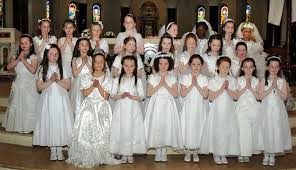
How I envied these girls!
Enter Catholic school. In 5th grade, the bullying at the local public school became so bad that my parents decided to take matters into their own hands and despite their misgivings about the Catholic Church, I was sent to a Catholic girls’ school. My grades immediately improved and I found it easier to make friends with these girls than at the public school. My parents were surprised (and probably a little disturbed) that one of my favorite classes (and the one I did best at) was Religion. I didn’t become religious back then, nor did my faith in God deepen (I was for all intents and purposes agnostic), but I found myself always looking forward to the masses we used to have at school on religious days. Although the highly liturgical services confused me at first (knowing when to stand up and sit down, memorize the various prayers, etc) I found myself drawn to the orderliness and beauty of the Mass. It somehow seemed Godlike and was steeped in history that the Protestant services I’d attended with my parents just didn’t have. I envied the cool trappings of Catholicism (when the other girls were going through Confirmation, they got a new name and a pretty dress and I wanted that too) and longed to be able to take Communion with everyone else. I wanted a set of my own rosary beads. Today I know these things really don’t matter (I think whatever denomination you are–even if none at all–is a matter of personal preference) but at my tender age, these tangible things seemed part of some wonderful, sacred, mysterious and heavenly world I couldn’t be part of. Sitting there in my folding chair watching the proceedings, I always felt the presence of God and a benevolent, forgiving love I never felt from my own family, even though I had to remain seated during the communion. It was one of the few places where I could feel the benevolence of God.
Many cradle Catholics remember negative experiences from their childhood about the Church and turned away from it as they came of age, but as someone who only knew it as a refuge from the harsh realities that took place in my agnostic home, I never developed those negative associations with Catholicism. I loved most of the nuns at my school. With one or two exceptions, they seemed so kind and compassionate, very saintlike–and they seemed to care about me in a way I never felt I got from my own family. Although I never talked about what went on at home, one nun in particular who seemed to favor me for some reason, guessed that things at home weren’t ideal, and told me to come see her anytime I needed to talk. I never did (for fear of what might happen if I “squealed” about the family to an outsider), but it felt good to know that she cared enough to reach out to me.
As I grew older I fell away from Christianity (not that I’d ever really embraced it much and knew next to nothing about the Bible or the life of Christ), and experimented with other belief systems, including Scientology and Buddhism, if anything at all. The Bible seemed to me like a book of ancient fairy tales with no relevance to my own life. I rarely prayed and looked down on churchgoing and religious people as ignorant and deluded. Although I never embraced full-on atheism (it was too depressing to think there was no afterlife at all), I thought that if God existed, he was pretty much hands-off and that everyone, other than the most hardened criminals and mean, cruel people, would get to Heaven, if there even was such a place. The concept of reincarnation made a lot more logical sense to me than the idea of heaven or hell.
But my soul was still starving and I think deep down I always knew this. Every once in a while, in spite of my doubts about the existence of God, I’d make time to attend a Catholic mass. I didn’t believe what they preached, in fact I thought most of it was pretty silly, but I loved the ritual and the order, and somehow always came away feeling transcended. I’d go take Communion (knowing as a non-Catholic I wasn’t supposed to) and feel somehow nourished. In a way I couldn’t explain, witnessing the reverence and beauty of the Mass, made me feel like part of something much bigger than myself and accepted for who I was, not (as in my FOO) expected to be someone I could never be.
I toyed with other Christian faiths, including Lutheranism and the Southern Baptist church. During the late 1980s, I attended a Lutheran church (and was confirmed as Lutheran) mainly because the man I married was Lutheran. The services were called masses and were very liturgical and quite similar in many ways to the Catholic mass, but they seemed watered down, somehow. For instance, the communion wafer was regarded as symbolic rather than being the actual Body of Christ. We never became deeply involved with the Lutheran church, and although we had our kids baptized Lutheran, we did not attend church on Sundays or otherwise do much to encourage their spiritual development.
When we moved to North Carolina from northern New Jersey, we were faced with culture shock–instead of having mostly Catholic and Jewish neighbors, suddenly we found ourselves surrounded by Southern Baptists who insisted we needed to be “saved.” Still looking for spiritual nourishment, I started attending services at the local Baptist church as well as Bible studies on Tuesdays nights. My kids attended 2 years of Vacation Bible School. I never cottoned to the hellfire-and-brimstone preaching though, or the literal interpretation of the Bible. I was especially turned off by the church’s conservative political agenda, that actually told us we were “going to Hell” if we didn’t vote Republican, as well as their dismissal of science. I decided to stop attending church there.

Hellfire-and-brimstone preaching is a turn off to me.
A few years later, my daughter had a friend at school whose parents were Southern Baptists, and my daughter, age 9 at the time, decided to be baptized in their church. I was fine with that, even though I disagreed with the southern Baptist belief system, because it took the burden off of me to be responsible for her spiritual growth. I attended her baptism and was surprised at how modern the service was, with a pop-rock band that played contemporary Christian music rather than traditional hymns. Intrigued, I decided to attend a few more services, but I always felt like I was at a rock concert rather than at church. In spite of the emphasis on Biblical literalism, during the long, emotional sermons, I never felt my soul uplifted or any real feeling of spiritual transcendence. Although very different from the touchy-feely, heaven-awaits-no matter-what-you-do preaching of the liberal Protestantism of my childhood, this hellfire-and-brimstone preaching bookended by Christian contemporary music with the words splashed on a huge TV screen didn’t do much for me either. I longed for tradition, for history, for meaning.
I still occasionally attended Catholic masses, but never thought I’d actually become one. But shortly after I went No Contact with my ex (who freeloaded off me and mentally abused me for almost 7 years following our divorce and nearly bled me dry emotionally, mentally, financially, and spiritually) I began to blog. My mental and physical health came back first, and then I realized I was still starving spiritually. I needed God, who after all, had been watching and protecting me all the time I was in an abusive marriage and had shown me on several occasions how real He was. Last October, I decided to start attending Mass as well as RCIA classes (the classes you take to become Catholic). I had doubts about much of the doctrine (and truth be told, still do). I still wasn’t sure I wanted to become Catholic, but I thought I should at least take the classes and make an educated decision.
To my surprise, I found that Catholic doctrine isn’t very different from what I’ve always believed anyway. The Bible is held as important (more important than many fundamentalist Christians believe we do) but much of its content is not not interpreted literally and therefore doesn’t fly in the face of centuries of scientific discovery and achievement. Yes, we are saved by grace alone (all Christians are), but works are also important and are tangible evidence of God’s grace. Sacraments (communion, confession, etc) give tangibility to God’s grace although (I don’t think) they are necessary for salvation. Confession is not a punishment; it is an opportunity to unload to someone else and makes you feel better afterwards (very similar to a 4th step in a 12-step program). Although I had my doubts at first, I’ve come to believe the Host (the communion wafer) does actually become the body of Christ, due to the glorious, transcended way I always feel after partaking. I do feel like my soul is being changed for the better, even though it’s not a Saul-to-Paul-like sudden conversion full of fireworks and drama.
I admit I do still have some issues, mostly having to do with the Catholic church’s stance on social matters such as abortion and homosexuality, as well as the fact that priests still must be male. I don’t think the Pope is infallible either (he is just a man), but I understand the reasoning behind having a Pope and I happen to like the current Pope anyway. I don’t venerate Mary and the saints, although I have utmost respect for them. Veneration isn’t the same as worship, anyway. Only Jesus as God is worshipped so there’s nothing un-Christian there, a far as I’m concerned.

Because of my doubts and personal proclivities, I’ll probably never be the “perfect Catholic” or “perfect Christian” but that’s okay. I pray that God keeps working on my soul to cleanse it from sin and I’m willing to believe anything God wants me to believe. I’m willing to turn my soul and my life over to the Creator. Whenever I’m at mass, I feel part of a vast family and something glorious, beautiful and so much bigger than myself or all humanity. I feel accepted in God’s kingdom and have begun to fear death and the future less than I used to. The tangibility, beauty and order of the liturgical tradition–the memorized call-and-response prayers, the communion procession, the incense, the swelling organ music and the singing, the kneeling and the standing, the Sign of the Cross, and all the rest of these “silly rituals”–makes me feel that God is a tangible, real thing, someone who is RIGHT THERE and that I can see, hear, smell, feel, touch and even taste. The traditional hymns with their pipe-organ and piano music and the ancient prayers imbue a sense of mystery and history into the services that neither liberal Protestantism or fundamentalist pop-rock sing-alongs do for me. And I love the Bible readings too. I’m beginning to feel that the messages in the Bible do have meaning for me personally. The orderliness and ritual of the mass is regarded by some as mindless, dull and lacking spontaneity (and to some extent I can understand this view), but I find the repetitive and predictable aspects such as the call-and-response prayers and chants to have an uncanny way of eventually filtering down from my mind into the deepest part of my heart, in a way a hellfire-and-brimstone or feel-good, prosperity-gospel sermonizing can never do.
Before becoming Catholic, I toyed with the idea of becoming Eastern Orthodox, a religion which, if anything, is even more liturgical and steeped in ritual, history, and tradition than the modern Catholic church (and is somewhat more liberal in its stance on women’s rights and birth control), but finding a sizable Orthodox community here in the Southern United States is a huge challenge to say the least. I did actually attend one Orthodox mass about five years ago (my son’s Kung Fu teacher was Russian Orthodox and invited us to attend his church), and although it was incredibly beautiful (and the food served afterwards was delicious), the feel of the Orthodox mass was a little too “foreign” for my taste. Anglicanism (The Church of England) also has a rich liturgical tradition (please see my Christmas post “O Come All Ye Faithful”) but again, is uncommon here in the southern US, and it’s still Protestantism anyway. I like the idea of being part of the oldest and largest practicing Christian community in the world that has such a rich and colorful history (even if at times in the past it wasn’t especially Christ-like). I feel proud to be a part of that. Although I know the trappings and ritual are more a matter of personal preference than salvation, for me they make an abstract God seem more real. Coming from such a chaotic, unpredictable background, the order and predictability of the liturgy is food for my soul. My adopted religion may not be the only road to salvation, but it’s the only road for me. Thanks be to God.
Millennials and liturgical Christianity.
As an aside, the Millennial generation, although largely turned off by religion, are, when drawn to religion, are converting to “high church” (liturgical) Christianity such as Anglicanism, Catholicism, and the Orthodox church. They are a generation that (like me, even though I’m not a Millennial) longs for a sense of tradition and connection with history that’s lacking in the evangelical, fundamentalist, and liberal Protestantism or New Age or atheistic belief systems they were raised with, all of which largely ignore or dismiss 1800 years of Christian history and tradition.
Further reading:
Why Millennials Long for Liturgy: http://www.theamericanconservative.com/articles/why-millennials-long-for-liturgy/
Millennials are Seeking Tradition, Sacramentality, and Liturgy: http://www.catholicvote.org/millennials-are-seeking-tradition-sacramentality-and-liturgy/










 Lucky Otters Haven