
Bring it on!

itsmytime

This week has been very difficult for me emotionally. It started with an unnamed, free-floating but intense anxiety and panic, to the point I could barely function. A few days ago I plummeted into a black depression that seemed different somehow in quality from my prior zombie-like apathetic depressions. it felt more alive and more proactive in some way. I’m pretty sure I had an idea all along of what was about to happen but it hadn’t quite bubbled into conscious awareness yet. Its rising through the murky swamp of my unconscious caused me to panic and then a kind of grief took over but I still couldn’t name what it was.

Most of you who read this blog regularly know I began this blog almost a year ago as a form of self therapy (because I couldn’t afford a therapist). From the beginning, I committed myself to 100% honesty. Well, I’ve probably fallen short of that goal, as I’ve omitted some important discoveries and other things about myself that I simply didn’t feel comfortable sharing, even under my alias.

Last night–nearly 11 months from the day I started this online journal–I had a huge breakthrough. Prior to this, I tried to sleep but could not. When I did my dreams were upsetting and I had this overwhelming sense of aloneness and separateness. I woke up shaking and close to tears. I gave up trying to sleep and talked to 2 close Facebook friends for awhile. They’ve been a bit worried about me this week because my mood has been so erratic and I’ve done so much crying, which until recently has been unusual for me. I cried all the time as as a child but then dried up sometime during my teens.

Several things have led to my breakthrough: writing a LOT about my feelings and recovery from narcissistic abuse, reading as much about narcissism, BPD and PTSD as I could get my hands on, trying my best to always be honest no matter how painful or embarrassing (but not always succeeding), and finding God and the power of prayer. It’s been an incredible roller coaster ride.

For several weeks prior to last night, I’d been praying for the ability to regain the easy access to my emotions I had as a child, only tempered with the wisdom and restraint of an adult, of course. I kept reading, writing, and trying to elicit emotion through music, movie-watching, and self-reparenting. I knew this required making myself as vulnerable as possible. I took myself to see “Inside Out,” which loosened something inside me but not quite enough. It was like one of those almost-sneezes that never quite comes out and leaves you wanting to punch a wall in frustration. Nothing much happened after that. I was growing impatient.

dear_past

A week ago, I fell into my panicky, anxious state followed by a “wet” depression (that included tears instead of my usual catatonic apathy). I didn’t even know what I was crying about. I lost my motivation to write (in retrospect, I think this as a form of self protection when I needed it). I was snappish and irritable on the job but would come home and set aside alone time so I could just let everything out without fear of embarrassment or shame. I knew instinctively something important was about to make itself known and that scared me, but I felt a kind of excitement too.

It happened last night at about 3 AM after my Facebook friends and I ended our conversation. I read something that triggered a deep knowledge that hit me like jolt of electricity. For a few terrifying minutes I felt like I couldn’t catch my breath and I might even throw up. I felt hot and cold flashes and started to shake. What I learned was overwhelming and devastating–but I also knew I’d known this for a long time but had repressed it.

Everything suddenly made sense and I felt like I was seeing my situation and all my relationships—hell, over 50 years of my life–with eyes that had been closed since I was very young. I remembered, vaguely, that someone told me something when I was four years old. I couldn’t remember what was said or who said it but I did know whatever it was had been the catalyst when all my problems started that would not abate for over 50 years. One day when I’m ready I’ll remember what actually was said and who said it. I cried harder than I’ve cried since I was about 12. I can’t go into detail right yet about what this discovery was–I’m not ready. I may never be ready. But it’s something that although its discovery is incredibly upsetting to me, it’s also something I needed to have in my conscious awareness before I could really start to do the hard work necessary for real healing.

God answers prayers in his own time. He’s working on me. I have faith he works on all of us if we reach out with a sincere heart and ask for help. Now that I have this information that was revealed to me, the next step is to figure out what to do with it. Right now I just feel shell shocked. I have to be gentle with myself while I work through and try to understand everything that happened. I’m working on finding a therapist to help me sort it out because I think it’s too big for me to handle all by myself anymore. All I can do right now is keep on praying and writing every day and working on myself and being as mindful as I can until I find someone appropriate. I know the work ahead of me is going to be harder now than it has been and that’s okay. It may take a long time and that’s okay too. I feel like I graduated from something last night. I’m ready for the next step. Bring it on!

Somehow I feel lighter today although I’m exhausted and desperately need a good night’s sleep.
I know I can do this thing. But for the love of all that is holy, WHY DID IT TAKE SO LONG?
Comparing covert narcissism and BPD

covert_narcissism2

I read an excellent article (thank to Natasha!) last night about covert narcissism, which is not currently recognized by the DSM, although it’s been considered as a provisional diagnosis.

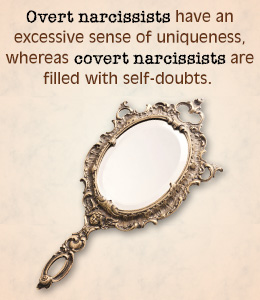
Covert (vulnerable) narcissists are essentially low-functioning narcissists who present a shy, avoidant, humble, or caring image but they also constantly struggle with feelings of inferiority, emptiness, and self hatred. Like overt narcissists, they are hypersensitive to criticism but don’t hide it as well. They can become quite parasitic, relying on the support of others, either financially, emotionally or otherwise–but never giving back, even if they try to make a show of how “giving” they are. From what I’ve read in this article, it seems that the symptoms of covert narcissism, a subtype of NPD, are remarkably similar to those of BPD, with a few glaring differences:

— The covert narcissist suffers from more pathological envy than a person with BPD. The envy stems from a hidden sense of entitlement or superiority to others that belies their false humility and actual low self esteem. BPD is not characterized by a sense of entitlement. In a way they are wearing a double mask or have two false selves: the grandiose false self (that cloaks the emptiness they really feel) which is cloaked by false humility and shame. A covert narcissist may constantly be apologizing, but they don’t really mean it.

— A covert narcissist is more likely than a borderline to seek out friends who they perceive as “beneath” them so they can feel superior in comparison. This also stands out from an overt narcissist, who will seek out anyone who can provide them with supply (and likes to be associated with those they look up to). Covert narcissists avoid people they perceive as superior or having more than they do, which is most people.

— The covert narcissist has Avoidant (or introverted) features not associated with the DSM-recognized symptoms of BPD (although it’s possible for a borderline to be introverted and socially phobic, or for Avoidant PD and BPD to be comorbid with each other, as they are for me). Covert narcissists are more socially awkward than borderlines and can seem very similar on the surface to someone with Aspergers or Social Phobia. But behind the avoidant or socially awkward traits is a fear of being discovered and a hidden feeling of superiority to other people, unlike someone with Aspergers who simply finds relating to people exhausting or uncomfortable or a person with Social Phobia, who finds relating to others terrifying.

— They have no empathy. Any “empathy” they show is false, intended to get supply by bolstering their image as a “nice” person. Borderlines usually have at least a rudimentary ability to experience empathy.

— Like a classic narcissist, a covert narcissist lives in fear of their own emptiness being exposed, while someone with BPD lives in fear of being abandoned.

— Borderlines are more likely to be suicidal or self-harm than a covert narcissist, who may do self destructive things or threaten suicide for attention (supply) but will rarely make a serious attempt.

— Borderlines are more impulsive.

http://www.researchgate.net/publication/275665641_Narcissistic_Personality_Disorder_Diagnostic_and_Clinical_Challenges

This is also a very good article comparing covert NPD with overt (classic, grandiose) NPD: http://narcissisticbehavior.net/revealing-the-two-faces-of-narcissism-overt-and-covert-narcissism/

Some people believe covert narcissists are actually more malignant than classic narcissists, because their agenda is so hidden (covert) and they can seem like such nice, humble people. Although they are harder to detect, I think they really want people to see them as “nice” even though their motives are entirely selfish. I think the reason some narcissists become covert is because early in childhood they learned that acting grandiose or entitled was too dangerous (they were likely to be punished for it) so they cloaked their grandiosity behind false humility and shame. This is why they often feel victimized by everyone but at the same time feel entitled to be treated as if they are special and separate themselves from others, who they see as morally inferior (but actually feel inferior to–yes, it’s very confusing!) At the same time, a covert narcissist is more likely to seek therapy than a classic narcissist because their lives are so unsatisfying and limited–and for the same reason also more likely to be cured if they commit themselves to getting better. In this way they don’t differ too much from people with BPD.

A person with NPD can also switch back and forth between the covert and overt subtypes. When things are going well and supply is abundant, a covert narcissist may become grandiose and aggressive, and a normally grandiose narcissist can become much more covert when their supply is running low or has been removed.

Cluster B disorders: an explanation

Informative video about the Cluster B disorders that discusses what they have in common and what causes someone to develop them. BPD has been unfairly stigmatized because of its similarity in some ways to the other disorders in this cluster, but few people recognize that borderlines don’t lack empathy or a conscience the way people with NPD and ASPD do, even though they can be difficult to deal with and even abusive when they are triggered.

Spiderkitten.

My daughter’s 3 1/2 month old kitten Zelda was climbing the walls today.

zelda1

zelda2

Full moon 2.

This is a photo I took of last night’s full moon. I played around with the photo a bit to enhance the colors and moodiness.

full_moon2
Click photo to enlarge.

Worry: the useless emotion.

worry_guy

In recent years, several emotions have been called out as unhealthy or maladaptive for human happiness. These emotions are worry, shame and guilt. In a narcissistic society where selfishness is held as a virtue, these three emotions are indeed maladaptive, especially shame and guilt. But shame and guilt keep us civilized. They keep us from doing bad things to others and they are the reason we have laws such as not murdering someone we don’t like. Shame and guilt (when appropriate, of course) have a pro-social function and are the inner brakes that keep us from hurting others or making restitution if we have. A car with no brakes is a dangerous thing. So is a human being. Shame and guilt are only “bad” when they’re excessive or unnecessary. But a person without the ability to ever feel shame and guilt is a sociopath with no conscience and without the ability to feel empathy for others, not a proper human being.

Worry is a different ball of wax. I can’t think of any good reasons for worry to exist. I’m one of those people who worry all the time, about everything. It’s not a fun emotion and is a huge damper to happiness. Worry is related to fear, but is a little different. Fear has its proper place. It keeps us from being harmed or killed. If we are walking in the woods and a bear blocks our path, it would be stupid to try to reason with the bear or fight it. We feel fear instead, which causes us to run or back away. If we meet a person who gives us the willies, fear is a natural response that keeps us from becoming that person’s victim. We learn to avoid that person. Fear is a survival emotion.

worry_quote

Worry is a kind of fear that isn’t set on the here and now. It’s set on what might happen in the future or sometimes what happened in the past. It causes a person to ruminate excessively and not be able to enjoy what’s taking place right then and there, because they’re too focused on nonexistent events or events that have already taken place and can’t be undone. If you worry constantly about losing your job, that will usually cause you to act less confident and make more mistakes and can even bring on the event you fear the most. If you worry your mate might leave you, your worry causes you to act clingy and possessive, and they could feel smothered and actually leave you. Worrying over things you have no control over is just, well, stupid.

Sometimes people worry about things that have already occurred too. If you snapped at your girlfriend for no reason, you might worry about that because you’re afraid they might leave you. Guilt–not worry–would be appropriate in a situation like this. Guilt will make you apologize to your girlfriend, after which you both feel relief. Worry will do nothing except make you obsess and ruminate over your mistake. Rather than act as an impetus to action or a motivation to correct your mistakes, worry over past events causes you to turn inward and beat yourself up without taking any action.

Some people are addicted to worry though, and go through life imagining the worst things imaginable. It’s impossible to be happy constantly believing the world is a dangerous place full of landmines and booby traps. I have no idea why so many people are addicted to worry, because it’s not a drug that has a pleasant high. It can even kill you because it causes excessive stress which is hard on your body and can lead to illness. I think worry was pounded into those of us who were victimized by narcissists because we lack confidence in our own ability to control the events in our lives. We believe we have no more control over things than a leaf blowing in the wind. But that’s another lie they tell us.

There are a couple of sayings I’ve heard about worry that sum it up pretty well and made me realize just how useless this emotion is.

1. Worrying about something is like paying interest on a debt you never owed.
2. Worry is useless because if the event you fear never happens, you lived through it for nothing; and if the event does happen, you lived through it twice.

Malignant narcissists practice black magic.

Witchcraft

This is a really powerful video by Smakintosh of Gospel Underground, who was the scapegoat and “black sheep” of his own family but because of that, is also the only one in his family who can see the truth about what their agenda really is.

I love listening to him speak, because you can tell he really feels what he is saying. He does because he’s lived it.

If your entire family has turned against you, it’s probably because one or sometimes two malignant narcissists have used cunning and deception to gaslight you and project their own evil onto you, while making themselves seem blameless and sometimes even getting others to believe YOU are the abuser and THEY are the victim. It’s a kind of sleight of hand or black magic they practice, even if they’re not aware they’re practicing it, that puts others under a powerful spell and holds them in thrall to the narcissist who has targeted you.

You may also have come to believe their lies that you are stupid, crazy, a loser, evil, abusive, or anything else that’s been projected onto you. You were the sacrificial lamb in their rite of deception.

You have been targeted because you–unlike the other non-targeted family members (or other members of a group) who are either flying monkeys or enable the narcissist–possess the ability to see the truth through the narcissist’s lies. They hate and fear that and that’s why they hate and fear you. They must diminish you and make you look bad and they are very skilled at convincing others what they say is true and you are the liar and sometimes even the abuser. They are very good at turning people against you so no one will believe you.

If someone is the black sheep of their family, or has been scapegoated or disowned, suspect a malignant narcissist in the background who’s succeeded in turning everyone against them.

The movie “Mommie Dearest” tells the story of how Joan Crawford targeted her daughter Christina and abused her for years, because Christina was able to see the empty void underneath her mother’s glamorous, “perfect” image. Ultimately, she was left out of the will and not in contact with anyone in the family except her brother Christopher (who was also scapegoated). At some point I’ll be writing up a review of the film.

The same sort of deception can be used to turn an entire community or even a nation against what is right and good, by just one or two evil people and their flying monkeys. Hitler’s Germany is a perfect example.