Eskimo Sociopaths

inuit_man
Lone Inuit man.

Here is a very interesting article that discusses how Eskimo (Inuit) hunters historically handled sociopaths and narcissists in their midst.

Eskimos probably had the right idea. In our modern culture today, we look up to narcissists and even sociopaths as role models.

In order to survive in their harsh, cold climate and procure enough food, Eskimo hunters had to work together as a group. Individualism, a we know it today, wasn’t even on the radar and wouldn’t have benefited the group. Cooperation–not individualism–was necessary for survival.

Not anymore. Today, individualism (and thus narcissism) has become adaptive because those people who only have their own self-interest as a priority tend to be the most successful. There’s something very wrong and evil about a society that glorifies individualism over cooperation.

ownyourcrazy101's avatarconfessionsofacrazybitch101

A stranger who I had a conversation with, had a beautiful mind and heart and we talked for an hour about everything. He told me a story about sociopath/narcissists from Eskimo ages….

Eskimos worked together. That’s how they survived was through hunting and team work. But, when they unmasked a sociopath in their pack, this threw off their hunting. This sociopathic Eskimo couldn’t work alongside the others, so they figured out a way to cure NPD/sociopathic Eskimos.

They would invite the sociopath along with them, in a group of three, to hunt. They gave the sociopath their own weapon and everything just as he was apart of their group. They would then venture far far out, to a place only two of them knew around and how to get back to their grounds from. They then told the suspected sociopath to sit on a bolder and wait for the prey…

View original post 196 more words

The curse of the Aspergers/Avoidant/Borderline triad.

social_isolation

Today I attended a beautiful Pentecost mass that was held outdoors. The day couldn’t have been more perfect for an outdoor celebration of the descent of the Holy Spirit on Jesus’ disciples. Unlike the disciples, I didn’t experience a sudden spiritual epiphany or dramatic change in my heart, or start speaking in tongues. But as always when I attend mass, I felt God’s presence around me (if not actually IN me) and felt surrounded by peace and light.

I looked at the tall trees gently swaying in the distance, their bright spring greens illuminated in the bright sunshine against the azure blue sky, and asked God to change me, to let the Holy Spirit flow inside me and fill me with its divine gifts of empathy, unconditional love, and joy. I asked Him to make me a better person who can connect with other people on a meaningful level–and having those gifts would make it so much easier for me to do that.

The truth is, I feel that I’m lacking in all three of these gifts. I do not have NPD and therefore have no desire to act in evil or toxic ways to others, but due to my other disorders–only one of them probably not due to abuse (Aspergers)–I often feel like there’s an emotional blockage keeping me from really being able to connect with other people, to really being able to empathize and feel WITH them the way people who have not been abused and do not have these disorders can do.

This particular triad of disorders is a tragic one. Even having one of these disorders cripples you and isolates you in various ways from others and can lead to a lonely life lacking in meaningful relationships, but having all three at once is devastating. It’s so hard for me to connect with the rest of humanity except on the most abstract level and as a result I’m often so very sad and lonely.

First, being an Aspie (the only disorder I was probably born with) makes it almost impossible for me to read social cues normally and although I can socialize well enough online (because it doesn’t require me to “think on my feet”–I have time to think through what I want to say or how to respond), in the day to day physical world my Aspieness makes me appear awkward and sometimes slow when I am forced to socialize, especially with neurotypicals who don’t understand people with Aspergers, so I avoid people. Due to my awkwardness I was a frequent target of school bullies, and it didn’t take long to learn that it was best to just keep my mouth shut and say nothing. I became painfully shy, fearing ridicule and humiliation. The old adage, “Tis better to say nothing and have others believe you are daft than open your mouth and remove all doubt” has been my motto most of my life.

aspergers_cartoon

The other two disorders I have–avoidant AND borderline personality disorders–I am certain were due to years of abuse by my narcissistic mother and to a lesser extent, my codependent father who colluded with her most of the time (although I never really doubted his love for me). The AVPD (a Cluster C “anxious” personality disorder) only exacerbates my Aspergers. They feed off each other.

Avoidants shy away from social contact because of their low self esteem and overwhelming fear of rejection. As a result they are usually painfully shy but can even seem aloof or cold. Avoidants are not schizoid though (people with Schizoid personality disorder dislike other people and prefer a hermit-like lifestyle; they don’t care how others regard them): on the contrary, we WANT friends, we WANT meaningful relationships, we WANT romance, we WANT others to like us–but our fear of engaging with others due to possible rejection keeps us isolated and alone. We build a protective shell of aloofness around ourselves so we can’t be hurt. People with AVPD are risk-averse, and are likely to be underachievers due to their unwillingness to take risks that may expose them to social embarrassment.

An Aspie with AVPD is nearly–or is–a social hermit, but not out of choice, like a person with schizoid personality disorder. Making friends–a skill that comes so naturally to most people–is something most of us never mastered well, if at all. Even having a relaxed conversation or opening ourselves to another human is like rocket science to those of us with both disorders. It’s a wonder that I was even ever able to engage in romantic relationships and have a family. Of course, all the men I dated and of course the one I married were narcissistic, mirroring the toxic dynamics I had with my family of origin.

avoidant_pd
Like the girl in this cartoon, I can relate to all of this, even the refusal to play charades! I was always terrified of that game because it requires a level of being able to read social cues and an ability to think on your feet, two qualities I don’t possess. And of course, the fear of risk-taking and humiliation.

And that brings us to my borderline personality disorder. BPD is not usually marked by overwhelming shyness or social awkwardness; in fact most borderlines are quite socially adept. But their disorder, like an Avoidant, is fueled by a deep-seated fear of rejection and almost always has its roots in childhood emotional abuse or neglect, as do all the personality disorders.

Borderlines long for close relationships and actively seek them out, but then push others away if they sense the other person might pull away or reject them first. They overreact to slights and are highly sensitive to criticism or rejection. Like a narcissist, they can be difficult to deal with because of this type of selfish oversensitivity can lead them to engage in some of the same antisocial behaviors and game playing people with NPD or even ASPD are guilty of, though not usually to the same degree because people with BPD have a conscience (even if it’s stunted in some) and don’t normally actively seek to hurt others. There are exceptions though–I was shocked and dismayed to read that both the murderer Jodi Arias and serial killer Aileen Wournos were both diagnosed with BPD, though in Wournos’ case, she was also comorbid with ASPD. Still, most borderlines, when they are made aware of how they have hurt their loved ones, feel remorse–but their guilt and shame can make them feel worthless and lead to self-destructive behaviors. It is not a fun disorder.

Though Borderlines are more likely to be self-destructive instead of deliberately destructive to others, this self destructiveness causes huge problems in their ability to form meaningful relationships, and due to their “go away–come closer” way of relating to others, their relationships are usually stormy and short-lived.

lucy_charlie
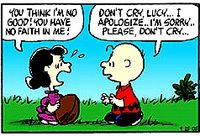
Sometimes I feel like either Lucy or Charlie Brown (who I’m pretty sure would have AVPD), and sometimes both of them at once.

I am cursed with the overwhelming shyness and social anxiety of Aspergers and AVPD, but during the rare times I have been able to form relationships or friendships, sooner or later I push those people away in some form or another–not because I want to, but because I either become so afraid of rejection I reject the other person first–or more frequently, unconsciously do something to make the other person leave me. BPD is very maladaptive to the sufferer–it tends to bring on the very thing the Borderline fears the most–rejection.

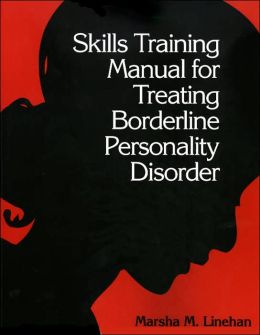
I was diagnosed with BPD in 1996 during a three month long hospitalization for major depression. At the time, I also had PTSD from being a victim of abuse by a malignant narcissist husband, who gaslighted me constantly and even tried (but eventually failed) to turn my own children against me. During that hospital stay, I was given a copy of Marsha Linehan’s excellent manual for BPD, “Skills Training Manual for Treating Borderline Personality Disorder.Dr. Linehan is a borderline herself (she had originally been diagnosed with schizophrenia but felt her “schizophrenia” was really a manifestation of her BPD). The techniques in the book are a form of DBT (dialectical behavioral training) which teaches the Borderline patient to act mindfully–to think before they act and consider consequences, because Borderlines (unlike people with NPD) act on impulse when they feel threatened.

linehan_book
Linehan’s excellent manual can be ordered here.

Linehan’s book helped immensely and since my long-ago hospital stay, I have learned to control many of my borderline symptoms. In fact I have become so good at it I rarely fly off the handle the way I used to or overreact to the degree I used to do. I still have my copy and have recently begun doing some of the excercises again because I still know there’s a LOT of room for improvement.

Like NPD, BPD doesn’t just go away. All personality disorders are incredibly hard to cure because they have become so much a part of the individual’s personality. There are still many times I unwittingly either push other people away OR get too close (or do both at the same time); I still have problems with understanding where other people’s boundaries begin and end. I also feel like there is a wall there keeping me from really being able to empathize with other people in a normal way. I can empathize in an abstract sort of way (it’s hard to explain what I mean by that but the empathy I do feel is sincere). It’s just so hard for me to connect on a meaningful level because I fear rejection so much. I want to be a friend to others; I want to make others happy; I want to be able to fully share in their emotions, good or bad–but I find it all so hard–not just because of my BPD, but my fear of engaging with others in the first place due to Aspergers and AVPD. This triad has been a huge curse all my life. But at least I know what my problem is. I’m what you would call “complicated.” I have my work cut out for me.

hope

Having all three disorders has made my life incredibly difficult and my relationships–when they exist at all–have been stormy or don’t last. But I don’t feel that I’m beyond hope. In fact, I’ve been feeling much better about myself since I started blogging and accepted God into my life. I do feel that He is changing me in a very meaningful and deep way. Maybe it’s not happening as quickly or dramatically as I had hoped, but it’s happening. I am feeling more ability to empathize with others and feel moments that come very close to pure joy. I have always had a great capacity to feel guilt and shame, so that has never been a problem. For a person with a Cluster B disorder, my conscience is probably TOO well-developed. I apologize for things I haven’t even done. Sometimes I feel like I’ve spent my entire life apologizing for my existence. I hate the idea of being a bad or evil person. I like it when I know I’ve made someone else happy. Those times when I can make others happy are becoming more frequent, and I think that’s a step toward healing. I’m also happy to report that my lifelong problem with envy appears to be disappearing. Envy is so toxic–mostly to the person harboring it. It’s a great relief to have that particular monkey off my back most of the time now.

So today’s celebration of Pentecost had special meaning, because even though I wasn’t knocked to my knees by the Holy Spirit, I felt a deep sense of peace, centeredness and just “being in the moment” that has always eluded me. I felt a genuine desire to become a person who can make a positive difference in the lives of others and can feel unconditional love even for those I do not know well. Now I just need to overcome my fear of engagement with others, but I have faith that in time that will happen too, and when that happens, a whole new world will open up to me as the walls I built at an early age begin to crumble and reveal the me I want to be–which is really the me God meant for me to be.

Never give up hope. Ever.

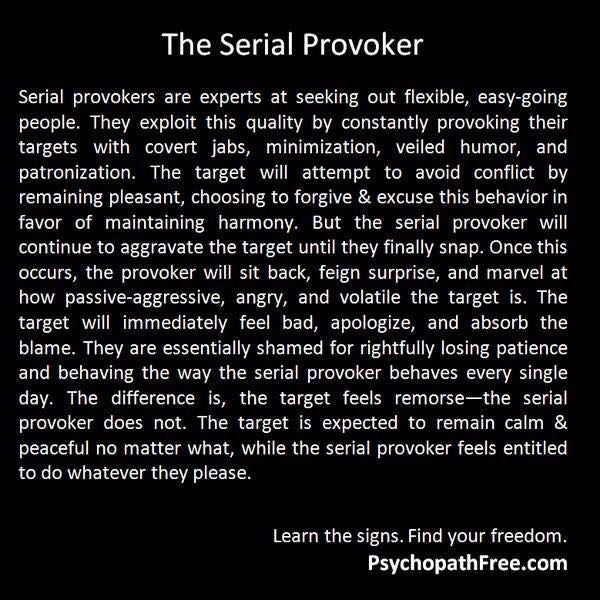
Serial provokers.

This is my ex to a T.

serial_provoker

Why isn’t there a 12-step program for narcissists?

narcissistsanonymous

…and I’m not talking about this either. 😉

A commenter on this post wondered why there aren’t any 12-step programs for people with NPD, and that got me thinking — well, why aren’t there?

About a month ago, my friend Mary Pranzatelli and I were having a conversation about this very same thing on Facebook.

There’s a lot of good reasons why a 12-step program might be helpful to a narcissist. After all, narcissism and addictive disorders like alcoholism have a lot in common. This isn’t an idea I just dreamed up. Sam Vaknin also wrote about the similarities, as well as others like psychologist Tian Dayton.

narcanontshirt

Here’s a quick list of things both narcissists and people addicted to substances have in common:

1. They are often in denial about their disorder. When a narcissist or an addict realizes they have a disorder they may want to get help. (This is actually the first step of programs like AA or NA.)
2. In some ways, both addiction and narcissism is a choice, even if it was made unconsciously (although there is likely to be a genetic component too that at least gives one a predisposition toward these disorders).
3. The narcissist’s drug of choice is narcissistic supply, which gives the narcissist an adrenalin rush. When it’s lacking or in short supply, they will crash and burn. The addict will also crash and burn without their fix.
4. Once a narcissist or an alcoholic (or drug addict), always a narcissist or an addict. You can stop drinking and using (or stop acting so narcissistic), but the underlying disorder is unlikely to ever be cured.
5. Treatments like CBT (cognitive behavioral therapy) work much like the 12 steps of AA–they change behaviors but not the underlying disorder. The person must make a conscious effort to replace the old behaviors with the new ones.
6. High possibility of relapse or “slipping” back into the addictive or narcissistic behavior patterns if the program isn’t strictly followed (or even if it is).
7. An addict or narcissist without their fix (or supply) can both act in antisocial, selfish and narcissistic ways until their fix (or supply) is procured.

and finally…

8. Because narcissism (and addictive disorders) have a spiritual component, admitting that God or a Higher Power can help you is an integral part of all 12-step programs.

addicts

True, a 12-step program wouldn’t cure narcissism (just as AA doesn’t cure alcoholism), but I think such a program could help a narcissist who is self-aware and wants to change their attitudes and the way they treat others.

So why isn’t there a 12-step program for NPD?

My insane narcissistic coworker.

woman doing housekeeping

In my part of the country, good jobs are scarce, and it’s very difficult to find decent work, especially in the field of writing or publishing. So, to make ends meet (barely) I clean houses. Yes, I’m definitely underemployed (who isn’t these days?), but I’m really not ashamed of what I do — it’s actually not as bad a job as you might think. In fact, most of the time I rather enjoy it (though it’s certainly not what I had in mind as a career for myself and never will be). It’s physical, keeps my weight down, and most of the time I don’t have to interact with people much, which I like. I also get to see some beautiful homes and some customers tip.

When I work alone (which I prefer), I can zone out and let my mind wander as I clean. I barely have to talk to anyone at all. I hate office politics and having to socialize as part of my job. With this job I just let myself into a house, do what I need to do, and leave. I don’t have to sit in a stuffy office all day dealing with people I would never spend time with if I didn’t have to.

But I don’t always get to work by myself, and from one day to the next, I don’t know if I’ll be working alone, or with a partner, or if I have to work with a partner, who I’ll be working with. Aspies like me hate that sort of unpredictability. Sometimes I get to work with someone I get along with, but things don’t always work out that way.

Today I got stuck working with the company narcissist. Everyone hates working with this young woman, but they won’t put her by herself because she sucks and can’t be trusted. She also can’t drive. No one will ride in a car with her, because she can’t focus on the road at all. She texts while she drives, gets distracted, and almost wrecked several times. She also wastes time, and snoops through people’s drawers, closets and personal belongings (she hasn’t been caught stealing though). I heard an incredible story that in one customer’s house, she found a gun in a drawer and started waving it around in the air, saying “Hey, look at this.” She was reported for that by her partner that day but incredibly, she wasn’t fired. She also talks to customers about inappropriate things, but for some stupid reason, the company will not fire her. I have no idea why. She’s a ticking time bomb, a liability, and everyone hates working with her.

snooping

Here’s how my day went today. Initially I was to clean two houses by myself, and was packed up and ready to go. Then at the last minute, I was told I’d be working with a partner. My heart sank when I heard it would be this woman, who I’ll call Karen.

I told Karen straight out I would drive. She doesn’t like my driving so she took her own car (she doesn’t like anyone’s driving). That was fine with me because I didn’t want to have to spend time riding with her.

We got to the first house, one I’m very familiar with. She had never been in it before. She told me she would do the “dry” work (vacuuming and dusting) because she couldn’t bend over. I said that would be fine; I didn’t really care. I just wanted the day to be over with. I listened to Karen brag about how much all the customers loved her and how she never gets complaints.

I cleaned the bathrooms and kitchen. As I was cleaning the master bathroom, Karen loudly asked me who normally does the dusting and then complained that the person who was doing it wasn’t doing it right. I came over to look. There was a thin coating of baby powder on top of a dresser. I told her it was that way every week; the customers use a lot of baby powder. Karen argued with me, saying no, that couldn’t be it, the person who had been cleaning it wasn’t doing their job right. I informed Karen the person who was doing it was a supervisor and knew what she was doing. Karen still kept arguing with me, saying that supervisor needed to learn how to do her job right. I ignored her after that, and Karen started talking to the customer, who was working in his garage. As Karen always does, she started yammering to the customer about personal issues with her husband; I wanted to sink through the floor in embarrassment, but I said nothing.

narcissist_punishment

We had no further altercations until after I finished cleaning the kitchen. Karen hadn’t even started vacuuming the downstairs yet. As always she was wasting time on bullshit, like spending 20 minutes arranging the tote of cleaning chemicals (she is very OCD too) and yapping to the customer who was obviously busy and just being polite. Instead of doing her job, she came into the kitchen and started cleaning it again.

I told Karen I had already cleaned it, and she said, “well if, you did your job right, blah blah blah…you missed, this, this and this.”
Whenever I had to clean this house (which I knew well) with anyone else, no one in a supervisory position over me ever had a problem with my work. I told her I resented her telling me how to do my job, especially because she hadn’t finished doing her own work yet and we had already been in the house far longer than we should have been. Karen’s response was, “Well, when you work with me, I’m your team captain and I’m supposed to check your work for quality.”

I found it hard to believe this incompetent, time wasting, snooping, yapping troublemaker would have been put in charge of anything. Besides, a team captain isn’t supposed to do their partner’s work over, just check it. But Karen was cleaning the entire kitchen which I had just finished a second time. I was livid. We had been in this house almost 2 1/2 hours; we should have been done an hour earlier. It never takes that long to clean.

Of course I started feeling victimized, wondering why the office would think Karen was a better worker than I was and putting her in charge, when no one else had ever complained about my work and no customers ever complained either. And although I’m not very fast (due to being older), I’m efficient and could have cleaned this entire house by myself in the amount of time we’d already been there.

Woman-looking-at-watch

I told her I didn’t believe her and was going to ask management if she was really put in charge of me that day. She shut up after that, and didn’t say another word to me, other than to tell me her back hurt and asked me to do her vacuuming for her. I conceded, while she sat in the car texting people and smoking cigarettes. I wound up doing about 75% of the work in that house, and we were there three hours when it should have taken less than two. To make matters worse, I would have to be sharing my commission with her instead of getting to keep it myself.

We finally made it to our second house but she was late, so I let myself in and started to clean it. I hoped she wouldn’t show up but she finally did. The customer wasn’t home, so Karen started looking at the designer shoes in the huge walk-in closet. I said nothing but made a mental note to tell management about that. Karen didn’t boss me around this time, but once again I wound up doing most of the work because she was complaining she didn’t feel well and had to keep sitting down. She left before the house was finished, leaving me to finish it by myself. I was actually glad to be rid of her. She was worse then useless.

I was still upset when I got back to the office and spoke to the manager. When I told her Karen had re-cleaned my kitchen and then justified that by saying she was my team captain, the manager cracked up laughing. She said, “Karen’s a troublemaker. I would never put her in charge of anyone.” I knew she had been lying, which was why she shut up after I told her I didn’t believe her and pretended to be sick after that.

I don’t know why they won’t fire Karen, but at least I know I won’t have to work with her again. My boss even said, “I knew I should have just let you work by yourself, so I’ll go ahead and pay you as if you did since it sounds like you did all the work anyway.” That was a big win, and I left work feeling much better.

I was physically and emotionally exhausted though, and when I got home fell asleep and didn’t wake up for hours.
That’s how narcissists can suck the life out of you.

Note: There seems to be a glitch in this post, with the large ad appearing at the top of the article. I don’t know how to fix that. I apologize if it looks tacky. It’s supposed to be at the bottom.

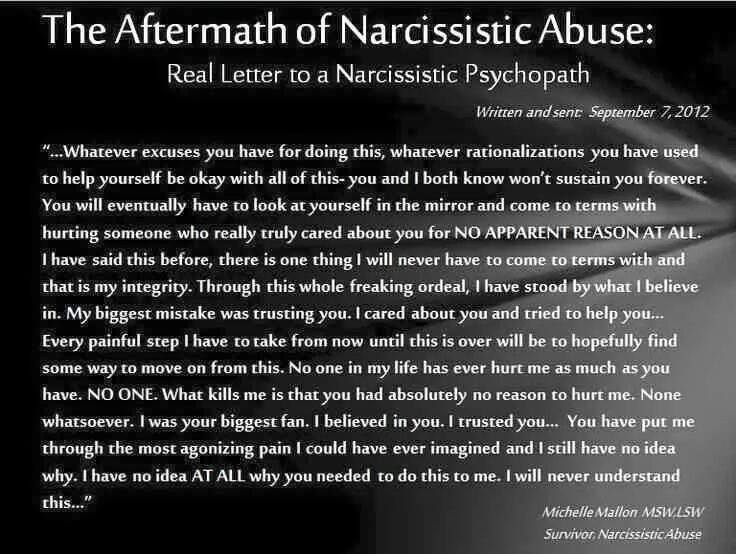
“Reclaiming My Life”– Michelle Mallon’s Story of Healing

after_narc_abuse

The following is a followup article to the one I linked to in my post After Narcissistic Abuse, in which Michelle Mallon talked about how her psychopathic therapist almost destroyed her life and stole her soul.

This is an important topic, because malignant narcissists, sociopaths and psychopaths are so often in the “helping” professions, especially psychotherapy. They prey on vulnerable people who come to them in desperation, hurting and wanting to trust someone. These “mental health” professionals know this. After gaining a patient’s trust, evil-intentioned and sadistic therapists like Michelle’s therapist use the things their client told them in confidence against them, or even use them to threaten or gaslight them.

I’ll only post the first part of the article, which is long. But the journey back to feeling normal from PTSD caused by abuse is sometimes a long and arduous journey. There’s no way to describe this process in just a few words or even a few paragraphs. To read the rest, you will need to click on the link to Michelle’s article, which appears at the end of this post.

Reclaiming My Life
By Michelle Mallon, MSW, LSW
In this article, Michelle Mallon discusses her healing journey following abuse by a psychopathic therapist.

Recovering from therapist abuse is hands-down the most painful experience I have ever gone through in my entire life. Healing was incredibly difficult for so many reasons, some of which make me very angry and some of which have brought me great insight. Because of the impact healing from therapist abuse has had on my life, I find it impossible not to want to reach out to others who have been hurt by mental health professionals. Some people have told me that this is because I am unable to “get over” what happened. I explain to them that there is a difference between “getting over” something terrifying and callously moving on, leaving so many others behind knowing that you were very lucky to have ever healed. (I usually say this right before I tell them what they can go do with themselves.) The reality is that for most of us trying to overcome therapist abuse (regardless of whether it is sexual, emotional, spiritual, etc.), very few other people have any idea what we are going through (even the mental health professionals we finally get up the courage to see after the abusive ones to try and pull ourselves back together). And because of that, healing can be significantly more difficult than it should be.

Just recently, I began reading the Your Stories page on this site. I was immediately reminded of the isolation and fear I felt as I tried to find my way through the aftermath of therapist abuse. I drafted a message for the Your Stories page and then I immediately felt like it was just not enough. I then asked Kristi if I could write a piece that would hopefully reach more survivors. I have found the path to healing. I don’t really know how I ever found it because, looking back, I can see just how carefully hidden the path is. I don’t know if my path to healing will be similar to yours. In the hopes that there will be some similarities, I want to identify the things that helped me find my way through this in case it can help even one survivor.

This time last year, I was just beginning to feel my “old self” returning. I was finally able to leave my house for short periods of time without having panic attacks or near panic attacks. I was beginning to be able to focus on something other than what had happened in the years before. And I have to tell you, I couldn’t have been more relieved. The truth was that for a very long time before this, I wasn’t sure I would EVER recover from what I had been put through. In fact, I truly believed I was broken beyond repair. It was the most frightened I have ever been in my life.

nurse-ratched
Nurse Ratched, the sadistic psychopathic nurse/therapist in the movie “One Flew Over the Cuckoo’s Nest.”

This year, my life is very different. I look back at the woman I was a year ago and I can see tremendous growth. However, I can also see that even as I was beginning to re-find myself under all of the manipulation and destruction I had been through, I still had a long way to go. There were times when I first started out on this journey where I was making progress, but I didn’t realize I was making progress. I would frequently begin to feel stronger only to be dealt a cruel blow of fear and confusion that would set me back for days, sometimes weeks. If I would have known then that this was how the process went, I don’t think the journey would have been nearly as frightening. And perhaps, this time next year, I will look back and see that I have continued to grow, even from this year. It’s impossible to say. This journey to healing has been nothing short of miraculous. Just when I think I have “uncovered” all of the insight this journey has to offer, I am humbled by another incredible phase of insight. I don’t know if this growth and self-discovery will ever stop. Perhaps if I viewed all of this more as a journey and not as simply reaching a destination, I would have found more peace in the whole process. But to be perfectly honest, as I started out on this journey there was nothing peaceful at all about any of this.

The truth is that the very start of my journey, like many of yours, was incredibly painful—almost unbearable at times. I felt completely lost. I really didn’t know how I had gotten to where I was, and I really had no idea how the hell to get back to where I was before. Some of the worst parts of the journey to healing after therapist abuse had to do with trying to make sense out of what happened with the abusive therapist. And because I still missed him, I was convinced there must be something wrong with me. For almost a year after I refused to see him any longer, I replayed everything that happened during the time that I knew him, trying to make sense out of what happened. I tried desperately to understand what I could have done differently to prevent the relationship from crumbling the way it did. I would look at certain aspects of what happened and think, “He must have cared about me and just lost sight of what he was doing.” And I would be at peace with that thought for a few days. And then nagging doubts would creep in, “But if that were true, why did he just leave me to fall apart on my own? Why, after I told him just how much this had harmed me, did he choose to remain silent and not help me find closure?” A person who cares doesn’t leave someone they hurt (even if it was unintentional) to self-destruct in the aftermath. It seemed like no matter which way I looked at what happened, I could not come up with a “reason” for what happened that made any sense at all. And for that reason alone I was doomed to continue to replay the events in my head, searching for an answer I might never ever find. How else could I feel safe against something like this happening again in the future? The only way I could move on was if I understood what happened and why. And the person who needed to help me understand all of that made it very clear that he had no intentions of ever helping me get to that point. And because of that, it felt like he completely controlled my recovery from this.

evil_inside

And then it happened. Driven by a relentless desire to understand WHY, I had searched tirelessly online for something that would help me understand what the hell happened. I had been seeing a new therapist for about nine months (and I have to tell you, doing that took all of the courage I had in my body!). There were so many times that she seemed just as confused as I was about what happened with the abusive therapist. I was trapped in a cycle of reliving everything that happened over and over again, searching for answers. It was driving me to the point of insanity. As I learned more and more about this thing called “Narcissistic abuse” I began to realize that there was a reason why I had been spinning my wheels trying to understand what happened. There are people who exist who lack any ability or desire to feel any empathy or remorse. Even worse, they lack a conscience. They can cruelly destroy people who are loving, caring and honest and not feel a bit guilt or sorrow for having done so. In fact, in many ways they appear to be “annoyed” by the fact that the people they have hurt are making such a big deal out of what happened. Even worse, they are masters at making themselves out to be victims. Oftentimes, people like these leave behind them a trail of broken bodies and wounded souls as they continue on their destructive paths.

I began to learn new words—words like grooming, gaslighting, trauma bonding and soul murder. These were words that I either had never heard before or had never truly understood until I lived them. These words—words that described things that I experienced but couldn’t put into my own words—were a vital part of my healing. Suddenly I felt a lot less alone. I knew that if someone came up with these words and the definitions that explained my story, somebody, somewhere understood.

But learning these words and reading about Narcissistic abuse was really just the start of my journey. Taking all of it in was a different story. I would frequently find myself wanting to read as much as I could about Narcissistic abuse and then I would experience times where I didn’t want to look at anything at all about it. At first I would get angry at myself because I thought I needed to go through this process a specific way and it was not always the same way that I was feeling. I would get so frustrated with myself as I would read pieces that helped me begin to move forward in my understanding of what happened, but then feel like I was moving backwards. I remember thinking that maybe I was just making myself believe that I was feeling better and that I was really not making any progress at all.

It turns out that understanding and reprocessing what I had been through happened in phases. This wasn’t like any learning I had done before. In the past, if I wanted to understand something I would read about it and integrate it into my way of seeing things. With Narcissistic abuse, there were so many “layers” of understanding that were essential to my healing that this linear process of learning that had worked for me in the past was ineffective with this. There were many times where I would read an article or a book about healing from Narcissistic abuse and feel as if I had taken all of the important insight that the piece had to offer. And then later, I would stumble upon the work again and be shocked that there was insight in it that I hadn’t noticed before. It wasn’t that the piece had been edited. It was because my brain was allowing me to take in more of the picture of what I had been through. That brain of mine, that part of me that I thought had surely been destroyed in the abuse, was actually guiding me carefully through the process of slowly taking in what I could handle. In fact, I can remember times where my brain would almost “compel” me to read more about Narcissistic abuse and times where it would want to do anything other than reading about Narcissistic abuse. I slowly learned to listen to my brain and do what it seemed to be urging me to do whenever it would do this.

And there was another aspect to understanding what I had been through. As I began to understand what my abusive therapist had put me through I began to realize that I had seen this kind of abuse before in my life. In fact, many adult survivors of Narcissistic abuse eventually come to learn (if they can find the path to healing) that they have been primed by previous Narcissistic abuse to tolerate later Narcissistic abuse. For me, like so many other survivors of this type of abuse, I found myself not only healing from one emotionally destructive relationship, but several. The grief was overwhelming.
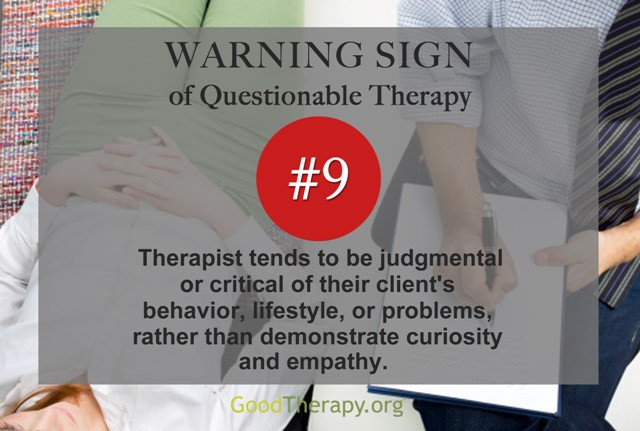
warning_sign9
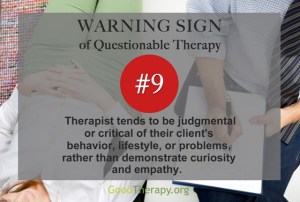
From 50 Warning Signs of Questionable Therapy or Counseling.

Perhaps one of the more difficult aspects of the abuse that I had tried to understand was where in the relationship with the abusive therapist that things went wrong. For a while, I believed that the therapist had somehow changed, since he seemed so competent for a long time before the abuse actively began. And I found myself searching for some point in time where I should have stopped trusting him. I think I believed that knowing this was important so I could have understood at what point my “screaming gut” was right. It wasn’t until a good friend of mine pointed something out to me that I hadn’t thought of before. He told me that there wasn’t any point in time when I should have trusted the abusive therapist. He said to me, “Michelle, he’s a predator. The only reason why he seemed so competent and trustworthy for so long at first was to gain your trust so he could effectively lure you away from your comfort zone. Tell me, would you have allowed him to say many of the things he said to you if he had started the relationship out doing that? No, your inner alarm bells would have been going off like crazy.” This was a pivotal moment for me because I had not given any thought at all to this possibility. I would never imagine hurting someone like that. It was finally starting to click in my head that I didn’t understand what happened for a reason. In fact, I never saw any of it coming because I never imagined anyone would ever treat another human being like this. My own profound compassion and deep empathy for others was something I assumed everyone else had. I am finding that many survivors of this type of abuse “suffer” from the same naiveté because of their own inner compassion and empathy.

Read the rest of Michelle’s story here: http://www.survivingtherapistabuse.com/2015/03/reclaiming-my-life/

Also, please read this article: 50 Warning Signs of Questionable Therapy or Counseling.
If your therapist does any of these things, they are red flags. Be wary or find another therapist.

Search term that made me go hmmmm

weedy+backyard

the narcissist’s front yard is immaculate but their backyard is a mess

Figuratively speaking, this is true, but I wonder if it’s literally true also. Do narcissists keep up the appearance of their house only where it can be seen? I wonder about that.

How to recognize a covert narcissist.

covert_narcissism

When most of us think of narcissists, we think of the overt type– arrogant and full of themselves, outwardly aggressive, flying into rages if they don’t get their way or their supply is not cooperating, confrontational, demanding, and high-maintenance. Think of the tyrannical boss everyone’s terrified of; the demanding, high maintenance, conceited friend; the roommate who feels entitled to “borrow” your clothes, car or money without asking; or the abusive and philandering husband–those are examples of overt narcissists. They’re in your face. They’re outwardly obnoxious. They may seem nice when you meet them (otherwise they wouldn’t be able to trap you as prey), but as soon as you’re in their clutches, they begin to show their true colors.

The second type, covert narcissists, seem much more benign, even after they’ve reeled you in as a source of supply. They don’t necessarily drop the nice act. That’s why they’re so dangerous. Because it’s hard to put your finger on what these dolls are actually doing, you may think there’s something wrong with you for feeling wary or nervous around such a “nice” person. They are the true wolves in sheeps clothing. The red flags are much harder to see in a covert narcissist. But make no mistake–they are predators too.

Some examples of covert narcissists include:

— the compassionate and friendly nurse who “accidentally” kills her patients.
— the needy friend who gives you unasked for gifts or does unasked for favors, then complains that you are acting selfishly if you want to spend time doing something besides being with them.
— the spouse who plays “martyr” and puts everyone on a guilt trip because of “everything they’ve done for you.”
— the friend who seems to have a neverending litany of problems, but when you try to help them they never take your advice or give you a long list of reasons why the advice you give them will never work. This friend is an emotional parasite, and will make you feel drained.
— the parasitic spouse who won’t get a job (and doesn’t appear to be trying). They keep giving you “reasonable” excuses as to why they can’t find one or why they haven’t tried to look. Really, they are just trying to live off you.

grovel
Illustration by Mike Reed.

The red flags we normally look for to peg a narc are much more difficult to detect in a covert narcissist, because they can seem so friendly, charming, generous and even altruistic (yes, altruism can be selfish when it comes with strings attached). The website Info Self Development, in their article about covert vs overt narcissists, lists these tell tale signs for recognizing a covert narcissist:

–Emptiness, seems to have something missing that you can’t quite put your finger on
–Stubborn, rarely apologising unless they want something from you (see narcissistic supply)
–Ability to make you feel guilty, even when something is not your fault
–Entirely self centered; they are the center of their own universe
–Expert liars; charming, hypnotic, a master of manipulation
–Projecting their insecurities and defects onto you
–Very sensitive to constructive criticism
–Inability to form intimate relationships
–Inability to feel genuine remorse
–Blaming others for their problems
–Low emotional intelligence
–Highly materialistic
–Extreme lack of empathy
–Superficially charming
–A victim mentality.

I think the last one is important– victim mentality. These are the do-gooders, the “altruists,” the first person to volunteer for the church fundraising drive, the mother who volunteers as the classroom mother, the favor-doing friend. If you fail to “appreciate” their good deeds to their satisfaction or live up to their unrealistically high expectations (for example not volunteering ALL your free time to the church fundraising drive), watch out. That’s when they will work behind the scenes to ruin your reputation through gossip, lies, and triangulation. They are “martyrs” and you are selfish and evil for not sacrificing yourself the way they have “for you.”

talk_to_me

They can also appear in the form of a needy “friend” who monopolizes your time with a seemingly neverending litany of problems or crises (sometimes brought on by themselves). They never seem to learn from their mistakes, and they will eat up your time and patience pleading or begging you to “fix” things for them. They almost seem to take a perverse pride in being victims. But any advice you give them will be dismissed or ignored. They will make excuses as to why the advice you gave them wouldn’t work. In some cases you may even be blamed for giving them the “wrong” advice, thereby making their problems even worse. They are emotional vampires who take and take, but never give anything back in return. If you ever have a problem, fuggaddaboutit. They won’t be there for you.

Covert narcissists may seem nice, but they aren’t. As with any narcissist, the best way to handle them is by avoiding them or cutting off contact with them if you can.

I am not your dream.

noones_dream

From the Facebook page Narcissistic and Emotional Abuse.

My son’s father turned from a loving dad into a monster.

ian_9months
My son at about 9 months. His dad doted on him then.

Turning on a child who was initially loved and doted on is not unusual for malignant narcissist parents. If the child proves to be sensitive, highly intelligent, or can see through the parent’s agenda, they may find themselves suddenly turned into scapegoats. Betrayal of a child means nothing to a narcissistic parent. The child was never a child even before the betrayal, just supply.

My son (who I’ve been calling Ethan on this blog but that is not his real name) was born in October 1991 and initially was very much wanted by his father. During his infancy his father appeared to love him very much and it wasn’t unusual to find my beautiful little boy snuggled up against his dad’s chest. Though Michael (also not his real name) was showing signs of the abuser he would soon become, the abuse was directed at me, and didn’t happen often enough in those days that I was that concerned.

By the time Ethan was 3 or 4 he was showing signs of being a highly sensitive (and very creative) child. He cried frequently and was given to tantrums when he sensed discord, anger or chaos around him. He was always very sensitive to his environment and didn’t react well to everyone and he hated change. He still remembers himself as being an extremely nervous child, but those nerves were due to his high sensitivity. I was much the same way when I was his age. I could always identify with my son.

I remember when he was two, when we were moving from New Jersey to North Carolina. Because we didn’t have a lot of money for a long distance mover, we moved most of our stuff (except large pieces of furniture) in a U-Haul and a car over five separate trips. During the time the house was being slowly emptied, Ethan began to act very strange. He stopped eating, looked pale and his eyes looked too big for his face. He hadn’t really started talking much yet, but did this strange “parroting”–he’d repeat “Hi Mommy! Hi Daddy!” over and over, in a strange high pitched voice. It was creepy. His doctor said not to worry, but he just wasn’t himself. Then it finally dawned on me: a very young child sees things disappearing and doesn’t understand why (he hadn’t come on the moving trips to see where the things were going). His two year old mind deduced that eventually his parents and baby sister would disappear too, leaving him alone, so the nervous parroting of “Hi Mommy, Hi Daddy,” was to make sure we were still there and weren’t going to leave him. To a sensitive child like Ethan who hated change as much as he did, watching the things in his environment disappear must have been traumatic for him. I asked him about this recently and he still remembers it. He told me my suspicions had been correct. He was afraid we would disappear!

ian_age3
Third birthday. He received a cake with a blue toy car on it.

Michael saw this high sensitivity as soon as it became apparent, and suddenly his affection toward his son came to a screeching halt. He began to pick on and belittle him, calling him names such as stupid, idiot, “faggy,” pussy, baby, and loser. As young as Ethan was, I could see how his self esteem was already taking a beating. Soon he became nervous and awkward around his father but of course this just fed the abuse.

Soon Michael began to physically abuse Ethan, spanking him almost every day just for being who he was. Whenever I criticized or questioned Michael about why he was treating Ethan this way, he just said he was trying to “toughen him up.” (this from a man who called himself a feminist–go figure that one out!) I told him his aggressive behaviors toward Ethan to “man him up” were not working because Ethan wasn’t built that way, and besides they were very unloving. I told him I was afraid Ethan would think his father hated him, but of course my concerns were dismissed and I was called wrong, stupid or crazy. We had many fights about this, but the abuse never stopped. In fact it kept growing worse.

Michael constantly made fun of Ethan, imitating his speech, his walk, his awkwardness. Ethan was bullied at school for a time, just as I was, and my heart broke for him. I loved my son so much, and couldn’t bear to see the way his father treated him.

ian_age8
Ethan at about age 8, around the time his father destroyed his car collection.

The incident that I remember with the most anguish occurred when Ethan was about 8. He had a collection of about 15 or 20 collectible cars his grandfather had given him over several years and Ethan was very proud of them. He displayed them on a 5-tiered shelf in his room. One evening Michael came raging into his room for one reason or another (he was often drunk and some of his rages seemed to be caused by nothing) and knocked over the stand, sending all the beautiful and expensive replicas crashing to the floor. All of them were destroyed beyond repair. Ethan burst into tears and begged him to stop, but Michael was relentless and began pounding on him, calling him a stupid faggot crybaby, and demanding to know why he couldn’t “man up.” I was in the room at the time, desperately trying to push him away from Ethan but to no avail, because Michael was much stronger than me, and by then I was myself afraid of his rages.

This incident haunts me to this day. It’s hard for me to think of it without my heart breaking, because of how painful it was to see my brilliant, creative, sensitive little boy’s car collection destroyed for absolutely no reason at all — and my son’s self esteem taking such a beating from the man who had once seemed to love him so much during his first few years.

Fortunately, Ethan was always much stronger than he seemed, and smart too. He chose to live with me after we divorced instead of his father. Kung Fu lessons paid for by my father (which he stuck with for 3 years and got as far as brown belt) and an Outward Bound expedition for his 8th grade trip began to change him and help him rebuild his self esteem.

ian_age15
Age 15.

He came out as gay at age 17, and since then has become a happy and well liked young man with many interests and talents who is making good choices in life. (He also chose to live hundreds of miles away from the family but I can’t say I blame him for that). While it’s sad he lives so far away, I’m happy that he’s happy now and that after everything he went through, he may be the most mentally stable member of the immediate family. He is the only one of us who doesn’t appear to have a personality disorder.

ian_age23
Today at age 23, living on the Gulf Coast of Florida.

Not all children who were turned on and scapegoated by a malignant narcissist parent were so lucky. Many were psychologically destroyed or even killed. Ethan was one of the lucky ones.

See also:
My Son Didn’t Escape Unscathed: https://luckyottershaven.com/2015/05/11/my-son-didnt-escape-unscathed/
My MN Ex’s Weird Attitude to His Son: https://luckyottershaven.com/2015/02/24/my-mn-exs-weird-attitude-to-his-son/