Panic attacks, dissociation, and my son’s anxiety issues.

escher

Geometries by M.C. Escher


My son, who already suffers from OCD and ADHD (both diagnosed) tweeted this the other night:

I just had one of the strangest things happen… and it was the scariest experience of my life. I just had a Depersonalization/Derealization episode. It was SO FUCKING TERRIFYING. I thought I was gonna wake up in the ER or never sleep again.

Then later:

Other than OCD, ADHD and depression i have no psych disorders i know of. That shit LITERALLY made me feel like i’d lost my grip on reality and self.

The next day:

I’m going to the emergency room.

A few hours later:

Guys, if anything happens i love you all. Absolutely terrified in the waiting room rn feeling like death.

Late last night:

I got released. They gave me an anxiety pill. It was officially diagnosed as an anxiety attack.

Today:

Looking into therapy. my anxiety is getting REALLY bad.

As his mom, of course I was alarmed by these tweets.  But, as someone who used to suffer from panic attacks just as debilitating during my 20s and 30s, I KNOW HOW HE FEELS!  Panic attacks suck, and the type that involve dissociation are absolutely the worst.   For me, the dissociation usually involved derealization (feeling like your environment was unreal) but sometimes depersonalization (feeling like you’re disconnected from the world or like you’re not in your own body) too.

The panic might be hereditary.  His father suffers from anxiety attacks too.   I used to have exactly the kind of panic attacks he describes — always some kind of dissociative hell where I felt like everything was a dream and the people around me suddenly looked very frightening — either robotic or demonic.  Sometimes they looked like wax figures or seemed like they were being run by machines, and the environment itself became very surreal and dreamlike.  Sometimes it looked like a cartoon or two-dimensional.

disorienting

Museum installation by artist Peter Koler

During the worst attacks, I used to feel like I was literally outside of my body, and that really freaked me out.   I actually would have trouble controlling my body.  I remember once this happened to me on the subway in New York (which is scary enough as it is!) and I literally had to run off the train as soon as it stopped and ran into a corner and started whimpering.    Sometimes I used to have to bite my hands to feel “real.”   There were a few times I actually drew blood from doing that.    These dissociative episodes felt just like a bad drug trip, and I’ve had a few of those too.

I suffered from my first dissociative panic attack at about age 10.  I was playing outside in the early evening in the driveway and suddenly I felt like I wasn’t in my body.   But I wasn’t able to find the words to describe the feeling, and when I tried to tell my mother about how “weird” I felt, she had no idea what I was talking about and said I was being overdramatic and imagining things.   Eventually it passed, but from then on, every so often I’d get that weird feeling again.   As I entered my teens and twenties, the attacks became worse and more frequent.   They eventually tapered off when I reached my thirties and I haven’t had a full blown panic attack in years.

In my case, the episodes may have been due to my generalized anxiety disorder (GAD) or possibly from C-PTSD and/or BPD.    I don’t think my son has BPD, but he likely has PTSD or C-PTSD (his father is a narcissist and we had a very toxic marriage when the kids were young, which I have described elsewhere in this blog).   OCD can definitely cause a person to have anxiety or panic attacks, and I’m sure having ADHD just exacerbates the tendency.

I talked to him tonight for a while about this, and suggested some mindfulness tools that have helped me.   I think CBT could help him with this.  Thankfully, he has health insurance with his job, and has set up an appointment to see a therapist.  The emergency room gave him a short term prescription for some anti-anxiety meds (not benzodiazepines though).   But there are many things he can do to help himself too.

He has never sought therapy for his anxiety or OCD because he’s been able to deal with it  on his own until now, but he does need help with the panic and dissociation.   He also admitted his new job is much more stressful than he expected, and he is already looking around for something else.

If you pray, please send your prayers his way.  No one ever died or went crazy from a panic attack, but as someone who’s suffered from them, I know they can certainly feel that way when you’re in the midst of one!

*****

Further reading:

Derealization and Depersonalization in BPD and NPD

Self-care in turbulent times.

dog-walking-in-snow

The trendy term “self care” irritates me the same way other trendy terms tend to irritate me, but it’s actually a good phrase and good advice.

I had two days off from work this week due to the snow, and I could have spent that time glued to the news, scanning Twitter for the latest Trumpian outrages (I can’t even keep up with them anymore), and making myself angry, depressed, and scared.

For a year I have struggled with retriggered C-PTSD because of this president and his abuse of vulnerable Americans, which includes myself because I am not rich or conservative.

I could have worked myself up into a righteous tizzy and returned to work feeling exhausted instead of refreshed.

But instead, I took a moratorium from the news and from the Internet.   Reading my Kindle copy of “Fire and Fury” (I’m almost done) was about the extent of my politics-related activities.   I cleaned my house (really well for a change) , organized a couple of closets, and actually cooked.   I spent time catching up with friends on Facebook and reading funny or inspiring websites, and watching funny animal videos.  I watched part of a “Bizarre Foods with Andrew Zimmern” marathon, and even walked in the snow.    I read one of the novels in the list of books I posted the other day, and was actually able to concentrate on the plot.   I’m almost finished with it now.

readingabook

I have to admit I felt a twinge of guilt for burying my head in the sand and choosing not to follow the news for a couple of days.    I’ve always believed if you’re not part of the solution, you’re part of the problem, but taking mental health breaks from all the chaos coming from the White House doesn’t mean you’re ignoring the dangers and becoming complacent and complicit.  It means you are a human being and need time to take care of yourself.  If you’re active in the resistance, whether as an actual activist, or just protesting online, you’re not going to be any good to anyone if you’re depressed, deflated,  apathetic, terrified, or unhealthily enraged.   All you’ll be able to do is spread negativity instead of inspiration and ideas.

So it’s absolutely imperative, especially if you suffer from PTSD, C-PTSD or a depressive disorder, to give yourself breaks from all the chaos and negative politics and take care of yourself.   It’s still possible to enjoy the simple things in life and even have fun, yes, even in the darkest times.   I can’t help but think of Anne Frank, a young girl confined in a German concentration camp, but she never let that reality break her spirit.  She was still a happy, positive person who spread joy and hope to others, even knowing she and her family were going to die.   Even today, her legacy still inspires others.

After my two days off spent staying away from politics and the news, I actually felt refreshed and ready to fight again.    So don’t feel guilty if you need to take breaks to concentrate on yourself, your friends or family.   Spend time doing things you like or that relax you — listening to music, watching a funny movie, meditating, praying, doing Yoga, reading a novel, cooking or baking, or spending time in nature (nothing is more healing than nature, if that’s your thing).   You are not abandoning your ideals or becoming complacent.   You are just refueling.

*****

Further reading:

12 Ways to Resist Without Losing Your Mind

Why isn’t a mental health assessment required for a new president?

danzcolorplus7013

Credit: Increasing Number of Psychiatrists Challenge The Goldwater Rule / FFRF Maine


My son is applying for a job as a police dispatcher.  Like all government jobs, it’s a good paying job, with great benefits, including comprehensive health care, dental, and an actual pension.   He’s already passed two of the tests and the pool of candidates is down to just a few.   He thinks he has a good chance of snagging this job, but he still has to pass a mental health examination, since a dispatcher’s job can be incredibly stressful.  You have to be able to act quickly and make life and death decisions.  You can’t let your own emotions get in the way if you get a frantic call from someone threatening to kill themselves, or from a terrified woman whose ex-lover is holding a gun to her children’s heads.    You can’t dissolve into a handwringing puddle of indecision when you get a call from someone saying their husband is having a heart attack.   You must be able to act efficiently and quickly, and keep your wits about you at all times.    The job, though it pays well and is stable compared to many other jobs, has a lot of turnover because many people find they can’t handle this type of life-and-death stress for very long.  There is good reason then, to give a candidate like my son a mental health assessment, to make sure they are emotionally stable enough to be able to handle the type of situations that will come up without snapping, becoming depressed, or even blaming themselves if something goes wrong (because sooner or later, it will: some who threaten suicide will succeed; some who have a gun pointed at their head will actually be shot).

But the job of police dispatcher is far, far beneath that of President of the United States.  Only one or two individuals will be affected at a time by the choices a dispatcher makes, while the President’s decisions have the potential to affect an entire country, or even the entire world.

We have a president who obviously has a severe mental illness.   He appears to fit ALL of the 9 DSM-IV-TR criteria for Narcissistic Personality Disorder:

A pervasive pattern of grandiosity (in fantasy or behavior), need for admiration, and lack of empathy, beginning by early adulthood and present in a variety of contexts, as indicated by five (or more) of the following:

(1) has a grandiose sense of self-importance (e.g., exaggerates achievements and talents, expects to be recognized as superior without commensurate achievements)

(2) is preoccupied with fantasies of unlimited success, power, brilliance, beauty, or ideal love

(3) believes that he or she is “special” and unique and can only be understood by, or should associate with, other special or high-status people (or institutions)

(4) requires excessive admiration

(5) has a sense of entitlement, i.e., unreasonable expectations of especially favorable treatment or automatic compliance with his or her expectations

(6) is interpersonally exploitative, i.e., takes advantage of others to achieve his or her own ends

(7) lacks empathy: is unwilling to recognize or identify with the feelings and needs of others

(8) is often envious of others or believes that others are envious of him or her

(9) shows arrogant, haughty behaviors or attitudes


If that’s not bad enough, Trump shows signs of severe paranoia and even a possible degenerative illness like Alzheimer’s.     It doesn’t take a trained psychologist to be able to see what is obvious:  Donald Trump’s behavior is not normal.    At best, he’s incompetent and unfit to lead a nation; at worst, he’s a clear and present danger to the planet.

Armchair psychiatrists’ speculations aside, no official diagnosis of NPD or anything else has been made for Donald Trump.   That’s because of The Goldwater Rule, which was instituted by the American Psychiatric Association to address the idea that diagnosing a public figure (Barry Goldwater’s fitness to run for president in 1964 was in question) without an official psychiatric assessment was unethical.

It’s my opinion (and that of some mental health professionals) that an exception to the Goldwater Rule should be made for Donald Trump, who is visibly mentally ill enough to pose a real danger to America and to the world.   But why wasn’t he given a psychiatric examination to determine his fitness to lead our country in the first place?

Personally, I don’t understand why a psychiatric assessment isn’t required for all incoming presidents, or even for anyone who makes the final two candidates in any election.    If my son has to take one to qualify for a job as a police dispatcher, then I definitely think it should be a requirement for any incoming head of state.

Indivisible: starting to get involved.

indivisible-goes-local

Every day, the Trump  administration’s actions get more outrageous, more boneheaded, and meaner.   They seem to have no shame in how low they will go to destroy an entire nation.  They care nothing about the American people or what they want or need; they have no respect for the Constitution, are contemptuous of basic human or civil rights,  they are without a shred of empathy or kindness, and seem intent on bringing what’s left of our system crashing down and leaving everyone who isn’t part of the 1% (or white) without a voice, without freedom, without healthcare, without education, without clean air or water, but heavily controlled, deceived, and policed instead.  They seem to be fostering ignorance, intolerance, divisiveness, and hatred.   Every day it seems to get worse.  This administration has not done one thing that benefits the vast majority of Americans, and every decision they have made has been stupid, or evil, and usually both.

According to experts, we no longer even qualify as a democracy; in fact, the other day I read an article saying that  we have dropped to 21st in the Democracy Index, between Italy and Japan.  As of 2016, we are categorized now as a “flawed democracy” but I’d say even that’s way too generous.   Since Trump took office, I would say by now we have sunk even lower that that.    The next category down is “hybrid regime” (common in much of Eastern Europe, and some African and South American countries), and then “authoritarian”  (Russia, China, North Korea, much of Africa, and most of the Middle East).  We seem to be emulating Russia, one of the most authoritarian regimes in the world — and we have a president who may well have committed treason by involving Russia in the election.   We are becoming one of the most hated countries in the world, if not the most hated.  Trump’s actions against immigration are not making us safer; they are actually making us far more vulnerable to attack, not only by angering other countries, but by alienating us from our allies (such as Mexico) so they may refuse to step in and help if we need them.

I know lately I’ve been writing a lot about the political situation because it’s everywhere — and has taken over my mind.     The other day, TIME Magazine had an article about a PTSD-like condition that has become epidemic ever since Trump was elected.   Here is another article I found (there are many others):

Psychologists Say Stress Caused By Trump Administration Poses Threat to Public Health

I remember asking my therapist if there was something wrong with me because I was getting so depressed and obsessing so much over the political situation.  In fact, he said that most of his clients are very upset and some are finding it difficult to function.  Our mental health really is is suffering, especially those of us already suffering from PTSD, C-PTSD and other trauma based conditions.

Rather than just writing about it all the time,  I’m finally getting involved.  Besides attending the March for Science on Earth Day (April 22), I’m attending an ACA (Obamacare) Rally here in my city on February 25th.     I’ve become a member of the Indivisible Movement, a movement that is growing as fast or faster than the Tea Party did.   It seems better organized and more focused than Occupy and doesn’t seem like it will fizzle out or be silenced anytime soon, or at all.   Joining the Resistance makes me feel better; it makes me feel like I’m making a difference and my voice is being heard.

I urge everyone who agrees that this administration is evil and cares nothing about anything but stripping away everything good this country once stood for to join the Indivisible movement and attend any rallies or Town Hall Meetings in your area.  It costs nothing to get involved.

Here is their website, where you can download their guide or ask questions.

https://www.indivisibleguide.com/

Why Scientology auditing is not at all like traditional psychotherapy (Part 1)

scientology_auditing

This is an actual question an auditor asks you during the introductory (“communications”) course that is really an early indoctrination procedure.

This is my second post about Scientology.  It will be in two parts.

My first post about Scientology was about my own experience (thankfully, short lived) in the cult, but this one will focus less on my own personal experience and more on how Scientology (and the related Dianetics) “auditing” works and why it isn’t at all like (and is far inferior to) traditional psychotherapy (that is, when you have a good, empathetic therapist).

But before I get into the differences, I feel it’s necessary to give you some background about Dianetics and Scientology auditing and the religion that arose from it.

Mainstream mental health: an imperfect science.
emotional_baggage

Psychotherapy isn’t perfect, and of course, there are many bad therapists.   Even when you have a therapist who you are comfortable with and who knows what they’re doing, it can take years to be “cured.”    It isn’t an exact science, or really, much of a science at all (it’s more of an art form) so there aren’t any easy answers or sure-fire “formulas.”   Human beings are complicated, and a modality that may work well on one person may actually do nothing for another, or even make them worse.   And of course, there are many terrible therapists, who are either completely incompetent, are only in it for the money,  lack enough empathy to be effective, are unconsciously attempting to work out their own issues (which is what attracted them to the profession in the first place), and even (if they are sociopathic or narcissistic, and many are) exploit or emotionally abuse their clients.

People can also become “addicted” to their therapists. They can become overly dependent on them and never leave therapy because they feel like they can’t cope on their own.   And it’s true, some therapists do become unhealthily attached to their clients, and discourage them from ever leaving.   A good therapist who doesn’t have unresolved attachment issues will discourage a client from becoming overly dependent on them (while still projecting warmth and empathy), with the end goal being for the client to be able to leave and  function better and feel happier, using new sets of emotional tools to do so.

But psychotherapists (both psychiatrists, who are medical doctors who can prescribe drugs, and psychologists and  clinical social workers, who cannot) are bound by the law. In a best case scenario, they must abide by the law and a certain code of ethics, or be barred from practicing their professions or even face civil or criminal charges.

All these disadvantages aside, traditional psychotherapy is a positive and life-changing experience for most people who undergo it and stick with it, and it has existed for over a century.  There are many different modalities suited for different psychological disorders or problems.   There are both short term and long-term methods.   Some, like CBT or DBT, aren’t cures but are really training methods that teach a person mindfulness skills so they can function better and are less symptomatic.  Others, like Freudian or Jungian psychoanalysis, schema therapy, attachment therapy, psychodrama, EFT, hypnotherapy, and other “talk therapy” methods are long-term modalities that actually attempt to get to the root of the client’s problems or release trauma.  Many therapists mix several different modalities, and some include mindfulness tools like meditation, visualization, and relaxation techniques into their sessions.  Talk therapy can take many months or even years to have results.   In a best case scenario, the client will be cured of whatever is ailing them.  Even if they aren’t cured, a lot of the charge that was feeding their disorder is removed. Some disorders, especially those that have a physical component or are due to faulty neurological “wiring” respond better to drugs than to talk therapy, and continued management by a psychiatrist may be necessary, even though improvement in symptoms is almost immediate.

Scientology’s beginnings. 
dianetics

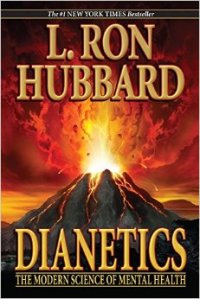
The book that started it all.

Scientology has always been very hostile to both psychiatry and psychology.  L. Ron Hubbard, a second rate science fiction author, had always been fascinated with the human mind and how it worked.  He published his bestselling  book about his discoveries, “Dianetics: The Modern Science of Mental Health” in 1950.  Dianetics is a bastardization of traditional psychoanalysis, but really isn’t much like it at all.   Hubbard was a sociopathic narcissist who had no degree in psychology and in fact lied about many of his accomplishments.

Dianetics uses elements of Freudian psychoanalysis, but is based on the belief that almost all people have “engrams” (unless they are “natural clears,” which are very rare).  Engrams are cellular imprints of moments of trauma that always contain some sort of physical pain and the “unconsciousness” that accompanies a painful or traumatic event.    The part of the mind that contains the “engrams” is called the reactive mind, and the goal of Dianetics “auditing” is to remove all the engrams through “reliving” the memories associated with them, so the person eventually attains a state called “Clear,” which means they have no reactive mind anymore and can act in rational and healthy ways not based on unconscious painful memories or trauma.

psychiatrykills

A Scientology anti-psychiatry demonstration.

In the early years of Dianetics, Hubbard attempted to get it recognized as a valid form of psychotherapy, but his book and methods were rejected by the mental health community. Hubbard, being a malignant narcissist who was devastated by this massive narcissistic injury, turned against the entire mental health field.  He vilified it and preached  to his followers that psychiatry and psychology were the worst evils to befall mankind and that Dianetics was the only valid way to become a happy and functioning person.


A new religion is born.

scientology_church

Hubbard began to market his book through the same pulp science fiction magazines  that published his stories, and his Dianetics book proved popular.  Many people claimed to be helped through Dianetics auditing, but this wasn’t enough for Hubbard.    He was quoted as saying, “the quickest way to become rich is to start your own religion,” and so he did.   Not only could he become the messiah of his own church based on his “miracle cure,” he also no longer had to pay taxes.    He trained many new auditors and started the Church of Scientology in December, 1953.    He added the levels of O.T. (Operating Thetan) states that go beyond the state of Clear.  An OT supposedly had complete control over matter, energy, space, and time, and at the highest level, could perform Herculean actions without even needing a body to do it.

To his religion Hubbard added a “space opera” cosmology, which sounds suspiciously like a plot in one of his stories.   The level of OT III is the level at which the “top secret” cosmology is finally revealed (of course, now due to the Internet, anyone can find out about it for free).   Supposedly, an evil galactic ruler called Xenu, who lived 75 million years ago, thought his planets were overpopulated and had most of the population frozen and dumped into volcanoes in Hawaii (which didn’t exist 75 million years ago), and programmed their spirits (thetans) with the “R6” implant, which is the reason why traditional religion and mental illness (and all other evils of mankind) came into being.    These disembodied spirits were then released and attached themselves to living people as “body thetans” (BT’s).  BT’s are analogous to possession by minor demons.   A person at the OT levels spends much time “auditing out” the BT’s to achieve more perfect spiritual enlightenment.  Scientology’s insane doctrine was illustrated in a famous episode of South Park in 2005.      It’s so unbelievable that the show had to show disclaimers at the bottom of the screen that said, “This is what Scientologists actually believe.”

xenu

From “Trapped in the Closet,” South Park episode.

Hubbard believed if this “top secret” material were revealed to someone at a lower level of “processing,” that they would die of pneumonia or go insane.  His real fear was probably that people might laugh his church out of existence.  Of course, most Scientologists (at least before the Internet) don’t even know about this secret doctrine because so few of them have achieved the state of OT III.   Many (who haven’t been completely brainwashed into believing anything they are told) leave when they find out.   Others are offended that figures like Jesus or the Buddha are considered “implants” who never even existed, especially since when they first joined Scientology, they were promised that their own religion was not incompatible with Scientology.  At OT III, they find out they must renounce their former religious beliefs, if they still had any.  It’s the ultimate bait and switch, something Scientology is well known for.

“You don’t get rich writing science fiction.  If you want to get rich, you start a religion.” — L. Ron Hubbard

Scientology also co-opted the Christian cross (although the eight pointed version Scientology uses is actually based on the Rosicrucian cross) and sometimes requires its clergy (professional auditors and high ranking church officials) to wear clerical collars in public to seem more authentic.

During the late 1950s through the 1970s, when people were becoming interested in alternative therapies and “new age” religions, the Church of Scientology exploded in popularity, until the late 1970s when the IRS and the FBI descended on Hubbard and his church due to tax fraud and other shady and unethical activities conducted at Scientology’s headquarters and at its paramilitary offshoot, The Sea Org.  While Scientology remains popular, especially among celebrities and the very wealthy, the costs of Scientology training and Dianetics auditing are far too expensive for the average person to afford, so the only people who can move up the “Bridge” and attain the rarified Clear or O.T. (Operating Thetan) states, are the very wealthy or those unfortunates who “work off” the expense as residents of the Sea Org (and rarely achieve those states anyway).

Dianetics and Scientology auditing vs. traditional psychotherapy. 

Moving away from the religious aspects of Scientology and back to its original purpose as a form of “therapy” (and most people who undertake Dianetics or Scientology auditing are only using it as a form of therapy anyway, having no idea of what they’re really getting into), please read Part 2:

Why Scientology auditing is not at all like traditional psychotherapy (part 2).

How to reparent yourself.

This short post went viral on my other blog, although I really have no idea why because not a whole lot of thought went into it and I wrote it on the fly, but it seemed to resonate, so I’m reblogging it here too. (Chair Girl is the name I give to my inner child in therapy).

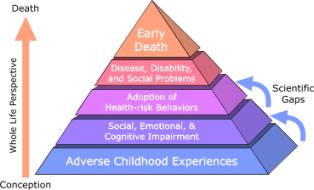
The Adverse Childhood Experience study (CDC)

Under my post Adult Poverty and Scapegoat-hood: A Connection?,  one of my commenters (katiesdream2004) mentioned a study conducted by the Centers for Disease Control (CDC) in the mid-late 90’s that researched the connection between adverse childhood experiences (which includes emotional abuse by parents and early caregivers) and ill health and general low quality of life in adulthood.  I decided to Google it and here’s what I found.

From their webpage:

ace_study

The Adverse Childhood Experiences (ACE) Study is one of the largest investigations ever conducted to assess associations between childhood maltreatment and later-life health and well-being. The study is a collaboration between the Centers for Disease Control and Prevention and Kaiser Permanente’s Health Appraisal Clinic in San Diego.

More than 17,000 Health Maintenance Organization (HMO) members undergoing a comprehensive physical examination chose to provide detailed information about their childhood experience of abuse, neglect, and family dysfunction. To date, more than 50 scientific articles have been published and more than100 conference and workshop presentations have been made.

The ACE Study findings suggest that certain experiences are major risk factors for the leading causes of illness and death as well as poor quality of life in the United States. It is critical to understand how some of the worst health and social problems in our nation can arise as a consequence of adverse childhood experiences. Realizing these connections is likely to improve efforts towards prevention and recovery.

A correlation was found:

Childhood abuse, neglect, and exposure to other traumatic stressors which we term adverse childhood experiences (ACE) are common. Almost two-thirds of our study participants reported at least one ACE, and more than one of five reported three or more ACE. The short- and long-term outcomes of these childhood exposures include a multitude of health and social problems.

The ACE Study uses the ACE Score, which is a total count of the number of ACEs reported by respondents. The ACE Score is used to assess the total amount of stress during childhood and has demonstrated that as the number of ACE increase, the risk for the following health problems increases in a strong and graded fashion:

Alcoholism and alcohol abuse
Chronic obstructive pulmonary disease (COPD)
Depression
Fetal death
Health-related quality of life
Illicit drug use
Ischemic heart disease (IHD)
Liver disease
Risk for intimate partner violence
Multiple sexual partners
Sexually transmitted diseases (STDs)
Smoking
Suicide attempts
Unintended pregnancies
Early initiation of smoking
Early initiation of sexual activity
Adolescent pregnancy

None of this should be surprising. Abuse early in life, whether emotional or physical, takes a huge toll on a person’s sense of self-worth and these people tend to enter adulthood lacking the emotional, financial and practical tools others have to create a healthy and successful life. They also lack the support systems others do, and I would guess the enormous stress of facing challenges that others get help with also has ill effects on health and wellbeing.

I did notice the list mainly includes unhealthy life “choices” such as smoking, illicit drug taking, and early pregnancy. However, I also see depression and general health problems on the list too. I’d include other mental illnesses such as PTSD, Complex PTSD, Borderline Personality Disorder, Avoidant Personality Disorder, and Social Anxiety, all which interfere with a person’s ability to function well in the working world and in interpersonal relationships. These mental disorders could also cause a person to make “bad choices” such as smoking or sexual promiscuity.  Some, like Social Anxiety or Avoidant Personality Disorder, could cause a person who doesn’t engage in unhealthy behaviors, to be afraid to take any risks in life, limiting their opportunities and setting them up for failure.

More research needs to be done, particularly on the connection between emotional/narcissistic abuse during childhood and poverty later in life.

You can read more on their website:
http://www.cdc.gov/violenceprevention/acestudy/

Mental Health ~ Coping Skills

Mental health madness.

doctor_lucy

Good mental health treatment is becoming increasingly a thing of the past. Many times, it simply isn’t available to those who aren’t wealthy. Most company-sponsored health insurance plans don’t even cover mental health anymore, unless it’s short term or if your problem directly affects your job. Most of the time, they’ll just fire your ass.

Mental health for the poor is even worse. If it’s even available in your community, it could take weeks or months of waiting after an entire day spent filling out forms before you even get your foot in the door for your “intake session.” Once you do get in the system (if you do), you’re sent to a bored psychiatrist who wants to pump you full of drugs instead of send you for long term psychodynamic therapy. Then you have to check in weekly with some condescending nurse-practitioner who asks you a litany of prefabricated questions (one size fits all!), takes your temperature and weighs you (why?), and asks you about your drug use.

That’s right. Drug use. It seems like psychotherapy programs for the poor try to siphon you off into a “drug treatment program” if you admit to even sipping a glass of wine a few times a year or having a few tokes of weed on occasion. Where I live, the only free “mental health” program is a drug-treatment program in disguise. Having little money, I went there not too long ago to get therapy for my depression and anxiety and had to fill out about 10 pages asking me about my “drug abuse history.” I walked out.

That’s why I’m currently paying out of pocket for a real psychodynamic therapist who focuses on digging into your childhood and stuff (eg, the kind of therapist rich people pay for) even though I’m poor as fuck.

Mental Health Blogger Award nomination.

mental_health_award

I’m humbled and proud to announce that Tessa from Tessa Can Do it has nominated this blog for the Mental Health Blogger Award. This award recognizes blogs that both promote mental health awareness and attempt to reduce the stigma associated with mental disorders.

Thank you so much for the honor, Tessa!

So I’m paying it forward by nominating five blogs I think deserve this award too. Nominees should do the following if they wish to accept the award:

The Rules:

1. Place this award somewhere on your website.

2. Nominate five bloggers who promote Mental Health awareness to receive this award.

3. Give reasons for your nominations.

My Nominations:

1. BPD Transformation has a very informative and well researched blog about Borderline personality disorder (BPD) and believes the negative “Cluster B” stigma associated with BPD can be eliminated by focusing on treating its symptoms over the medical model of misleading diagnostic labeling.

2. An Upturned Soul is a narcissistic abuse survivor whose articles are very well written and entertaining at the same time. This blogger definitely knows a lot about NPD and malignant narcissism but writes in a way that doesn’t automatically bash people who have NPD but instead attempts to educate people about them so they can protect themselves accordingly. I also like her out of the box thinking and thought provoking ideas.

3. Grace For My Heart is a Christian-oriented blog written by a pastor. While not specifically about mental illness, every Friday Pastor Dave features his intelligent and engaging “Narcissist Friday” posts, which focus on NPD and narcissistic abuse. I’m impressed by Pastor Dave’s intelligently written posts that do not stigmatize or promote hatred of people with NPD, but at the same time make it clear how dangerous people with this disorder can be and that the best thing the rest of us can do for ourselves is not to have contact with them.

4. Make BPD Stigma-Free! — the title of this blog is self explanatory. It’s also a good source of information about BPD and methods of treatment and therapy.

5. Discussing Dissociation: Thoughts from a Trauma Therapist — Although this site focuses on those suffering from DID (dissociative identity disorder), there is much information and help here for anyone suffering from other mental disorders caused by abuse and trauma, such as C-PTSD; and the dissociative symptoms associated with the “dramatic” Cluster B personality disorders.