Why isn’t there a 12-step program for narcissists?

narcissistsanonymous

…and I’m not talking about this either. 😉

A commenter on this post wondered why there aren’t any 12-step programs for people with NPD, and that got me thinking — well, why aren’t there?

About a month ago, my friend Mary Pranzatelli and I were having a conversation about this very same thing on Facebook.

There’s a lot of good reasons why a 12-step program might be helpful to a narcissist. After all, narcissism and addictive disorders like alcoholism have a lot in common. This isn’t an idea I just dreamed up. Sam Vaknin also wrote about the similarities, as well as others like psychologist Tian Dayton.

narcanontshirt

Here’s a quick list of things both narcissists and people addicted to substances have in common:

1. They are often in denial about their disorder. When a narcissist or an addict realizes they have a disorder they may want to get help. (This is actually the first step of programs like AA or NA.)
2. In some ways, both addiction and narcissism is a choice, even if it was made unconsciously (although there is likely to be a genetic component too that at least gives one a predisposition toward these disorders).
3. The narcissist’s drug of choice is narcissistic supply, which gives the narcissist an adrenalin rush. When it’s lacking or in short supply, they will crash and burn. The addict will also crash and burn without their fix.
4. Once a narcissist or an alcoholic (or drug addict), always a narcissist or an addict. You can stop drinking and using (or stop acting so narcissistic), but the underlying disorder is unlikely to ever be cured.
5. Treatments like CBT (cognitive behavioral therapy) work much like the 12 steps of AA–they change behaviors but not the underlying disorder. The person must make a conscious effort to replace the old behaviors with the new ones.
6. High possibility of relapse or “slipping” back into the addictive or narcissistic behavior patterns if the program isn’t strictly followed (or even if it is).
7. An addict or narcissist without their fix (or supply) can both act in antisocial, selfish and narcissistic ways until their fix (or supply) is procured.

and finally…

8. Because narcissism (and addictive disorders) have a spiritual component, admitting that God or a Higher Power can help you is an integral part of all 12-step programs.

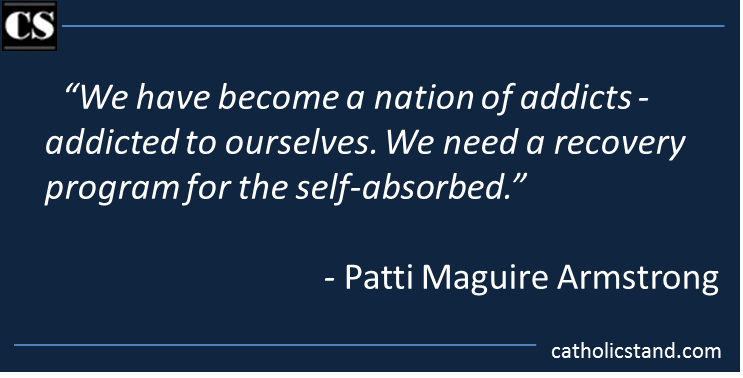
addicts

True, a 12-step program wouldn’t cure narcissism (just as AA doesn’t cure alcoholism), but I think such a program could help a narcissist who is self-aware and wants to change their attitudes and the way they treat others.

So why isn’t there a 12-step program for NPD?

What’s your guiltiest pleasure?

Admit it. You have one. Mine is…

wait for it…

impatient

Bro-country!

tailgate

brocountry

This video was meant to make fun of bro country (because it all sounds the same!) but if you’re like me, you’ll keep pressing play over and over!


Credit: created by Gregory Todd aka Sir Mashalot, and for updates on his next video and mp3 of this song, he can be found at https://www.facebook.com/sirmashalot.gregorytodd

I wrote about this mash-up here.

What’s your guilty pleasure?

The Tree

I was thinking about this today and remembered I had written about it. I think it’s time to reblog this article. I hope some of you find it inspirational.

luckyotter's avatarLucky Otters Haven

CLF - Olmstead Parks

Until August 1999, I had a vague concept of God and if anyone had asked, would have told them I was agnostic, leaning toward atheist. I was very far away from God in those days–embroiled in a deteriorating marriage to a narcissistic psychopath, drinking and smoking pot in an attempt to “put up” with him, all while I was raising two young children. I also was an unfaithful wife (as was my husband) and handily made excuses about my infidelity based on his abusive treatment of me and the fact he was unfaithful too. I never darkened any church’s doorway, and thought prayer was useless and silly. God was an abstract and mostly irrelevant concept to me–of no further consequence to my personal life than an Ebola case in Africa. My theory back then was that if there was a God, then maybe he created the universe, but then he…

View original post 1,123 more words

Blogging Silence: Blogging is not for the Lazy

I just discovered this blogger who writes about…blogging! I could really relate to this article because I’ve also noticed that if you don’t post for even a day or two, your views drop to next to nothing–even with a high follower count. If you’re a serious blogger you cannot be lazy. You may be able to skip one day or so, but no more than that. The blogosphere just keeps growing and the competition can be stiff. Having a successful blog is hard work, but also a lot of fun if you’re serious about it.

Of course, not all bloggers blog to be popular. Some people even set their blogs to private as a sort of online journal. Or don’t allow comments. All that is fine, but if you want to increase visibility, I don’t recommend doing those things.

Second chance to participate in parental narcissism survey!

narcissistic-mothers-sm

To all ACONs:

I emailed Valerie Berenice Coles, Ph.D candidate from The University of Georgia to find out when the results of the survey about parental narcissism I posted about back in the winter would be published. I received this reply:

Hi Lauren,

Thank you so much for you email! I promise I have not forgotten about the report. After concluding the first study we received so many request from individuals that missed the study that we opened another study for those who missed the first one and are including those responses in the report (which WILL be sent out this summer). If you happen to have any readers who did not participate in the first study but are interested in getting involved (there is only 1 $100 gift card this time), the link is: https://ugeorgia.qualtrics.com/SE/?SID=SV_8cDgGItIiXqe3B3

This study will be up through June. If you have any other questions, please let me know!

Valerie Berenice Coles, MA
PhD Student, Research Project Manager
Graduate Assistant to Franklin College of Arts and Sciences Student Ambassadors Program
University of Georgia
Department of Communication Studies
Caldwell Hall

http://comm.uga.edu/people/individuals/155

parental_narcissism

So, for any ACONs who did not have a chance to participate in the first survey, which ended on February 28th, here is another chance to help out and possibly win a $100 gift card too.

The survey will only take about 15 minutes of your time but those 15 minutes will be invaluable in helping to find out more about this very important topic.

As I did the last time, I will be posting a link to the survey in the sidebar.
Again, here is the link to the second survey:
https://ugeorgia.qualtrics.com/SE/?SID=SV_8cDgGItIiXqe3B3

Also, as soon as the results are available from the first study, I’ll be posting them here.

The best cake I ever ate.

princess_cake

When I was about 14, my mother and I spent a weekend in Connecticut with some Swedish friends of hers. I never forgot the cake they served. I think it was probably the best cake I ever had. I couldn’t get enough of it. I was told it was called a Princess cake and is a traditional dessert in Sweden.

Wikipedia has a good article about this delectable cake. It has an interesting history too.

A princess cake (prinsesstårta in Swedish) is a traditional Swedish layer cake consisting of alternating layers of airy sponge cake, pastry cream, and a thick-domed layer of whipped cream. This is topped by marzipan, giving the cake a smooth rounded top. The marzipan overlay is usually green, sprinkled with powdered sugar, and often decorated with a pink marzipan rose.

The original recipe first appeared in the 1930s Prinsessornas Kokbok cookbook, which was published by Jenny Åkerström, a teacher of the three daughters of H.R.H. Prince Carl, Duke of Västergötland. The cake was originally called grön tårta (green cake), but was given the name prinsesstårta or “princess cake” because the princesses were said to have been especially fond of the cake. The princesses were H.R.H. Princess Margaretha (1899–1977; later Princess of Denmark), H.R.H. Princess Märtha (1901–1954; later Crown Princess of Norway), and H.R.H. Princess Astrid (1905–1935; later Queen of the Belgians).[3] The cake is widely featured in Tom McNeal’s book Far Far Away.

princess_cake2

I attempted to make a Princess cake once, but didn’t have much luck with the whipped cream, which turned to a gooey liquid and created a mess of the beautiful smooth marzipan coating. It’s not an easy recipe, but if you want to try making one yourself, here is a recipe that looks good: http://www.pbs.org/food/recipes/prinsesstarta-princess-cake/

For the marzipan, some grocery stores sell it in ready made tubes in the baking section, which could save you time instead of having to crush the almonds yourself. You can also use a good storebought jam instead of making your own, which may simplify things. The chocolate piping in this recipe is optional. I don’t think it’s necessary. The fondant rose is a nice touch, but also is optional. A dusting of powdered sugar on top of the marzipan with no further embellishments still looks great.

Ingredients

For the vanilla custard:
600ml (20 fl oz) milk
1 vanilla pod, split in half lengthways and seeded scraped out
6 free-range egg yolks
100g (3½ oz) caster sugar
50g (1¾ oz) cornflour
50g (1¾ oz) unsalted butter

For the jam:
200g (7 oz) raspberries
175g (6 oz) jam sugar

For the sponge:
4 large free-range eggs
150g (5½ oz) caster sugar
75g (2½ oz) cornflour
75g (2½ oz) plain flour
1 tsp baking powder
50g (1¾ oz) butter, melted

For the fondant rose:
25g (1oz) pink ready-to-roll icing
icing sugar, for dusting
To decorate:
750ml (1⅓ pints) double cream
50g (1¾ oz) dark chocolate (36% cocoa solids), melted

For the marzipan:
400g (14 oz) ground almonds
150g (5½ oz) caster sugar
250g (9 oz) icing sugar, plus extra for dusting
2 medium free-range eggs, beaten
1 tsp almond extract
green food coloring paste (do not use liquid food coloring)

princess-cake640x360-288x162
The finished result of this recipe.

Directions
For the vanilla custard, pour the milk into a pan with the vanilla seeds and vanilla pod and place over a low heat until just simmering. Remove from the heat.

In a large bowl, whisk the egg yolks, sugar and cornflour together until pale and creamy.
Remove the vanilla pod from the warm milk. (You can rinse this off to use in making vanilla sugar.)

Stir the warm milk slowly into the egg mixture. Pour the mixture back into the pan and cook over a low heat for 4-5 minutes, whisking, until the mixture thickens. (It should be very thick.)
Remove from the heat and beat in the butter until melted and incorporated. Transfer to a bowl, cover the surface with clingfilm to prevent a skin forming and leave to cool. Set aside to chill in the fridge.

For the jam, tip the raspberries into a deep saucepan with the sugar and two tablespoons of water. Cook gently over a low heat, stirring occasionally, until the sugar is dissolved. Bring the mixture to the boil and boil vigorously for about four minutes, or until the temperature reaches 104C/219F on a sugar thermometer. Transfer to a heatproof bowl and leave to cool completely.

For the sponge, preheat the oven to 180C/160C(fan)/Gas 4. Grease and line the base of a 23cm (9 in) springform tin with baking parchment.

Put the eggs and sugar into a large bowl and using an electric mixer, whisk together until the mixture is very pale and thick and the whisk leaves a trail on the surface when lifted. This will take about five minutes.

Sift the cornflour, flour and baking powder over the egg mixture and carefully fold in using a large metal spoon. Fold in the melted butter, taking care not to over mix.

Pour the mixture into the lined tin and bake for 25-30 minutes until the sponge is golden-brown and has just started to shrink away from the sides of the tin. Remove from the oven and set aside to cool. When cool enough to handle, turn out on to a wire rack to cool completely.

For the fondant rose, roll 10 little pieces of fondant into small balls about the size of a cherry stone.

Dust two small pieces of greaseproof paper with icing sugar and one by one, place the balls of fondant between the sheets of greaseproof and flatten each ball out with your fingers, to a thin circle, approximately 2cm/1in in diameter. These form the petals. Roll the first petal up like a sausage to form a bud and wrap the remaining petals around the bud to make a rose. Bend and curl the edges of the petals, to make them look more realistic. Leave to dry for at least an hour.

To assemble the cake, using a serrated knife, cut the cake horizontally into three even layers. Place one of the sponges onto a serving plate. Spread a very thin layer of custard over the base of the first sponge.

Spoon a quarter of the custard into a piping bag fitted with a small plain nozzle and pipe a border around the edge of the sponge – this is to contain the jam.

Spoon the jam over the sponge, and spread evenly within the border.

In a bowl, whip 600ml/20fl oz of the double cream to firm peaks. Fold half of the whipped cream into the remaining custard.

Spread one-third of the custard cream over the jam.

Place the second sponge on top and spread over the remaining custard cream.

Place the third sponge on top. Spoon over the remaining whipped cream covering the sides and smoothing into a small dome shape on the top. Set aside in the fridge for an hour.

For the marzipan, mix the ground almonds and sugars in a mixer fitted with a dough hook, before adding the eggs and almond extract.

Knead in the bowl until it forms a stiff dough. Turn out onto a surface dusted with icing sugar. Using a cocktail stick add a tiny amount of green food coloring and knead to an even pastel green color.

Roll out the marzipan on a surface lightly dusted with icing sugar, to a 40cm/16in diameter circle, large enough to cover the cake. Lift the marzipan up over the cake and using your hands, shape the marzipan around the sides of the cake to get a smooth finish. Trim any excess.

Whip the remaining 150ml/5½fl oz of cream to medium peaks and spoon into a piping bag fitted with a small star nozzle. Pipe around the base of the cake.

Spoon the melted chocolate into a small paper piping bag. Snip off the end and pipe a swirl over the top of the cake. Top with the fondant rose.

pink_princess_cake
A pink princess cake.

You can also order a Princess cake from several online sources. They aren’t cheap, but the expense may be worth it if you’re not a pretty advanced baker. I couldn’t find any simple recipes for this cake.

Here are a few online outlets where you may order one.

Copenhagen Bakery and Cafe: http://www.copenhagenbakery.com/product/Princess-Cake/
Schubert’s Bakery: https://www.schuberts-bakery.com/whipped-creme-cakes/swedish-princess-cake.html
IKEA used to sell these cakes too, but all I could find on their site was a miniature version that looked like a cupcake. Here it is, if you’re interested: http://www.ikea.com/us/en/catalog/products/30206306/

My insane narcissistic coworker.

woman doing housekeeping

In my part of the country, good jobs are scarce, and it’s very difficult to find decent work, especially in the field of writing or publishing. So, to make ends meet (barely) I clean houses. Yes, I’m definitely underemployed (who isn’t these days?), but I’m really not ashamed of what I do — it’s actually not as bad a job as you might think. In fact, most of the time I rather enjoy it (though it’s certainly not what I had in mind as a career for myself and never will be). It’s physical, keeps my weight down, and most of the time I don’t have to interact with people much, which I like. I also get to see some beautiful homes and some customers tip.

When I work alone (which I prefer), I can zone out and let my mind wander as I clean. I barely have to talk to anyone at all. I hate office politics and having to socialize as part of my job. With this job I just let myself into a house, do what I need to do, and leave. I don’t have to sit in a stuffy office all day dealing with people I would never spend time with if I didn’t have to.

But I don’t always get to work by myself, and from one day to the next, I don’t know if I’ll be working alone, or with a partner, or if I have to work with a partner, who I’ll be working with. Aspies like me hate that sort of unpredictability. Sometimes I get to work with someone I get along with, but things don’t always work out that way.

Today I got stuck working with the company narcissist. Everyone hates working with this young woman, but they won’t put her by herself because she sucks and can’t be trusted. She also can’t drive. No one will ride in a car with her, because she can’t focus on the road at all. She texts while she drives, gets distracted, and almost wrecked several times. She also wastes time, and snoops through people’s drawers, closets and personal belongings (she hasn’t been caught stealing though). I heard an incredible story that in one customer’s house, she found a gun in a drawer and started waving it around in the air, saying “Hey, look at this.” She was reported for that by her partner that day but incredibly, she wasn’t fired. She also talks to customers about inappropriate things, but for some stupid reason, the company will not fire her. I have no idea why. She’s a ticking time bomb, a liability, and everyone hates working with her.

snooping

Here’s how my day went today. Initially I was to clean two houses by myself, and was packed up and ready to go. Then at the last minute, I was told I’d be working with a partner. My heart sank when I heard it would be this woman, who I’ll call Karen.

I told Karen straight out I would drive. She doesn’t like my driving so she took her own car (she doesn’t like anyone’s driving). That was fine with me because I didn’t want to have to spend time riding with her.

We got to the first house, one I’m very familiar with. She had never been in it before. She told me she would do the “dry” work (vacuuming and dusting) because she couldn’t bend over. I said that would be fine; I didn’t really care. I just wanted the day to be over with. I listened to Karen brag about how much all the customers loved her and how she never gets complaints.

I cleaned the bathrooms and kitchen. As I was cleaning the master bathroom, Karen loudly asked me who normally does the dusting and then complained that the person who was doing it wasn’t doing it right. I came over to look. There was a thin coating of baby powder on top of a dresser. I told her it was that way every week; the customers use a lot of baby powder. Karen argued with me, saying no, that couldn’t be it, the person who had been cleaning it wasn’t doing their job right. I informed Karen the person who was doing it was a supervisor and knew what she was doing. Karen still kept arguing with me, saying that supervisor needed to learn how to do her job right. I ignored her after that, and Karen started talking to the customer, who was working in his garage. As Karen always does, she started yammering to the customer about personal issues with her husband; I wanted to sink through the floor in embarrassment, but I said nothing.

narcissist_punishment

We had no further altercations until after I finished cleaning the kitchen. Karen hadn’t even started vacuuming the downstairs yet. As always she was wasting time on bullshit, like spending 20 minutes arranging the tote of cleaning chemicals (she is very OCD too) and yapping to the customer who was obviously busy and just being polite. Instead of doing her job, she came into the kitchen and started cleaning it again.

I told Karen I had already cleaned it, and she said, “well if, you did your job right, blah blah blah…you missed, this, this and this.”
Whenever I had to clean this house (which I knew well) with anyone else, no one in a supervisory position over me ever had a problem with my work. I told her I resented her telling me how to do my job, especially because she hadn’t finished doing her own work yet and we had already been in the house far longer than we should have been. Karen’s response was, “Well, when you work with me, I’m your team captain and I’m supposed to check your work for quality.”

I found it hard to believe this incompetent, time wasting, snooping, yapping troublemaker would have been put in charge of anything. Besides, a team captain isn’t supposed to do their partner’s work over, just check it. But Karen was cleaning the entire kitchen which I had just finished a second time. I was livid. We had been in this house almost 2 1/2 hours; we should have been done an hour earlier. It never takes that long to clean.

Of course I started feeling victimized, wondering why the office would think Karen was a better worker than I was and putting her in charge, when no one else had ever complained about my work and no customers ever complained either. And although I’m not very fast (due to being older), I’m efficient and could have cleaned this entire house by myself in the amount of time we’d already been there.

Woman-looking-at-watch

I told her I didn’t believe her and was going to ask management if she was really put in charge of me that day. She shut up after that, and didn’t say another word to me, other than to tell me her back hurt and asked me to do her vacuuming for her. I conceded, while she sat in the car texting people and smoking cigarettes. I wound up doing about 75% of the work in that house, and we were there three hours when it should have taken less than two. To make matters worse, I would have to be sharing my commission with her instead of getting to keep it myself.

We finally made it to our second house but she was late, so I let myself in and started to clean it. I hoped she wouldn’t show up but she finally did. The customer wasn’t home, so Karen started looking at the designer shoes in the huge walk-in closet. I said nothing but made a mental note to tell management about that. Karen didn’t boss me around this time, but once again I wound up doing most of the work because she was complaining she didn’t feel well and had to keep sitting down. She left before the house was finished, leaving me to finish it by myself. I was actually glad to be rid of her. She was worse then useless.

I was still upset when I got back to the office and spoke to the manager. When I told her Karen had re-cleaned my kitchen and then justified that by saying she was my team captain, the manager cracked up laughing. She said, “Karen’s a troublemaker. I would never put her in charge of anyone.” I knew she had been lying, which was why she shut up after I told her I didn’t believe her and pretended to be sick after that.

I don’t know why they won’t fire Karen, but at least I know I won’t have to work with her again. My boss even said, “I knew I should have just let you work by yourself, so I’ll go ahead and pay you as if you did since it sounds like you did all the work anyway.” That was a big win, and I left work feeling much better.

I was physically and emotionally exhausted though, and when I got home fell asleep and didn’t wake up for hours.
That’s how narcissists can suck the life out of you.

Note: There seems to be a glitch in this post, with the large ad appearing at the top of the article. I don’t know how to fix that. I apologize if it looks tacky. It’s supposed to be at the bottom.

“Reclaiming My Life”– Michelle Mallon’s Story of Healing

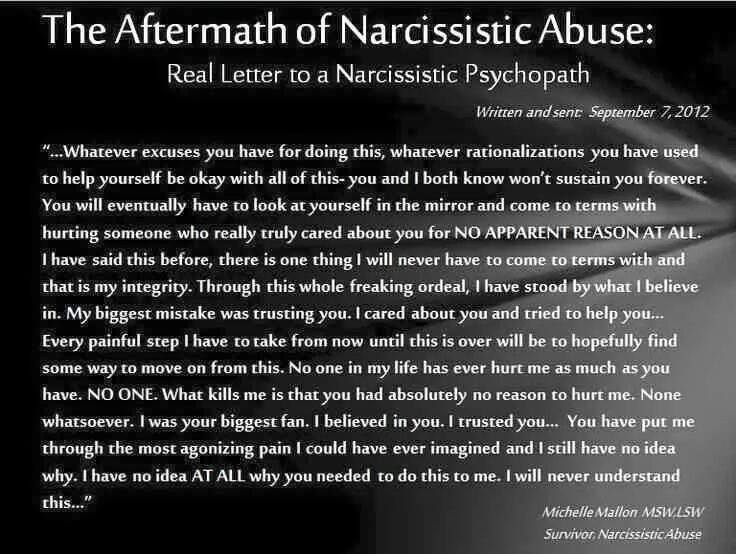
after_narc_abuse

The following is a followup article to the one I linked to in my post After Narcissistic Abuse, in which Michelle Mallon talked about how her psychopathic therapist almost destroyed her life and stole her soul.

This is an important topic, because malignant narcissists, sociopaths and psychopaths are so often in the “helping” professions, especially psychotherapy. They prey on vulnerable people who come to them in desperation, hurting and wanting to trust someone. These “mental health” professionals know this. After gaining a patient’s trust, evil-intentioned and sadistic therapists like Michelle’s therapist use the things their client told them in confidence against them, or even use them to threaten or gaslight them.

I’ll only post the first part of the article, which is long. But the journey back to feeling normal from PTSD caused by abuse is sometimes a long and arduous journey. There’s no way to describe this process in just a few words or even a few paragraphs. To read the rest, you will need to click on the link to Michelle’s article, which appears at the end of this post.

Reclaiming My Life
By Michelle Mallon, MSW, LSW
In this article, Michelle Mallon discusses her healing journey following abuse by a psychopathic therapist.

Recovering from therapist abuse is hands-down the most painful experience I have ever gone through in my entire life. Healing was incredibly difficult for so many reasons, some of which make me very angry and some of which have brought me great insight. Because of the impact healing from therapist abuse has had on my life, I find it impossible not to want to reach out to others who have been hurt by mental health professionals. Some people have told me that this is because I am unable to “get over” what happened. I explain to them that there is a difference between “getting over” something terrifying and callously moving on, leaving so many others behind knowing that you were very lucky to have ever healed. (I usually say this right before I tell them what they can go do with themselves.) The reality is that for most of us trying to overcome therapist abuse (regardless of whether it is sexual, emotional, spiritual, etc.), very few other people have any idea what we are going through (even the mental health professionals we finally get up the courage to see after the abusive ones to try and pull ourselves back together). And because of that, healing can be significantly more difficult than it should be.

Just recently, I began reading the Your Stories page on this site. I was immediately reminded of the isolation and fear I felt as I tried to find my way through the aftermath of therapist abuse. I drafted a message for the Your Stories page and then I immediately felt like it was just not enough. I then asked Kristi if I could write a piece that would hopefully reach more survivors. I have found the path to healing. I don’t really know how I ever found it because, looking back, I can see just how carefully hidden the path is. I don’t know if my path to healing will be similar to yours. In the hopes that there will be some similarities, I want to identify the things that helped me find my way through this in case it can help even one survivor.

This time last year, I was just beginning to feel my “old self” returning. I was finally able to leave my house for short periods of time without having panic attacks or near panic attacks. I was beginning to be able to focus on something other than what had happened in the years before. And I have to tell you, I couldn’t have been more relieved. The truth was that for a very long time before this, I wasn’t sure I would EVER recover from what I had been put through. In fact, I truly believed I was broken beyond repair. It was the most frightened I have ever been in my life.

nurse-ratched
Nurse Ratched, the sadistic psychopathic nurse/therapist in the movie “One Flew Over the Cuckoo’s Nest.”

This year, my life is very different. I look back at the woman I was a year ago and I can see tremendous growth. However, I can also see that even as I was beginning to re-find myself under all of the manipulation and destruction I had been through, I still had a long way to go. There were times when I first started out on this journey where I was making progress, but I didn’t realize I was making progress. I would frequently begin to feel stronger only to be dealt a cruel blow of fear and confusion that would set me back for days, sometimes weeks. If I would have known then that this was how the process went, I don’t think the journey would have been nearly as frightening. And perhaps, this time next year, I will look back and see that I have continued to grow, even from this year. It’s impossible to say. This journey to healing has been nothing short of miraculous. Just when I think I have “uncovered” all of the insight this journey has to offer, I am humbled by another incredible phase of insight. I don’t know if this growth and self-discovery will ever stop. Perhaps if I viewed all of this more as a journey and not as simply reaching a destination, I would have found more peace in the whole process. But to be perfectly honest, as I started out on this journey there was nothing peaceful at all about any of this.

The truth is that the very start of my journey, like many of yours, was incredibly painful—almost unbearable at times. I felt completely lost. I really didn’t know how I had gotten to where I was, and I really had no idea how the hell to get back to where I was before. Some of the worst parts of the journey to healing after therapist abuse had to do with trying to make sense out of what happened with the abusive therapist. And because I still missed him, I was convinced there must be something wrong with me. For almost a year after I refused to see him any longer, I replayed everything that happened during the time that I knew him, trying to make sense out of what happened. I tried desperately to understand what I could have done differently to prevent the relationship from crumbling the way it did. I would look at certain aspects of what happened and think, “He must have cared about me and just lost sight of what he was doing.” And I would be at peace with that thought for a few days. And then nagging doubts would creep in, “But if that were true, why did he just leave me to fall apart on my own? Why, after I told him just how much this had harmed me, did he choose to remain silent and not help me find closure?” A person who cares doesn’t leave someone they hurt (even if it was unintentional) to self-destruct in the aftermath. It seemed like no matter which way I looked at what happened, I could not come up with a “reason” for what happened that made any sense at all. And for that reason alone I was doomed to continue to replay the events in my head, searching for an answer I might never ever find. How else could I feel safe against something like this happening again in the future? The only way I could move on was if I understood what happened and why. And the person who needed to help me understand all of that made it very clear that he had no intentions of ever helping me get to that point. And because of that, it felt like he completely controlled my recovery from this.

evil_inside

And then it happened. Driven by a relentless desire to understand WHY, I had searched tirelessly online for something that would help me understand what the hell happened. I had been seeing a new therapist for about nine months (and I have to tell you, doing that took all of the courage I had in my body!). There were so many times that she seemed just as confused as I was about what happened with the abusive therapist. I was trapped in a cycle of reliving everything that happened over and over again, searching for answers. It was driving me to the point of insanity. As I learned more and more about this thing called “Narcissistic abuse” I began to realize that there was a reason why I had been spinning my wheels trying to understand what happened. There are people who exist who lack any ability or desire to feel any empathy or remorse. Even worse, they lack a conscience. They can cruelly destroy people who are loving, caring and honest and not feel a bit guilt or sorrow for having done so. In fact, in many ways they appear to be “annoyed” by the fact that the people they have hurt are making such a big deal out of what happened. Even worse, they are masters at making themselves out to be victims. Oftentimes, people like these leave behind them a trail of broken bodies and wounded souls as they continue on their destructive paths.

I began to learn new words—words like grooming, gaslighting, trauma bonding and soul murder. These were words that I either had never heard before or had never truly understood until I lived them. These words—words that described things that I experienced but couldn’t put into my own words—were a vital part of my healing. Suddenly I felt a lot less alone. I knew that if someone came up with these words and the definitions that explained my story, somebody, somewhere understood.

But learning these words and reading about Narcissistic abuse was really just the start of my journey. Taking all of it in was a different story. I would frequently find myself wanting to read as much as I could about Narcissistic abuse and then I would experience times where I didn’t want to look at anything at all about it. At first I would get angry at myself because I thought I needed to go through this process a specific way and it was not always the same way that I was feeling. I would get so frustrated with myself as I would read pieces that helped me begin to move forward in my understanding of what happened, but then feel like I was moving backwards. I remember thinking that maybe I was just making myself believe that I was feeling better and that I was really not making any progress at all.

It turns out that understanding and reprocessing what I had been through happened in phases. This wasn’t like any learning I had done before. In the past, if I wanted to understand something I would read about it and integrate it into my way of seeing things. With Narcissistic abuse, there were so many “layers” of understanding that were essential to my healing that this linear process of learning that had worked for me in the past was ineffective with this. There were many times where I would read an article or a book about healing from Narcissistic abuse and feel as if I had taken all of the important insight that the piece had to offer. And then later, I would stumble upon the work again and be shocked that there was insight in it that I hadn’t noticed before. It wasn’t that the piece had been edited. It was because my brain was allowing me to take in more of the picture of what I had been through. That brain of mine, that part of me that I thought had surely been destroyed in the abuse, was actually guiding me carefully through the process of slowly taking in what I could handle. In fact, I can remember times where my brain would almost “compel” me to read more about Narcissistic abuse and times where it would want to do anything other than reading about Narcissistic abuse. I slowly learned to listen to my brain and do what it seemed to be urging me to do whenever it would do this.

And there was another aspect to understanding what I had been through. As I began to understand what my abusive therapist had put me through I began to realize that I had seen this kind of abuse before in my life. In fact, many adult survivors of Narcissistic abuse eventually come to learn (if they can find the path to healing) that they have been primed by previous Narcissistic abuse to tolerate later Narcissistic abuse. For me, like so many other survivors of this type of abuse, I found myself not only healing from one emotionally destructive relationship, but several. The grief was overwhelming.

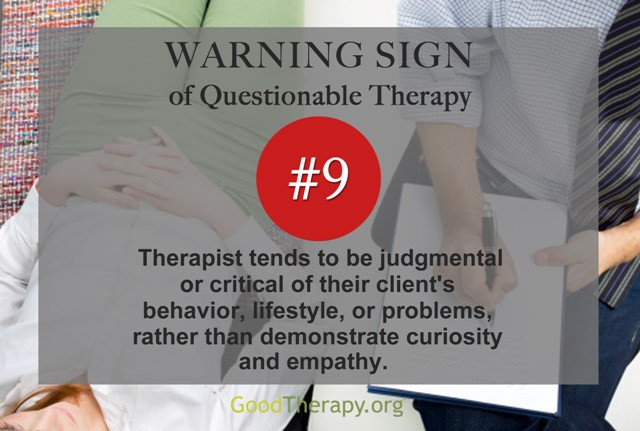
warning_sign9
From 50 Warning Signs of Questionable Therapy or Counseling.

Perhaps one of the more difficult aspects of the abuse that I had tried to understand was where in the relationship with the abusive therapist that things went wrong. For a while, I believed that the therapist had somehow changed, since he seemed so competent for a long time before the abuse actively began. And I found myself searching for some point in time where I should have stopped trusting him. I think I believed that knowing this was important so I could have understood at what point my “screaming gut” was right. It wasn’t until a good friend of mine pointed something out to me that I hadn’t thought of before. He told me that there wasn’t any point in time when I should have trusted the abusive therapist. He said to me, “Michelle, he’s a predator. The only reason why he seemed so competent and trustworthy for so long at first was to gain your trust so he could effectively lure you away from your comfort zone. Tell me, would you have allowed him to say many of the things he said to you if he had started the relationship out doing that? No, your inner alarm bells would have been going off like crazy.” This was a pivotal moment for me because I had not given any thought at all to this possibility. I would never imagine hurting someone like that. It was finally starting to click in my head that I didn’t understand what happened for a reason. In fact, I never saw any of it coming because I never imagined anyone would ever treat another human being like this. My own profound compassion and deep empathy for others was something I assumed everyone else had. I am finding that many survivors of this type of abuse “suffer” from the same naiveté because of their own inner compassion and empathy.

Read the rest of Michelle’s story here: http://www.survivingtherapistabuse.com/2015/03/reclaiming-my-life/

Also, please read this article: 50 Warning Signs of Questionable Therapy or Counseling.
If your therapist does any of these things, they are red flags. Be wary or find another therapist.

20 truths of blogging.

number_20

In my 8 months of blogging I’ve learned a few things. Here are 20 of them.

1. Nothing is too personal to write publicly about. There will always be someone who will be grateful you shared it. As for the rest, they don’t care as much as you think they do. That soul-baring post is probably only embarrassing to you.

2. If you have a post you’re afraid to make public, make it public anyway (see #1). It’s okay to run naked in public sometimes. You’ll feel freed.

naked

3. You are going to have haters. It’s unavoidable. If you can’t handle people hating you or your blog, you have no business blogging.

4. If your blog starts getting popular, your haters will be more numerous and more vocal. It’s okay to have haters. Love your haters. They’re obviously obsessed enough with you to visit your blog and that increases your views.

5. Some people you thought were your friends or supporters are not. Be careful who you trust.

6. If you write about a serious or dark topic, break it up with a little fluff sometimes. Or write about something else. But don’t lose your focus.

piece_of_fluff

7. Trolls are easily controlled. Just don’t approve their comments or send them to Spam/Trash.

8. Be agreeable. Don’t attack commenters who disagree with you. Most people are reasonable and disagreements can lead to some interesting debates where both of you may learn something.

9. If you decide to run ads, you’re not selling out. If you’re serious about blogging or writing, it’s a good idea if you have enough traffic.

10. You do not need to pay for SEO. All you need is patience. If you post often enough and your blog starts getting enough hits (USE THE SHARE BUTTONS–or at least have them available under your posts so others can do your dirty work for you), those hits will eventually lead to more hits, and this keeps feeding on itself. Eventually you’ll find some of your posts appearing at the top of the search engines, and once that happens, the sky’s the limit.

waste_of_money

11. You can’t “make” a post go viral. There is absolutely no way to tell what article of yours may go viral or when. It could be one you never expected to, or it could happen months after you first posted it. When it happens, it’s a complete surprise and a completely amazing feeling.

12. Don’t write something just because you think it’s popular if it isn’t something of interest to you. Don’t try to be cool–people can always tell if you’re trying too hard. You’re either cool or you’re not, but you don’t have to be cool to have a great blog. (I’m definitely not cool).

13. You are going to lose followers. It’s inevitable. As long as you are gaining more followers than you’re losing, then there’s no problem. The people who are unfollowing you are probably not people you want to have sticking around anyway.

unfollowers

14. You will change in ways you never expected. Blogging is an adventure.

15. Don’t beat yourself up if you miss a day and don’t post. We all have those days we need to take a break or just can’t think of a good idea. If it really bothers you, reblog someone else’s article or post a funny picture or inspirational saying. People always love those.

16. When all else fails, post a picture of a cat or a cat meme. Cats on the Internet are like sex in the movies. They attract viewers. Kittens are even better. Everyone loves kittens, even people who hate cats.

kitten

17. Use pictures and graphics, especially in long posts (but don’t use so many your post looks like the cover of a supermarket tabloid). No one wants to read a wall of text, even if you’re the best writer ever. But they want a clean look too, so be careful how many graphics you use, especially if you are running ads too. No one likes a cluttered, messy looking blog that makes their eyes hurt or gives them flashbacks to the MySpace era.

18. You don’t have to be a great writer. You just have to be original and willing to take a few risks.

19. Always be honest even if your opinion might be controversial or unpopular. Controversial posts may get you more haters, but they’ll also make your views soar.

haters_bitches

20. Haters can make good fodder for new posts. Sometimes those posts will be your most interesting. But be careful about calling out specific people by name; you could get in trouble for that.

Dancing alone on the beach.

That’s what my son is doing here.