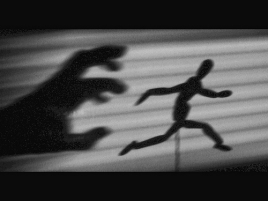
The ultimate dissociative experience.

thanatophobia2

Death isn’t something I like to think about, much less write about.  In fact, it’s my biggest fear (outside of the death of one of my children).  Oh, I know all the pat arguments and rationalizations that it’s not so bad–death is a part of life, death is nothing to be afraid of, if you’re a good Christian you will go to Heaven and there will be no fear, nothing at all will happen so there will be no fear, even the idea that death is beautiful.

I woke this morning, as I often do, thinking about how much I fear my own death.  I think this is a little obsessive-compulsiveness on my part, and probably something I should talk about more in therapy.   The mental health field has a name for the irrational or excessive fear of death: thanatophobia.    So far I’ve only talked to God about my phobia but I feel like He isn’t listening.     People in my age group (50’s) say they’re beginning to come to terms with the prospect of death, but so far, for me, that hasn’t happened.  I get more scared every year.

Maybe death terrifies me because it entails complete ego loss–it’s the ultimate dissociative experience, and as someone who has had massive panic attacks usually instigated by dissociative experiences (feeling out my body, feeling like things are dreamlike or unreal, etc.) it would be natural for me to be afraid of what it might feel like.   It’s like someone who had a bad drug trip and is mentally unstable to begin with being slipped some acid when they’re unaware of it–and never being able to return to reality.

I don’t like to write about death, because even thinking about it too long makes me extremely anxious.  But I need to write about it, and need to talk about it with others, and maybe find comfort in the fact that others have the same sense of trepidation and worry.  Maybe I’m not alone in my fear of death and dying.   So I’m going to plow on. Writing about it surely can’t hurt.

thanatophobia

I’ve been told by many Christians that, if I am strong in my faith, that there is nothing to fear, because I can be sure of my place in Heaven after I die.   But this makes things even worse for me, because I do have doubts in my faith and I am not at certain I am going to Heaven, or even that there is a Heaven.   No matter how much I pray for perfect faith, I can’t seem to make my mind rid itself of its many doubts.   There are just some things about Christianity I can’t make myself believe or at least not question.  Again, maybe it’s my obsessive-compulsiveness.   As someone who is afraid to trust anyone and is hypervigilant, it’s even hard for me to completely trust God and not worry about what will happen to me after I die. I look at others–even narc abuse survivors who should be as hypervigilant as I am–who seem to have attained perfect faith and I marvel at this. How do they do it?

Although it’s hard for me to believe that if I question Christianity or what the Bible says, that God will send me to burn in Hell for eternity even if I’m otherwise a good person (that seems like a terribly cruel, narcissistic God to me), how do I know for sure God isn’t like that?  Maybe God is really that cruel and narcissistic, but in that case, why would I want to even spend eternity in Heaven, trapped there with sanctimonious, self righteous, insufferable believers? (I’m not saying all believers are like that, but I’ve met more than a few who are).  In that case, maybe Heaven would be more like Hell.     But Hell…well, I definitely don’t want to go there.

But Christianity is only one way to look at the issue of death.  Let’s face it.   No matter how sure you are in your faith, whatever it is, none of us really knows what’s going to happen after we die.   What if the New Agers are right and what happens is you look back and see yourself lying on the hospital bed, pavement, or whatever, see your own broken, bleeding, or used-up body there, and then watch as they pull the sheet over your head?  What if you are swooshed at light-speed down a long tunnel toward “the light” and meet angels and see otherworldly landscapes and other inexplicable things?   Or what if you float around the earth as a disembodied spirit, revisiting your friends and relatives you left behind?   People who have reported NDE’s (near death experiences) have said that at some point they become aware they have died (that’s usually when they “come back”) and most say it’s very disorienting and even scary at first, because their bodies just aren’t there.   All of these things, no matter how pleasant others have said they are, strike terror in me, because they sound like dissociative experiences that you can never escape from.   I’ve struggled with episodes of dissociation my entire life, but no matter how terrifying they became, I always knew I’d “return” and the experience would probably only last a few minutes.   Does something happen after you die where you’re no longer afraid of such things, or do you just learn to deal with it?

death_quote

Maybe this is true, but I wish I could believe it.

What if the atheists and existentialists are right and nothing happens after you die?  What if you simply cease to exist?   While I find that prospect extremely depressing,  it actually causes me the least anxiety.   Eternal sleep and unconsciousness doesn’t seem so bad to me.  If you’re aware of nothing, well, there’s nothing to be afraid of or get depressed about, is there?  But I still don’t like the idea that this life is ultimately meaningless.   What is all the struggle for then?

Reincarnation doesn’t seem so bad, and actually does make some logical sense to my scientifically-leaning brain, but it flies in the face of being a Christian.   I don’t know of any Christians who acknowledge that reincarnation is a possibility after death.  But why couldn’t it be? As a Catholic, we believe in the concept of purgatory, a place of purification (not punishment) after death.  But no one can explain what purgatory might be like.  Maybe living additional lives is what purgatory actually means?   Again…we just don’t know.

'It's not that I'm afraid of dying, Doctor... It's just that I don't want to be there when it happens!'

‘It’s not that I’m afraid of dying, Doctor… It’s just that I don’t want to be there when it happens!’

Maybe we just go back to wherever we were before we were born, and have amnesia for this life. Or maybe it’s like eternal dreaming (that doesn’t sound too bad). Again, we don’t know.

Besides the inevitable experience of death, which seems bad enough, I’m terrified by the prospect of dying.   I’m in my 50’s, and figure I might (realistically) have about another two or three decades of life left.   To someone my age, that doesn’t seem so long.  Twenty years ago was 1996; thirty years ago was 1986.   That means that in that same amount of time, going forward, I will probably be leaving my body permanently, but before that, I may well suffer either unbelievable pain or a few moments of sheer terror.   Few people just die peacefully in their sleep or just suddenly keel over while out on the golf course (that’s the way a 90 year old great uncle of mine died).   Most suffer first, either for months (as in a long illness) or a few seconds (as in an accident).   I’m terrified of both.  I know there’s no way to get out of this life alive, so the inevitable is going to happen, and there’s not a whole lot of time left before it does. Even worse, each year time seems to hurtle forward twice as fast as the year before. What seemed like “a long time ago” to me twenty years ago now seems like the blink of an eye.

As someone who tends to overthink everything,  I probably think about death and dying way too much.  I know I should just stop and enjoy life while I still have it.   But the more I try not to think about it, the more I seem to.   It’s like that game where you try not to think about an elephant.  I pray about this all the time but it hasn’t helped very much.    I just keep feeling guilty because  no matter how hard I try, I can’t embrace my Christianity with perfect faith.   I have no guarantee I’m going to Heaven.   I keep questioning everything and then I worry about going to hell.  Or being eternally dissociated, which to me would be hell.  Or just worrying about the intolerable suffering that will precede my exit from this planet.    Maybe I need to talk to my therapist about this because it seems like it could be a form of undiagnosed OCD.

Further Reading:
My Fear of Death

Why I love liturgy.

A view of the famed Rose Window in Notre Dame Cathedral, Paris, France.

A view of the famed Rose Window in Notre Dame Cathedral, Paris, France.

Back in April, during the Easter Vigil mass, I became a Roman Catholic. This came as a surprise to many people I know, since I’d spent most of my life as an agnostic and at times veered close to atheism. I’ve also toyed with Buddhism and Scientology (and I admit I still have a soft spot for Buddhism because it appeals to my rational mind, and that isn’t likely to change). Due to the recent charges of sexual abuse taking place in the Catholic church, this oldest and largest of all Christian denominations has become more criticized than ever, and probably rightfully so. I don’t think it’s the only religious organization that has been guilty of such behaviors, but I think it’s the most publicized. I’m also not ignorant of the fact that the Catholic Church has a bloody and often very un-Christlike history, especially during the Middle Ages, as well as being the wealthiest religious organization in the world and often full of hypocrisy. In addition, I do not believe that being a Catholic is the only way to salvation. Any Christian who has accepted Jesus Christ as their personal Lord and Savior in their hearts will get to Heaven, regardless of denomination (why did I almost spell that DEMONination?) and don’t necessary even have to attend church at all.

So why did I become a Catholic, you ask. Why did I join a church that’s so rife with its past of violence, and a present still full of intolerance, sexism, and heirarchy? The answer to this is complicated.

I was raised in a family that although nominally Christian, was basically agnostic. We did not attend church regularly (although I was sent to Sunday school as a young child), and holidays like Christmas and Easter were recognized more for their fun/materialistic secularity (gift giving, Santa Claus, the Easter Bunny, new Easter dresses and coats, etc.) than for the solemn events in the life of Christ they actually honor. My family regarded them as “children’s holidays” that adults indulged and that would eventually be outgrown. Although I was baptized Methodist (and I was surprised to learn my Protestant baptism was recognized as valid by the Catholic Church), we never became very active in any church and therefore were not part of any enduring “church family.” When church was attended, it was a sterile, secular affair, full of feel-good stories of God’s unconditional love, lessons about tolerance and social justice (nothing wrong with that, of course, but it wasn’t very religious nor fill me with a sense of awe or wonder), and very little that was Biblical or traditional. Services revolved mainly around the sermon, always a feel-good pep talk about God’s all-encompassing love and loving one another. All of this clap-happy, touchy feely reformed-Protestant stuff flew in the face of the constant anger, rage, loneliness, and discord that was constantly going on at home. Due to that, all the messages about positive-thinking and feel-goodness seemed insincere and meaningless, and didn’t address the very real problems in my family that made me feel so defective and different from everyone else.

For a short time–maybe one or two years–my father became fascinated by Christian Science, and I was sent to a Christian Science Sunday school. I was too young to comprehend the metaphysical beliefs they espoused, which basically preached that all that was material was an illusion, and only Spirit mattered (later my father would become active in Religious Science, a similar belief system that isn’t based in Christianity and overlaps a great deal with New Thought, part of the New Age movement). I couldn’t wrap my young brain around the metaphysical mumbo jumbo I heard on Sunday and I desperately needed something tangible to offset my growing feelings of dissociation from myself and the rest of humanity and from God Himself. I was filled with uncertainty about what was real and what wasn’t. Living on a diet of spiritual junk food, I was starving for emotional and spiritual sustenance. Although I coudn’t have put it into words, I needed to experience the Divine with my five senses.
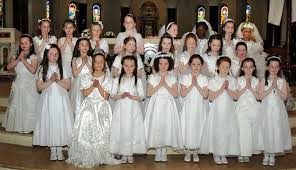
holy_communion
How I envied these girls!

Enter Catholic school. In 5th grade, the bullying at the local public school became so bad that my parents decided to take matters into their own hands and despite their misgivings about the Catholic Church, I was sent to a Catholic girls’ school. My grades immediately improved and I found it easier to make friends with these girls than at the public school. My parents were surprised (and probably a little disturbed) that one of my favorite classes (and the one I did best at) was Religion. I didn’t become religious back then, nor did my faith in God deepen (I was for all intents and purposes agnostic), but I found myself always looking forward to the masses we used to have at school on religious days. Although the highly liturgical services confused me at first (knowing when to stand up and sit down, memorize the various prayers, etc) I found myself drawn to the orderliness and beauty of the Mass. It somehow seemed Godlike and was steeped in history that the Protestant services I’d attended with my parents just didn’t have. I envied the cool trappings of Catholicism (when the other girls were going through Confirmation, they got a new name and a pretty dress and I wanted that too) and longed to be able to take Communion with everyone else. I wanted a set of my own rosary beads. Today I know these things really don’t matter (I think whatever denomination you are–even if none at all–is a matter of personal preference) but at my tender age, these tangible things seemed part of some wonderful, sacred, mysterious and heavenly world I couldn’t be part of. Sitting there in my folding chair watching the proceedings, I always felt the presence of God and a benevolent, forgiving love I never felt from my own family, even though I had to remain seated during the communion. It was one of the few places where I could feel the benevolence of God.

Many cradle Catholics remember negative experiences from their childhood about the Church and turned away from it as they came of age, but as someone who only knew it as a refuge from the harsh realities that took place in my agnostic home, I never developed those negative associations with Catholicism. I loved most of the nuns at my school. With one or two exceptions, they seemed so kind and compassionate, very saintlike–and they seemed to care about me in a way I never felt I got from my own family. Although I never talked about what went on at home, one nun in particular who seemed to favor me for some reason, guessed that things at home weren’t ideal, and told me to come see her anytime I needed to talk. I never did (for fear of what might happen if I “squealed” about the family to an outsider), but it felt good to know that she cared enough to reach out to me.

As I grew older I fell away from Christianity (not that I’d ever really embraced it much and knew next to nothing about the Bible or the life of Christ), and experimented with other belief systems, including Scientology and Buddhism, if anything at all. The Bible seemed to me like a book of ancient fairy tales with no relevance to my own life. I rarely prayed and looked down on churchgoing and religious people as ignorant and deluded. Although I never embraced full-on atheism (it was too depressing to think there was no afterlife at all), I thought that if God existed, he was pretty much hands-off and that everyone, other than the most hardened criminals and mean, cruel people, would get to Heaven, if there even was such a place. The concept of reincarnation made a lot more logical sense to me than the idea of heaven or hell.

But my soul was still starving and I think deep down I always knew this. Every once in a while, in spite of my doubts about the existence of God, I’d make time to attend a Catholic mass. I didn’t believe what they preached, in fact I thought most of it was pretty silly, but I loved the ritual and the order, and somehow always came away feeling transcended. I’d go take Communion (knowing as a non-Catholic I wasn’t supposed to) and feel somehow nourished. In a way I couldn’t explain, witnessing the reverence and beauty of the Mass, made me feel like part of something much bigger than myself and accepted for who I was, not (as in my FOO) expected to be someone I could never be.

I toyed with other Christian faiths, including Lutheranism and the Southern Baptist church. During the late 1980s, I attended a Lutheran church (and was confirmed as Lutheran) mainly because the man I married was Lutheran. The services were called masses and were very liturgical and quite similar in many ways to the Catholic mass, but they seemed watered down, somehow. For instance, the communion wafer was regarded as symbolic rather than being the actual Body of Christ. We never became deeply involved with the Lutheran church, and although we had our kids baptized Lutheran, we did not attend church on Sundays or otherwise do much to encourage their spiritual development.

When we moved to North Carolina from northern New Jersey, we were faced with culture shock–instead of having mostly Catholic and Jewish neighbors, suddenly we found ourselves surrounded by Southern Baptists who insisted we needed to be “saved.” Still looking for spiritual nourishment, I started attending services at the local Baptist church as well as Bible studies on Tuesdays nights. My kids attended 2 years of Vacation Bible School. I never cottoned to the hellfire-and-brimstone preaching though, or the literal interpretation of the Bible. I was especially turned off by the church’s conservative political agenda, that actually told us we were “going to Hell” if we didn’t vote Republican, as well as their dismissal of science. I decided to stop attending church there.

hellfire
Hellfire-and-brimstone preaching is a turn off to me.

A few years later, my daughter had a friend at school whose parents were Southern Baptists, and my daughter, age 9 at the time, decided to be baptized in their church. I was fine with that, even though I disagreed with the southern Baptist belief system, because it took the burden off of me to be responsible for her spiritual growth. I attended her baptism and was surprised at how modern the service was, with a pop-rock band that played contemporary Christian music rather than traditional hymns. Intrigued, I decided to attend a few more services, but I always felt like I was at a rock concert rather than at church. In spite of the emphasis on Biblical literalism, during the long, emotional sermons, I never felt my soul uplifted or any real feeling of spiritual transcendence. Although very different from the touchy-feely, heaven-awaits-no matter-what-you-do preaching of the liberal Protestantism of my childhood, this hellfire-and-brimstone preaching bookended by Christian contemporary music with the words splashed on a huge TV screen didn’t do much for me either. I longed for tradition, for history, for meaning.

I still occasionally attended Catholic masses, but never thought I’d actually become one. But shortly after I went No Contact with my ex (who freeloaded off me and mentally abused me for almost 7 years following our divorce and nearly bled me dry emotionally, mentally, financially, and spiritually) I began to blog. My mental and physical health came back first, and then I realized I was still starving spiritually. I needed God, who after all, had been watching and protecting me all the time I was in an abusive marriage and had shown me on several occasions how real He was. Last October, I decided to start attending Mass as well as RCIA classes (the classes you take to become Catholic). I had doubts about much of the doctrine (and truth be told, still do). I still wasn’t sure I wanted to become Catholic, but I thought I should at least take the classes and make an educated decision.

To my surprise, I found that Catholic doctrine isn’t very different from what I’ve always believed anyway. The Bible is held as important (more important than many fundamentalist Christians believe we do) but much of its content is not not interpreted literally and therefore doesn’t fly in the face of centuries of scientific discovery and achievement. Yes, we are saved by grace alone (all Christians are), but works are also important and are tangible evidence of God’s grace. Sacraments (communion, confession, etc) give tangibility to God’s grace although (I don’t think) they are necessary for salvation. Confession is not a punishment; it is an opportunity to unload to someone else and makes you feel better afterwards (very similar to a 4th step in a 12-step program). Although I had my doubts at first, I’ve come to believe the Host (the communion wafer) does actually become the body of Christ, due to the glorious, transcended way I always feel after partaking. I do feel like my soul is being changed for the better, even though it’s not a Saul-to-Paul-like sudden conversion full of fireworks and drama.

I admit I do still have some issues, mostly having to do with the Catholic church’s stance on social matters such as abortion and homosexuality, as well as the fact that priests still must be male. I don’t think the Pope is infallible either (he is just a man), but I understand the reasoning behind having a Pope and I happen to like the current Pope anyway. I don’t venerate Mary and the saints, although I have utmost respect for them. Veneration isn’t the same as worship, anyway. Only Jesus as God is worshipped so there’s nothing un-Christian there, a far as I’m concerned.

rosary_beads

Because of my doubts and personal proclivities, I’ll probably never be the “perfect Catholic” or “perfect Christian” but that’s okay. I pray that God keeps working on my soul to cleanse it from sin and I’m willing to believe anything God wants me to believe. I’m willing to turn my soul and my life over to the Creator. Whenever I’m at mass, I feel part of a vast family and something glorious, beautiful and so much bigger than myself or all humanity. I feel accepted in God’s kingdom and have begun to fear death and the future less than I used to. The tangibility, beauty and order of the liturgical tradition–the memorized call-and-response prayers, the communion procession, the incense, the swelling organ music and the singing, the kneeling and the standing, the Sign of the Cross, and all the rest of these “silly rituals”–makes me feel that God is a tangible, real thing, someone who is RIGHT THERE and that I can see, hear, smell, feel, touch and even taste. The traditional hymns with their pipe-organ and piano music and the ancient prayers imbue a sense of mystery and history into the services that neither liberal Protestantism or fundamentalist pop-rock sing-alongs do for me. And I love the Bible readings too. I’m beginning to feel that the messages in the Bible do have meaning for me personally. The orderliness and ritual of the mass is regarded by some as mindless, dull and lacking spontaneity (and to some extent I can understand this view), but I find the repetitive and predictable aspects such as the call-and-response prayers and chants to have an uncanny way of eventually filtering down from my mind into the deepest part of my heart, in a way a hellfire-and-brimstone or feel-good, prosperity-gospel sermonizing can never do.

Before becoming Catholic, I toyed with the idea of becoming Eastern Orthodox, a religion which, if anything, is even more liturgical and steeped in ritual, history, and tradition than the modern Catholic church (and is somewhat more liberal in its stance on women’s rights and birth control), but finding a sizable Orthodox community here in the Southern United States is a huge challenge to say the least. I did actually attend one Orthodox mass about five years ago (my son’s Kung Fu teacher was Russian Orthodox and invited us to attend his church), and although it was incredibly beautiful (and the food served afterwards was delicious), the feel of the Orthodox mass was a little too “foreign” for my taste. Anglicanism (The Church of England) also has a rich liturgical tradition (please see my Christmas post “O Come All Ye Faithful”) but again, is uncommon here in the southern US, and it’s still Protestantism anyway. I like the idea of being part of the oldest and largest practicing Christian community in the world that has such a rich and colorful history (even if at times in the past it wasn’t especially Christ-like). I feel proud to be a part of that. Although I know the trappings and ritual are more a matter of personal preference than salvation, for me they make an abstract God seem more real. Coming from such a chaotic, unpredictable background, the order and predictability of the liturgy is food for my soul. My adopted religion may not be the only road to salvation, but it’s the only road for me. Thanks be to God.

Millennials and liturgical Christianity.
As an aside, the Millennial generation, although largely turned off by religion, are, when drawn to religion, are converting to “high church” (liturgical) Christianity such as Anglicanism, Catholicism, and the Orthodox church. They are a generation that (like me, even though I’m not a Millennial) longs for a sense of tradition and connection with history that’s lacking in the evangelical, fundamentalist, and liberal Protestantism or New Age or atheistic belief systems they were raised with, all of which largely ignore or dismiss 1800 years of Christian history and tradition.

Further reading:
Why Millennials Long for Liturgy: http://www.theamericanconservative.com/articles/why-millennials-long-for-liturgy/
Millennials are Seeking Tradition, Sacramentality, and Liturgy: http://www.catholicvote.org/millennials-are-seeking-tradition-sacramentality-and-liturgy/

“Soulmates in Hell: Religious Narcissists–Evil in Disguise. “

jesus_cares

I stumbled on a new blog and just read this article. Every word the author says is true. I’ve known so many religious types who use religion as a tool to abuse. These are truly the wolves in sheep’s clothing. Unfortunately, such people’s children are often turned off my the whole idea of God and religion because it becomes so triggering.

Soulmates in Hell: Religious Narcissists–Evil in Disguise
By Larry Giddens

If you have had the unfortunate experience of being in a relationship with a narcissist with religious pretensions, you know how difficult and confusing it can be. The narc spouts scripture and postures as “holy”, and they use religion to create a veneer of “godliness”.

Now, I’ve read various articles on the topic that seem to miss the point, which is, that a religious narcissist will just drive you crazy with their constantly letting you know how much better they are than you, or anyone else, for that matter. There is no situation for which they won’t butt in with some scripture quote, and no conversation that won’t soon turn into a sermon, just to let you know that while you have mundane, everyday concerns like whether you need to buy milk, their mind is on “the things of God”.

The rest of this article can be read here.
http://soulmateinhell.blogspot.com/2015/10/religious-narcissists-evil-in-disguise.html

Where I stand on “positive thinking.”

positive_thinking_problem
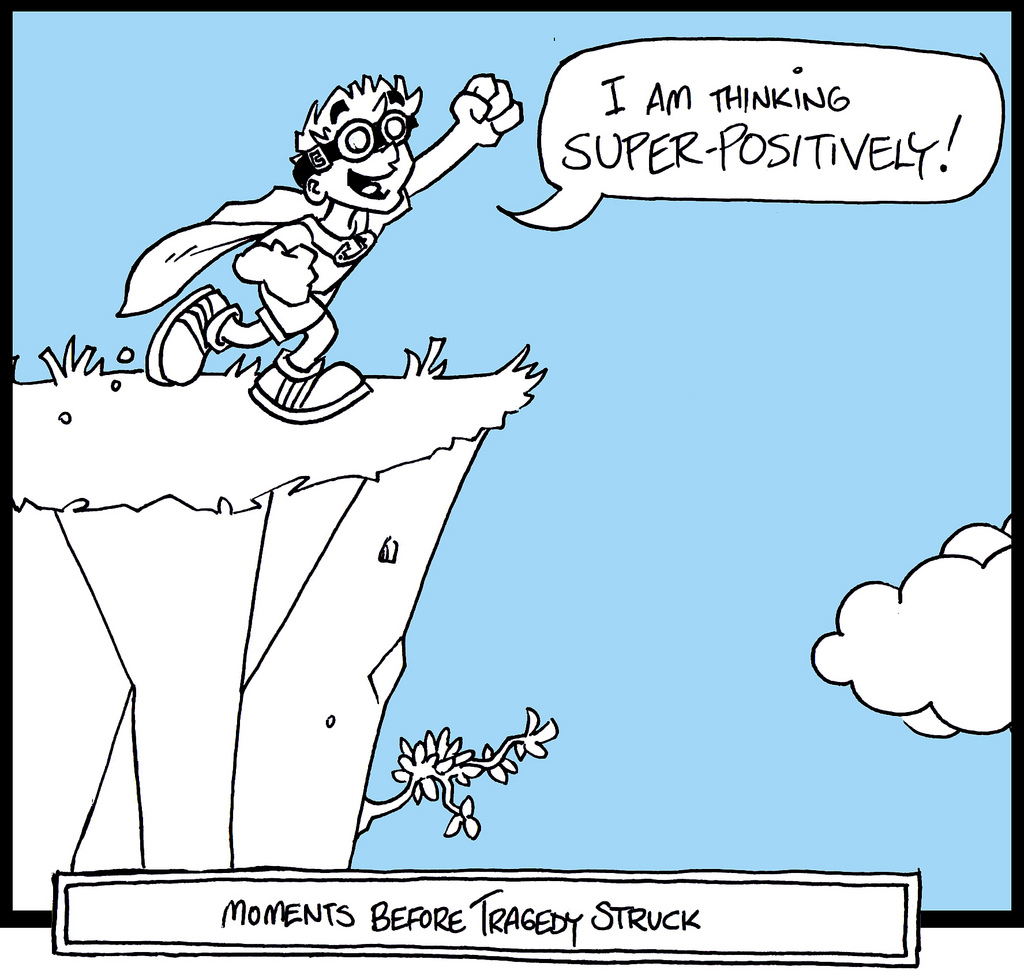
Positive thinking taken to extremes is deluded thinking.

I’ve seen several blog posts about the problem of forced positive thinking lately, and since this is an issue that has concerned me for a long time, I thought I’d add my own take on it.

In recent years, there’s been an increased societal pressure toward “positive thinking.” I think two factors have led to this trend–the New Age philosophy that we can “be as gods ourselves,” and the continued glorification of the Reaganistic optimism of the 1980s. The signs are everywhere, in self-help and pop psychology books, in countless popular slogans and memes that appear on bumper stickers and coffee mugs, on motivational posters, on calendars, on the political campaign trail, and all over social media such as Facebook. The forced positive thinking brigade has even infiltrated churches. Motivational speakers like Tony Robbins and preachers of the “Prosperity Gospel” like Joel Osteen have gotten rich by telling us that if we only think positive thoughts, our entire lives will change for the better. They tell us if we let go of negative thought patterns, we can become happy, successful, healthy, and wealthy.

This is all fine and good, and personally I see nothing wrong with positive thinking for its own sake. Even if the outer trappings of your life rival those of someone living in a Third World nation, it’s certainly better for you if you can scare up a little optimism and hopefulness, and it’s definitely bad for you to dwell in hopelessness, depression and negativity. At the very least, seeing the glass as always half-full will make you more accepting of your sorry lot and therefore happier. That said, it’s incredibly difficult to see the glass as half full when there is barely a drop in your glass. That would be deluded, not positive, thinking.

For all its advantages to our psychological well-being, there’s a dark side to the positive thinking movement too, which goes hand in hand with the current societal glorification of narcissism and the nasty belief that selfishness and lack of compassion are virtues. While telling people that thinking positive thoughts is not a bad thing itself (because there is truth to the idea that negativity tends to draw in negative things–I have seen this dynamic for myself), the positive thinking movement has been taken to disturbing extremes. It’s led to victim-blaming and an overall lack of empathy for the less fortunate. The poor are blamed for their own poverty, regardless of the circumstances that might have led to it or keep them trapped there. They are told they are “not positive enough” or “made bad choices.” Even worse, some churches of the “prosperity gospel” ilk tell them they must have some moral failing or God would be rewarding them with material blessings. They are made to feel shame and guilt for their sorry financial condition. The chronically ill and disabled are likewise blamed for “not taking care of themselves” or “choosing bad habits.” It’s easy enough for someone who has never had to struggle with poverty or serious illness to thumb their noses at those who have and tell them it’s all their own fault.

broken_society

Is this the way Jesus would have acted? No, of course it isn’t. In fact, most of Jesus’ followers and disciples were the most financially and physically vulnerable members of his society. Jesus himself was humble carpenter and certainly not rich. He didn’t condemn these unfortunates or shame them for failing to be positive enough, or making the “wrong choices.” In fact, he seemed to love these vulnerable people most of all. Whatever happened to the “social gospel” of the late 19th and early 20th century? Oh, that’s right–it became “communism.” Somewhere along the way, compassion for the less fortunate and the culture of charity got twisted into “weakness” and “enabling.” The enormous popularity of Ayn Rand, who believed the greatest human evil was altruism, is disturbing, especially since her philosophy of “objectivism” has infected the minds of powerful politicians of a certain political persuasion, including many “Christians.”

While I don’t subscribe to some Christian fundamentalists’ idea that Satan is behind all this worship of greed and self-love and the denigration and victim-blaming of the less fortunate, I do think it’s a very destructive turn in the way our culture thinks, and it’s psychopathic in nature. Lately I’ve been seeing more blog articles criticizing this trend, and that seems like a good sign that at least a few people (usually victims of narcissistic abuse themselves) are finally realizing our society has become woefully empathy-deprived. Hopefully their message can break out of the blogosphere it’s currently confined to and begin to touch the hearts of The Powers That Be who are not yet completely brainwashed by the Cult of John Galt.

It’s absolutely fine (and desirable) to be a positive thinker, because positive thinking does tend to have its rewards, but blaming the misfortunes of others on their negative thinking or worse, their moral failings is just a form of societal gaslighting and is utterly evil itself. It’s also rife with hypocrisy– the Positive Thinking Powers That Be denigrate the emotions of guilt and shame for themselves, but they make sure those who haven’t been blessed the way they have feel plenty of guilt and shame for not having been “enough.” They never stop to think how impossible it is for someone who is struggling every day just to have enough to eat or with severe pain or illness to think in a positive way. It’s much easier for the already privileged and healthy to be able to say “life is good” and mean it. The well heeled Positive Thinking bots never stop to think of this–or they just don’t care, which is most likely the case, because those who haven’t been “blessed” with wealth or good health MUST have done something wrong to deserve it.

Any society that is empathy-starved is eventually going to self destruct.

For further reading, check out this article from The New York Times and also this one about empathy being a choice.

To My Non-Christian Friends: What You Should Know

This is one of the most intelligent articles I’ve ever seen written by an evangelical Christian. I don’t have much more to say, just read the article, because everything I could say is already said here.

I’m a Christian, but so many Christians disappoint me because they cannot tolerate the fact that my Christianity isn’t exactly the same as their Christianity. I wish all Christians would think more like the person who wrote this article.

allmyroads's avatar

non-christian

I am a Christian. As a Christian- particularly one of the Evangelical bent- mine is a tradition that has a reputation for abrasive condemnations of those who aren’t Christians: screaming brimstone and judgment from street corners, condemning alternate viewpoints and pushing legislation in an attempt to perpetuate our own beliefs. We’ve not exactly painted ourselves in a good light.

But the flag under which Christians are called to die isn’t one of religious propaganda, nor is the heart of our gospel a ‘turn or burn’ story. That said, there are things I- as a Christian- hope, want, pray, desire and truly want all non-Christians to know.

Here’s a few of them:

1) You are a person, not a project.

When I look at you I don’t see a box to be checked, a sinner to be saved, a victory to be won or a task to be accomplished. I see…

View original post 737 more words

So I’m officially Roman Catholic.

The Easter Vigil Mass tonight was beautiful, and started with a fire outside, where a torch was lit and we all lit candles from the torch and went inside the church (St. Joan of Arc in Candler, NC).

It was a bilingual Mass, because 3 Mexican guy were also receiving the sacraments of Confirmation (my confirmation name is Catherine) and first Communion.

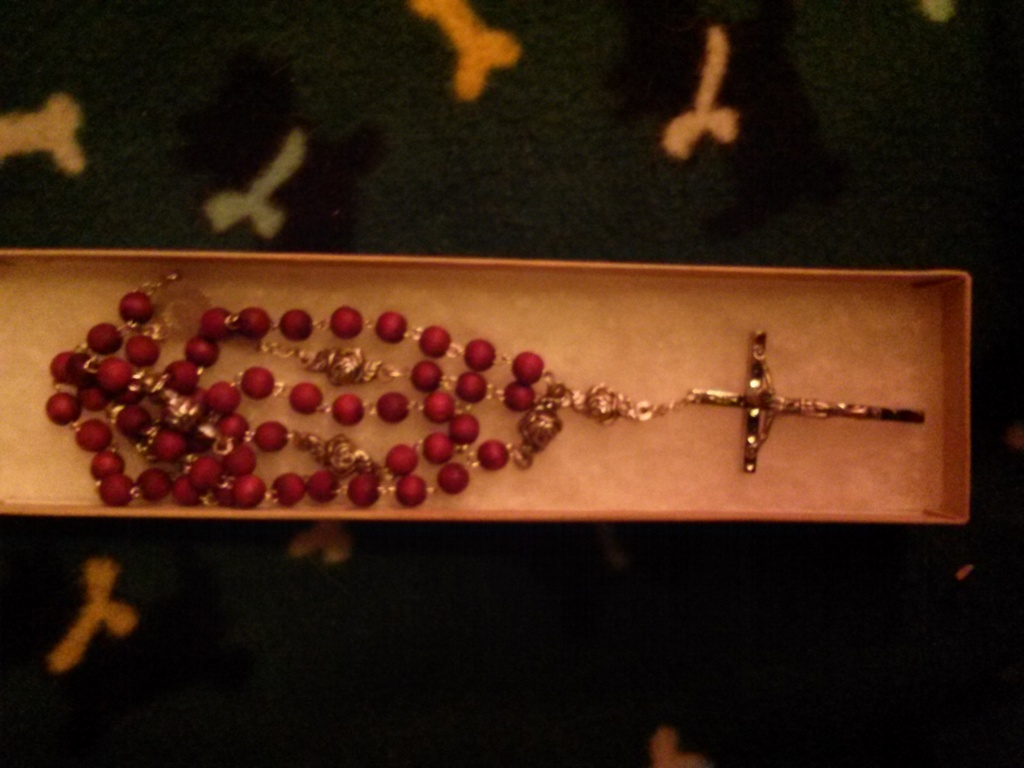
My sponsor Rachel (for infants, a sponsor is called a Godparent) was with me the whole time and helped me rehearse before Mass started. She presented me with a gorgeous rosary with red wooden beads that actually has the scent of roses!

The moment when we were called up to receive Confirmation (which comes first for adults), I panicked a little, but then got myself together and actually did feel filled with the Holy Spirit afterwards.

The Mass was about 3 hours, and because it was bilingual, instead of a lot of solemn hymns, Mexican hymns were sung in Spanish while someone played Spanish guitar, and everyone started dancing at the end.

Pictures were taken afterwards, and I got a lot of hugs (as did the 3 Mexican men) and congratulations, and also a gift bag containing all kinds of literature and a little plastic rosary.

I feel like I’m on a new journey now, that dovetails perfectly with the one I’ve been on.
I feel like I’ve returned home. Even though I was nominally Methodist, I was raised in urban New Jersey and New York, so I grew up with Catholicism. My family were not churchgoers or very religious. I went to Catholic schools and almost all our neighbors were either Catholic or Jewish. Because being at home was usually so unpleasant, I found a lot of comfort in the Mass and at my Catholic schools and at the homes of my Catholic friends. I’m glad to be home.

The other thing I love is feeling like I finally finished something I set out to do. For many years, I never finished anything I started–I’d either lose interest or assume I wouldn’t be able to do it. I had such dismal self-esteem. This is something I actually followed through on until I completed it, and that’s a great feeling. It means I’ve come a very long way from a year ago.

Here are all the photos.

Dressed and ready to go to the Easter Vigil Mass, around 6 PM:
easter_night2 easter_night3
easter_night5

After my conversion:
torch-lighting group_photo1
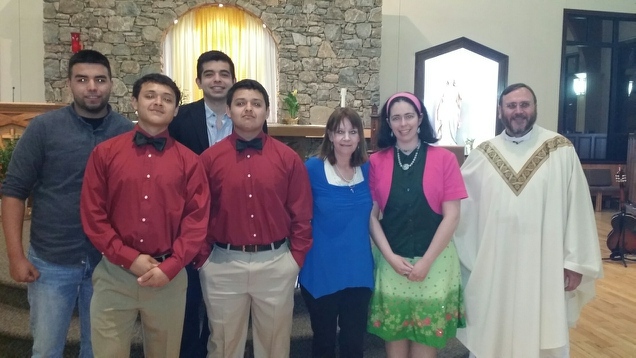
Lighting of the torch; group photo of Father Dean, me, the 3 Mexican catechumens, and my sponsor Rachel.

group_photo2 group_photo3
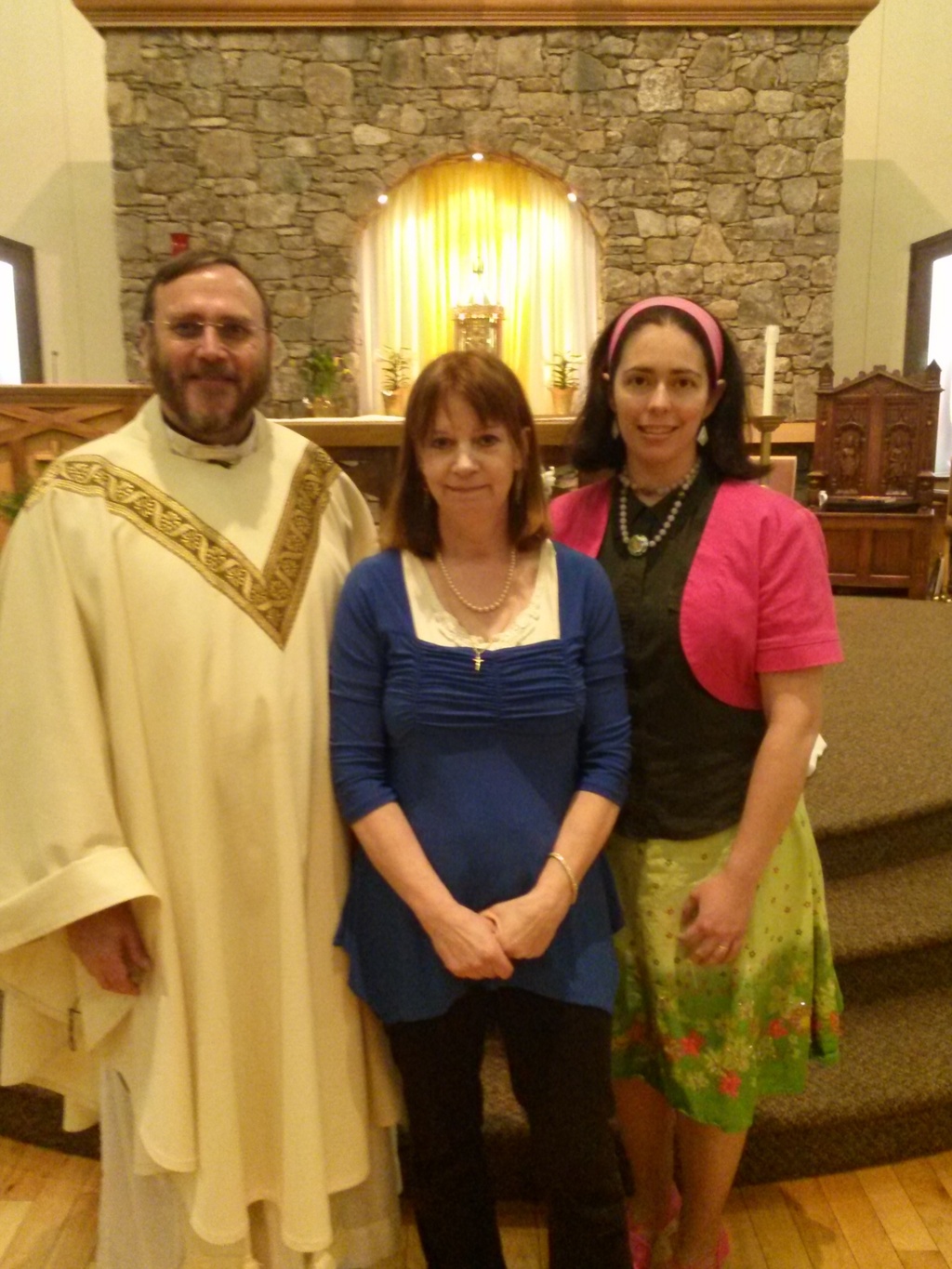
Photos of Father Dean, me, and Rachel.

Photo of the rosary Rachel gave me:
rosary

I’m finally getting really excited about this.

'I'm afraid you're mistaken sir. A catalytic converter is not a Catholic missionary.'

In late October, after a lifetime of being agnostic but intermittently dabbling in various cults (Scientology) and religions including Buddhism and fundamentalist Christianity (Southern Baptist), I made the decision to become a Roman Catholic. If you’re interested in the reasoning behind my decision and the evolution of that decision, read the articles under “My Spiritual Journey” under “My Story” in the header (scroll to the bottom to find those articles), especially this one and this one.

My decision to follow Jesus Christ was quite strange and unexpected (it started as a sort of bet with God), and the two articles describe how that process worked. I was literally an agnostic on October 19th and made the decision to become Catholic on October 25th.

I’ve been attending Mass almost every Sunday (I did sleep in a few Sundays, lol) and always get something valuable out of them (besides finding the Mass very beautiful and appealing to me on an aesthetic level–I love the ritual), But still I struggled with doubts about the Church and Christianity in general, although I believed enough to accept Jesus Christ as my personal savior.

In last night’s RCIA class (which are very informal and it’s a small group), we talked about the role of Mary in the Church and the importance put on her. I already knew Mary is not worshipped and is not thought of as divine like God or Jesus, but she acts as an intercessor and is venerated–which means you can ask her to pray for you on the behalf of God. The saints serve the same role.

We talked about the qualities Mary had (and many of the saints had or have) that make her special to God. I won’t get into the idea of her being conceived without original sin because that gets into the dogma and many of you do not believe this (and I admit I have doubts myself). But I will say that Mary in particular had qualities that are not valued in today’s narcissistic world. Mary was the opposite of a narcissist–she was humble, obedient to God, compassionate, merciful, and very maternal, and yet she was very, very strong and her love of God and her Son knew no limits. Personally I think she was an empath. She appeals to me because she’s the mother we all should have had. No matter how old we are, we never lose our need for a loving, compassionate, merciful mother. Mary can be the mother I never had.

La_Vierge_au_lys
“La Vierge au lys” by William-Adolphe Bouguereau – PaintingHere.com. Licensed under Public Domain via Wikimedia Commons – http://commons.wikimedia.org/wiki/File:La_Vierge_au_lys.jpg#/media/File:La_Vierge_au_lys.jpg

It was the most enlightening and interesting RCIA class we’ve had yet.

New conversions are done on Easter Saturday (April 4th this year) and the heavy duty preparation for new members takes plan during Lent (which began on Ash Wednesday at the end of February). I chose a sponsor (Godparent) about a month ago, a lovely woman named Rachel. Last Saturday we went to a Mass at another church where the catechumens (people converting) were introduced by their sponsors and blessed by the Bishop of the Charlotte Diocese. Afterwards there was a brunch across the street where I got to talk to the Bishop, who hugged me.

But I still didn’t feel as excited about it as I felt I should. I still had doubts (and still do) but there are some doctrines I want to believe so much that I’m willing to suspend my disbelief and take into account that some things that happen may not have a scientific explanation–or do have one that we cannot explain with the scientific knowledge we currently have. I was surprised to find the Catholic church so friendly to science (including divinely inspired evolution, which I believe in anyway) but it really shouldn’t be too surprising, because so many of our most renowned scientists were in the Catholic clergy or just very devout Catholics.

One of the “mysteries” I’m willing to suspend disbelief on is transubstantiation (the idea that the host and wine during communion actually transform into the body and blood of Jesus Christ, and are not just symbolic. This is in the Bible so in no way goes against Biblical teaching, but Protestantism changed this idea into one where the host is merely a symbol or remembrance, not the actual body of Christ.

I absolutely love the idea of something as unique and miraculous as taking the actual body of Christ into myself (taking him into my soul), so I’m willing to suspend disbelief and in time I may actually believe this is what happens.

transubstantiation
Transubstantiation.

I_cant_believe_its_not_jesus
A humorous take on the above — sorry, too funny not to share.

Today I had an appointment with Father C. about my first Penance (confession). Rather than being a dark and punitive thing and something to dread, it brings relief. It seems to work almost like Step 4 of a 12 Step Program, where the idea of “confessing” your sins (wrongdoings) to a priest takes the burden of guilt off of you, and you are absolved and forgiven. Then you are told what you need to do, usually reciting some Our Fathers or Hail Marys. I don’t have any problem with that, and being the kind of person I am who struggles with guilt constantly, I think this will be very helpful.

My first Penance (one of the seven Sacraments) will take place on Monday night. Over the weekend, Father C. wants me to make a list of what I think of as my sins, and try to put them in some kind of order. I don’t have to list every sin I ever committed, because I’d be confessing until the day I die, but just the ones I think are important or feel the worst about. I will be praying for guidance this week because I want my list to contain the sins that matter the most to God, not necessarily just in my own mind.

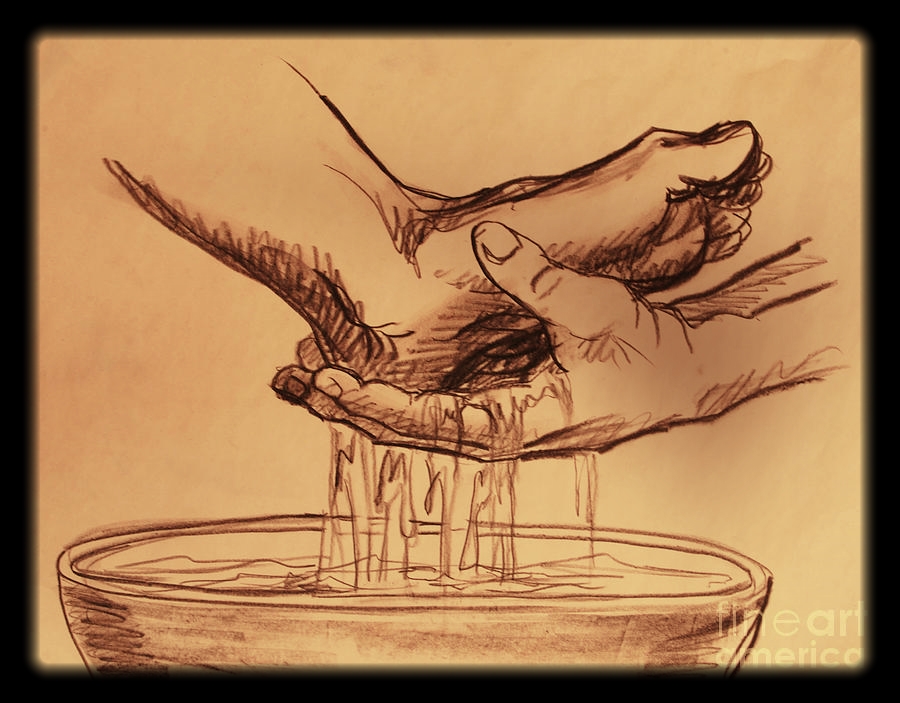
On Holy Thursday (one week from today), I’m attending a foot washing service, where my sponsor and the priest will each wash my feet, symbolizing how Jesus washed the feet of his disciples. I feel strongly that this will be an extremely moving and very spiritual moment for me. It’s a loving act, but the recipient must be willing to become both humble and vulnerable to fully understand the meaning of Jesus’ act.

foot_washing

Jesus spoke to his disciples of the meaning of foot washing in John 13: 1-15:

1 And before the feast of the passover, Jesus knowing that His hour hath come, that He may remove out of this world unto the Father, having loved His own who are in the world—to the end He loved them. 2 And supper being come, the devil already having put it into the heart of Judas of Simon, Iscariot, that he may deliver Him up, 3 Jesus, knowing that all things the Father hath given to Him—into His hands—and that from God He came forth, and unto God He goeth, 4 doth rise from the supper, and doth lay down his garments, and having taken a towel, he girded himself; 5 afterward he putteth water into the basin, and began to wash the feet of his disciples, and to wipe with the towel with which he was being girded. 6 He cometh, therefore, unto Simon Peter, and that one saith to him, “Sir, thou—dost Thou wash my feet?” 7 Jesus answered and said to him, “That which I do thou hast not known now, but thou shalt know after these things;” 8 Peter saith to him, “Thou mayest not wash my feet—to the age.” Jesus answered him, “If I may not wash thee, thou hast no part with me.” 9 Simon Peter saith to him, “Sir, not my feet only, but also the hands and the head.” 10 Jesus saith to him, “He who hath been bathed hath no need, save to wash his feet, for he is clean altogether; and ye are clean, but not all;” 11 for He knew him who is delivering him up; because of this He said, “Ye are not all clean.” 12 When, therefore, He washed their feet, and took His garments, having reclined at meat again, He said to them, “Do ye know what I have done to you? 13 Ye call me, ‘The Teacher’ and ‘The Lord’, and ye say well, for I am; 14 if then I did wash your feet—the Lord and the Teacher—ye also ought to wash one another’s feet. 15 For I have given thee an example, that ye should do as I have done to ye. Verily, verily, I say unto ye, the servant is not greater than his lord; neither he that is sent greater than he that sent him. If ye know these things, happy are ye if ye do them.”

I’m meeting with Father one more time after that to talk about the Big Event, which will take place on Saturday night, the day before Easter (that’s when the big Easter mass where the new converts are welcomed into the Church takes place. In the Catholic church, Easter is a much bigger deal than Christmas).

On Saturday morning of the big day, I attend a rehearsal with my sponsor. That night, at 8 PM the Mass takes place. My daughter is the only family member I have attending, but that’s okay. At that time I’ll receive the Sacraments of Communion (no, I do not have to wear a lacy white dress or a veil like little Catholic girls do) and then Confirmation. I have chosen Catherine as my confirmation name — Saint Catherine of Siena was a strong faithful woman of God, and she is the patron saint of writers. I love the strength of the name. I didn’t have to think about this one too much. It just came to me as being perfect.

I don’t have to be re-baptized. My Methodist baptism is considered acceptable (which surprised me). Any Baptism using water and the sign of the cross is sanctioned as acceptable in the Roman Catholic church.

I’m a little nervous of course, but after my meeting tonight, I’m finally realizing how close I am to this happening and just how big this is for me, and finally feeling excited about it. I’m not without my doubts, but am willing to take that big leap of faith and I can’t wait.

If you’re interested in reading other stories of people who decided to convert (or return to) Catholicism, WhyImCatholic.com is is a great website and a lot of fun to read, too.

The day I went to Hell.

singularity-mind

A old friend from another website I used to frequent and I were having an interesting conversation earlier today on Facebook about my conversion to Catholicism on Easter. My friend converted two years ago (from Episcopalian) so of course he knows much more than I do.

Both of us love philosophical musing and talking about weird, metaphysical subjects so as conversations sometimes will, soon I was asking him if he believed in Hell (he does but doesn’t think it’s a hellfire and brimstone sort of place) and if he believes all narcissists will go there (he thinks they will and there’s no hope for any of them; I don’t think that’s necessarily the case unless they’re psychopathic or malignant).

I asked him what he thought hell was like and he replied that it was worse than a fire and brimstone hell because it would involve the lost soul forever drifting alone in between the galaxies, where there are no stars and no light…utterly alone, and lost for all eternity with no hope of finding their way back to…anything at all.

This suddenly brought back memories of a bad LSD trip I took many years ago, when I was in my 20s. I was never adventurous about taking recreational drugs and pretty much stuck with alcohol and pot, which seemed safe. I must have known on some level I didn’t have the right sort of temperament to react well to a strong psychedelic drug, so I never messed with them except for this one time.

Psychedelic drugs make you extremely suggestible, and heighten whatever mood you’re already in or exaggerate what you’re already worried about. This is why it’s recommended that if you decide to experiment with this class of recreationals, to only do it in a setting you’re comfortable in and have a trusted “trip sitter” who is not under the influence there just in case a freak-out occurs. As a person who was constantly on edge and a nervous wreck anyway (and I also took it with someone I didn’t know well), the outcome wasn’t going to be good (but it sure was interesting).

My trip memories came flooding back (not as a flashback, just a memory) so I described these memories to my Facebook friend today. Personally I think these drugs can be extremely dangerous because I think that, much like messing with the occult, they can open doors better left bolted shut, and reveal truths about the universe we may not be ready to know or ever should know. You can be shown things you can’t begin to understand and that lack of understanding will terrify you. Basically, they constitute a way to eat from a Tree of Knowledge that can really fuck your head up for a long time, even causing a psychotic break, or at the least just cause extreme discomfort for awhile.

At first I thought nothing was going to happen, because the weirdness didn’t kick in for almost half an hour. Then I started to shiver as if I was cold but I wasn’t cold. The shivering was coming from inside me. Everything became metallic. My surroundings developed sharp edges that gleamed like the edges of knives and the sounds around me sounded like metal and glass.

metallic_tree

We were outside. I watched a car zoom by and thought it looked and sounded funny–sort of like a cartoon–so I started laughing. I thought it was alive. I started rambling (probably incoherently) about why cars weren’t considered to be living things because they sure acted like living things and even had “systems”–the body covered with a metal skin, the engine (the heart), the transmission and electrical system (the nervous system), the various fluids that lubricated and made it run (blood and other bodily fluids), even a waste elimination system (the exhaust). And they had four “legs” that kept them moving. They could get sick and be “diagnosed.” Their inner workings seemed as complex to me as the inside of the human body. They even had quirks and “personalities.”

This early part of the trip was kind of fun but I was still disturbed by the metallic sound and cartoonish look of everything. The world seemed like it was screaming and shards of metal were slicing into my brain like razor blades. A fly landed on my arm and I screamed because I thought it was some kind of tiny machine that could see inside my soul. The fact that such “engineered insects” and even smaller nanomachines actually exist freaks me out more than a little.

artificial_insect
Creepy artificially engineered insect.

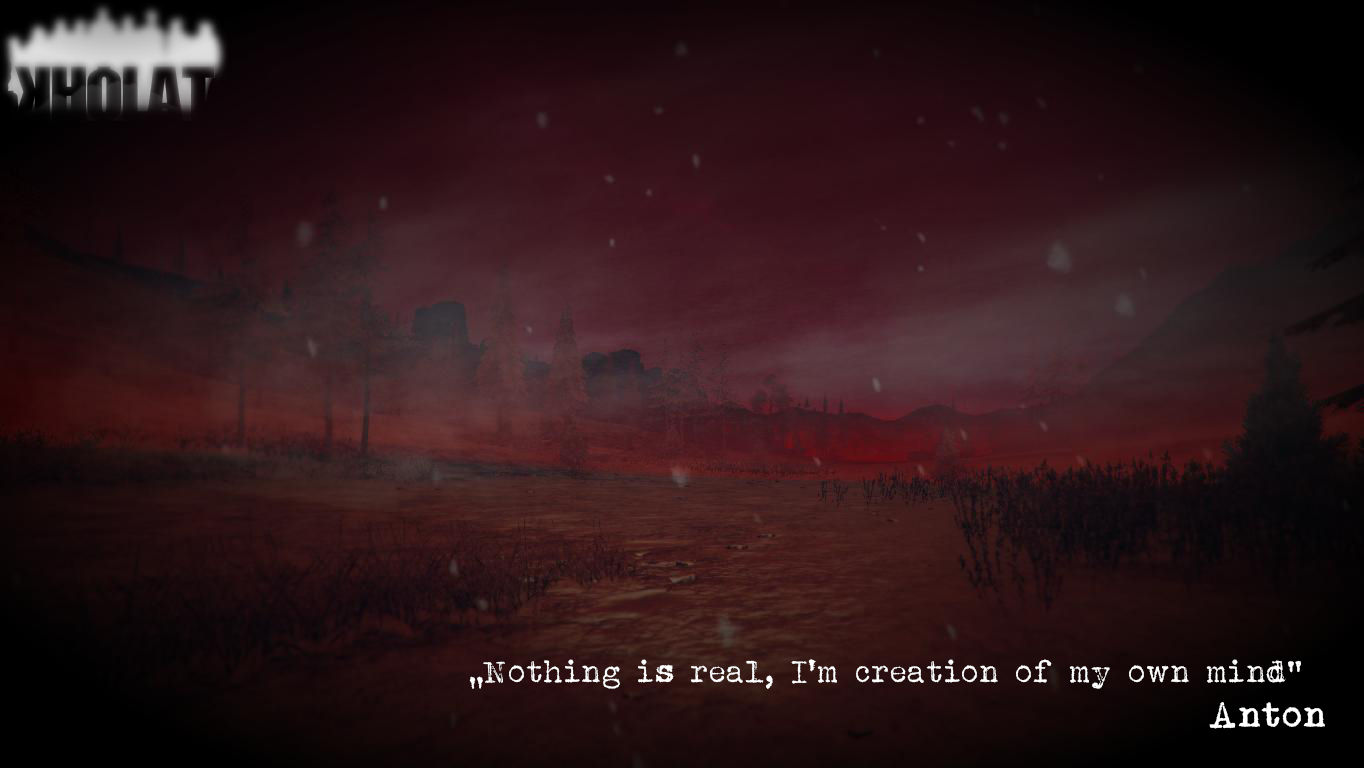
Then I had a bizarre thought that came out of nowhere. I “realized” that nothing was real–that everything and everyone I had ever known, everything I ever learned about or experienced, in fact every person and every experience I had ever had since the time I was born–none of it was real. Everything and everyone I knew was merely a creation of my own mind. (I understand some Eastern religious practices actually do believe this).

But if everything I saw and knew and experienced was nothing but a mental construct I created from my own mind, and nothing really existed, then where were my own thoughts coming from?

nothing_is_real

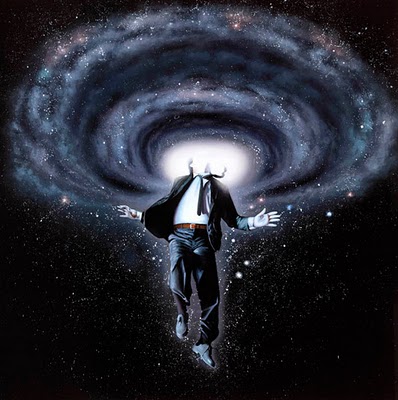
I was a singularity, a tiny speck of bright white consciousness, floating alone in the black void of deep space, light years away or an eternity away from any known universe. I felt utterly alone and lonely, and wondered why only my consciousness existed. I was overcome with profound sadness.

And then realized this meant I must be God. I was pure consciousness floating bodiless within an eternity of nothingness. I could create my reality out of nothing. If that was the case, I could create a whole new universe. As God, I was the consciousness that brought on the Big Bang. I thought about creating a new universe, one that would make me happy instead of so miserable, afraid and sad. But I was too afraid to create anything at all. What sort of “God” would be so scared and so powerless?

god_creating

I started to freak out. I remembered my past life, my job, my school, my friends, my family. I wanted to get back but didn’t know how. I had a massive panic attack so intense I thought I would die. Maybe I was already dead. Maybe I had never existed at all…who the hell was I? Where was I?

I was trapped in some weird time loop. Although I (think) I only had these realizations, thoughts and visions once, I had the unsettling feeling I had been through this exact experience many times before, and in fact this experience had been my only reality throughout all eternity. Everything else had been a dream. This was the only reality.

Gradually I began to come back to the world. My friend told me he was worried about me because all I had done was sit on the floor, backed into a corner of his kitchen, moaning and mumbling incoherently. He said my eyes looked like black pools of terror. He tried to give me some coffee but I had pushed him away. I didn’t remember doing that.

It was definitely an interesting experience but one I would never try again.

My Facebook friend and I started talking about the devil and whether he existed. Anyone who would think of themselves as God, even in a deluded drug induced state, was being influenced by Satan, who thought of himself as God or at least that he should have been God. I’m still not sure I believe in Satan, but this argument made a kind of sense. The overall feeling of my LSD experience was one of profound despair, terror, evil and separation from God.

blackhole2
Could this be Hell?

Being “God”–a singularity of consciousness amid an eternity of nothingness–was terrifying. I told my friend I thought perhaps I went to Hell and it was exactly as he had described: a place of nothingness between the galaxies or even outside any known universe, perhaps within a massive black hole, an eternal separation from all that was real, whether bad, good or in between.

I was never so glad to return to the mundane and too often very boring and painful reality of the earthly world I lived in, just one insignificant human among billions of others just like me. I actually appreciated all the little things that angered, upset or annoyed me, at least for a little while.

Looking back on that experience now, I think I actually was in hell. I think that, if Satan does exist, utter aloneness, terror and despair is what he feels (but don’t worry, I’m not Mick Jagger and have no sympathy for the devil). Satan is the Ultimate Narcissist, and still believes he is greater than God, the source of all that is–and he hates God for casting him out of heaven into that eternal black void of nothingness.

Wow, this is getting real…

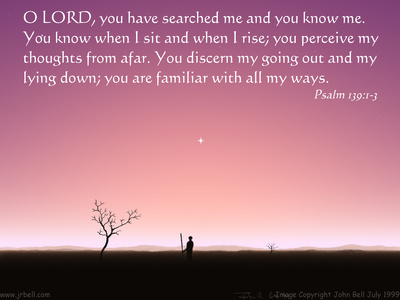
psalm139

Back in late October, I made the decision to become Catholic. I’ve been attending RCIA (Rite of Christian Initiation) classes every Wednesday night since then.
If you want to read about how my decision evolved, you can read these blog posts:
My Problem with Christianity
I Made a Little Deal with God Today
So Apparently God Accepted My Deal (Part 1 of 2)
So Apparently God Accepted My Deal (Part 2 of 2)
Which Religion is the One True Religion? (not really about my spiritual journey, but might be of interest to readers interested in this topic)

The mass where I’ll be initiated into the church will be at the Easter Vigil Mass on the evening of Saturday, April 4th. I’m the only Anglo candidate this year (the others are Hispanic and attend the Spanish speaking masses). This part of the country isn’t exactly swarming with people wanting to become Catholic!

I’ll be receiving all the sacraments (communion and confirmation) at that time (Confession must be done prior to that). My Methodist baptism is recognized as valid, which surprised me. I have to find the certificate though, which I know I do have, so no having to contact my parents about it. Whew!

I met with the priest tonight to discuss what else I need to do to get ready. There are a few special masses I need to attend, and I also will be meeting with the Bishop in a few weeks. Time has really flown–it’s going to happen in exactly two months! Two months ago was December, and that seems just like yesterday. Things are getting real.

I feel like this is going to be a life changing event for me. I know about all the problems people have with the Catholic church, and some of those arguments are valid. But I feel like this is the direction that’s right for me and that God is leading me to. My other blog posts will explain why.

In fact, the other day I was talking to an old friend on Facebook and he told me he became Catholic last year and it’s the best decision he ever made. I was encouraged by that because it’s all a little scary!

Scientology: a cult of psychopathy

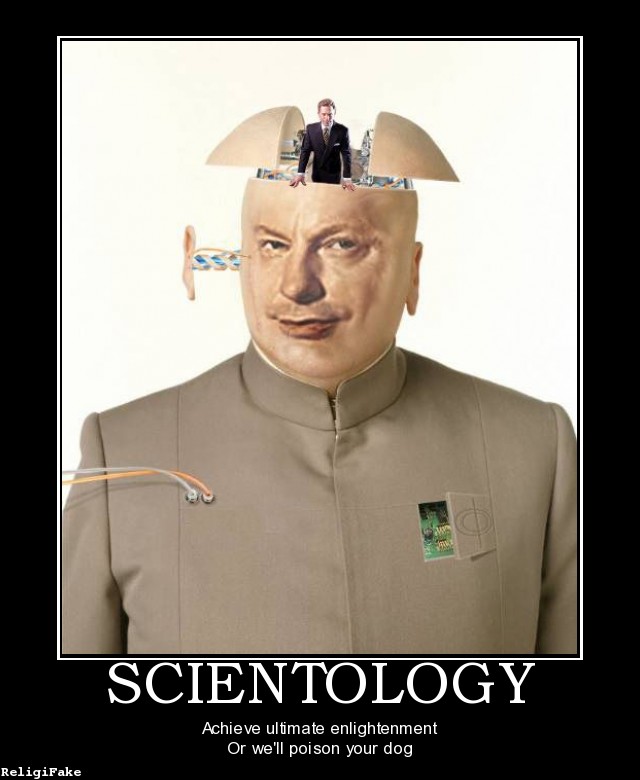
hubbard

Scientology, like most cults, uses exactly the same brainwashing techniques the narcissist does to recruit and retain its members. Here’s a video I found on the Ex-Scientologist Message Board, where Sam Vaknin talks about the “cult of the narcissist,” and even though it’s not specific to Scientology, it’s spot on in describing the mind games narcissists use to trap their prey (sorry, I was unable to embed the video). The same techniques apply to most cults. Scientology is one of the most dangerous.

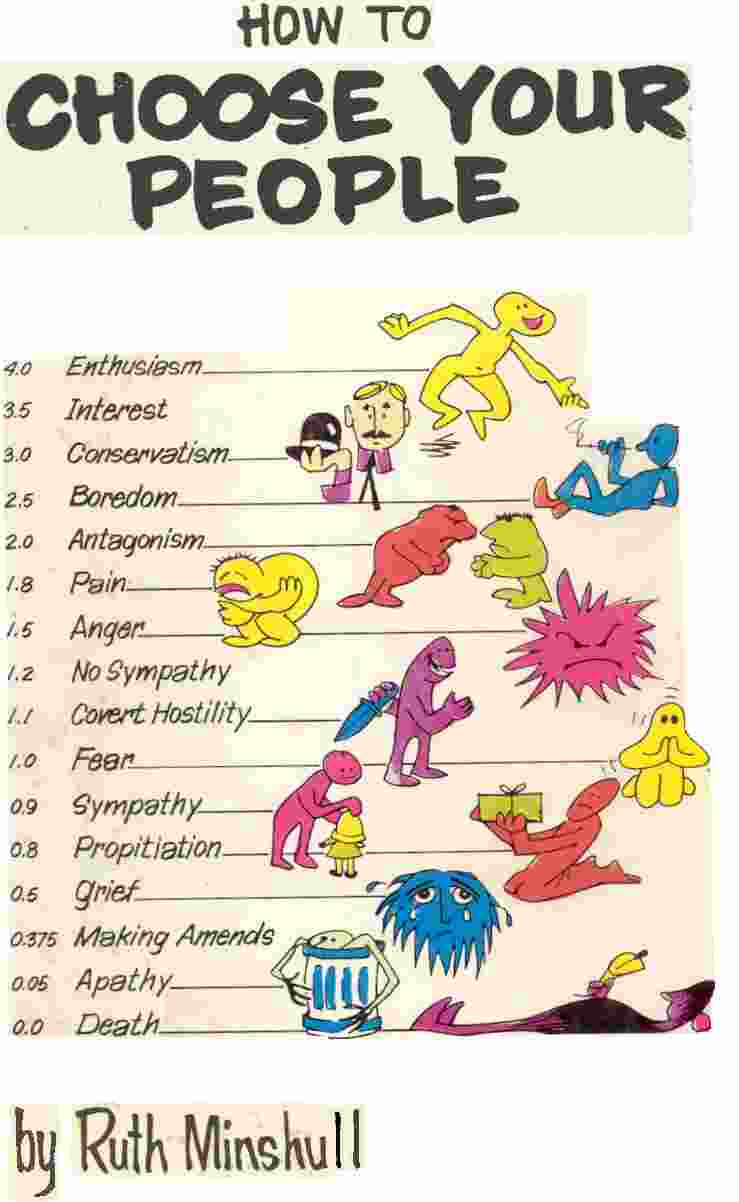
In 1978 and 1979, I flirted with Scientology. This happened when I came across one of its books (one of the only ones not written by its founder L. Ron Hubbard, who was not only a malignant narcissist of the highest order, but also a very bad writer), an easy to read and humorous “self help” book called “How to Choose your People,” by a writer named Ruth Minshull. The book was discontinued many years ago, probably because it wasn’t written by Hubbard and therefore not acceptable “scipture.” “How to Choose Your People” was entertaining and well written, and I found its idea of something called “The Tone Scale” intriguing and it seemed to make sense. I liked the idea that emotions ran on a sort of continuum, with one logically leading to the next. Every human being can be placed somewhere on this “tone scale.” Although most people move around on the scale according to their mood, everyone can be placed at a “home” tone, where they will be most of the time. The “tones” ranged from Apathy (the lowest you could go–this would be where severely depressed and suicidal people are) to Enthusiasm (very happy and contented people). Each tone was assigned an arbitrary number, although no one ever explained what those numbers meant.

There were two “emotions” around the middle of the scale, called Covert Hostility (1.1) and No Sympathy (1.2, making it slightly “better”). Although not at the bottom of the scale, while I was involved in Scientology (and the related Dianetics, the mental “technology” that is similar in some ways to psychoanalysis and serves as a tool to brainwash its members), Covert Hostility and No Sympathy were considered by most Scientologists to be the two worst places to be on the Tone Scale. No one wanted to be labeled a “1.1.” Because if you were, it meant you were a Suppressive Person–that is, a psychopathic person who could harm the Church and its members. If you were pegged a “1.1” or a “1.2” you could be excommunicated or punished by a cruel form of shunning (which I was subjected to at one point).

The traits of someone with a “tone” of Covert Hostility or No Sympathy are exactly the same of those of the malignant narcissist. Here is a picture of the tone scale as it appeared on the cover of Minshull’s 1976 book. (There is an expanded tone scale too, which has additional levels, but for our purposes this one is sufficient).

minshull1

Click image for larger view.

So I finished Minshull’s book and was intrigued enough to go to the local Scientology Center (on New York’s upper west side–I was living in Queens, NY at the time) and find out more. They gave me a “personality test,” that was supposed to identify what my issues and weak points were. There were 200 questions on the test, but when I was done, someone sat down with me and went over my results and convinced me I needed Dianetics auditing or classes in Scientology (much cheaper than Dianetics auditing) to overcome these weak points. The recruiter was very convincing and friendly, and assured me I would only be set back $15 to sign up for the HAS course (Hubbard Apprentice Scientologist aka “Communication Course”), which was really training in something called Training Routines (TR’s) which were used as brainwashing techniques.

At first the TR’s were very seductive–they were fun and actually seemed to work. They did help me be able to “confront” people better, or at least seemed to. The TR’s themselves involved things like sitting in a chair staring at someone as long as you could without reacting, laughing, or looking away. After this, the ante was upped to something called “bullbaiting,” where the person could try to get you to react and “lose your Confront” by insulting you, trying to make you laugh, or calling you names. There were higher levels of TR’s that involved walking across the room, touching things, asking if birds could fly, and reading passages from “Alice in Wonderland” of all things.

All these things were supposed to help you communicate with others better and raise your “tone,” but in actuality, these were all brainwashing techniques that would eventually result in giving you the infamous blank stare that many Scientologists seem to have while under the cult’s thrall.

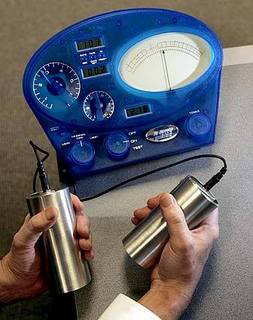
After I “passed” the Communications Course (by getting a “floating needle” on a lie-detector type of device called the E-Meter), I was convinced without too much difficulty to sign up for the next course, the HQS course (Hubbard Qualified Scientologist). That one set me back $250. (The prices are probably much higher today). By this time of course, I’d been sufficiently indoctrinated that $250 for further “processing” and “training” didn’t seem that bad. It didn’t take much to convince me to hand over the money.

In order to help pay for the course (because in those days $250 was a lot of money, especially for a 19 year old) it was suggested I work at the Center part time, answering phones and opening and distributing mail. The position paid nothing, but I got “credits” to help pay for the course. Of course, by now I was spending most of my free time at the Center, because right after “work” it was time for the classes, which ran about 4 hours a night (5 days a week).

Students were closely monitored and every class ended with a session on the E-Meter. If you were caught yawning or daydreaming you were told you had a “misunderstood word” and had to go back and re-read Hubbard’s unreadable material to try to find the word you did not understand. You were not allowed to move on until you found the word and “passed” on the E-Meter. I began to realize I wasn’t having much fun anymore, but if you criticized Scientology or its “teaching technology” in any way, you would be sent to Ethics.

e_meter
Scientology E-Meter

No one wanted to be sent to Ethics. If you were sent to Ethics, it meant there was a problem and you were considered a “Potential Trouble Source” and disciplinary action would be taken. I was sent to Ethics about three times, all for very minor transgressions such as minor criticism. The punishments ranged from having to re-read material (and be “passed” being connected to an E-Meter), to cutting off friends and family members who could be potential “Suppressive Persons” or enemies of Scientology (you would be required to write them a letter telling them you were cutting them off), to shunning, to excommunication.

I was once subjected to shunning. I was told although I would still be required to fulfill my job duties and attend classes, no one would be allowed to speak to me and I was allowed to speak to no one (unless it was directly related to my job or something I was learning). It was horrible. This torment on for several days, until I was “passed” up a level and allowed to be spoken to again. But before that could happen, I had to go up to every high level member and employee, make amends to them and “re-introduce” myself.

Toward the end of the HQS course, you are told to recruit other people into Scientology. I had to go outside, no matter what the weather, and try to talk people into coming up to the Center to take its personality test. The more advanced TR’s taught in this class became increasingly bizarre. These sessions could go on for hours, and as part of the training, I was also required to “audit” other students and conduct TR’s on them. If they proved difficult or uncooperative, I was the one who was blamed and was not allowed to stop “running the TR’s” until my student had passed on the E-Meter. If it went on all night, then so it did. You were not allowed breaks to eat or rest, and neither was your student. I remember once being so exhausted from lack of sleep and hunger that I burst into tears in the middle of running a session, and was immediately sent to Ethics and that’s how I got the “shunning” punishment. I was stunned by their total lack of empathy.

I thought about leaving, but didn’t dare–because they threatened you with something called “Fair Game.” No one ever explained exactly what that was, but in Hubbard’s indecipherable scripture, “fair game” appeared to imply the Church reserved the right to stalk you, torment or even kill you if you “blew” (left). I’d also paid so much money into it by this point and spent so much time with them that I was hesitant to toss in the towel.

Shortly before I was to graduate from HQS (which I never did finish), I was sent to talk to a recruiter about my next “step up the bridge.” I was told I should sign up for “Life Repair,” which cost $6K. I told the recruiter I did not have that kind of money. The recruiter turned to the hard sell at that point. He told me to get a bank loan or ask my parents for the money. Neither was possible. There was no way I could pay back the bank, as my other (paying) job was part time and paid only $2.75 an hour (minimum wage at that time), and my parents were not the type to hand over large sums of money, even for something legitimate.

Finally, after two hours of unsuccessfully trying to get me to sign up for this $6,000 auditing package, the recruiter gave up and was quite hostile to me after that. He not only told me that I must not really be interested in moving up the Bridge, but that I was probably a Suppressive Person and an enemy of Scientology because I would not put myself in huge debt to continue to be brainwashed.

It was at this point I left the Church. I just didn’t care anymore. I had gradually come to realize that the “emotional tone” of the organization was somewhere around Covert Hostility and No Sympathy–which was quite interesting since those were the tones that were the most hated and feared and were the realm of the dreaded Suppressive Person. In other words, Scientology was a psychopathic, narcissistic cult, founded by a psychopathic malignant narcissist (1.1 on his own Tone Scale) whose ravings (and fabrications as a “war hero” among other things) are legendary. What they were really doing was projecting their own emotional tone (malignant narcissism) onto those who disagreed with them.

I also realized how I had been gradually seduced into this psychopathic organization through misrepresentation, manipulation, threats and lies. The personality test and the inexpensive and fun HAS course that promised to help me feel happier and more confident was merely the “love bombing” phase before the abuse that would come later and increase over time. I did NOT want to become one of the upper-level Scientologists, with their blank, weird stares, creepy smiles and total lack of empathy. Just look at Tom Cruise today: does he even seem human anymore? Hell, I’d rather be a Suppressive Person any day than one of them.

I didn’t get nearly as far up the “Bridge” as many other people, and therefore did not experience some of the trauma and torture inflicted on members who are more deeply enmeshed with this psychopathic cult. Eventually they WILL take over your entire life. For anyone interested in finding out more about the evil mindgames this cult plays, its psychopathic paranoia about both government agencies like the IRS and its hatred and fear of traditional psychotherapy and psychiatry, and the horrific (and sometimes fatal) punishments inflicted on many of its members and their families, I highly recommend either of these two websites that call out Scientology for what it really is.

The Ex-Scientologist Message Board: http://www.forum.exscn.net/ (This is where I found the Sam Vaknin video posted at the beginning of this article).
Operation Clambake: The Inner Secrets of Scientology: http://www.xenu.net/

Oh, and this is my 300th post!