So my psychopathic sperm donor’s being rewarded for being “homicidal”–WTF?

fucking_insane

Apparently, we live in a society that REWARDS a psychopathic malignant narcissist for being a potential homicidal maniac.

The latest on my MN sperm donor’s disability case is that his PAYMENTS WILL BE INCREASED BY ABOUT 100% due to his being deemed TOO HOMICIDAL to be employable. The HUGE irony here is that it was because of the restraining order I filed on him in February of 2014 due to his physically attacking my daughter that this has been determined.

So when all is said and done, he’s going to be bringing in about $400 a month more than I make a month for WORKING MY ASS OFF just to sit around at home DOING ABSOLUTELY NOTHING but making everyone around him miserable.

This on top of the nearly $30K he is getting in BACK DISABILITY PAYMENTS for all the years he freeloaded off me.

images

Do I get anything out of this? HELLS TO THE NO, I don’t. I only get the “satisfaction” of seeing this pathetic, useless malignant narcissist PSYCHOPATH rake in enough cash to be able to live quite comfortably, largely due to my being a codependent doormat for years and then standing up for myself.

Oh, and get this. He’s talking about the new car he’s going to buy when I don’t even earn enough to get my own 14 year old car a tuneup.

What the actual f*ck?

This loser should be in fucking JAIL, not being REWARDED financially for being a potentially murderous psychopathic sicko. This ridiculous excuse for a human being sits around getting high all day and trolling political websites (yes, he is one of those Internet trolls we all hate) and no matter what he does or doesn’t do, everything ALWAYS works out for this sorry POS, while I always have to STRUGGLE MY ASS OFF.

Sorry about the expletives, but I’m so mad right now I want to go break something.
His disordered swelled head, maybe?

Only in America, folks. Your tax dollars at work. :/ (No, I am not a Republican btw).

WHERE IS THE FUCKING JUSTICE?????

Psychopathic malignant narcissists are real-life body snatchers.

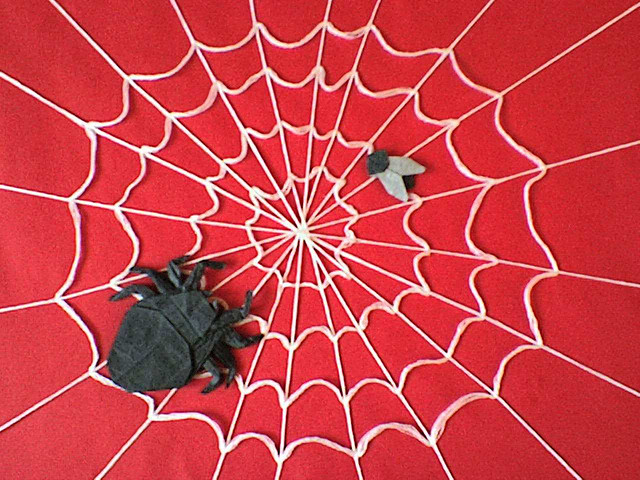
spider_fly

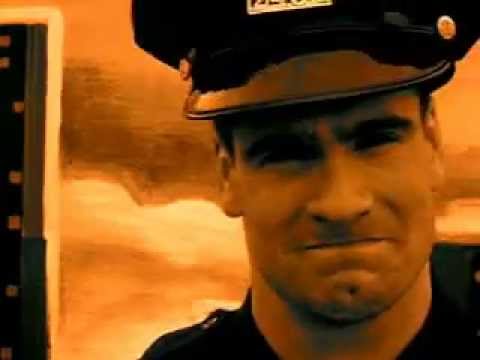
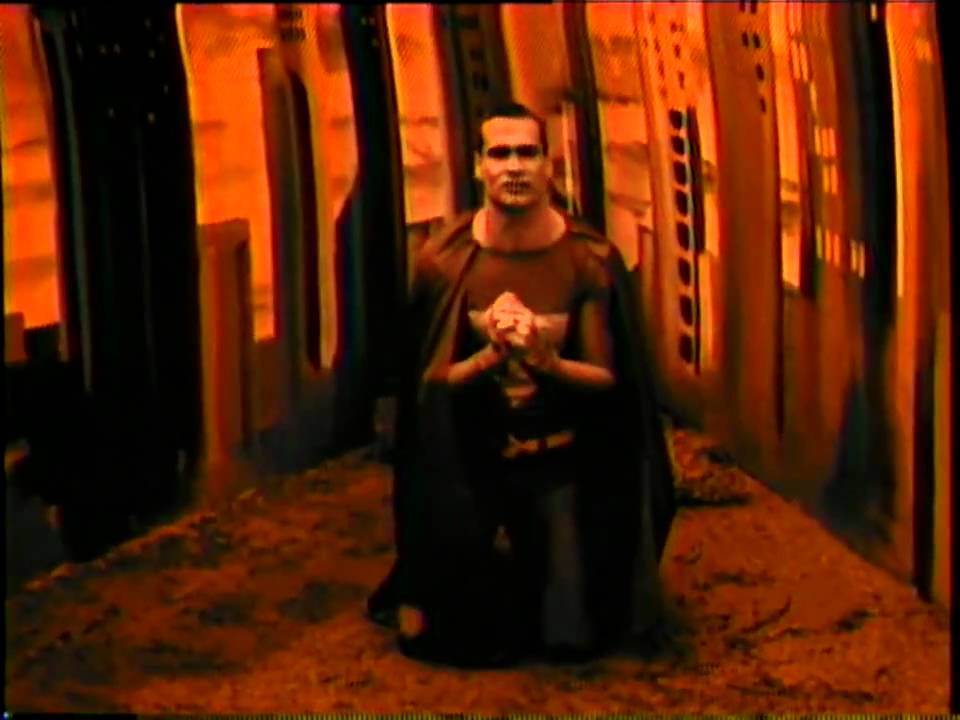
In the late 1990s, poet, musician and activist Henry Rollins recorded his alternative rock hit “Liar,” which probably describes the evil of the psychopath/malignant narcissist more eloquently than any other song I’ve heard about narcissism. I posted about it here.

The lyrics describe what these human bags of dogsh*t do so well I’m going to pick the song apart by sections and talk about the way malignant narcissists and psychopaths attempt to destroy your soul and turn you into one of them.

You think you’re gonna to live your life alone
In darkness
And seclusion
Yeah I know
You’ve been out there
Tried to mix with those animals
And it just left you full of humiliated confusion
So you stagger back home
And wait for nothing
But the solitary refinement of your room spits you back out onto the street
And now you’re desperate
And in need of human contact

A potential victim is at their most vulnerable to narcissistic abuse when they have been abandoned, hurt or are down on their luck. A malignant narcissist, using “cold empathy,” knows exactly what you’re thinking, and knows how lonely you are and how much you’ve been hurt by past abuse. They smell vulnerability like a wolf smells blood and will make a beeline toward you.

And then
You meet me
And you whole world changes
Because everything I say is everything you’ve ever wanted to hear
So you drop all your defenses and you drop all your fears
And you trust me completely
I’m perfect
In every way
Cause I make you feel so strong and so powerful inside
You feel so lucky

When you meet the psychopathic narcissist, he or she will pretend to understand you and be sympathetic. If the narc is a good actor, you may be duped into thinking this is the most empathetic, understanding person you have ever met. You cannot resist their charms and attention and you trust them enough to tell them your darkest and most intimate secrets. Make no mistake–they will use this against you. This love bombing phase is really just the narc’s way of finding out where your buttons are and knowing where to hit you later on where it’s going to hurt the most.

henry_rollins1

But your ego obscures reality
And you never bother to wonder why
Things are going so well

Bingo. The malignant POS is lying to you and thinks you’re a blithering idiot for believing their lies. “Things going well” is just temporary. They are fattening you up for the kill like a Thanksgiving turkey. Gobble, gobble!

You wanna know why?
Cause I’m a liar
Yeah I’m a liar
I’ll tear your mind out
I’ll burn your soul
I’ll turn you into me
Cause I’m a liar, a liar
A liar, a liar

They tear your mind out by cruelly playing with your head using the whole bag of narcissist tricks: gaslighting, projecting, lying, projecting their faults onto you, triangulating, hoovering, blame-shifting, invading your mental, emotional and physical boundaries and generally making you doubt your own reality. Constant gaslighting in particular can drive a person to think they’re insane, and it’s possible that actual insanity could be the end result.

In your weakened emotional and mental state, you may suffer Stockholm Syndrome and begin to identify with your abuser. You may begin to do things that go against your morals and ethics in order to please them. They may force you to engage in illegal or immoral acts, and because you dare not disobey them and you doubt your own reality, you will go along with what they want.

Many victims of abuse have been arrested for heinous acts they were coerced into by their abuser. Going against one’s own morals eventually will turn a person evil. See my post Stephen’s Story (“The Choice”) for a description of how a victimized person can turn evil when attempting to pacify evil people. M. Scott Peck also described this phenomenon in his book, “People of the Lie.”

henry_rollins2

I’ll hide behind a smile
And understanding eyes
And I’ll tell you things that you already know
So you can say
I really identify with you, so much
And all the time that you’re needing me
Is just the time that I’m bleeding you

Malignant narcissists don’t really have any of their own thoughts or feelings. They learn to feign emotion. What you think of as empathy and understanding is really just the narcissist reflecting back to you what you want to hear. They are very good at knowing exactly what you are thinking and what you want. They can parrot things you have already told them in a different way so you think what they said is insightful and original. It isn’t. It’s just a paraphrasing of what you have already told them or what they have figured out about you.

Don’t you get it yet?

They hold you in contempt for your stupidity for believing them. Of course you are not stupid, and are understandably confused, but they are contemptuous of the trust you have handed over to them. They will work on destroying it and at the same time, destroy your trust in others, by using them as flying monkeys against you. Eventually you will trust no one and when this happens, you may do anything to earn back their “love,” even things you are morally against. There are so many victims of abuse who have done things for their psychopathic lovers like lie on tax returns, steal for them, buy drugs for them, and even kill for them. In most “killer couple” partnerships, one of the couple (usually the woman but not always) is a long-term victim of a psychopath and has become evil by association.

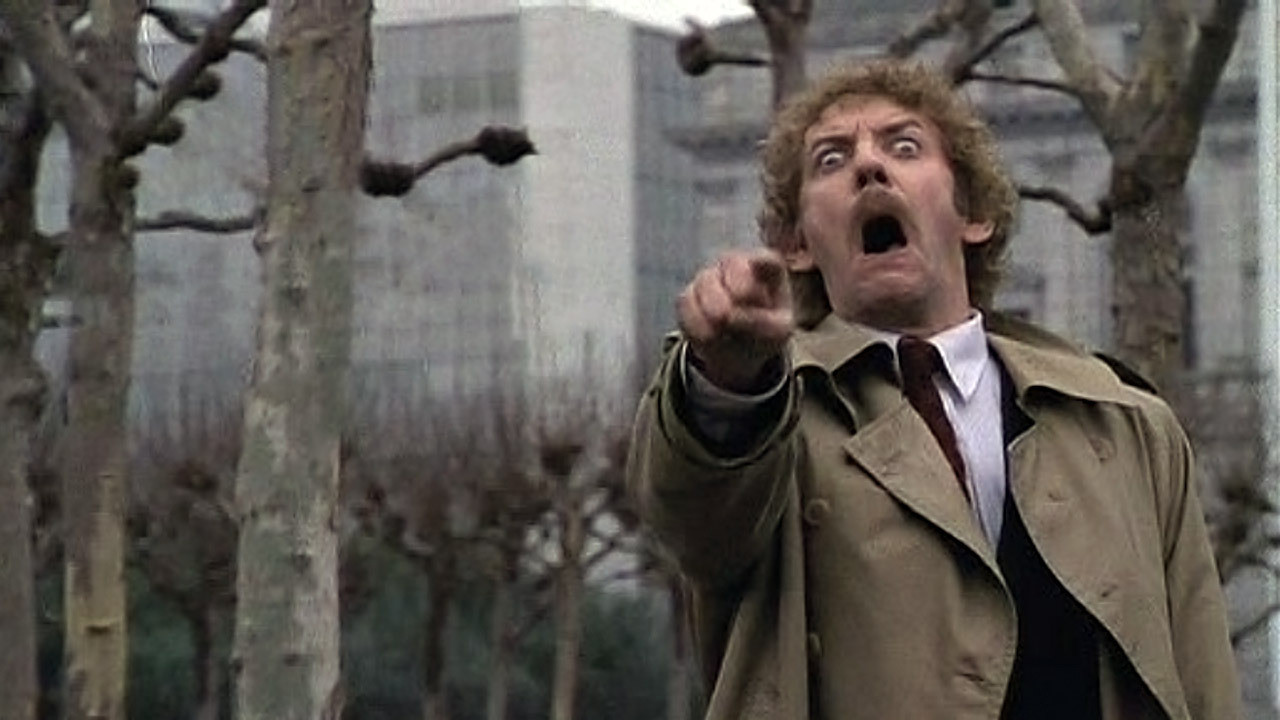
In 1978, there was science fiction/horror movie called “Invasion of the Body Snatchers.” It became a huge hit. Malignant narcissists and psychopaths are real life body snatchers. Your continued association with one of these creatures is dangerous because they can infect you with their evil and your soul can be lost, just like the harpie-like body snatchers that retained only their human physique in the movie.

body_snatcher

I’ll come to you like an affliction
And I’ll leave you like an addiction
You’ll never forget me
You wanna know why?

A relationship with a psychopathic malignant narcissist is an affliction, even if at first it feels like the greatest thing ever. Even after they have nearly destroyed you with their abuse, you may still believe you need your narcissist and feel lost without them. That’s the way they want you–helpless and adrift. That’s because having you that way makes it easier for them to hoover you back in later on with love bombing and fake apologies, or if they are very sadistic and have no intention of returning, it makes them happy to see you alone and miserable without them.

Cause I’m a liar
Yeah I’m a liar
I’ll rip your mind out
I’ll burn your soul
I’ll turn you into me
Cause I’m a liar, a liar
Liar, liar, liar, liar

I don’t know why I feel the need to lie
And cause you so much pain
Maybe it’s something inside
Maybe it’s something I can’t explain
Cause all I do
Is mess you up and lie to you
I’m a liar
Oh, I am a liar

They may know there’s something very wrong with their minds and souls, but they don’t care. They know they’re messing with your mind but again, they don’t care.

If you’ll give me one more chance
I swear that I will never lie to you again
Because now I see the destructive power of a lie
They’re stronger than truth
I can’t believe I ever hurt you
I swear
I will never to you lie again, please
Just give me one more chance
I will never lie to you again
I swear
That I will never tell a lie
I will never tell a lie
No, no

henry_rollins4

The psychopathic malignant narc is using fake apologies, lies and love bombing in their attempt to hoover you, their mark, back in for more abuse.

Ha ha ha ha ha hah haa haa haa haaa
Sucker
Sucker!
Oh, sucker
I am a liar
Yeah, I am a liar
Yeah I like it
I feel good
Ohh I am a liar
Yeah
I lie
I lie
I lie
Oh, I lie
Oh I lie
I lie
Yeah
Ohhh I’m a liar
I lie
Yeah
I like it
I feel good
I’ll lie again
And again
I’ll lie again and again
And I’ll keep lying

henry_rollins3

They love doing what they do because it makes them feel powerful and in control. Their “fix” of abusing you makes them feel good. There is no intention on their part to change because it’s you who suffers, not them.

I promise.

Probably the only promise they’ll ever keep.

Robert Durst disgusting excuse

I agree with Gale how outrageous this is. This man is a psychopathic murderer who is using ASPERGERS as an excuse to get away with his heinous acts. Not only is he a raging liar, by using Aspergers as his excuse, he is giving that disorder a bad reputation (it’s already bad enough that Aspies have are erroneously accused of having no empathy just because we don’t always express it as well as a neurotypical). Of course there will be those who will believe him. This murderer is no Aspie–he is a raging, dangerous, evil PSYCHOPATH.

Gale A. Molinari's avatargalesmind

robert-durst-allegedly-exposes

Last night I was appalled to see that this murderer’s lawyer is going to use the same excuse that got this murder off last time. ASPERGERS! This is really outrageous.

http://www.cbsnews.com/news/48-hours-presents-robert-durst-the-bizarre-saga/

http://wrongplanet.net/robert-durst-and-murder-in-galveston-texas/

Robert Durst is about to get away with more murders. Using the badly understood condition known as Aspergers. This is a terrible precedent to set. How is the fact that he has Aspergers affect the fact that he murdered a man, cut him in pieces and tossed him in the water. Then he went on the lam. Now with this new arrest his lawyer is claiming the producers of the program where he admits while talking to himself and miked that he “killed them all”.  He has withdrawn cash in small bills, put them in several envelopes ready to mail. He had his passport and other documents and was reported to be planning to flee to Cuba.

These…

View original post 127 more words

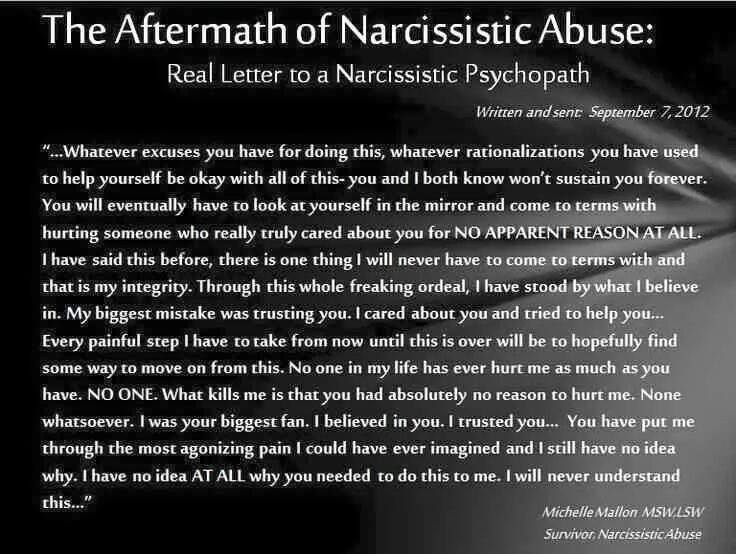
After narcissistic abuse.

Image

after_narc_abuse
Click to enlarge.

ETA: Here is an essay by Michelle Mallon, who wrote this letter. I’m not entirely sure, but I think the psychopathic therapist she writes about here may be the person she wrote this letter to.
http://www.naswoh.org/?page=mallon

It’s prudent to be careful who we choose as a therapist. So many of them are narcissistic or even psychopathic. They’re drawn to the field of psychotherapy because it allows them plenty of narcissistic supply and the opportunity to hurt vulnerable people. In a professional setting, it’s hard to see the red flags, especially if the therapist seems sympathetic.

If you begin to feel used, gaslighted or abused in any way by your therapist, or just feel uncomfortable around them, LEAVE.

Video: A Brief History of Psychopaths and Antisocials

Sam Vaknin posted a new video yesterday, “The Morally Insane Psychopath: A Brief History of Psychopaths and Antisocials.” I decided to repost it on this blog because it’s such a fascinating subject that isn’t widely known or easy to find information about in one place. I never really looked into the history of the field of psychopathy and narcissism before, and whether or not you agree with Sam and his views about narcissism (or are on the fence like I am), Mr. Vaknin does have encyclopedic knowledge about this field of psychology.

So much has changed!

Sam looks like he’s lost weight.

My daughter’s sociopathic ex isn’t done with her yet.

audacity
Credit: Universal Republic Records.

Remember Paul, the psychopath who gave such a great impression but was actually a crackhead who was abusing my daughter while she was living with him? The one who gaslighted her and told me horrible lies about her smoking meth and shooting heroin (when she wasn’t doing any such thing) during their short relationship over November and December? The one who actually turned me into his flying monkey until I realized what this character was really up to?

Well, guess what. My daughter got a summons to appear in court about the “door she broke” (when he slammed her into it when she tried to leave) and the “money she stole” (the settlement money my DAUGHTER got for her car accident that I was foolish and trusting enough to let HIM hold onto for her because I didn’t trust HER).

I would laugh if it wasn’t so crazymaking for both of us. What a loser.

“The Con Man Cometh”

I found a short story from Sam Vaknin’s website, that really may not be that fictional. Fiction often says more about the writer of a story than even confessional nonfiction. This story, really a monologue to a hypothetical “mark,” seems as if it could be a look inside Sam’s motives for writing about narcissism and running forums and online groups for its victims. I think it speaks for itself.

Yes, Sam could be conning us all, and most likely is, but frankly I don’t care and never will. His words, regardless of his true motives, have helped me and other victims of narcissistic abuse, and his writing, as always, is hauntingly poetic.

His eloquent words provide a searingly vivid look inside the mind of malignant narcissist who may also be psychopathic. It helps us to know the way they think. It’s prudent to be very careful not to engage directly with even an insightful, intelligent narcissist as they too are dangerous. But if you keep your distance they can teach you something.

The Con Man Cometh

con_man
Image of Abhishek Bachchan (Bollywood actor) from Apunkchoice.com

Swathed in luminosity, we stir with measured competence our amber drinks in long-stemmed glasses. You are weighing my offer and I am waiting for your answer with hushed endurance. The armchairs are soft, the lobby is luxurious, as befits five-star hotels. I am not tense. I have anticipated your response even before I made my move.

Soon, temples sheathed in perspiration, you use the outfit’s thick paper napkins to wipe it off. Loosen your tie. Pretend to be immersed in calculations. You express strident dissatisfaction and I feign recoil, as though intimidated by your loudness. Withdrawing to my second line of defense, I surrender to your simulated wrath.

The signs are here, the gestures, the infinitesimal movements that you cannot control. I lurk. I know that definite look, that imperceptible twitch, the inevitability of your surrender.

I am a con man and you are my victim. The swindle is unfolding here and now, in this very atrium, amid all the extravagance. I am selling your soul and collecting the change. I am sharpened, like a raw nerve firing impulses to you, receiving yours, an electrical-chemical dialog, consisting of your smelly sweat, my scented exudation. I permeate your cracks. I broker an alliance with your fears, your pains, defense compensatory mechanisms.

I know you.

I’ve got to meld us into one. As dusk gives way to night, you trust me as you do yourself, for now I am nothing less than you. Having adopted your particular gesticulation, I nod approvingly with every mention of your family. You do not like me. You sense the danger. Your nostrils flare. Your eyes amok. Your hands so restless. You know me for a bilker, you realize I’ll break your heart. I know you comprehend we both are choiceless.

It’s not about money. Emotions are at stake. I share your depths of loneliness and pain. Sitting opposed, I see the child in you, the adolescent. I discern the pleading sparkle in your eyes, your shoulders stooping in the very second you’ve decided to succumb. I am hurting for what I do to you. My only consolation is the inexorability of nature – mine and yours, this world’s (in which we find ourselves and not of our choice). Still, we are here, you know.

I empathize with you without speech or motion. Your solitary sadness, the anguish, and your fears. I am your only friend, monopolist of your invisible cries, your inner hemorrhage of salty tears, the tissued scar that has become your being. Like me, the product of uncounted blows (which you sometimes crave).

Being abused is being understood, having some meaning, forming a narrative. Without it, your life is nothing but an anecdotal stream of randomness. I deal the final, overwhelming coup-de-grace that will transform the torn sheets of your biography into a plot. It isn’t everyday one meets a cheat. Such confident encounters can render everything explained. Don’t give it up. It is a gift of life, not to be frivolously dispensed with. It is a test of worthiness.

I think you qualify and I am the structure and the target you’ve been searching for and here I am.

Now we are bound by money and by blood. In our common veins flows the same alliance that dilates our pupils. We hail from one beginning. We separated only to unite, at once, in this hotel, this late, and you exclaim: “I need to trust you like I do not trust a soul”. You beseech me not to betray your faith. Perhaps not so explicitly, but both your eyes are moist, reflecting your vulnerability.

I gravely radiate my utter guarantee of splendid outcomes. No hint of treason here. Concurrently I am plotting your emotional demise. At your request, not mine. It is an act of amity, to rid you of the very cause of your infirmity. I am the instrument of your delivery and liberation. I will deprive you of your ability to feel, to trust, and to believe. When we diverge, I will have molded you anew – much less susceptible, much more immune, the essence of resilience.

It is my gift to you and you are surely grateful in advance. Thus, when you demand my fealty, you say: “Do not forget our verbal understanding”.

And when I vow my loyalty, I answer: “I shall not forget to stab you in the back.”

And now, to the transaction. I study you. I train you to ignore my presence and argue with yourself with the utmost sincerity. I teach you not to resent your weaknesses.

So, you admit to them and I record all your confessions to be used against you to your benefit. Denuded of defenses, I leave you wounded by embezzlement, a cold, contemptible exposure. And, in the meantime, it’s only warmth and safety, the intimacy of empathy, the propinquity of mutual understanding.

I only ask of you one thing: the fullest trust, a willingness to yield. I remember having seen the following in an art house movie, it was a test: to fall, spread-eagled from a high embankment and to believe that I am there to catch you and break your lethal plunge.

I am telling you I’ll be there, yet you know I won’t. Your caving in is none of my concern. I only undertook to bring you to the brink and I fulfilled this promise. It’s up to you to climb it, it’s up to you to tumble. I must not halt your crash, you have to recompose. It is my contribution to the transformation that metastasized in you long before we met.

But you are not yet at the stage of internalizing these veracities. You still naively link feigned geniality to constancy, intimacy and confidence in me and in my deeds, proximity and full disclosure. You are so terrified and mutilated, you come devalued. You cost me merely a whiskey tumbler and a compendium of ordinary words. One tear enough to alter your allegiances. You are malleable to the point of having no identity.

You crave my touch and my affection. I crave your information and unbridled faith. “Here is my friendship and my caring, my tenderness and amity, here is a hug. I am your parent and your shrink, your buddy and your family.” – so go the words of this inaudible dialog – “Give me your utter, blind, trust but limit it to one point only: your money or your life.”

I need to know about your funds, the riddles of your boardroom, commercial secrets, your skeletons, some intimate detail, a fear, resurgent hatred, the envy that consumes. I don’t presume to be your confidant. Our sharing is confined to the pecuniary. I lull you into the relief that comes with much reduced demands. But you are an experienced businessman! You surely recognize my tactics and employ them, too!

Still, you are both seduced and tempted, though on condition of maintaining “independent thinking”. Well, almost independent. There is a tiny crack in your cerebral armor and I am there to thrust right through it. I am ready to habituate you. “I am in full control” – you’d say – “So, where’s the threat?” And, truly, there is none.

There’s only certainty. The certitude I offer you throughout our game. Sometimes I even venture: “I am a crook to be avoided”. You listen with your occidental manners, head tilted obliquely, and when I am finished warning you, you say: “But where the danger lies? My trust in you is limited!” Indeed – but it is there!

I lurk, awaiting your capitulation, inhabiting the margins, the twilight zone twixt greed and paranoia. I am a viral premonition, invading avaricious membranes, preaching a gospel of death and resurrection. Your death, your rising from the dead. Assuming the contours of my host, I abandon you deformed in dissolution.

There’s no respite, not even for a day. You are addicted to my nagging, to my penetrating gaze, instinctive sympathy, you’re haunted. I don’t let go. You are engulfed, cocooned, I am a soul mate of eerie insight, unselfish acumen. I vitiate myself for your minutest needs. I thrive on servitude. I leave no doubt that my self-love is exceeded only by my love for you.

I am useful and you are a user. I am available and you avail yourself. But haven’t you heard that there are no free lunches? My restaurant is classy, the prices most exorbitant, the invoices accumulate with every smile, with every word of reassurance, with every anxious inquiry as to your health, with every sacrifice I make, however insubstantial.

I keep accounts in my unstated books and you rely on me for every double entry. The voices I instill in you: “He gives so of himself though largely unrewarded”. You feel ashamed, compelled to compensate. A seed of Trojan guilt. I harp on it by mentioning others who deprived me. I count on you to do the rest. There’s nothing more potent than egotistic love combined with raging culpability. You are mine to do with as I wish, it is your wish that I embody and possess.

The vise is tightened. Now it’s time to ponder whether to feed on you at once or scavenge. You are already dying and in your mental carcass I am grown, an alien. Invoking your immunity, as I am wont to do, will further make you ill and conflict will erupt between your white cells and your black, the twin abodes of your awakened feelings.

You hope against all odds that I am a soul-mate. How does it feel, the solitude? Few days with me – and you cannot recall! But I cannot remember how it feels to be together. I cannot waive my loneliness, my staunch companion. When I am with you, it prospers. And you must pay for that.

I have no choice but to abscond with your possessions, lest I remain bereft. With utmost ethics, I keep you well-informed of these dynamics and you acknowledge my fragility which makes you desirous to salve my wounds.

But I maintain the benefit of your surprise, the flowing motion. Always at an advantage over you, the interchangeable. I, on the other hand, cannot be replaced, as far as you’re concerned. You are a loyal subject of your psychic state while I am a denizen of the eternal hunting grounds. No limits there, nor boundaries, only the nostrils quivering at the game, the surging musculature, the body fluids, the scent of decadence.

Sometime, the prey becomes the predator, but only for a while. Admittedly, it’s possible and you might turn the tables. But you don’t want to. You crave so to be hunted. The orgiastic moment of my proverbial bullets penetrating willing flesh, the rape, the violation, the metaphoric blood and love, you are no longer satisfied with compromises.

You want to die having experienced this eruption once. For what is life without such infringement if not mere ripening concluding in decay. What sets us, Man, apart from beast is our ability to self-deceive and swindle others. The rogue’s advantage over quarry is his capacity to have his lies transmuted till you believe them true.

I trek the unpaved pathways between my truth and your delusions. What am I, fiend or angel? A weak, disintegrating apparition – or a triumphant growth? I am devoid of conscience in my own reflection. It is a cause for mirth. My complex is binary: to fight or flight, I’m well or ill, it should have been this way or I was led astray.

I am the blinding murkiness that never sets, not even when I sleep. It overwhelms me, too, but also renders me farsighted. It taught me my survival: strike ere you are struck, abandon ere you’re trashed, control ere you are subjugated.

So what do you say to it now? I told you everything and haven’t said a word. You knew it all before. You grasp how dire my need is for your blood, your hurt, the traumatic coma that will follow. They say one’s death bequeaths another’s life. It is the most profound destination, to will existence to your pining duplicate.

I am plump and short, my face is uncontrived and smiling. When I am serious, I am told, I am like a battered and deserted child and this provokes in you an ancient cuddling instinct. When I am proximate, your body and your soul are unrestrained. I watch you kindly and the artificial lighting of this magnific vestibule bounces off my glasses.

My eyes are cradled in blackened pouches of withered skin. I draw your gaze by sighing sadly and rubbing them with weary hands. You incline our body, gulp the piquant libation, and sign the document. Then, leaning back, you shut exhausted eyes. There is no doubt: you realize your error.

It’s not too late. The document lies there, it’s ready for the tearing. But you refrain. You will not do it.

“Another drink?” – You ask

I smile, my chubby cheeks and wire glasses sparkle.

“No, thanks” – I say.

Sociopath vs. psychopath: is there a difference?

psychopathy

I’ve been using the terms psychopath and sociopath interchangeably on this blog, even though I’m aware there are differences between the two. I was curious enough to Google what the difference is, and came across an article in Psychology Today that explains how they are alike–and how they differ.

How to Tell a Sociopath from a Psychopath
By Dr. Scott Bonn

Many forensic psychologists, psychiatrists and criminologists use the terms sociopathy and psychopathy interchangeably. Leading experts disagree on whether there are meaningful differences between the two conditions. I contend that there are clear and significant distinctions between them.

The fifth edition of the Diagnostic and Statistical Manual of Mental Disorders (DSM-5), released by the American Psychiatric Association in 2013, lists both sociopathy and psychopathy under the heading of Antisocial Personality Disorders (ASPD). These disorders share many common behavioral traits which lead to the confusion between them. Key traits that sociopaths and psychopaths share include:

A disregard for laws and social mores
A disregard for the rights of others
A failure to feel remorse or guilt
A tendency to display violent behavior
In addition to their commonalities, sociopaths and psychopaths also have their own unique behavioral characteristics, as well.

Sociopaths tend to be nervous and easily agitated. They are volatile and prone to emotional outbursts, including fits of rage. They are likely to be uneducated and live on the fringes of society, unable to hold down a steady job or stay in one place for very long. It is difficult but not impossible for sociopaths to form attachments with others. Many sociopaths are able to form an attachment to a particular individual or group, although they have no regard for society in general or its rules. In the eyes of others, sociopaths will appear to be very disturbed. Any crimes committed by a sociopath, including murder, will tend to be haphazard, disorganized and spontaneous rather than planned.

Psychopaths, on the other hand, are unable to form emotional attachments or feel real empathy with others, although they often have disarming or even charming personalities. Psychopaths are very manipulative and can easily gain people’s trust. They learn to mimic emotions, despite their inability to actually feel them, and will appear normal to unsuspecting people. Psychopaths are often well educated and hold steady jobs. Some are so good at manipulation and mimicry that they have families and other long-term relationships without those around them ever suspecting their true nature.

When committing crimes, psychopaths carefully plan out every detail in advance and often have contingency plans in place. Unlike their sociopathic counterparts, psychopathic criminals are cool, calm, and meticulous. Their crimes, whether violent or non-violent, will be highly organized and generally offer few clues for authorities to pursue. Intelligent psychopaths make excellent white-collar criminals and “con artists” due to their calm and charismatic natures.

The cause of psychopathy is different than the cause of sociopathy (1). It is believed that psychopathy is the result of “nature” (genetics) while sociopathy is the result of “nurture” (environment). Psychopathy is related to a physiological defect that results in the underdevelopment of the part of the brain responsible for impulse control and emotions. Sociopathy, on the other hand, is more likely the product of childhood trauma and physical/emotional abuse. Because sociopathy appears to be learned rather than innate, sociopaths are capable of empathy in certain limited circumstances but not in others, and with a few individuals but not others.

Psychopathy is the most dangerous of all antisocial personality disorders because of the way psychopaths dissociate emotionally from their actions, regardless of how terible they may be. Many prolific and notorious serial killers, including the late Ted Bundy and John Wayne Gacy, and Dennis Rader (“Bind, Torture, Kill” or BTK) are unremorseful psychopaths. Psychopathic killers view their innocent victims as inhuman objects to be tormented and violated for their amusement.

Contrary to popular mythology, most serial killers are not mentally ill or “evil” geniuses. See my related article: http://www.psychologytoday.com/blog/wicked-deeds/201406/serial-killer-myth-1-theyre-mentally-ill-or-evil-geniuses

tedbundy ed_gein
Although both were deadly serial killers, Ted Bundy was a psychopath who gave a good impression and knew how not to get caught; Ed Gein was most likely a sociopath who acted more impulsively, was more disorganized and didn’t give a very good first impression. Though both men’s crimes were equally heinous, Bundy’s eyes seem “colder” than Gein’s.

Although the traits of a psychopath more closely resemble those of a person with Narcissistic Personality Disorder (NPD) than those of the more impulsive, disorganized sociopath, both are actually described here as variations of ASPD, not NPD. Once again, if ASPD is really “NPD on crack” then it follows that NPD and ASPD are both on the same spectrum, with ASPD (and psychopathy/sociopathy) at the top of the spectrum. If this is in fact the case, people with NPD, even malignant narcissists, may border on psychopathy, but would not actually qualify as true psychopaths.

Here’s a little graph I devised to illustrate where all the Cluster B disorders may fall on a spectrum. These are just my guesses and are not based on psychological research, just my instinct and gut feelings.

psychopathy_graph
Click image to enlarge.

Is antisocial personality disorder really NPD on crack?

I have to admit I’ve been confused by the distinctions between the Cluster B personality disorders, especially those of NPD and ASPD. There seems to be little distinction in most literature between NPD and ASPD (antisocial personality disorder) with most experts saying the difference is just a matter of degree, with ASPD (psychopathy or sociopathy) being higher on the spectrum than NPD.

Let’s turn to the Bible of mental disorders for some clarification. These are from the DSM IV-TR, but have apparently been updated, because these descriptions are all labeled obsolete. But for our purposes, I’ll stick with these criteria.

Diagnostic criteria for 301.81 Narcissistic Personality Disorder

Handsome narcissistic young man looking in a mirror

A pervasive pattern of grandiosity (in fantasy or behavior), need for admiration, and lack of empathy, beginning by early adulthood and present in a variety of contexts, as indicated by five (or more) of the following:

(1) has a grandiose sense of self-importance (e.g., exaggerates achievements and talents, expects to be recognized as superior without commensurate achievements)

(2) is preoccupied with fantasies of unlimited success, power, brilliance, beauty, or ideal love

(3) believes that he or she is “special” and unique and can only be understood by, or should associate with, other special or high-status people (or institutions)

(4) requires excessive admiration

(5) has a sense of entitlement, i.e., unreasonable expectations of especially favorable treatment or automatic compliance with his or her expectations

(6) is interpersonally exploitative, i.e., takes advantage of others to achieve his or her own ends

(7) lacks empathy: is unwilling to recognize or identify with the feelings and needs of others

(8) is often envious of others or believes that others are envious of him or her

(9) shows arrogant, haughty behaviors or attitudes

Diagnostic criteria for 301.7 Antisocial Personality Disorder

antisocial_personality

A. There is a pervasive pattern of disregard for and violation of the rights of others occurring since age 15 years, as indicated by three (or more) of the following:

(1) failure to conform to social norms with respect to lawful behaviors as indicated by repeatedly performing acts that are grounds for arrest
(2) deceitfulness, as indicated by repeated lying, use of aliases, or conning others for personal profit or pleasure
(3) impulsivity or failure to plan ahead
(4) irritability and aggressiveness, as indicated by repeated physical fights or assaults
(5) reckless disregard for safety of self or others
(6) consistent irresponsibility, as indicated by repeated failure to sustain consistent work behavior or honor financial obligations
(7) lack of remorse, as indicated by being indifferent to or rationalizing having hurt, mistreated, or stolen from another

B. The individual is at least age 18 years.

C. There is evidence of Conduct Disorder with onset before age 15 years.

D. The occurrence of antisocial behavior is not exclusively during the course ofSchizophrenia or a Manic Episode.

Just for comparison’s sake, let’s include the (obsolete) criteria for the other two Cluster B disorders: BPD (Borderline Personality Disorder) and HPD (Histrionic Personality Disorder):

Diagnostic criteria for 301.83 Borderline Personality Disorder

borderline

A pervasive pattern of instability of interpersonal relationships, self-image, and affects, and marked impulsivity beginning by early adulthood and present in a variety of contexts, as indicated by five (or more) of the following:

(1) frantic efforts to avoid real or imagined abandonment.
Note: Do not include suicidal or self-mutilating behavior covered in Criterion 5.

(2) a pattern of unstable and intense interpersonal relationships characterized by alternating between extremes of idealization and devaluation

(3) identity disturbance: markedly and persistently unstable self-image or sense of self

(4) impulsivity in at least two areas that are potentially self-damaging (e.g., spending, sex, Substance Abuse, reckless driving, binge eating).
Note: Do not include suicidal or self-mutilating behavior covered in Criterion 5.

(5) recurrent suicidal behavior, gestures, or threats, or self-mutilating behavior

(6) affective instability due to a marked reactivity of mood (e.g., intense episodic dysphoria, irritability, or anxiety usually lasting a few hours and only rarely more than a few days)

(7) chronic feelings of emptiness

(8) inappropriate, intense anger or difficulty controlling anger (e.g., frequent displays of temper, constant anger, recurrent physical fights)

(9) transient, stress-related paranoid ideation or severe dissociative symptoms

Diagnostic criteria for 301.50 Histrionic Personality Disorder

histrionic_personality

A pervasive pattern of excessive emotionality and attention seeking, beginning by early adulthood and present in a variety of contexts, as indicated by five (or more) of the following:

(1) is uncomfortable in situations in which he or she is not the center of attention

(2) interaction with others is often characterized by inappropriate sexually seductive or provocative behavior

(3) displays rapidly shifting and shallow expression of emotions

(4) consistently uses physical appearance to draw attention to self

(5) has a style of speech that is excessively impressionistic and lacking in detail

(6) shows self-dramatization, theatricality, and exaggerated expression of emotion

(7) is suggestible, i.e., easily influenced by others or circumstances

(8) considers relationships to be more intimate than they actually are

It does seem that ASPD is more linked to criminality than NPD, most likely due to poor impulse control, which isn’t a problem in people with NPD. People with ASPD are more willing to break the law and are more likely to be in prison. They are less likely to be concerned with image or consequences of their actions (most people with NPD want to maintain their sqeaky clean image which means staying out of prison). Antisocials also seem more prone to violent behavior.

The DSM criteria for ASPD seem to describe psychopathy/sociopathy. Most narcissists are probably not psychopaths, but are on the same spectrum. Does this mean that ASPD and NPD should really be considered the same disorder, with ASPD higher on the psychopathy spectrum?

BPD is more clearly distinguishable from ASPD and NPD because a person suffering from this disorder does have a conscience and can feel empathy and remorse, but like someone with ASPD they have problems with impulse control. Also, their motives for doing what they do are different: they fear abandonment, while people with ASPD and NPD fear their true self being exposed.

HPD seems very similar to the somatic form of narcissism and includes many narcissistic traits. However, it seems that someone with HPD would be more prone to drama, neediness and tantrum throwing (although these traits aren’t unknown in narcissists). Like BPD, the motives for the sufferer’s behavior seem based on insecurity and fear of abandonment rather than the need to maintain a false front.

NPD and ASPD are more common in males than females, and HPD and BPD are more common in females than males. Does gender determine what disorder a child is more likely to develop later in life? Are BPD and HPD really the “female” forms of the other two disorders?

ASPD almost seems like an exaggeration of typically male traits–aggressiveness, lack of emotion (except rage), and risk taking; whilst HPD seems like an exaggeration of typically female traits — excessive emotionality, preoccupation with beauty/sexiness, and excessive neediness. BPD and NPD are somewhere in between these two and can include elements of both: ASPD –> NPD –> BPD –> HPD

The fact that the American Psychiatric Association keeps changing their criteria just makes things even more confusing.

Malignant narcissism in fairy tales.

Children are educated about malignant narcissism and psychopathy at an early age through seemingly innocent fairy tales. A large percentage of them are really tales of jealousy, envy, pride, vanity and greed. The evil intentioned villains are usually in a parental or caregiving role, and the young heroes who draw the abuse and wrath of the villain must find a way to survive–which means either escape or destruction/disempowerment of the villain.

The plot descriptions for the first four are all from Wikipedia.

Cinderella

cinderella

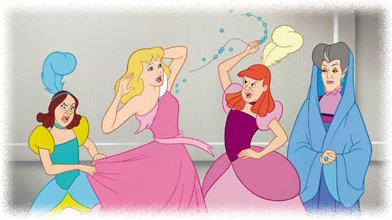
There are many different versions of this famous story; this is one of the most famous. In this tale, the malignant narcissist is Cinderella’s envious stepmother and her two stepsisters. Cinderella is clearly the Scapegoat Child, and her stepsisters the Golden Children.

A wealthy gentleman’s wife lay on her deathbed, and called her only daughter to her bedside. She asked her to remain good and kind, and told her that God would protect her. She then died and was buried. A year went by and the widower married another woman, who had two daughters of her own. They had beautiful faces and fair skin, but their hearts were cruel and wicked. The stepsisters stole the girl’s fine clothes and jewels and forced her to wear rags. They banished her into the kitchen to do the worst chores, and gave her the nickname “Aschenputtel” (“Ashfool”.) Despite all of this the girl remained good and kind, and would always go to her mother’s grave to cry and pray to God that she would see her circumstances improve.

One day, the gentleman visited a fair, promising his stepdaughters gifts of luxury. The eldest asked for beautiful dresses, while the younger for pearls and diamonds. His own daughter merely asked for the first twig to knock his hat off on the way. The gentleman went on his way, and acquires presents for his stepdaughters. While passing a forest he got a hazel twig, and gave it to his daughter. She planted the twig over her mother’s grave, watered it with her tears and over the years, it grew into a glowing hazel tree. The girl would pray under it three times a day, and a white bird would always come to comfort her.

The king decided to give a festival that would last for three whole days and nights, and invited all the beautiful maidens in the land to attend so that the prince could select one of them as his bride. The two sisters were also invited, but when Aschenputtel begged them to allow her to go with them into the celebration, the stepmother refused because she had no dress nor shoes to wear. When the girl insisted, the woman threw a dish of lentils into the ashes for her to pick up, guaranteeing her permission to attend the festival, and when the girl accomplished the task in less than an hour with the help of two white doves sent by her mother from Heaven, the stepmother only redoubled the task and threw down even a greater quantity of lentils. When Aschenputtel was able to accomplish it in a greater speed, not wanting to spoil her daughters’ chances, the stepmother hastened away with them to the ball and left the crying stepdaughter behind.

The girl retreated to the graveyard to ask for help. The white bird dropped a white gown and silk shoes. She went to the ball, with the warning that she must leave before midnight. The prince danced with her, but she eluded him before midnight struck. The next evening, the girl appeared in a much grander gown of silver and glass shoes. The prince fell in love with her and danced with her for the whole evening, but when midnight came, she left again. The third evening, she appeared dressed in spun gold with slippers of gold. Now the prince was determined to keep her, and had the entire stairway smeared with pitch. Aschenputtel lost track of time, and when she ran away one of her golden slippers got stuck on that pitch. The prince proclaimed that he would marry the maiden whose foot would fit the golden slipper.

The next morning, the prince went to Aschenputtel’s house and tried the slipper on the eldest stepsister. The sister was advised by her mother to cut off her toes in order to fit the slipper. While riding with the stepsister, the two doves from Heaven told the Prince that blood dripped from her foot. Appalled by her treachery, he went back again and tried the slipper on the other stepsister. She cut off part of her heel in order to get her foot in the slipper, and again the prince was fooled. While riding with her to the king’s castle, the doves alerted him again about the blood on her foot. He came back to inquire about another girl. The gentleman told him that they kept a kitchen-maid in the house – omitting to mention that she was his own daughter – and the prince asked him to let her try on the slipper. The girl appeared after washing herself, and when she put on the slipper, the prince recognized her as the stranger with whom he had danced at the ball.

In the end, during Aschenputtel’s wedding, as she was walking down the aisle with her stepsisters as her bridesmaids, (they had hoped to worm their way into her favour), the doves from Heaven flew down and struck the two stepsisters’ eyes, one in the left and the other in the right. When the wedding came to an end, and Aschenputtel and her prince marched out of the church, the doves flew again, striking the remaining eyes of the two evil sisters blind, a punishment they had to endure for the rest of their lives.

Snow White

snow_white

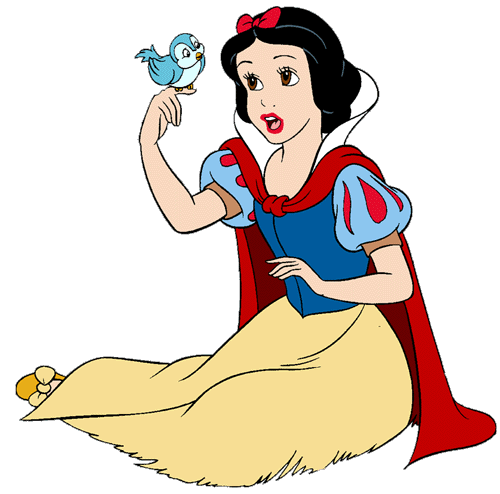
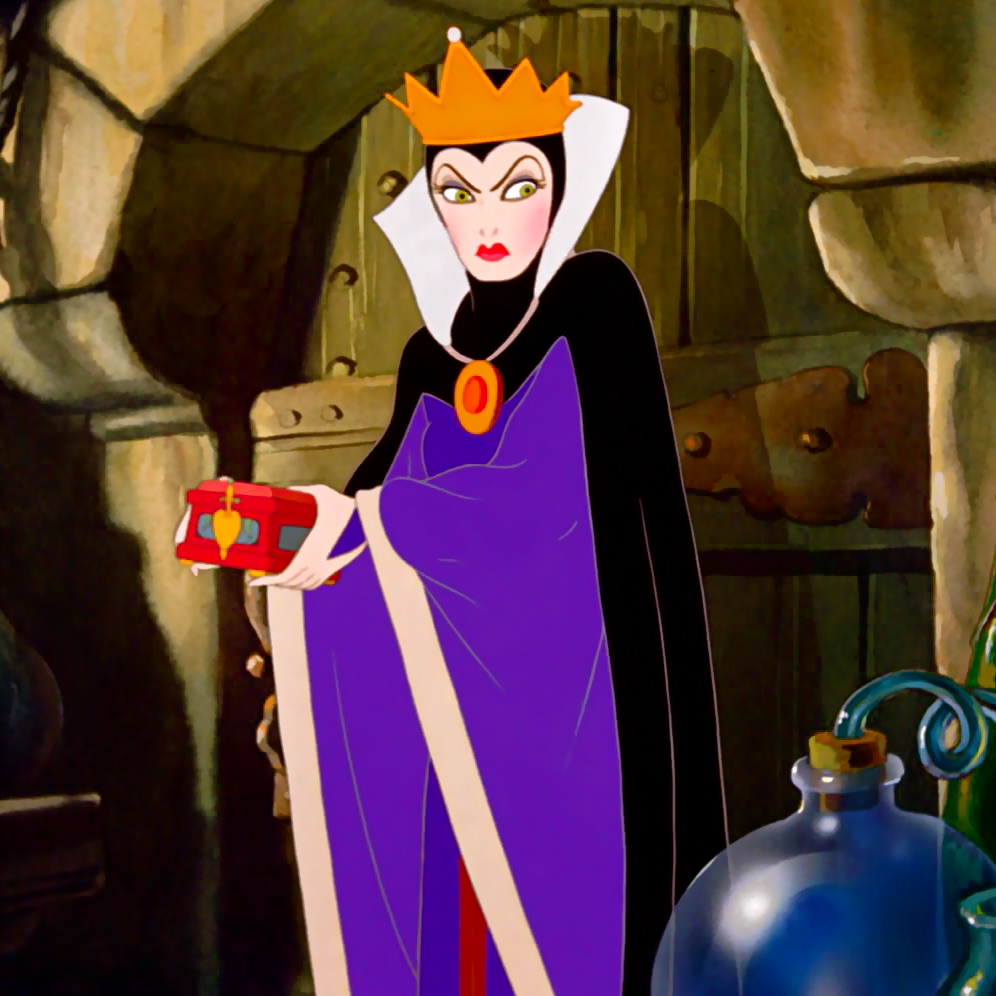
In this tale, the malignant narcissist is Snow White’s pathologically envious and vain stepmother.

At the beginning of the story, a queen sits sewing at an open window during a winter snowfall when she pricks her finger with her needle, causing three drops of red blood to drip onto the freshly fallen white snow on the black windowsill. Admiring the beauty of the resulting color combination, she says to herself, “Oh how I wish that I had a daughter that had skin as white as snow, lips as red as blood, and hair as black as ebony”. Soon after that, the Queen gives birth to a baby girl who is as white as snow, has lips red as blood and has hair as black as ebony. They name her ‘Snow White’, but sadly, the Queen dies after giving birth to her.

After a year has passed, the King takes a new wife, who is beautiful but also unutterably wicked and vain. The new queen possesses a magic mirror, which she asks every morning, “Magic mirror in my hand, who is the fairest in the land?” The mirror always replies, “My queen, you are the fairest in the land.” The Queen is always pleased with that because the magic mirror never lies. But when Snow White reaches the age of seven, she becomes more beautiful each day and even more beautiful than the Queen, and when the Queen asks her mirror, it responds, “My queen, you are the fairest here so true. But Snow White is a thousand times more beautiful than you”.

This gives the queen a great shock. She becomes yellow and green with envy and from that hour on, her heart turns against Snow White, and she hates her more and more each day. Envy and pride, like ill weeds, grow in her heart taller every day, until she has no peace day or night. Eventually, the Queen orders a huntsman to take Snow White into the deepest woods to be killed. As proof that Snow White is dead, the Queen demands that he return with her lungs and liver. The huntsman takes Snow White into the forest. After raising his knife, he finds himself unable to kill her as she sobs heavily and begs him; “Oh, dear huntsman, don’t kill me! Leave me with my life; I will run into the forest and never come back!” The huntsman leaves her behind alive, convinced that the girl would be eaten by some wild animal. He instead brings the Queen the lungs and liver of a young boar, which is prepared by the cook and eaten by the Queen.

After wandering through the forest for days, Snow White discovers a tiny cottage belonging to a group of seven dwarfs. Since no one is at home, she eats some of the tiny meals, drinks some of their wine and then tests all the beds. Finally the last bed is comfortable enough for her and she falls asleep. When the seven dwarfs return home, they immediately become aware that someone sneaked in secretly, because everything in their home is in disorder. During their loud discussion about who sneaked in, they discover the sleeping Snow White. The girl wakes up and explains to them what happened and the dwarfs take pity on her, saying; “If you will keep house for us, and cook, make beds, wash, sew, and knit, and keep everything clean and orderly, then you can stay with us, and you shall have everything that you want.” They warn her to be careful when alone at home and to let no one in when they are away delving in the mountains.

evil_queen

Meanwhile, the Queen asks her mirror once again; “Magic mirror in my hand, who is the fairest in the land?” The mirror replies; “My queen, you are the fairest here so true. But Snow White beyond the mountains at the seven dwarfs is a thousand times more beautiful than you”.[1] The Queen is horrified to learn that the huntsman has betrayed her and that Snow White is still alive. She keeps thinking about how to get rid of Snow White, then she disguises herself as an old peddler. The Queen then walks to the cottage of the dwarfs and offers her colorful, silky laced bodices and convinces the girl to take the most beautiful bodice as a present. Then the Queen laces it so tightly that Snow White faints, causing the Queen to leave her for dead. But the dwarfs return just in time, and Snow White revives when the dwarfs loosen the laces.

The next morning the Queen consults her mirror anew and the mirror reveals Snow White’s survival. Now infuriated, the Queen dresses as a comb seller and convinces Snow White to take a beautiful comb as a present. She brushes Snow White’s hair with a poisoned comb, and the girl faints again, but she is again revived by the dwarfs. And the next morning the mirror tells the Queen that Snow White is still “a thousand times more beautiful”. Now the Queen nearly has a heart attack in shock and rage. As a third and last attempt to rid herself of Snow White, she secretly consults the darkest magic and makes a poisoned apple, and in the disguise of a farmer’s wife, she offers it to Snow White. The girl is at first hesitant to accept it, so the Queen cuts the apple in half, eating the white (harmless) half and giving the red (poisoned) half to Snow White. The girl eagerly takes a bite and falls into a state of suspended animation, causing the Queen to triumph. This time the dwarfs are unable to revive the girl because they cannot find the source of Snow White’s poor health, and assuming that she is dead, they place her in a glass coffin.

Time passes and a prince traveling through the land sees Snow White. He strides to her coffin and, enchanted by her beauty, instantly falls in love with her. The dwarfs succumb to his entreaties to let him have the coffin, and as his servants carry the coffin away, they stumble on some roots. The tremor caused by the stumbling causes the piece of poisoned apple to dislodge from Snow White’s throat, awakening her. The Prince then declares his love for her, and soon a wedding is planned. The couple invite every queen and king to come to the wedding party, including Snow White’s step-mother. Meanwhile the Queen, still believing that Snow White is dead, again asks her magical mirror who is the fairest in the land. The mirror says; “You, my queen, are fair so true. But the young Queen is a thousand times fairer than you”.

Appalled, in disbelief, and with her heart full of fear and doubts, the Queen is at first hesitant to accept the invitation, but she eventually decides to go. Not knowing that this new queen was indeed her stepdaughter, she arrives at the wedding, and her heart fills with the deepest of dread when she realizes the truth. As a punishment for her attempted murders, a pair of glowing-hot iron shoes are brought forth with tongs and placed before the Queen. She is forced to step into the burning shoes and to dance until she drops dead.

The Sleeping Beauty(Perrault’s version)
sleeping_beauty

The malignant narcissist in this tale is an angry and envious fairy.

At the christening of a king and queen’s long-wished-for child, seven fairies are invited to be godmothers to the infant princess. The fairies attend the banquet at the palace and are seated. Laid before them is a golden casket containing gold jeweled utensils. Soon after, another fairy enters the palace and is seated without a golden casket. This eighth fairy is overlooked because she has been within a tower for many years and everyone thinks she’s been either dead or enchanted. Six of the other seven fairies then offer their gifts of beauty, wit, grace, dance, song, and music to the infant princess. The eighth fairy is very angry that she has been overlooked and, as her gift to the princess, enchants the infant princess so that she will prick her hand on a spindle and die. One fairy, who hasn’t yet given her gift, attempts to reverse the evil fairy’s curse. However, she can only do so partially—instead of dying, the Princess will fall into a deep sleep for 100 years and be awakened by a kiss from a prince.

The king forbids any sort of spinning all throughout the kingdom. Fifteen or sixteen years pass and one day, when the king and queen are away, the Princess wanders through the palace rooms and comes upon an old woman, spinning with her spindle. The princess, curious to try the unfamiliar task, asks the old woman if she can try the spinning wheel. The princess pricks her finger on the spindle and inevitable curse is fulfilled. The old woman cries for help and attempts are made to revive the princess. The king attributes this to fate and has the Princess carried to the finest room in the palace and placed upon a bed of gold and silver embroidered fabric. The king and queen kiss their daughter goodbye and depart, proclaiming the entrance to be forbidden. The good fairy who altered the evil prophecy is summoned. Having great powers of foresight, the fairy sees that the Princess will be awoken to distress when she finds herself alone, so the fairy puts everyone in the castle to sleep. The fairy also summons a forest of trees, brambles and thorns that spring up around the castle, shielding it from the outside world and preventing anyone from disturbing the Princess.

A hundred years pass and a prince from another family spies the hidden castle during a hunting expedition. His attendants tell him differing stories regarding the castle until an old man recounts his father’s words: within the castle lies a beautiful princess who is doomed to sleep for a hundred years until a king’s son comes and awakens her. The prince then braves the tall trees, brambles and thorns which part at his approach, and enters the castle. He passes the sleeping castle folk and comes across the chamber where the Princess lies asleep on the bed. Struck by the radiant beauty before him, he falls on his knees before her. The enchantment comes to an end by a kiss and the princess awakens and converses with the prince for a long time. Meanwhile, the rest of the castle awakens and go about their business. The prince and princess walk to the hall of mirrors to dine and are later married by the chaplain in the castle chapel.

After having been secretly wed by the reawakened Royal almoner, the Prince continues to visit the Princess. She bears him two children, L’Aurore (Dawn) and Le Jour (Day), which he keeps secret from his mother, who is of an ogre lineage. Once it was time for the Prince to ascend the throne, he brings his wife, children, and the talabutte (“Count of the Mount”).

The Ogress Queen Mother sends the young Queen and the children to a house secluded in the woods and directs her cook to prepare the boy with sauce Robert for dinner. The humane cook substitutes a lamb for the boy which satisfies the Queen Mother. She then demands the girl but the humane cook, once again, substitutes a young goat which also satisfies the Queen Mother. When the Ogress demands that he serve up the young Queen, the young Queen offers to slit her throat so that she may join the children that she imagines are dead. While the Queen Mother is satisfied with a hind prepared with sauce Robert in substitution for the young Queen, there is a tearful secret reunion of the Queen and her children. However, the Queen Mother soon discovers the cook’s trick and she prepares a tub in the courtyard filled with vipers and other noxious creatures. The King returns in the nick of time and the Ogress, being discovered, throws herself into the tub and is fully consumed. The King, young Queen, and children then lived happily ever after.

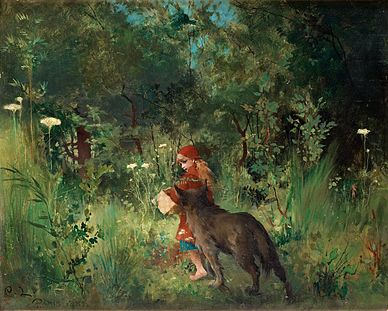
Little Red Riding Hood

little_red
In this tale, the wolf is a psychopathic predator who pretends to be Riding Hood’s grandmother.

The story revolves around a girl called Little Red Riding Hood, after the red hooded cape/cloak (in Perrault’s fairytale) or simple cap (in the Grimms’ version called Little Red-Cap) she wears. The girl walks through the woods to deliver food to her sickly grandmother (wine and cake depending on the translation). In the Grimms’ version at least, she had the order from her mother to stay strictly on the path.

A mean wolf wants to eat the girl and the food in the basket. He secretly stalks her behind trees, bushes, shrubs, and patches of little and tall grass. He approaches Little Red Riding Hood and she naïvely tells him where she is going. He suggests that the girl pick some flowers; which she does. In the meantime; he goes to the grandmother’s house and gains entry by pretending to be the girl. He swallows the grandmother whole (in some stories, he locks her in the closet) and waits for the girl, disguised as the grandma.

When the girl arrives, she notices that her grandmother looks very strange. Little Red then says, “What a deep voice you have!” (“The better to greet you with”), “Goodness, what big eyes you have!” (“The better to see you with”), “And what big hands you have!” (“The better to hug/grab you with”), and lastly, “What a big mouth you have” (“The better to eat you with!”), at which point the wolf jumps out of bed, and swallows her up too. Then he falls asleep. In Charles Perrault’s version of the story (the first version to be published), the tale ends here. However, in later versions the story continues generally as follows:

A lumberjack (in the French version but in the Brothers Grimm and traditional German versions, a hunter), comes to the rescue and with his axe cuts open the sleeping wolf. Little Red Riding Hood and her grandmother emerge unharmed. They then fill the wolf’s body with heavy stones. The wolf awakens and tries to flee, but the stones cause him to collapse and die. (Sanitized versions of the story have the grandmother shut in the closet instead of eaten, and some have Little Red Riding Hood saved by the lumberjack as the wolf advances on her, rather than after she is eaten.)

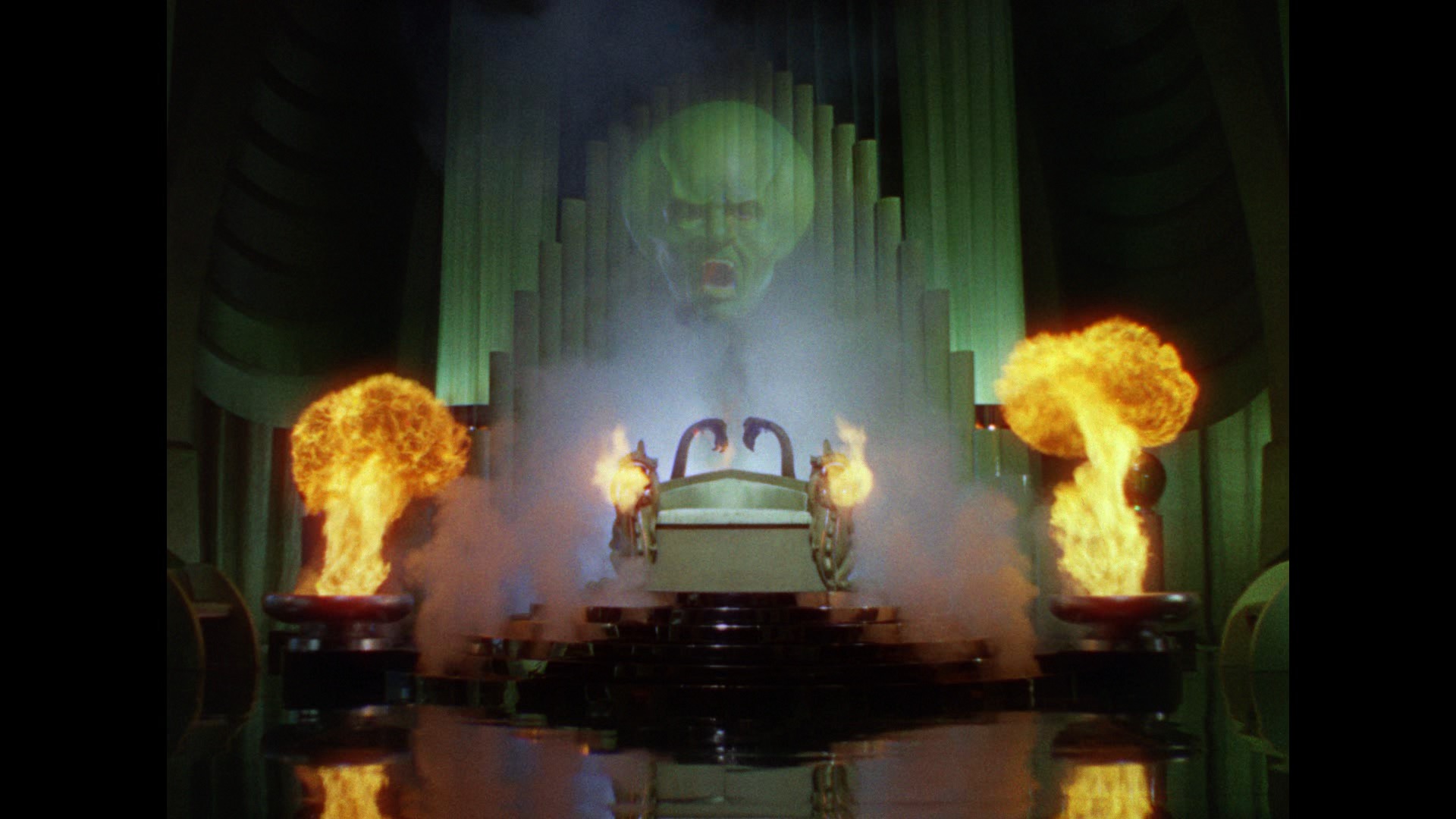
The Wizard of Oz

wizard_of_oz

Although of more recent vintage than fairy tales and therefore not considered to be one, I feel this story belongs here anyway.

The Wicked Witch of the West/Miss Gulch is the psychopathic malignant narcissist. The Wizard, although not a villain, is also a narcissist whose mask of intimidating power and might is stripped away to reveal the True Self–a “humbug” with grandiose delusions and low self esteem. The fact that, in the film, the Wizard shows shame and remorse when he is called out by Dorothy for being a “very bad man,” indicates he’s either not a true narcissist (he may be a Borderline instead) or is very low on the spectrum.

The narcissistic abuse community’s term “flying monkey” came from this story. The flying monkeys were The Wicked Witch’s slaves that carried out her bidding, but they were really just victims themselves.

This IMDB.com plot description is for the 1939 movie.

Dorothy Gale is an orphaned teenager who lives with her Auntie Em and Uncle Henry on a Kansas farm in the early 1900s. She daydreams about going “over the rainbow” after Miss Gulch, a nasty neighbor, hits Dorothy’s dog Toto on the back with a rake, causing Toto to bite her. Miss Gulch shows up with an order to take Toto to the sheriff to be euthanized, but Toto jumps out of the basket on the back of Miss Gulch’s bicycle and runs back to Dorothy. Fearing that Miss Gulch, who does not know that Toto has escaped, will return, Dorothy takes the dog and runs away from home. She meets an itinerant phony fortune teller, Professor Marvel, who immediately guesses that Dorothy has run away. Pretending to tell her fortune and wishing to reunite Dorothy with her aunt, he tells her that Auntie Em has fallen ill from worry over her.

Dorothy immediately returns home with Toto, only to find a tornado approaching. Unable to reach her family in their storm cellar, Dorothy enters the house, is knocked unconscious by a loose window, and apparently begins to dream. Along with her house and Toto, she’s swept from her sepia-toned world to the magical, beautiful, dangerous and technicolor land of Oz. The tornado drops Dorothy’s house on the Wicked Witch of the East, killing her. The witch ruled the Land of the Munchkins, little people who think at first that Dorothy herself must be a witch. The Wicked Witch of the West, who is the sister of the dead witch, threatens Dorothy. But Glinda, the Good Witch of the North, gives Dorothy the dead witch’s enchanted Ruby Slippers, and the slippers protect her. Glinda advises that if Dorothy wants to go home to Kansas, she should seek the aid of the Wizard of Oz, who lives in the Emerald City. To get there, Dorothy sets off down the Yellow Brick Road.

Before she’s followed the road very far, Dorothy meets a talking scarecrow whose dearest wish is to have a brain. Hoping that the wizard can help him, the Scarecrow joins Dorothy on her journey. They come upon the Tin Woodman, who was caught in the rain and is so rusty he can’t move. When they oil his joints so he can walk and talk again, he confesses that he longs for a heart; he too joins Dorothy. As they walk through a dense forest, they encounter the Cowardly Lion, who wishes for courage and joins the quest in the hope that the wizard will give him some. Dorothy’s three friends resemble the three farmhands who work for Dorothy’s aunt and uncle back in Kansas.

On the way to the Emerald City, Dorothy and her friends are hindered and menaced by the Wicked Witch of the West. She incites trees to throw apples at them, then tries to set the scarecrow on fire. Within sight of the city, the witch conjures up a field of poppies that cause Dorothy, Toto, and the lion to fall asleep. Glinda saves them by making it snow, which counteracts the effects of the poppies.

The four travelers marvel at the wonders they find in the Emerald City and take time to freshen up: Dorothy, Toto and the Lion have their hair done, the Tin Woodman gets polished, and the scarecrow receives an infusion of fresh straw stuffing. As they emerge looking clean and spiffy, the Wicked Witch appears on her broomstick and skywrites “Surrender Dorothy” above the city. The friends are frustrated at their reception by the “great and powerful” Wizard of Oz — at first he won’t receive them at all. When they finally see him (the doorkeeper lets them in because he had an Aunt Em himself), the Wizard declines to help them until they bring him the broomstick of the Wicked Witch of the West. Daunted but determined, they set off again.

wicked_witch

The witch sends winged monkeys to attack Dorothy’s party before they reach her castle; the monkeys snatch Dorothy and Toto and scatter the others. When the witch finds that the Ruby Slippers can’t be taken against Dorothy’s will as long as the girl is alive, she turns her hourglass and threatens that Dorothy will die when it runs out. Meanwhile, Toto has escaped and run for help. Dressed as guardsmen, the Lion, the Tin Man, and the Scarecrow sneak into the castle and free Dorothy. They’re discovered before they can escape, however, and the witch and her guards corner them and set the Scarecrow on fire. Dorothy douses him with a pail of water, splashing the witch by accident. The water causes the witch to disintegrate (“I’m melting!”). The guards are happy to let Dorothy have the witch’s broomstick, and Dorothy and her friends return to the Emerald City.

The wizard isn’t pleased to see them again. He blusters until Toto pulls aside a curtain in the corner of the audience chamber to reveal an old man who resembles Professor Marvel pulling levers and speaking into a microphone — the so-called wizard, as the Scarecrow says, is a humbug. He’s abashed and apologetic, but quickly finds ways to help Dorothy’s friends: a diploma for the Scarecrow, a medal of valor for the Lion, and a testimonial heart-shaped watch for the Tin Man. Then he reveals that he’s from Kansas himself and came to Oz in a hot-air balloon, in which he proposes to take Dorothy home.

wizard_of_oz2
This isn’t who the Wizard really is, but the mask he’s projecting.

The wizard appoints the Scarecrow, Tin Man, and Lion rulers of Oz in his absence. Just as the balloon is about to take off Toto runs after a cat and Dorothy follows him. Unable to stop, the wizard leaves without Dorothy. But Glinda appears and explains that Dorothy has always had the power to get home; Glinda didn’t tell her before because Dorothy wouldn’t have believed it. Bidding her friends a tearful good-bye, Dorothy taps her heels together three times, repeats “There’s no place like home,” and the Ruby Slippers take her and Toto back to Kansas.

Dorothy wakes up in her own bed with Auntie Em and Uncle Henry fussing over her. Professor Marvel and the farmhands Hunk, Hickory, and Zeke stop by to see how she’s doing. She raises indulgent laughter when she tells them about Oz, but she’s so happy to be home she doesn’t mind that they don’t believe her. Miss Gulch is never mentioned again.